
-
Vagueness: 'I know'I've been very clear. I've given you a chance to answer, to tell us all what the hell you have in mind, but you respond with evasiveness.
-
Vagueness: 'I know'So you have no answer? No clarification of the OP? No attempt to tell us in what way you think "I know" is vague?
-
Vagueness: 'I know'I would have deleted the OP if I'd seen it before it generated a discussion. It's so lacking in anything philosophical or interesting that it looks like just an attempt to get on the main page instead of the Lounge, where your threads usually end up.
You don't know what "know" means? Have you looked it up? Have you got anything to say about how it has been treated by philosophers?
In what way is its use vague, as you keep on saying it is, with no explanation? You have not described the problem with "I know" or how it is vague. It's your OP that is vague. There is no clear question, and what there is doesn't make much sense.
It seems inherent, that we assume that the other person "knows" — Wallows
Not at all. When someone says they know, we don't just assume they do, unless it seems fairly uncontroversial and we don't have reason to doubt it, in which case we might give them the benefit of the doubt. But you don't give any context anyway; there are different ways of using the word.
What is the philosophical issue? What does this have to do with formal languages, which is something you brought up? -
Against TranscendentalismDo you think "speculative" is really applicable to the moral aspect of the position I'm against? To my ear that sounds specifically about what might be real or true, not what might be moral or good. — Pfhorrest
Yes, I see what you mean. -
Against TranscendentalismLess troublesome terms, ones that don't introduce Kant's more subtle and unique transcendental, are immanent and speculative. Kant uses these terms too, but in an obvious way that's in line with what you're saying.
-
Against TranscendentalismYeah I think that works.
EDIT: Although it's probably still going to be confusing and distracting for anyone who has struggled with these terms in Kant. -
Against TranscendentalismMy instinct is to say you should ditch the word entirely and find something else (I may think of something later), but between those two options I'd go for the latter. The trouble with that is you inevitably introduce a distinction that you're not interested in, which distracts from your main points. In fact, that criticism would apply to the other option too.
Incidentally, and to make things even more confusing, your own position might be classed as a form of transcendental philosophy, in that it attempts, a bit like Kant, to describe and police the boundary between legitimate and illegitimate philosophy, between thinking about the objects of experience and a speculative metaphysics about objects beyond it. -
Against TranscendentalismI've just read the essay and I can see that despite the clear definition of transcendentalism at the beginning, elsewhere in the essay you use transcendental in the sense of Kant's transcendent. I don't think you can mention Kant and then ignore the distinction.
-
Against Transcendentalism@Pfhorrest I'm sorry if you think I'm rudely ignoring your essay and the reasons you chose to use the term transcendentalism, but I can't resist a bit of Kant clarification:
The distinction between transcendent and transcendental is very important in Kant. He uses transcendent to describe metaphysics that reaches beyond possible experience, as opposed to immanent metaphysics, which is effectively just physics (or in any case is restricted to the empirical use of the understanding). This is the distinction you have in mind in the essay.
Let us call the principles whose application keeps altogether within the
limits of possible experience immanent principles, and those that are to fly beyond these limits transcendent principles. — Kant, CPR, A296/B352-3
In contrast, he uses transcendental to describe his own philosophy, the enquiry into the possibility of the a priori. There are quotations all over the CPR to this effect, if I recall correctly (I don't have access to it right now). Here's one I found somewhere:
We must not call just any a priori cognition transcendental, but must call transcendental (i.e., concerning the a priori possibility or the a priori use of cognition) only that a priori cognition whereby we cognize that—and how—certain presentations (intuitions or concepts) are applied, or are possible, simply a priori. — Kant, CPR, A56/B80-81
Since this is what Kant is doing, transcendental cognition is okay according to him, but transcendent isn't.
This unfortunate but now unavoidable distinction makes "transcendentalism" ambiguous in a work of philosophy, even without taking into account the most common use of the term: https://en.wikipedia.org/wiki/Transcendentalism . But maybe it's fair to use it when you define it clearly as you do, as to do with Kant's transcendent rather than his transcendental.
EDIT: These definitions are pretty good:
https://kantphilosophy.wordpress.com/technical-terms-of-kantian-philosophy/transcendent: the realm of thought which lies beyond the boundary of possible knowledge, because it consists of objects which cannot be presented to us in intuition-i.e., objects which we can never experience with our senses (sometimes called noumena). The closest we can get to gaining knowledge of the transcendent realm is to think about it by means of ideas. (The opposite of ‘transcendent’ is ‘immanent’.)
transcendental: one of Kant’s four main perspectives, aiming to establish a kind of knowledge which is both synthetic and a priori. It is a special type of philosophical knowledge, concerned with the necessary conditions for the possibility of experience. However, Kant believes all knowing subjects assume certain transcendental truths, whether or not they are aware of it. Transcendental knowledge defines the boundary between empirical knowledge and speculation about the transcendent realm. ‘Every event has a cause’ is a typical transcendental statement. (Cf. empirical.) -
Discussions about stuff with the guestsWe've had reading groups, and we had monthly readings for a while, a couple of years ago, in which we would discuss short philosophy papers. It was good while it lasted, but we were persuaded to choose a couple of really crappy or boring papers and that probably put people off.
All it takes is for a few people to dedicate their effort and time. There have been lots of suggestions for reading groups over the past few months, mainly by Wallows, but nothing has come of them.
https://thephilosophyforum.com/categories/16/reading-groups -
Discuss Philosophy with Professor Massimo PigliucciHe has suggested trying again in the future some time, with just one thread and a more general topic.
-
TPF Quote Cabinet
Along with Jonathan Miller, Clive James and Gary Rhodes died yesterday as well. Rhodes, being a chef and not a writer, wasn't known for his words, but James wrote a lot of good stuff:
Common sense and a sense of humor are the same thing, moving at different speeds. A sense of humor is just common sense, dancing.
All intellectual tendencies are corrupted when they consort with power.
There is no reasoning someone out of a position he has not reasoned himself into.
Personally, I liked his criticism:
Here is a book so dull that a whirling dervish could read himself to sleep with it. If you were to recite even a single page in the open air, birds would fall out of the sky and dogs drop dead. — Clive James on Brezhnev: A Short Biography -
Wittgenstein - "On Certainty"47..."Forget this transcendent certainty, which is connected with your concept of spirit."
In what way is certainty linked to the notion of spirit? — ZzzoneiroCosm
It's a puzzling one. First, it's clear that here and throughout On Certainty he attacks the notion that ordinary certainty is not enough, that we need, not only a solid bedrock, but one that is is somehow guaranteed to be solid, for all time and universally, that is, an absolute certainty. This impossible kind of knowledge would be transcendent, as it would require a foundation external to human capacities.
This is where the concept of spirit comes in, I think. Transcendent (not transcendental) metaphysics is part of what Wittgenstein and others were reacting against in the early 20th century. Passage 47 implies that he sees a connection between the epistemological search for absolute certainty, and transcendent metaphysics such as that of the rationalists. In OC, Wittgenstein is discussing Moore, who was defending common sense against philosophers such as Bradley, for whom the concept of spirit may have been significant, as it was for Hegel, who heavily influenced Bradley. Wittgenstein's word is Geist, the same as Hegel's. Spirit transcends our everyday reality, and is thus similar to the Holy Grail of epistemology.
Here's the context:
46. But then can’t it be described how we satisfy ourselves of the reliability of a calculation? O yes! Yet no rule emerges when we do so.—But the most important thing is: The rule is not needed. Nothing is lacking. We do calculate according to a rule, and that is enough.
47. This is how one calculates. Calculating is this. What we learn at school, for example. Forget this transcendent certainty, which is connected with your concept of spirit. — Wittgenstein
So calculating according to a rule is enough. Even if it is legitimate to ask if the rule itself is reliable, we shouldn't expect by doing so to find another, higher level, transcendent rule. In the end it is in the very following of the rule that one attains correctness and reliability.
Wittgenstein appears to view this yearning for transcendent truth, rules, knowledge, certainty, and so on, as all connected to the bad philosophical habit, a legacy of theology, that Kant ends up rejecting in the Critique of Pure Reason. As far as Wittgenstein was spiritual, he regarded it as involving what cannot be said, and therefore as nothing to do with philosophy. -
Marx's Value TheoryI think art is an exception to the kind of commodity production that Marx identifies as being the normal capitalist way of going on. Art is more akin to previous, less alienated modes of production. In any case, Marx wasn't remotely concerned with it in Capital, because it's atypical.
But if you're thinking of art production as a model of un-alienated production and exchange, then maybe you're on to something.
In Capital, as fdrake suggests, Marx identifies anything that we value as a use value before we consider whether and how it's being produced for and exchanged in a market. It doesn't matter for his purposes, in that work, in what way these things are useful or desired: they can be any kind of wanted things, not only necessities but also works of art, entertainment, gratification, etc.
By the way, don't mistake Marx's neglect here, in Capital, for a temperamental or moral neglect of art in general. -
Why was the “My computer is sentient” thread deleted?I deleted it for low quality.
My computer is sentient, you can not deny it!
What if I say a PC becomes conscious the moment you connect it with a monitor and it displays some content. Then I can say, look, there it is its qualia right there on the display, that's what it thinks, that's what it feels. It does not feel like we do in terms of pain and desire, but in terms of geometry of overlapping densities of magnetic and electric fields, however is that supposed to feel.
How can you deny this sentience?
It seems more like a passing thought than a philosophical thesis or discussion-point. A lot of work has been done in philosophy of mind, cognitive science, and so on, but this OP didn't acknowledge any of that.
If I haven't seen a discussion before it has generated a lot of comments, I will sometimes leave it even if it's low quality. In this case, it hadn't generated much discussion when I saw it. -
Heidegger, Hume, and scientistsmatter only 'has being' when appears in human form. That's why we're 'beings' and things, just 'things'. — Wayfarer
People have pointed out to you a few times before just how idiosyncratic your use of "being" is, at least in philosophy. This discussion is partly about about Heidegger, and Heidegger uses the term being in the traditional Aristotelian sense: a being is something that can be said to be. Being is about existence. -
Notifications?From your profile, click 'Edit profile' > 'Set preferences'. I guess if you check the box labelled 'Email me when I'm mentioned in a discussion', that will do it. I'm not sure though, because I have most email notifications turned off.
-
The leap from socialism to communism.So the solutions you talk about obviously seem like solutions now. We're in the same situation now as the early fossil-fuel enthusiasts were in 200 years ago. What happens when we find out the Indium in solar panels causes devastating damage to microbes, the disruption to air streams caused by wind power results in damaging weather pattern changes, the habitat loss from converting to biodiesel is worse than the fossil-fuel it's replacing... These are all real concerns by the way, just not well researched enough to provide any concrete worries yet. The point is our optimism about growth blinds us to the historic fact that virtually everything we thought was going to be some brilliant development turned out to be shit, in terms of some (usually long-term) undesirable consequences. — Isaac
True, and yet...
Few things are more important.
What makes you so confident that, unlike almost every development in the past, today's 'solutions' won't just end up being tomorrow's problems? — Isaac
That's not exactly what I'd say. I'd say I'm confident that we can deal with the problems that come up. It's never absolutely certain but I think the alternatives to technological progress are immoral, unfair, dangerous. My attitude to the precautionary principle is, roughly, that if you know you can make a change for the better, and if it won't be outweighed by changes for the worse as far as you can tell, then there is no justification for failure to make that change. This is how we do it.
And it's important to point out that past developments have not just ended up being today's problems. They have been good in many ways.
There are exceptions, of course. Nuclear weapons, for example, which could end up being a really stupid idea. This does show that the technological cannot be separated from the political, but I don't think it should lead us to seek to slow down technological progress as such. -
The leap from socialism to communism.I disagree with this, I don't see how, on the face of it, more of the same could possibly be a cure for the problems the previous growth caused. — Isaac
There are several ways. For climate change, there are technological solutions, such as clean energy, and they require massive research and investment; and societies with highly developed infrastructure and commanding resources effectively can protect themselves from unwelcome changes. So both mitigation and adaptation can be achieved with growth. For other environmental problems, we can see the positive results in developed countries already, where e.g., pollution has been reduced.
It's not more of the same, but more and different.
I think this is more myth-building. Its the only way we've found because it's the only way we've really tried. That's not much to commend it. For a start, economic growth does not seem at all to depend on how capitalist a country is. Some very socialist economies are doing very well, some extremely free-market economies have done very badly. If the degree, or proportion, of capitalism in an economy does not correlate well with human development, it seems, on the face of it, quite unlikely that its capitalism that's responsible — Isaac
But you appear to agree that "it's the only way we've found", which is what I said (although I actually said "best way we've found so far") Otherwise sure, you're pretty much right here I think. I'm not arguing for capitalism but for growth. -
The leap from socialism to communism.I've answered all this already. We choose to measure specific metrics because they're the things we value, the things we want more of. We favour them as being more important than other things. It's reasonable on this basis to describe their increase as improvements, and this doesn't entail ignoring the context.
-
The leap from socialism to communism.We've certainly strayed a long way off topic. I forgot it was about the "leap from socialism to communism."
-
The leap from socialism to communism.You're saying that the preference of the householder for having a washing machine has been shown (and so is a reasonable factor to include in the judgement), but the associated environmental and social problems have not (and so it is reasonable to exclude them from the judgment)? — Isaac
No that's not my position. My position is that there have been associated problems, and that recent climate change and other environmental problems are caused by economic growth, but that the two things are not inevitably linked, at least not to the detriment of human beings. I believe that the primary aim of policy should be to improve people's lives and that the best way to do that while also solving the associated problems is more economic growth, which will allow us all to switch to cleaner energy, find more resources and use existing ones better, and also allow particularly vulnerable populations to protect themselves from change. In a nutshell, an economically growing humanity can clean up after itself, as is evident when we look at history.
There are several commentators who argue this case from across the political spectrum, but unfortunately many of them go too far in celebrating the wonders of capitalism. This is understandable: capitalism might not be the best way to solve these problems, but so far it is the best way we've found to achieve quick growth, and given the choice between capitalism and Malthusian de-growth, I'll take the former, along with the millions who buy washing machines as soon as they can afford them.
This is more or less where I'm coming from: https://www.neweurope.eu/article/the-no-growth-prescription-for-misery/
Obviously if I'm going all-out to argue for this I'll have to do a lot more, but I'm not sure I want to get into one of those statistics-drenched debates, and I hadn't really intended to get into it when I first entered this discussion--so if I decide to chicken out, I apologize. -
The leap from socialism to communism.That's the matter I'm taking issue with. I don't see how it makes any sense to say something is an improvement "in itself" where, by that, you mean "when ignoring certain other factors inextricably connected with it" . — Isaac
It does make sense. If I couldn't buy a washing machine (income) and didn't have access to a launderette (infrastructure or economic development, not part of the HDI but significant for my example), it would make my life worse. To measure things at all requires the isolation of specific metrics. The ones we choose to measure here are based on the things we all value; they are factors that contribute to freedom, opportunity, health, leisure, and so on.
Here's a contrived example. We value education. It's usually better to go to school than not to go to school, even if there's a risk that you will be run over by a car on the way there. But, you may ask, what if going to school always leads to traffic-related premature death: surely that means going to school does not represent an improvement over not going to school? Of course not: it just means we need to do something about the traffic or the location of the school (or whatever).
But, you may further ask, what if going to school inevitably leads to traffic-related premature death? I.e., what if the increased HDI, and economic growth more generally, inevitably leads to environmental catastrophe and social breakdown? Well, that hasn't been shown.
So maybe this is all just about the choice of words. I think that @boethius could make his case more strongly by saying, yes, there have been improvements, but those improvements have been achieved unsustainably, and continuing to pursue them will lead to terrible consequences. And then we could argue about that, which is the substantial disagreement.
Maybe you can now see what I've been doing here. I have not really been arguing directly over that substantial disagreement, but trying to reveal what @boethius's choice of words, his choice to actually deny demonstrable improvements, says about his position more generally. -
The leap from socialism to communism.Because in itself the availability of washing machines is an improvement, and I'm not going to argue for that. There may be other metrics that have shown other things getting worse, and you're right that the underlying issue here is to interpret that balance of gains and losses, but my point was to reveal boethius's stark denial of real gains for people (again, I'm not going to argue that the increased HDI figures show real gains for people).
If my argument begs the question, it does so in the way that Moore's Here is one hand does. -
The leap from socialism to communism.What's dishonest about repeating my argument and dealing with criticism? — boethius
Precisely this kind of response. You know very well that I did not claim there was anything dishonest about repeating your argument and dealing with criticism. This is tiresome.
How do you know it's not that you have missed the point and how is argument I'm intentionally missing the point more credible than the argument you're intentionally missing the point and pre-emptively accusing me of what you're doing as a Trumpian-style diversion tactic that has proven to be extremely effective on those that lack critical thinking skills?
Please, share your reasons why we should assume prima facie that your argument throwing shade on my intentions is more credible than a similarly structured argument throwing shade on your intentions of throwing shade on my intentions. — boethius
This is gibberish, but from what I can make of it it's full of baseless assertions, and baseless attributions of what you see as the enemy position. Diversion tactic? What are you talking about? I came here to make two simple points, first that you used "fetishism" in a way unrelated to Marx while claiming it was "Marx's language", and second that economic growth has led to improvements. You have done everything you can to deny that these improvements are improvements at all, and this is what I want to show, that you are dismissing real benefits that people have enjoyed, on the basis of possible future problems. I'm not interested in directly confronting your inhumane apocalyptic dogma. -
The leap from socialism to communism.Millions disagree with a lot of things I believe, doesn't bother me. I'm pretty confident we can find many things you believe where we can see millions disagreeing with. — boethius
You missed the point, or else you're intentionally ignoring it (which seems likely based on the intellectual dishonesty of your recent posts). The point is not simply that millions disagree with you, but that those millions disagree with you because they have benefited from the massive improvements that I mentioned. Their lives have improved. For example, they have lost less children thanks to their improved access to improved healthcare, they've been able to send those children to school, they've lived longer and healthier lives, they've been able to buy washing machines to release women from day-long drudgery, and so on. In saying that these millions disagree with you, I wanted you, or people reading this, to see what you are saying, namely that these improvements are not really improvements at all--and thus to see just how misanthropic and reactionary your position is. -
DeplorablesIt's been nearly three years since Trump won the 2016 election and we have ample evidence to confirm that racism in fact played a key role in mobilizing votes for Trumps. Not "economic anxiety". In fact, I would challenge anyone to find studies that do show economic uncertainty was the key issue for Trump voters. Unfortunately, a random gym owner does not count. Despite the video claiming that a majority of Trump voters were enticed by his message due to economic struggles, more Hillary voters claimed that the economy was a more important issue than Trump voters (52% vs. 41%), while a majority of Trump supporters claimed that immigration was one of their biggest issues (64% vs 33%). — Maw
Thanks for the information. While I think that the data tells us a more complex story than you're suggesting, it does look like I was wrong about Trump voters. I didn't know the issues had been so racialized. But I'm still going to defend my basic points--later some time. -
DeplorablesIf you read the actual facts about Trump's character, career, history and politics, there is no way you could support him, but of course, neither he nor his supporters read anything much, let alone anything critical. So we're supposed to recognise that wilful ignorance and mendacity constitute a 'tectonic shift'.
I don't think so. — Wayfarer
This is exactly the kind of attitude that the video is targeting. They knew all that and still voted for him, and I don't think you care why.
I don't get why centrist liberals always want to make such a display of their outrage, even after three years. It's embarrassing. -
Deplorables:up:
BTW I enjoyed your righteous ranting about impeachment recently in one of the Trump threads. -
The leap from socialism to communism.
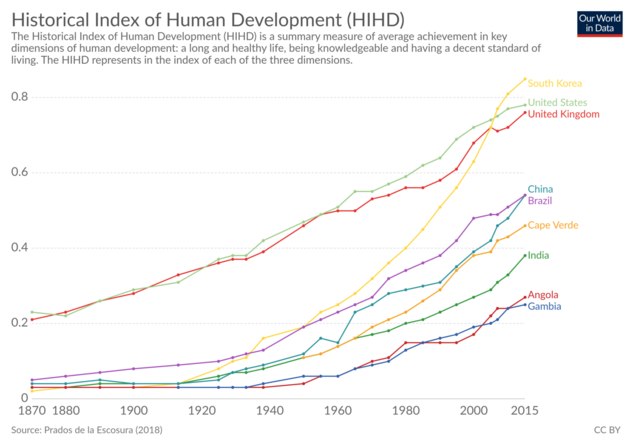
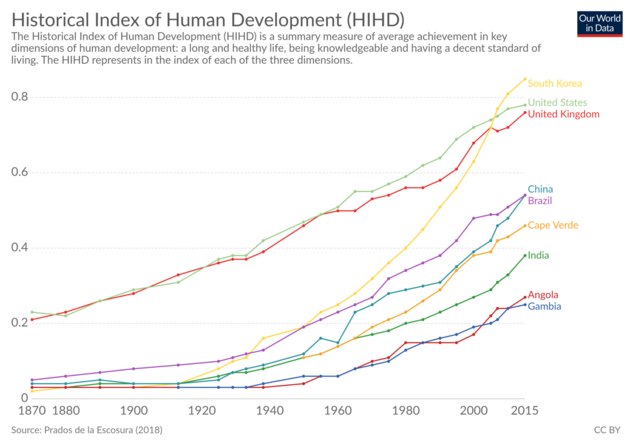
NOTE: "The Human Development Index (HDI) is a statistic composite index of life expectancy, education, and per capita income indicators"
Are you saying that these are not improvements at all, because other problems somehow make them illusory? Millions would disagree.
The mistake you make is "that these increases have improved life". This conclusion does not follow from the premise "some metrics have increased". — boethius
I am saying that life has improved in certain measurable ways.
Now please don't respond once again by arguing against claims that everything is getting better. I'm not making that claim.
Links:
https://ourworldindata.org/grapher/human-development-index-escosura?time=1870..2015&country=GBR+USA+KOR+IND+CHN+BRA+CPV+AGO+GMB
https://en.wikipedia.org/wiki/Human_Development_Index -
The leap from socialism to communism.I don't accept it in the next sentence. I accept that some metrics have increased, that is not the same as saying there has been an overall improvement. — boethius
I said that "economic growth in capitalist form has made life better in several measurable ways", not that "there has been an overall improvement". If you accept that some metrics have increased, and that these increases have improved life, then you agree with the statement you said your were debating against.
I do not view improvements that are not sustainable as improvements — boethius
Maybe this is the answer, in which case, yeah, reactionary. -
The leap from socialism to communism.This what I'm debating against. This argument reduces to "measurable if you choose to measure metrics that have increased", which, sure, I grant that. But that some metrics have improved is not sufficient reason to conclude capitalism or modernity in general has been an overall improvement. — boethius
First you say you're arguing against the claim that "economic growth in capitalist form has made life better in several measurable ways" but then you appear to accept it in the next sentence. I did not claim that capitalism has made everything better. I was trying to point out that any critique of capitalism that doesn't accept, or that disapproves of, the improvements that capitalism has enabled is worthless, or worse, reactionary.
Otherwise I completely disagree with your basic argument that industrialization and urbanization are bad, but I didn't really intervene here to debate it. -
The leap from socialism to communism.'Communism' as represented by totalitarian Soviet Stalinism, definitely was no more ecologically sound than capitalism, being just as dependent on oil and doing things like draining whole lakes to grow cotton along with other catastrophes. (And there is a seed of this in Marx who does not question the goodness of industrialization; an industrialization fetishism to use Marx's language.) — boethius
Marx does not use "fetishism" in this sense, and he arguably doesn't even use the word pejoratively. Rather, he uses it to mean the attribution to inanimate objects of powers or characteristics that properly belong to people. In particular, he writes about the reification and naturalization involved in market exchange, which is a "fetishism of commodities" in which relations between labouring people are seen as relations between objects: social relations become properties of things, and this state of affairs is experienced as being natural.
Generally, economic growth in capitalist form has made life better in several measurable ways for people all over the world. This in itself is not an "argument supporting the status quo", but just a fact. Similarly, we can acknowledge the benefits of growth in the Soviet Union without endorsing forced collectivization, terror, and the use of slave labour (and environmental devastation, as you point out). My argument against capitalism is that progress in human development doesn't happen fast enough, fairly enough, or securely enough, and ties us all into a system of endless toil and precarity. -
Currently ReadingHah, that's an interesting choice. Nowadays the book is probably more name-checked than actually read, but I thought it was a well-written novella in the antiutopia genre (not to mention prophetic - it was written hot on the trail of the Bolshevik revolution, almost 30 years before 1984). — SophistiCat
I liked it a lot. It's remarkable that he saw what was happening as early as 1920. Remarkable either because he prophesied some of the features of the regime and the society that would characterize Stalinism, or just because those features were clearly evident soon after the revolution--which is remarkable to me as someone weaned on the Trotskyist version of events in which the revolution was fine and dandy before Stalin took power.
Apropo of nothing, I slightly know his father, a Russian poet, and I met the future author when he was still in school. Haven't read the book though. — SophistiCat
Cool. I haven't read it either to be honest. I'll get to it. -
Adventures in Modern RussiaLooking forward to hearing more from jrob. — Baden
Recently my adventures have been limited to sitting by the window looking at the birds while I convalesce, but I'll see what I can do. -
Adventures in Modern RussiaI see what you mean about redneck culture. It's not like that here at all. The macho culture, in which toughness is cultivated among both men and women, is pervasive and doesn't signify class.
Talking of class, I'm not sure how it works here. It's certainly nothing like Britain, where class is determined or signified in multiple other ways than money and power. For example, I'm told that there is very little variation in spoken accent among Russians, across society and across the country. And I haven't noticed any snobbery, although there's a high degree of respect for success in the professions, in art and science, and in business. But it looks like one's social status is entirely independent of one's origin, all else being equal (but practically, one can be born into a dynasty of former KGB or Party apparatchiks).
Regarding homophobia, many of the liberal Russians I know don't consider themselves homophobic, but they'd be seen as such by Westerners. They say that Russia is not as homophobic as the propagandist Western media likes to portray it, and that "we have our gays here too" (in the typical Russian patriotic paternal manner), and that they have their own night-clubs and sub-culture--but they're suspicious of or baffled by things like Gay Pride and the public assertion of homosexual identity. It could be that they're simply unaware of the level of oppression faced by gay people in Russia, or they think it's a minor issue.
I very much second what Baden said (the avalanche movie is Force Majeure, by the way, one of my faves.) — csalisbury
Yeah it's been on my to-watch list for some time. -
BanningsI banned @S, formerly Sapientia.
I had deleted several posts in a long-running dispute between him and another member in the Should hate speech be allowed? discussion. The posts were low quality and mostly off-topic, and @S's were often aggressive. After deleting them I posted this to them both, in the discussion:
Take your pointless dispute elsewhere, preferably not on this forum. — jamalrob
@S replied with this:
Firstly, fuck you.
And secondly, if you don't want to see discussions like that between me and him, then ban me. You have my permission, not that you need it, and I've just swore at you, so...
I didn't take the decision lightly, particularly because he has been part of this community for a long time. Almost anyone else responding to moderation in that way would have been instantly banned, and we do try to be consistent, but in this case we gave him time to retract. That never happened, so he's gone.
Note also that he had been warned about his behaviour several times before. -
Hate the red template
As I think I've already explained in two separate threads, I tried different colour schemes in response to a request for a "night mode". I'll probably change it back.
Jamal

Start FollowingSend a Message
- Other sites we like
- Social media
- Terms of Service
- Sign In
- Created with PlushForums
- © 2026 The Philosophy Forum