
-
Liberté, égalité, fraternité, et la solidarité.Yes, I pretty much agree, except for the "precisely why Paris got attacked" bit.
-
Liberté, égalité, fraternité, et la solidarité.You're privy to their plans? You know what they want to accomplish? — Benkei
What I said about them is based on what they have said they want to do and what they say motivates their actions, which are in turn consistent with those motivations. Maybe you should read Wood's article again. -
Liberté, égalité, fraternité, et la solidarité.I'm not even certain they want our support. You blindly assume that Western values are wanted there. There are more ways to social justice than Western democracy and imposing Western-style institutions. Imposing our values, our narrative of modernity isn't working and we need to open ourselves up to solutions that are specific to the area. Whatever intervention on our side, even if it were successful in eliminating IS, would be oppression in itself and therefore not solve the underlying problem. — Benkei
Frankly Benkei, this is rancid. I mentioned "secular values, freedom for women, reason and the diversity of cultural heritage, democracy, dissent, and religious difference". Are you suggesting that these are just our values? This reveals, more than anything I have said, a patronizing and essentializing "us and them" attitude to people in the Middle East. Are Kurdish women equal to men because this was imposed on them by the West? Did the Iranian people build an innovative music scene in the 1970s because they were agents of Western Imperialism? Did the people in Tahrir square demonstrate in favour of democracy because they were told to do it by the CIA? Are the women in the Middle East who bravely campaign for women's rights merely imposing an alien culture on a naturally barbaric people? Have Shias and Sunnis lived in peace together for many decades in many places only because they were brainwashed by Americans?
I did not call those values Western. You did, and that two-faced imperialism underlies everything you say. They are values that are up for grabs for anyone who wants to grab them, and people around the world have grabbed them and continue to want them. They are universal. -
Liberté, égalité, fraternité, et la solidarité.You might want to read the article instead of imposing your readymade cartoon narratives on to what I'm saying. I'm not making it about us and them, if by that you mean Westerners against Muslims. It is you and Benkei who are doing that. They (ISIS) hate not only ordinary Westerners for their freedoms--and they explicitly do; just read their statements claiming responsibility--but anyone in the Middle East who is more free than their pure brand of Islam allows, e.g., the Kurds with their sexual equality, the Alawites with their syncretism, the Lebanese with their cosmopolitanism, etc. And really any Muslim in the Middle East and throughout the world who doesn't abide by their strict version of Sharia law, which is nearly all of them.
-
Liberté, égalité, fraternité, et la solidarité.I'll take that as a "no", at least to the first question.
The problem is that there is a bunch of bloodthirsty genocidal dickheads with power and territory who plan to kill millions of people in the Middle East and destroy any traces there of secular values, freedom for women, reason and the diversity of cultural heritage, democracy, dissent, and religious difference, and who are sometimes willing to take that war overseas, making this not just a problem for the Middle East. If people in the West, who benefit from the freedoms that ISIS is trying to eradicate, do not show solidarity with those in the Middle East who are fighting them or who are too scared to fight them, then they are morally bankrupt. -
Liberté, égalité, fraternité, et la solidarité.Have you read the article?
Also, are you suggesting that the defeat of ISIS is not a worthy goal? -
Liberté, égalité, fraternité, et la solidarité.Your characterization of my position does not follow from the words I quoted from Kenan Malik.
certainly isn't anti-diversity and pluralism — discoii
You're joking, right? -
Liberté, égalité, fraternité, et la solidarité.Yes, and? What does that have to do with your characterization of my position--the one I objected to?
-
Liberté, égalité, fraternité, et la solidarité.you are so quick to try to place a complete moral blame on Muslims and would like to frame ISIS as some sort of group that just came to be in a vacuum because they hate laughter and puppy dogs. — discoii
Just a note to point out that I did not say anything remotely like this, nor would I. -
Liberté, égalité, fraternité, et la solidarité.But ISIS is not a group whose immediate targets are Western states, and they are not motivated primarily by anti-imperialism, and they are not made up primarily of people who have suffered so much at the hands of the West that they burn with the desire for revenge. I think this is a fantasy, and I don't know how anyone with some knowledge of what ISIS is and what it has done could be taken in by it.
-
Liberté, égalité, fraternité, et la solidarité.My limited understanding of ISIS was challenged by this article in the Atlantic: http://www.theatlantic.com/magazine/archive/2015/03/what-isis-really-wants/384980/ . Graeme Wood has done some careful research and challenges some commonly held beliefs. After reading this I'm convinced that the West should:
1. Declare war on the caliphate and treat citizens who have dealings with it under the good old statutes of treason, etc..
2. As the caliphate depends on holding territory, give maximum aid to alternative claimants to the territories they have a legitimate claim to and can control.
3. Selectively destroy munitions, military infrastructure, administrative centers etc. as we would do with any conventional enemy.
4. Above all avoid any rash changes in foreign policy. I see no need to change our policies on Syria, for instance. Assad needs to go, the refugees need help. — photographer
Yes, that article was an education for me too. It casts doubt on the oft-heard opinion, expressed already in this thread, that military action is useless because the ISIS fighters will just melt away into obscurity for a while to bide their time, i.e. that ISIS is just like al-Qaeda. If Wood is right, everything hinges on their holding of territory. And that is something that can be taken from them. -
Liberté, égalité, fraternité, et la solidarité.Once again, many lefties and liberals rush to characterize this attack as an understandable response to Western militarism. It seems like a willful blindness. ISIS no doubt benefited from the incompetence of the Western intervention, but there is a barely repressed urge among left liberal commentators to go further, to say "what do we expect?" But contrary to what is implied in these sentiments, ISIS are not heroic freedom-fighters struggling against oppression, pushed to violence by the military actions of the West--as Kenan Malik points out:
The terrorists did not target symbols of the French state, or of French militarism. They did not even target tourist spots. They targeted, rather, the areas and the places where mainly young, anti-racist, multiethnic Parisians hang out. The cafes, restaurants, bars and music venue that were attacked – Le Carillon, La Belle Equipe, Le Petit Cambodge, and the Jewish-owned Bataclan – are in the 10th and 11th arrondisements, areas that, though increasingly gentrified, remain ethnically and culturally mixed and still with a working class presence.
[...]
What the terrorists despised, what they tried to eliminate, were ordinary people, drinking, eating, laughing, mixing. That is what they hated – not so much the French state as the values of diversity and pluralism. — Kenan Malik
https://kenanmalik.wordpress.com/2015/11/15/after-paris/
And if left liberals really do want to halt the "clash of civilizations" narrative and to stand up for the rights of ordinary Muslims, then they must stop reacting to attacks like these by saying, in effect, "look what happens when you push a Muslim to breaking point." It doesn't take a genius to see how racist this attitude is. -
Liberté, égalité, fraternité, et la solidarité.As long as certain versions of creationism willfully distort established scientific facts, then it might be seen as the duty of a state to protect its citizens from fraud, the same way it ought to do it for products, such as power balance bracelets, which make fraudulent claims. — Πετροκότσυφας
I can hardly imagine a sentiment further from the spirit of science and free enquiry. -
Poll on the forthcoming software update: likes and reputationsI am willing to sacrifice my reputation for the good of the community. O:)
-
Reading for November: Davidson, Reality Without ReferenceQuick question: wouldn't "Hello!" be treated as a sentence in linguistics?
-
Poll on the forthcoming software update: likes and reputationsA supplementary question to that option is this. If it is not in fact possible to do that, or not possible for a while, would you rather have likes as they are now or get rid of post likes and accrual entirely?
-
What are you listening to right now?70s Iranian funk. I'm guessing 1979 put a stop to this sort of thing.
-
Where we standLooks like it's a Bing thing. The same search here, without quotes, returns TPF in second place behind you know who. Pretty cool.
-
Wiser Words Have Never Been Spokenthis is only the opening part of The Lord of the Flies, where everyone is still nice to each other. Man's primeval nature will emerge eventually, leaving you mods plenty to do. :D — Arkady
By "Man's primeval nature" I take Arkady to be referring to Kwalish Kid, but he's yet to find his way here. -
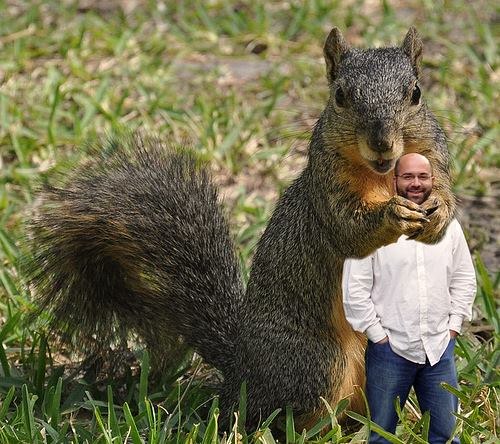
Squirrels and philosophy: 11 degrees of separationYou click on the first link that goes to another article.
-
Squirrels and philosophy: 11 degrees of separationAlmost, but the first link in consciousness is 'quality'.
-
Squirrels and philosophy: 11 degrees of separation@shmik's in the lead so far.
The object of the game, I suppose, is to find the least philosophical thing on wikipedia. Note: when any links go to a wiktionary entry I go back and click on the next link. -
Squirrels and philosophy: 11 degrees of separationIt was quite remarkable that in each case the last several steps were the same, beginning at natural science, even in the case of Bieber.
-
Is it rational to believe anything?I don't believe the sun will rise in the east. I know the sun MUST rise in the east — Bittercrank
If you do know that the sun will rise in the east, we'll grant you all the rest.
But do you? -
Is it rational to believe anything?But "I don't believe X: I know X" means "I don't just believe X: I know X", and this is often how the colloquial use is put. It's very much in line with the JTB definition. When "just" is not used, I think it's implied. On the other hand the JTB definition looks like a clumsy attempt to encapsulate this colloquial use; in the latter, a belief that is true and justified is transformed into something more than a belief--not just a belief that happens to be true and justified but attaining another epistemic state entirely--and a literal understanding of JTB can lose sight of this.
It seemed like BC was actually making another distinction, one that epistemologists would complain about, between a subjective belief and an objective physical necessity. But this really boils down to an assurance of knowledge too, because it's an attempt at guaranteeing the truth component of a JTB, with a mention of celestial mechanics in lieu of justification. -
New article published: The Argument for Indirect RealismI meant to suggest that if the view is contrary to the empirical evidence then there are more reasons to reject it than endorse it. — Michael
What empirical evidence? -
New article published: The Argument for Indirect RealismIt's very controversial in philosophy, which is what we're doing here (saying that "I don't think it's a philosophical issue" is a philosophical point, of course). But I was referring to your verificationist argument anyway.
Don't force me to get into this debate. ;) -
New article published: The Argument for Indirect RealismI and a great many philosophers (it's not a minority view as far as I can see) totally disagree. But I'm not here to argue the case; I intervened to expose the fallacy of presenting a controversial thesis as obvious. And then you attempt to likewise present extremely controversial support for this obviousness.
-
New article published: The Argument for Indirect RealismIf colours were objective then, like other objective things, they should be susceptible to experimental verification (even by the blind). The fact that there doesn't seem to be any experimental verification, despite the advancement of modern science, shows problems with the view. So in a way it was a rhetorical question to highlight the fact that even though it's a popular view it's obviously false – as our best observations observations undermine it. — Michael
This really will not do. You are asking us to take your verificationist argument to be unassailable. I was inviting you to engage with the actual philosophy about it. -
New article published: The Argument for Indirect RealismI wasn't trying to change your mind. I was showing that it was incumbent on you not to present a controversial thesis as if it were obvious. And if you were in a philosophical discussion that involved a dispute about whether Yahweh existed, you would likewise have to do more than appeal to your prejudices (personally I don't get involved in those debates because like you I think it's bloody obvious).
Jamal
Start FollowingSend a Message
- Other sites we like
- Social media
- Terms of Service
- Sign In
- Created with PlushForums
- © 2026 The Philosophy Forum