
-
Giving everyone back their land
What arguments? I responded already to your misunderstandings about Vikings and N. Ireland. Apart from that, there is an "er no" which I already asked you to connect to one or more of my previous statements. Then there's a strawman where you claim I suggest "the right to land ownership [is] only proportional to the clamour made by those demanding reparations" (obviously not only given what I've already written, so this is hardly worth spending time on). Finally there is an allusion to the anarchist statement that "property is theft", which doesn't address anything I've written. -
Giving everyone back their land
I saw you in the OP as attempting a reductio on the idea of giving everyone back their land, or political control of territories previously settled or seized by foreigners (as applies in N.Ireland, for example). Which you can do, but it's just as easy to do a reductio on the idea of allowing the illegal seizure or settling of a territory to always go unchecked. My objection is to the idea, which I inferred from your OP that as the former is absurd, the latter must not be (correct me if I misread you). What is absurd in my view is reducing disputes over land and the control of territory in general to this level of simplicity. -
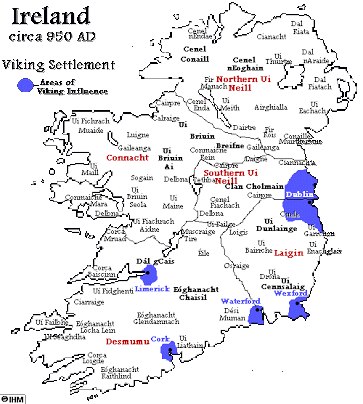
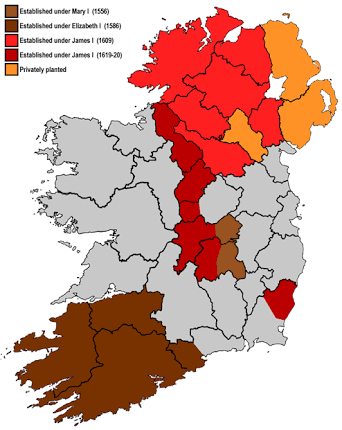
Giving everyone back their landJust in case anyone is wondering, the Vikings never "stole significant territory" in Northern Ireland. They settled the South (see map). And in my comment, I was obviously referring to the protestant settlers from Britain and their ongoing conflict with those who came before.
Viking Invasions:
Protestant Plantations:
. -
Giving everyone back their land
-
Giving everyone back their land
The complexity requires the application of intelligence, patience and empathy for both sides in any dispute over land, particularly one that has already, or has the potential to, end up in war. That paid off in Northern Ireland, for example. What isn't helpful is ignoring the complexity in favor of arguing about binary oppositions that could be written on the back of a postage stamp, such as "give everyone back their land" vs "don't give anyone back their land". -
Giving everyone back their land
And the corollary question is: should we just allow people to take others' land with impunity? Which on a grand scale translates to, is ethnic cleansing OK? The answer by the way is "no" and it's very easy to hold that position without demanding New Yorkers vacate Manhattan and give it back to the Indian population their ancestors decimated hundreds of years ago. Anyway, we've already had these facile comparisons of Palestinians with Native Indians in another discussion. Are we really going to rehash that nonsense here? If that's the direction this is going in, then just take it to that discussion which is already a mess rather than start a new mess here. -
Are there any non-selfish reasons for having children?
And funny that this type of thinking can only take hold (even in a minor way) in the top ten percent of countries by level of quality of life in just about every indicator. I vote for mandatory "holidays" in the DRC to cure the malcontents of their malaise. If life is not much more likely to be a gift than a curse when we are born into the relative privilege and wealth we in developed countries enjoy, then we really are... But that's not the case, thankfully. -
What will Mueller discover?Deleted overly cynical rant. — Erik
Pity. As cynical rants go, it was a good one. :up:
So... Sean Hannity, eh?
https://www.nytimes.com/2018/04/16/business/media/sean-hannity-michael-cohen-client.html
Sadly, this is probably perfectly acceptable to Trump partisans. -
The American Gun Control Debate
Here's my legislation:
Basic handguns and rifles allowed but on a licensed basis i.e. you have to pass a competency test and undergo strict background criminal and mental health checks to own one. Everything beyond that including semi-automatic weapons banned. Simple. (And no impact on the much coveted 2nd amendment as owners still have the right to bear arms just not all arms—the latter point being in principle already conceded by acceptance of the illegality of machine guns and etc.)
Predicted result: A little less freedom (for owners of dangerous guns). A lot less death and injury for everyone else. -
Disappearing Posts
Not in the spam filter and not in the change log, so it doesn't appear that you were modded. Let's just put it down to bad luck...? -
Why has change in society slowed?If you focus on a narrow band of technology as you do above, you'll get sudden jumps followed by more stable levels of development. And the perception of the importance of the jumps is not always only to do with the technological level itself but also with marketing, availability, affordability, media interest etc. Location is also a factor. So, you say the 1990s were filled with technological advancement, but all you seem to mean is that in Western countries the internet and email became widely available then. And then from 2000 to 2010 we had the invention of a couple of very successful consumer gadgets, the smartphone and tablets. Highly impactful but not so wide a range of tech, and underlying processor technology continues to follow Moore's law anyway. Also, moving away from the internet and computerized gadgets, did you notice any major advances in air travel, rocket technology or cars from 1990 to 2010? Certainly not much compared to 1940-1960. And since 2010, we've had mass-produced electric cars (Tesla) and successful private rocket launches (SpaceX) in those areas just to focus on what Elon Musk has been doing. Then we can talk about biotechnology, environmental technologies and so on, and again the picture might not look so bleak for this decade. All that's only to say that perceived overall technological advancement doesn't necessarily have a lot to do with actual technological advancement.
-
Beautiful Things
Phillystine!! If everyone doesn't hate your art, it's no good. I rest assured in my obscure unpopularity. -
Disappearing Posts
-
Beautiful ThingsIt appears that the common elements are: — Hanover
...that they are horrible, over-processed crap.
(There is literally not one passable picture on that whole page.) -
Disappearing Posts
Yes, and I agree with you in the sense that I recognize that science and philosophy are not absolutely clearly demarcated just like philosophy and the arts aren't; science bleeds into philosophy and philosophy bleeds into the arts, but this is not the place to debate the details of that particular issue. I just wanted to let you know that you can post questions on science with some philosophical element to them in the questions category. Or if you want to develop a non-philosophical science question further in an OP (with the intention of discussing and debating it) you can post it in the science and tech category. And with any OP, if you have some doubt about where to put it or what to do with it, you can always run it by any of us first and we'll help you out. We're not enthusiastic about deleting OPs but do like to keep the place well-organized. -
The American Gun Control Debate
Yes, and what an AR-15 bullet, for example, can do to the body in terms of damage is not comparable at all to an average stab wound just like sticking a pin in someone is not comparable to sticking a knife in them. That's been demonstrated earlier in the discussion. And these are the types of weapons that most gun control advocates want banned. Why so many Americans insist on having guns that can create holes the size of pineapples in each other is just beyond me. -
Disappearing Posts
There's a 'Questions' sub-category in the Learning Centre (see menu on the left) for stuff that isn't homework, can't easily be Googled but at the same time isn't intended for extended debate and discussion but merely for informational purposes. -
Donald Trump (All General Trump Conversations Here)I like his reaction to the most recent Syria atrocities. Even the Tweets. Notwithstanding that following that up with real action will be the important thing.
-
Donald Trump (All General Trump Conversations Here)This is relevant to what I mean. And worth watching on its own terms anyhow. (Have a look around the fifteen to twenty-five minute mark when he talks about Rumsfeld and unknown knowns—"What we don't know that we know" etc. What Trump supporters know but "don't know" that they know is that he's guilty. And it's the virtual operation of that knowledge that paradoxically fuels their indignancy at his unfair treatment [what they directly "know"].) So I claim anyhow...*sniffle* and so on, and so on...
-
Donald Trump (All General Trump Conversations Here)
Sure, all I'm pointing to is the common psychological phenomenon of fuelling a moralizing attitude with energy garnered from an emotional response to knowledge of a reality that undercuts the rationale for that very attitude. It's not just Trump supporters that do that either. This just seems to be a good example of it. -
Donald Trump (All General Trump Conversations Here)What I find particularly interesting about the whole thing is that the level of moral outrage of those on his side is more or less directly proportional to knowledge of his guilt. Those who most know that he is guilty of something are those most morally indignant at the 'unfair' treatment he's receiving. It's kind of a wave of ironic hypocrisy with Trump at its epicentre moving outwards through his lawyers and spokespeople through Fox News and Breitbart and his wider pool of support. And the funny thing is I think it is "real" moral outrage in a sense—it's not just a calculated act—with the knowledge that there is nothing really to be morally outraged at (as he clearly has dirty hands) operating at a kind of virtual background level that sustains the whole charade.
-
Donald Trump (All General Trump Conversations Here)
But he's innocent and never did anything wrong, ever, either before or after he became president; and they have found and will find nothing as he keeps telling us. Therefore, everything is hunky dory. All this investigation will do is prove how pure and misunderstood a soul he is and we'll all end up eating humble pie and go back to loving him. What could be better than that? -
Donald Trump (All General Trump Conversations Here)
:lol:
And Fox News are cheering him on. Asking with a straight face "Is it time to fire Mueller?". So, you have a MSM outlet now essential advocating a President act like a tin-pot dictator. Sad times for democracy. -
Why is the verb 'realise' used as a state verb and much less commonly as an action verb in English?
Pretty much, I'd agree. I always find the above much more logical anyhow. Classical grammar is a confusing mish-mash of tradition and rationalization. -
Why is the verb 'realise' used as a state verb and much less commonly as an action verb in English?@JJJJS
Traditional grammar doesn't deal very well with this and stuffs 'to realize' in as a 'state' or 'stative' verb along with 'to be' etc. There's supposed to be a grammatical commonality in terms of the non-use of the present continuous among state verbs, but there are loads of exceptions to that and in terms of the complement, realize takes an object either usually in the form of a clause (Bitter's 1st example) or a simple direct object (2nd example). Verbs like "to be" and "to have", truer state verbs, don't. It's a bit of mess, basically.
So, I recommend looking at a functional grammar (see diagram below) to get this type of thing clear in your mind. It's in general a much better tool for understanding how the specific language you're looking at works than classical grammar is as the latter is stuffed with illogical rules, some of which are borrowed from other languages (Latin, for example, in the case of English).
Anyhow, "realize" does represent a kind of state, a psychological (but not a relational) one, in the first example, the state of realizing something. So, it appears somewhere between pure relations and pure actions. The diagram below helps visualize the gradual transformation. Verbs like "to be" and "to have" are true state (or relational) verbs—they describe the subject either in terms of identification (e.g. "I am an animal trainer") or attribution (e.g. "I am scared" (intensive)), (I have a knife (possessive)), (I am in the cage (circumstantial)). Verbs like "to do", "to put" etc., on the other hand, are pure actions. Verbs like realize then in the first sense describe conscious thoughts, feelings and senses and behave in the grammar somewhere between pure "state" and pure "action" verbs hence why it's confusing to think of them as either and why they don't behave grammatically as either. (Though realize in the second sense of "made something happen" is, of course, much closer to a pure action verb).
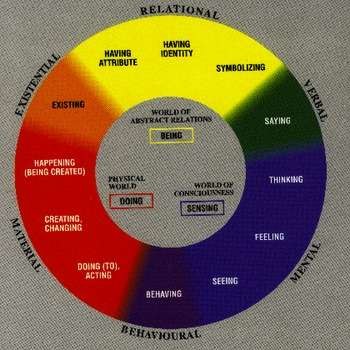
(BTW The "Existential" category refers to phrases like "There is a problem", "There seems to be a hurricane coming" etc...) -
Donald Trump (All General Trump Conversations Here)
But he's given huge tax breaks to the rich, tried to destroy Obamacare, deruglated business, is trying to gut environmental regulations, has banned transgender people from the military, and is doing his best to build a wall along the border. How more liberal can you get? -
Vegan EthicsDon't see a reason to delete the pictures. Do see a reason to delete very personal insults. It's an emotive topic but let's at least emote on topic.
-
Feature requestsOur Facebook page is one of the few bright spots on an otherwise trivia-littered, over-commercialized, insipid, vanity-driven, dopamine-inspired landscape. — Baden
Your response has been posted on The Philosophy Forum Facebook page. Congratulations and Thank you for your contribution! -
Feature requestsOur Facebook page is one of the few bright spots on an otherwise trivia-littered, over-commercialized, insipid, vanity-driven, dopamine-inspired landscape.
-
The American Gun Control Debate
OK, by that logic no new weapons in development are covered under the 2nd amendment right if they are not yet legal. So, if we decide to ban all new weapons (never make them legal) it would not infringe on the 2nd amendment. And applying the principle retroactively, nothing but the weapons originally extant at the time of the 2nd amendment were covered by the 2nd amendment. Ergo, nothing but muskets and the like need be covered. -
The American Gun Control Debate
So, every weapon that has ever been legal is protected under the 2nd amendment? And every weapon that has never been legal is not protected? That's your position?? -
The American Gun Control Debate
Now, you are saying it's legality that matters. So, if assault weapons are illegal in illinois now, then it's not a 2nd amendment infringement just as with bazookas being illegal it's not a 2nd amendment infringement.
Baden
Start FollowingSend a Message
- Other sites we like
- Social media
- Terms of Service
- Sign In
- Created with PlushForums
- © 2026 The Philosophy Forum