
-
The 7 questionsIt could be that it's conjugations are computer-generated, and what would a computer know about it? — Bitter Crank
That would be it. Someone needs to refine the algorithm. The answer to the perpetual question "'To can', or not 'to can'...?" is most definitely not 'to can'.
So, in the Old English (and other) sources, cunnan from which "can" is derived, would have had an infinitive form. — Bitter Crank
Fair enough, but Old English is hardly less different to modern English than modern English is to Dutch. Anyway if you need an infinitive, just use "to be able to", and don't say modern English doesn't cover its bases! -
Is it correct to call this email from Trump fascism?
It's exceptionally stupid (as if it proves anything beyond the abysmal level of his supporters' political intellect), but I don't see fascism in it. -
The 7 questions
This is not something we can conceptualize. If it were, we would be already doing so; so the effort to find a new question word related to it would be pointless. We'd have one. Right? Within our conceptual scheme, "new" question words would be as superficial as translations from other languages. -
The 7 questionsThe infinitive of 'can' is 'to can'. Outside of food preservation, I've never come across "to can" until a few minutes ago in a dictionary entry. — Bitter Crank
The "to can" refers only to the food preservation sense. There is no "to can" in the other sense as it's a modal auxiliary. It doesn't have a non-finite form, i.e no "to can", no "canning" etc. -
Is dictatorship ever the best option?
Leaving aside the self-flagellating irony of your Palestinan friend's comment for the moment, does the dicator have to be bloodthirsty? Are bloodless coups and "benign" dictatorships ruled out? I'm thinking here of the example of Thailand where the establishment of a military junta halted a conflict that was spiraling out of control and in the process almost certainly saved lives. -
The 7 questions
How to get the bull out of the grammar china shop? ;)
Just a couple of points. You haven't covered all possible question words / phrases nor all types of question. "How many" and "how much", for example, differ from "how" in calling for number and amount rather than a way of doing things (note that although functionally a "what" could do the trick here, so could it for "where" (what place), which (what one), and who (what person); in each case a thing represented by a noun phrase is called for - and knowing this leads us towards the more sensible categorizations of functional grammars). As for types of question, you've left out the category of yes / no questions entirely. This is where the confusion about auxiliaries comes in. They're used in yes / no questions (along with tag and alternative questions). (Oh, and "could" is past use of "can" but only when you are talking of ability, not possibility or permission).
Anyway it doesn't make any sense to go looking for new question words. That would mean looking for new functions. As if we don't have it covered. Language is always complete in its context. It doesn't need any help.
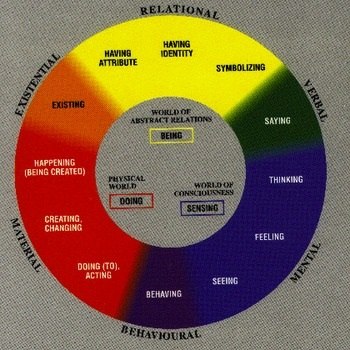
Traditional grammar won't help you much with this. Check out a functional grammar like Halliday's SFL. It puts this kind of stuff in context.
-
Why the is-ought gap is not a big dealTractatus 6.43: "If good or bad willing changes the world, it can only change the limits of the world, not the facts; not the things that can be expressed in language.
In brief, the world must thereby become quite another. It must so to speak wax or wane as a whole.
The world of the happy man is a different one from that of the unhappy man" -
Why the is-ought gap is not a big deal
It was a take on a Wittgenstein quote "The world of the happy..." etc. I'm on the normal emotional range bus and intend to enjoy the ride. -
Why the is-ought gap is not a big dealThe bus of the happy man is a different one from the bus of the unhappy man.
-
Quarterly Fundraiser
Yes, but then it won't happen and we'll keep the money anyway. ;) Anyone can of course nominate someone to be moderator at any time by sending a PM to one of the staff with reasons for their choice. We don't have a vacancy at the moment, but we'll take that into consideration the next time we do. -
The Free Will Defense is ImmoralCreating conscious agents with testosterone and then falling back on free will is like giving toddlers hand guns and then falling back on the constitution.
-
Humans are preventing natural Evolution.I doubt it's strictly the biological definition, though — Marchesk
Ok, but you still haven't presented any evidence backing up your thoughts and doubts. I at least quoted "Rational Wiki". As I said, if you can find a definition of biological evolution from a reliable scientific source that excludes artificial processes as causative, I would love to see it. -
Humans are preventing natural Evolution.
'Intelligent design' is a religiously inspired pseudoscience. It doesn't figure in the debate raised in the OP. If conscious agents cause changes in a gene pool (which are passed on) they are causing evolution. -
Humans are preventing natural Evolution.
Pretty much, and it can happen by 'natural' means including natural selection and lots of other stuff and various 'artificial' means. It's all equally evolution. -
Humans are preventing natural Evolution.(I didn't btw claim mechanisms aren't an important part of science or anything remotely close to that. I was talking about the adjective 'biological' in the phrase 'biological evolution' - just like before).
-
Humans are preventing natural Evolution.
We could go on like this forever. If you find any evidence to suggest anything I've said is inaccurate or misrepresents the scientific view, let me know. -
Humans are preventing natural Evolution.
You're conflating the 'what' and 'how' again. Anyway, what I've been saying is straightforward scientific orthodoxy. 'Biological' is about the 'what' not the 'how' . -
Humans are preventing natural Evolution.
Scientists use the term to distinguish the evolution of organisms from other stuff. That's the 'what'. The 'how' is up for grabs as has already been explained. -
Humans are preventing natural Evolution.
Cancer and the like is not evolution. Evolution results in heritable changes in a gene pool. -
Humans are preventing natural Evolution.Although, I have to wonder if bringing species back from extinction is actually evolution under that definition? — Marchesk
It would just depend on whether changes were made to the genes in the process. If cats die out and we bring them back as they were, they wouldn't have evolved. -
Humans are preventing natural Evolution.
-
Humans are preventing natural Evolution.
Sure, human activity including technological activity could be a mechanism of evolution. Why not? Artificial selection is. -
Humans are preventing natural Evolution.
Evolution is defined by heritable changes in the gene pool from generation to generation. Doesn't matter how they get there. Genes come and go. That's it. -
Humans are preventing natural Evolution.... that is not necessarily the best adaption to our environment? — Javants
Just to add to what @StreetlightX said, evolution doesn't primarily "care" what the best adaptation to an environment is. Any gene that offers a competitive advantage will spread through the gene pool (all other things being equal) even if this perversely leads to maladaptation. Consider a population of birds who hatch their eggs at an optimal time of year with regard to availability of food. Now consider a gene that causes an individual bird to hatch earlier. That bird's young may eat more due to lack of competition for food from other hatchlings thus increasing fitness thus spreading the gene for the suboptimal hatching date around etc. In this way species can adapt themselves away from optimal environments. Once you've accepted that principle, there's no real problem to solve. -
Turning the problem of evil on its head (The problem of good)
It's all in the above. If you still don't see why your cherry-picked example can't be generalised to render only one half of the dichotomy incoherent (and herein lies your claimed asymmetry) then all I can suggest is you consider a few more examples. -
Essence of Things
Sure, in practice, it won't necessarily matter much but the approaches have very different philosophical bases. -
Essence of Thingswhere and how do we draw the line? — mew
You observe what others call games and you call those types of things games too. There is no absolute "line". More a fuzzy boundary constrained by use. -
Turning the problem of evil on its head (The problem of good)
God created man in his own image and so on. But I'm less interested in the theology than the psychology here. -
Turning the problem of evil on its head (The problem of good)In other words, what's sauce for the omnibenevolent goose is sauce for the omnimalevolent gander.
Baden
Start FollowingSend a Message
- Other sites we like
- Social media
- Terms of Service
- Sign In
- Created with PlushForums
- © 2026 The Philosophy Forum