
-
Donald Trump (All General Trump Conversations Here)
You have to be very careful how to do this, because more censorship likely isn't the answer as likely many politicians aren't so inept as Trump, who hasn't been able to communicate so well as once off Twitter (as he of course has minimal leadership or organizational skills). It will likely just irritate people more.I seriously think that large part of this problem can be solved by prohibiting any type of targeted advertisement, news, videos, links etc. and break the bubbles. I suspect that as a result most narratives will become more centrist, more "the average" etc. and people will be more readily confronted with opposing views, learn to deal with those views and talk about it with unlike minded individuals. — Benkei
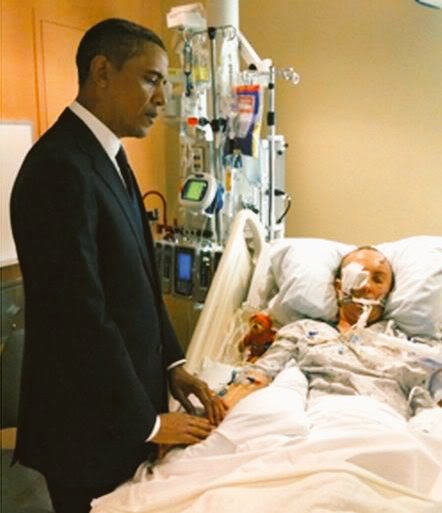
There is the ugly path from political polarization to political violence, which then can become the "new normal" that further erodes the democratic process and strengthens calls for authoritarianism. You have had already prime example of political violence in the US, naturally with the Jan 6th riot, but also starting from the shooting incident of Gabrielle Giffords in 2011 and the other incident that happened at a congressional baseball game for charity in 2017 or the shooting of Gabrielle Giffords. The shooter in the baseball shooting incident was actually an leftist terrorist. Luckily some of the Republican members had army medical training and could immediately give first aid to Scalice and the Capitol Police could pin down the terrorist that he couldn't continue firing at the congress members.
President Obama with Giffords after the shooting:
The real worrying sign is how little these incidents actually raised any debate about political violence. Of course this is very typical: political violence is a taboo. It happens only in "Banana-republics", not in civilized countries. And this is true both in Netherlands and Finland as in the US. For someone lets say going to a political demonstration and then getting killed or the event of a political assassination are not the things either the media or the political leadership want to remember. Nobody will admit it would be anything else than a extremely rare thing that doesn't have any links at all to the present political climate. The sad thing is that usual it does.
No, my fear is how bad it will have to become before Americans will admit that they do have a problem with violence. Because on the positive side, it really isn't yet a real problem, but all the hallmarks that it could be in the future are there. Yet again, things can also get better. -
Donald Trump (All General Trump Conversations Here)Pretty damning and in a way still missing the point. His solutions are still technocratic, a tweak here and there, but the problem seems now fundamental to me. — Benkei
If a person starts with:
with a reasonable chance over the next three to four years of incidents of mass violence, a breakdown of federal authority, and the division of the country into warring red and blue enclaves. The warning signs may be obscured by the distractions of politics, the pandemic, the economy and global crises, and by wishful thinking and denial.
And then ends with:
There is something obviously something out of touch. If you assume that there is a reasonable chance of mass violence and breakdown of federal authority, arguing about election technicalities is a bit strange. This is simply because with mass violence and breakdown of federal authority election technicalities don't matter.Heading into the next election, it is vital to protect election workers, same-day registration and early voting. It will also still be necessary to pass the John Lewis Voting Rights Advancement Act, which directly addresses the state legislatures’ electoral power grab. Other battles — such as making Election Day a federal holiday and banning partisan gerrymandering — might better be postponed.
If the US would be, as Kagan writes, "is heading into its greatest political and constitutional crisis since the Civil War", election technicalities aren't the answer. To do something about the polarization of politics is the problem. The political discourse is just spiraling out of control. It's like people are just waiting for the next clash to ensue. Who would want to join politics in this kind of political environment? Basically seeing part of the voting public as the problem won't help: it's a way to advance the polarization, encourage alienation and separation of the voting blocks. And naturally the right in the US has already for years has been on this path: the other side simply hasn't lousy policies, it's a mortal threat. And this drumbeat just continues.
Anyway, the next mid-terms will be ugly. Not a great start then for the 2024 elections. -
The Inflation Reduction Act
Just for the record, the statistics here:That’s just not true. Biden is doing better than this time in the Trump presidency, by a decent amount. — Xtrix
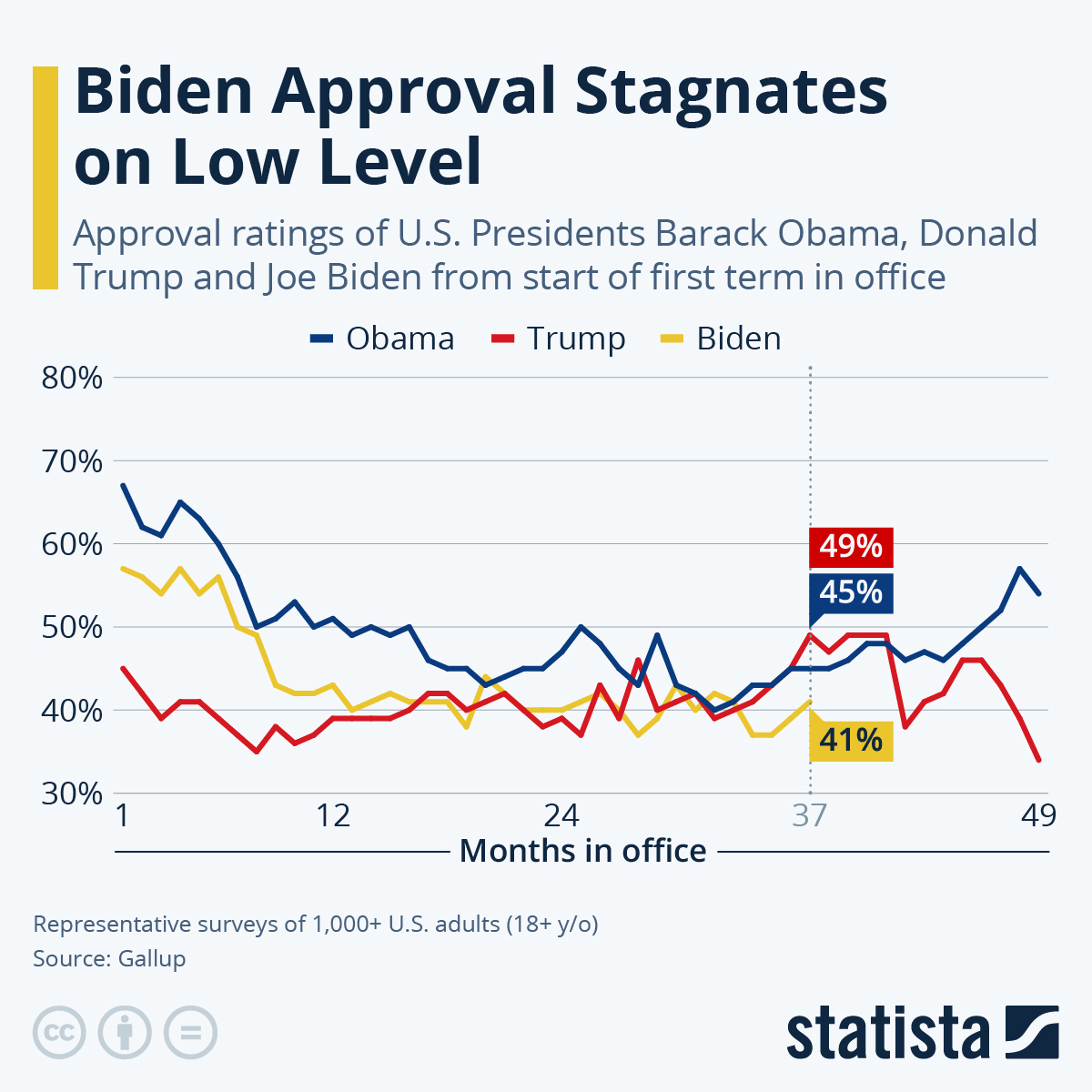
So @Xtrix is right, even if Joke Biden has taken a tumble. What for me is surprising that sometime nearly 50% approved Trump. But then it went down again... -
What would happen if the internet went offline for 24hrswhat if the entire internet shut down for a day? What would the be most major impacts/consequences for the globe in this brief but major widespread return to a pre-globalised technological dark age? — Benj96
The media hype would be enormous. Once people would get back online. Ooh, the horror, the horror.
Extended outages in the Electric grid, especially in winter, are far more dangerous than the whimsical issue that Facebook or Twitter being down. With failure of the electric grid at winter many relying on electricity for heating might die. And the industrialized farming would have its problems too.I suppose the Earth is due for another Carrington Event. — 180 Proof
But not an issue we could not handle. And afterwards we would just make our back up systems more reliable. -
Donald Trump (All General Trump Conversations Here)
May be? I think they are quite obvious ways. Political power is to control how things are talked about and how people see the issues. It's not only about truth and lies, the discourse is important too.You’re saying that silencing opposition and controlling the truth may both be strategic power plays? — praxis -
Donald Trump (All General Trump Conversations Here)And in the US of 2016, 2020, and god help us likely 2022 and 2024, the assumption that we collectively have common sense is open to question. 2020 we got by, but not by enough. How, short of trauma, is common sense restored? — tim wood
That is the real question here.
How do you assume that the polarization would stop? There really is the danger that the election of 2020 (and it's aftershocks) is going to be the new normal. I'm not seeing a way it would get better. Populism rules supreme. -
Donald Trump (All General Trump Conversations Here)Yes, that part of it is almost that simple. But the election itself is not. And if and when an electorate shows itself afflicted, are there to be no remedies? — tim wood
For a democracy to function sets demands for the citizens. Voters have to have some knowledge and especially interest in the collective decision making. The basis is that the majority of people do have common sense. That's all. And it works. Somehow. Not a perfect system, but still far more better than authoritarianism.
Yes, constitutions, minority rights and other issues are OK as "safety valves", yet if the electorate wants to imprison all red haired women as being dangerous witches, there go the redheads to prison. We assume that the majority of people do think that imprisoning women based on their hair color is a lunatic idea and hence nobody will come up with the idea and get majority support for it. We should see the real motivation when there are limitations to voting: usually they aren't from the fear that the voters would vote recklessly and "put female redheads to prison" or something similarly ludicrous.
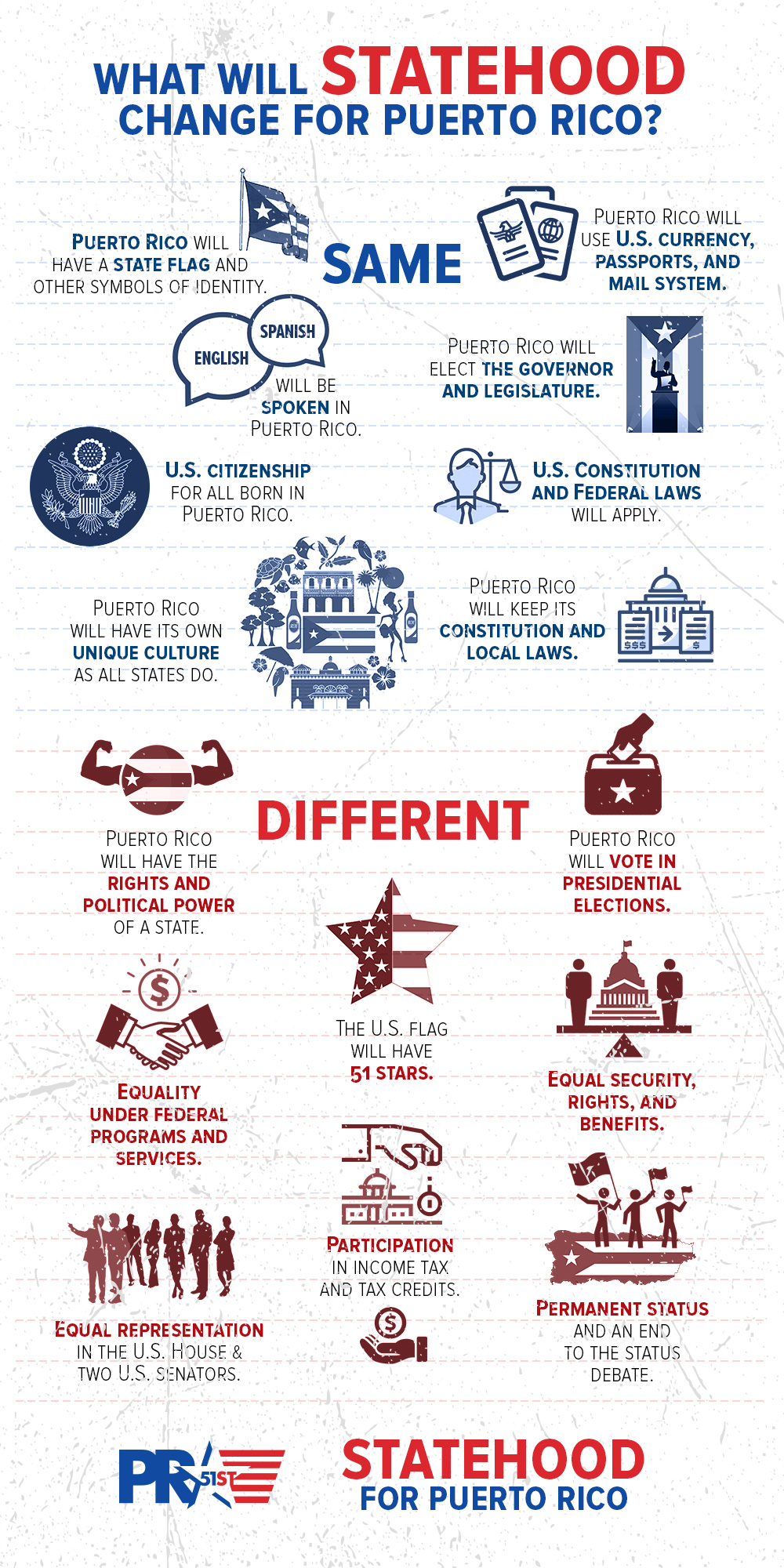
Usually someone in power fears that by going to the simple "citizenship is 1 vote" idea would politically give them a political disadvantage. Hence for this reason, just to give one example, Puerto Ricans aren't given the right as US citizens to vote in Presidential elections as Puerto Rico isn't a state or part of any state, but a territory (and their representatives in the House don't have a vote). And this of course was very typical with other colonies...when European States had more of them as now.
-
Donald Trump (All General Trump Conversations Here)
No.You’re saying that you can’t tell truth from lies? — praxis
I'll try to explain. So someone said this:
whatever they believe gains them some kind of advantage, regardless of what's said is true, so the basic strategy is not to silence opposition but to control the truth or reality. — praxis
To control the truth, or just force others the subjective truth is what Postmodernism views this thing. A power play. -
With any luck, you'll grow oldWhat were the best years of your life, so far? — Bitter Crank
Was close to dying few years ago. Happy about every day afterwards that I can share with my children and even to write here on PF. My youngest child was then quite young, so she wouldn't have remembered much of me. Now she'll remember.
Best years? The present that we are living. Never doesn't get better than that. Best past years? When I was 12. Still a child and no worries, yet you could think and understand things and you remember things well. Before that sucking teenage time.
What kills is loneliness. You don't have motivation to live. Once all your friends have died, then it's bad. Then people can start question life and have the attitude, "Ok, that was it". -
Donald Trump (All General Trump Conversations Here)
I think it should start from things like felons would never lose their right to vote, even while they are incarcerated.Seriously though, advocating for so-called voting competency tests is an all round terrible idea. — StreetlightX
Citizenship should be enough for to have the right to vote. -
Donald Trump (All General Trump Conversations Here)I don’t know what you mean. — praxis
Postmodernism (and epistemology generally) distinguishes between subjective truths and objective truths. The former are statements about one’s individual experience of the world, while the latter comprise propositions supported either inductively or deductively. - postmodernism stresses the distinction between objectivity of facts, versus objectivity of knowledge or people. It accepts the possible existence of facts outside human context, but argues that all knowledge is mediated by an individual and that the experiences, biases, beliefs, and identity of that individual necessarily influence how they mediate any knowledge.
Finally, postmodernism criticizes individuals’ claims of objectivity via a critique of power. Specifically, it argues that the degree to which society accepts an individual’s claim of objectivity is directly proportional to that individual’s structural power.
That's the diplomatic way to say it. The other way to say this is that there aren't objective truths and it's all subjective truths and so I can make my own truths...because that's power.
It's all just a power game.
That kind of postmodern thought. -
Anti-Vaxxers, Creationists, 9/11 Truthers, Climate Deniers, Flat-Earthers
Yep. Likely this is the case.Deflated is far the more likely, certainly internationally. — tim wood
But of course likely people will simply deny the facts and just accuse of others being naive. Deny all those rented cold storages that had to be used when the morgues were having problems to deal with the dead. And as now the health sector has adapted to fight the virus, who cares if the most deaths for instance in Florida happened this August, not last year?

-
Donald Trump (All General Trump Conversations Here)It seems to me that Trump and his supporters say whatever people want to hear and whatever they believe gains them some kind of advantage, regardless of what's said is true, so the basic strategy is not to silence opposition but to control the truth or reality. — praxis
This is the reality. What suits them best are the facts. It's all just political rhetoric, everything. Talk about making your own reality.
A bit postmodern, don't you think? -
Is a constitution undemocratic? Is it needed to protect minority rights?What is wrong in having safety valves?
Having things to be little harder to change than just getting a simply majority (50%) is a good thing. Having written constitutions are good, but then again if you have a solid institutions in your democracy, it isn't so crucial.
On the other hand, you can have the all the legal trappings of a democracy, a Constitution, elections and a legal system, but if they aren't upheld, nothing matters.
Take the example of Liberia. It declared it's independence in 1847 and had basically 1-to-1 the Constitution of the US. But in reality power was with the small minority of those who were descendants of those freed slaves. And the democracy in the country was questionable. Then just one day in 1980 seventeen non-commissioned officers lead by a sergeant major walked to the Presidential Residence and shot the President and took power. Then he later staged fraudulent elections and was for ten years a dictator, which afterward lead to one of the nastiest civil wars Africa has seen with things like cannibalism and roaming child soldiers and overall anarchy. -
Donald Trump (All General Trump Conversations Here)
Oh yes, their God Emperor.I'll be interested to see how mid terms go. Trump voters are mad at the GOP leadership, rightly intuiting that they despise their "God Emperor." — Count Timothy von Icarus

I actually remember one true Trump believer using that name in 2016. Now he was a genuine racist (worried about the white race dying in the US) and living in a trailer (and not on this site, not even as a banned member). Yes, stereotypes have their actual living examples.
It's a religion for them. Or a cult (would be more proper). That people here are outraged at Trump and hate him gives them pride that their God Emperor did win the 2016 elections. They will happily jump in the "stop the steal" bandwagon for what it's worth. It annoys others, so they like it.
So it's a hijack.
The GOP doesn't need the Electoral College. They win majorities of House votes. The Democratic dream of minority votes surging against the GOP has never materialized, and by the third generation, new immigrants are far more attracted to the party. Their problem is that their loonies keep winning primaries, and their variously insane and racist messaging is killing them in national elections. — Count Timothy von Icarus
It's actually quite typical. The most hardcore supporters dominate the primaries, which isn't in the favor of mainstream voters, especially those who can change the party they are voting.
This is the likely outcome, actually. People will just stay away from this loonie crowd. It's not like an angry movement will emerge from somewhere demanding "their party back"! Change will come in the way of people just forgetting past stuff.And as we saw in Georgia, railing about fraud that hasn't occured kills your turn out. So a big upset could be on the way. — Count Timothy von Icarus
It's a religion. And religions are a faith based issue. Not a fact based issue.Like Trumpism though, this can all be explained by the oppression of their base, the evil media, and voter suppression, clearly it couldn't be that they just aren't that popular and need to compromise... — Count Timothy von Icarus
A good comment, @Count Timothy von Icarus! :up: -
Donald Trump (All General Trump Conversations Here)
The present situation in the Republican Party is...silly. Yet as said, the party has been hijacked. And of course it is true that there's still time until 2024 and much will happen.I think it's a silly mistake for Republicans to rally behind this guy still. But they're pretty much out of ideas, and they're afraid of those voters who still love the guy. They're really caught in a bad spot in this respect. All the better for the country, in my view. — Xtrix
And there's the reason just why it will stay like it is. At least if it comes to the GOP.US elections wouldn't be polarized dumpster fires if we didn't have such an incoherent and broken election system.
If we went via the popular vote, the GOP would have won one election in a third of a century. — Count Timothy von Icarus -
The Inflation Reduction ActI think that’s a good start. — Xtrix
Civilian Climate Corps? Hundreds of thousands in this Corps?
What does it do? Would it do something that is already done with something other?
Or is this a rehash of the work relief program Civilian Conservation Corps given a new name?


Sounds interesting, what is the actual plan?Putting the U.S. on track to run on 80% clean electricity and to cut economy-wide carbon emissions in HALF by 2030 — Xtrix -
CoronavirusSo yeah, I get the distrust, I just don't think it translates into having to distrust vaccinations. There's no particular reasons to distrust vaccines other than general distrust of governments and big pharma and that simply isn't evidence. — Benkei
And then we do live in democratic countries, where people can and will have their own ideas. Some countries more than others.
Even here in law abiding Finland, where of the population over 12 years old over 80% have gotten the first shot and 69% have gotten the second shot has been given to the majority of people. Yet even from the 65+ age cohort still just slightly over 91% - 93% have been vaccinated. So I guess that every tenth likely won't get a shot. The government has an objective to have 4/5 of the population having two shot vaccinations and rest there. To get higher, you would have to really forcing people to get vaccinations. -
Donald Trump (All General Trump Conversations Here)No one cares what this deranged imbecile has to say anymore. — Xtrix
The way I see it, there is a lot of commentary on Trump still in the media.
Plus the GOP seems to be hijacked by the "Trump crowd" ...or at least so it's depicted in the media. So Biden won. But it wasn't in the ballpark of Reagan winning over Mondale in '84 or Roosevelt winning over Landon in '36.

Has anybody seen signs of the political polarization going away?
Besides, what would be the reason why elections in the US wouldn't be dumpster fires? -
The Turing RuleCareful with the syllogism. Not that the computer, if it passes the test, is a person. It is that the computer is intelligent. — Caldwell
Even if it is so intelligent after all.
Start with current top notch datamining capability and computer recognition, lets say every comment here on PF and on other Philosophical discussion site (still, quite finite amount of discussion threads), then add a great English language program, and realistically you could have a program that would fool people most of the time.
And still it would be a simple ordinary computer program using algorithms "if....then" to produce the fooling. Nothing AI about it!
How to know that it's a stupid computer program? It's only as good as the human programmer has made it. Get the program to participate in dialogue that the programmer hasn't anticipated and soon you might find the flaws. The program cannot do what it isn't programmed to do. (Even if it has likely a mechanism programmed in it to do in this case ad hominem attacks, which would we a very human response). -
Agriculture - Civilisation’s biggest mistake?My argument though will be that it is through the surplus created by agriculture that wealth was generated and as a consequence the early beginnings of the idea that those with power (strength in the main but ideas too) created the very early beginnings of the class struggle and the haves and have nots. — David S
On the other hand, with just hunter gatherers, there basically wouldn't be culture as we know now. Would writing and more advanced mathematics even be needed?
Yes, we can yearn for the Noble Savage who hasn't been spoiled by civilization.
Well, that civilization is our culture, so... -
The Inflation Reduction ActMyself I'm usually skeptical of beautiful looking young politicians, because it raises the question of just who picked them up and was it indeed their looks that got them to the place where there are now. They are in the same group with celebrities and athletes, who can have after their actual career settle for a political career. With women there have been some embarrassing failures, notably in the US when John McCain's team accidentally picked Sarah Palin for the Veep position. They were in a hurry.
Actually plain looking women politicians seem far more competent as there has to be a reason why they have climb the political ladder. Same is for the minorities: have they done something or have they been picked as to get the quota. The target group for young female politicians isn't actually middle aged men ogling at their looks, but the older generation of voters who finally decide they ought to give their vote for a younger generation. And why not to give the vote for that nice looking energetic young woman!
(The Iron Lady at the start of her political career. A woman leader who usually is totally forgotten when the issue of women and power is debated. Because...some actually didn't like her politics. Which in a way is good that she is judged by her politics, not by being a woman.)

(Another successful politician that obviously didn't get the vote because of her looks.)
-
The Inflation Reduction ActI was just about going to post the video that @Praxis posted on the Trump thread on Marjorie Taylor Greene. Yep, she was happy when January 6th happened. So you have those women too.
So I guess we can agree that one's genitals aren't the most important reason to pick a politician. Far more is what the politician believes in and what he or she does. -
Donald Trump (All General Trump Conversations Here)So...
What do people think about Trump being the Republican candidate in 2024?
And what a wonderful happy time Americans would have again if Trump would be re-elected? -
Donald Trump (All General Trump Conversations Here)Certainly not news after the fiasco at Helsinki in 2018. Leak the kompromat, Vlad ... :smirk: — 180 Proof
After watching the whole press conference held here by Trump and Putin in 2018 is all that actually one needs to firmly understand that Trump's relationship with Russia was not normal. It wasn't a normal press conference between the US and some other country. It was more like Putin as Soviet Union would held a press conference with East Germany or a satellite state. It simply wasn't and isn't normal.
And likely some Americans will deny it forever.

-
The Inflation Reduction Act
Yet then there's the reality:
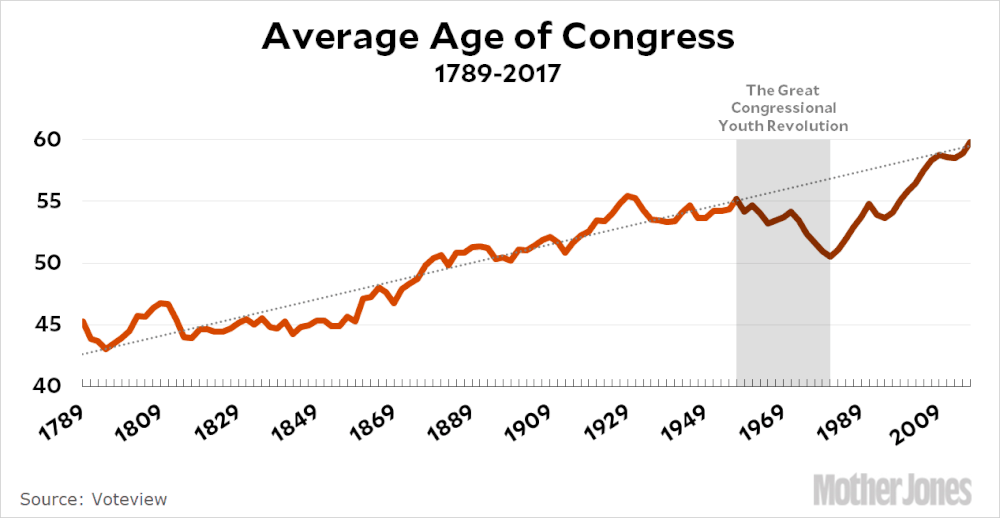
How about trying to change these statistics in the next elections? No seriously, this is a clear sign of the parties being out of touch of the people and quite complacent in sharing the power in the US.
Damn. Imagine getting to look at these women all the time as opposed to Mitch McConnell and Joe Biden. That alone makes it preferable. — Xtrix
American political parties should note that, actually. The hilarious issue is now that all the party leaders in the administration coalition are women, all the party leaders in the opposition are men. -
The Inflation Reduction Act
Having looked at the history of the so-called "infrastructure bill" or the earlier stimulus packages, I would look at where the money really goes in the end.As you know, they have to make it appear related to the budget to pass reconciliation, but these are real policies being enacted. — Xtrix -
The Inflation Reduction Act"Here's the reigns, bitches! Have fun!" — James Riley
Well, you would love the leftist-centrist administration here that we have, dubbed by the opposition "the Lipstick administration":
(Prime Minister and the leader of the Social Democrats in the middle. Other ministers in the picture are party leaders also:)
-
The Inflation Reduction Act
Again this is far more a policy and legal matter than something that could be solved by more spending. Think of universal health care that costs less than in present US. That would mean that also doctors would get a lot less. US Doctors are now paid the most in the World. The unfortunate issue is that there are too many who benefit from the current system and they have too much lobbying power. Overhaul of the system is a huge task.It does matter. Free community college, free child care, having Medicare cover eye classes and hearing aids, extending the child tax credit, creating thousands of charging stations, subsidizing clean energy, funding the IRS, etc etc— these are all very beneficial for the majority of Americans and the planet. — Xtrix
That would be the case. Yet I think you would simply need totally different political parties than the two you have now. I simply don't see it happening. And think Naomi Klein in The Shock Doctrine: The Rise of Disaster Capitalism was partly right of how things are done. Of course it's not pre-planned as Klein naturally makes it to be (with the worst intentions, as usual). Only when the option to do as before simply isn't there, when the World hits a severe crisis, then drastic reforms will be made. But not before.If we closed loopholes, prevented stock buybacks, nationalized the banks that needed bailouts, taxed the wealthy at higher rates, ended the stepped up basis, implemented a wealth tax, increased capital gains taxes, ended tax havens, allowed Medicare to negotiate drug prices, cut military expenditures, etc— there would be no deficit. — Xtrix
What those reforms will be in the end depends on the people: will they accept what the elite gives them or doesn't. -
The Inflation Reduction ActAnd it continues the same way when Republicans are in power, only on steroids' with a large dose of denial. — James Riley
The is a genuinely bipartisan policy. Of course where the spending goes differs a lot. Or how actually prudent an administration is.
When a global pandemic hit and people were forced to close shop for a while, it's understandable. The real issue comes when the pandemic is over (or is the new normal).It will be fun to try trickle up instead of trickle down, though, for a change. — James Riley -
Critical Race Theory, Whiteness, and Liberalism
Well. let's see if you get an answer.Asking for a definition for the sake of clarity isn't asking someone to defend anything. — I like sushi -
The Inflation Reduction Act
But it doesn't matter!I don’t think you’re referring to the reconciliation bill. What I’m talking about includes measures for child care, climate change, and many other provisions that would be good for this country. — Xtrix
It can be infrastructure spending, spending to thwart the climate change, spending on health care or education. It doesn't matter.
You see, you have to understand how the US works. You have the most expensive health care system in the World that still performs extremely poorly by OECD-country standards when the whole population is taken into account. You have the most expensive education system, that indeed has the best universities around (the Ivy-league and so on), yet overall performance of the system is, again, poor. And it's very expensive. Something is simply wrong when you don't get the best effective service for the most money.
Shoveling money to a broken system won't help, because thanks to the political system you cannot make structural changes that could improve the basic situation. You could have free higher education, universal health care and likely have it cost LESS. But that simply won't happen. There isn't that political will.
Since you can just print the money (and the US is doing it now as other countries aren't buying that debt), nothing will change. There simply is no motivation for change. -
The Inflation Reduction ActPlus, taxes don't pay but a small fraction of our debt/deficit. We are the world bank (that is so long as the heavy-hitters trade on the petrodollar, and not barter or use some other form of currency; if they do that, we just sanction them or invade them). So, we just print money. That's what we've been doing all along. — James Riley
And that's my basic point. (Yet do note that your not the World Bank, your the biggest customer for the World. The US isn't financing the World.)
A large part of the US government spending is based on acquiring more debt (or to print money) perpetually. It's perpetual. There isn't any solution to this. No solution, no change, until a financial crisis. And it's silly for some to remind that the debt was as huge during WW2, but it was paid back, because that was totally different: consumption was cut, for example no private automobiles were produced and the whole economy was put to war footing that ended when the war ended. But now the deficit spending is about totally ordinary spending at normal times.
But as you said (just like Dick Cheney), deficits don't matter. Just note that the speed is increasing and the deficits are getting larger...
Likely Robert Reich is correct. But then, the show is continuing the same way under Biden too. Nothing will stop it now, especially after large direct money transfers to US citizens is becoming the new norm.I don't know if it's true, but I'm entitled to my confirmation bias, aren't I? — James Riley -
The Inflation Reduction ActYeah....but here's the problem:
(US Today)Nationwide, it takes an annual income of $538,926 to be among the top 1%. Among the approximately 1.4 million taxpayers who meet this threshold, the average annual income is about $1.7 million
So I gather that the 1% of taxpayers then make 2,38 trillion dollars annually, right?
Well, just the budget deficit this year is somewhere like 2,3 trillion, hence NEARLY ALL of their income would go just to cover what is now put on the tab or monetized. That is before additional spending... And of course, try taking all the income away of every hundredth taxpayer. -
Critical Race Theory, Whiteness, and Liberalism
Good luck with that. Nobody hasn't actually defended the theory itself. The "defending" comments, if you can say there are those, usually make the point that those making a critique about the theory in the first place are just wrong (in so many other ways).I would ask anyone who feels a strong inclination toward Critical Theory to give an explicit definition/s of what exactly is meant by Power and how Power can manifest. — I like sushi -
The Inflation Reduction ActAnd let's remind ourselves that the vast majority of spending is on autopilot. Until that crash happens and some unhappy administration has to do "adjustments" to social security and health care.

-
The Inflation Reduction Act
How about seeing the forest from the trees here?For anyone still keeping up with this bill (arguably the most important news story there is), what do we think will happen here? A watered down version or nothing whatsoever? The clock is ticking. — Xtrix
This all is simply a way to sustain the economy by more debt financing. It's basically a stop gap measure to keep a failed financial system afloat. The reasons for the spending are simply political rhetoric as everybody understands that ten years time goes well further than this administration. Politicians just give the most benign sounding reasons for the bill, then will typically haggle over the pork in the usual way.
It's similar theater as the debt-ceiling debate. Sure, perhaps the bill can get dragged on for some time, but sooner or later that spending bill, any spending bill, has to be put out. Otherwise the markets will crash.
The political reasoning: if markets crash > economic recession > very unhappy voters > democrats lose the next elections. That's the real motivation here.
What has to be understood that this will continue until a severe crisis happens. It is intended to be so. And the hope is that happens only after ten years or so. -
Afghanistan, Islam and national success?Who was fighting a war other than the neocons? — Athena
As I said on another thread, also the hypothetical Gore administration would have gone to Afghanistan. And to respond to a terrorist attack with a military attack was something that already the Reagan administration had done. It's really, really difficult to think that Americans would have after 9/11. If Bush would have negotiated with the Taliban and gotten them to hand over Osama bin Laden to the US, likely then he would have lost the next election. Even ironic is the Peace-deal that Trump made with the Taliban: they would immediately accepted such a paper in September/October 2001.
The issue never was what to do with Afghanistan. Or how to win...an insurgency of one's own making. -
Afghanistan, Islam and national success?
Let's remember that we are talking about Afghanistan.Anyway,can we have an agreement that trading is important to stimulate both the mind and the economy and the US failed to establish regional relationships that are essential to Afghanistan being a healthy country? Agree the problem is Afghanistan's economic and trading problem and its isolation from others, not Islam? Yes? — Athena
Trade didn't even come to be an issue: trade and economic issues are mainly for peacetime. Not when you are fighting a war (and utterly losing it), you don't care about trade and the economy. These are issues mentioned in rosy speeches.
I'll just repeat myself, but I think it ought to be really looked at how absolutely dysfunctional the whole Afghan policy has been.
I think the real fact is that the US failed utterly to establish any relationship with the neighboring countries by simply not caring at all about these countries and their objectives. It is really no surprise that the US now does not have ANY bases in any of the neighboring countries (unlike Russia, btw). It has to operate from Qatar that is on the Persian Gulf. And because the Taliban had a safe haven in Pakistan (and Pakistan had nuclear weapons), the US was in a very bad situation strategically. And then it simply lost it's will, which was the final nail in the coffin for the "Westernized" Afghanistan.
Simply put it: Americans created their own narrative about the war and for the reasons to fight the war without any interest or thought given either to Afghans, Afghan internal politics or neighboring countries and their objectives. That's the real reason. And you can see it in the commentary now given by Joe Biden extremely well.
A war fought with so much hubris and self centeredness simply will fail. -
Afghanistan, Islam and national success?
Math is considered to be science. You think all math is inductive reasoning?Aristotle's logic is deductive reasoning. Science is inductive reasoning. — Athena
If I could add something to this. When it comes to science and scientific thought, either the collapse during the Dark Ages or the Renaissance of it later, religion isn't the sole culprit or reason. Yes, it is part of the reasons, but not the only actor. I would think that simply the in the first case the collapse and then a rebirth of a globalized economy is a far more important reason. Science and scientists, just as artists and engineers, need an economy where there is a demand for such highly advanced professions and enough revenue to pay for their services. A poor, regional economy that basically just survives won't create such highly specialized professions. There simply has to be those patreons and their wealth.To say science reemerged in a Christian society seems to deny what the rest of the world achieved and what the achievements of others has to do with the advancements that the west made. Perhaps we could discuss why the west became a leader? We are dealing with Christians opposing science so how can we see them as the friend of science? — Athena
That the artists or scientists aren't killed as heretics is of course one issue....


ssu

Start FollowingSend a Message
- Other sites we like
- Social media
- Terms of Service
- Sign In
- Created with PlushForums
- © 2026 The Philosophy Forum