
-
Critical Race Theory, Whiteness, and LiberalismI think here is a good interview about the issue of Critical Race Theory or what the problem is with it is without the Republican / right-wing hysteria. John McWhorter is one of those reasonable commentators daring to make comments about this.
-
CoronavirusJust to make the observation note that this isn't just your average flu epidemic.
It's not completely unsurprising: just look at the flu epidemics from the Spanish flu to the present. Add to the fact that medicine and health care has rapidly improved from the start of the last Century. Every other epidemic (pandemic) has had far less deaths with (with the exception of HIV). -
Coronavirus
Someone that doesn't know or understand that there are far more Americans today than one hundred years ago has to go to himself or herself. It isn't misleading.Exactly. So it's a misleading statistic deliberately cited in terms designed to further the fear and panic. Yet you thought it a good idea to promote it. — Isaac
But naturally to some people you have to state the obvious.
Comes to my mind the calculation that there were 2,5 billion Tyrannosaurus Rex dinosaurs that lived on Earth ages ago. Of course the species wandered around for 2 million years, so actually at one time there was roughly around the World 20 000 specimens of the dinosaurs living. (Just for comparison, there are roughly 55 000 grizzly bears today in North America today).
I assume that if (or when) the million mark is reached years from now, people will likely disregard it in a similar way...as being misleading. And why wouldn't they. That HIV has killed roughly 36 million people doesn't matter either. -
CoronavirusOf course there are more Americans now than then. But I think the article you referred to was referring to other proclaims.
Absolute global povetry has gone down. But that naturally isn't the politically correct news to say. Especially for Americans.About 50,000 people die every day because of the effects of poverty. What massive global action are we taking to prevent those deaths?...oh yes..fuck all again. — Isaac
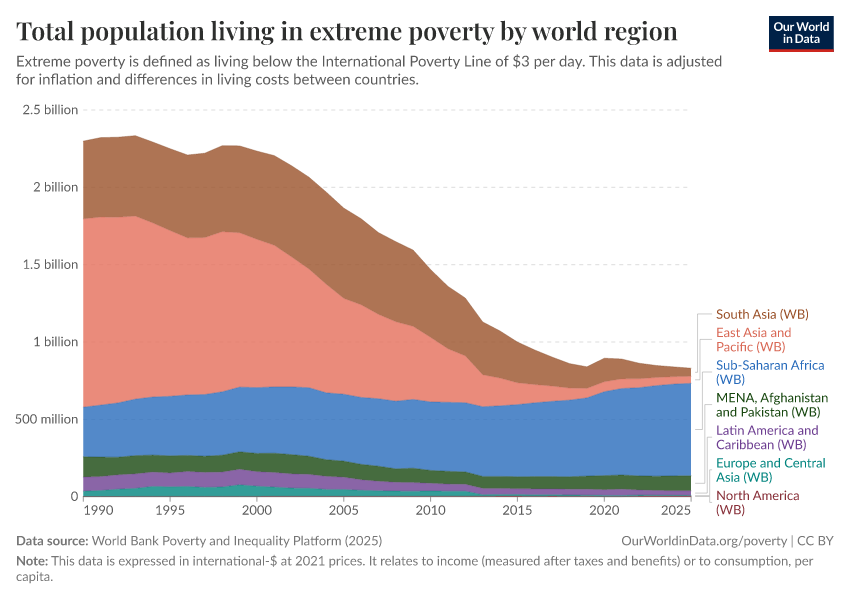
And the reason why American aren't aware that things have improved in other places:

-
CoronavirusAnother statistical mark reached by the present pandemic:
COVID-19 has now killed more Americans than the 1918 Spanish flu pandemic did, when roughly 675,000 people died.
By Tuesday, the number of COVID-19 deaths in the United States had passed 676,000, according to data from Johns Hopkins University.
About 1,900 Americans are now dying in the United States every day, on average — the highest level since last March. A simulation model designed by researchers at the University of Washington predicts an additional 100,000 Americans will die of COVID-19 by Jan. 1, 2022, which would bring the total death toll to 776,000, the AP reported. -
Anti-Vaxxers, Creationists, 9/11 Truthers, Climate Deniers, Flat-Earthers
That's one way to justify your position. I'd say "Stop the steal" is here an even better example where the Republican politicians and lawyers that supported Trump hopelessly tried to bring some credibility to a crazy man's narcissistic impulses and his bizarre claims that the election was stolen. Anything goes that will make it at the present. With wild accusations you can seize the moment in the media, but it won't stand in court, literally in this case. Yes, obviously it's not science, but politics, but unfortunately even scientific discourse can be hijacked in this way.Yes, we should start with the conclusion we like and then keep changing our reasoning until we justify it regardless of any mathematics, evidence, or line of reasoning to the contrary - what a brilliant way to go about thinking over a topic. — Isaac
Btw, making outrageous claims that won't hold up with longer scrutiny might be even the strategy when the audience doesn't remember or isn't interested to genuinely inform itself on the events, but just responses to the present day "outrage issue". Conspiracy theorists behave like this: when the outrageous isn't true and shown not to be true, you have already moved to the next outrageous claim.
That about the tactics. Yet in truth a large part of these issues where science "gets attacked" are basically political issues. Or simply put it: when our policies are justified by scientific observations, then, unfortunately, science gets dragged into politics. The obvious way to be against the implemented policy is to be against the scientific observations.
Science of course tries to be objective and the normative part (how things should be) isn't anymore so much about science but policy. And perhaps with the exception of creationism, which actually does inherently go against modern day science, usually all political sides do accept science. That is when science isn't made part of the so-called "Cultural War". And unfortunately again, it is. And that is very sad. -
Anti-Vaxxers, Creationists, 9/11 Truthers, Climate Deniers, Flat-EarthersTo show that the layman (assuming he's interested in being right) — Isaac
Quite an assumption to be made.
I would think the layman would simply choose the option that fits the closest to his or her Worldview in general. There being two or more opposing views means that the issue isn't a simple tautology and for the layman to hear about opposing views means that either the issue isn't settled or there is a sustained campaign to fight the so-called scientific truth for some reason. -
Can Buddhism accomodate the discoveries of modern science?Thanks for your answer, Baker. I guess we often have this ideas or stereotypes of how peaceful the Buddhists are. Of course one shouldn't forget that people in the end are quite similar everywhere, and if things go bad, people can be violent and intolerant to each other. And it's actually stupid in my view to argue that the reason is purely because of religion.
-
The Decay of ScienceYou mean the model of lògical positivism? — Thunderballs
Logical positivism is the philosophical school the promotes this thinking. It differs from positivism in that the ultimate basis of knowledge rests upon public experimental verification or confirmation rather than personal experience. Hence the importance of the experiment, document, data. I would describe the school (and others may disagree) as positivists who put a lot of importance to the scientific method.
And of course that seems quite OK and fair. The only problem comes when people, as usual, take this to the extreme and start thinking that when you cannot make the scientific experiment, then those things don't matter so much. Or start to look for things that prove the (usually) mathematical model. Simply putting the cart (scientific model) in front of the horse (curiosity about reality) and then being puzzled how it's not going so well as the other way around.

-
The Decay of ScienceI think what is meant that Bohr didn't address the Nature of reality anymore. It's that in which science, physics in particular, is (normally) interested. Instead Bohr had that positive "shut up and calculate" attitude. Only what we know matters. So he preaches. — Thunderballs
Well, basically logical empirism / logical positivism is that "shut up and calculate" attitude. Logical positivists put the data, the experiment, on a pedestal. At worst, it becomes a worship. The problem is that people can forget that it's just a model. In other words the model used starts to be the reality. -
Is there something like AS, artificial stupidity?
At least there is the stupidity of thinking that a basically totally classical computer program with just a lot of feedback loops to process gathered information is something different from the past, Artificial intelligence.With interest I followed the thread on stupidity. Contrasted with intelligence I wondered. There is much ado about AI. But what about AS, artificial stupidity? Does it come along naturally in making AI? — Thunderballs
That stupidity, believing the hype, exists. -
Can Buddhism accomodate the discoveries of modern science?
First question: Are there militant Buddhist extremists who attack people in order to defend their cherished religion?Do expand on how Buddhism is more able to accomodate the discoveries of modern science. — baker
If not, why not? -
The Decay of ScienceGuess who the front-men are. Bohr, for example. — Caldwell
Well, I don't know so much about Nils Bohr and his philosophy, but basically what to me his theories look like to be grounded on is logical empirism or logical positivism. That could explain the idea of taking an experiment and then describing your whole philosophy around the outcomes of that experiment. A rather positivist way to do science I would say. Of course there's a huge difference between the physics and then the philosophical implications we give to it.
I'm not so familiar what was the link between Bohr and the decay of science, even if I tried to look at your comments several pages back. -
Who is to blame for climate change?
Those simply aren't the same things.Can they predict anything even a month in advance? If not, why should we trust their prediction decades ahead? — stoicHoneyBadger
I can make the prediction that in 200 years everybody participating in this Forum now will be dead. I think you can agree that my prediction is extremely likely to be true. But I cannot predict who is the person now participating in this Forum who will die next. The most likeliest are those who are old or who have a very bad health condition. Yet the sample size is so low that statistics don't help us much. -
Anti-Vaxxers, Creationists, 9/11 Truthers, Climate Deniers, Flat-Earthers
No. Just to show how non-functioning the democracy of the Weimar Republic was then and how many campaigns were about smashing the rulers or the other parties. The Brownshirts weren't the only street gang around then.You're both just trying to excuse naivety with deadly consequences at this point. — Tzeentch
Actually one only has to read "Mein Kampf" and then come to the conclusion that this person will truly go through with what he has written about the Jews and about Germany getting Lebensraum from the East. That is a far more precise warning than a election poster. Yet do notice that "Mein Kampf" wasn't a hit beforeHitler came to power. I'm not so sure how many had read it then.
And there you find the real problem: because, just as now, a lot of politicians say one thing and do another. Many aren't ideologues. They will use some rhetoric only to get into power, while not going through with their most bizarre objectives. Many people will think that there's the "campaign rhetoric" and the the "actual political decisions made" and that these can be quite different. Historical hindsight gives us the certitude of what some politician or political movement could and would do. It's a different thing when the issue hasn't happened. -
Who is to blame for climate change?
Nuclear lobby is quite miniscule and not so strong. Besides, Coal mining has earlier been important employer for example in the Appalachian range, so it's no wonder that a populist politician declared himself of supporter of Coal. Got the votes from from the rust belt!What many fossile plants in the US? I thought it was nuclear energy that banged the main drum! — Thunderballs

-
Anti-Vaxxers, Creationists, 9/11 Truthers, Climate Deniers, Flat-EarthersActually, campaigning in elections then in Germany was quite similar with other parties too. Many anticipated, few would have really known.
Do notice the violent theme of the parties campaigning:



-
Why does economy need growth?
The nasty recessions usually happen after a speculative boom that has been created by lax funding by the financial sector. Housing market booms and busts create the most serious ones as houses cannot be manufactured by robots in China, but actually employ a lot of people. And once a banking crisis happens, the banks won't lend and even otherwise healthy companies are in trouble. Then when unemployment grows, things look bad, people save.What brings about depressions in general and in economy in particular? — Thunderballs
Economists have brazenly announced for years that THEY can do away with the boom and bust cycle, but I'm not so sure. They usually create just a far bigger problem later. -
Who is to blame for climate change?What's done differently in the US? — Thunderballs
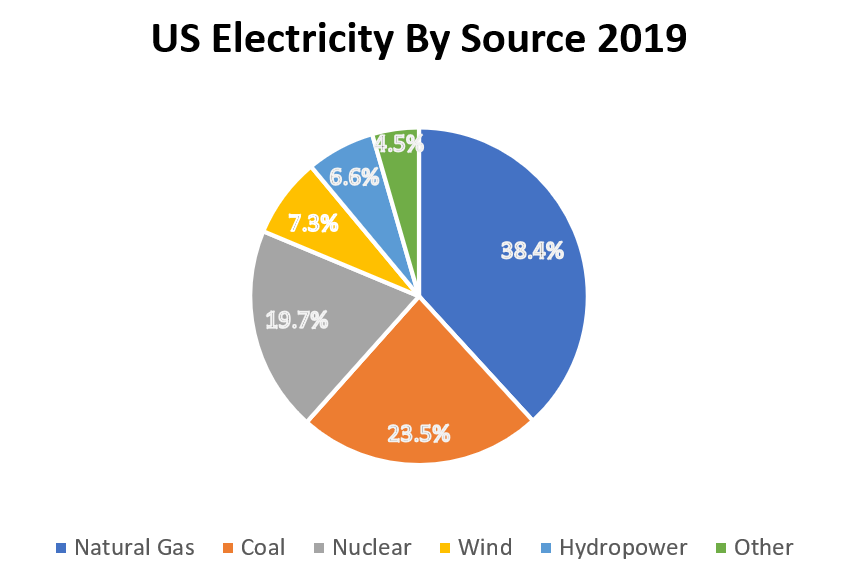
Let's start with the sources where countries get their electricity. Here's the pie chart for the US in 2019:
Then let's compare this to France:
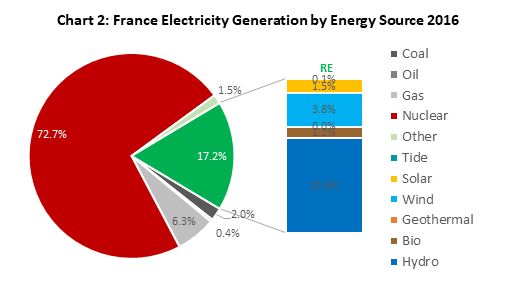
Do you spot any difference? Hint: using Nuclear energy doesn't produce emissions creating climate change. Here you can see the effects of energy policy. That coal power plants produce nearly a third of the electricity in the US and only 2% of the electricity in France matters.
And this is just electricity production... -
Why does economy need growth?If you would have decreasing negative population growth in the World, I guess it would be totally OK for economy to be shrinking.
Yet the population is still growing. And it's good for the society that these new people will have jobs, can sustain themselves and live happy lives as we have done. Too many unemployed and an economy not working will likely lead to violence and war. History has shown this many times. -
Joe Biden (+General Biden/Harris Administration)Although I'll give him credit for pulling out of Afghanistan. — StreetlightX
Logically you should give credit for Trump too, a peace deal that Biden just implemented. :snicker: -
The Decay of ScienceJust thinking, would it be better to say that there is a decay in the understanding of science?
-
Who is to blame for climate change?
Sure. But even if per capita stats show who use energy the most, for things like climate change the real issue are the aggregate emissions:Some have a larger impact than others. The US, Canada, and Australia have the highest emissions per person. — Count Timothy von Icarus
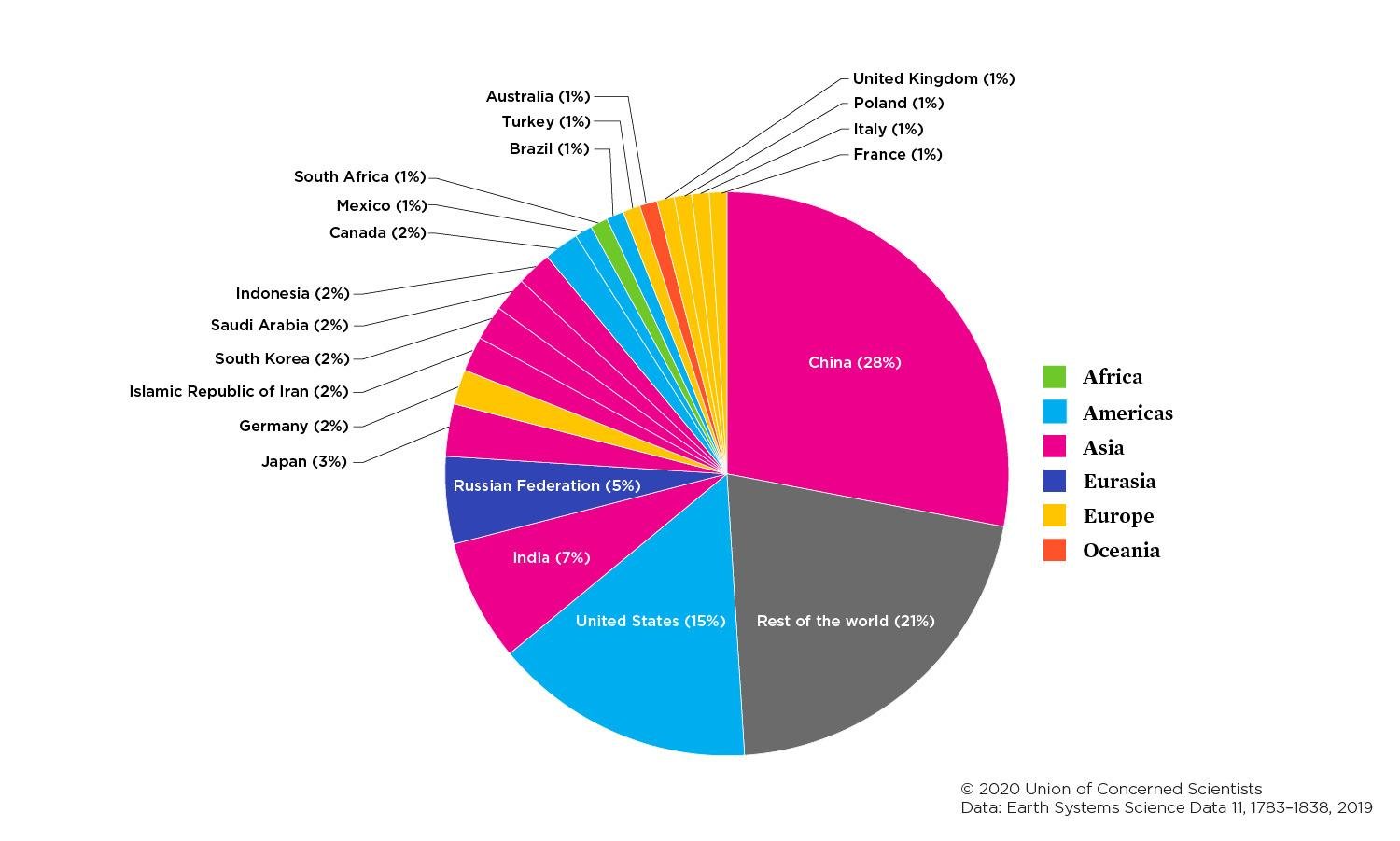
It's telling that altogether France, Germany, UK and Japan in the aggregate emit just half of what the US does, even if the combined population of these countries is bigger than the population of the US. There's the real effect of selected energy policy. And naturally China is the biggest emitter (28%), but India just 7% even if the populations start to be on par (there are only 59 million fewer Indians than Chinese).
So the real issue is for India not to pick the way of Coal plants, but for example renewable energy and nuclear. -
The Decay of Science
Oooh, that would be the day.China can mass produce as much as it wants but only Europe is truly preparing for a new economy and will likely have significant returns in their investments in the future. — Shawn
As an European, I would like to be this optimistic.
I think that nearly anything can be literally destroyed without even a thought about it's very essence. Kill all those who know and burn the books. Wars aren't usually fought to destroy cultures and natural disasters don't have any objective or agenda, but they can put things back a lot.The critique against science, insofar as the decline theorists are concerned, has always been metaphysical. That is, they are arguing about the very essence of science. How else can something be destroyed, but through the demolition of its very essence. Science has qualities essential to it. — Caldwell
Or then you can have ideas like Pol Pot and the Khmer Rouge had of truly starting over...by killing all of the present "intellectuals".
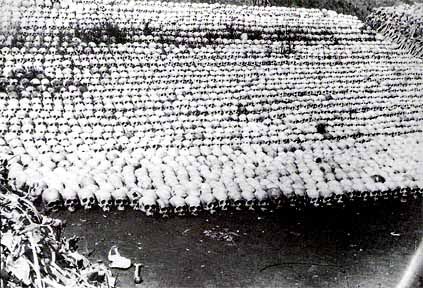
At least historically one can see that a lot of knowledge has been lost in the past only to be reinvented or rediscovered later. Just imagine a world where the library of Alexandria and every book and manuscript there would have made it intact without any fire or any religious fanatic burning the books to the present. At least the History of Antiquity would be quite different. -
Could Science Exist Without Philosophy? (logic and reasoning)
Only that perhaps philosophy does have some fields that clearly aren't science or scientific. Or you have to have quite a philosophical view to think that Aesthetics, Ethics, Religious Philosophy or Metaphilosophy are part of science.The connexion between science and philosophy stretches back to the very beginning of philosophy or should I say science. Is there a difference? — TheMadFool -
Could Science Exist Without Philosophy? (logic and reasoning)
No.And since there are no Philosophical Facts,
Both SSU and The Mad Fool must agree that there can be no Scientific Facts.
THIS IS CALLED LOGIC — Rxspence
Actually that is only your Philosophy.
The philosophy of that "there are no Philosophical Facts, hence there can be no Scientific Facts".
Sorry, but you cannot do without Philosophy here. Logic needs a logical system. And picking that system to model reality is a philosophical choice. -
CoronavirusSo-called "virus" is 100% political scam. - All alternative medications proven to be effective are minimized and reduced to "fake science" or whatever they can come up. — protonoia
Yeah. Being logical is so overrated.
One doctor that I know said this earlier this summer: we'll get shot just as we can get the annual flu shot. And history how pandemics have transformed sure would say that this could become the future.
-
Anti-Vaxxers, Creationists, 9/11 Truthers, Climate Deniers, Flat-EarthersPersonally, I like it when predictions are made— like in the QAnon conspiracy theory — because when they fail to come true (as they always do), the failure is palpable. But most nonsense doesn’t make predictions, and in fact can’t be falsified in any way. — Xtrix
One simply has to have general knowledge and insight to the issue. What matters even more is to understand the political biases that people have. Usually these are given far too much importance, but the easy simple way is to watch or read the different coverage of an issue. This is very useful as you can easily understand what are the facts and what part is story told in the certain way. Once you understand the bias what Fox News, RT Today, MSNBC, CNN has, it's easy to spot an agenda. The conspiracist will not do this: he or she will cling on to one true narrative and not even look at what other (false) narratives there are of the issue. Because the other is "the evil propaganda" of the "evil actors".
Well, let's just remember that even in this site you start to argue about mathematics something that is clearly wrong, I think those who do reply to you will have "immovable positions". The basic thing again comes down to the level of general knowledge the person has.I think all that’s left is to understand how and why people come to these immovable positions in the first place. — Xtrix
Without basic school level knowledge of things people will be the most insane things. -
Anti-Vaxxers, Creationists, 9/11 Truthers, Climate Deniers, Flat-Earthers
Some are, but are they all like that?Is it even worth it to engage with these people?
They're immune to facts and they will not change their minds no matter what happens, which is interesting psychologically. But should we engage for the sake of others who are rational but "on the fence"? — Xtrix
And what issues do you put into this category "not worth to engage"?
How about those who say that the Lab-leak hypothesis of the Corona-pandemic should be investigated? Or those who claim Pakistan to be the culprit of terrorism? Or what about the attack on USS Liberty in 1967?
Remember that this is also the way to control the public discussion. In it's obvious case. Sometime the "village nut" is the only one that is talking sanity. I've experienced in my own country during the Cold War when the existence of the Soviet Union was totally given. Anybody who would have anticipated that the Soviet Union would collapse would have been marked as a lunatic. You don't engage with lunatics.
That said, unfortunately you are also correct. Most of them do already think that everybody else that "those who have seen the light" are against them. Other people are "the Sheeple", who don't use at all their own brains but slavishly repeat what is given to them. This attitude makes them already confrontational and not open for discussion. And if they get banned from sites, the feeling just intensifies. -
Self referencce paradoxesWhy does a self reference lead to paradoxes so many times? — VincePee
Because you can make negative feedback loops, which math & logic have a problem with.
Basically one gets the problem easily when thinking of algorithms and computers.
Now you cannot program a computer, that basically follows algorithms with the command:
"Do something else, not written on this program".
The self-referential part is that the computer is following this program. Then it would have to do something not in the program. It cannot, because it's following algorithms. There are no instructions how to "do something else", because if there was, it thus then would be written in the program. -
Afghanistan, Islam and national success?Well, the Taliban aren't going to be just left with their own ideas. The neighboring countries and the Great Powers, even if not enthusiastically, will try to influence what will happen in Afghanistan. Hence they won't be left alone I think.
For example Vietnam didn't have it peaceful after the South collapsed and the country was unified. Then they had a border war with China and then intervened and overthrew the Pol Pot regime in Cambodia. Only afterwards it's been rather peaceful in that area of the World. even if South-East Asia has it's fair share of insurgents lurking in the jungles. -
Afghanistan, Islam and national success?And Pakistan is still a member of the British Commonwealth which has exactly the same map as the British Empire: — Apollodorus
And this just shows just how awesome the English, sorry, the British are in these things. Russia tried this with the CIS, but failed to get the Baltics obviously into this commonwealth and has fought wars and annexed parts of former members Ukraine and Georgia. Other members naturally have taken notice of this. So not so friendly Commonwealth that one after all.
And they don't play cricket.

This just shows the strategic narcissism of the US and it's carefree ignorance of the objectives of other countries.
When it comes to Afghanistan in 2001, the real objective would have been to give assurances to Pakistan that it can indeed leave out in the cold it's own creation, the Taliban, yet be totally confident that it's back, Afghanistan, will be safe from Indian influence. The Afghan question is a huge one for Pakistan as there is the Durand line dividing the Pashtuns into two and Afghanistan even itself has been a threat to Pakistan. Here was the opportunity for the US to use it's closest ally, the UK, perhaps through it's Commonwealth connections to assure that indeed Pakistan would be safe and on the same time reassure India that there was no foul play here.
But that didn't happen. The US diplomacy was then "either you are with us or against us". And while from the start the US was declaring that it was only in Afghanistan because of Al Qaeda and would not be long around, it's totally natural for Pakistan to believe this "We will go out from here" message and both back the Taliban and play along with the War on Terror.
And when Pakistan did this, what could the US do? Bomb Islamabad? Hence not only get the remnants of the Taliban fight against it, but also have even Punjabis from Pakistan to volunteer to fight in Afghanistan against the US? Add one nuclear armed country to the Axis-of-evil?
No, here the strategic narcissism, term invented aptly by former national security advisor H.R. McMaster, kicked in and caused the Pakistani aid to the Taliban simply becoming a "politically-incorrect" issue and the continuation of US aid to Pakistan becoming a reason for a hope that somehow Pakistan would change it's course. US simply didn't know what to do with Pakistan. Yet with the aid from Pakistan and the sanctuary of Pakistan, the Taliban won the war.
The muteness about Pakistan and it's role in the collapse of the Afghan government and the victorious offensive of the Taliban tells how incapable the US is to face real geopolitics and will easily lull itself into repeating it's own invented discourse about the events where no thought was given to other actors than itself.
I agree with this.But it is wrong to assume that the British have no influence. It's just that they prefer to operate in a more behind-the-scenes way than the French. — Apollodorus
But what's the point of having that subtle behind-the-scenes approach when you have to just take what a US President hastily decides things without even consulting you first? Was the UK government informed about the deal with the Taliban during the Trump administration? To my knowledge, no. Was the UK government consulted when the Afghan government was collapsing? Again, to my knowledge, no.
What's the point of having a smart behind-the-scenes diplomacy when the Leader of the alliance simply makes decisions for itself without ever consulting you?
The US doesn't attack countries with known nuclear weapons. It attacks only the one's with alleged nuclear weapons.From that point, things got more and more lethal. US Deputy State Secretary Richard Armitage did tell the Pakistanis after 9/11 in 2001 that the US would bomb them back to the Stone Age if they didn't sort out the terrorists. But the Pakistanis have carried on playing their usual double game, and the West got fooled one more time. — Apollodorus
Sounds reasonable, actually.

(Even if it should be noted that Pakistani soldiers do have been killed in US drone strikes. Oops.) -
Afghanistan, Islam and national success?Good informative response.
It's no wonder that the ISI is praised for it's professionalism as it has obviously been set up by talented experts, the British, in the first place.
Yet the interesting thing here to note that when Great Britain indeed had influence on the institutions of these young countries, it didn't go the way France has gone with it's colonies especially in Africa. When you look at the French in Sub-Saharan Africa, they basically never left and intervene all the time still. France stayed in Africa. France never shread the idea of it being one of the Great Powers. The UK looked and found a place next to the US as it's trusted ally (which now looking things, wasn't such an outstanding move as the US doesn't care much if anything about it's allies, when they don't have a lobby group like the AIPAC). France sustained it's armed forces ability to operate independently and the French Foreign Legion has been quite active even after the wars of decolonization ended.
Neo-imperialism after decolonization? All the foreign militaries in Africa. Note the amount of bases that France has:

The UK was a different animal. It was humbled by the Suez Crisis and largely put aside that imperial touch that it had earlier. Especially faced with a catastrophic Palestine withdrawal, it didn't stay there as a major player. To sell arms to the oil rich countries was enough I guess. BP found other places (like the North Sea) to operate than Iran. Operation Ajax wouldn't have happened if it wouldn't have been for Kermit Roosevelt and the CIA. During the Cold War once the greatest Navy in the World assumed it's primary role to be anti-submarine warfare, not power projection, which likely was the reason for the Falklands/Malvinas war. (If the Royal Navy would have held to one flat top carrier with F-4 Phantoms, it would have likely deterred Argentina from trying to annex the Falklands.)
This means that when we make larger historical projections, we should note that the UK of today is quite different from the Empire it had in the past. It doesn't have the similar aspirations and not the similar will for imperialism as in the past. Hence today it's much more important what the followers of ZIa think to do now than what the UK foreign office thinks to do there.
It might well be in the future what the US thinks and what it's President says doesn't matter so much as earlier, if the withdrawal continues.
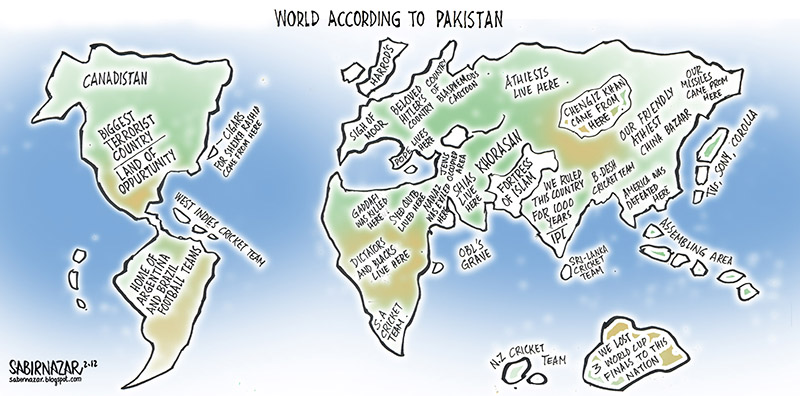
How Pakistan view the World, according to the Pakistani cartoonist Sabir Nazar:
-
The Decay of Science
Violence can defeat quite much everything.That violence can defeat science. There is a tipping point after which, it's just all decay. — Caldwell
Yet I think even the most violent, ruthless tyranny will look at part of science as important: to get technological advancements in warfighting and surveillance and control capabilities. Those who want for the society to "go back" into a better time still somehow acknowledge that in the defense of their realm they have to have up-to-date weaponry. Naturally such limited interest in science won't do much, but at least it's not anything.
Yet I think the real danger is that science falls down to similar level as technological innovation, thought as just a part needed in investment to get economic growth, to improve our existing gadgets. When science falls down from it's actual philosophical quest for new knowledge, that will be "the decay" of science. Nobody will admit it has happened or will happen when it happens.
Science is then just a 9 to 5 job for people who have trained to be scientists. And their agenda is to get financial support to basically have a job that feeds themselves and their families. And this money comes from various donors that are interested in certain type of research. And hence scientific research is not made by curiosity, but by the interests of foundations and those who have money.
So what does the "decay of science" look like?
It's like the historian that dreams of writing history about things that interest him or her when he or she is retired. But before that, the historian has to write histories that he or she is successful in getting funding. That historian, even if not a scientist, isn't alone.

And of course, the academic world can easily be made extremely bureaucratic and not have the least interest to do actual science, but replace it with pseudoscience. -
Madness is rolling over AfghanistanEven if an Indian news channel might be biased against Pakistan, still it looks quite clear that Pakistan is at least assisting if not supervising the Taliban.
Pakistan's objectives are clear, if not perhaps obtainable. Yet as usual, the US wasn't interested in them (who cares to think about what other nations intend) and hence the defeat in Afghanistan.
Analysts and officials in Pakistan believe the Taliban’s victory serves dual purposes. It helps Pakistan to secure its interests in Afghanistan both by having a friendly group in charge of the government and by limiting the space for Indian engagement in Kabul. Pakistan has long accused regional rival India of working to destabilize its western border region via Afghanistan. With the Taliban in power, the sense in Islamabad is that alleged foreign support for terror groups like the Tehreek-e-Taliban Pakistan (TTP) and for Pashtun and Baloch nationalist groups will diminish. In addition, Pakistan hopes that a Taliban-led government will provide it with opportunities to expand its geoeconomic footprint as it seeks to connect Central Asia with access to the Arabian Sea at Gwadar. This strategy expects that the Taliban will both be able to effectively stabilize Afghanistan and prevent anti-Pakistan groups from launching attacks, both of which are questionable assumptions. -
Afghanistan, Islam and national success?The Arabs did not have an advanced culture. — Apollodorus
Yeah, this is your punchline argument. Hmm.
What I was referring to was that for the Mamluks, the vassals of the Ottomans, and for the Ottomans themselves the French invasion force was a surprise. Only some 115 years earlier the Ottomans had been sieging Vienna, but now an equal size force of French nearly annihilated the Mamluk / Ottoman force without losing many troops in the Battle of the Pyramids.
But of course, Napoleon later fled back to France and the French force was later destroyed. But it showed what was to come, yet the Ottoman Empire couldn't pull off a Meiji Restoration like Japan did. Is this due to religion or because of the problems of the Ottoman Empire, I don't know. It's an interesting question. Hence when WW1 came around, the Ottomans were not ready and couldn't stay out of the war. -
Afghanistan, Islam and national success?
I knew only Lysenkoism and it's war against genetics, but naturally the "political correctness" went on to every field of science there is.The communists of the USSR were atheist and deterministic, firmly rejecting quantum physics and Einstein's relativity. — Athena
Well, likely the atomic bomb turned Stalin's opinion about it in an instant!
When it was. It's an interesting history just why it then went into the backwardness and only was abruptly awakened by Napoleon invading Egypt. But then it was too late and the Ottoman Empire was "the sick man of Europe".Islam was both liberal and scientific when it was the center of world trade. — Athena -
Afghanistan, Islam and national success?
Yes. Just like they did in Hungary 1956 or in Czechoslovakia 1968.So, the Soviets intervened to protect the communist-led regime, not a particular individual. — Apollodorus
It's interesting to note that to crush the "Prague Spring" the Soviet Union along with Poland, Bulgaria and Hungary, deployed half a million troops into the small country. The Soviet forces in Afghanistan were of the similar size of the Obama surge later (little over 100 000), which in both occasions wasn't enough to pacify the rather large mountainous country.
Of course Pakistan had (and still has) an interest in extending its influence over Afghanistan. No one disputes this. — Apollodorus
I think it's just an issue that we just should remember, because too many times we see everything from the prism of the West doing things in the World. Having the typical narrative that nearly all bad happens in the World because of the US (or something like that). The US is just one actor and in these regions the countries themselves have their own independent objectives and agendas. To think of them just as pawns or victims of the US or the West is just wrong. -
Are there things we can’t describe with the English language?Are there things we can’t describe with the English language?
Some philosophers think this way. Or that basically some things ought to be uttered in the actual language they were first used in the specific meaning.
They have to use terms like da sein when talking about existential philosophy of Heidegger. They just irk if someone just translates it to Heidegger's "existence", or "being their".
Nope.
Use the German word. Closer to what Heidegger meant. -
Covid denialism as a PR stunt
Actually not.Well, proving a conspiracy can be next to impossible, or entirely impossible, that's the whole point of a conspiracy. — baker
Start with finding people who have absolutely no connection and focusing on totally different aspects noting the conspiracy. Learn the history. Above all, real conspiracies do leave traces.
Then think it through yourself. Does Slovenian politics resort to such antics? Who would artificially create this pseudo-group? Slovenia is a very small country. What goes around comes around.
Basically about the role of the GIA in that conflict.Only vaguely. It seems very complex. Are you referring to the roles of Les éradicateurs and Les dialoguistes? — baker
There are many accusations that the Algerian government helped the GIA and even posed as GIA members when committing atrocities. Then there is the history that basically the group was more interested in attacking the islamists and the AIS, the major insurgent alliance. When the islamists wanted to get France to act as an mediator in the conflict, the GIA suddenly made a terrorist attacks in France (and France started to back the Algerian government). And then when the peace deal was made...poof! The GIA simply evaporated. Later Al Qaeda in the Islamic Maghreb denounced the actions of GIA in indiscriminately killing of civilians.
I remember reading from a memoir of an ex-islamist radical that had turned informer how deep disagreements erupted at these activist cells about the actions GIA was taking in the fight (for example massacring whole villages).
And there's simply many references on just how GIA worked for the government:
The GIA was widely reported to have been infiltrated by state agents who tried to cause divisions within the Islamist camp. Analysts argue that the army’s manipulation of the GIA was a key factor preventing the development of a unified rebel front. Unlike the other armed groups, the GIA carried out indiscriminate attacks against civilians, abducted and killed foreigners, planted bombs in public spaces and committed massacres across the countryside. In 1995, the GIA declared all Algerians to be takfir, or apostates.
The last sentence sounds absolutely bizarre, but it's true. Algerians weren't worthy of them!
Of course this is sidestepping the actual topic, but I'm trying to make the point that if there is really a conspiracy, then there will be real traces of it. Nonexistent events don't leave them.

ssu

Start FollowingSend a Message
- Other sites we like
- Social media
- Terms of Service
- Sign In
- Created with PlushForums
- © 2026 The Philosophy Forum