
-
The movie, "Altered states" meaning?I perfectly agree. it's that intuition behind 'enactivism' or the 'embodied mind' kinds of theories which have become very influential since the 1990's. — Wayfarer
Today I learned! Thanks for the reference.
https://en.wikipedia.org/wiki/Enactivism -
The movie, "Altered states" meaning?To which I don't have the answer. Really interesting film, though. — Wayfarer
I never saw it but I remember it at the time. When I was in school they showed us some science film about sensory deprivation tanks in which people would hallucinate. I thought that's what the movie was about.
From that film (the high school science film, not Altered States) I drew the conclusion that our bodily relationship to the physical world was an essential part of our psyche, thus (as I later came to understand it) disproving ideas such as simulation theory and uploading our minds to a computer.
I loved William Hurt in Body Heat. This site should have a movie forum. There's a lot of philosophy in movies. For example Body Heat teaches you not to help your new girlfriend get rid of her inconvenient husband, if you didn't already learn that lesson from Double Indemnity. -
The movie, "Altered states" meaning?Natalie Wood’s last movie. — Wayfarer
The question is, did Robert Wagner kill her? -
The Mind-No Mind Equivalency ParadoxYou're avoiding the question which means you understood my point! — TheMadFool
I didn't feel like outlining the case against Darwinian evolution, which I know a little about. Was that your point?
I'd delegate that job to an intelligent designer!!!!
— fishfry
This is the heart of the matter. Those who deny an intelligent designer must concede that evolution is an intelligent design. Thus, those who deny the existence of a creator deity must concede that intelligent designer present = intelligent designer absent. Hence, the mind, no-mind equivalency paradox. For those who believe in an intelligent designer, there's no issue at all - the "intelligence" displayed by evolution matches perfectly with their belief. — TheMadFool
Well God could have invented evolution, if that's your point. I've never been one to think that science disproves God. Whatever scientific theory you have, be it multiverse or eternal inflation or big bang or primordial quantum field à la Lawrence Krauss, you could say God did that. What science has done (some say) is to make the nonexistence of God possible. I don't personally get worked up over this issue. I'm a confirmed agnostic and decidedly non-passionate about the issue.
the case against Darwinian evolution
— fishfry
What would that look like? — TheMadFool
Don't have time to enumerate the entire case nor do I remember it all, but look up David Berlinski ("The Devil's Delusion"), Michael Behe, and Stephen Meyer, three names that come to mind. Also see the Wiki article below. As I recall, and again this is just off the top of my head, some of the objections are the sheer unlikeliness of evolution, irreducible complexity (the famous bacterial flagellum), the fact that mutations almost always make things worse, the specificity of the genetic code, the Cambrian explosion, the lack of intermediate fossils, etc. I watched a bunch of these vids a while back. Like I say, not a big interest of mine, I power-watched a whole lot of these for a few days several months ago. Basically I must have watched one, and then Youtube's insane recommendation algorithm kept serving them up till I knew as much as I cared to about the subject, then forgot most of it.
Bottom line is that there is some serious scientific doubt about classical Darwinian evolution. After all Darwin formulated his theory before we even knew about genes, let alone DNA and our modern understanding of biology. One can criticize the theory and look for refinements without going full God squad. On the other hand many of the critics do take the intelligent design or full religious view. I don't see how that helps anything. "God did it" is no answer to anything. It doesn't remove the need for scientific progress. I view God and science as "non-overlapping magisteria." Newton was religious and he was a heck of a scientist. I have no problem with that.
https://en.wikipedia.org/wiki/Non-overlapping_magisteria
https://en.wikipedia.org/wiki/Objections_to_evolution -
The Mind-No Mind Equivalency ParadoxA simple question: Given what we know and what we don't how would you design evolution? In other words, if you were on the team that designs evolution, what sort of features would make it robust? — TheMadFool
I'd delegate that job to an intelligent designer!!!! -
The Mind-No Mind Equivalency ParadoxThe solution would depend on the problem, right? — TheMadFool
Thoughtful planning using the best available information, imperfect though it may be, would always be better than acting randomly and hoping for a favorable outcome. I can't fathom your assertion to the contrary. Or if you were paraphrasing the OP, I can't fathom that either. -
The Mind-No Mind Equivalency ParadoxThe point is we have to make decisions without knowing all the relevant information. — TheMadFool
But we do this every day. Perhaps I didn't understand the point. The claim was that acting randomly was better than trying to intelligently plan. I can't understand that. Nobody would live their life like that.
What sort of plan would you recommend? — TheMadFool
If I think the climate is cooling, I hook up with the wooliest mammoth I can find. Otherwise not. Of course I can't be sure what the future will bring, but we try to make an educated guess and act accordingly. I must be missing something if that's not regarded as obvious.
In fact even in the area of Darwinian evolution, we have practical experience. Farmers breed crops for consumer demand, for shelf life, and so forth. They don't just grow things randomly and hope for the best. Controlled breeding is super important in farming. -
Essay Number One: ‘Perceptions of Experience and Experiences of Perception’Let us imagine a generic ‘hammer’, and I expect most of us will conjure up the image of a regular ‘hammer’ used for bashing nails into walls and such. — I like sushi
I immediately thought of MC Hammer. What does that mean?
Then of course there's Hammer films, the great producer of horror movies. And Mike Hammer, the famous fictional private eye. What does it all mean? I thought of Dag Hammarskjöld, the UN Secretary General in the 1950's. Many such associations are imprinted in my neural pathways. It truly is a mystery how all that works. Something about Proust's cup of tea. One thought leads to another. You know, the smartypants types who think all this can be encapsulated into electronic neural networks are missing a lot. We have no idea how the mind works, but it's far stranger than logic can sort out. -
"Bipartisanship"wouldn't call climate change or wealth inequality the "margins." One party at least acknowledges both are problems and makes proposals to deal with them — Xtrix
So nice that you picked those two, since they're diametrically opposed and clearly reveal liberal elitist hypocrisy.
Every time you reduce air pollution over a first-word liberal enclave, you condemn another hundred thousand or so third worlders to death. When you make energy more expensive, poor people can't afford it. The very poorest in the world can't get clean water and die of disease. All so wealthy liberals in developed countries can feel good about themselves.
Here's a small example. In Ireland, they're diverting crops to biofuels. Environmentalists like that. Sadly, the policy is starving the poor.
If a policy was enacted that not only failed to achieve its intended results but actually managed to significantly worsen the situation, plunging millions of people into further poverty along the way, it would be considered reckless mismanagement to continue with it.
Yet this is the situation Ireland and the EU finds itself in. Fully aware that European biofuel targets are leading to increased hunger and land grabs in the developing world, European energy ministers, including Pat Rabbitte, on December 12th failed to address this disastrous policy.
https://www.irishtimes.com/news/world/european-biofuels-policy-is-feeding-cars-but-starving-people-in-developing-world-1.1633379
Here's a piece on When Environmental Regulation Harms the Poor.
And How green energy hurts the poor
And How a Green New Deal could exploit developing countries
The Green New Deal has changed the conversation among progressive Democrats about how to deal with climate change, from simply managing a disaster to how to take advantage of an existential threat to build a more just society.
However, should this legislative concept be transformed from the hypothetical framework it is today into actual policies, some of the solutions it engenders could make global inequality worse. As a scholar of colonialism, I am concerned that the Green New Deal could exacerbate what scholars like sociologist Doreen Martinez call climate colonialism – the domination of less powerful countries and peoples through initiatives meant to slow the pace of global warming.
And: Green efforts that raise energy costs disproportionately hurt black people and poor people
You can Google around for dozens of similar stories.
The fact is, green energy policies are a disaster for the poor people in developing countries. The liberal elite virtue signal about environmentalism, while their policies contribute to massive increases in economic inequality and literal misery for the poorest people on the planet.
There are many reports and studies along these lines. Make energy more costly and the poor suffer. But the liberal elite feel better about themselves.
So the Democrats aren't "doing something" about the environment. They're doing things to feel better about themselves at the expense of actual people. This is typical of liberals these days. They say they're on the side of good, but they're often not.
A big problem I have with liberals these days is their lack of thoughtfulness in favor of slogans. "Clean up the environment!" "Raise up the poor!" Never thinking for a moment that these two objectives are in conflict; and that what is needed is a balancing of interests. A recognition that when you raise the cost of energy, a lot of people suffer. Actual humans. Liberals seem to like nice-sounding ideas at the expense of living, breathing human beings.
There's a single word that encapsulates these ideas: tradeoffs. Many well-meaning liberals prefer slogans and "I'm good you're bad" thinking to the hard work of grappling with the realities of the world.
You can run the numbers. If you replaced all the gas-guzzlers tomorrow morning, where would you get the electricity to run them? Wind and solar won't scale fast enough and may never scale at all. But "abolish gasoline powered cars" makes for a great slogan. No thoughtfulness behind it.
I could talk about California's energy policies, which have led to widespread power outages every summer; or California's water policies, in which no new reservoirs have been built in 50 years, during which the state's population has doubled. This is exactly how liberal policies are destroying the lives of actual humans, while liberals twist their arms patting themselves on the back and walk around feeling smug. You exemplify the type. -
The Mind-No Mind Equivalency ParadoxIn other words, and here's where it gets interesting, mindless evolution through random mutation is exactly what a mind which is as intelligent as us would do given the way things were, are, will probably be. — TheMadFool
Haven't followed the thread, only responding to this. But I don't agree. Say I'm a wooly mammoth and I notice the climate is getting cooler. By random chance I would mate with any old mammoth and if the weather gets colder and I mated with a not-so-woolly mammoth, my offspring would be out of luck. But if I'm a smart, planning kind of mammoth, I would mate with the wooliest mammoth I could find so as to give my offspring the best chance of survival in the coming cold snap.
In other words planning beats chance. Right? -
"Bipartisanship"These are conservatives, and Republicans; they are the people who like to self-identify as the opposite of what they are. And they spend vast resources in an effort to convince everyone they are not these things. — James Riley
That's funny, I thought it's the left that does that. Racists who claim to be anti-racist. Fascists who claim to be anti-fascist. Global elitists who claim to be against wealth inequality. People who live in gated communities with private security forces who want to defund the police so that more poor people can get killed.
But on your topic, I believe there is a huge amount of the worst kind of bipartisanship. The disastrous Iraq war was bipartisan. Bush would have been stopped in his tracks if Hillary hadn't given an impassioned thirty minute speech on the Senate floor supporting the invasion of Iraq. That gave cover to all the "centrist" ie corporate Dems to support the war. On questions of foreign policy, wealth inequality, and corporatism, there's not a hare's breath (or a hair's breadth, never know which one it is) between the left and the right in the US. The reason there's so much enmity between the two sides is that they are fighting on the margins about things that don't matter all that much; while the big things are ignored. That's how the global elite and the military/intelligence/media/industrial complex like it.
Remember the Occupy protests? They were all about class. "Banks got bailed out, we got sold out." I read an article a while back analyzing the mentions of class versus race in the news. Shortly after Occupy, race came to the forefront. If they can make people believe it's black versus white, then nobody will notice the profound issues of class underlying many of our problems. That's not an accident, it's by design. Those at the top turn the rest of us against each other.
I well remember the 2006 midterms that were taken as a powerful referendum against Bush's wars. That's the election that brought Nancy Pelosi to the Speakership. The anti-war left, whatever remains of it [nb: On matters of war, I am with the anti-war left], rejoiced. When the first war funding bill of her Speakership came up for a vote, Pelosi ... supported it. That's the day I realized the fixe was in. Well Hillary's speech and vote for the war were another day. But Pelosi's signoff of the Iraq war funding, after she was put in power by a nationwide vote against the war. sealed it.
As George Carlin said: It's all a big club. And you ain't in it. [Warning: F-bombs and truth bombs]. -
Logical proof the universe cannot be infiniteYou prefer that to mine? How so? — bongo fury
You're right, I'm wrong. -
Logical proof the universe cannot be infiniteIt's about digital image and number of pixel combinations, number of unique pictures the grid can possibly, theoretically, represent. I did open the thread by talking about digital photo, and only later mentioned computer screen, but just as an example of a finite resolution digital image. It has nothing to do with computers, software or memory, it is purely hypothetical scenario exercise in only math and logic. — Zelebg
You can't render data you haven't got. You haven't demonstrated that you have all the data in the universe, or that all the data in the universe is finite, or that even if it is, you have enough storage to hold it. I think if you would carefully write down your argument you'd see that it fails.
I do think we're talking past each other at this point. I can only urge you to clarify your ideas. You have claimed you can zoom arbitrarily. That is not possible if the object of interest represents more data than you can store. -
Logical proof the universe cannot be infiniteAgain, what a finite resolution image can potentially show has nothing to do with computers and memory limitations. — Zelebg
LOL. Perhaps I'm not understanding you, because you couldn't possibly believe what you wrote. Your screen can't show data that the computer doesn't know about. Your computer only has a finite amount of data. You can't render anything on the screen below that level, because you haven't got the data. This is a very elementary point.
Just explain to me in simple terms how a computer display can render data that it doesn't have in its memory. -
Logical proof the universe cannot be infiniteI said down to nanometre, and explained previously zoom in can be arbitrarily small. — Zelebg
It's not possible for zoom to be arbitrarily small because your computer can't hold that much data. Try arbitrarily zooming into Google maps and you'll see that it's limited by the available data. -
Logical proof the universe cannot be infiniteIt's a simple logic exercise. There is no planet in the universe that your monitor could not show a photograph of, from far away, down to every single square nanometre of it. And since finite resolution monitor can only show finite number of different screens, it means the number of unique planets in the universe cannot be infinite. — Zelebg
This is bad logic. What you can see on your monitor with the naked eye is not all there is. You are saying that we can see only so many different things with the resolution of our eye, and that the number of distinct things we can perceive is relatively small. I agree with that. Then you are concluding that there can be nothing else.
In other words consider two distinct objects that look the same to the naked eye. You are claiming they are not distinct objects. That's bad logic. All you've shown is that the resolution of our naked eyes isn't very good. Please think of the great Antonie van Leeuwenhoek, the first person to see microbes. In your world they don't exist, simply because our feeble eyes can't resolve them. Clearly you are mistaken and making a very elementary error of logic.
If this one point is not yet clear, I'm afraid any further discussion is pointless. — Zelebg
I've stated my points to my satisfaction. Nice chatting with you. I always appreciate the opportunity to mention Skewes's number under any circumstances. All the best. -
Logical proof the universe cannot be infiniteI don't see why involve computation/simulation in this. For whatever problem we do not yet know the answer to, your computer screen will be able to represent description of the solution if it exist. — Zelebg
You need to look at the Wiki page I linked on the Halting problem. It's an easily stated problem that no computer can possibly solve. It was discovered by Turing in his famous 1936 paper in which he outlined the notion of computation.
I
So, I am talking about describable phenomena, and I do not know what is indescribable phenomena or can such thing exist. — Zelebg
You, or your cat walking across your keyboard, wrote the following in your OP:
it potentially contains a picture of anything that was and can ever be, a picture of everything that can possibly be, both in reality or imagination, and yet the number of those pictures is not infinite.
Therefore, the universe, along with the number of things, actions, or concepts, is not, and cannot be infinite, not even potentially. Right? — Zelebg
You are clearly talking about everything that is.
But now you say you are only talking about everything that is describable. By whom? By human beings on earth? Well the number of things that could be verbally described by all the human beings who have ever existed is a very small number compared to the size of your grid. So in that case I would grant your premise.
But please note that you have now entirely changed your claim from saying that your grid can represent everything in the universe, to only that which is "describable," a term you haven't bothered to define. And that switcheroo makes a huge difference.
Because finite resolution is no limit for the amount of detail or zoom factor, so your monitor can show whole Earth from far away, but it can also zoom in and show microscope images of tiny bacteria from up close, and further down it can show electrons and protons, and whatever else as CGI, as diagrams or other kind of symbolic representation. — Zelebg
Only to the limit of your memory to know what's there. You can zoom in on a map because the map's database already holds the data. All the zoom is doing is giving you a different view of the data that already exists in the computer's memory. Likewise you can only zoom in on detail that you already have in your grid; and the information capacity of your grid is limited.
So I repeat my question. By what scientific principle do you claim that the amount of information in the universe is less than the limited size of your grid?
This holds true for any past, present and future planet and its every square nanometer we zoom in on. Your monitor can show it all, and then some. — Zelebg
Only if you have the data stored first. And you have not demonstrated that the total amount of data in the universe is below the limits of your grid.
After all if you have the entire state of the universe stored in memory (which is impossible, because of the infinite regress problem I've already pointed out), you could use a conventional laptop screen to represent parts of it at any zoom level. You are confusing view resolution with the resolution of your stored data.
You should really think about how zooming into a map actually works. The data has to already be there in order for the screen to give you that view.
If you go to Google earth or Google maps and keep zooming in, what happens? Eventually you can't zoom in any more. Why not? Because you've reached the limit of the data that they store. Your viewer would have the same problem. You can only zoom in to the limits of the data you store. -
Logical proof the universe cannot be infiniteas long as it can be described with pictures or words, or whatever symbols and diagrams, there is an empty space on your computer screen waiting and ready to represent it, in more than one way. — Zelebg
So you agree that you can only represent computable phenomena. You can't, for example, solve the Halting problem. But it's not known whether the universe is computable or whether the universe can solve the Halting problem. Some people believe so, but there's no proof, nor is it even clear what would constitute proof.
But how can you be certain there are no levels of detail below the resolution of your universe? After all that's a finite number. It's large by everyday standards, but it's very small compared to Skewes's number, Graham's number, Tree(3), the larger Busy Beaver numbers, and other ginormous (Sean Carroll's word) large positive integers studied by mathematicians and computer scientists.
Those numbers may not have physical existence in terms of planets or molecules. But they have undeniable mathematical existence. Where does mathematics fit in your universe?
What scientific principle limits the universe to only that many distinct states, large though your number may be? Wolfram Alpha gives your number as approximately . There are more decimal digits of pi than that. How would you represent them?
And to reiterate my earlier concern; if you can perfectly replicate the universe in your grid, you would need to replicate the grid itself, right? Your grid is a physical thing in the universe. Wouldn't that give you a bit of an infinite regress problem?
Or as William Blake said:
To see a World in a Grain of Sand
And a Heaven in a Wild Flower
Hold Infinity in the palm of your hand
And Eternity in an hour
https://www.poetryfoundation.org/poems/43650/auguries-of-innocence -
Logical proof the universe cannot be infiniteIf you would please answer the question: could there possibly be a planet in the whole universe whose every single square millimetre it could not show (and even with arbitrary given magnification / zoom in, that is unlimited detail)? — Zelebg
All of them. The detail of the universe far exceeds what you can represent. You couldn't even fully represent a grain of sand ... for the reason that we don't fully understand a grain of sand. What holds the quarks together? Gluons. Why does that work? Why does the binding energy of the quarks create mass and thereby distort the fabric of spacetime, creating the illusion of gravity? We don't know these things. You don't know these things.
Of course you are right, you can indeed represent a picture of a physical object that's perfect up to the resolving ability of the human eye. But that's not much of a standard. It puts us back in the era before we knew about microbes and the germ theory of disease. There's a lot more to the world than we can see.
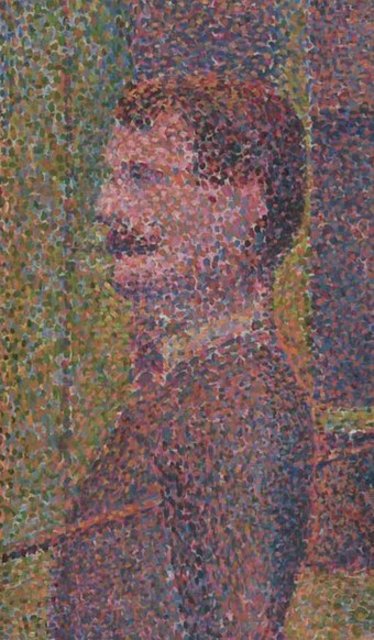
The artistic movement of pointilism comes to mind. Your image is only an approximation to a certain level of detail.
-
Logical proof the universe cannot be infiniteWhat part, what detail could it not show? For example, could it show every single square millimetre of Earth, Moon, Jupiter, and Mars? And so on... could there possibly be a planet in the whole universe whose every single square millimetre it could not show? — Zelebg
Your digital photo is a thing in the universe. It lives in a piece of silicon memory in a computer. We think of software as ethereal or nonphysical, but an electrical engineer can measure the electric charges of the bits in a memory chip. Computer memory is a physical thing and the data stored therein is likewise physical. It requires energy to maintain.
If your photo perfectly images everything in the universe, it must image itself in every detail. You have an infinite regress problem in your thought experiment. All simulation arguments do.
But of course that leads to the refutation of your argument. At some level of detail, we must only approximate the world. You can't perfectly image the image of the universe. You must necessarily omit some level of detail. Likewise you must necessarily omit some level of detail about everything. Just like a movie isn't reality even though we see people moving around. It's one still frame after another, and the retention of our eye/brain system fills in the blanks and creates the illusion of motion.
At best you have an approximation of reality. The interesting parts are everything your approximation fails to capture. -
Logical proof the universe cannot be infinitePerhaps the best way to explain it is to ask what part of the universe it can not show? — Zelebg
Itself, of course. It could not show itself in full detail. -
Can it be that some physicists believe in the actual infinite?It is not mathematically possible for an all powerful and all good god to exist, the laws of thermodynamics, which are constraints and not some handwaved rule, apply to even god. Yin-yang and karma and whatnot is all related to thermodynamics and thus thermodynamics and energy predate any god, including the Christian god who might have been here since the big bang but for sure did not cause it. Infinite time means infinite energy increase, which is of course true. The big bang was one of infinite numbers of big bangs generated by some sort of perfect order system completely collapsing according to the laws of thermodynamics because you would need literal infinite rates of energy transfer to maintain a perfectly ordered state. Brian Greene is beyond any philosopher or most physicists — intpath32
The question of whether God is bound by the laws of physics is an old one. I found some references but these are not definitive, I just grabbed them off Google to illustrate that people have been thinking about the matter. I didn't read any of them, just wanted a random sample.
https://www.reddit.com/r/AskAChristian/comments/7br2fb/are_angels_bound_by_the_laws_of_physics_is_god/
https://faithfoundedonfact.com/is-god-bound-by-logic/
https://theconversation.com/can-the-laws-of-physics-disprove-god-146638
https://philosophy.stackexchange.com/questions/47105/are-gods-also-bound-to-the-laws-of-physics
https://www.quora.com/Does-God-obey-the-laws-of-physics
https://consultingbyrpm.com/blog/2011/08/can-god-violate-the-laws-of-physics.html
Now for my own contribution, consider a video game designer who creates an artificial but self-consistent world. The beings in that world are bound by the laws as defined by the designer; but the designer lives in what we call the real world and is not bound by the artificial rules of the game.
Why wouldn't God be exactly the same way? God has created the world, including the laws of physics. God's creatures, namely us, are bound by the laws of physics. But God isn't. Remember, God said, "Let there be light." I've always found it interesting that the ancients who wrote the Bible intuited that electromagnetic radiation was fundamental. And clearly the ancients saw God as existing outside of time and space, outside of the laws of physics.
Another point is that the laws of physics themselves are historically contingent ideas of human beings. It's a philosophical assumption that there are actually any laws that govern the universe, as opposed to science being a collection of theories that just seem to work to a good approximation, but that aren't actually true in any absolute sense. In fact there is a name for the belief that the world studied by science is real: scientific realism. There's no absolute proof that scientific realism is true. It could all be a dream, I could be a brain in a vat, or I could be a Boltzmann brain, a momentary coherence in an otherwise random and formless universe.
The same reasoning applies to simulation theory, which a lot of people take seriously these days. The advocates of simulation theory assume that the Great Programmer in the Sky operates according to the same laws of physics that we do and reason accordingly. But of course such an assumption is unwarranted. The Programmer, if such there be, lives in a completely different world with totally different physics. We can't use reason and logic to figure out what the next level up is like.
I haven't seen much of Brian Greene, but I'm a big fan of Sean Carroll. -
Complexity and the Busy Beaver problemWhat I'm asking is if there's a way to determine partial computable functions from total computable functions for the Busy Beaver issue not to arise? — Shawn
What specifically is the Busy Beaver issue? I'm not following the details. I'm sure I don't know the answer anyway. Noah's response on SE seemed comprehensive.
Can you say in your own words what the Busy Beaver function is, and what's interesting about it? -
The overlooked part of Russell's paradoxA set can't contain itself. Period! — TheMadFool
I already gave you multiple pointers to articles about non well-founded sets, and I showed you how a graph with a single node and an edge from that node to itself models a set that contains itself.
Here is that thread. You might be interested in rereading it and looking at the references I gave.
https://thephilosophyforum.com/discussion/comment/546388
The essential point is that there is no actual definition of a set. A set is defined by its behavior under a given collection of axioms. If you include the axiom of regularity, no set can contain itself, and also there are no circular membership chains like .
On the other hand, it turns out that the negation of Regularity is consistent with the other axioms. That's the key point. There's no a priori reason a set can't contain itself. After all the collection of all ideas is an idea, and the collection of all collections is a collection. Self-containing entities are natural.
The ONLY reason there isn't a set of all sets is that we typically adopt an entirely arbitrary axiom saying so. Drop the axiom, and sets can contain themselves.
https://en.wikipedia.org/wiki/Axiom_of_regularity -
Complexity and the Busy Beaver problemIs this due to the bounded values between partial computable functions and total computable functions is itself indeterminate to determine thus complexity, and therefore, following from this complexity for the precise boundary is unascertainable? — Shawn
You broke my parser. -
Complexity and the Busy Beaver problemit becomes more a linguistic issue than a logical one. — TheMadFool
It's a syntactic issue. Proofs are syntax. Symbol manipulation. A computer can verify a proof. There's no meaning in syntax. A proof just means you have a collection of symbol strings that can be manipulated according to predefined rules to end up with some other symbol string. Formally, that's what a proof is. -
Complexity and the Busy Beaver problemIf we go by symbol count, argument B is much, much shorter than argument A i.e. symbol count judges argument A and B as different. However, logically, these two arguments are identical, their premises are identical, their conclusions are too. — TheMadFool
The first step in counting symbols is to fix the alphabet and inference rules. What you've done is use two different symbolic systems. -
Complexity and the Busy Beaver problem:sweat: So, I wasn't talking nonsense. — TheMadFool
I can't be certain of that. Symbol count is a sensible way to measure the length of a proof. I wasn't entirely sure what you were getting at, so I said it was another way. I suppose it is. I didn't follow the divisible by 3 part.
That's news to me. The way it seems to me, there's no point in talking about a book - the book being a message of some kind - in terms of how many words are in it. — TheMadFool
Some writers get paid by the word. Didn't your English teacher ever tell you to write a 200 word essay or whatever? Before the Internet, newspaper writers had to adhere to strict word counts to fill up but not exceed the available space. Word count is one of the most common metrics in writing.
Similarly, proofs - logical entities - shouldn't be viewed as symbols. — TheMadFool
But that's exactly what they are in formal terms. Formally you have an alphabet, and strings of symbols written using the alphabet. If you have a collection of strings that can derive another string, using carefully specified derivation rules, that's a proof. The total length of the characters in the strings is the length of the proof. Those are standard definitions. In fact in doing proofs about proofs, one often uses induction on the symbol length of a proof. -
Complexity and the Busy Beaver problemWhat I find problematic with defining proof length in terms of numbers of symbols in one is that it seems to miss the point. Proofs are, if you really look at it, logical entities and symbols are not, at least not in the numerical sense. — TheMadFool
Symbol length is just one way to measure the length of a proof. It's the one the OP is interested in but it's not the only one.
On the other hand from a formal perspective, a proof is just a syntactic entity. It's just a long string of symbols. So it does make sense to count the total number of symbols and call that the length of a proof. It's not the only way, but it's a perfeclty sensible way.
In my humble opinion, proof "lengths" must be measured, if possible, in terms of how many logical steps are taken from the start (premises) to the end (conclusion). To illustrate,
1. p v q [premise]
2. ~p [premise]
Ergo,
3. q [conclusion] — TheMadFool
Of course that is "a" way to measure proof lenght. But when you say proof lengths MUST be measured that way, it's a bit dogmatic. Like saying distances MUST be measured in meters, whereas I, a confirmed Yank, prefer feet and yards. There's no preferred way, there are just different ways to measure things.
The proof "length" in the above argument, a disjunctive syllogism, is 3 since 3 logical steps were taken. If we use symbol count then the same proof has a proof length of 6 symbols. I'm not sure but it might be that there's a correlation between symbol sets for a particular logical system and the number of logical steps necessary for a proof in that system. — TheMadFool
I don't think anyone's disagreeing with this, it's just that the OP is interested in total symbol length.
Also, natural deduction seems to employ a classical method which consists of 3 propositions, 2 premises and 1 conclusion. What this means is, if we take into account logical steps instead of symbol count, proof lengths should be multiples of 3. This immediately gives us an easy technique for finding put if a given proof is the shortest available or not. If a proof has logical steps that aren't multiples of 3, something's wrong. [Warning! I might've overlooked other factors that might affect the number of logical steps in a proof]. — TheMadFool
Again, if I'm understanding this thread, the OP is interested in total symbol length as the measure of the length of a proof. But there could be other measures. -
Complexity and the Busy Beaver problemI see a paradox. If I'm anywhere near the ballpark, finding a shorter proof (should) take(s) longer than finding a longer proof? — TheMadFool
That reminds me of the famous quote attributed to Blaise Pascal, inventor of the Pascal programming language, I would have written a shorter letter, but I did not have the time.
https://www.npr.org/sections/13.7/2014/02/03/270680304/this-could-have-been-shorter
(*) Just kidding.
You definitely got your money's worth from Noah's answer. He also commented, "This is something you've done in your other posts: you're throwing around computability/complexity-theoretic terminology in too vague a way to really be addressed. You should see if you can precisely pose one of the various questions you're asking; I think trying to do this will help clarify the issues."
You (and other thread participants) might enjoy this amazing paper by Scott Aaronson and one of his students, The 8000th Busy Beaver number eludes ZF set theory
One can also phrase what we’re asking in terms of the infamous Busy Beaver function. Recall that BB(n), or the nth Busy Beaver number, is defined to be the maximum number of steps that any n-state Turing machine takes when run on an initially blank tape, assuming that the machine eventually halts. The Busy Beaver function was the centerpiece of my 1998 essay Who Can Name the Bigger Number?, which might still attract more readers than anything else I’ve written since. As I stressed there, if you’re in a biggest-number-naming contest, and you write “BB(10000),” you’ll destroy any opponent—however otherwise mathematically literate they are—who’s innocent of computability theory. For BB(n) grows faster than any computable sequence of integers: indeed, if it didn’t, then one could use that fact to solve the halting problem, contradicting Turing’s theorem.
But the BB function has a second amazing property: namely, it’s a perfectly well-defined integer function, and yet once you fix the axioms of mathematics, only finitely many values of the function can ever be proved, even in principle. To see why, consider again a Turing machine M that halts if and only if there’s a contradiction in ZF set theory. Clearly such a machine could be built, with some finite number of states k. But then ZF set theory can’t possibly determine the value of BB(k) (or BB(k+1), BB(k+2), etc.), unless ZF is inconsistent! For to do so, ZF would need to prove that M ran forever, and therefore prove its own consistency, and therefore be inconsistent by Gödel’s Theorem.
Pretty wild stuff. -
Hole in the Bottom of Maths (Video)That's condescension coming from a person who can least afford it. — TonesInDeepFreeze
Oh no, @Metaphysician Undercover has plenty of that. -
Can it be that some physicists believe in the actual infinite?What is the set then? You already said it's not the names. If it's the individual people named, then they necessarily have spatial temporal positioning. You cannot remove the necessity of spatial-temporal positioning for those individuals, and still claim that the name refers to the individuals. That would be a falsity. So I ask you again, what constitutes "the set"? It's not the symbols, and it's not the individuals named by the symbol (which necessarily have order). What is it? — Metaphysician Undercover
In the case of a collection of things in the physical world, they have spatio-temporal positoin, but there is no inherent order. How would you define it? You can't say leftmost or rightmost or top or bottom-most, because that only depends on the position of the observer. In modern physics you can't even line things up by temporal order since even that depends on one's frame of reference, and there is no frame of reference.
The point is even stronger when considering abstract objects such as the vertices of a triangle, which can not have any inherent order before you arbitrarily impose one. If the triangle is in the plane you might again say leftmost or topmost or whatever, but that depends on the coordinate system; and someone else could just as easily choose a different coordinate system.
Well, it might be the case, that this "is simply how mathematical sets are conceived", — Metaphysician Undercover
Ok!! Well we have made progress. You agree finally that mathematical sets have no inherent order, until we impose one. This point is made more strongly by mathematical objects that may not be familiar to you, such as topological spaces. A set may have many different topologies. A topological space is first a SET with no inherent topological structure. Then we impose a topological structure on it by associating the set with a SECOND set called the "topology," which is a particular collection of subsets of the first set. Given a set there are many different topologies that can be put on it. No one topology has any primacy over any other.
This pattern is so pervasive in math that it soon becomes second nature. You have a bare set with no structure. You impose on it an order to make it an ordered set. Or you impose a topology to make it a topological space. Or you impose a binary operation or two to make it a group or a ring or a field. That's the power of mathematical abstraction. You start with a bare set and toss in the ingredients you want. Like making a salad. You start with a bowl. The bowl is not initially any kind of salad. It's not even inherently a salad, it might turn out to be a bowl of oatmeal. You start with the bowl and add in the ingredients you want to get a particular object that you're interested in.
but the question is whether this is a misconception. — Metaphysician Undercover
It's been a long time, but we've made progress. You agree finally that a mathematical set has no inherent order, and you ask whether that's the right conceptual model of a set. THIS at last is a conversation we can have going forward. I don't want to start that now, I want to make sure we're in agreement. You agree that mathematical sets as currently understood have no order, and you question whether Cantor and Zermelo may have gotten it wrong back in the day and led everyone else astray for a century. This is a conversation we can have.
This is not true, the order has not changed . The vertices still have the same spatial-temporal relations with each other, and this is what constitutes their order. By rotating the triangle you simply change the relations of the points in relation to something else, something external. — Metaphysician Undercover
What is the natural, inherent order of the vertices of a triangle? This I really want to hear.
So it is nothing but a change in perspective, similar to looking at the triangle from the opposite side of the plane. It appears like there is a different ordering, but this is only a perspective dependent ordering, not the ordering that the object truly has. — Metaphysician Undercover
What is the inherent order of the vertices of a triangle? Which one is first, which second, which third? How do you know? I want you to answer this.
Clearly your example fails to give what you desire. We are talking about "inherent order". This is the order which inheres within the group of things. It is not the perspective dependent order, which we assign to the things in an arbitrary manner, which is an extrinsically imposed order, it is the order which the things have independently of such an imposed order. — Metaphysician Undercover
I get that. So what is the inherent order, the "order which the things have independently of such an imposed order," of the vertices of an equilateral triangle? I am standing by for your response.
The issue is whether or not there can be a group of things without any such inherent order. — Metaphysician Undercover
I'd prefer the word "collection," since a group is a specific mathematical object that's not at issue here. But I would say the vertices of an equilateral triangle are a pretty good example of a collection of three things that have no inherent order. If you disagree, tell me which one is first.
It is only by denying all inherent order that one can claim that an arbitrarily assigned order has any truth, thereby claiming to be able to attribute any possible order to the individuals. — Metaphysician Undercover
Triangle triangle triangle. Please answer.
In your example of "equilateral triangle" you have granted the points an inherent order with that designation. [/quote[
How so?
— Metaphysician UndercoverYou can only remove the order with the assumption that each point is "the same". However, it is necessary that each point is different, because if they were the same you would just have a single point, not a triangle. — Metaphysician Undercover
This is sophistry. Clearly there is more than one point in math. I daresay there's a physical analogy here, because other than position, all electrons in the universe are the same. All points on the real line or in Euclidean space are the same. There's a point here and a point there. You can't deny and wish to retain any intellectual credibility.
Therefore, it is necessary to assume that each point is different, with its own unique identity, and cannot be exchanged one for the other as equal things are said to be exchangeable. So when the triangle is rotated, each point maintains its unique identity, and its order in relation to the other points, and there is no change of order. A change of order would destroy the defined triangle. — Metaphysician Undercover
Come on, man. The point at (0,0) and the point at (1,1) are two distinct points. Or two distinct locations in the plane, if you like to think of it this way. You can't pretend to throw out analytic geometry by denying there are points.
However I will give you this. We can use the word congruent instead of identical. Two geometric objects are congruent if they have the exact same shape, even if they are in different locations or have different orientations. I trust that handles your objections to saying they are identical.
You think it's a good example, I see it as a contradiction. "Vertices of a triangle" specifies an inherent order. — Metaphysician Undercover
Tell me what the order is so that I may know.
The point though, is that to remove all order from a group of things is physically impossible.[/quote[
I disagree with that even physically, since time and space are not absolute in modern physics. But in math, a collection of things has no order. The vertices of an equilateral triangle are a crystal clear example. If you disagree, tell me which one is first in such a way that a Martian mathematician would make the same determination.
— Metaphysician UndercoverAnd, "order" is a physically based concept. So the effort to remove all order from a group of things in an attempt to "conceive of abstract order" will produce nothing but misconception. If this is the mathematician's mode of studying order, then the mathematician is lost in misunderstanding. — Metaphysician Undercover
Mathematical order is inspired by physical order, but goes far beyond it. Graph theory for example is all about partially ordered sets. Big deal in computer science, social media, and machine learning.
There is a fundamental principle which must be respected when considering "the many different ways to order" a group of things. That is the fact that such possibility is restricted by the present order. This is a physical principle. Existing physical conditions restrict the possibility for ordering. Therefore whenever we consider "the many different ways to order" a group of things, we must necessarily consider their present order, if we want a true outlook. To claim "no order" and deny the fact that there is a present order, is a simple falsity. — Metaphysician Undercover
Which are the first, second, and third vertices of an equilateral triangle?
The "inherent order" is the order that the things have independently of the order that we assign to them. — Metaphysician Undercover
Which is what? What is the inherent order of the earth, the sun, and a bowl of spaghetti? What is the inherent order of the vertices of a triangle? Would this order be the same for any observer in the universe? Make your case. You don't seem to be able to grapple with any specific examples.
This is the reason why the law of identity is an important law to uphold, and why it was introduced in the first place. It assigns identity to the thing itself, rather than what we say about it. We can apply this to the "order" of related things like the ones you mentioned. The sun, earth, and moon, as three unique points, have an order inherent to them, which is distinct from any order which we might assign to them. — Metaphysician Undercover
And what is that order? You keep saying they have an inherent order but you won't say what that order is.
The order we assign to them is perspective dependent. The order which inheres within them is the assumed true order. In our actions of assigning to them a perspective dependent order, we must pay attention to the fact that they do have an independent, inherent order, and the goal of representing that order truthfully will restrict the possibility for orders which we can assign to them. — Metaphysician Undercover
Then what is their inherent order, one that would be recognized by any intelligent observer anywhere in the universe? When we meet Martian mathematicians we expect they will know pi (or one of its multiples such as 2pi or pi/2 etc.) I would not expect them to agree on the order of the vertices of a triangle as you seem to claim they would.
Now, you want to assume "a set" of points or some such thing without any inherent order at all. — Metaphysician Undercover
For purposes of founding all the diverse set-based mathematical structures such as totally ordered sets, partially ordered sets, well-ordered sets, topological spaces, measure spaces, groups, rings, and field, vector spaces, yes. Exactly. That's the formalism. You can't argue with a formalism any more than you can argue with how the knight moves in chess.
Of course we can all see that such points cannot have any real spatial temporal existence, they are simply abstract tools. — Metaphysician Undercover
Yes, has it really taken you this long to understand that?
To deny them of all inherent order is to deny them of all spatial-temporal existence. — Metaphysician Undercover
Mathematical abstractions don't have spacio-temporal existence. This is news to you?
The point which you do not seem to grasp, is that once you have abstracted all order away from these points, to grant to them "no inherent order" by denying them all spatial-temporal relations, you cannot now turn around and talk about their possible orders. — Metaphysician Undercover
Of course we can. We have a bare set. We order it this way. We order it that way. We put on a partial order, a linear order, a well-order. We make it into a topological space in several different ways. We make it a group or a ring or a field. I'm sorry you haven't seen any modern math but you must recognize your own limitations in this regard.
Order is a spatial-temporal concept, and you have removed this from those points, in your abstraction. That abstraction has removed any possibility of order, so to speak of possible orders now is contradiction. — Metaphysician Undercover
More repetitive falsehoods.
Assuming you have understood the paragraphs I wrote above, let's say that "a mathematical set is such a thing". It consists of points, or some similar type of thing which have had all principles for ordering removed from them, therefore these points (or whatever) have no inherent order. — Metaphysician Undercover
Ok. Good.
By what means do you say that there is a possibility for ordering them? — Metaphysician Undercover
Define a binary relation on the set that is antisymmetric, reflexive, and transitive. As explained in painful detail in the Wiki article on order theory.
They have no spatial-temporal separation, therefore no means for distinguishing one from the other, they are simply assumed to exist as a set. How do you think it is possible to order them when they have been conceived by denying all principles of order.? To introduce a principle of order would contradict the essential nature of these things. — Metaphysician Undercover
Of course the elements can be distinguished from each other, just as the elements of the set {sun, moon, tuna sandwich} can. There's no inherent order on the elements of that set.
I'm waiting for a demonstration to support this repeated assertion. How would you distinguish one from another if you remove all principles which produce inherent order? — Metaphysician Undercover
How about {ass, elbow}. Can you distinguish your ass from your elbow? That's how. And what is the 'inherent order" of the two? A proctologist would put the asshole first, an orthopedist would put the elbow first.
Accepted, and I think that course of two identical spheres is a dead end route not to be pursued. — Metaphysician Undercover
If I use the word congruent, the example stands. And what it's an example of, is a universe with two congruent -- that is, identical except for location -- objects, which can not be distinguished by any quality that you can name. You can't even distinguish their location, as in "this one's to the left of that one," because they are the only two objects in the universe. This is proposed as a counterexample to identity of indiscernibles. I take no position on the subject. but I propose this thought experiment as a set consisting of two objects that can not possibly have any inherent order. -
Donald Trump (All General Trump Conversations Here)The only two things that will save the USA is if the GOP splits or if Trump ends up in jail before elections. The latter can be frustrated through delaying tactics and the former is looking less likely every day. — Benkei
Hi, just happened by and have not followed this thread for months, so my comment is completely out of context and only directed at exactly the text quoted.
Let's say the left gets their wish and Letitia James or some other eager leftie prosecutor puts Trump in prison. Striped shirt and pants, ball and chain around his ankle, wielding a scythe under the hot sun on a Louisiana chain gang. Cool Hand Luke. "That Donnie he's a good ol' boy," in George Kennedy's voice.
Now what do you think is the effect on the 74,216,154 Americans who went to the polls and voted for him in 2020? Wouldn't they be even more upset than they are already? How about the citizens and legislators in the red states? In the red counties of the blue states? How exactly would your scenario "save America?" Or are you going to imprison the 74 million as well? Curious to know how this is supposed to play out. The Senate is split 50-50 and the Dems hold the house by a single-digit majority. The incumbent president's party almost always loses Congressional seats in the midterms anyway. Wouldn't this just bring Republicans and conservatives to the polls in record numbers and with massive enthusiasm?
So you put Trump in prison. What next? How does this bring peace and harmony to the US? How does this play out? How exactly does this "save America?" -
Can it be that some physicists believe in the actual infinite?Right, and do you also see now, that the mathematical concept of a set is incoherent? I hope so, after all the time I've spent explaining that to you. — Metaphysician Undercover
No, it's your own private concept of a set that's incoherent. But what I do find noteworthy is that you genuinely believe (unless everything you post on this site is an elaborate troll, which I do suspect) that you are "explaining" anything to me. On the contrary, you're demonstrating your mathematical ignorance, which I labor mightily, and without hope of succeeding, to correct. Like Sisyphus rolling his boulder uphill, only to watch it roll down again; in vain do I endlessly explain to you that mathematical sets have no inherent order, only to suffer yet more sophistry from you.
Now, do you see that Sonny and Cher, Meta and fishfry, as individual people, have spatial temporal positioning, therefore an inherent order? — Metaphysician Undercover
As sets, they have no order. If you ADD IN their spatio-temporal position, that gives them order. The positioning is something added in on top of their basic setness. For some reason this is lost on you.
I am here, you are there, etc.. We can change the order, and switch places, or move to other places, but at no time is there not an order. — Metaphysician Undercover
Yes. That is true. But the SETNESS of these elements has no order. Not for any deep metaphysical reason, but rather because that is simply how mathematical sets are conceived. It is no different, in principle, than the way the knight moves in chess. Do you similarly argue with that? Why not?
So, you propose a set [a,b.c], [c,b,a], or phrase it however you like. You have these three elements. Do you agree that the three things referred to by "a", "b", and "c", must have an order, just like three people must have an order, or else the set is really not a set of anything? — Metaphysician Undercover
No. Consider for example the vertices of an equilateral triangle. We may call them v1, v2, and v3, realizing that this labeling is completely arbitrary and that labels could be assigned in many different ways. Six different ways in fact. Now we have a SET of vertices which we can denote {v1, v2, v3} or {v2, v1, v3} or {v3, v2, v1}. In each case the set of vertices doesn't change. There are three vertices and they are the same set of vertices regardless of how we list them.
Now consider. You claim that their position in space defines an inherent order. But what if I rotate the triangle so that the formerly leftmost vertex is now on the bottom, and the uppermost vertex is now on the left? The set of vertices hasn't changed but YOUR order has. So therefore order was not an inherent part of the set, but rather depends on the spatial orientation of the triangle.
There is nothing which could fulfill the condition of having no order. — Metaphysician Undercover
I just gave you a nice example, but I'm sure you'll argue. I push the boulder up the hill, it rolls down again.
I know, you'll probably say it's abstract objects, mathematical objects, referred to by the letters as members of the set, therefore there is no spatial-temporal order. — Metaphysician Undercover
Well, I take heart in your at least acknowledging my position. Just as the three vertices of a triangle have no inherent order. And that if you do assign them an order based on "leftmost" or some such, that order is contingently based on the orientation of the triangle. But a triangle's orientation is not an inherent part of its trianglitude. It's the same triangle no matter how we spin it.
Or would you say that the earth right now isn't the same as the earth five minutes from now, because it's spun on its axis? I think you either have to admit that a triangle is the same triangle no matter how it's oriented; OR you have to claim that the earth isn't the same earth from moment to moment because it's spinning. As if you could rearrange your living room by moving your couch, and it somehow becomes a different couch.
But even this type of "thing" must have an order as defined by, or as being part of a logical system, or else they can't even qualify as conceptions or abstract objects. — Metaphysician Undercover
Vertices of a triangle. Inherently without order. Any spatial order is a function of the triangle's contingent orientation. I think this is a good example.
Without any order, they cannot be logical, and are simply nothings, not even abstract objects. — Metaphysician Undercover
The vertices of a triangle are not nothing, they're the vertices of a triangle.
It appears like you want to abstract the order out of the thing, but that's completely incoherent. — Metaphysician Undercover
Well no, not really. I do abstract out order, for the purpose of formalizing our notions of order. I'm not making metaphysical claims. I'm showing you how mathematicians conceive of abstract order, which they do so that they can study order, in the abstract. But you utterly reject abstract thinking, for purposes of trolling or contrariness or for some other motive that I cannot discern.
Order is what is intelligible to us, so to remove the order is to render the concept unintelligible. What's the point to an unintelligible concept of "set"? — Metaphysician Undercover
It clarifies our thinking, by showing us how to separate the collection-ness of some objects from any of the many different ways to order it.
Yes. Now do you see that these three things have order, regardless of the order in which you name them? — Metaphysician Undercover
Vertices of an equilateral triangle. Let's drill down on that. It's a good example.
But take the sun, the earth, and the moon. Today we might say they have an inherent order because the sun is the center of the solar system, the earth is a planet, and the moon is a satellite of the earth.
But the ancients thought it was more like the earth, sun, and moon. The earth is the center, the sun is really bright, and the moon only comes out at night.
Is "inherent order" historically contingent? What exactly do YOU think is the "inherent order" of the sun, the earth, and the moon? You can't make a case.
And all things have some sort of order regardless of whether you recognize the order, or not. If there was something without any order it would not be sensible, cognizable or recognizable at all. — Metaphysician Undercover
Vertices of an equilateral triangle.
In fact it makes no sense whatsoever to assume something without any order, or even to claim that such a thing is a real possibility. — Metaphysician Undercover
A mathematical set is such a thing. And even if you claim that your own private concept of a set has inherent order, you still have to admit that the mathematical concept of a set doesn't.
So to propose that there could be a complete lack of order, and start with this as a premise, whereby you might claim infinite possibility for order, you'd be making a false proposition. — Metaphysician Undercover
You're wrong. Or a troll. Lately you're starting to convince me of the latter.
It's false because a complete lack of order would be absolute nothing, therefore nothing to be ordered, and absolutely zero possibility for order. — Metaphysician Undercover
Repeating the same ignorant falsehood doesn't work in mathematics. Only in politics.
But you want to say that there is "something" which has no order, and this something provides the possibility of order. By insisting that there is no order to this "something" you presume it to be unintelligible. — Metaphysician Undercover
Repetitive and wrong. And boring. At least say something interesting once in a while.
If you think about what it means to be a conceptual abstract sphere, the answer ought to become apparent to you. What makes one sphere different from another is their physical presence. If you have two distinct concepts of a sphere, then they are only both the exact same concept of sphere through the fallacy of equivocation. If you have one concept of an abstract sphere then it is false to say that this is two concepts. It is simply impossible to have two distinct abstract concepts which are exactly the same, because you could not tell them apart. It's just one concept. — Metaphysician Undercover
Take two identical sphere, of radius 1, say, in Euclidean three-space. You might say that one is to the "left" or "above" the other, as the case may be; but that is only a function of the coordinate system. And changing the coordinate system doesn't change the essential nature of an object. So if you had a universe consisting of two identical unit spheres and nothing else, how would you tell them apart? For ease of visualization, take them as two unit circles in the plane. How do you tell them apart without reference to a coordinate system?
(Edit) -- Ah, I see your point. Let me rephrase that. I'll stipulate that if they are identical, they are the same sphere. You have corrected me and I stand corrected. Consider two congruent spheres of radius one. The rest of my argument stands as stated.
It is not I who is making the dumb propositions. — Metaphysician Undercover
What I referred to as a dumb proposition is your claim that you can't have two identical spheres [Edit -- congruent] because pi is irrational. That's just such a bad argument that you should be embarrassed. The unit circle in Euclidean space has a circumference of 2 pi. I am sorry to have to be the one to break that news to you. But why do you care? Pi is a computable real number. We have many finite-length algorithms that exactly and uniquely characterize it. -
The overlooked part of Russell's paradoxChallenge for you: Can you prove that a set contain itself? Feel free to use any axiom of your choice. — TheMadFool
It's technical to prove that non well-founded sets are consistent. See
https://math.stackexchange.com/questions/1148634/show-that-there-are-non-well-founded-models-of-zermelo-fraenkel-set-theory
I don't claim to understand the responses, but this is how people prove consistency of non well founded sets. In this case they're not showing a set that contains itself, but rather a model of set theory with an infinite membership chain
The discussion thread consists of highly technical responses from professional mathematicians. There are no specific examples of sets that contain themselves; but rather, consistency proofs for ZF with the negation of the axiom of foundation/regularity.
ps here is a better answer.
https://math.stackexchange.com/questions/253818/example-of-set-which-contains-itself
The answer is that it's consistent with ZF (minus regularity) to have a set . There's no point asking, "What is it?" It's what it is as notated. The point is simply that it's logically consistent to have such a thing.
That thread also points to this article:
https://en.wikipedia.org/wiki/Aczel%27s_anti-foundation_axiom
It says:
An accessible pointed graph is a directed graph with a distinguished vertex (the "root") such that for any node in the graph there is at least one path in the directed graph from the root to that node.
The anti-foundation axiom postulates that each such directed graph corresponds to the membership structure of a unique set. For example, the directed graph with only one node and an edge from that node to itself corresponds to a set of the form x = {x}.
I believe that last bit gives us the best visualization we're going to get for a set that contains itself; namely, a graph consisting of one node with a path that points from the node to itself.
The point being is that any set may be viewed as a graph, where the edges are the element-of relation. If you let the graph loop, you have a set that violates Regularity/Foundation. -
The overlooked part of Russell's paradoxA set that contains itself: ??? — TheMadFool
I don't think there are any common or obvious examples, but they are studied. Perhaps there are some clues here, I didn't read through this.
https://plato.stanford.edu/entries/nonwellfounded-set-theory/
No examples here either.
https://en.wikipedia.org/wiki/Non-well-founded_set_theory
It's interesting that there are articles about non well founded sets, but no specific examples. The SEP article does have some clues but nothing particularly simple. -
The overlooked part of Russell's paradoxI don't like using markup. The text is plenty clear enough. — TonesInDeepFreeze
FWIW I think I've convinced myself that you're right. Under regularity, the collection of sets that are members of themselves is indeed the empty set. In fact the empty set is often defined as . It's always bothered me that there is no containing set as required by specification. But this is a standard definition. So maybe it's ok. I don't know why it's ok. I should look into this.
I didn't go through your proof yet but perhaps I'll make a run at it. -
Can it be that some physicists believe in the actual infinite?The problem is that your demonstration was unacceptable because you claimed to start with a set that had no order. A newborn is not a thing without order, so the newborn analogy doesn't help you. — Metaphysician Undercover
A newborn doesn't have a hat but it can acquire one.
But the deeper point is that YOUR CONCEPT of a set has inherent order, and that's fine. But the mathematical concept of a set has no inherent order. So you have your own private math. I certainly can't argue with you about it.
So we start with the unordered set {a,b,c}.
— fishfry
You are showing me an order, "a" is to the right of "b" which is to the right of "c". And even if you state that there is a set which consists of these three letters without any order, that would be unacceptable because it's impossible that three letters could exist without any order. — Metaphysician Undercover
You're confusing presentation with the set itself. The sets {a,b,c}, {c,b,a}, and {a,c,b} are exactly the same set. Just as Sonny and Cher are the same singing group as Cher and Sonny. They're the same two people. You and I are the same two people whether we're described as Meta and fishfry or fishfry and Meta. If you can't see that, what the heck could I ever say and why would I bother?
If you insist that it's not the letters you are talking about, but what the letters stand for, or symbolize, then I ask you what kind of things do these letters stand for, which allows them to be free from any order? To me, "a", "b", and "c" signify sounds. How can you have sounds without an order? Maybe have them all at the same time like a musical chord? No, that constitutes an order. Maybe suppose they are non-existent sounds? But then they are not sounds. So the result is contradiction. — Metaphysician Undercover
Whatever man. You're talking nonsense. The Sun, the Moon, and the stars are the same collection of astronomical objects as the Moon, the stars, and the Sun.
I really do not understand, and need an explanation, if you think you understand how these things in the set can exist without any order. What do "a", "b", and "c" signify, if it's something which can exist without any order? Do you know of some type of magical "element" which has the quality of existing in a multitude without any order? I don't think so. I think it's just a ploy to avoid the fundamental laws of logic, just like your supposed "two spheres" which cannot be distinguished one from the other, because they are really just one sphere. — Metaphysician Undercover
Whatever. I can't add anything. The points you're making are too silly to require response.
Huh, all my research into the axiom of extensionality indicates that it is concerned with equality. I really don't see it mentioned anywhere that the axiom states that a set has no inherent order. Are you sure you interpret the axiom in the conventional way? — Metaphysician Undercover
Yes.
I have no problem admitting that two equal things might consist of the same elements in different orders. We might say that they are equal on the basis of having the same elements, but then we cannot say that the two are the same set, because they have different orders to those elements, making them different sets, by that fact. — Metaphysician Undercover
They're different as ordered sets, but the same as sets.
Are you serious? If I can imagine them as distinct things, I know that they cannot be identical. That's the law of identity, the uniqueness of an individual,. A fundamental law of logic which you clearly have no respect for. — Metaphysician Undercover
If I stopped responding would that be ok? I've been done with this for a while. You're not making any points worthy of response.
The argument of Max Black fails because pi is irrational. There is no such thing as a perfectly symmetrical sphere. The irrationality of pi indicates that there cannot be a center point to a perfect circle. Therefore we cannot even imagine an ideal sphere, let alone two of them. — Metaphysician Undercover
That might be the dumbest thing you've ever said. If you said that no two physical spheres could be identical, that would be true. But why can't I have two conceptual, abstract spheres? There can't be a center point to a perfect circle? Look @Meta if you deny the unit circle in the Euclidean plane, with its center at the origin, we're done here. We're done here anyway, you are not making any points that seem reasonable to me. Pi is a computable real number anyway, so even if the universe is a simulation, the great computer in the sky would know about pi.
Yes, it seems like mathematics has really taken a turn for the worse. If you really believe that mathematicians are aware of this problem, why do you think they keep heading deeper and deeper in this direction of worse? I really don't think they are aware of the depth of the problem. — Metaphysician Undercover
How would you fix math? -
The overlooked part of Russell's paradoxTo prove the existence of a set, we don't always have to do it directly from separation. We have union, power set, etc. But in this case I did prove it from just separation, extensionality, and regularity, as separation was used in the previous result that ExAy ~yex. — TonesInDeepFreeze
I'll try to go through your proof later. I'd prefer it if you'd mark it up but I'll slog through the ASCII later maybe. I think you are making an interesting point. You might be right after all, I'm not sure.

fishfry

Start FollowingSend a Message
- Other sites we like
- Social media
- Terms of Service
- Sign In
- Created with PlushForums
- © 2026 The Philosophy Forum