
Comments
-
The overlooked part of Russell's paradoxRussell's paradox shows the contradiction in set theory with unrestricted comprehension. After Russell's note, we moved to a set theory that does not have unrestricted comprehension. — TonesInDeepFreeze
Yes correct! Exactly. But you are also claiming that "the set of all sets that are members of themselves" exists and is the empty set. That's not consistent with what you just said! You can't invoke unrestricted comprehension. All you've done is remind me that when I tell people that "the empty set is the set of all purple, flying elephants," I'm violating the axiom schema of specification. But at least I'm doing it for a good cause :-) -
The overlooked part of Russell's paradoxLooks okay now. — TonesInDeepFreeze
Good, thanks.
No, I don't. — TonesInDeepFreeze
My head hurts but I think I'm right. Let's see what comes next ...
It doesn't depend on the abstraction operator. I could just as well write the whole conversation without the abstraction operator. — TonesInDeepFreeze
Then do so. Let me see it. Writing it in words doesn't help. "The set of sets that are members of themselves." It's true that there aren't any such sets (under regularity). But it does NOT mean there is a set of them. So if you claim there is a SET of them, let me see a legal set specification.
Again: Yes I agree that under regularity, there are no sets that are members of themselves. But there is NOT a SET of all sets that are members of themselves, not even the empty set. Though I agree that it's a bit of a puzzler. To solve it you have to get very formal. Show me a valid set specification that supports your claim and I'll believe you.
To prove the existence of sets having a certain property, we can only use the axioms. But the axioms don't say that other sets don't exist, except as we can prove from the axioms that there do not exist sets of a certain property. — TonesInDeepFreeze
You can't form the set you claim exists. So you are saying that some set exists that's not given by the axioms? That's a stretch. Explain this a bit more.
Again, the axioms don't prove that there does not a exist a set whose members are all and only those sets that are members of themselves. Indeed, with regularity, the axioms prove that here does exist such a set. — TonesInDeepFreeze
So you agree you can't prove that your set exists, but you claim it exists anyway? Is that your argument? You might almost have an argument, I want to make sure I'm understanding you.
Let me restate your argument. The empty set is the set of all flying purple elephants. And the empty set is the set of all sets that contain themselves under regularity.
Perhaps you've convinced me. Is that what you mean? You could be right.
In order to object to this argument, I have to say that the set of all flying purple elephants is also not a legal set. The set of all flying purple elephants that are animals is the empty set. And if I get pedantic that way about the axiom schema of specification, then your argument fails. But I admit it's not an entirely bad argument. -
The overlooked part of Russell's paradoxI thought Russell's paradox was meant to undermine set theory. — TheMadFool
It undermined Frege's idea that a set is defined by a predicate, as in "the set of things satisfying such and so." That leads to a contradiction. The fix is to require that the predicate must be applied to an already existing set, as in "the set of things in some set X that satisfy such and so." This is the meaning of the axiom schema of specification.
"given a set A and a predicate P, we can find a subset B of A whose members are precisely the members of A that satisfy P."
https://en.wikipedia.org/wiki/Axiom_schema_of_specification
In symbols, if we know we have some set , we can form the set where P is some predicate.
But we can NOT form the set , that gets us into Russell trouble. -
The overlooked part of Russell's paradoxYour math notation in your previous post does not format form me. — TonesInDeepFreeze
It formats fine for me, but it took a couple of edits before it did. Is it still bad? Can't do anything about that, it looks right at my end.
Anyway, {x | ~xex} is not at question. There is no such set. — TonesInDeepFreeze
Then we're in agreement and you have conceded my point, since that is exactly the set you claim exists. Write out your claim formally and you'll get exactly what you just wrote.
I don't think you mean {x | ~xex}. We're talking about {x | xex}. — TonesInDeepFreeze
Yes ok, you're right, but that also is not a legal set specification.
"given a set A and a predicate P, we can find a subset B of A whose members are precisely the members of A that satisfy P."
https://en.wikipedia.org/wiki/Axiom_schema_of_specification#Statement
In order to form the set of all sets that are members of themselves, you have to start with some existing set and then apply specification to the predicate "x element of x". -
The overlooked part of Russell's paradoxSet theory does not allow taking a universal complement like that. — TonesInDeepFreeze
I'll retract that objection and reiterate my point that you cannot form the set absent some existing set. Which in your case needs to be the universal set, which does not exist. At best you can form the set for every set you can name. That's the best you can do. -
The overlooked part of Russell's paradoxWith regularity, It's the empty set.
And we can't derive a contradiction by dropping an axiom, so such a set is consistent also without regularity. But it would be inconsistent with set theory without regularity if every set were a member of itself. — TonesInDeepFreeze
Hmmmm. Don't think this can work. If there's a set of all sets that contain themselves, then its complement is the set of all sets that don't contain themselves; which both does and does not contain itself. So this can't work.
Why not? Well to form a set via the axiom schema of specification, you need an existing set: where is a set and is a unary predicate.
You would like to form the set but you haven't got an existing set to start with, so this is not a legal set specification.
Of course you COULD form the set or , for example. Given any particular set, you can form the set of all its elements that are not elements of themselves, and the result (under regularity) will be the empty set. But you cannot form the set of ALL such sets, because you have no universal set with which to invoke specification.
What say you? I admit this is a tricky one but I've got myself 99.9% convinced of my own reasoning. -
Hole in the Bottom of Maths (Video)It is terrible. I mentioned why earlier in this thread. — TonesInDeepFreeze
Sorry to hear that, I really enjoy his physics videos. He has one on why nobody has ever measured the speed of light that's most ... illuminating. -
The overlooked part of Russell's paradoxThat is incorrect. With the axiom of regularity, that set is the empty set. And without the axiom of regularity, it would still be consistent for there to be a non-empty set of all sets that are members of themselves. For example, allow that there is just one set S that is a member of itself. Then the set of all sets that are members of themselves is {S}. — TonesInDeepFreeze
Second this (almost). Here are the relevant links. Turns out that self-containing sets are an object of interest. However I do not believe there could be a set of all sets that contain themselves, even in the absence of regularity. Such a set would be subject to Russell's paradox.
https://en.wikipedia.org/wiki/Non-well-founded_set_theory
https://plato.stanford.edu/entries/nonwellfounded-set-theory/ -
Hole in the Bottom of Maths (Video)If you can correctly extract from the video that Godel's argument is circular, then the video is wrong. — TonesInDeepFreeze
I haven't watched the vid, is it any good? Veritasium is usually pretty good but not always. When I saw that he'd done one on this subject my first reaction was, "Not this sh*t again." Then I remembered that every day, there are people hearing about incompleteness for the first time. So it's fine that people are doing new videos on it. On the other hand, it's labeled, "The hole in mathematics," or "The fatal flaw in mathematics," or some such nonsense, and clearly that's giving a lot of people some wrong ideas. After all, computer science doesn't have a "hole" or a "fatal flaw" just because the halting problem is unsolvable, and that amounts to the same thing.
If you watched this vid, can you tell me if it's giving people false ideas? Or is the video accurate and people are getting the false ideas by themselves?
To me, incompleteness is not a hole or a flaw. It's deeply liberating. It shows that mathematics can never be reduced to a mechanical calculation. Mathematical truth will always transcend mere rules. -
Vaccine acceptence or refusal?That's what they told the rest of the world.
I they did that, there would still be 500 million Chinese, or fewer. Now everyone who reads this thread knows that. But no, you can't accept it, because you cited precisely a great number of FreeWorld Jourals that said the same thing that you bought, hook, line, and sinker. Whereas those who think for five minutes, will see that those who believe the FreeWorld journals are gullible, non-thinking, and incapable of allowing logical conclusions to enter their minds, once they have made it up.
This is the difference between brain-washed American individualism and shrewd Chinese external affairs propaganda. — god must be atheist
Just yesterday I happened to run across yet another article about the subject. If you want to claim that everyone's been lying -- that there was no one-child policy -- well, I myself am a huge proponent of free speech, and I support your right to shout theater in a crowded fire. Peace, brother.
The 'One-Child' Policy Was Tyrannical in Theory and Brutally Oppressive in Practice -
Vaccine acceptence or refusal?Interesting. Do couples want more than 3 children? — TheMadFool
That is not even remotely the point. The point is that in China, it's the State that says how many children a couple may have. They enforce, or enforced the rule (not clear if they still do this) with mandatory contraception and sterilization. It's the difference between authoritarianism and liberty; collectivism and individuality; coercion and choice. -
Can it be that some physicists believe in the actual infinite?That book gets important technical points wrong and it's a deplorably tendentious hatchet job. (I don't have the book, and it's been a long time since I read it, so I admit I can't supply specifics right now for my criticism.) — TonesInDeepFreeze
LOL. So I've heard. But the larger point remains, that in the past century math has experienced a loss of certainty.
deplorably tendentious hatchet job — TonesInDeepFreeze
You say that like it's a bad thing. -
Hole in the Bottom of Maths (Video)Philosophy of science is as useful to scientists as ornithology is to birds', saith Richard Feynman. — Wayfarer
To be fair, Feynman liked to play a wiseass like that; but in fact he was quite a thoughtful philosopher of science. -
Can it be that some physicists believe in the actual infinite?How is it possible that a set can be ordered in one way and in a contrary way at the same time, without contradiction? Fishfry resolves this by saying that a set has no order, so order is not a property of a set. But then it appears like fishfry wants to smuggle order in, with some notion of possible orders. However the set is already defined as not having the property of order, therefore order is impossible. — Metaphysician Undercover
I wasn't born wearing a hat but I can go buy one. The idea that a thing can't gain stuff it didn't have before is false. But I've already shown you how we impose order on a set mathematically. We start with the bare (newborn if you like) set. Then we pair it with another, entirely different set that consists of all the ordered pairs of elements of the first set that define the desired order.
So we start with the unordered set {a,b,c}. And we PAIR it with a different set {(a,b), (a,c), (b,c)} that defines the order a < b < c.
Now note well please. I am not saying that this process corresponds to any aspect of reality. It plainly doesn't. It is rather the way we formalize the idea of ordering a set.
Perhaps a key distinction I haven't explicitly called attention to is this:
I am not talking about reality. I am talking about how we use math to MODEL certain aspects of reality . With that distinction, I believe all our problems are solved. Math is a tool kit for modeling things we may be interested in. It's not the things themselves.
Also: "How is it possible that a set can be ordered in one way and in a contrary way at the same time, without contradiction?" Like ordering schoolkids by height, or alphabetically by name. Two different ways to order the same set. I can't understand why this isn't obvious to you.
Between you and fishfry, the two of you do not even seem to be in agreement as to whether a set has order or not. Fishfry says that a set has no inherent order. You say that not only does a set have order, but it has a multitude of different orders at the same time. See what happens when you employ contradictory axioms? Total confusion. — Metaphysician Undercover
A set has no inherent order. That's the axiom of extensionality. A set may be ordered in many different ways, by pairing it with another set consisting of the ordered pairs that defined the order we're interested in.
Wow, that's an even worse interpretation of what I'm saying than TIDF's terrible interpretation. I argue to demonstrate untruths in math, and you say I'm claiming math is absolute truth. This thread has gone too far. I think you're cracking up. — Metaphysician Undercover
If you wish to argue the untruth of math, you won't get an argument from me. Math isn't supposed to be about the truth of particular things. Math says IF this THEN that. Or it reveals structural truths, as in group theory. But the contradictions you think you see, are only contradictions between math and what you THINK math is. But if your ideas are wrong, your argument fails.
No, I have read a fair bit of Russel and he was in no way responding to the same points I'm making. More precisely he was helping to establish the situation which I am so critical of. Remarks like that only inspire mathematicians to produce more nonsense. — Metaphysician Undercover
Not for nothin' is category theory called abstract nonsense. Never let it be said that mathematicians don't have a self-deprecating and self-aware sense of humor. Something you might aspire to emulate.
We've been through the axiom of extensionality you and I, in case you've forgotten. It's where you get the faulty idea that equal to, means the same as. — Metaphysician Undercover
Well your objection to it is wrong. Two sets are the same set if they have the same element. They are not two identical copies of the set. They're the same set. I don't see what your objection is, nor did I follow your objection several years ago. Jeez has it been that long? LOL.
Contradiction again. If you cannot distinguish one from the other, you cannot say that there are two. To count two, you need to apprehend two distinct things. But to say that you cannot distinguish one from the other means that you cannot apprehend two distinct things. Therefore it is false to say that there are two. So you are just proposing a contradictory scenario, that there are two distinct spheres which cannot be distinguished as two distinct spheres (therefore they are not two distinct spheres), hoping that someone will fall for your contradiction. Obviously, if one cannot be distinguished from the other, they are simply two instances of the same sphere, and you cannot say that there are two. And to count one and the same sphere as two spheres is a false count. — Metaphysician Undercover
You can't visualize two identical spheres floating in an otherwise empty universe? How can you not be able to visualize that? I don't believe you.
Here, look.
Max Black has argued against the identity of indiscernibles by counterexample. Notice that to show that the identity of indiscernibles is false, it is sufficient that one provide a model in which there are two distinct (numerically nonidentical) things that have all the same properties. He claimed that in a symmetric universe wherein only two symmetrical spheres exist, the two spheres are two distinct objects even though they have all their properties in common.
https://en.wikipedia.org/wiki/Identity_of_indiscernibles
I did not make this up. I'm not clever enough to have made it up. I read it somewhere. Now you've read it.
Coming from the Platonic realist who claims the reality of "mathematical objects". — Metaphysician Undercover
I claim their mathematical existence and not their physical existence. But I admit that I'm not sufficiently knowledgable in philosophy to verbalize these subtle distinctions. Does the number 5 exist? Yes, as an abstract object. What does that mean? I can't personally say, but plenty of smart people have made the attempt.
Right, just like the statement from Russel. That's why there is a real need for metaphysicians to rid mathematics of falsity. The mathematicians obviously do not care about festering falsities. — Metaphysician Undercover
No, on the contrary. Mathematicians love festering falsities. And of course even this point of view is historically contingent and relatively recent. In the time of Newton and Kant, Euclidean geometry was the true geometry of the world, and Euclidean math was true in an absolute, physical sense. Then Riemann and others showed that non-Euclidean geometry was at least logically consistent, so that math itself could not distinguish truth from falsity. Then Einstein (or more properly Minkowski and Einstein's buddy Marcel Grossman) realized that Riemann's crazy and difficult ideas were exactly what was needed to give general relativity a beautiful mathematical formalism. The resulting "loss of certainty" was documented in Morris Kline's book, Mathematics: The Loss of Certainty. Surely the title alone must tell you that mathematicians are not unaware of the issues you raise. -
Can it be that some physicists believe in the actual infinite?Yes, that is quite common. However, as I said, in a strict technical sense, we don't need to regard 'set' as primitive. 'set' does not occur in the axioms, and is not even a primitive in the language. — TonesInDeepFreeze
Yes ok I think you're right about that. -
Can it be that some physicists believe in the actual infinite?There are mathematicians and philosophers who do claim that mathematics states metaphysical (platonic, or however it may be couched) truths. — TonesInDeepFreeze
Well I'm a formalist sometimes and a Platonist other times. I made the point earlier to @Metaphysician Undercover that while math isn't "true" in the sense he thinks it's supposed to be, on the other hand it DOES express certain relational or structural truths. For example group theory expresses everything we could ever know about invertible transformations. Group theory expresses truths about such things. Yet formally, groups are sets, and sets have an very tenuous claim on being real. So somehow, math is fiction yet expresses deep structural truths. A lot of philosophers have said clever things about this.
There are many mathematicians to whom truth and falsity are very relevant. And not just model-theoretic truth and falsity. — TonesInDeepFreeze
Yes, but in what sense? I like my example. I don't think sets are particularly real. I don't ever try to defend the reality of sets. I don't believe there is an empty set or a set containing the empty set and the set that contains the empty set. But groups are defined as particular types of sets, and group theory expresses deep truths about invertible transformations. Out of nonsense, we get sense.
my diagram was intended to help make a point, but it clearly didn't work very well
— fishfry
It didn't work to bring Metaphysician Undercover to reason. But it was a fine illustration for anyone with the ability and willingness to comprehend. — TonesInDeepFreeze
It was a fine example indeed! But @Meta cleverly turned it against me and made me regret mentioning it. He does that so well! :-)
Set is an undefined term, just as point and line are undefined terms in Euclidean geometry.
— fishfry
Not quite. The only primitive of set theory is 'element of'. We don't need 'set' for set theory as we need 'point' and 'line' for Euclidean geometry. — TonesInDeepFreeze
From the very first paragraph of the introduction to Kunen's Set Theory: An Introduction to Independence Proofs, he says: "All mathematical concepts are defined in terms of the primitive notions of set and membership." Then as the text evolves, he builds up the usual hierarchy of sets starting from the empty set, and never seems to say what a set is; except that a set is one of the things built up. That's what I know about it, but I'm not equipped to dispute the fine points. I think it's fair to say that set is an undefined term; but there's no actual axiom that says, "Set is an undefined term." The whole business is kind of vague, actually.
Of course, in our background understanding we also take the notion of a 'set' as a given. But in actual formality, 'set' can be defined from 'element of'. — TonesInDeepFreeze
Yes ok, I think I agree with your point. The larger point that I made to @Meta still holds. Informally a set is a bag of groceries or a circle with some red dots in it; but formally, a set has no meaning of its own outside of its behaviors under the axioms.
The ZF axioms fully characterize what sets are, by specifying how sets behave.
— fishfry
But there are important properties of sets that are not settled by the axioms, so many set theorists do not believe that the axioms fully characterize the sets. — TonesInDeepFreeze
Yes of course. Skolem thought that his Lowenheim-Skolem theorem showed that the notion of set isn't nearly as definite as we think. And of course there are various different axiomatic systems such as Von Neumann–Bernays–Gödel set theory, or Morse-Kelley set theory. And each such system is incomplete, so there are always true statements about sets that we can't prove. So it's fair to say that nobody knows for sure what a set is. Even the greatest set theorists; especially the greatest set theorists.
As to what sets actually are, nobody has the slightest idea.
— fishfry
I have an exact idea, relative to the the undefined 'element of'. For me, 'set' is not the notion itself of which I could not explicate, but rather the actual primitive 'element of'. — TonesInDeepFreeze
I don't think I'm in a position to argue that point one way or the other. Not entirely sure I'm following. -
Can it be that some physicists believe in the actual infinite?I didn't claim that you said "all" or "most". Rather, I shared my impression that most mathematical creativity is in theorem proving. I don't take either one of devising new systems or theorem proving to be the essence of mathematical creativity, but would be happy to agree that together they combine to make the essence of mathematical creativity. — TonesInDeepFreeze
I think we can defer to Gowers's great essay, The Two Cultures of Math, which he identifies as theory builders and problem solvers.
https://www.dpmms.cam.ac.uk/~wtg10/2cultures.pdf -
Vaccine acceptence or refusal?I made my case. Your intellectual deficit in math makes it impossible for you to appreciate my case. Case closed. — god must be atheist
I think we found something to agree on. Nice chatting with you. -
Vaccine acceptence or refusal?I believe that. Simple people have no critical ability, and therefore they can't analyze meritfully the publications they read. — god must be atheist
China had for decades a one-child policy, which was apparently relaxed to a two-child policy, then just this week was relaxed again to a three-child policy. By your own numbers, their population has doubled in 60 years, implying an annualized population growth rate of 1.2% per year. So you're not making much of a case. -
Vaccine acceptence or refusal?This is a huge, huge, huge lie. Chinese families had more than two children on the average per two parents. This is so easy to prove that you will fall off the chair. — god must be atheist
I can only go by the published literature on the subject. Perhaps you can point me to references to the contrary, in which case I will thank you for the correction.
https://en.wikipedia.org/wiki/One-child_policy
Hungary has had a less-than-two-children society. Not because of enforcement, but due to parents' choice. This resulted first in a stagnation per number in the society, which in the last decade started to dwindle. — god must be atheist
Can you see the profound distinction between parents' choice and government edict? That's the subject at hand: Statism versus liberty. Collectivism, which you seem to favor, versus individualism, which I favor.
If, and only if, Chinese families had one or two children, like you and the rest of the math-stupid people claim, their numbers would have equalled the growth rate of Hungary. Because you guys with a North American education can't conceptualize the truth, that it does not matter whether you have a thousand people or a thousand billion, if each parent has two children, the growth rate should stay stagnant. — god must be atheist
I'd be grateful for references. I've been reading about China's population control measures for decades. If the literature is wrong, or if there's alternative literature that I should be aware of, I would be happy to be educated on the subject. Of course "educated" is not the same as insulted, so if you can manage the former instead of the latter, have at it. Of course if you prefer to play the insult game I can do that too, but I find it tedious. Mostly when posters resort to insults, I just stop responding to them.
But you and a billion other math-imbecilic people can't understand this. You are blinded by the huge population of China, so to you it's no surprise that in sixty years China has doubled its population, going on fast to tripling it. — god must be atheist
If they've doubled their population in 60 years, by the rule of 72 that's a pretty low rate of population increase. Even if they tripled it it's a pretty low rate of increase. Perhaps you can run the numbers, since my pretty little head isn't capable of doing so.
The Chinese are shrewd, and they know math. And they know the rest of the world hates math. This was a ridiculously easy sell for them. — god must be atheist
I'm totally confused. First, the conversation you and I were having was between collectivism and individuality; authoritarianism and libertarianism. The State versus the individual. This is an ancient and vibrant debate that goes back to the ancient philosophers. I'm glad to have the conversation with you.
But now you are claiming that China apparently does NOT and never has had strict limitations on reproduction; yet nevertheless their annual population growth rate, obtained from doubling the population in 60 years, amounts to 72/60, or 1.2% per year. That seems LOW, not high. If, of course, I managed to do the math right. But maybe you can correct me on that.
So your entire post doesn't make sense.
So don't give me this crap that that the Chinese forced their population to have one, later only two children. This is a myth they threw in your face, my friend, and you bought it as it were cupcakes. — god must be atheist
Perhaps you can go over and straighten out Wikipedia.
https://en.wikipedia.org/wiki/One-child_policy
And Britannica.
https://www.britannica.com/topic/one-child-policy
And Investopedia.
https://www.investopedia.com/articles/investing/120114/understanding-chinas-one-child-policy.asp
etc.
As I say, I'd be grateful to be educated on this topic if the sources I've been reading for decades are wrong.
And again, the original convo was the State versus the individual. You are claiming China is all-in for liberty and individuality? Really? You have a hard sell, but I have an open mind. Make your case. -
Can the universe be infinite towards the past?Question: is it? Or do they think in terms of unbounded? Or even unending? Or, is the physicist's infinite a term of art that differs significantly from the mathematician's infinity? — tim wood
It's my general observation that when physicists talk about infinity they usually mean something entirely different than the way mathematicians use the term. They usually do mean unbounded, or even "really, really big." In the case of eternal inflation, though, my understanding is that they really do mean that time is literally infinite, actually infinite, in the future. That's the only way they can get the math to work out. As far as Penrose's endless cycles, I don't know if he believes they go forever in the past and the future, but I don't see why they wouldn't. In the theory, at least. -
In praise of science.On consideration, the posters here have been overwhelmingly in praise of science, but concerned about consequent social and environmental issues. — Banno
I wonder why you won't engage with the substantive point I've made against the praise of science. Here's a piece that I just ran across an hour ago by Thomas Frank, publisher of The Baffler, and a writer of impeccable leftist credentials for years.
His article is If the Wuhan lab-leak hypothesis is true, expect a political earthquake. In this article, he makes many of the same points I've made. He links a NYT article from last year: Coronavirus Is What You Get When You Ignore Science
Scientists are all we have left. Pray for them.
This is, in retrospect, the worst kind of scientism, the antithesis of science. It turns out that the scientists were involved in subverting a US government law outlawing GOF research, funding that research, saying that if a pandemic happened it would be worth it anyway.
Now you can only have one of two responses: (1) This is not science. In which case I'd note that you are committing the No True Scotsman fallacy, and that sadly this IS what science has come to; or (2) Agree that some science should be condemned and not praised. Which frankly, I'm sure you actually agree with.
Instead, from the beginning, you've tried to claim my remarks were off topic. This I cannot understand.
Of course I agree that my recent remarks on China were off topic, but that was because someone addressed me with an off topic remark that I could not allow to stand without rebuttal.
But the basic fact remains. Science has gone off the rails lately. You either concede the point, or try to make the claim that what Fauci does has not been science, and that "Follow the science" has not been science. Simply continuing to claim that my response is off-topic does not sit well with me. -
Can it be that some physicists believe in the actual infinite?Don't you see that I said math is not like chess. Therefore I do not treat math like chess. I answered your question. — Metaphysician Undercover
You seem to want to place math on some kind of pedestal, as if someone is claiming it's absolute truth, then you point out that it's not absolute truth. But that's a classic strawman. Nobody is claiming math is absolute truth but you. Math is just a way that we formalize certain intuitive notions. But it's a formalization and not intended to be the "real thing." So your metaphysical points may be right, but you are wrong in believing that anyone is claiming that math is stating metaphysical truths. On the contrary, all mathematical truths are relative. IF this THEN that. Math takes no position on whether "this" is true or even meaningful. Math only says that if you accept this then you can prove that. You are the one trying to make more of this than anyone intends. Can you see that?
Then your complaint is with the physicists, engineers, and others; and not the mathematicians, who frankly are harmless.
— fishfry
Obviously not, as you've already noticed, — Metaphysician Undercover
"Mathematics considered harmful," LOL. The reference is to the early days of programming, when GOTO statements were prevalent and led to messy, "spaghetti" code. Computer scientists Edsgar Dijkstra published an article called Go To Statement Considered Harmful. Ever since then, "X considered harmful" is an inside joke in CS. This is the first time I've ever seen anyone claim that mathematics is considered harmful! Hence my amusement. Perhaps you can 'splain yourself.
No, my complaint is with the fundamental principles of mathematicians, As explained already to you, violation of the law of identity, contradiction, and falsity. — Metaphysician Undercover
Nonsense, nonsense, and nonsense. You haven't made your case in three years of trying.
You, and Tones alike (please excuse me Tones, but I love to mention you, and see your response. Still counting?), are simply in denial of these logical fallacies existing in the fundamental principles of mathematics, and you say truth and falsity is irrelevant to the pure mathematicians. — Metaphysician Undercover
But truth and falsity ARE irrelevant to pure mathematicians. Russell famously quipped, "Mathematics may be defined as the subject in which we never know what we are talking about, nor whether what we are saying is true." Don't you think he was recognizing and responding to exactly the point you are making? What do you make of old Bertie's remark?
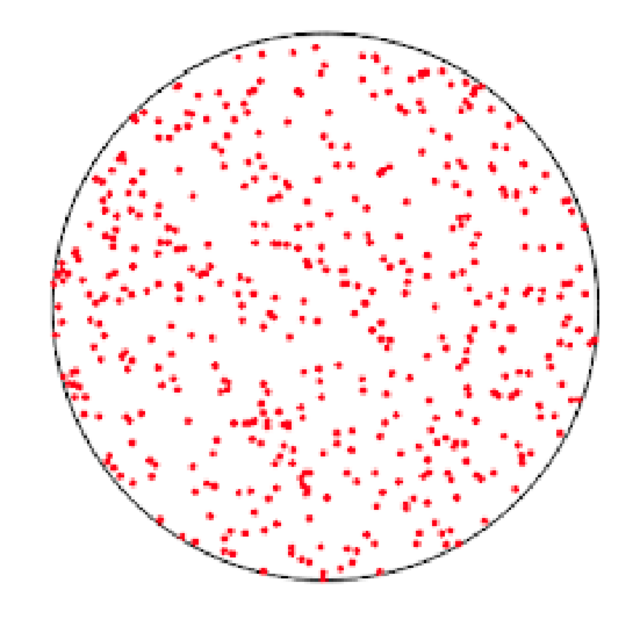
In case you forgot, you posted a diagram with dots, intended to represent a plane with an arrangement of points without any order. This is what I argued is contradictory, "an arrangement... without order". — Metaphysician Undercover
And as I already said, my diagram was intended to help make a point, but it clearly didn't work very well, so forget it. Sets are defined by the rules of set theory, nothing more and nothing less. And once again I pointed you to the axiom of extensionality. So nevermind the dots in the circle. If the analogy was lost on you, then forget it. You can't still be arguing against an example. Try understanding the axiom of extensionality.
And this was representative of our disagreement about the ordering of sets. You insisted that it is possible to have a set in which the elements have no order. You implied that there was some special, magical act of "collection" by which the elements could be collected together, and exist without any order. — Metaphysician Undercover
No more magic that the rules of chess are magic when they say how the various pieces move. The rules of set theory say how sets behave. The analogy is perfect, whether you get it or not.
What you are in denial of, is that if the elements exist, in any way, shape, or form, then they necessarily have order, because that's what existence is, to be endowed with some type of order. — Metaphysician Undercover
Existence is to be endowed with order? Now that is utter nonsense. One example that comes to mind is the famous counterexample to the identity of indiscernibles, in which we posit a universe consisting of two identical spheres. You can't distinguish one from the other by any property, even though the spheres are distinct. This example also serves as a pair of objects without any inherent order.
But "existence is to be endowed with order?" Man you are just flailing, making things up instead of honestly engaging.
You tell me, just imagine a plane, with points on the plane, without any order, and I tell you I can't imagine such a thing because it's clearly contradictory. If the points are on the plane, then they have order. And you just want to pretend that it has been imagined and proceed into your smoke and mirrors tricks of the mathemajicians. I'm sorry, but I refuse to follow such sophistry. — Metaphysician Undercover
Well ok. I can't add much. As I've noted, we're kind of done here. I have nothing to add and you aren't interested in engaging with math. You prefer to reject it wholesale and that's your privilege. I can't do anything about it. Not for lack of trying.
Why not give it a try? I can argue with the fantasies in your head, demonstrating that they are contradictory. So please explain to me how you think you can have a collection of elements, points, or anything, and that collection has no order. Take this fantasy out of your head and demonstrate the reality of it. — Metaphysician Undercover
Reality? I make no claims of reality of math. I've said that a hundred times. YOU are the one who claims math is real then complains that this can't possibly true. The solution is that nobody claims math is "real" in the sense that you mean. Of course math is real in terms of implications: if this, then that. But math makes no claims as to the truth of "this." Only IF this THEN that. Nobody says sets are "real" in any meaningful sense. Sets are abstract thingies (you don't like the word objects) that behave according to rules; just like chess pieces. You don't want to get that but your refusal to get that is the root cause of your misunderstandings. Nobody claims math is real in the sense that YOU use the word real.
But on the other hand math IS real, in the sense that, for example, the rules of group theory fully encapsulate the behavior of reversible transformations, like addition and subtraction, or multiplication and division, or rotating counterclockwise by 47 degrees and rotating clockwise by 47 degrees. The math of group theory is abstract and not "real" as YOU use the word real, but the relationships encoded by group theory ARE real. And you simply won't grapple with this. I don't know why.
The dots. I believe, were supposed to be a representation of points on a plane. The points on a plane, I believe, were supposed to be a representation of elements in a set. And you were using these representations in an attempt to show me that there is no inherent order within a set. So, are you ready to give it another try? Demonstrate to me how there could be a set with elements, and no order to these elements. — Metaphysician Undercover
https://en.wikipedia.org/wiki/Axiom_of_extensionality
https://en.wikipedia.org/wiki/Zermelo%E2%80%93Fraenkel_set_theory
That's all there is too it, since you take pot shots rather than attempt to derive understanding from visual analogies. The ZF axioms fully characterize what sets are, by specifying how sets behave. As to what sets actually are, nobody has the slightest idea. Set is an undefined term, just as point and line are undefined terms in Euclidean geometry.
I've explained to you the problem. You describe the set as a sort of unity. And you want to say that the parts which compose this unity have no inherent order. Do you recognize that to be a unity, the parts must be ordered? There is no unity in disordered parts. Or are you going to continue with your denial and refusal to recognize the fundamental flaws of set theory? — Metaphysician Undercover
No. I describe a set as whatever obeys the ZF axioms. There are alternative axiom systems that describe a different notion of set. We do have intuitive, casual, naive examples of what we mean, but presenting these to you (collections of things, bags of groceries, circles containing red dots) are lost on you and only give you ammunition for childish objections.
So a set is whatever ZF says a set is. Just like the knight moves the way the rules of chess say the knight moves. They are both formal systems with no referent in the real world. -
Can it be that some physicists believe in the actual infinite?Devising new frameworks and systems is an important aspect of creativity in mathematics. But, while I can't properly quantify, it seems to me that most of mathematical creativity is in proving theorems. — TonesInDeepFreeze
Isn't "important aspect" weaselly enough? I didn't say "all" or "most," just an important aspect. A lot of the big breakthroughs do involve radically new ways of seeing things. I'm not quantifying it, was just pointing out to @Metaphysician Undercover that there's a lot more to math than just following arbitrary rules. -
Can the universe be infinite towards the past?Can't speak about Kant. But the physics theory of eternal inflation posits an infinite future. And Penrose's conformal cyclic cosmology posits an endless succession of big bangs. So infinite time, past and/or future, is a part of speculative physics these days.
-
Integrated Information TheoryIt is not a measure of my mentality before my first cup of coffee — magritte
My understanding is that Tononi's phi is intended to be exactly that. But I only linked to the Aaronson article and haven't paid much attention to IIT, and can't comment authoritatively. -
Can it be that some physicists believe in the actual infinite?I didn't answer, because it's not relevant. Philosophy is not a game in which you either accept the rules of play or you don't,, neither is theoretical physics such a game, nor is what you call "pure mathematics" (or as close to "pure" as is possible). In these fields we determine, and create rules which are deemed applicable. So your analogy is not relevant, because the issue here is not a matter of "will you follow the rules or not", it's a matter of making up the rules. And there's no point to arguing that people must follow rules in the act of making up rules because this is circular, and does not account for how rules come into existence in the first place. — Metaphysician Undercover
This was in reference to my question, Why don't you treat math like chess, and accept it on its own terms? And I see no answer here. Math is a game that has standard rules, and many varieties of nonstandard rules. The essence of creativity in math is to make up new rules. That's the history of math, the creation of new rules that violated the old. Because you won't put aside your naive objections long enough to understand math, your objections have no force, because they come across as petulant rather than informed. As far as how the rules came into being in the first place, there is a huge, extensive literature on the subject from Frege and Russell and Zermelo through the modern philosophers of math. A history you have no interest in, because you prefer to remain ignorant. The problem is that you can't make a good case, because your ignorance of the subject shines through above all.
Ok, we've found a point of agreement, physics has lost it's way. Do you ever think that there must be a reason for this? — Metaphysician Undercover
Yes, primarily two. One, we have reached the point where experiments are so expensive as to command a large share of the public treasury. Bill Clinton came into office in 1993 and killed the Superconducting Supercollider. a project that would have reached far higher energies than the Large Hadron collider at CERN. And the next generation of particle accelerators is estimated to come in at over $20B. The expenditures have become a matter of politics, and there are always more worthy and immediate causes to be funded.
Secondly, just as there were a couple of thousand years between Aristotle and Newton, and 250 or so years between Newton and Einstein, it may well be that physics needs to tread water for another couple of centuries before the next breakthrough. We can't hope to have a major revolution every year or even every century.
And, since physics is firmly based in mathematics, don't you see the implication, that perhaps the root of the problem is actually that mathematics has lost its way. — Metaphysician Undercover
Not in the least. Math stands on its own. Just as math invented non-Euclidean geometry 70 years before Einstein had any use for it, math today as always is full of meaningless and useless curiosities that may or may not find practical application in the future. Math stands on its own and needs no applicability or practicality to justify itself. This is your fundamental conceptual error. It's not the fault of math that physics is lost. That's the physicists' problem. The mathematicians are doing just fine; and for that matter, are in the midst of a great period of revolutionary turmoil and development in its foundations, to wit category theory, homotopy type theory, computerized proof assistants, and neo-intuitionism. Developments far ahead of anything the physicists care about or even know about.
Physicists, engineers, and others, applying mathematics in the world have a huge impact on the world in which I live, unlike Parcheesi players. — Metaphysician Undercover
Then your complaint is with the physicists, engineers, and others; and not the mathematicians, who frankly are harmless. This is your core error. You have no idea what math is about, so you think it's engineering.
Despite arguments that mathematical objects exist in some realm of eternal truth where they are ineffectual, non-causal, I think it is undeniable, that the mathematical principles which are applied, have an impact on our world. I believe it is inevitable that bad mathematics will have a bad effect. — Metaphysician Undercover
Again, your complaint is with those mis-applying math or applying math to bad ends. The mathematicians themselves do work that is so far out there that the only reason you think it has any applicability to the real world is that you have no idea what modern math is or does. If you're upset with applications of math, then your complaint is with those applying it. The math exists on its own, and must be understood and comprehended on its own terms. If you can't do that, your ire is greatly misdirected.
That people vehemently support and defend fundamental axioms which may or may not be true, refusing to analyze and understand the meaning of these axioms, simply accepting them on faith, and applying them in the conventional way, in new situations, with little or no understanding of the situation, or the axioms, to me is a clear indication that bad results are inevitable. — Metaphysician Undercover
Again, your ignorance betrays you and makes talking to you tedious. There's been 170 years of intensive research into mathematical foundations, starting with the revolution of non-Euclidean geometry. I could point you to Zermelo, or Mac Lane, or Maddy, but what good would it do? You'd rather be ignorant than learn anything. You say that people have accepted the axioms on faith "with little or no understanding," which betrays an ignorance that would deeply embarrass you, if you had any self-awareness of your mathematical and philosophical ignorance.
You do not seem to be making any effort to understand this fundamental principle, which is the key to understanding what I am arguing. A group of particles, or dots (we cannot really use "points" here because they are imaginary) existing in a spatial layout, have an order by that very fact that they are existing in a spatial arrangement. — Metaphysician Undercover
Particles? Dots? What are those? In math, the elements of sets are other sets. There are no particles or dots. Again, you confuse math with physics.
Yes, they can be "ordered any way you like", but not without changing the order that they already have. The order which they have is their actual order, whereas all those others are possible orders. — Metaphysician Undercover
The very conception of a mathematical set does not include any inherent order. You're just making that up and I'm supposed to sit here several times a week and argue with you about it. It's pointless and tedious. Why don't you learn something about sets instead of showing off your ignorance?
Do you understand and accept this? — Metaphysician Undercover
Your delusions about mathematics? Of course not.
Or do you dispute it, and know some way to demonstrate how a spatial arrangement of dots or particles could exist without any order? — Metaphysician Undercover
I have no idea what you could possibly mean by dots or particles. A set is defined by the axioms of set theory. The axiom of extensionality says that a set is entirely characterized by its elements. Period. That's all anyone needs to know about sets, but you prefer to live in your own fantasy world of dots and particles. You're making it up.
It's one thing to move to imaginary points, and claim to have a specific number of imaginary points, in your mind, which have no spatial arrangement, but once you give them a spatial arrangement you give them order. — Metaphysician Undercover
There is no spatial arrangement. You're just throwing an ignorant tantrum about things you refuse to learn.
Even if we just claim "a specific number of points", we need to validate that imaginary number of points without ordering them. — Metaphysician Undercover
Validate the imaginary number of points? What does that mean? I have no idea.
This is what Tones and I discussed earlier. — Metaphysician Undercover
I'm not reading much of this thread, only my mentions.
How can we count a specific number of points without assigning some sort of order to them? — Metaphysician Undercover
I can't argue with the fantasies in your head. Set theory is what it is.
To count them we need to distinguish one from the other by some means or else we do not know which ones have been counted and which have not been counted. So even to have "a specific number of points", imaginary, in your mind, requires that they have an order, or else that specific number cannot be validated. — Metaphysician Undercover
Counting is a much more sophisticated operation than merely positing the existence of a set. To count, we must have the cardinal or ordinal numbers. To have the cardinal or ordinal numbers, we must conceptually build them up from the basic concept of set, which is as I've tried to describe to you.
Yes, I'm making a point about "randomness" because you are using the term "random" to justify your claim that a bunch of dots in a spatial arrangement could have no order. — "Metaphysician
There are no dots. I don't know what dots are. I tried to give you a visual example but perhaps that was yet another rhetorical error. I should just refer you to the axiom of extensionality and be done with it, because in truth that is all there is to the matter.
You simply say, the points are "randomly distributed" and you think that just because you say "randomly", this means that there actually could be existing dots in a spatial assemblage, without any order. But your use of the term does not support your claim. There was a process which placed the dots where they are, therefore they were ordered by that process, regardless of whether you call that process "random" or not. — Metaphysician Undercover
Forget the visual analogy. Now you're just arguing with the analogy and not with the concept of set. A set is entirely determined by its elements. That's rule one of the game. Take it or leave it. I don't care.
I looked at the Wikipedia entry, — Metaphysician Undercover
You surely did not engage with it.
and it does not appear to cover the issue of whether existing things necessarily have an order or not. So it seems to provide nothing which bears on the point which I am trying to get you to understand. — Metaphysician Undercover
https://en.wikipedia.org/wiki/Axiom_of_extensionality -
Vaccine acceptence or refusal?they are individualists, and they should be FORCED to be cut off from all the amenities of living in a society, if they believe that their rights trump the needs of society. — god must be atheist
https://en.wikipedia.org/wiki/Collectivism
You know I just happened to learn yesterday that China will now allow married couples to have three children. That's an increase from the two they were formerly allowed to have, which is itself an increase from the one kid they used to be allowed to have.
Based on your viewpoint, I assume you wholeheartedly support the right of the government to control who may reproduce and how many offspring they may have.
https://www.bbc.com/news/world-asia-china-57303592
And of course, "My body, my choice" is the supreme maxim of the individual. But the State has ultimate authority over the reproductive facilities of its subjects, I assume you would agree. If the State bans abortion, you must obey. If the State requires abortion, as China does once you've had the allowed number of offspring, you must obey.
Perhaps you would care to put your authoritarianism into context, lest I misunderstand you.
Or do I perhaps understand you far too well? -
Vaccine acceptence or refusal?since the new administration came into office, the US vaccination program has actually been pretty good, unlike what it would have been under the useless previous administration — Wayfarer
You don't credit Trump's Operation Warp Speed with the development of a vax in record time? During most of 2020, Democrats said that no vax could ever be developed. Kamala Harris said that she would refuse to take any vax developed by Trump. Of course subsequently she has gladly taken that exact vax.
Operation Warp Speed
Why Trump's Operation Warp Speed is credited with helping race for COVID-19 vaccine -
Vaccine acceptence or refusal?"My body, my choice." Where have I heard that? — fishfry
LOL. I thought I made that up myself. Turns out you can buy t-shirts.

-
Vaccine acceptence or refusal?I think people should be free to take or reject the vaccine. — Apollodorus
"My body, my choice." Where have I heard that? -
Can it be that some physicists believe in the actual infinite?That the subject at first makes little sense is probably usually true. And it's true for me for many different subjects. But symbolic logic is one subject that made perfect sense to me immediately. — TonesInDeepFreeze
Me too. But I well remember my experience in abstract algebra. At first it made no sense whatsoever, and it was that way several weeks into the course, until the textbook mentioned a particular example that related to something I was already familiar with. I said, "Ah, this stuff is actually ABOUT something!" That was a great revelation. -
Can it be that some physicists believe in the actual infinite?Again I don't agree with this. Many things I've learned made sense to me right from the start. Even learning the numerals, how to count, and simple arithmetic, addition, subtraction multiplication, division made sense to me right from the start. It was only later, when they started insisting that there existed a number, distinct from the numeral, that things started not making sense. — Metaphysician Undercover
Ok. I can understand that. But I'm offering you a way out. Just take the position of formalism. There are no numbers, only numerals and the rules for manipulating them. Then you can enjoy the game without reifying it. Like chess. Could that be a philosophical viewpoint that would allow you to get past your current impasse?
I had a similar experience later with physics. We learned basic physics, then we learned about waves, and got to experiment in wave tanks. We learned that waves were an activity within a medium and we were shown through diagrams how the particles of the medium moved to formulate such an activity. All of this made very much sense to me. Then we were shown empirical proof that light existed as waves, and we were told that light waves had no medium. Of course this made no sense to me. — Metaphysician Undercover
It makes no sense to anyone else either. This is well known. Especially in terms of quantum fields being "probability waves." That makes no sense to me. Physics has perhaps lost its way. Many argue so. You and I might well be in agreement on this.
When I learn a game, I must learn the rules before I play. If the rules are such that I have no desire to play the game, I do not play. It's not a question of whether the game makes sense or not, so the analogy is not a good one. — Metaphysician Undercover
Ok. I get that. And I've asked you this many times. You don't want to play the game of math. So then why the energetic objection to it? After all if someone invites me to play Parcheesi and I prefer not to, I don't then go on an anti-Parcheesi crusade to convince the enthusiasts of the game that they are mis-allocating their time on a philosophically wrong pursuit. So there must be more to it than that. With respect to a perfectly harmless pastime like Parcheesi or modern math, one can be for, against, or indifferent. You have explained why you are indifferent; but NOT why you are so vehemently against.
Finally, you decided to address the issue. If there are points distributed on a plane, or 3d space, the positioning of those points relative to each other is describable, therefore there is an inherent order to them. If there was no order their positioning relative to each other could not be described.. — Metaphysician Undercover
Makes no sense. It's perfectly clear that you can order a random assemblage of disordered points any way you like, and that no one order is to be preferred over any other.
You say that they are "randomly distributed", to create the illusion that there is no order. — Metaphysician Undercover
Yes I did say that, and for that reason. We understand each other on this point. The points are placed randomly, so there is no inherent order to their position.
But the fact is that they must have been distributed by some activity, and their positioning posterior to that activity is a reflection of that activity, therefore their positioning is necessarily ordered, by that activity. — Metaphysician Undercover
Well yes, the random number generator I used was actually determined at the moment of the big bang, if one believes in determinism. But you're making a point about randomness, not about the order of the points. You are not persuading me with your claim that a completely random collection of points has an inherent order.
If you think you can interpret the rules as we go, then I'd advise you not to play any games with me. — Metaphysician Undercover
You're flailing.
The inherent order is the exact spatial positioning shown in the diagram. If any point changes location, then the order is broken. Is that so difficult to understand? A spatial ordering is not a matter of first and second, that is a temporal ordering. — Metaphysician Undercover
Ok. Perhaps we can put this one to bed now and meet again some other time. You don't want to read the Wiki piece on order theory. You don't want to learn any math, even for the sake of sharpening your own arguments against it. I do believe we've gone as far as we can here. My conscience is clear as to my having made a good faith effort to inform you as to how mathematicians regard the subject of order. -
Can it be that some physicists believe in the actual infinite?That about sums it up. Math is like religion, a whole bunch of bullshit which we are told to accept on faith — Metaphysician Undercover
I was thinking you'd respond to that with a little self-aware sense of humor.
I found that out at about tenth grade, despite living in an extremely mathematically inclined family. — Metaphysician Undercover
Could there be some unresolved psychological dynamics at play?
In any event, can you please respond to my point about chess? Surely if you learned to play chess, or any other artificial game -- monopoly, bridge, checkers, baseball -- you were willing to simply accept the rules as given, without objecting that they don't have proper referents in the real world or that they make unwarranted philosophical assumptions. If you could see math that way, even temporarily, for sake of discussion, you might learn a little about it. And then your criticisms would have more punch, because they'd be based on knowledge. I wonder if you can respond to this point. Why can't you just treat math like chess? Take it on its own terms and shelve your philosophical objections in favor of the pleasure of the game. -
BlackRock and Stakeholder CapitalismHow many people know what this is? Without Googling or Wikipedia-ing it, I'd like an honest answer. — Xtrix
Famous move w/Spencer Tracy. 7.7 on IMDB.
https://www.imdb.com/title/tt0047849/reference -
Integrated Information TheoryIIT, originated by Giulio Tonini, — frank
Scott Aaronson debunkificated this a while back. David Chalmers shows up in the comment section.
https://www.scottaaronson.com/blog/?p=1799 -
Can it be that some physicists believe in the actual infinite?@Metaphysician Undercover, What is the inherent order of the points in this set? Can you see that the points are inherently disordered or unordered, and that we may impose order on them arbitrarily in many different ways? Pick one and call it the first. Pick another and call it the second. Etc. What's wrong with that?
-
Can it be that some physicists believe in the actual infinite?You seem to have a very naive outlook. How do you propose that one proceed toward "learning the subject", when the most basic principles in that subject do not make any sense to the person? — Metaphysician Undercover
Well in fact that is exactly how one learns math! Once you get past calculus, the early upper division math classes make no sense to students. Abstract algebra and real analysis typically baffle students, until at some point they either get it or give up. It's like saying that learning to play a musical instrument is tremendously difficult at first so people should just give up. On the contrary, you do your scales over and over and over and one day you find that you can play music passably well. It's called learning.
It's true of virtually EVERYTHING that at first, the subject makes no sense. You just do as you're told, do the exercises, do the homework, do the problem sets without comprehension, till one day you wake up and realize you've learned something. It must be that you've learned nothing at all in your life, having given up the moment something doesn't make immediate sense to you.
If you truly wish to criticize the foundations of math, wouldn't it make sense for you to temporarily put aside your objections, and learn the material on its own terms? Especially as you've found someone willing to explain it to you. Then after you have grasped the basic methodologies, such as abstraction and layering properties on top of formless sets -- THEN you are in a better position to make substantive criticisms rather than childish ones.
When you learned to play chess, or any game -- bridge, poker, whist -- do you say, "Oh this is nonsense, no knight REALLY moves this way," and quit? Why can't you learn a formal game on its own terms? If for no other reason than to be able to criticize it from a base of knowledge rather than ignorance? If you've never seen a baseball game, it makes no sense. As you watch, especially if you are lucky enough to have a companion who is willing to teach you the fine points of the game, you develop appreciation. Is that not the human activity called LEARNING? Why are you morally opposed to it?
Finally, even your basic objection to unordered sets is wrong. Imagine a bunch (infinitely many, even) of points randomly distributed on the plane or in 3-space. Can't you see that there is no inherent order? Then you come by and say, "Order them left to right, top to bottom." Or, "Order them by distance from the origin, and break ties by flipping a coin." Or, "Call this one 1, call this one 2, etc."
Where is the inherent order in an otherwise random assemblage of points?
I had difficulty even in grade school, when the teachers insisted on distinguishing numbers from numerals. Where are these "numbers" that the teacher kept trying to tell us about, I thought. All I could see is the numerals, and the quantity of objects referred to by the numeral. But the teacher insisted no, the numeral is not the number. So it took me very long to figure out that the numeral was not the "number" which the teacher was talking about, and that the number was just some fictitious thing existing in the teacher's mind, so I shouldn't even bother looking for it because I have to make up that fiction in my own mind, for there to be a number for me to "see". — Metaphysician Undercover
I feel for you. LOL. But you see, you WERE capable of getting it. Or you could just take the formalist perspective and say that the entire thing is a fictional game made up of marks on paper. In which case you couldn't object to math any more than you can object to chess.
To me, the distinction between a numeral and a number is fundamentally unintelligible, as a falsity, because it requires producing a fictitious thing in my mind, and then talking about that fictitious thing as if it is a truth. — Metaphysician Undercover
So just adopt the formalist perspective. There are only numerals and the rules for manipulating them. It's a game. What on earth is your objection? Were you like this when you learned to play chess? "There is no knight!" "The Queen has her hands full with Harry and that witch Meghan!" etc. Surely you're not like this all the time, are you?
Or will you simply assert that mathematics is far superior to philosophy, — Metaphysician Undercover
If you can find any instance of my ever asserting such a thing on this forum, then show it. Otherwise you have lied, claiming I said something I never said nor implied in any way.
then run off and hide under some numbers somewhere when the unintelligibility of your principles is demonstrated to you? — Metaphysician Undercover
On the contrary. I'm doing you the service of attempting to explain to you how modern abstract mathematics is set up. And I'm giving up, since it's clear that you'd rather cling to your naive and incorrect beliefs about the subject rather than learn anything.

fishfry

Start FollowingSend a Message
- Other sites we like
- Social media
- Terms of Service
- Sign In
- Created with PlushForums
- © 2026 The Philosophy Forum