
-
God and antinatalismBut in that case, it's that pessmism that is keeping (and possibly, making) one poor. — baker
That's an assertion that is not even close to being necessarily true. Actually, it might be quite the opposite, that someone is pessimistic because they are poor, and I wouldn't blame them! But I want you to understand that there is a distinction between "pessimism' and "Pessimism". Regular pessimism is simply an outlook or a personality tendency. Philosophical pessimism generally has a larger picture understanding how suffering is related to the world. It's the difference between someone being stoical and a Stoic. -
God and antinatalismThey can still indulge in something that has become unavailable to me. — baker
That is unfounded and a cliche. You can be poor and pessimistic. You can be digging in a field and think in your mind the whole time "I hate this shit.. Why is life like this?"
Actually, my very point that we are flooded with activities we'd rather not do if we had a choice, is part of the pessimism, so that is just proving the point if anything. But it is not a "truism" that one cannot connect one's very mundane activities with the "larger picture", pessimistic or not. That is up to the individual and how they process their practical efforts with larger ideas in general. -
God and antinatalismLiving off a cozy trust fund has it upsides, such as one being able to afford decadent pessimist views. Too bad it doesn't work the other way around: indulging in misery doesn't make one rich. — baker
Unnecessary and unfounded ad hom. Are you a trust fund baby for writing a meaningless quip on a philosophy forum? -
Transhumanism with Guest Speaker David Pearce
Hi David, gene editing to the degree you are proposing has not been done to a real human (except perhaps one in China). What if it's the case that the way the phenotype and epigenetic results of gene editing work, it creates less happy humans, who suffer more? We are betting that the practical application will somehow prove out the theories. What if it doesn't and gene editing too has become a dead end? -
God and antinatalism
Schopenhauer himself would have probably took umbrage at piecemealing his systemic philosophy but ok. Also literally his ethics and aesthetics come out of his metaphysics which is based on Will and Platonic Ideas. No reason to swipe at me if you wanted to start a Schopenhauer thread though. If you want to contribute to the one I recently created where I ask about Will's connection to Representation, have at it.It's "sad" insofar as it leaves out many fascinating topics of conversation that Schopenhauer was fascinated by, such as his accounts of the world being a representations, his observations about psychology, physiology, art and much else. — Manuel -
God and antinatalismYou are right - this thread has received much more attention than it deserves. — Banno
If only I bet on how many times you used sarcasm and one-line quips as a stand-in for philosophy I would be a pretend billionaire. -
God and antinatalismHaving said that, I think telling people they should not have babies does not make much sense. Each person has his or her own reasons. They should consider the pros and cons of having a baby. But the focus on pain avoidance is too narrow, in my view. — Manuel
Yet human life is about living in a society which is a collection of habits and historical contingency, which forces one to deal with these de facto actions one must do to survive, get comfortable, and find ways to occupy the mind. So having babies is not only "telling" people they "should" do something, but actually FORCES people do literally "DO SOMETHING" lest dire circumstances of neglect, homelessness, starvation, free-riding (pushing it on others), or the like. So one is a strong suggestion, the other is a de facto force on another. I don't think I have to say which one is more intrusive to another individual in a profound way. -
God and antinatalismI don't understand. Why is this topic so popular? Heck, one would get the very misleading impression that Schopenhauer (who tends to be associated with this movement) was only about life being bad. Most of his work is showing how amazing our capacities are! His whole metaphysical-epistemological project, and his psychological insights are second to none.
That's quite sad, I think. — Manuel
I am probably the main proponent of Schopenhauer around here, so not sure your assessment of associating him with popular versions of AN is on the mark. As far as his metaphysics, it was suffused with philosophical pessimism. Will is insatiable, and eats its own tail which leads to the World as Representation being that of illusionary individuation (aka suffering of the individual being).
As far as the popularity of the topic, it's not really, but as of late there have been several threads, which I'm glad to see. But you can say any philosophy you don't get or agree with as "sad" to be popular, so this just shows your personal bias more than anything about the philosophy. I do hope it gets more popular, but Socrates was hoping the Socratic Method would be popular, and Plato the Forms and Wittgenstein the idea of language games. There is nothing wrong with wanting to see the popularity of a philosophy one agrees with. -
Guest Speaker: David Pearce - Member Discussion Thread
I actually agree with you on the ever-presence of the PWE in Western culture. I think this speaks to the topic of my thread on Credibility and Minutia here: https://thephilosophyforum.com/discussion/10642/credibility-and-minutia -
Arguments for having ChildrenFOR FUCK'S SAKE. I DID NOT SAY "antinatalism is proselytizing". PLEASE DON'T MAKE UP SHIT AND QUOTE IT AS IF I SAID IT. — unenlightened
Then what was the intention of this quote?
I take another view. what I do not respect so much is the proselytising. — unenlightened
Was that again only to a specific poster or antinatalism? That one seemed aimed at AN because it was right after your reference to AN as a legitimate philosophy (general not specific).
convert or attempt to convert (someone) from one religion, belief, or opinion to another.
So, did you read my last post where I address this?
We can discuss in any number of threads; we can argue it back and forth. But now you are again misrepresenting my position, and that is an unfair and unreasonable practice. It is another rhetorical trick, and it stinks. — unenlightened
I'm not trying to. Unless I am misreading you, and you can try to show where this is, you are saying that repeated discussions of a topic (like AN) is proselytizing, and I rebutted this in a long post.
And it is not antinatalism that stinks, it is your debating style, and your use of illegitimate means to try and convince others of the strength of your position. And that is what I am calling 'proselytising'. — unenlightened
This has move to another argument that was just brought up now that is specific to me and not antinatalism, but that was not what you seemed to be referring to before. What about my style is "illegitimate"? It seems, you just don't agree with the position. -
Arguments for having ChildrenIf you would read what I say, you would understand more and be less insulted. — unenlightened
Fair enough, it looked like you were talking about AN in general.
I respect antinatalism as a legitimate position; — unenlightened
:up:
I take another view. what I do not respect so much is the proselytising. — unenlightened
Well I think this whole "antinatalism is proselytizing" thing is unfair and just based on strong biases against it. This too would be a rhetorical tactic. Perhaps we should stop talking about Forms because Platonists are proselytizing. The next argument about Platonic Forms should be stopped. Perhaps all talk of Aristotle's virtues should stop. Perhaps all applied ethics dealing with murder and stealing should stop. All political philosophy dealing with communist ideas, capitalist ideas, and specific philosophers who advocated this to stop. You see, it becomes a slippery slope to calling any repeated discussion of a stance you don't like as "proselytizing". I think this is a cop out. You have options.. Don't read the threads if you don't like it. I mean, if it is popular enough, it can have its own section. But this proselytizing claim seems to be more bias against the a philosophy you don't like. Let me give you a counter example..
If David Pearce's transhumanism ideas became popular, and I saw a whole bunch of threads about transhumanism.. I would simply say, "Oh that has become popular philosophy and is something people want to discuss in various forms". Even if I disagreed with it, what the hell does it matter to me if there are 50 threads on this, and only a few on Bertrand Russell's view on mathematics or some other more classically well-known philosophy? Anyone who brings up Wittgenstein one more time and his Logical Investigations.. shut it down. Next time I even hear the term "eliminativist materialism", that's gotta go.. I can't stand that stance, so then next person who has a thread about that, I am going to cry proselytizing.
So your next move is to say that it's the posters not the topics.. So then any specialist..anyone who has an interest or expertise in a certain subject or field.. they gotta go too because I don't like their interest.
Actual proselytizers try to look for people easy to convince. Almost everyone on this forum seems to be cantankerous disagreeable people that argue everything. Seems a pretty inhospitable place for proselytizing. Rather, it is a place for dialectic on particular topics to take shape, form, and nascent ideas to come out in thesis-antithesis-synthesis Hegelian fashion that happens if (good) philosophical discourse takes place. -
Arguments for having ChildrenIn the exchange above, I did make a point that this thread and others similar make too much use of challenging questions, and that such questions are rhetorical devices not arguments. I will not waste more time on that, or on the rhetorical questions. — unenlightened
You're essentially saying you don't like the philosophy's arguments so you won't engage in it. I know you think antinatalism as a rhetorical question rather than an argument, but you never spelled out how specifically antinatalism is not an argument. You have only asserted that human life includes procreation. Human life also includes a lot of nasty things, so? Where is your argument against antinatalism other than it is currently something people do?
At the same time you did mention part of the basis of the argument for antinatalism which is that suffering is something not to bring lightly into the world for another person. Why that is not an argument I don't know. It seems like now you are using rhetorical devices to try to wave off the argument you don't like.
Don't force a nearly inescapable game on someone. Don't cause conditions for unnecessary harm on someone. That right there can be discussed in much more detail as a premise. I give a foundation of violating dignity when creating great amounts of unnecessary harm on someone else's behalf. Others have other deontological or consequentialist approaches. Some people also employ the Benatarian asymmetry of it being "good" that no one was harmed, sub species aeternatatis. Either way, you can't just say there's no argument when clearly many people are putting one out there. It just seems a rhetorical device that you are using to try to not have to deal with it. -
Arguments for having Children
Actually Schopenhauer was not an advocate for suicide. He sympathized with it, but was against it as a "way out". Schopenhauer thought that suicide was the Will "willing" against itself and thus still willing. The only "way out" for Schopenhauer was living an ascetic life and denying the will to a point of enlightenment or salvation from Will's grasp or effect. -
Arguments for having ChildrenIs the lack of consent offset by the fact that whatever you bring into existence has the option of going back to non-existence (suicide)? Also, if I slip five dollars into someone's pocket without their consent, have I harmed them? — RogueAI
I would say it revolves around dignity (which consent and forced actions can fall under) and causing unnecessary suffering. Was putting someone into existence causing unnecessary suffering on someone else's behalf? If so that person's dignity was violated. Is someone causing another person to play a game (i.e. the game of being presented unwanted challenges and overcoming them) on someone else's behalf? That person's dignity was violated.
Putting the five dollar bill in someone's pocket is not violating dignity, even though it was without consent. The force was not to the threshold where the dignity was violated. -
Arguments for having ChildrenInitial thought, though, is that it seems to address unborn child issue, but when it comes to suicide, it's placing the dignity of the individual who is doing the choosing over the dignity of the individuals who are left behind (like the old saying "Suicide doesn't stop the pain; it just transfers it). — James Riley
AN wouldn't necessarily have a theory of suicide, that would have to be part of the person's overall ethical theory. So, in the case of the dignity variation, one is choosing one's own time/place to die, and one wants to do it, thus one isn't violating one's own dignity. Are you using other people for this act? No. Well, then it is permissible. It is indeed causing harm to others, but its debatable if it is "unnecessary" and it isn't violating dignity. So it would be something to consider, but perhaps not totally a moral consideration as much.
However, you can make a case that suicide is causing "unnecessary suffering" to other people, but I'm not sure if it passes the dignity test. It is forcing others to deal with something, but does it meet the threshold of "force"? That is a harder question. I do see dignity as a threshold and analog of degrees rather than digital binary violated/not violated. For example, if a kid was drowning and I had to wake a lifeguard up to save the kids life, I have slightly "harmed" the lifeguard, and "forced" him to wake up, but I don't see that as violating the lifeguard's dignity. However, if I was to force the lifeguard to only teach lifeguarding lessons for the rest of his life because I thought the greatest amount of good would come from that for the greatest number of people, that would be violating the lifeguard's dignity. -
Arguments for having ChildrenI didn't think I had a conclusion? — James Riley
It was that antinatalists only worry about the greatest good for the greatest number (classic utilitarianism).
But now that you mention it, is the antinatalist only concerned with heading off the suffering of one? And if more than one, then why? Wouldn't aggregation be a consideration, even if not utilitarian? Or maybe even then? — James Riley
No, while there is debate about the "Big Red Button" and the "Benevolent World Exploder Argument" (https://en.wikipedia.org/wiki/Negative_utilitarianism#:~:text=Some%20replies%20to%20the%20benevolent,perhaps%20in%20a%20worse%20way.) Actually, our guest speaker, David Pearce even wrote about this, so you may want to ask him more his thoughts.
That would be a caricature of the most extreme and not a majority view (as far as I know). For example, my antinatalism is more based on a deontological foundation whereby one does not cause unnecessary harm while still respecting the dignity of the persons involved. Dignity is important here because the harm isn't just some abstract thing we are trying to prevent but is inhered/experienced-by an individual person. Once born, this person has interests, goals, fears, etc. One would be overlooking this individual by simply killing them off for a "greater goal". Thus, preventing unnecessary harm has to be coupled with dignity for morality to be actually "moral". So YES harm prevention is a large part of it, but the level at which morality takes place is the individual, and recognizing them qua them, and not as some vehicle for a greater good.
Thus, killing people off would be violating ANs (my conception at least) own morality of viewing people having some dignity. One of the major reasons for AN is the decision to have a child is overlooking the lifetime of harm that will occur for that child. Also, it is assuming that because YOU believe life's challenges/overcoming-challenges game is good to play another person should have to play this game too. It's a game that would be inescapable except for severe self-harm, something people can't do very easily without fear of pain and the unknown. Thus, killing a person for some greater good is in the case of people "already born" overlooking that person's dignity whereas creating a new person, would be violating the dignity of a future person by overlooking the fact that one is putting that person in "harms way" and forcing them into a nearly inescapable "challenge/over-coming challenge" game.
Also, as just another AN viewpoint, death itself can be considered its own harm, thus causing death is itself causing unnecessary harm to an individual. -
Arguments for having Children
One does not have to be an aggregate utilitarian to be an antinatalist. Thats where your conclusion went wrong. -
Arguments for having Children...just a note to say that this conversation between you two has made my life worthwhile. — Banno
I believe the Joe Pesci line belongs here...
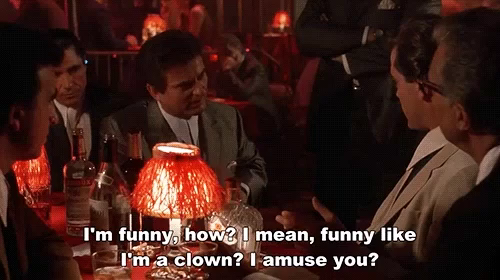
-
Arguments for having ChildrenFuck it, dude I can't be bothered any more. Carry on without me. — unenlightened
Ok, you can just try to explain how my particular argument is not an argument. -
Arguments for having ChildrenI don't need to make an argument, I am stating a fact about what makes an argument. Do you dispute the fact? Go consult an elementary logic text. Or just ignore the facts and me too. Or whatever. — unenlightened
But I am saying to apply your critique of why my argument is not an argument not just a general critique of how a question isn't an argument or something like that. -
Guest Speaker: David Pearce - Member Discussion ThreadThere's plenty of life happening right now where not only suffering is absent but entirely blissful. So Y does not always follow X, if it did, or would be a sufficient cause, which it isn't. — Benkei
So what. If even only half the time, or part of the time it was suffering, if you want to prevent any condition where suffering will occur for another person, and add to that the empirical part of knowing that there are known forms of inescapable suffering and unknown (to the parent) forms of suffering for what the child will suffer, that cannot be mitigated easily, then yes antinatalism would be the best claim.
I can't force you to see the claim as something you yourself should follow. However, I can make the argument which itself is sound. You can prevent another person from suffering X suffering (the suffering incurred in a life) by preventing birth. That is not even an argument but a fact. The argument would come in as to whether this is particularly moral or not. I think your reasoning here that it is not in the realm of morality because it is not the proximal cause is weak at best because if one is looking to prevent all the forms of suffering that occur for a person in a lifetime, than this would not satisfy it. If this does not bother you than nothing the antinatalist would say would convince you.
I also have my own spin which is the "dignity" of the future child may be considered violated because an unnecessary step of put in conditions of being caused to suffer and game-playing (the game of life) was enacted for the child where one did not have to do this. I did have an debate with Khaled about what dignity entails. As I look at it more, it is more about degrees of harm one is causing unnecessarily. For example, waking up a life guard to save a drowning child is a degree of harm that is not sufficiently overlooking the lifeguard's dignity. However, if I forced the lifeguard into a lifetime of lifeguarding school to get the most positive result overall, that would be overlooking his dignity. Starting a life on someone else's behalf due to the lifetime of conditions of possible harm occurring would be overlooking the child's dignity because one is now looking at outcomes (seeing a new being play the game of life) rather than caring about preventing the harms on the child itself. -
Arguments for having ChildrenYou are wrong to disagree. It is a simple matter of grammar, that a question is not a proposition, and has no function in an argument as either a premise or conclusion. Rather it is a rhetorical device that attempts to put pressure on the interlocutor to make statements that can be attacked without stating an argument that can itself be attacked. A question can be wonderful opening to an open discussion, but as an argument, it is a trick and a cheat. — unenlightened
Ironically, you did not make an argument for why my particular argument is not an argument. Poor form if you want to show what you are accusing. -
Arguments for having ChildrenThe question is a complaint, not an argument. — unenlightened
I disagree that it is not an argument. However, I can accept that the insistence of it (the complaint) is part of the pessimistic process of catharsis perhaps. But that is also bad faith, because people may argue it forcefully because they feel as passionately about it as vegans for animal rights issues, etc. -
Guest Speaker: David Pearce - Member Discussion ThreadI think you are overmining the idea that morality has to be equal to legality. It doesn't. Veganism may be true, it doesn't mean it should be enforced by the government. Thus I wouldn't use "Because I was born" as an excuse in court. But certainly in a moral sense, I can ask whether you want to cause the conditions for which all instances Y suffering onto another being will occur, and if the answer is no, then I would point to antinatalism being something to consider. Morally, it is not good to unnecessarily create the conditions for suffering for another person (nothing is being mediated for that person to begin with to cause a lesser harm for a greater, for example).
Another example is being an asshole or an internet troll. That's not illegal, but in a minor way, may be immoral in some sense if one bases morality on character, deontological or even consequentialist terms. -
Guest Speaker: David Pearce - Member Discussion Thread
You are not addressing the argument that if Y always follows from X, then if you don't want Y, X.
You are trying to do a switcharoo where I am aggregating all instances of Y and you keep on trying to parse it back out to each instance of Y. Each instance of Y is contained in Y.
Each instance of suffering is contained in life. Life is caused by birth. If b is caused by a, you can prevent b by not causing a. -
Guest Speaker: David Pearce - Member Discussion ThreadDon't raise another straw man. That all life at some time experiences suffering is not the subject of debate and totally irrelevant. All games involve losing but the game doesn't cause you to lose. — Benkei
This is the crux of our disagreement. I am saying that we should not force others to play a game where they sometimes (and sometimes a lot) will lose. And loss here isn't just losing some change, but many varieties, complexities, and degrees of suffering. -
Guest Speaker: David Pearce - Member Discussion ThreadBecause it's sufficient to establish that it isn't life and after that I don't care, because suffering is particular. And if life doesn't cause it, there's no moral case to be made against having babies. — Benkei
I don't buy it. If the same state of affairs is almost always (by empirical evidence) coupled with any X particular cases that cause suffering, why does it matter proximate cause if it is ALWAYS accompanied by some cases X? Then why would this fact of its causal necessity not be factored in?
If every time you did X, Y negative happened, why would it matter which particular Y, we know that X will lead to Y? And Y (cases of suffering) ALWAYS accompanies X (by empirical evidence).
Are you trying to make a case that, there is a possible world where Y is not accompanied by X? If so, is that really our world? Hence my emphasis on empirical evidence rather than simply possibilities. -
Credibility and Minutia
True enough.. but we can assume people are valued more for their productive capacity than not, and thus taken more seriously the more they are seen as having "contributed" something substantial to the system. -
Guest Speaker: David Pearce - Member Discussion ThreadThe argument is about properly identifying what causes suffering and it isn't life. — Benkei
Um, so how is that not an empirical question? This I am admitting.. We would have to observe what suffering there is, and what causes it.
So what is your point Benkei? I am directly answering your ideas about proximal cause, etc.
Even if we were were to empirically observe what causes each individual case of suffering, I contend that life contains many cases of suffering (via empirical evidence), and it cannot be ameliorated easily.
What can prevent all cases of suffering? Let me see.. Preventing birth. I don't need to know each case of suffering to know that all of it can be prevented with one non-action. -
Credibility and Minutia
Agreed, and there can be a whole discussion of expertise vs. wisdom, etc. However, I would like to focus specifically on expertise in the science/technology/practical trades that leads to measurable increase in innovations and production of goods and services. The middle-class respectable man is measured by how they produce. "What did you DO today?" And those who increased production measurably with something tangible, seem to be the most respected. I am not saying this has to be a Bill Gates or an Elon Musk. Rather, this could just be a very well credentialed technician who knows their field very well and has measurably contributed output to it. These are the people whose positions make them praiseworthy to the respectable middle-class, and so "must" be most wise because they embody their value of production of goods and services, increase in technological capacity, etc.. Thus the assumption is that if they are so "productive" they must hold the values of the middle-class that gets them to be so contributing to the system (pragmatic-realists). So it would be more than disconcerting if a middle-class admirer was to find out that this person was an antinatalist as well.. They might say something like "Oh, but but, you put output into the system, and why aren't you buying into the values of "the system is good" if you have "contributed" (that concept here is biased too) to the system so much? -
Arguments for having ChildrenCorrect. But this focuses on the pain side, there are other considerations. Unless you think pain is the only metric that matters in human life. It's a very important metric, though not the only one. — Manuel
I think preventing pain is more important than bestowing pleasure, certainly. There is no obligation for providing pleasure, but certainly if one is ABLE to prevent pain, one should. If that means no human in the first place, what does that matter (for THAT human)? Pleasures missed out, to me, isn't a thing for anyone. But certainly pain that is had, is pain that is had by SOMEONE.
That's not the only way out. You can choose to struggle and look at the good aspects, that's always a possibility. But suicide is an option for anybody who thinks life is unbearable. And a good option to have too. Your perspective would strengthen substantially if we could not kill ourselves, that is, the only option for death is old age or injury/disease. — Manuel
Yes that is cruel too. I like baseball, therefore I want to force recruit you into the game. Your only escape if you don't want to hit, slide, and catch all day is kill yourself or get better at it and "accept" it. OR you can not put someone in the game in the first place. However, this game is the "challenge/overcoming challenge" game which is more than presumptuous to assume OTHER PEOPLE must play.
Other people have different judgments. — Manuel
And THAT is a major point. If other people have different judgements, then certainly putting people into existence is a MAJOR judgement you are making on SOMEONE ELSE'S behalf. However, if you choose not to put someone in existence, someone else is not living out the collateral damage. Also, going back to the game. Even if someone else likes the game, is it right to assume that force recruiting them is okay because YOU deem the game so good, that everyone else should play it? -
Arguments for having ChildrenThe question of whether my values should or can be attributed to a non-existent entity doesn't arise. It only arises after a person is born. — Manuel
I've already written a lot on this so don't wish to go into another argument, but surely we can consider a future state where a person will exist by our current actions, correct? Just because there is no person suffering NOW, doesn't mean that the current action can't lead to a future person who suffers, which clearly it would in this case.
Whether these other considerations are enough to justify a person having children varies. For those who do have children, or want to have them, the issue of potential pain can be answered with potential pleasure. — Manuel
Does it matter if no "one" experiences a life that has a balance of pleasure or pain? "Who" exactly is suffering from this loss?
But there's a way out and it's a viable option for everybody. Whether people can overcome the biological imperative for wanting to stay alive, is person dependent. — Manuel
Ah, so you "bestow" an inescapable game on another person, one where the only way out is killing yourself. That seems pretty cruel.. Force into game that can only escape via extreme self-harm, one which is not easy to do for inbuilt fears of pain and the unknown. However, just because people don't commit suicide at the drop of a hat, doesn't mean that this is fair either. It just shows more that humans have a hard time inflicting self-harm and getting over death anxiety. -
Arguments for having ChildrenHonor, honesty, struggle, sacrifice, ideals and the like do not fit in neatly to such a pleasure/pain schema, but it's not talked about much in these arguments, at least none that I have seen.
I think these things also merit mention, because they are also important in the life debate. — Manuel
But I guess the question would be whether YOUR values should be bestowed on someone else, who may not share them. Further, even if you do not use pleasure/pain, or suffering, that will be a factor in the person who is born, and thus you have now created the conditions where someone else will suffer. YOU deem the challenge/overcoming challenge game as good. However, is it RIGHT to recruit another person into this inescapable game? Isn't this overlooking the person being born (their dignity) in the pursuit of YOU seeing SOMEONE ELSE go through a game that YOU value? -
Credibility and MinutiaYou mean like Bill Gates? — Olivier5
He's a good example. But it can be a more unknown person who can prove their credentials in their productive capacities. Then the middle-class type might have a bias to believe they "know" something in the philosophical realm. -
Credibility and MinutiaI agree, and wish to add that other divisions also create credibility (and the opposite): level of smarts, level of religiosity, level of physical strength or athletic ability, level of good looks!! Yes, look at the celebrity thing. Level of social status, level of talent (among writers, artists and performers), etc. All divisions by sub-culture have their heroes. Heck, even being well-groomed and well-dressed (and the opposite) can give preconceptions to one's credibility or not. — god must be atheist
Yes, I agree with those, but I am focusing specifically on productive capacity, specifically ones that involve practical trades and science/technology because these are seen as particularly valuable and credible. -
Credibility and MinutiaI think it's an urban myth that this is so. But it can certainly happen that a person who has expertise in one field takes for granted that said field is as important to and revealing of humanity as a whole as it is to said person's career and means of living. — baker
Very good point. You know about a bunch of theories on math, ergo you must know something more than the person that does not study this when it comes to some other X philosophical thing about big questions about the human condition. Now widen this to more practical things like making tangible products and services (engineering and trades for example). It's even more tempting to say they must know something more about the human condition. Thus my juxtaposition of the respectable productive man with the odious antinatalist position. Normally the middle-class type would say: "Ah yes, all is well, this very (what I deem) productive citizen is some variant of "pragmatic-realist" (or put any what-is-considered respectable philosophy here).. It may cause cognitive dissonance to learn that same person is an antinatalist, They did stuff that "helped" society in such a tangible way... "Why are they against bringing more people into the world?" might be their question. Minutia, minutia, minutia. -
Credibility and MinutiaNo. If anything, the deciding factors are 1. a person's socio-economic class, 2. that classes don't mix well.
Simply put: rich people (or those aspiring to be so) will not deem arguments from poor people as credible (regardless what the argument is about), and vice versa. — baker
Agreed. I am just trying to define the "respectable middle-class" approach is measuring someone's productive capacities (and I specified examples of this). In a philosophy forum like this, or in most places where these philosophical debates take place, you are dealing with these middle-class types. -
Credibility and MinutiaHe would have credibility and legitimacy in dealing with computers, including in the general philosophy of computers. But he would be lost on a medical issue, or a social one. — Olivier5
Don't you think there is a "production bias" for middle-class types in general though, when it comes to legitimacy? The more you produce tangible things that increase some sort of tangible product/services, that confers credibility. -
Guest Speaker: David Pearce - Member Discussion ThreadI continually demonstrate life doesn't cause suffering, so your rebuttals are irrelevant unless they specifically deal with issue of causality and prove that life causes suffering. If it doesn't cause suffering, then ending life to end suffering is an idiot move.
Here's another analogy for you. A painting has paint, therefore the painting causes paint. — Benkei
I did address causality here:
I also mentioned (and you didn't address) that what your argument is really trying to address is the empirical question of whether each individual case of suffering in a person's life can be ameliorated and gotten rid of. Obviously I think that is near improbable to zero. Besides which, combined with the deontological approach, that might not even matter as a consideration being that you are making unnecessary risky decisions on another person's behalf in the first place- putting them in (what we know to be from empirical evidence) a lifetime's worth of enduring negative experiences and having to overcome them. I think whether or not positive experiences are involved too, doesn't negate the fact that this negative experience/overcoming "game" is being unnecessarily bestowed upon a future person (on their behalf) in the first place. — schopenhauer1
So if you actually read it, you can parse out several ideas. I will do it for you since you refuse:
1) It's an empirical question of if suffering exists to varying degrees and levels in a human life.
2) You think that the individual cases of sufferings in life can be ameliorated completely. I don't. I think that individual cases of suffering will probably never be gotten rid of.
3) Being that life will never be a paradise/charmed life, whatnot, and that it is unknown how much and what kinds of suffering there are in a human life, then it would be wrong to make the unnecessarily risky decision on another person's behalf, putting them in a lifetime's worth of well-known and unknown forms of negative experiences. -
Guest Speaker: David Pearce - Member Discussion ThreadYour rebuttals don't come into play until it is accepted life causes suffering so I don't need to address them because they're irrelevant. — Benkei
What do you mean by that? I addressed your claims, this is evasion. If you want to show my how I didn't address your claims in my rebuttal, go ahead.
schopenhauer1

Start FollowingSend a Message
- Other sites we like
- Social media
- Terms of Service
- Sign In
- Created with PlushForums
- © 2026 The Philosophy Forum