
-
The Bare NecessitiesIn summary, necessities seem resigned to trivialities, perhaps like simple Platonic abstracts.
One might be inclined to ask if there even are any necessities...? — jorndoe
If a simple world is possible, not much is necessary.
In fact you have already made clear that all that is necessary for a possible world is that it obeys the standard rules of logic. This I would say is a constraint on how one can talk about it rather than what it is.
I conclude that anything is possible and nothing is necessary or impossible; necessity and impossibility reduce to the rules of talking sense, and talk does not constrain existence. -
What is self-esteem?No one shouldn't, and for the same reason. If you are happy about being happy and unhappy about being unhappy, your mood swings will be exaggerated.
-
What is self-esteem?Depends on which old days, of course. — mcdoodle
A bit of point missing going on here. One of the right things of which one should be proud was not 'being proud'. One of the things one should not love oneself for is loving oneself.
Most of us have some virtues and some vices, and it is 'reasonable', to be proud of one's virtues and ashamed of one's vices. But if pride is a virtue and shame is a vice, as promoted by certain cod psychological quarters, the feedback destabilises the personality, and leads towards manic depression, the overachiever's disease. -
What is self-esteem?Self esteem is how much you like yourself. — Ashwin Poonawala
The question arises in what esteem should one hold self-esteem?
If self-esteem is esteemed, then having high self-esteem will lead to higher self-esteem, and having low self-esteem will lead to lower self-esteem. It is an inherently unstable condition, as if the air conditioning has been wired up backwards, so that when it is hot the heating kicks in, and when it is cold, the cooler operates.
In the old days, humility was a virtue, and pride a sin - so it was the opposite situation where one could be proud of one's humility, but humiliated by one's pride. This is a stable self regulating system, and much to be preferred. -
What Colour Are The Strawberries? (The Problem Of Perception)Incidentally, I happened across the same picture except on this site the strawberries look grey to me. Has anyone checked out the actual image for actual reddish actual pixels?
-
What Colour Are The Strawberries? (The Problem Of Perception)Anyway, I have definitely demonstrated the power of poetry.
Strawberries are of course green, until they get the urge to be eaten, which is the plant's way of getting the kids to move out. Their power over the human mind is itself poetic, and far more mysterious than that of grey pixels. But as well as fruiting, they also send out runners and so are both mobile and potentially immortal. No wonder they manipulate us with such ease. -
What Colour Are The Strawberries? (The Problem Of Perception)I see a brick bridge. — Sapientia
Looks more like pixels to me. And what's that thing under the bridge of pixels that looks like an upside down bridge? Is it a bridge made of water? We're playing duck/rabbit aren't we? -
What Colour Are The Strawberries? (The Problem Of Perception)There was a blind woman on the old pf for a while, who presumably did not see pixels, but still managed to reply to them.
-
What Colour Are The Strawberries? (The Problem Of Perception)How many were there?
— unenlightened
Irrelevant. — Sapientia
Indeed! And it is irrelevant that there were any pixels at all. The same meaning could be conveyed with brush strokes, finger-painting, or carved in tablets of stone. All that is relevant is the structure, not the substrate. Identical pixels, differently arranged, would convey a different meaning or no meaning. Which is why it makes sense to say that to see pixels is to see nothing; to see something is to see a structure, not pixels, but the relationships of pixels. Hence the old saw about not seeing the wood for the trees. -
What Colour Are The Strawberries? (The Problem Of Perception)I saw the pixels — Sapientia
How many were there? -
What Colour Are The Strawberries? (The Problem Of Perception)I'm seeing some pixels on my screen that you have indirectly put there. But seeing pixels is seeing nothing.
With a bit of 'brain adjustment', I see what you mean. Sure, in the dark, the dress would look black, and wouldn't look like a dress. Seeing is brain adjustment, interpretation. We know there are no strawberries or dresses on our screens, as MU points out. We make an adjustment in seeing red strawberries in blue light as a way of making sense, so we know that seeing is active interpretation not passive registering of pixels. An ambiguous image has more than one sense to be made and thereby illuminates how we see, which is how we interpret. What makes no sense to me is that it should be misinterpreted as illuminating our inability to see. Once you get to the shop and look at the dress, or the strawberries, or the vase, you see what is there. Online shopping is a bit more hit and miss, like online philosophy. -
What Colour Are The Strawberries? (The Problem Of Perception)Couldn't the dress be both? It would just depend on how you look at it, no? — Moliere
The dress wasn't both, but definitively whichever it was, I forget now. The particular image was ambiguous, not the dress itself. One does not often mistake two faces for a vase, or one's wife for a hat. -
What Colour Are The Strawberries? (The Problem Of Perception)Line 1 is a feeble joke.
Line 2 is a serious question that you need to address, because the way you talk is as if the brain processes and adjusts, and then there is seeing of the result, as if there is a homunculus in there somewhere watching a screen.
Line 3 takes indirect realism to its illogical conclusion.
Suppose one does some processing in front of the eye, with polarised lenses. Filtering out the reflected glare enables one to see detail that would otherwise be lost. Not detail that 'isn't really there'. One does not say that a camera is indirectly seeing because one puts a filter on the lens, so why should one say it of oneself? Interpretation, of light conditions and other stuff is part of seeing, and 'optical illusions' expose how we see, not how we fail to see. We see the true colour despite poor lighting. Hurrah for seeing! -
What Colour Are The Strawberries? (The Problem Of Perception)That's added by our brain's processing. — Michael
Ah, the communal brain, what would we do without it? ;)
What is seeing? Is it something other than the brain's processing of the eye's sensation? Light does not enter the brain, therefore we see nothing. Does this make sense? -
Arguments for moral realismIf significance is always related to a pov, then there must be a pov in which these 2 other povs both share equal significance. — shmik
There is, it's my pov.
From the pov of an astronomer, the stars are each as big and bright as the sun (approx). He does not cease to feel the warmth of the sun, or start to feel the warmth of the stars, but he understands that it is so. It's all a matter of perspective. -
What Colour Are The Strawberries? (The Problem Of Perception)So I look at blue pixels and see red strawberries? — Michael
Well no. When I look at blue pixels I see that they are blue, that's how I know they are blue. And when I look at strawberries, I see that they are red, and that's how I know they are red. I don't know what a tetra-chromatic sees in these circumstances, but probably not something that isn't there, even if it's something I don't see. -
What Colour Are The Strawberries? (The Problem Of Perception)Strawberries are red, pixels are blue,
Indirect realism still isn't true. -
Contradictory proverbs - the middle path"It takes one to know one, but opposites attract", said the pot to the kettle as they leapt together from the fire to the frying-pan. "But ignorance is bliss, knowledge is power, and to understand all is to forgive all." replied the kettle. "No one ever thinks about my blackness", the frying pan's eloquent silence conveyed.
-
Do these 2 studies show evidence that we live in a simulation or a hologram?The only thing I would like to know is if this is really, truly proof that we live in a hologram? — Existensialissue
The best it could possibly be is hologrammatical proof, not real or true proof. If one is in the desert, one might reasonably be anxious that the oasis one seems to see in the distance might be a mirage, but to be anxious that the desert itself is a mirage seems extravagant, indeed meaningless. -
Arguments for moral realismI don't think of consciousness is a container and definitely the difference between people is much more than the so called contents of consciousness. — shmik
I don't see how you can be definite about what you are not conscious of. But of course there is much one is not conscious of that varies from person to person, habit, neurology, the state of their gut bacteria. There is much of the world one is not conscious of too. I don't think we disagree about that.
Don't get hung up about 'container'. It is just a convenient shorthand. Shall we say that to be conscious is to be the 'centre' of an 'experiential world? If that is an acceptable locution, then we can replace 'container' with 'centrality' and 'contents of consciousness' with 'experiential world'.
There is a large gap between caring and feeling of obligation towards others and moral realism. — shmik
I'd be grateful if you could explain the gap, because I don't see it. The nearest I can get is that morality as pontificated in prescriptions and proscriptions is a poor substitute for the weakness of caring about others. Because I don't actually feel your pain, I don't tend to care about it as much as my own, but this is merely a limitation of my senses - shortsightedness. Morality simply reminds me that you are sensitive too.
Significance is always significance to something, to a being, to a process, to a god. There is no abstract significance which allows us to equate each persons point of view. — shmik
Perhaps you are looking at the horizon, while I am looking at a bird, which is looking for grubs, and a cat which is looking at the bird with a view to lunch. Four very different views and significances. Each significance is a relation of a pov to a view. The horizon has no pov.
But back here in cyberspace, we are indeed talking about significance and points of view in the abstract, and it seems to have some significance to me, even if you think it is vacuous, though why you would indulge in vacuous talk is a mystery. So I assume you are saying something else; that pov's are incommensurate, incomparable.
That I entirely agree with, and it explains why the trolley problem is both intractable and somewhat offensive. Still, replace the people with logs of wood, or whatever does not have a pov, and there is no problem at all. Pull a lever or don't, chuck a log on the rails or not, and the trolley will stop somewhere and no harm done. As it is, the thought experiment requires a choice, and invites a calculus of pov's which cannot be made, and, dare I say, ought not be made. One must do something or nothing, but, I would say, it is not a moral choice at all, just as 'women and children first' is more of a social custom than a moral prescription - a way of deciding the undecidable. -
Post truthThe list is too inclusive to differentiate fascism from other kinds of political arrangements. — Bitter Crank
Like any other 'ism, Fascism is first and foremost a state of mind. I hope Mongrel will excuse my dissection:
a sense of impending decline or doom... uneasy and fearful... need to separate... We're sick and we need to get back to our glorious historic presentation. — Mongrel
There is no need to sharply differentiate the pathology, it's a spectrum illness. No need either to identify some person that is it or has it and another that does not, it is a social malaise, and it strikes whenever there is a downturn, and infects even its opponents. -
Post truthSo Trump's a fascist. Got it. — Thorongil
It's a stupid game, this. The sign doesn't mention Trump, and my post doesn't mention Trump, and the sign says Early warning signs. Many of these signs are present in Europe and elsewhere. The straw man that you "got" is a way to dismiss and shut down a debate that needs to be had. I don't think this is fake, and I don't think it is directed at Trump. Rather it functions as part of the educative role of the Holocaust Museum, and deserves to be taken seriously.
If there was one fascist in the US, there would be nothing to worry about. But Fascism is more a direction a country or the world can be going in than the title of a leader. -
Post truthIt's not a definition, its a list of warning signs. If you got one, don't panic; if you got them all, don't complace.
Like blood in your stools might not be (due to) bowel cancer, but don't bet on it. -
Post truth
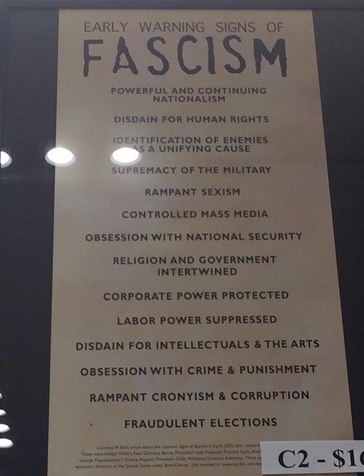
From a display in the United States Holocaust Museum. Purveyors of old news, but not fake news.
When one has early signs of a serious illness, it is recommended that one not deny and ignore them, but face the facts, and start treatment as soon as possible. -
Arguments for moral realismThis seems similar to me to our realization of an external world; which I have never been able to convince myself is a matter of mere inference; even though when strictly considered,from a "purely rational" perspective, it seems as though it must be. See, even here, here I am speaking of "our realization of an external world", as if I could ever know such a thing! And yet.... — John
Try this for size. What one might realise at some point is the distinction between internal and external. One does not have in one's possession an internal world from which one infers the external world, one is presented with and as a world undistinguished as self/not-self, or internal/external. The tastefeel of (m)other/milk/hunger/warm/I/world is.
The philosopher is alone trapped in an internal world of thought and sensation, but this is a sophisticated malady consisting of the mistaking of thought for world. And from there arises this talk of subject and object, and the sovereignty of self, but at the same time it's denigration in favour of the object. I blame Descartes.
Separation from (m)other is a natural process of insight and maturation perverted by a 'system' of 'Education'. One does not then need inference and argument to recreate the world, because the separation is only conceptual in the first place; self does not annihilate the world.
So the philosopher looks at the properties of objects and the sovereignty of self and finds no relation - and obligation is a relation. No wonder he gets depressed and loses all meaning. -
Arguments for moral realismDo you think there are any truths about human subjective nature? You know, things like people don't (generally) like to be used, objectified, raped, thieved from, tortured, bullied, deceived, humiliated, and so on? — John
Sure, those things are true. — shmik
If one can speak objectively of human subjectivity, then it seems to follow that there is something generic about it. One might say that the contents of awareness are always unique, such contents including a sense of self and personal preferences, yet the container is everywhere the same -awareness is the same whether it is yours or mine.
If such is the truth, it is not directly experienced, but inferred; I do not feel your pain, but your pain is as real as mine. I do not need to be told that I ought to avoid my own pain, because it is within my direct awareness, but the need to avoid your pain emerges indirectly from the understanding that we are not as separate as immediate experience suggests.
If your point of view is as real and as significant as my point of view, for all that I have no access to yours, then my obligation to you is equal to my obligation to myself. Of course it is unnatural to talk about obligation to oneself, because it is automatic - 'when hungry I eat, when thirsty I drink'. The understanding that your hunger and thirst are just as significant as mine is the foundation of obligation to another.
It is as if you are a limb that is numb to me, and I am a limb that is numb to you, and morality is the truth that if you damage a limb, you are damaging yourself, for all that you do not feel anything. -
The world is the totality of facts.So, what is it? Metaphysics or no metaphysics? — Question
I think this is metaphysics: the world is under no obligation to conform itself to our talk; therefore we had best conform our talk to the world, to the extent we can.
To expect the world to conform itself to our talk is what is known as magical thinking. As if a cunning arrangement of words can oblige things to be thus and so. -
The world is the totality of facts.Yes. If talk proves talk wrong, stop talking. If talk proves the world wrong, talk differently. Which do you think you've done?
-
The world is the totality of facts.You will need to dismantle Relativity as well as Set Theory, not to mention reason if you want to maintain a "totality of facts". — tom
I actually prefer to dismantle reason, over dismantling the world. That talk and theory and reason is in the end inadequate to the world is relatively unproblematic; we can always just shut up about what cannot be said. And that seems preferable to trying to excise it from the world. -
The world is the totality of facts.My understanding is that this is definitive. It locates facts as physical, worldly affairs rather than linguistic. Statements of fact are statements about the world, and the facts are the truth makers. Thus the statement, "The world is the totality of facts." is not a fact, but a definition, a linguistic affair, for or against which factual evidence cannot be brought.
As such, it is certainly vulnerable to being shown to be contradictory or incoherent, but since there does seem to be a world, and we do talk about it both as a totality and as fragmentary facts, it is so fundamental to discourse that it might well be easier to dismantle set theory if it proves to be in contradiction with such a statement. -
Post truthMost ominously, he is an intellectual in politics excited by grand theories — a combination that has produced unpredictable results before.
And I predict it will do so again, according to this theory I have. -
The terms of the debate.We do want interesting, engaging, thought provoking material, but what that is for me is not what it is for everyone else, and making it this way for the "audience" can only really be making it this way for me. — Wosret
Yes. It is necessarily an act of empathic imagination, but actually not only that. Because I can ask you what you find engaging and thought provoking, and what you find button pressing and off-putting. And while tastes and tolerances and empathy vary widely, there is, I think, a wide (not universal) consensus, despite the protestations here-above, about what we want to see more of and what we want to see less of. -
The terms of the debate.Isn't that what we're already doing, and what Baden did before he decided to delete those posts? You just disagree with the decision he made. But then someone is going to object to most every decision. That's just life. — Michael
I don't disagree with that decision, as I have already said. And since the decision was made after I started this thread, it is not the case that "we're already doing" it. It is also not the case that this thread is just my disagreeing with a decision. But apart from that, I entirely agree - it is indeed life.
Perhaps I should have emphasised above where you quoted me that not responding, and not intervening should also be questioned, and at the moment rather more so. I do know that moderators always get stick, and it requires some resilience to look at oneself squarely and decide whether the stick in each case is merited.
We agree on the moderating decision except for the timing (right?). — Baden
Right. It kind of derailed this discussion a bit, and also made it look like a narrow personal campaign, which it isn't. But let's move on.
I find the amount of "loose talk" is increasing. Being a serious philosopher, I think loose talk is garbage and detrimental to the site. — Metaphysician Undercover
Thanks MU for actually engaging at last, and for some words of support. It's not just the delusions of my age addled brain, then. I think part of the problem is that the site is growing, and the informality that worked fine with members of the old forum, who knew each other, the form, and the boundaries from experience, does not work so well when there are many new members. One can take abuse from one's friends that one finds offensive coming from a stranger. It follows that now there are more strangers, even friends need to be more polite, to set the tone.
Finally, it is quite evident that most likely, some participants are incapable of making such judgements, as am I being irritating, of themselves. How can I ask myself am I being irritating when I have no regard for what irritates another. Furthermore, and this is the real problem, there are some members of society who have an innate desire to be irritating. — Metaphysician Undercover
In the end, or perhaps quite near the beginning, there are those that need to be got rid of. But most people learn from the environment. Having one's pearls cast away is a sobering experience, and most people will anyway adjust their tone to conform as best they can to what is going on around them. So the more one is intolerant of bad behaviour, the less one will see it. And unfortunately, vice versa. -
The terms of the debate.Well the subject of this thread appears to be what to do about off-topicness. — Metaphysician Undercover
The subject is governance. The feedback I am giving is that the governance of the forum, like the governance of many places in the world is failing. I notice that people are confused about the subject, are tending on one side to hasty reactions, and on the other to hasty dismissals.
There are those that are happy with the regime, who think any discussion is fruitless, petty, whining, or some such, and are happy to contribute their views, which they presumably think are fruit of some kind. Then there are the moderators themselves, who are obliged to consider my criticisms but seem to be inclined to destroy the evidence and 'sort out' the problem, rather than to actually look at what the problem is.
The thesis that it is fruitless to consider what is fruitless is one that I dismiss without argument as being contradictory and fruitless. However, given that it is an honest view, it seems that it needs to be expressed, and addressed in some way, if only by pointing out the contradiction.
My wish for the forum is that it should be more interesting and readable, and more significant than the comments section of a youtube video. This requires governance, it doesn't happen on its own. Such governance needs to be in the interests of, and acceptable to, the averagely interesting and readable contributor. (excuse me for stating the blindingly obvious, but in the circumstances it seems I need to start from first principles).
So this particular little thread started to become part of my thinking when I noticed that a respectable if sometimes irritating member had posted a quite interesting video, and then, as a result of negative comments made without even watching the video or knowing the speaker from elsewhere, had withdrawn it. This example of the good being driven out by the bad made me realise that personal attacks, ridicule, browbeating, and the proliferation of nonsense act as negative moderation themselves.
There are immoderators active on this site weeding out the good posts and posters, and encouraging the bad. I do not moderate on this site, but I still philosophise, and so I have been thinking and posting about the issue, relating it to current affairs, and doing my best in my own posts to encourage folks to do some thinking about what is going on. It's an uphill battle.
The problem, then, is how to raise the tone of debate, how to prevent good posters from being discouraged and silenced, how to maximise freedom, given that laisse faire does not lead to the desired result, but to the degeneration of the site. So this means we have to reach some sort of consensus about what makes a good post and what makes a bad post, and this is not all that easy, because, as I pointed out above, someone can honestly think that this discussion is fruitless, and they might be right, so I ought to at least consider it.
And as I am getting it from both sides, as it were, from the moderators 'everyone knows what a shit storm is' and from the immoderators, 'this is an essay length petty complaint', I have considered it, and concluded that both sides are wrong. This is an important and timely issue, that people don't want to go into because it is so intractable, and because it reflects upon the posters and moderators themselves. It is a painful topic.
So to continue the story, I persuaded the poster to put the video up again, which he did in a new thread. And what ensued was the sequence now deleted and characterised as a shit storm, in which I took no small part by way of calling out what I saw as bad behaviour being repeated at some length, intimidating the op and preventing intelligent discussion. Since I do not moderate myself, I drew this to the attention of the staff, and no action was taken, until I started this thread, using that thread as an example to illustrate the current debate. And then the shit storm was quickly excised.
This is unfortunate, because although it was unpleasant and very much off topic, the shit storm brought out various issues, and illustrated some of the difficulties that an ordinary poster faces when moderation is lacking. And this is another illustration of the difficulty of moderation; from my point of view, the shit storm was a valuable illustrative sequence that ought to have been preserved in order to be criticised and understood (or perhaps as an awful warning).
Now one of those issues, which has come up here as well, is 'just ignore it'. Well, no. We have been doing that and so have the moderators, and it does not go away, but proliferates. Engage, ignore, report, moderate, withdraw. there is I think no clear rule to be made as to what is best to do in every circumstance, But I am quite sure that ignore as a general policy does not work.
I suppose that the nearest I can get to a policy to recommend is something like this:
For ordinary members, ask yourself if your post is making a positive contribution, does it encourage philosophical engagement or add interest for others, does it clarify or confuse, does it indeed say anything at all useful or amusing to others.
And for moderators, they have to ask broadly the same question of their intervention. But for moderators there is also a matter of proportionality and consistency.
Paul, in his finite wisdom suggested that the person to bear in mind in all this is the silent reader, who is interested in the topic. They are not, in my imagination, interested in personal remarks, amusing insults, the pronouncements of thoughtless ignorance, and so on.
But the point is, one cannot simply accept some formula, one has to keep questioning oneself, Am I making a contribution, or am I just being irritating. One has to examine this carefully, because, and I hope this is a case, sometimes being irritating is a valuable contribution.
I'll shut up now, having hopefully irritated almost everyone. -
The terms of the debate.He kind of has a point... — Sapientia
Do you really think so? I thought he might have a point too, and that is why I responded. I'm quite amenable to having differences of opinion. There is the principle of charity that wants people to have a point, even if it's mistaken. It takes a few exchanges to really bring out that there is no point, only a desire to disrupt and humiliate. -
The terms of the debate.It might be me but I read the OP as an invitation to find a shared MO that's conducive to the quality of this site without moderating action. But maybe unen can clarify.
Value judgments over other people's characters generally don't help. — Benkei
The original intention was much wider than just this board. There is an ongoing global issue about freedom of speech; the backlash against political correctness, the triumph of lies and propaganda, and the stifling of debate through the undermining of its value as a means of establishing truth.
My thesis is that freedom of speech requires moderation. Without moderation, there is no freedom but the dictatorship of the trivial, aggressive, and hysterical. WRT this forum, the only way to manage with a minimum of moderation is to have a consistently intolerant program of moderation, such that folks learn quickly what is and is not acceptable. This, you will appreciate, is my inner Augustino expressing itself. Liberal socialists need to toughen up.
One has to make judgements of character; how else does one select moderators, politicians, spouses or employees? Having said that, expressing such judgements is almost always off topic in the threads.
This particular thread is concerned with the character of the forum in general, established by posting habits and moderating habits, but more generally with the character of debate in the world at large.
Look at this, for example:
Creating essay length threads complaining about how you can't be as authoritarian as you'd like to in one small corner of the Internet is to be really petty. — Thorongil
I wanted to read your posts in this thread, so I've responded. — Thorongil
How can one have a sensible conversation about anything with this sort of nonsense littering up the thread? I'd far rather have some adverts. And of course there will be more where that came from. -
The terms of the debate.Whatever gives you the impression I want any sympathy?
But I think I know why. You'd like to be able to wield the power to delete and ban whatever and whomever doesn't meet your own subjective criteria for being "likable" and "interesting," — Thorongil
Well that's just butt stupid. I do have that power, but have decided I don't want to exercise it any more.
Creating essay length threads complaining about how you can't be as authoritarian as you'd like to in one small corner of the Internet is to be really petty. — Thorongil
It's rather a shame you don't take your own advice and stop reading my posts, and making petty complaints about my petty complaints. That's the thing with trolls, they won't stay under their own bridges, but have to invade everyone else's with their contradictory and hypocritical comments. You have no insight, nothing to say on the topic, but here you are again making your usual dismissive and vacuous remarks. You do understand that what I am doing here is troll baiting, don't you? -
The terms of the debate.But, let's stop really being so complicated about this, with all our talk about rules, precedent, clear moderating rules, bad facts, and bad law. The problem most often comes down to someone. Get rid of that someone and we no longer have all these complicated problems.
The reference was made to Paul and how he handled things. He not only didn't have rules, but he expressed a disdain for rules. What he did was sort of decide, based upon what he thought was right and wrong, and just banned people unapologetically. — Hanover
How odd, to call for us to stop using a whole lot of terms that you have just introduced for the first time.
Paul had lengthy guidelines both for posters and for moderators, and there was a good deal of discussion of them and some amendments were made. One of the complaints moderators frequently heard was along the lines of 'why have you deleted my post when there are all these other posts that are just as bad?' The usual response was that moderators don't see everything, but it is nevertheless the case that what is allowed to pass sets the tone for others as to what is acceptable and so increases. Keeping the tone overall moderate is important, and letting things slide and then banning is a really poor policy. -
The terms of the debate.I can be a sneaky bastard at times, but this has not gone the way I intended at all.
"If you don't like it, go somewhere else." I don't like this attitude, and I don't find it interesting, but if I ignore it, I legitimise it. It's very simple for someone who is unbothered by bad behaviour, and to an extent it is good advice to ignore it, up to a point.Don't read or post about what you don't like or aren't interested in. It's very simple. — Thorongil
But 'it' is not that simple. We have moderators deletions and bans because one has to read stuff before one can decide it is unlikeable or uninteresting, and one clearly does not want discussions to become dominated with unlikeable and uninteresting stuff, because one loses interest in reading or contributing anything at all. That this happens was demonstrated in the shout box by a poster removing his link rather than have to read the vitriol that ensued. -
The terms of the debate.Anyway, I consider your OP to be about something beyond that. As you said yourself:
I am hoping to look in a more abstract way at how our conversations need to be ordered to maximise freedom, given that absolute freedom is both impossible and undesirable. In this sense, it might be better classified under politics, or metaphysics than feedback, but I feel that the latter classification best communicates the particular knottiness of a discussion about discussion. — Baden
Indeed. But how can I remain abstract, when you are being so practical? I don't disagree with your decision, as the op makes very clear. But you have cut my Gordian knot, and I can no longer untangle it. My discussion has been shut down with a mandated agreement, and I am left with the half-discussion of your moderating decision, which is indeed not complicated.
Much ado about nothing it seems to me.... — Thorongil
Inclinations vary. One of the differences between myself and Paul at the old site was that he was fairly tolerant of flaming, and I was considerably less so. Here, I have taken a back seat, and the tolerance of flames, and other things is greater - so it seems to me. I come across a deal of stuff I would intervene in if I was still intervening.
It is generally the case that whatever is accepted becomes acceptable, so I think the terms of debate are important. If moderating is loosened, discussion becomes more informal, which might be pleasant, but it also becomes potentially more unpleasant, and the failure to suppress aggression risks alienating a whole swathe of voices. Again compared to the old site, for example, I think this place is uncongenial to women. I see that as a failing.
That is to say, tolerance in one direction constitutes intolerance in another, at least in the sense that one man's meaty discussion is another man's poisonous atmosphere. That there is no issue for you simply places you amongst the meat-eaters, It doesn't indicate that they should prevail.
unenlightened
Start FollowingSend a Message
- Other sites we like
- Social media
- Terms of Service
- Sign In
- Created with PlushForums
- © 2026 The Philosophy Forum