
-
How can we justify zoos?Nowadays we can see films of the lives of animals in their natural habitat — jkop
One naturalist - photographer recommended we stop taking pictures of wild animals, too, especially where the presence of photographers becomes a further degradation of the environment. Flying to somewhere in Africa, Central America, Nepal, Siberia, wherever, to drive around, camp, photograph, and so on isn't helping wild animals. There is already a huge supply of nature pictures, he noted. Just being there, driving around, camping, and all that is one more small assault on already fragile environments and ecologies. -
When does dependence become slavery?Thanks for that.
"The Drinking Gourd" references the big dipper constellation. The edge of the cup (two stars furthest from the handle) point toward Polaris, the north star, which is the first star in the handle of the little dipper. So, "follow the north star" north.
I'm most familiar with Pete Seeger's performance. https://www.youtube.com/watch?v=YgakshXwosA The Drinking Gourd was popular with American folk groups back in the 50s and 60s. Seeger, Weavers, New Christy Minstrels, etc. Seeger, the Almanac Singers and the Weavers were all far left. Pete Seeger and the Weavers were big radio hits (pre TV era), which is surprising considering the post WWII right wing backlash in the 1950s. -
The nature of the Self, and the boundaries of the individual.While watching the light at the end of the tunnel... you are aboard the oncoming train that is shining the light at the end of the tunnel... — 0 thru 9
Or, "The light you see at the end of the tunnel is an express train coming at you very fast." -
The nature of the Self, and the boundaries of the individual.Questions such as this, "The nature of the Self, and the boundaries of the individual" are the "chewiest gristle" indeed.
Wayfarer's view that the self "is never an object of perception, nor amongst the objects of perception" seems true. I have no doubt that other selves exist, and I hope I am right that all the selves there are follow the same general pattern of being--else, how could we understand each other?
There are certain kinds of selves that have invisible tentacles extending in all directions and one never knows when one might step on one and be blasted. These selves take up a lot of room. The steppes of Russia are not sufficient for some. And some selves find small sleeping rooms spacious enough. -
Decisions we have to makeI suppose this was as close to an existenital crisis as I've ever had and indeed there was some sort of fear associated with the entire happening. There were indeed a few religious minded people who did confront me with such a question or should I say bargin?
Anyway... the fear never seemed to justify an appeal to a supernatural ally as to work as a placebo to vanquish my fears. — Mayor of Simpleton
When the existential crisis arrives (whatever it is) there is no particular model we have to follow. Rather, I think, we will follow whatever course presents itself, and that might be the course we have most often taken. If it makes sense at that time, if it harmonizes with who one is, then that is the "right" one.
For some people, it is very important that other people should have a deathbed religious crisis of some sort. They want the departing person to See The Light, or something. At my death bedside one of my dear sisters will be sitting there attempting to direct my departure according to her conservative Baptist plan. Just shoot me.
A gladsome Yuletide greeting to you and yours. The days are getting longer now and are supposed to be getting colder. We have the regulation minimum of snow on the ground, but freezing rain and thunderstorms are forecast for Christmas day. It does happen. in 2009 Christmas Eve streets were flooded with rain, then it all froze and stayed frozen until March.
Forget the halls and boughs of holly, fa la la la la la.
Decking walls with thorns is folly , fa la la la la la. -
Whole is greater than the sum of its partscontentious. We could be mereological nihilists and think that the parts of the flower are arranged "flower-wise", but not believe that there is such a thing as a "flower". — darthbarracuda
Maybe we could be mereological nihilists, but we are not -- I'm not anyway. Speak for yourself.
As such, the world is messy. — darthbarracuda
Right, because the soup of many parts boiled over, covering everything up with hot, emergent, whole, complexity. -
Whole is greater than the sum of its partsThe "whole is more than sum of its part" means nothing. It is a just a bumper sticker, a symbol of our ignorance to understand complex phenomena like brain. — miosim
No, no, no. The phrase "the whole is more than the sum of its parts" is not a bumpersticker slogan. Its an accurate assessment of a world in which many phenomena (including us) are emergent, always exceeding the sum of our parts.
Another example. A rich delicious soup has a fixed list of ingredients. Eat the raw ingredients ground up together and it won't taste very good. Simmered in a pot for several hours, and it's heavenly. Flavors emerge in the soup that weren't there in the "un-stewed" parts.
I don't know... If you don't get it, you don't get it. No soup for you. -
When does dependence become slavery?You need to get out and see more shows.
I suppose Gilbert's and Sullivan's work could count as "show tunes" even though The Mikado was written in 1885 and counts more as operetta (or opera to some people).
You might be one of those unfortunates that rushes into a theater without reading the marquee first and doesn't know whether he is watching Parsifal or Pinafore. -
When does dependence become slavery?"No risk, no reward".
If you were to sum up the ideology behind any revolution.... — Gooseone
Less than an ideology, "No risk, no reward" is more a truism, but one well worth remembering.
An ideology would be "The role of a capitalism is to extract maximize profit from the productive process." Or oppositely, (but related) "Labor produces all wealth." Following the wrong ideology can lead to autofucktative results. When labor thinks that it is just fine for capitalists to extract the maximum from their work, they are fucking themselves. Capitalists don't usually make the same kind of mistake because they have clearer class consciousness. Capitalists understand which side of the bread is buttered.
Workers tend to think that with hard work, gumption, a couple of bright ideas, "no risk, no reward", and so on they too will become rich capitalists. Workers who lack accurate information about class structure and operation are not sufficiently aware that hard work will tire them out without making them rich. Add gumption, a couple of bright ideas, and so on -- and they will still be tired out and be no richer than they were before.
If workers want to get rich, they have to do more than merely emulate capitalists: They have to seize the property of the capitalists and operate it for their own benefit. Former capitalists become workers like everybody else (but like as not an unusually resentful, bitter, hateful, and unhappy batch of workers). That's OK. If they don't work, then they won't eat very well. If they do work, they'll get the same rewards as everybody else. If they don't like this deal, there is always a one way ticket to the scenic Aleutian Islands. -
When does dependence become slavery?Not that I'm disagreeing with BC. — mcdoodle
God forbid!
Enter Foucault, stage left. Each of us is complicit in the framework of power we find ourselves in, indeed I oppress myself, I self-censor, I apologise when I don't need to, I accede when I could have asserted. This does seem to me something in us - each of us spends years accepting parental / institutional authority, before each of us breaks out in our own way, with all sorts of residual obedience to habit / instruction / people. — mcdoodle
Yours is a succinct summation of our situation.
Just as there is no government without the consent of the governed (a statement which is generally true if not applied too literally), everyone in the workplace gives daily assent to the rightness of the bosses (of no special merit) telling many people (who the bosses don't need to know much about) what to do--when, where, and how.
a lot of people in secular "advanced" societies might be suffering from a distinct lack in ideology. — Gooseone
Indeed they might.
It takes clear ideology, along with strong solidarity, to successfully challenge the dominant paradigm. Do it alone and you will be kicked out the door. Do it together with vague understanding and you'll find all of your wages docked. -
When does dependence become slavery?I promised my liver would behave after next week. >:) — Cavacava
The reason that livers don't decide — Hanover
Gilbert and Sullivan mention liquified livers in one of their songs...
A more humane Mikado never
Did in Japan exist;
To nobody second,
I’m certainly reckoned
A true philanthropist.
It is my very humane endeavour
To make, to some extent,
Each evil liver
A running river
Of harmless merriment. -
When does dependence become slavery?Why are there cracks to fall through in the first place? — Mongrel
Those aren't cracks. What you call "cracks" is the grating in the bottom of the machine. -
When does dependence become slavery?Righto. But bear in mind that in a system of wage slavery, not having a place on the assembly line means yet another more severe form of degradation. Unemployed wage slaves have just about no reason whatsoever to exist, as far as the system is concerned.
There is no intention within the power elite to reorganize society so that people who do not want alienating labor can find a path to something better.
Some people, in some situations, are happy doing alienating labor. I've been there a couple of times doing fairly simple shit work that had absolutely no value to me, but the setting was interesting. (It was reboxing old, water-damaged trust files for First Bank and Trust (now US Bank). What made this task moderately interesting was that most of the other people working on the project were patients from Hazelden Drug Treatment and we were free to talk while we worked. It was practically a graduate seminar on drug abuse and drug treatment.)
Another thing that made this crap job OK was that the management didn't care what we were doing as long as there was a steady flow of unboxed, sorted, reboxed, labeled, and cataloged boxes to be shipped out to a storage company--and the bank hoped, never to be looked at again. -
When does dependence become slavery?When does dependence become slavery? The moment the IT Department installs filters which interfere with freely surfing the web?
A human society is different from that. The idea of slavery causes revolts and revolutions. I'm trying to find the beginning of that. Is it something that's done to us? Or is it something we're all collectively creating? — Mongrel
Slavery existed for a long time within Greek and Roman culture without causing any (successful, at least) revolutions. And slavery in Greece and Rome wasn't all about pedagogues (παιδαγωγός) teaching children poetry. The model of slavery in Rome may not have been as implacable as slavery in America.
Marxists speak of wage slavery. In harsher capitalistic societies if you do not work, you do not eat and that is "your problem, not mine". Marx (or maybe the American socialist DeLeon) noted that in America it was cheaper to hire an Irish worker to fix a roof than use a slave. If the Irish worker fell of the roof and died, the largest possible cost would be the day's wages before he died. If a slave fell off the roof and died, one would be out a good deal of money.
Capitalism has moderated; crumbs are dropped on the chronically unemployed -- General Assistance (like, $250 a month). Unemployment helps short term unemployment. Disability programs help those who can't work. But still, if you don't work, you get very little. This isn't an accident.
It takes visibly impoverished unemployed people, slums, shelters, food shelves and such to make millions of people drag themselves into their dreary jobs, spend the day being managed by overseers, getting paid too little for the value produced (the key to capitalism), and then drag themselves back home for whatever is left of the day.
Only a small proportion of hourly wage workers are engaged in labor that is not alienating. A good share of salaried workers aren't doing anything very fulfilling either. A relatively small minority of workers are engaged in labor that provides personal satisfactions. (Maybe 15%? 20%?)
It's pretty much wage slavery for most of us, -
Philosophy is an absolute jokeMaybe we should vote again, just like the Brits should return to the polls on Brexit and maybe get it right this time.
-
Philosophy is an absolute jokeThe absolute failure of philosophy — lambda
Just curious, How much difference would it make if philosophy were merely a failure, and merely a joke rather than an "absolute failure" and an "absolute joke"? Are absolute jokes especially funny? -
Whole is greater than the sum of its partsThere is a book, The Art of Clean Up, which organizes whole objects into their parts, like this bouquet of flowers:
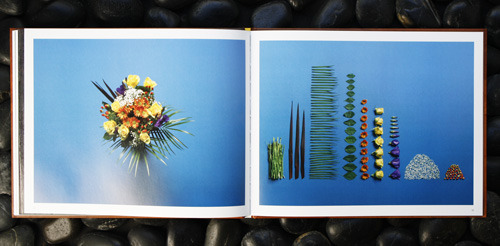
Which is greater: the live plant parts forming a whole bouquet, or the disassembled bouquet laid out in rows as parts? The parts are the same, the mass is the same, but one is a bouquet, the other one isn't.
Theoretically, we could take your brain apart and lay out the neurons, vessels, white matter, etc. side by side on a very large table. Which would be greater? Your disassembled brain (parts) or your whole brain?
Clearly, the whole is greater than the sum of its parts, because as part of the whole, nerve cells, flower petals, and so on can do things that they can't do alone. Actually, as parts, nerve cells can't do much of anything. -
How can we justify zoos?It won't be long before some species exist only in zoos. Take the orangutangs living in the Indonesian forest which is rapidly being cut down and broken up into fragments in which the great Asian ape can not survive. The forests are being cut down for timber, paper production, and huge palm oil plantations.
Rhinoceroses are another example. The number of giraffes is dropping rapidly. Pandas...
Having a piddling genetic pool of species in zoos is the next thing to not having them at all, of course. Zoos do not make up for wrecking the rain forests.
We could, of course, live without so much paper, timber, and palm oil. Is the demise of orangoutangs worth healthier arteries in humans (if that is even the tradeoff for not sucking up hydrogenated vegetable oils the way we used to)? -
Decisions we have to makeThat's not so much fear as . . . well, I'm not sure what to call it. — Terrapin Station
Profound regret, maybe? -
Decisions we have to makeOr you can opt for eternal non-existence
— Bitter Crank
Ah, but can you? How do you know the itch which gave birth to you in the first place won't forever continue to do that? — Wayfarer
Of course I know no such thing, but nowhere along the line did the idea of of infinite rebirth sprout and take root. I won't fear that I will be reincarnated as a scarab beetle, either, or that my relatives will in some way be responsible for supporting my ghost in the after world. Scores of millions of people on their death beds will be concerned about those issues, and they won't be concerned about fluffy clouds and angels with harps of gold.
I don't know how I will feel as I lay dying. Lots of dying people feel really just wretched, and are probably not engaging in a lot of philosophizing. They're trying to just make it through the day, or to death, whichever one comes first. On the one or two occasions when I have been very, very sick I didn't give the afterlife a thought.
Now is the time to deal with the issue, when one is feeling pretty good and clear headed. Think about it and settle on one side of the fence or the other. There either is a god or their isn't. Then live accordingly. -
Sapientia should read thisI have more reason to speak them then someone with less controversial views. — Ovaloid
Sure, we are interested in at least making a strong case for our views; how often one person is actually so convinced of somebody else's view point that they actually change their mind... probably not that often.
Why do you, with controversial views (if they are), have more reason to speak them than people whose views are not controversial?
I'm not unsympathetic. As someone with controversial, and sometimes very unpopular views, I get that one feels obligated to reveal what thinks is true. But this obligation is pretty much driven by emotion. I want to be heard. I'm not disparaging that motivation -- I think emotion is more responsible for what we believe and think than logic will ever be.
Did you respond to Sapientia in the thread from whence your reference came? -
Decisions we have to makeOne could at the last assent to a god who unconditionally accepts us and understands our frailties, follies, and foolishnesses. This god forever cares for the souls of all humanity , regardless of what they did or didn't believe, did or didn't do, and IF indifferent to our suffering in this world, does not rejoice in our pain. What this god offers is the expectation of an eternal home, neither a tedious heaven nor a hideous hell.
Feel free to add on whatever else you need. You want to be reunited with dead lovers, dead dogs, dead parents, and dead children? Sure. No problem. You want the tunnel of light? Fine. You want fluffy white clouds, harps, trumpets, and angel wings? OK, but be aware that this option also comes with red devils, pitchforks, and pits of boiling high fructose corn syrup. Upon death you roll the dice, which may or may not be loaded, and you get EITHER the white fluffy clouds or the hot fructose.
Or you can opt for eternal non-existence, which offers relief from your present suffering. Unfortunately, you can not combine offers. You either get reunion with dead lovers, or you get eternal non-existence, but not both. -
'Proper' interpretationAre you trying to say that a person should not complain if he or she is misunderstood? — Ovaloid
Yes.
I am at least as likely as you are (maybe more so) to write something that falls short of precision and clarity. It is the writer's job to eliminate as much ambiguity and vagueness as they can from their compositions. It is the reader's job to read as carefully as they can, and I am as likely (maybe more so) as anyone else to fail at this task.
Now, it is possible to write with perfect clarity and precision and have people reject one's statement. Rejection isn't the same as misunderstanding.
If it wasn't clear to you that I was rejecting some of what you wrote, and wasn't merely confused, then that is my fault, not yours. -
What's wrong with ~~eugenics~~ genetic planning?Actually the way I, OP, used it, it could also mean a cultural attitude and thinking or saying otherwise shows that you haven't actually read the OP properly. — Ovaloid
I don't know why you are telling me this 16 days after I posted my comment. I could have died and been buried a couple of weeks ago, and might have left this world without your ever-perceptive correction.
If posters want their texts to be read in a very specific way, then they better write precisely structured posts so that errant "misreadings" are nigh unto impossible. We cast our bread on the water. If gulls rather than swans swoop in and snatch it... well, that's life in the big city. -
What is self-esteem?
Step 1. Acknowledge that your inner critic is very negative and won't shut up. Expect to hear from it regularly. One of the objectives of meditation practice is to learn to let mental chatter float by without responding to it. I'm not sure you can just make it shut up. Hence, #2...
Step 2. Hire another internal critic to say positive things about you. That's right, imagine it. Imagine your positive minded critic saying good things about you. Hear it say those positive things. You say those positive expressions to yourself out loud.
Not being perfect isn't a disaster. Nobody is perfect.
Is the negative yammering in your head a result of low self-esteem? Oh, maybe. It could be. Unenlightened doesn't think so, but then he doesn't get it. It could also be a habit of mind to think poorly of your self. (so, stop that. Start thinking better of yourself.) It could be an insufficiency of pleasurable neurotransmitters in your brain's synapses. Not enough serotonin, maybe.
If it is a deficiency of serotonin, maybe an antidepressant that boosts serotonin levels would help. The reason for seeing a psychiatrist, and not a GP, about depression is that psychiatrists often have more experience with prescribing, and get better results. But... not always.
Are you involved in positive social activity with other people? Sometimes good company can be an effective anti-depressant, in the short run, at least.
Good company helps, bad company makes things worse. It's the same with food: Good food is better than bad food. -
What is self-esteem?Well of course, I myself see myself as acute, sharp and fine, 8-) but my own condition is entirely beside the point, except just now to illustrate how put-downs tend to provoke put-ups. But I repeat, personally, since you make it so, why should I care whether I am obtuse or acute, blunt or sharp, coarse or fine? How does this good feeling or bad feeling enable or prevent me from posting in whatever manner I post? — unenlightened
Note, I said your response seemed obtuse, blunt, and coarse, (and surprisingly so) not that you are personally obtuse, blunt, or coarse.
As a concept, self-esteem is having its day. According to Google Ngram, the use of the term was flat and sparse between 1800 and 1940https://books.google.com/ngrams/graph?content=self+esteem&year_start=1800&year_end=2000&corpus=15&smoothing=3&share=&direct_url=t1%3B%2Cself%20esteem%3B%2Cc0, *** at which point it began its rapid ascent.
Some people dislike the term--midwestern suburban political and religious conservatives, for instance. There was a very negative reaction when some state education departments added a self-esteem promoting component to the curriculum. I am not suggesting that you are part of that cohort. You have your own reasons for disliking the term/concept. (It is a guess, of course, that you dislike the term. Maybe you love it.)
Contemporary mental health thinking holds that it is a good thing if people think well of themselves, whether they are obtuse or acute, blunt or sharp, coarse or fine. (There are limits, however. The self-confidence, self-esteem, and auto-biographical praiseworthiness of a Donald Trump locates him in the category of puffed-up narcissist.)
Self esteem is part of a larger picture of what healthy personhood can be. Self-confidence, self-assurance, self-respect, dignity, morale, self regard, self-satisfaction, and so on, are related terms. One word list has it that humility, modesty, and meekness are it's opposites, which is certainly debatable. Self-loathing, self-abnegation, and self-destruction are the well that one falls into when self-esteem runs out.
*** Here's an sample of how Google Ngram gets its information:
Phrenology: Or The Doctrine of the Mental Phenomena, Johann Gaspar Spurzheim - 1833.
"Organ of Self-esteem. Self-esteem is one of the faculties generally attributed to external circumstances ; but its activity is so very great and universal, that I am astonished it has not been at all times considered as a special feeling."
If you go to the site you can be linked to the books from which texts are taken and read pages... -
What is self-esteem?I disagree. Why does one need it? For what? Can one not tend the garden or wash the dishes without? — unenlightened
Your response just seems obtuse, blunt, and coarse. Self-esteem is a good feeling about the good of one's being. My guess is that you have it and have no intention of abandoning it.
Using your logic...
I only need high self-esteem if I have low self-esteem. I convince myself of my potency because I feel impotent. — unenlightened
...I would assume the only reason you see no need for self esteem is that you already have it. -
What is self-esteem?Would you say that depression came first or is this a matter of society inflicting pain and suffering on an individual to live up to some standards that we collectively believe in?
The dissonance between shared beliefs and one's own self can be quite burdensome. — Question
The cowboys inflict some pain and suffering on errant members of the herd. There are standards that we collectively believe in. Where depression comes in depends on the individual. For some, depression was in the beginning, is now, and might seem like 'ever shall be' (unless they happen to find some effective drugs, therapy, get more light in the winter, change their life...) For others it is a result of getting herded where they really don't want to go and being harassed by the cowboys too much.
Dissonance between shared beliefs and the self is a given for most people, unless one happens to be the Ideal Type that so fits society's expectations that there is no dissonance. Some people are, most people aren't. Dissonance can serve as an impediment or an imperative, depending. Some say "Conform." I say, "Join the Resistance."
I only need high self-esteem if I have low self-esteem. — unenlightened
One needs a reasonable degree of self-esteem whether one has it or not. The cost of not having enough self-esteem is generally costly for the individual, The cost of having way too much self-esteem is often born by society (after they get elected president). -
How things came to be this way. Share your story of the universe.There was a big bang and then the beginning. Later we showed up. Now we're spinning yarns about how we got here. Most of the evidence is hearsay, for practical purposes, whether it's the Logos or the cosmic microwave background. When did I come to believe? When Professor T. M. Beyer lectured about the two competing theories, the steady state or the big bang, in Geology. I took his word for the big bango, and I've read and heard more accounts, and I take it as gospel if it leaves out God and things resting on the backs of giant turtles.
-
Is hard determinism an unavoidable theological conclusion?Hard theological determinism (or 'predestination') seems to be a logical consequence of God's omnipotence. — lambda
The all-powerful, all-knowing, ever-present, God is, of course, deterministic. You can't hardly avoid it.
Such a god, however, gets in the way of another doctrine that most people like very much, and that is at least some degree of free will.
The solution is to chisel out territory where our decision making can occur freely. Otherwise, we are just doing what we are compelled to do at every instant. In such a world sin and salvation is pretty much irrelevant.
Aren't theologians being inconsistent when they say "God is omnipotent, omniscient, and omnipresent and man has free will"?
Sure they are, but since God is man-made (created in our own image), we can build in however many exceptions we want. One might say there is no reason for anyone to feel guilty no matter what they did, because god determines everything. Well! Hold on, that undermines the control mechanism of guilt, which we have to keep -- otherwise people would be running around doing whatever they felt like. Can't have that!!! Obviously there is room for people to autonomously perform evil acts for which they can be hanged, or made to feel very very guilty.
Humans often screw things up, and god is no exception. -
What is self-esteem?What is self-esteem? — Question
Accepting and liking one's self. A sense of self-worth
People who are low achievers can have healthy self-esteem, and high achievers can have an unhealthy sense of unworthiness. One has to accept what one is, whatever that is. This is a truism, of course, but truisms are... true. It is also true that people can have ridiculously over-inflated egos and estimations of their self-worth which 99.9% of everybody else won't agree with.
Part of the structure of what we call depression is a perfectionist drive on one hand, and a beating one's self over the head for failing to be perfect. This vicious cycle drives down one's sense of self-esteem.
It doesn't follow that accepting one's self means never having to try to be better. One can accept one's self, and work towards self-improvement. But one will want to avoid perfection. Very, very, very few athletes (like gymnasts) ever get a perfect 10. Nice when it happens, but one doesn't have to aim for a 10 in one's personal life.
Humans are imperfect, rough-cut, at least somewhat irrational beings, Many of us have unfortunate histories which are going to get in our way all the way to the grave. That's why self-acceptance is important: we're knotty pine, cracked porcelain, faded purple, rusted steel. Never perfect, usually not all-around excellent. We can't accept others until we have accepted ourselves. -
PopSci: The secret of how life on Earth beganEvery single person who died before Darwin published Origin of Species in 1859 was ignorant of humanity's origins, because they knew nothing of evolution. But everyone alive now, barring isolated groups, can know the truth about our kinship with other animals. — Wayfarer
Granted, this has nothing to do with the origin of life, but ...
I'm reading an interesting book on horse power in the US during the 19th century. Horse breeders had a few problems in getting the results they wanted (or at least getting them reliably):
1. They didn't know about dominant and recessive traits (Gregor Mendel's work wasn't republished until early in the 20th century). Of course they knew little to nothing of evolution.
2. Their more general ideas about breeding practice included: the stud was the transmitter of characteristics, their ideas about particular breeds (like percheron, quarter horse,, pinto, etc.) were contradictory and inconsistent.
3. They thought horses were "moral animals" and some people disliked the idea of breeding donkeys and horses together, because it was a violation of the horse's dignity. The term "mulatto" which was applied to people with black and white ancestry, originally referred to mules.
4. The sharpest theory (without mendelian principles) was "breed the best to the best" and fix features by inbreeding. But some people didn't like the idea of "incest" being "forced upon" horses who were, after all, "moral".
Considering that millions of horses were bred and raised, 19th century horse producers had some practical skill, but it didn't add up to a lot of understanding. If a horse got sick, which they did rather regularly, they didn't have much science until the the last quarter of the century, and even then, germ theory wouldn't have reached your average hamlet for a while. -
Does there exist something that is possible but not conceivable?Granted. I can't turn out Pulitzer Prize content all the time. Sorry.
-
Does there exist something that is possible but not conceivable?It's possible that Trump will make a good president, but it's not really conceivable.
-
So you think you know what's what?I also don't base anything re my political or social philosophy on any of that information — Terrapin Station
No? But I bet your political and social philosophy is informed, none the less. Knowing how many billions of dollars are spent on extra pairs of shoes or pet peripherals (not food, but all the other stuff) or entertainment-oriented magazines isn't the basis for a philosophy, but it could be the basis for understanding that many nations have enough extra money floating around to solve some of their problems, IF they wished to. -
So you think you know what's what?I readily agree that we don't, for the most part, have a handle on what's what and what's not. I did the quiz yesterday and did quite well, though was embarrassed by missing a question on wealth distribution which I grouse about a lot. (I wasn't far off, though.)
Is it a problem? Yes. Will anything be done about it? Probably not. Why not? Because most people are not, and are not going to be even midlevel devision makers, and it doesn't matter what they know or don't know. The power elite isn't dedicated to the task of democratizing power, and hence, democratizing knowledge. Fifty years ago, insightful observers of the educational scene concluded that one of the primary functions of the educational establishment was to regulate the labor pool. Classroom teachers, of course, didn't think that's what they were doing, and probably principals didn't either. But school (the last 2 or 3 years of high school and undergraduate college) do delay more or fewer students from going directly into the labor pool, and it helps direct them to the right area of the labor pool.
Teaching geography in its various forms--maps, economic facts, demographics, etc., is a piece of the cure. So is teaching history -- local, national, and international history. The solution is not difficult IF it is deemed worthwhile. As it happens, it has not been deemed worthwhile. -
The key to being genuineWatched clocks never boil — wuliheron
Good. I like that. Simple and a nice turn of phrase. Did you make that up or did you steal it from somewhere. (Artists steal everything, somebody famous said.)
Authenticity is when any distinctions between our hearts and brains,
No longer matter anymore because harmony neither acts nor reasons;
Knowing without knowing the only thing we can know is but nothing,
Being incapable of ever straying far from the path lost and all alone! — wuliheron
"Knowing without knowing the only thing we can know is but nothing," I can't decide whether there is more than meets the eye in this line, or less. Maybe this quatrain could be tightened up a bit.
Most of your lines are end-punctuated; you don't seem to use multiple clauses that can form a stanza. Is this a virtue or a defect, do you think? Speaking of stanzas... perhaps more breaks in the block of text would be useful. For instance:
For us to be all that we can be each heart must first be free!
For us to be all we can be each must free their loving hearts!
Set your heart free, and it will reward the favor many times!
Set your heart free if you want, to experience actual freedom! — wuliheron
These four lines break into two related two-line stanzas quite nicely.
Any reputation is like a fire that can be arduous to rebuild! — wuliheron
This thought is a bit murky... once it goes out, it is difficult to gather the fuel and get it going again? True, though. "In America, there are no second acts." somebody said. Other times, other places, people's reputations are extinguished and they rise again -- not from the ashes, they rise someplace else, fresh territory. There are second, third, fourth, and fifth acts. Were I to go back to age 21, and have to endure the bits and pieces of my history as I lived it through the next 50 years, uff. Very unpleasant thought.
In general, your poems reflect much more 'exuberance' and almost a revelatory drive. At least, this seems quite unlike the Wuliheron I remember from the old forum.
Your poems have something of stream-of-consciousness looseness about them. Do you go back and edit them, or is it more "What I have written, I have written--period'? -
Philosophy talk dot orgThat would be annoying. Some PR firm is probably working with them on establishing a "more definite identity". I hate these kinds of things. The Minneapolis Institute of Art recently decided to call itself "Mia" - pronounced "me ah". Totally loathsome. Another huge annoyance, even though I don't have to deal with it often: instead of "Champaign-Urbana", THE U of Illinois has reversed the order of the two names given for its location. Urbana Champaign? Why?
-
The alliance between the Left and IslamFor the lazy: stoning to death is the punishment.
— Emptyheady
I think you reveal yourself here as an amateur Islamic scholar, unaware of the subtleties, nuances and rules of abrogation in that deeply complex religion. Allow me to educate you:
While stoning to death is AN accepted method of killing gays (Quran 7: 80-84, 15:72, 27:58, 29:40), it is not the ONLY method.
Gays can also be killed by throwing them off roofs, THEN stoning them if they are not already dead. OR they can be burnt at the stake. — tom
Glad we got that cleared up.
@emptyheady
I used to know actual leftists, but most of us have died, gone into dormancy for the duration, or aren't dead yet.
The leftists I knew disdained the religions equally: Hindu, Christian, Moslem, Buddhist, Jewish, New Age, liberal, conservative. All opium.
For such leftists as still call themselves that, and progressives (whatever that is) perhaps the problem is their relativist views. Few of them have much religious conviction or knowledge, the lack of which may leave them feeling slightly guilty and unequipped to assess their own or others' religions. Progressives are also afflicted by the soup du jour approach: Who is not being adequately cherished today?
There is also what Bertrand Russel warned about: the alleged superior virtue of the oppressed. It doesn't exist. The oppressed are just as likely to be morally contemptible as anybody else. Being oppressed doesn't make people good. Oppression just puts the sons of bitches at a disadvantage. How much sympathy are the disadvantaged sons of bitches worth?
Are all Moslems bad? No. Is Islam all good? No. Did Islam accrete and hold onto some primitive tribal content that they would do well to get rid of? Yes. Is Islam given to greater extreme views than Christianity or Hinduism? Maybe not, but most religionists are capable of going off the deep end. Is Christianity any better than Islam? To the extent that it has overcome it's witch-burning queer stoning scarlet letter branding tendencies, yes--it is. Enlightened Christianity or Islam are still opiates.
Fundamentalist Moslems, Hindus, Christians, etc. are all a plague. Conservative religionists are a drag. Moderate, wishy-washy believers are just smoking lukewarm dope.
BC
Start FollowingSend a Message
- Other sites we like
- Social media
- Terms of Service
- Sign In
- Created with PlushForums
- © 2026 The Philosophy Forum