
-
Just for kicks: Debate FascismOutstanding examples of fascist governments may be dead, right now, but fascism itself emerged out of nothing much a little before 1920. By 1930 it was in full swing in a number of countries.
Yes, neo-naziism is not a viable political movement at the moment. It strikes me mostly as some sort of weird psycho-sexual costume party.
But... that said, there is always the possibility of it's reappearance, not motivated by the conditions of the early 20th century, and not using quite the same rhetoric. The next fascism will be new fascism and not just reheated left overs.
True enough, "fascist" is an epithet a good share of the time. One should not throw it around loosely, not because somebody will be insulted, but because one should use an epithet like "fascist" with some precision. (Not all epithets need to be used precisely. "Bastards" for instance can have their biological father as father-in-fact. Assholes are not literally anuses.) -
What are you listening to right now?
La Seine est aventureuse
De Châtillon à Méry,
Et son humeur voyageuse
Flâne à travers le pays...
Elle se fait langoureuse
De Juvisy à Choisy
Pour aborder, l'âme heureuse,
L'amoureux qu'elle a choisi!
Elle roucoule, coule, coule
Dès qu'elle entre dans Paris!
Elle s'enroule, roule, roule
Autour de ses quais fleuris!
Elle chante, chante, chante, chante,
Chante le jour et la nuit,
Car la Seine est une amante
Et son amant c'est Paris!
Elle traîne d'île en île,
Caressant le Vieux Paris,
Elle ouvre ses bras dociles
Au sourire du roi Henri...
Indifférente aux édiles
De la mairie de Paris,
Elle court vers les idylles
Des amants des Tuileries!
Elle roucoule, coule, coule
Du Pont-Neuf jusqu'à Passy!
Elle est soûle, soûle, soûle
Au souvenir de Bercy!
Elle chante, chante, chante, chante,
Chante le jour et la nuit...
Si sa marche est zigzaguante
C'est qu'elle est grise à Paris!
Mais la Seine est paresseuse,
En passant près de Neuilly,
Ah! comme elle est malheureuse
De quitter son bel ami!
Dans une étreinte amoureuse
Elle enlace encore Paris,
Pour lui laisser, généreuse,
Une boucle... à Saint-Denis!
Elle roucoule, coule, coule
Sa complainte dans la nuit...
Elle roule, roule, roule
Vers la mer où tout finit...
Elle chante, chante, chante, chante,
Chante l'amour de Paris!
Car la Seine est une amante
Et Paris dort dans son lit! -
Is an armed society a polite society?Is Landru a real person? — The Great Whatever
Yes, Virginia, there is a Landru. Landru, an omniscient computer on the planet Beta III, had a near-tyrannical hold on Beta III's people until Captain Kirk put a stop to it. This is the way Landru wished to represent himself. Apparently Kirk wasn't quite as successful as he thought. Landru escaped from Kirk through an unguarded TV screen back in the 1960s. Just walked out of the screen into a state college dorm TV room and took over. A generation of leftist students was the result. There was infiltration and subversion. There were sexual outrages on campus. Lesbian separatists performing unspeakable acts on the Quad (It was quickly paved over -- literally - to contain the sacrilege. Sodomy in the stacks. Buggery back stage. Je suis l'homme -- well never mind.

-
Is an armed society a polite society?This is a video I saw on the NYT site of a man being shot by police. He was a suspect in a bank robbery. He was thought to be holding a barber's straight-edge razor. This is a good example of excessive force. The suspect didn't have a gun and hadn't displayed a gun in the alleged bank robbery. (He said he had a bomb.) Even though a throat could be cut quite nicely with a razor, a taser or a non-lethal shot (or maybe just a whack on the wrist with a club) would have been sufficient to disarm and or briefly incapacitate the man.
This situation is similar to a shooting in Chicago (from a year ago) in which an officer gets out of a squad car and in a few seconds shoots a young black male suspect (for something involving burglary, can't remember just what) who was running down the street, past the officer. The Chicago victim was not thought to have a gun. Shootings like this, of black men usually, are what infuriate the Black Lives Matter group.
Frequent gun fire in cities, frequent fratricidal killings by gangs and various criminal enterprises, gun ownership driven by fear of attack and fear that the police will fail to protect the community, high levels of suicide, undercounted non-employment, cutbacks in essential social support systems (the safety net), failing school systems, declining health outcomes (where that is happening), deep levels of chronic poverty, and so on are threats to the the liberty of a nation IN THIS WAY:
All these things undermine the average citizen's confidence in the institutions of society and lead them to be more susceptible to the harsher solutions offered by outright fascists, crypto-fascists, and proto-fascists. Is there a fascist plot in the works? I really don't know. I rather hope not--BUT, ineffectively controlled violence favors the development of fascistic groups. The militarization of police and the often disproportionate responses to any kind of resistance to the police are not typical of civil government.
I'm not blaming the heavy handed actions of the police alone. Liars, thugs, thieves, knaves, and scoundrels make their own hefty contribution to uncivilized life. They are not, generally speaking,any sort of force for good, civilizing influence, or democratic uplift movement. Neither are terrorists. Neither are mendacious, hypocritical, sanctimonious, devious, corrupt politicians. They all make it easier for some demagogue to step in and offer "simplification" with an iron fist. -
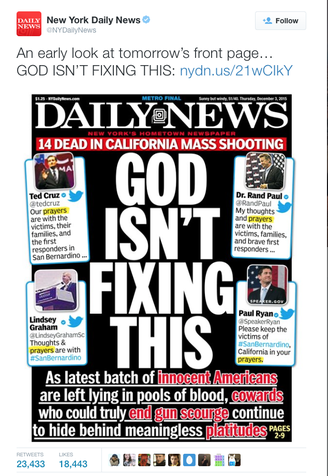
Is an armed society a polite society?I have no objection to sincere prayer; neither does God (He said so). When politicians who are running for office call for prayer, especially those politicians who are highly unlikely to do anything about violence in America, one should presume that a mendacious travesty is underway.
Suggesting that our thought and prayers be with the victims is cheap grace. It's a ploy. It's an affront to both the victims and to the God to whom the prayers would be directed.
What the legislators should be praying for is the courage to do what any rational legislature would do, even if it means they are bounced from office in the next election: enact laws that tighten access to assault weapons and hand guns--laws that are as tight as the NRA's grip on these bastards' balls. -
Is an armed society a polite society?I thought this was a good response to the sanctimonious and hypocritical calls for prayers by various candidates for the nomination to the POTUS slot on the ballot.
-
What is love?I've never been convinced that there is any such thing as "platonic love". I think it is a euphemism for a relationship that has not gotten, and won't get, to first base. I don't think there is any such thing as romantic love which doesn't have a sexual component -- whether sexual attraction or desire is expressed or not. I also don't think there is such a thing as "asexual" anything in human relationships. Sex is, per Sigmund Freud's account and many others' testimony, ubiquitous in human affairs. It isn't that we have to fuck everybody and everything we see, it's just that a sort of very basic sex drive (the id) powers our personalities. It's the most basic emotional force we have --the basic desire to exist and have pleasures.
-
What is love?I didn't think it was controversial that men are less attached to their children than women, on whatever metric you care to use. Or am I wrong about that? — The Great Whatever
You are wrong about that (and some other points) because you are generalizing far too broadly. Some men clearly do not like, do not care about, and do not want to be around to nurture, support or defend their children. What percentage? Some. I don't know how many. It would not take a an incredibly difficult research project to find out.
Are all women attached to their children equally, and more than any man could be? No. Some women would rather not raise the children they have. Some men make better mothers than some women. Some children are unlucky enough to have parents who are both either hostile or indifferent to their children's needs.
Some men are clearly attached to, love, adore, and want to be around their children a lot. What percentage? Some. I don't know how many. It would not take an incredibly difficult research project to find out.
I predict that our researchers would find that the statistically averaged man and woman have slightly different levels of attachment to each other and to their children, but that individually their attachment levels would fall within a range adjacent to the central tendency. You would't find many men and women who were several standard deviations away from the average. (This is true for all sorts of things.)
Do men and women actually love each other for the person their partner is? Yes, most heterosexuals love their partners a good share of the time as authentic persons. No person loves their partner unequivocally and unconditionally 100% of the time. For one thing, that kind of love takes time to develop -- it doesn't show up on the honeymoon or maybe even by the 10th wedding anniversary. For a second, people are just too irritating at times. It's surprising that more married people are not killed by their partners. If married couples stay together for a long time (like 25 years) they have a good chance of arriving at love that is at least closer to unequivocal and unconditional.
Over-generalizing about gay men is as prone to bad results as overgeneralizing about straight men. Most gay men fall into the area close to the average and either side of it. How many partners do gay men have? Some have 2,000 in a life time but most don't (happily or not). One variable is how quickly they settled down. I find it very difficult to imagine either what it is like to find a man and stick with him for 50 years without having sex with anybody else, or why one would want to do that. It's surprising that more gay men are not killed by their partners. If I had it to do over again, I would still play the field for a decade or so first. But, none the less, some gay men have met each other at work, church, the bar, the furniture department, or wherever and stayed together thereafter. (Mercifully, that is not the norm -- yet, anyway.)
Numerous studies have found that gay men's emotional and intellectual capacities for love and caring, achievement, insight, mental health, and all that are quite solid. They can behave in ways that many heterosexuals find appallingly libertine, and still be healthy people. Are gay men all that different from straight men? Why don't straight men have tons of sex before (or after, even) they marry? Well, some do -- but for the most part, straight women don't let them get away with that approach. Gay men don't have straight females around to put a break on free range sex. Straight men do. -
Is an armed society a polite society?Unfortunately guns, gun ownership, gun violence, the 2nd Amendment, and some other issues have been become so intertwined they are inseparable.
- Most Americans (2/3) don't own guns.
- The 1/3 of Americans who own guns are not responsible for most of the deaths resulting from gun fire.
- A large majority of Americans want some kind of policy (nobody knows what this would be) which would reduce violence.
- The leadership of the National Rifle Assn. (NRA) are not entirely in step with their own members.
- Many of the guns used to kill people are obtained through less-than-legal means.
- But some massacres (Like the latest one) involved at least some legally purchased guns.
- Gun violence is not evenly distributed across the population.
- The community who suffers the most from reckless gun violence by gun owners (the black community) is at odds with the police.
- Some black deaths as a result of police fire were literally over-kill, but most of them were not.
The first problem we need to solve is how to reduce purely domestic, civil gun violence among the demographic groups that represent a disproportionately large share of the shooters and the shot.
The second problem we need to solve is is how to limit access to guns by the relatively small number of people who are deranged, mentally very unstable, delusional, and paranoid. (This can not be done with inadequate forensic psychiatric services.)
The third problem we need to solve is how to limit access to guns by the larger number of people who are engaged in criminal enterprises.
The fourth problem we need to solve is how to identify potential terrorists. (Terrorism might be scarier than routine run of the mill killings, but the far greater danger is from the low-lifes running around shooting at each other.)
The fifth problem, really the ultimate one, is how to change our society from the shithole it is becoming for large numbers of people, to one toward which most people feel much more loyalty, commitment, and from which they get more satisfaction. This problem makes gun control look like child's play, because it involves reorganizing national priorities, drastic reform of tax law, domestic re-investment, and a batch of other things that the ruling class really isn't all that interested in doing.
- We won't solve our violence problem as long as we have a large number of people (across races, age groups, sex) disappearing from the labor market because they can't find work.
- We can't solve our violence problem as long as we have a readily recognizable underclass which is largely confined to one race. (And the solution isn't to integrate the underclass by reducing even more people to lumpen status.)
- We won't solve our violence problem as long as we have a steadily diminishing number of jobs that involve production of sufficiently valuable goods to produce a decent income.
- We son't solve our violence problem as long as we continue to have an inflow of fairly low-skilled labor from countries with very low wage scales.
A lot of stuff has to happen if we are to solve our problems. I wouldn't suggest anybody hold their breath. -
Is an armed society a polite society?What I said was "An armed society is cautious, wary, and nervous." in response to the idea that an armed society is a polite society.
"I merely conclude that people shooting each other is impolite, and there are much less harmful ways to be rude."
Emily Post suggests we not shoot each other. Bad etiquette. Right. -
Is an armed society a polite society?Ted Alcorn, the research director for Everytown for Gun Safety, a nonprofit organization that advocates gun control, said the shootings with multiple victims were a tiny subset of everyday gun violence in America. “You have 14 people dead in California, and that’s a horrible tragedy,” he said. “But likely 88 other people died today from gun violence in the United States.”
-
What is love?One definition I like is that "love is a combination of lust and trust." (Word is Out, 1976 gay documentary)
Erotic love feels good, and it generally is good. Reciprocal love validates the individuals in the pair. Other loves (filio, agape, storge) are also good--maybe they are more of a virtue than erotic love, but erotic love is indispensable.
Much of what we are taught about love is baloney--saccharine clichés. There are, for instance, some practical reasons for lovers to be faithful in the relationship. Sexually transmitted infections are unpleasant. Having several lovers at one time is exhausting and immensely time consuming. (Love demands more than sex.) I don't believe that strict sexual fidelity to one person is essential to love, though fidelity in love certainly helps relationships last. (That is, the primary loved partner always comes first.)
I agree with TGW about gay marriage -- it's something that those who are most interested in assimilation and parity in relationships want. I lived with my partner for 30 years without marriage. We stayed together because we wanted to stay together. Marriage wouldn't have improved on that. I liked the idea of the socially unsanctioned relationship. Liked it better that there wasn't official approval. -
Leaving PF...I can participate more in the threads that don't inevitably lead to bitter hatred among users. — darthbarracuda
I haven't seen that happening here. I didn't see that happening much at the other PF either. People may vehemently disagree. People may zero in on a particular statement and blast away (such as has happened in the thread about armed societies being polite...). When people flew into rages, it generally seemed like the standard nonsensical rude internet behavior we all know and love so well.
But this goes with the territory. It would be terminally boring if everyone approached disagreement as a mere coding problem which required minor correction in texts. One would want to scream, "Come on, show some emotion, damn you!" -
Suffering - Causes, Effects and SolutionsIt's hard to disentangle the various influences within a culture. Some aspects of the current "culture wars" are a result of people trying to "dis-entangulate" the mess. Quite a few cultures around the world have been severely hammered by scientific developments, industrialism, capitalism, fascism, communism, wars, and so on. The 20th Century was carpet bombed by all this stuff, but the whole process of working out the relationship between classical faith and the enlightenment has been pretty rough (from a long term perspective).
A convenient metric for our time is the hemorrhage of Christians from the formal church in the 1960s--and ever since--50 years of departures which have not returned. But one has to ask what exactly happened. Was it rejection, boredom, or searching that lead to the departures? Take the most serious of believers -- the professed religious nuns and monks of the Roman Catholic Church: They left the orders in droves -- presumably not for casual or trivial reasons. Were they seeking more authenticity, or were they just fed up with rigidity? Both? More besides? What?
My guess is that many of the people who left their catholic and protestant churches did so because what they were hearing from the pulpit, what they were doing during the service, the kind of social life the church provided, and the way church teachings meshed with contemporary social problems no longer matched the realities of their lives.
The growing denominations -- the evangelicals and fundamentalists -- are sometimes a sensitive response and frequently a crude reaction to modernity. The fundamentalists, especially, have taken up positions which are at odds with modernity of course, but also at odds with much of mainstream traditional Christianity.
My personal view is this: Most people today--having sustained a lifetime of hammering from advertising, mass media, low grade education, less-than-subtle approaches to human psychology, shit hole experiences of employment, steady declines of purchasing power and income, growing wealth disparities (and the good things that wealth can buy)--are just plain bewildered by what all is happening to and around them. -
Medical Issues...we were going between 20 and 25 mph and he took a hard left — ArguingWAristotleTiff
See, horses are always pulling this sort of double-cross -- knowingly and with malice aforethought. The toll of death and injury mounts hideously, yet we consider le cheval such a good friend. If les chiens snuck up and bit their best friends as often as les chevals sneakily consign their riders to the tender mercies of gravity and momentum, we would not call them our best friends.
Le cheval harbors deep resentments about carting us and our stuff from place to place -- something that seems profoundly perverse to them, and they carefully observe opportunities to even the score--which dear devious Dasher duly did, leaving you in traction for months and an opium addict to boot. "SUCCESS!" he neighed. -
Must Philosophy instruct science?↪Bitter Crank, credit goes to you for the inspiration for the term "philistine". — darthbarracuda
I have a super computer working on whether that was a compliment or an insult. No results yet. -
Suffering - Causes, Effects and Solutions"The West" is going through a long transition, true enough, away from the certainties of 18th century (and earlier) faith and towards a faith with fewer certainties and a better appreciation of the natural world. This isn't entirely new, of course.
"Your West" doesn't include everyone, by a long shot. There is a range of views. Among the disbelievers (who are a minority) materialism is de regueur (and why wouldn't it be?) and among believers there are some who deny evolution and materialism and live in some sort of early 19th century la la land. Most believers, however, in the west find ways of fitting science into the divine scheme of creation.
The West is animated by a kind of anti-faith... Well, there are people who have lost faith in Christianity and haven't picked up another faith; there are a lot of people who did not lose their faith in the first place. There are some who never had any faith to begin with.
I'm not quite sure whether we would put the same people on your list of those who are animated by anti-faith. Not precisely sure of what anti-faith is either -- please detail it a bit more. -
Suffering - Causes, Effects and SolutionsWAYFARER: You and Marchesk should definitely NOT get married because you already have irreconcilable differences. You can be friends, but don't move in together because you'll end up killing each other over an unfortunate disagreement about transcendence and materialism.
Either view can lead to absurdities. We end up being machines, in the case of some versions of materialism, and Man created by God to have dominion over all the earth has had difficulty figuring out the downsides of his decision making. He's getting the picture now and it's not good. -
Just for kicks: Debate FascismHere's a quote from the other forum, fresh off the press:
Hi. I'm basically philosophically illerate.
I wanted to know of conservative philosophers. Books and arguments I can look up that defend the following stances:
-Family values
-Honoring traditions
-Respecting and accepting authority at almost all cases
-Patriotism
-Defense of an authoritarian, iron fist state
I was just wondering.
RESPONSE:
-Family values
-Honoring traditions
-Respecting and accepting authority at almost all cases
-Patriotism
-Defense of an authoritarian, iron fist state
These are not exactly "conservative" values as much as they are characteristic of "fascist" values. Very conservative politicians touch on some of these, like family values, but they generally don't do that much to actually promote families. Ditto for patriotism and traditions.
How so?
Fascism, especially in the defense of an authoritarian iron fisted state and accepting authority automatically, doesn't rely on philosophical support at all. Fascists are generally uninterested in philosophy and intellectualism, and intellectuals generally don't do well under fascist rule. So, what does fascism rely on?
Ritual, emotion, rhetoric, the iron fist, obedience, violence. Take a look at the Nuremberg Rallies which the Nazi's organized. They featured torch-light parades of troops, music, elaborate ritual, the display of fascist symbols, and so forth. Quite impressive. They weren't all at night, of course. Stirring speeches were given by Adolf Hitler and others. As one philosopher observed, "the preferred aesthetic of the fascist is war." Violence. Mussolini said "I am fascism." In my person I define what it is. In Germany, it was "The Fuhrer can not be wrong." Fascists follow the Maximum Leader. He (it would always be a he) does not need the help of philosophy because HE defines fascism in his person.
Now, authoritarianism isn't automatically anti-philosophy. Stalin was an authoritarian, but he wasn't a fascist. His regime wasn't much nicer than Hitler's (it was a bit better) but Stalin very much was in favor of philosophy. One might not like his philosophy, but he believed in it enough to write a lot of texts trying to square his policies with Marx and Lenin. His rule didn't depend on the success of his philosophizing. Even his friends who liked his philosophical writings could end up getting shot. Stalin was a paranoid personality. The USSR is lucky to have survived him. The Communist Chinese Regime under Mao Zedong was authoritarian too, and pretty violent. They weren't fascist either. Not nice, but not fascist.
There is a discussion at the THE PHILOSOPHY FORUM you might find helpful: thephilosophyforum.com/disc...or-kicks-debate-fascism/p1 .
At the link you'll find quite a bit of good information and some references to books that explain this further. Check it out. And welcome to Philosophy Forum, and you'll be welcome at THE PHILOSOPHY FORUM as well. -
Suffering - Causes, Effects and SolutionsWe suffer because we're animals with nervous systems. — Marchesk
This efficiently summarizes the situation. -
Suffering - Causes, Effects and SolutionsFrom what I got from your response is that existential pains are contingent upon the mentality of the individual. How much of that mentality requires willful ignorance, if any? — darthbarracuda
I wouldn't want to rashly impute "willful ignorance" to people who are suffering existentially. The extremely alienated, discouraged, and miserable person probably didn't get there willfully, whether from ignorance or something else. The society of humans can alienate, discourage and immiserate people, and quite often does.
When a beloved person is suffering from terminal and painful disease, their nearest and dearest lovers, relatives, and friends suffer -- not in pain, but from the witness of inexorable pain. Buddha on his death bed is supposed to have said to his disciples, "Decay is inherent to all compounded beings. Therefore, press on with diligence."
I have found that to be both comforting and good advice. But those who mourn at the passing of one they love are not suffering from willful ignorance; they are suffering from grief--an existential condition. That all compounded beings decay (often painfully) and die in pain puts death in perspective but it doesn't reduce grief.
For the person who is dying in pain and knows he is dying, there is suffering not softened by morphine. He also grieves for those he loves, has regrets that can not be acted upon, has wishes unfulfillable, and so on. Perhaps there is the fear (or the hope) of an afterlife, and whatever that might entail. -
At what point does something become a Preference Rather than a Program?People have long cared deeply about what happens to the characters in epics, dramas, stories, films, television--and now video games. Art produces artificial characters (that's what art does), and the more they seem believable and interesting, the more we are likely to care about their artificial lives. We may care a lot about an artificial character if we have "cathexis" with that character. Cathexis = the concentration of mental energy (to a possibly unhealthy degree) on one particular person, idea, or object. We might then impute to the artificial life a definite reality. The NPC can seem to become "real". Just like Frodo did. Or Harry Potter. Or Darth Vader.
One wouldn't want to get carried away with imputing reality to characters in games and epics. People get carried away with imputing complex mental processes to their pets. At least an actual dog can have actual preferences (our retriever had all sorts of preferences and balked when they were not honored). A character in a novel can not have actual anything, EXCEPT that the author is an actual person. The same goes for video games -- there is a real author behind the artificial characters.
Part of the pleasure of fiction is to join with the author in a game of "let's pretend"--the necessary voluntary suspension of disbelief. Of course Frodo, Harry, and Darth don't exist. They are nothing more than ink spots on paper. BUT... we can "bring them to life" and sort of "share their reality". We take the author's text as a testament of their reality. -
Feature requestsYes. The regretted writings of philosophers are a valuable source of insight into the philosopher. Don't you wish Plato, Schopenhauer, and Nietzsche had not been able to throw away their regretted lines?
-
The Ethics of Eating MeatWe "feast" too often and too much for our bodies' own good. Feasts were normally celebrations and an opportunity to obtain a good sized serving of meat. How often? I'd have to look at very old calendars but let's say, 60 times a year--on average, once a week, and less. These were not all 'great' feasts, like the saturnalia, solstice, or yule feast. More like minor feasts. One would sacrifice a chicken instead of a lamb. A can of sardines instead of a steak.
Between feasts people ate brown bread, gruel, some vegetables--not a lot in the northern areas. Maybe bits of dried fruit. Beer (home made, in a barrel--maybe with chickens roosting over the barrel--see John Skelton's long raucous poem, The Tunning of Elynour Rummyng.) Some cheese, some milk, maybe. An egg every now and then. Fish perhaps. No meat. It would all depend on one's location in the world, the season, and one's prosperity.
Of course, people ate better in mid summer and fall than they did from late winter to early summer.
This didn't really change until relatively recently (like the 19th century). Greater and more wide-spread prosperity enabled more people to inch up the social/dietary ladder. Better agriculture and trade helped. "Plenty" arrived for many people in the 20th century, but diets were still comparatively parsimonious until quite recently--say, since 1970, just to pick out an arbitrary date.
People started eating more servings of protein foods (meat, milk, cheese, fish) and with it a lot more fat. Real bread was 'refined' into the Wonder Bread sponge, gruel was replaced by Fruit Loops, actual cheese was replaced by Velveeta plasticized cheese-like by-product, and so on. Pizza was probably the leading edge of the higher-fat-extra-protein glacier. (Pizza became a thing in the 1960s, at least in the midwest.)
Part of our problem today is that jumping off the high-fat, high-protein, high sugar glacier to the low-fat, lower protein, much lower sugar zone is that psychologically it has become something of a dive into an empty swimming pool.
A healthier diet would hearken back to the 19th century and earlier (minus all the alcohol they were drinking--a lot!) and would just be much more vegetable than meat. Keep the 9 servings of fruits and vegetables, lower fat milk, cheese, eggs, whole grains and beans, and eat meat sparingly.
I'd recommend a gradual change towards a more parsimonious diet over several months time. Start at the shallowest end of the empty swimming pool and move slowly. Consider returning meat to it's feast status.
All of this is, of course, good advice. Do as I say, not as I do. -
Suffering - Causes, Effects and Solutions↪Bitter Crank Tanha can be mitigated, though. So why wouldn't you try to lower the amount of discomfort one feels? — darthbarracuda
"Tanha" isn't familiar enough for me to use confidently. But... pain, suffering, dissatisfaction, thirst, hunger--all those conditions where "things" are out of balance or intensely unpleasant, whether they be transitory or permanent, merely painful or suffering-which-deprives-ones-life-of-meaning, have a physical basis (like physical trauma) or are psychological (like psychosis), SHOULD ALL BE RELIEVED, MITIGATED, REDUCED, STOPPED, CURED, or whatever word seems to fit. I wouldn't think of getting my teeth drilled, or undergo any sort of ghastly dental procedure without local anesthesia being injected first. And I wouldn't want a ghastly, disfiguring, life-and-meaning-depriving cancer to go untended either.
There is a significant worldwide shortage of narcotic pain killers and there is no good reason for this. Poppy growing areas produce enough opium for the various opium-derivitives to be manufactured to meet world wide requirements--at an affordable price. Further, synthetic analgesics like lydocaine (and various other similarly named compounds) are inexpensive.
In 2015 no one anywhere should be required to suffer unendurable pain with no prospect of relief. There are newer pain killers which are effective against difficult pain (which might not be inexpensive yet). Lyrica, Neurontin, and Tegretol (anti seizure drugs), antidepressants, nerve blocks, and biofeedback are all of some benefit to various people.
For suffering caused by existential crises, severe mental illnesses (like bi-polar or schizophrenia) have equivalent but less effective "pain killers" but the main treatment for this kind of suffering is interpersonal -- social support, kindness, psychotherapy (not for a cure, but for better coping), and the like. -
The Ethics of Eating MeatThe vegetarian may hold higher moral ground than the carnivore. However, I like and I plan on continuing to consume meat. Eating meat can be more or less ethical.
These make carnivorie more ethical:
1. Being apprized of the conditions under which animals are turned into meat.
2. Choosing humanely raised and slaughtered meat (over totally rationalized industrialized methods)
3. Minimizing the amount of meat consumed
People who grow up in farming areas, whether on a farm or near a farm, have some idea of what animals experience. These days, people who care to know will understand what their egg, skinless chicken breast, hamburger, farm-raised fish, or pork chop suffered (or didn't), even if they live on the 75th floor of a midtown Manhattan co-op.
Eating force-fed Pâté de foie gras (goose liver) seems patently unethical. Animals (calves, swine) raised in quarters so confined they literally can't turn around, or are bred to gain weight so fast their legs can't support them (turkeys) is an example of unethical rationalized industrial production.
Eggs, chickens, geese, ducks, cattle, pigs, goats and sheep can all be raised under humane conditions. What can't happen is raising the volume of meat we presently produce for domestic consumption and trade. Generally, Americans eat more meat than is necessary (or desirable) for a healthy diet. 1 3-oz. serving per day is enough; can one get along on less and eat a healthy diet? Absolutely.
If Americans ate a minimum of meat (rather than as much as possible) most animals could be raised ethically. As a double plus benefit, raising less meat, milk, and eggs would make a significant contribution to reducing our carbon footprint.
There is a financial cost involved. Producing chickens and eggs on actual pasturage is much less efficient than rationalized industrial methods. A dozen eggs produced this way would cost about twice as much as "cage free organically fed" eggs cost -- in other words, about $8 to $10 a dozen. Roosters raised for meat would cost more too. 2,500-cow milking operations of the sort they use in Texas are incompatible with free-range grazing cows. It would take way too long for 2,500 cows to wander out to the pasturage and then wander back in -- you need a lot of acreage for 2,500 cows. Thus it is that humanely raised milk, beef, and pork also costs more than industrialized production.
Animals that dine al fresco and walk around all day on dirt have more natural lives, most likely more pleasant, but they don't grow or produce as fast as animals raised indoors. They use up more energy just being themselves. They take their time. And for chickens especially, if they aren't protected in some way (even pasture raised animals) there is continual predation by wild animals like hawks, fox, coyotes, and wolves who like the same meat we do.
Other countries have their own ethics problems with food which they will have to address. -
Suffering - Causes, Effects and Solutions
Did you try editing the re-post, and just deleting everything and then "posting" nothing?
Hmmm, maybe that doesn't work. Never mind. Ax a modulator. -
Suffering - Causes, Effects and SolutionsHowever, I disagree with your assessment that pain is not suffering. If physical or psychological pain was not uncomfortable to us, than we would not have a problem with it. — darthbarracuda
Oh, pain is a pain, no doubt about it. The thing is, we can stand pain. I've broken 5 different bones, had bad abrasions from wiping out on the bike, tore muscles in my thigh--and all these accidents were VERY painful. Like a lot of people, I've had bad headaches from time to time. An eye surgery was very painful. Etc. But the thing is, they were sort of tolerable (sometimes with a little help) AND they weren't going to last too long, and they didn't.
Pain that doesn't go away, like chronic and severe herpes zoster (shingles) is suffering. Shingles is only painful -- there are no other consequences. Very severe pain, even if we are perfectly ambulatory and can still think straight counts (in my book) as "suffering" and not "just pain". There's no standard line, either. What is tolerable for one person may be actual suffering for somebody else.
But pain alone, even severe pain (10/10), that is short term is endurable and doesn't deprive one's life of meaning. It might even give it some meaning. Somebody getting some ghastly dental procedure that will be over in 20 minutes and will leave one with only a sore mouth--however painful it was at the moment the heavy duty iron file was shoved up under one's gum into the base of one's brain and then slowly twisted--isn't suffering because it is over quickly. Is it worth complaining about? Absolutely! Is it worth getting out of the chair and kicking the dentist in the balls? Quite possibly. Suffering? No. -
Suffering - Causes, Effects and SolutionsI would make a sharper distinction between pain and "negative emotional states" (if they really are negative) and suffering. A person whose leg is broken will likely experience severe pain which will, even with excellent treatment, last a period of time and may have permanent consequences. That's not suffering. It's a real problem and it's not negligible.
Being depressed because one's leg is broken and one suddenly is cut off from one's daily exercise is a negative emotional state, for sure, but I wouldn't call that state suffering per se either. It's a real problem and it's not negligible, either. All of this will eventually get better; one will runs again. One will stop being depressed
I would prefer to define "suffering" as experiences which cut one off from one's sources of meaning, satisfaction, and happiness. Take a different kind of problem: arthritis, chronic serious edema, and severe obesity (this is a real case). These three chronic, not easily treated, and serious conditions cut Marie off from the activities from which she had previously derived meaning in life, satisfaction, and intellectual stimulation--work, theater performances, concerts and travel. She was essentially immobilized at home (and poor). There were no real cures for any of these conditions: She was not a good candidate for bariatric surgery or knee replacement. As her life became more restricted, her mental health gradually deteriorated. Habits that were not in themselves significant became problematic.
Marie "suffered" rather than merely experiencing pain, discomfort, and disappointment. She wasn't merely depressed, merely uncomfortable, merely inconvenienced. Her meaning in life had been lost, essentially, cutting her off from that which makes life worth living.
Suicide wasn't even an feasible option. Her drugs were monitored, and she had lone since become unable to climb out of a window (to fall) or to jump off a bridge (to drown). She was trapped and had little future. That's suffering.
Marie was diagnosed with cancer, and to some extent, welcomed the diagnosis. Cancer could be counted on to produce death -- maybe not as quickly as one would like, but it did offer a way out. So she declined treatment and the cancer killed her. Tragic? No. What was tragic was the way her life was drained of meaning, enjoyment, and interest.
Couldn't she have solved these problems? Well sure, if she was somebody else -- if she wasn't the person she was other forms of satisfaction, enjoyment, interest, and meaning could be found. But Marie didn't/couldn't/wouldn't because she was Marie and not a different person. -
Medical Issuesdeforestation
world war 3
running out of coffee at home — jorndoe
My sympathies to you and your better half.
All three are approximately equivalent disasters, with the third having an edge. Though, the first and second could make the third a source of chronic and enduring suffering. Wage war and cut down the trees or not, but coffee above all else.
As for speeches and presentations... severe but short lived anxiety. -
Is an armed society a polite society?One third of Americans own guns; the other two thirds do not. The super-majority (66%) do not have to worry about the government taking their guns away from them. Actually 98% of the the third that own guns don't have to worry about the government either. Unfortunately, they think they do.
The fire under this debate is fueled by the "x" percentage of gun owners whose possession of firearms has the force of a sacrament, and the gun and ammunition manufacturing and sales industry. This industry is against gun control of any kind because it would place a steel ceiling on their growth potential. IF gun control were federal law, 200 million Americans would suddenly not be potential customers. The various manufacturers would have to settle for replacement sales, and very small growth -- mostly in hunting rifles.
Hunting is less popular now than in the previous decades. Vegetarians and PITA can not claim much credit for this. My guess is that easy access to areas where one can hunt available game is less now than in the past. The upper midwest is being overrun by deer, but if you have to fly in from New York City, it's just not convenient. Plus, it can take several outings to bag one.
Maybe about 16% (+/-) of the population (most of the sacramental gun owners) daydream about that glorious day when the government finally shows up on their doorstep to take away their guns (and their porn, drugs, unvaccinated children, unregistered dogs, illegally downloaded Beatles albums, untaxed cigarettes, etc.) and they heroically defend themselves against tanks, black helicopters, ICBMs -- whatever the guv'mint throws at them. -
What are you listening to right now?Listening to some Quartetto Gilato -- Border Crossing. Violating borders seems to be in these days, so give it a listen.
-
How to teach deontology?Speaking of consequentialism...
What is the consequence of this wrong teaching with its severe and false implications?
That aside, what goes on in the classroom between instructor and student is always problematic--not because the instructors are lying or the students are sleeping, but introducing the average naive student to ANY field risks inadvertently misdirecting students. (Misdirection might be a result of bad teaching, but more likely is just a result of where any given student is at any given moment.) I experienced misdirection in high school and college. On a few occasions it was deliberate, mostly just accidental. -
Less Brains, More BodiesThe "disembodied" need to get re-embodied. (Fortunately, this is not a ghoulish problem with a ghastly solution.) Living flesh and its various needs, wants, capabilities, powers, and weaknesses, is what we are about. This is true whether we are chaste or wanton, hedonists or ascetics, anorexic or obese, smart or stupid, handsome or ugly, fit or fat, etc. Disembodiment is a piece of self loathing or at the very least, an unhealthy indifference to the manifestations of the physical self.
It would do some philosophers good (and others who may not be "philosophers" per se) to spend some time in the fleshpots of the world. Too many people walk the strait and narrow path of physical self-denial. (It isn't that they are saintly; they are just out of touch.)
Emotions may issue forth from the limbic system, which I think of as more "the body" than the brain. A lot of our emotions are just not worth having if we don't experience them in the flesh. Obviously, sexual arousal belongs to the flesh, but so does amazement, anger, awe, and so on through the alphabet.
I probably wouldn't agree with everything Maxine Sheets-Johnstone says, but I think she is right about movement. There are movement therapies for sick brains. (Not talking about physical therapy for stiffened joints or paralyzed limbs.) The way people move in the world, even examined in a casual passing way, affects, reflects, and shapes the way they think. (That's one of the reasons teachers always tell you to SIT UP STRAIGHT.) Slouching, shuffling, mumbling, sort of 'crawling' through life -- all that -- is something that some able bodied people do to their detriment. Movement can be both symptom and cause at the same time.
A dance teacher at the University once lamented that many of the men in the physical education program did not know how to skip! They either never felt like skipping, thought it was too feminine, or had forgotten how. Some men can't dance because they are too inhibited, and some men suffer from "pelvic lock" which makes it difficult for them to "get down and boogie" so to speak. There's nothing anatomically wrong with them: they just don't move very fluidly. (Women also express problems in the way they move -- different problems with different movement expressions.)
(Full disclosure: I can't dance. I'm waaaaay too inhibited, and it isn't a "mental problem" it's a problem of the way I feel embodied. I'm not talking about dancing tangos. I'm talking about free-form disco dancing. On a few occasions, sufficiently lubricated, I made a stab at it; fortunately this was before cell phone cameras became ubiquitous. At least I can skip.) -
What's cookin?We were also discussing chickens and eggs. Does killing pigs and making bacon come first, or does your going to the store to buy bacon come first? I say the store comes first. In the good old days, you decided to have bacon for breakfast so you arranged for a boar to screw a sow so she would get pregnant, produce little piggies, which would grow up to become bacon. Ditto for the eggs. You wanted fried eggs so you bought some chickens so that they would lay enough eggs for everyone. You wouldn't buy the chickens and then wonder what to do with the eggs.
-
Left of the blue wall"Left" and "blue" in humans are processed in the language center, which rats don't need much of. The frequency of radiation we call blue and the direction that relates to the side of our body in which the heart is located are handled in at least three separate areas of the brain. (proprioception, spacial relationships, and color).
The capacity to associate things which are handled in various parts of the brain no doubt occurs in rats --memories of pain and the odor of cats, for instance, are probably associated and handled in separate unrelated parts of the rat brain.
And maybe rats aren't smart enough, or maybe they haven't needed this kind of association to survive, and birds did.


BC

Start FollowingSend a Message
- Other sites we like
- Social media
- Terms of Service
- Sign In
- Created with PlushForums
- © 2026 The Philosophy Forum