
-
Cupids bowhow does Chronos fit in — god must be atheist
Wikipedia has a chart of the Greek gods @ https://en.wikipedia.org/wiki/Family_tree_of_the_Greek_gods
I thought Chronos was one of the ur-generation, but as you said, "the ancients were heavily leaning on differently evolved mythologies specific to their tribes". I didn't think Eros was primordial either, so... The more you learn, the less you know.
For what it's worth Etyonline says
Cupid
Roman god of passionate love, late 14c., from Latin Cupido, personification of cupido "desire, love, passion," from cupere "to desire" (see cupidity). Identified with Greek Eros. Cupid's bow as a shape, especially of lips, is from 1858.
cupidity (n.)
"eager desire to possess something," mid-15c., from Anglo-French cupidite and directly from Latin cupiditatem (nominative cupiditas) "passionate desire, lust; ambition," from cupidus "eager, passionate," from cupere "to desire." This is perhaps from a PIE root *kup-(e)i- "to tremble; to desire," and cognate with Sanskrit kupyati "bubbles up, becomes agitated;" Old Church Slavonic kypeti "to boil;" Lithuanian kupėti "to boil over;" Old Irish accobor "desire."
Despite the primarily erotic sense of the Latin word, in English cupidity originally, and still especially, means "desire for wealth."
kewpie (n.)
1909, American English, coined by their inventor and illustrator, Rose C. O'Neill (1874-1944), as an altered form of a diminutive of Cupid. Kewpie doll is from 1916.
Let's hear a round of applause for our Proto-Indo-European forebears, from Sanskrit to Old Church Slavonic and beyond.
The apotheosis of Cupid is in the song "Stupid Cupid", a song written by Howard Greenfield and Neil Sedaka which became a hit for Connie Francis in 1958. -
Cupids bowApologies for my inaccuracies guys. My bad haha. It was somewhat of an impulsive spontaneous musing that I found intriguing. A guess I should have looked up a few definitions first to clear up the post of impurities. Lazy work lol. — Benj96
Apologies are not in order. Greek deities and their multitudinous forms and devious activities are a specialty field. Everything Greek and Roman is specialty stuff. There is so much history, so little time.
The Greek gods were a quirky bunch. Athena sprang out of the head of Zeus, for instance. Dionysius' mother was Semele, a mortal and pregnant by Zeus. Hera, Zeus's jealous wife, told Semele to look at Zeus in his godly thunderbolt form. She did and was promptly fried. Zeus rescued their child, Dionysius, and sewed him up in his thigh for the next few months. Talk about dysfunctional families!
The oldest gods, like Eros, were parentless forces of nature who more 'emerged' than were born.
Love among the Greeks was more complicated than your typical Hollywood romance where girl meets boy, boy screws girl, girl accuses boy of rape, and so on ad nauseum:
Storge = the bond of empathy
Eros = romantic love, sexual love
Philia = friendship or brotherly love
Agape = unconditional love
Eros had romantic love and sex--useful, for sure, but no god was in charge of storge, Philia, and agape, as far as I know. How far is that? Two or three nanometers.
"Accept my gifts, my insight, my power and you will be able to bring people together, you shall be able to imbue them with pure love: love for one another, and love for themself - passion for and awareness of one's own talents, joy for their own life and being. Love in all its forms. You can heal the world."
No greek god could manage all that. They were not that nice, for one thing and "healing the world" is far more complicated herding 8 billion cats. I mean, think: the Supreme Being and Creator of the Universe wasn't able to get the small tribe of Israelites to behave. 8 billion of us? -
Do you feel like you're wasting your time being here?I would like to see more high quality stuff — Jamal
"Do you feel like you're wasting your time being here?"
What is "wasted time"?
No, we don't want to see more high quality stuff. Quality is too demanding, too burdensome, hard to produce, often tedious to read. We don't have to go for absolute slop, but let's be sensible: sitting down at the mighty Mac and turning out refined, insightful, elegant, and witty text is a major drain on one's ever-diminishing intellectual resources. I could be brilliant, but then I would be too exhausted to appreciate the adulation which fallow philosophers would shower on me.
Enough about the flight to quality! -
World/human population is 8 billion now. It keeps increasing. It doesn't even matter if I'm gone/dieHey there, welcome to THE Philosophy Forum. We are happy to have you here. Stay a long time!
quote="niki wonoto;d13793"]Most people in this world are oblivious or ignorant to this harsh reality[/quote]
Some ants live, some ants die — niki wonoto
nothing really matters — niki wonoto
it all sounds the same — niki wonoto
Speaking of everything sounding the same, stop whining about reality; ants (fact: they ALL die); meaninglessness (nothing is meaningless--there is no such thing as meaningless sex, for example); 7,500,000,000 people being oblivious or ignorant--how the hell do you know that?
People keep living everyday, thinking that their lives mean something; that their lives have meaning or purpose. — niki wonoto
Yeah, the fucking nerve!
Dear, I don't subscribe to this view myself, but it's worth adding to one's repertoire of responses to reality, such as it is.
-
Cupids bowWould I like to be Eros? Sure. God of love and sex--I could work with that.
as you string the bow of love and unite people with their authentic selves — Benj96
Sounds like mission creep. I don't think authenticity was the remit of Eros or Cupid.
Option 2 would become terminally boring pretty quickly.
No one will love you for who you are. You will be alone so that they may be toghether. " — Benj96
Hey, the Greek Gods are not social workers who get lost in their good works. Erotic arrows are lobbed at mortals who are doomed from the get go, anyway. Primordial deities just don't have to worry about 'losing themselves'.
Were I Eros, I could end the war on Ukraine by making Vladimir Putin the sex-slave of Vladimir Zelensky, for instance. Donald Trump could be made to fall for any old horse's ass, just to keep him busy with something besides American politics. -
Cupids bowI am afraid you have waded into deeper and hotter water than you supposed.
Eros (also Cupid) is the little boy. Aphrodite (also Venus) is the goddess of love. She sends him to shoot people with his little arrow to make them fall in passionate [erotic] love with some specified other person. — Vera Mont
Cupid is Roman. Eros is Greek.
The name Cupīdō ('passionate desire') is a derivative of Latin cupiō, cupĕre ('to desire'), itself from Proto-Italic *kup-i-, which may reflect *kup-ei- ('to desire'; cf. Umbrian cupras, South Picene kuprí). The latter ultimately stems from the Proto-Indo-European verbal stem *kup-(e)i- ('to tremble, desire'; cf. Old Irish accobor 'desire', Sanskrit prá-kupita- 'trembling, quaking', Old Church Slavonic kypĕti 'to simmer, boil')
Hesiod says that Eros was primordial, the 4th god to come into existence after Chaos, Gaia, and Tartarus. Parmenides says he was the first god to emerge.
Eros is not the fat little imbecile of Valentines Day, "blackwinged Night laid a germless egg in the bosom of the infinite deeps of Erebus, and from this, after the revolution of long ages, sprang the graceful Eros with his glittering golden wings, swift as the whirlwinds of the tempest." Further, he is the god of love, yes, but equally SEX.
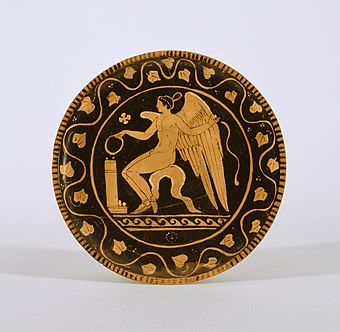
There are others involved in Eros' life, depending on which biopic one saw. Eros has a complicated relationship with his brother, Thanos, who often tries to destroy the universe. Another brother, Anteros, is the god of requited love (literally "love returned" or "counter-love") and also the punisher of those who scorn love and the advances of others, or the avenger of unrequited love.
One could go on and on here, but that's enough. -
Tarot cards. A valuable tool or mere hocus-pocus?Tarot cards may be 100% hokum, but that wouldn't prevent someone from gaining personal benefit by using them. After all, a good share of psychoanalysis seems just as hokey, but within living memory it has been quite respectable. Penis envy? Oedipal complexes? Sounds like bullshit to me. The interpretation of dreams holds that certain things, like staircases, have definite meaning when they appear in a dream, nuanced by whether one is ascending or descending, what's at the top and bottom and who is on them. Could be, I suppose. It's no more unlikely than 1 of 20 cards revealing truth.
The thing is, people like attention, and sitting down with a tarot card reader is probably at least somewhat satisfying. The reader appears to be peering intently into one's 'situation'. Feels good. Same for fortune telling, tea leaf reading, or channeling the dead. Hocus pocus, but nobody ever went broke underestimating people's gullibility. -
Are You Happy?When asked whether she was happy, the opera diva Beverly Sills said, "Let's just say I'm cheerful."
I am happy. I am either at peace or resigned to the inevitable. I don't let doomsday bother me; do you let it bother you?
The drummer in Elvis Perkins' band makes me happy,
-
A self fulfilling short life expectancyWould you splash out, go wild, enjoy the pleasures of life while you could, — Benj96
You asked A4H, but... what the hell. IF the 2nd coming were imminent, my guess is that going wild and enjoying the pleasures of the harbor during the countdown might move one out of the SAVED column into the DAMNED column. On the other hand, Jesus has a good nose for pious fraud, so last-minute piety might not wash either.
I'm not sure what the Divine thinks of satisfying fleshly desire, but in Deuteronomy 14:26 there are instructions for celebrating if one can not travel to the temple in Jerusalem to deliver one's tithe.
And thou shalt bestow that money for whatsoever thy soul lusteth after, for oxen, or for sheep, or for wine, or for strong drink, or for whatsoever thy soul desireth: and thou shalt eat there before the LORD thy God, and thou shalt rejoice, thou, and thine household.
Certainly, "lusteth after" sounds promising.
So, it would appear that God the Father isn't altogether opposed to us having a good time. Maybe God the Son and his mother are more up-tight. No idea where the Holy Ghost stands on partying. Being incorporeal, probably doesn't know what it is.
Personally, I'd like to spend the countdown at a nice gay bathhouse which, hopefully, would be busy. Like St. Catherine of Siena said, All the way to heaven IS heaven." Was she thinking of gay bathhouses too? -
A self fulfilling short life expectancyFor me it was a close call, an near encounter with death that shook me up and forced me to reckon with my ultimate mortality. I'm much more cautious in lue of that. — Benj96
There you go.
The trick is to have a close encounter with the grim reaper and live to tell about it. -
A self fulfilling short life expectancyThey act as if they are invicible. Hedonism, indulgence. Living as if tomorrow would never come around. — Benj96
The act like they are invincible because it seems like they are. Hey, young people can get away with all sorts of things that will be a lot less tolerable in 30 years! They have not had the major injuries, infectious diseases, cancers, economic disasters, and so on to feel just how fast things can go from good to bad and from bad to worse. Given time, they will.
When I was in my 20s (1960s) the world looked A LOT BETTER than it does now. They may have negative self-fulfilling prophecies, but so does the world they live in! If we were making actual progress on global warming, maybe they would have a more positive attitude. If the economy were not so obscenely unbalanced in favor of the parasitic 1%, maybe they would have higher expectations.
Young people burn the candle at both ends--"smoke, drink, party like crazy, take drugs, sleep little, take risks"--because they can get away with it, at least for a while (x number of years). Eventually most young people get older and start to slow down. At some point they discover they can't quite drag themselves into work after a late night of sex, drugs, and rock and roll. After enough mornings of feeling crapulous, they will start cutting back.
Or they won't and they'll drop dead early. -
A whole new planetTheir approach and our response is a fertile topic in science fiction. Were you beamed aboard the alien ship from earth by the aliens to provide guidance on how to approach us, what would you say?
Let's say the aliens can breathe our air. They are symmetrical beings with manipulative
"fingers" and 4 limbs, have several sensory capacities, but are overall somewhat repulsive in appearance (imagine as you will). Being sensible aliens, they have been surreptitiously studying us and can hear and understand your speech, but have some difficulty producing human speech sounds, so they communicate with you through a screen. They don't tell you and you don't know how much destructive power they are capable of projecting. -
A whole new planetHow many years would have passed on Earth? — jgill
Earth will probably be irrelevant to those on board. This is a one-way trip. There is an overwhelming chance they won't be able to go back whence they came. A message to earth will take 100 ears to arrive, and 100 years for a return message. They will be 'out of range' in a big way, (Some scoff writers propose leaving a string of transmitters along the way to stay in touch. Not sure how much that would help.
They probably won't travel at 95% of light's speed for long. It will probably take them quite a long time to reach maximum speed, and way before their arrival, they will have to start slowing down, else they will whiz past the destination.
Caution is prudent, but IF the planet can support our form of life, there is probably similar (carbon based) life there. Whether the natives are amoebas, big stupid lizards, or refined intelligent beings, trouble WILL ensue. We, being what we are, will \ cause problems. Either our bodily flora and fauna will make them sick, or theirs will make us sick. They, beings of refined taste and intelligence, may decide we would be good to eat. Or, visa versa. Even if they are refined and intelligent, the opportunities for catastrophic misunderstanding is enormous,
Flip the situation: a space ship arrives on earth from a planet 100 light years away. Ultra big surprise! What is our likely response? -
Should I become something I am not?
1) What am I?
If I behave in a selfish, greedy, vindictive, manner am I then a selfish, greedy, vindictive person? Am I something other than how I behave? If I am how I behave, then changing behavior changes me. If I am something other than my behavior, what does changing mean? Can I be selfish, greedy, and vindictive but actually be a selfless, generous, forgiving person?
What constitutes "who we are" and "how we are" impinges on any efforts to become something else, it seems.
2) A person can pretend to become something he or she is not, but can a person become in fact what he or she is not?
I believe we have an identity -- who we are -- which is at first a fuzzy state that is given a push toward a particular direction and definition through childhood and into adulthood. At some point we become who we are and who we are going to be.
We can use various stage settings and flattering lighting to present ourselves, but in cold daylight, we are what we are.
3) An opposite view holds that our behavior and our identity are independent. Behavior creates a reputation that is our public identity. Our reputations are provisional and subject to change through amelioration and peroration. Whatever our reputation may be, we are not the same as our reputations.
4. If a person's identity is judged to be good, then bad behavior doesn't matter. For consistency's sake, if a person's identity is judged to be bad, then good behavior doesn't matter either. Saints can do not wrong and devils can do no right.
#3 is represented in certain varieties of religious thinking. Calvinists believe people are predestined to be saved (go to heaven) or be damned (go to hell) independent of their pious behaviors. If one is pre-ordained to be damned, nothing will help. The damned are screwed from the getgo and the saved have a validated ticket (not quite how Calvin put it).
Theologians in the Calvin camp devised escape hatches from Calvin's unknowable and inflexible system of saved and damned. They felt that Christians required a way to become (something else--saved) despite predestination. -
Does solidness exist?Welcome to The Philosophy Forum.
I understand electrons aren't solid, but what of protons and neutrons, et al? Are there really tiny dense indivisible b-b's that make up matter. It seems that everything I read about this, implies that ultimately nothing is really solid. — Watchmaker
My poor understanding is that protons and neutrons are actual matter. In turn, they are composed of subatomic particles like quarks. Quarks, as far as we know, are the end of the line. If all the little "b-b's" were just floating around, nothing would be solid or have any form. As it happens, the little "b-b's" that make up protons and neutrons, and they in turn, are bound together by the strong force. Atoms are bound together by the electrostatic force which is responsible for matter being solid and having form. There are two other fundamental forces, the weak force and gravity. Gravity also holds things together -- which is how planets, stars, and galaxies maintain their form. I'll pass on the nature of the weak force.
The reason for my question relates to dualism and the problem of the immaterial soul/mind interacting with the physical body. There seems to be a disconnect there for many people. It's said by many that this is a logical problem.
However, if it's true that nothing is really solid, that all matter is ultimately immaterial, then wouldn't that solve this interaction problem? It would no longer be the immaterial mind interacting with and acting upon the physical body. It would be the immaterial mind interacting with the immaterial compositions of matter. — Watchmaker
What is matter? Never mind. What is mind? Never matter. That's baloney!
The disconnect between mind and matter comes from a "spiritual" view of the world. The brain is clearly material and material processes produce our minds. Hence, the mind is material. The idea of "mind" as a something disconnected from matter is just hocus pocus. Adding soul to mind just makes the magic more complicated.
How far can something that is solid in the absolute sense, be infinitely divided? — Watchmaker
It can't. -
Free Speech and TwitterI'd prefer the now antiquated concept of self regulation, where news outlets adhere to journalistic standards. That used to be a thing. — Hanover
I also prefer the print media's self-regulation--in an open atmosphere where the quality of self-regulation can be publicly examined. Noam Chomsky spent a lot of time dissecting what he thought were the deceptions and strategic omissions of the newspaper-of-record, The New York Times. The NYT is better than most. It takes more than self-regulation to produce a great newspaper -- it also takes a large audience and revenue.
Twitter (and other social media) are not analogous to 'the press'. Print and broadcast news companies have a limited number of more or less professional staff producing and editing copy. Twitter, Facebook, et al have billions of contributors, and the task of the social media companies is to keep a lid on the proceedings. Their problem is not maintaining high levels of quality; it's to prevent their descent into the hellscape of trash (which will repel major advertisers).
On the other hand, social media and the press have similar enterprise issues: maintaining the customer base (the advertisers) by delivering the commodity (the eyeballs) to maintain cash flow and profitability. The market contributes to self-regulation: if the public drifts away from the product, the advertisers (and revenue) goes with them. That last is the sad story of old print media.
Revenue follows eyeballs and the advertisers decided that the eyeballs on the internet were more accessible and targetable than the eyeballs on the local daily newspaper.
Free speech and the market! -
Do Antinatalists Celebrate Thanksgiving? If So, How?At least some present day Wampanoag people have said they regret their ancestors helping the Pilgrims.
-
Do Antinatalists Celebrate Thanksgiving? If So, How?Joy and gratitude don't seem to be the salient features of antinatalism. They probably are equally unmoved by Christmas, Halloween, Easter, and the 4th of July. Maybe April 1 is their holiday to annually mark the filthy despicable trick played on them. If they like more religious forms, Ash Wednesday (without Fat Tuesday) would be another day for them to celebrate. Ashes to ashes, dust to dust, we remember we should never have happened.
Antinatalists do display an admirable fidelity to their belief. They seem to be freshly resentful on a daily basis. Oh that we who happily reconciled with existence early on could be so faithful in our gratitude!
Even if you resent it, @Schopenhauer1, I wish you a Happy Thanksgiving. The turkey never asked to be hatched either, let alone being beheaded, gutted, stuffed, and cooked. Do cranberries resent their blooming parents? Pity the plants! They have had to endure unauthorized existence for many more millions of years than animals.
Maybe the Earth itself resents being formed out of cosmic dust, and then having to orbit a star for eternity? How does the Universe itself feel about its unrequested existence?
All Creation is peevish and resentful? -
The philosophy of anarchyThis is exactly the problem I have with the idea of the social contract. — Tzeentch
You express antipathy to states and the violence they might, may, will, or already have deployed, and you are quite right that states employ force. (Wasn't it PM Margaret Thatcher who said h didn't suffer from "a sickly inability to use force"?). Therefore, I assume you will fly the anarchist banner. Now, you also express antipathy to this idea of the "social contract". A lot of people dislike the term. Fine -- one can get alone without using that term.
What happens, though, is that we find ourselves wondering what we are obligated to do. We have attended a really nice party. We will wonder what our obligations are to the host: should we return a similar invitation? Should we send a thank you note? Bottle of wine? Or, just forget about it.
The idea of etiquette (something I am not good at) is an example of a social contract. Someone buys you a beer at the bar; you should buy them the next round. It's not that complicated.
I think we have a number of obligations to others. We are supposed to rake up our leaves and shovel the snow off our walks. (Some people) believe that we are expected to maintain an attractive lawn. Is a yard covered by ground ivy attractive? It's green and flat. IMHO, it takes too much labor, weed killer, fertilizer, and obsessive-compulsive disorder to maintain the perfect lawn. But... some people think that's part of the social contract.
In an anarchist society, I would think mutual obligations would be much, much more important than they are in our hierarchical atomized society. Without a state, peace among the people will have to be self-sustaining, wouldn't it? That implies a common agreement on what goes and what doesn't. A social contract.
If you don't like the term, fine: Don't use it. But some of us find it a convenient way to reference complicated systems of mutual obligation. -
The philosophy of anarchyYes they are, and states are not. — Tzeentch
It is neither the function of the state to be loving and nurturing, nor can the state BE loving and naturing. Why not? Because states are not families, not composed of a handful of people, and their function is to maintain civil order as they mediate mediate the competing interests of millions of citizens, That said, they are not required to violently oppress and abuse the citizens in the process.
There are states which fail to meet my expectations: quite a few states, really. Burma, Afghanistan, Russia, China, North Korea, Mexico, El Salvador, Ethiopia, and Somalia, for example. Not a complete list at all. At any given time in history, most states have managed to meet your expectations of violence and exploitation including the United States and the various nations in the European community.
IF the citizenry are able, they change the state (by reform or revolution) so that it ceases to oppress.
The root of the problem is not in the existence of states per se. It is in the perverse behavior of those who wield power. -
The philosophy of anarchyBesides, what if the social contract is obviously defunct? Do I still have to abide by its rules? — Tzeentch
No. Without a functioning social contract, you have chaos, and all you can do is try to stay alive.
I invite you to envision a family — Tzeentch
No. Your approach resembles the antinatalist approach. A person is created without being consulted and therefore has to endure the consequent suffering against their will. Your vision of family (at least as you have projected it here) expects violence and ruthless exploitation. It isn't that ruthlessly exploitative families never have existed. They have--but they are not the model 99.9% of people strive for. Families are generally nurturing and loving. Do people fail in this project? Sure. We are fallible.
The social contract (which is, granted, not a signed document. and nobody thinks it is) yields mutual support and benefit. That's how a functioning society works.
The social contract of mutually beneficial behavior would exist in an anarchist society as much as, maybe more than, it does in a hierarchical society. Our human ability to mirror other people's needs, desires, pains, etc. long preceded civil society. -
The philosophy of anarchyI don't see why it would be acceptable in one instance, but not in the other. It seems like a double standard to me. — Tzeentch
Because a society is not the same as a family. I grew up in a family where confrontations were rare. We seven children behaved ourselves without violence. Threats of violence? As my father would say, "If you don't stop complaining [crying, whining, etc], I'll give you something to complain about." Or, "If you don't stop squabbling [in the back seat], you can get out and walk home."
When were these threats turned into violence? They were not. Our parents' anger was novel enough for us to take it seriously all by itself. Were we ever spanked? Yes. Was that violence? No; it didn't rise to the level of violence. There are families where parents exercise violence freely; fists, kicks, hard slaps, belts, etc. I have seen this in action in families (and worse, actually) and I definitely do not approve of it.
There is no parent in society. There are citizens, and there is a government. there are written and unwritten rules governing interaction between citizens, and between the government and citizens. A lot of these rules have the force of law. There are penalties laid out for violating the law. Unwritten rules have penalties which result, too. Like, leave angry drunks alone. Threaten an angry drunk and you will likely get socked.
Societies have an implied social contracts which bind citizens to treating each other more or less civilly (and most of the time, the contract is honored). There are mutual obligations which are understood. The law, however, is not an IMPLIED social contract -- it is explicit. We understand that if we violate the law, there may well be quite unpleasant consequences. Prison is one of the possible consequences.
If you think being in prison is the same as being tortured, then that is what you think. I don't agree; I would vastly prefer not to be in prison, but it isn't ipso facto the same as torture. (That said, a prison certainly can be operated in such a way that it is torture).
I will agree that the threat of violence (of some material sort) lies behind governmental authority and power. Law and the social contract assigns to the state the privilege of exercising violence to compel compliance in designated situations. I'm OK with that. If we don't want to be the recipient of privileged violence, then we don't flagrantly violate the law. We are careful about when, where, how, and why we tempt the state into pouncing on us.
The smart rat doesn't tempt the cat to pounce, unless he's very near his bolt hole. -
The philosophy of anarchyWhat would you call a household where everybody does what the head figure wants out of fear of getting beaten?
And what would your reaction be if the head figure excused themselves by saying the beatings are only a last resort for when the fear of being beaten isn't sufficient to force obedience? — Tzeentch
I'd also call that abusive parenting; societies are not families, though.
Despotic regimes employ violence on similar terms: IF you do not obey the Maximum Leader, the result will be imprisonment, beatings, torture, and possibly death. Such despotic regimes exist, but they stand out against the majority of societies whose response to unlawful behavior goes no further than imprisonment. Imprisonment is coercive, certainly, but coercion is not the same as violence (beatings, torture, execution etc.).
Violence or nothing is a false binary. Societies use coercion (fines, for instance) to enforce rules. Leave your car on the street after a snow storm, and it might get towed away--a coercive measure people find quite aversive. Coercion yes, but the streets cannot be cleared of snow if people don't move their cars out of the way.
Force and coercive measures are not inherently violent. There are also passive measures which society uses -- literal and figurative 'speed bumps'. Regulatory review of land use proposals are a speed bump; ruling against the developer ("No, you can't build a slaughterhouse in the middle of a residential area!"). The refusal of a permit is likely to feel coercive. If the developer persists, force (in the form of intrusive court proceedings) may be used. We're not talking about beatings or killing anybody here. Force and coercion are none-the-less employed. -
The philosophy of anarchyGovernments have violence as the last resort, but have several options before the beating and shooting begin.
Briefly speaking, anarchy means "without rulers". Anarchists argue that the institution we refer to as "government" is illegitimate, because no one has the right to rule over another. Ruling over others is akin to owning them, which is essentially the model of having masters and slaves. — AntonioP
Do people, individual and collective, NOT have the right to employ government?
No, ruling over others is not in itself akin to owning them. In a feudal society the peasants may have had very few rights, but they weren't slaves. (We ought to know what real master/slave relationships look like.) Modern despotic governments maximize their control through pervasive surveillance and the threat of violence, and some countries are like that; most are not.
Our best bet is a democratic society with a sufficiently limited government that it is possible to conduct one's life as one likes more or less, while at the same time living within rules that make community possible. This will involve a fair amount of social friction. Some people will make too much noise; some will use alcohol and drugs which impair their behavior (however subjectively pleasant they may be); some people won't mow their lawn; some people will have sex in public places; some people will engage in.petty crime and get away with it.
Some people will behave in a way that is unacceptable for any society to accept: shooting people at random; stabbing somebody on the bus; reckless driving; selling spoiled food, stealing large amounts of money; burning buildings down, etc. A livable community requires ways to effectively suppress these kinds of criminal behavior. -
Can we choose our thoughts? If not, does this rule out free will?As topics go, whether or not we have "free will" might be unanswerable.
A lot of our mental activity goes on outside of the portion that we are consciously aware of. What the brain delivers to our consciousness if pretty much fait accompli. We don't decide what we like, what we want, or what we think. Do you like strawberries? If so, did you decide to like strawberries, or did you just find them delicious?
For instance, I may have consciously decided that your topic title was interesting, but I'm not sure about that. Perhaps an unconscious predisposition compelled me to respond to you. I did not "decide" how to compose this response. It just arrived in my fingers on the keyboard. I have, however, edited what occurred to me. Was the editing an act of free will or was it the product of a fussy compulsion? Don't know.
It doesn't matter, really. Whether we have free will or not, we have evolved to operate more or less successfully. We are, fortunately, not left to our devices. We require years of careful rearing before we are able to live independently. A lot of who and what we are is supplied by genes and experience before we have a choice in the matter. -
US MidtermsDo you accept that? or do you really think every politician is nefarious? — universeness
I accept that. No, I do not think most politicians are nefarious. Many politicians are well-motivated, with the intention to perform good public service.
That said, economic interests modify what "good public service" means. The United States is a big country with 300,000,000+ people. It is easier to judge politicians on a state and local level than the national level. That's probably true in the UK, too.
As for bitter crankery, it is just a handle, not a summation. It could be ishkabibble just as easily. Or universeness. -
US MidtermsI don't find it ironic — universeness
I suppose I can spell it out for you. Once upon a time, decades ago, I had a disagreement with someone about philosophy, politics, or religion (can't remember) and they called me a bitter crank. The irony is that I was not / am not bitter, and in my opinion, not a crank either. I thought it a novel and amusing brickbat to turn into a bouquet.
If you still don't get it, or don't like it, then... too bad.
Well, I dont know the name of the current body of such political facilitators in the USA, but in the UK the body you describe is called the civil service. — universeness
The Civil Service in the US administers the laws passed by the 2 political bodies. By law, the Civil Service is protected from politics:
Hatch Act Overview (U.S. Office of Special Counsel)
The Hatch Act, a federal law passed in 1939, limits certain political activities of federal employees, as well as some state, D.C., and local government employees who work in connection with federally funded programs.
The law’s purposes are to ensure that federal programs are administered in a nonpartisan fashion, to protect federal employees from political coercion in the workplace, and to ensure that federal employees are advanced based on merit and not based on political affiliation.
So in the US system, the intent is to separate the administration of the law from the politics involved in the creation of the law.
I do not like the conduct of politics, but it is absurd to suppose that it can be done away with. Given the reality of politics, the best policy is to stay alert to what is going on above and below the table. That's what a free press is supposed to help us do. An eviscerated press can't perform it's vital functions.
Politics exists because people have an appetite for power and preferences for particular policies.
The way to make politics really dangerous is to deny it exists. Some people apparently suppose that people conduct election campaigns, get elected, and then sit in legislatures or congress and engage in pristine impartial procedures to produce laws for the equitable good of all. Horse shit, of course. It's also dangerous to under rate the intensity of partisan motivation. There really are very ambitious people who covet power most greedily. -
US MidtermsOne can imagine many schemes that could/would/might thwart partisan politics. We could, for instance, select people at random to fill seats in Congress or Parliament. Why don't we try it?
We don't try such schemes for three reasons. First, groups of people have real interests and they are often at odds with other groups. Hence, politics. Second, whenever a convention is held to conceive reform, politics is present at the moment of conception. A political disinterested constitutional convention is an oxymoron. Third, even IF some scheme were devised that would eliminate the emergence of political parties, it would require some sort of heavy handed administrative body to enforce it. The anti-political administration would end up being worse than the political parties.
Smaller reforms in the way politics operates are a better bet. Maintaining open access to the polls, for instance, is one such approach. Conservatives (in the US) have tended to erect barriers to voter access. Or, recently, they have tried to eliminate voting by mail. Public financing of campaigns is another smaller idea. -
US MidtermsIt's a mistake to think that conservatives are all better now, having gotten Trump out of their system.
Conservative interests and politics have been a negative and enduring drag on American life for a long time. Whether they are called "republican" or "democrat" doesn't matter that much. Conservatives resisted legislation to establish Social Security, Unemployment Insurance, social welfare programs, Medicare, Medicaid, and more. Southern Democrats (DBA conservatives) imposed race-based limitations on progressive programs such as UI and and federal housing programs.
Democrats are not eligible for political sainthood either, but they have tended to be more progressive than their conservative counterparts. -
Deciding what to doImmanuel Kant: What can I know? What should I do? What may I hope?
Just thought I'd throw that in; I don't know if Kant came up with a satisfactory answer.
I am no expert on animal behaviour but it seems to me humans can never exist (spontaneously?)like an animal in the wild without language communities and complex learning. — Andrew4Handel
Actually, humans do live in the wild -- a wild country of languages, complex meaning, communities, cultures, elaborate knowledge, etc. We exist in it spontaneously because this wild land of "civilization" is our natural world. It is everything from wonderful to god-awful.
Every decision we make we don't know if we are doing the right thing and what the consequences are going to be. — Andrew4Handel
Maybe the first time you encounter strong drink (alcohol) you will not know what the consequences are of guzzling the whole bottle of wine, You will soon find out, and you won't forget the lesson. Eat a pound of chocolate in one go and you will be aware that too much of a good thing is not all that wonderful.
existential crisis — Andrew4Handel
Given our large brains with our capacity to dig ourselves in pretty deeply, the occasional existential crisis is a given. Almost all the time, we dig ourselves out of the hole and move on. -
Threats against politicians in the UShere the Chad Mitchel Trio satirizes the John Birch Society, a far right political group from the 1960s:
Here's a ridiculously long film about the John Birch society. Sample it at 40:00 minutes.
-
Threats against politicians in the USThere is no comfort or justification in it, but the fact is that the United States has had some outstanding episodes of violence and threats of violence directed at political persons and institutions (as opposed to violence directed against banks, convenience stores, competing gang members, and collateral victims). To start with, there was the Revolution of 1776. There was a war of property acquisition (the Mexican- American war); the south succeeded from the union and was forced back over a lot of dead bodies. The wars against the American Indians. A century of crude oppression of blacks after the civil war.
In 1856, in the United States Senate chamber, saw Representative Preston Brooks, a pro-slavery Democrat from South Carolina, used a heavy walking cane to attack Senator Charles Sumner, an abolitionist Republican from Massachusetts. Senator Sumner suffered brain injuries.
Labor organizations have been subject to periodic physical attacks -- not just propaganda -- for 150 years. The violence of the 'Red Scare' of 1919-1921 was directed at labor and blacks.
Four Presidents have been assassinated, within less than 100 years, beginning with Abraham Lincoln in 1865. Attempts were also made on the lives of two other Presidents, one President-elect, and one ex-President.
A politically driven gun-fetish has resulted in 1/3 of the population owning guns, everything from small pistols to military weapons.
So... we should not be surprised that anti-democratic violence continues. I don't like it, but the current batch has been bubbling up for 2 or 3 decades. -
Why do Christians believe that God created the world?I find that your post is not yielding much light.
If God wants us to know what he is like, then he can do that. And he has — Bartricks
Really.
Note, I am not interested in a psychological or sociological or historical explanation of why it is that Christians typically believe God created the world. — Bartricks
You might find more enlightenment about the matter if you don't insist on only "philosophical" reason. -
Why do Christians believe that God created the world?Well, why do you not believe that God created the world? What justification do you have for this belief?
IF God is omnipotent, who else could have created the world? Some other omnipotency?
The belief that God created the world goes back to the development of creeds (over a fairly long period of time). "I believe in God the Father almighty, maker of heaven and earth".
A lot of what Christians believe is based on their early roots in Judaism. The Jews, per Genesis 1:1, believed that God created the heavens and the earth.
A God-Creator 'works' because we seem to require a beginning to everything, somehow. Big Bang or Fiat Lux.
The more we talk about the nature of God; what God did or did not do; what God is or is not like, etc. the deeper into the indefensible we get. Our claims about God are indefensible because we can't know God. In my opinion (talk about hubris!) God (the Father) is above and beyond our knowing. God (the Son) is the knowable person of God.
Christians chatter and natter on about God (the Father) as if he was as familiar to them as the manager of the local Safeway supermarket. Christians make as many unsupportable statements about Jesus (and the Holy Ghost). Why do they do this?
I tend to think that we are better off NOT thinking that God is all-loving. God might oversee without intervention. Omniscience is a major stumbling block for our alleged free will. If God is all knowing, I'm content thinking that we have zero freedom of action. For that matter, I'm not sure God is omnipotent either. (A limited God presents other problems.) -
Is it ethical for technological automation to be stunted, in order to preserve jobs?The problem isn't software. Software and machinery have no agency. They are tools. Whether the tools are deployed for collective benefit, or very individual benefit makes the difference. In the present world, collective benefit seems to be more accidental than intended. Mostly enterprise is directed toward corporate profit.
An axiom of Marxism is "labor creates all wealth". If substituting software and machinery for labor also creates wealth, we could -- if we so wished -- distribute the wealth created by machines among the laborers who lost their jobs.
Labor is an essential part of us; in a myriad ways, the work we do defines us -- positively as well as negatively. I have performed tedious detail work that I would have given to a machine in a flash, had one been nearby. On the other hand, creative work I have performed (not "art") was immensely fulfilling.
In a phrase: People over profit. -
Merging Pessimism Threadsevangelists — Jamal
The problem here is more monomania or monotony than evangelism.
I am not an antinatalist despite the grim prospects for generations following in a hot world. However, Shopenhauer1 has done a good job of elaborating the principle that is behind the decision of people to NOT bear children. But hot weather is just the latest pain. Before global warming there were equally bad prospects for suffering.
Maybe the erudite moderators could have come up with something a little more elegant than "life sucks". "Suck" is worn out; as an expression of dissatisfaction, it sucks. -
Liz Truss (All General Truss Discussions Here)
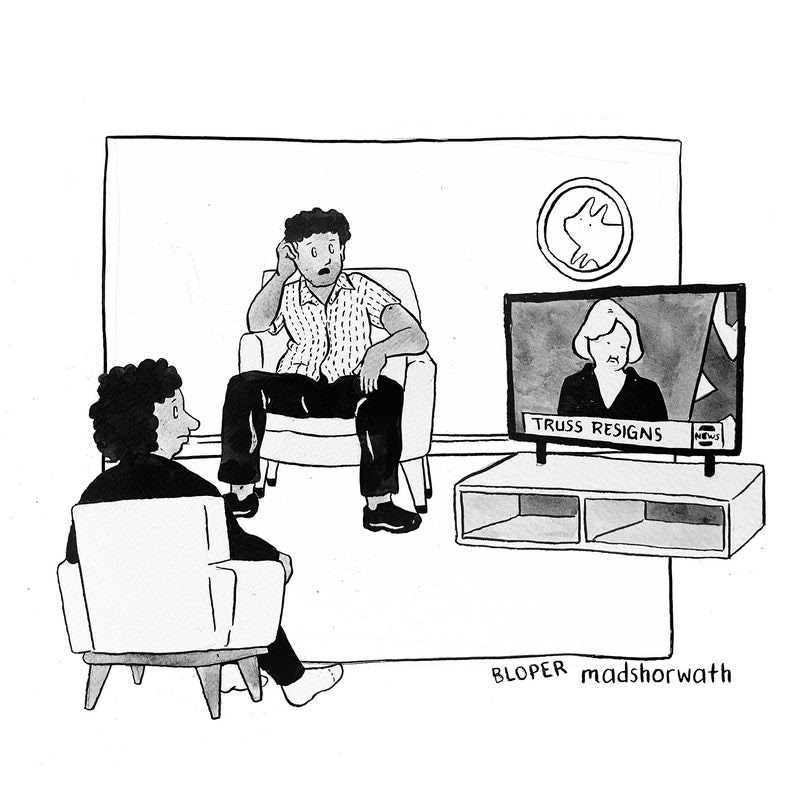
SO, OVER THERE LEADERS WILL RESIGN JUST FOR DOING A BAD JOB? SOUNDS NICE.
BC

Start FollowingSend a Message
- Other sites we like
- Social media
- Terms of Service
- Sign In
- Created with PlushForums
- © 2026 The Philosophy Forum