
-
The Death of Roe v Wade? The birth of a new Liberalism?elect people who will provide protection through laws. — frank
Yes, absolutely.
A lot of Americans are religious. So what — frank
They aren't all religious in the same way. Religious people hold a range of opinions on what is moral and what is not moral. Secular law should not be based on canon law in a secular democracy.
Granted, and this makes it complicated, religious ideas about what is moral may overlap with secular ideas about what is moral. Stealing is considered wrong by most people, secular or religious. The list of sins in the churches (temples, mosques, etc.) shouldn't be the basis of secular law. -
The Death of Roe v Wade? The birth of a new Liberalism?Laws and constitutional amendments are the mechanisms for cementing the will of the people.
Roe comes from an era when it was thought that judges should take it upon themselves to make social changes that havent been arrived at democratically. Times have changed. — frank
The CITIZENS UNITED decision was handed down in 2010. Apparently times haven't changed.
Laws and constitutional amendments may very well be a concretization of the people's will, or not.
The 18th Amendment concretized SOME peoples' will to ban liquor -- rural Protestant voters in particular. At that time, rural voters had an outsized level of representation -- corrected later in "one man one vote" decision (Reynolds v. Sims 1964) which stated that congressional districts had to have equal population. It was clear throughout Prohibition that the majority of the people (urban dwellers in particular, and Catholics) did not support prohibition of alcohol. -
The Death of Roe v Wade? The birth of a new Liberalism?If the people judge that murder is taking place in private, then it's most definitely a governmental issue. — frank
Your statement seems more like a play on words than a serious objection.
Is a fertilized egg, a non-viable fetus, or a near term fetus, a person? Thereby hangs the tale.
Defining a fertilized egg or a non-viable / viable fetus as a person seems to be first a religious definition (based on the idea of 'ensoulment') that has been taken up by religious-minded secular legislators.
Religious definitions (God, sin, sanctification ensoulment -- personhood--transubstantiation, virgin birth, etc.) should not be enshrined in civil law for two reasons: the citizenry is diverse and holds diverse religious positions (or no religious positions at all); and whether to hold any or no religious view is a private matter. How to care for one's health and whether to bear children or not, are also private matters.
The anti-abortion/anti-birth control policy is often judged to be part of patriarchal control of women. Most paleo-conservatives and troglodytes are sophisticated enough that they won't profess this view openly, but the intent seems obvious enough a good share of the time.
The right to privacy is the basis of court judgements In other areas as well. For example, the court has held that two men having sex in a bedroom have a reasonable expectation of privacy. Lower courts had earlier held that two men having sex in a video stall of an adult bookstore (not on a park bench) had a reasonable expectation of privacy, and that the police were not justified in busting the door down to arrest them. -
The Death of Roe v Wade? The birth of a new Liberalism?Well, yes. Let people decide -- that's what Roe vs. Wade established. Same for several other private activities. The personal sphere is private and not a proper object of governmental intrusion.
-
The Death of Roe v Wade? The birth of a new Liberalism?Very rarely (ever?) do I feel a need to defend Streetlite. He surely could have phrased it less abrasively. I think what he meant was that Ginsberg should have resigned early in her illness, rather than gutting it out into a Republican administration.
Do any SCOTUS justices think they are a-political? the law is political; they are political creatures of necessity. -
The Death of Roe v Wade? The birth of a new Liberalism?SC justices tend to hang on until the the grim reaper takes them away. There had been discussions about her leaving sooner but she refused, Strategic "early" retirements are very rare.
There should be mandatory retirement. "For life" doesn't mean quite the same number of years that it did when the SCOTUS was created. Deaths or forced retirements may be inconvenient, no matter what system is in place.
The key to maintaining control over "democratic" government is to maintain control from the bottom up. Local political machinery has to be in place for the national machinery to hold on to power. If Democrats once knew that, they seem to have forgotten, Republics have learned it well.
Another thing, the opponents to Roe vs, Wade have maintained a 50 year (1973-2022) campaign to overturn the decision. Victory at this point can not be a surprise, because piece-by-piece, the conservatives have been moving necessary pieces on the political chessboard toward checkmate. -
Vexing issue of VeganismFeed to meat efficiency, anyone?
Bear in mind that the feed efficiency of animals depends on whether we are talking about a live, cackling chicken or a serving of skinless, boneless meat.
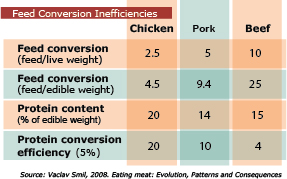
It also depends on whether we are talking about a chicken running around outside all day, or a chicken that is in a cage with very limited space, bred and fed to grow fast and die young. Truly free-range animals are going to reach their best market weight slower than confined animals. I prefer range-fed beef, but it does take longer for a grass / hay fed cow to reach market weight. (Grass and hay fed cows are also healthier--not requiring antibiotics to control crowd-sourced infections and to speed weight gain.)
I'm an enthusiastic carnivore, but the methods of mass production of chicken, pork, and beef are disgusting in several senses of the word. The methods in use are pretty much required if corporations are going to maximize profits--and if meat is going to be relatively cheap. -
What is the extreme left these days?We have both gotten used to being voices howling in the wilderness. We wilderness howlers are dismissed out of hand, even if our howled message is right on the money. Dressed in rags, eating locusts, (roasted. salted, nutty, crunchy, nutritious), howling, of course; and harshing the mellow of the bourgeoisie just doesn't make one popular,
"Blessed are the shat upon." Simon and Garfunkel -
What is the extreme left these days?Yes: The only war is the class war. We have nothing to lose but our chains and a world to gain. Check.
Maybe where you live, the rhetoric of "One has to operate organized in the vanguard to combat the rigid corporate elect and crush it's wicked new slavery schemes with the remorseless and righteous left fist and blow a far left uppercut in the name of global freedom and justice. It's the argot necessary to break the chains. gets the blood of the working class boiling but, the world I live in departed that time and place decades ago.
The rhetoric doesn't work (here and now) because the working class has changed. First, most workers don't think of themselves as working class. They think they are middle class. "Workers" are the unskilled louts who clean the offices in which they labor. They and their boss both think that the boss creates wealth by his brilliance (or profound crookedness) or maybe by magic. That they themselves, the workers--even office workers--create all wealth is an idea that has not occurred to them,
Once upon a time workers understood that they were exploited. With the help of PR, lies, propaganda, advertising, oft repeated cliches, and cheap bread and circuses they have lost consciousness. Their awareness has regressed into "preconsciousness". Education has to start with the basics of today's experiences, not those of 1844, 1890, 1968, or 2001.
I don't know; when I look at Global Warming I wonder whether we have time to accomplish anything.
"The red star is on the rise my fiend." Did you mean "fiend" or "friend"?
I prefer Billy Bragg's version of the Internationale:
-
What is the extreme left these days?the revolutionary political vanguard organization of the working class in Italy. — Hillary
Such argot tells me that the Partito Comunista is talking to itself. No wonder they didn't break 1%. -
What is the extreme left these days?There is production, consumption, production, and consumption only. — Hillary
Paraphrasing the ur-leftist himself, "the conditions of production determine the conditions of society".
The upheavals in changing production, say from the beginning of the Industrial Revolution to the present, have driven upheavals in the culture. The 19th - 21st centuries contain the story of almost continual change in culture, technology, working conditions, trade, and, well, everything.
There are historical reasons why you can say, "There is no left left." One reason (at least in the United States) is that socialist organizations, socialist publications, and socialist organizing have all been subject to corporate and government suppression since the end of WWI - 1918. The "Red Scare" of 1919 involved brutal action against leftist activists. Anyone identified as an effective "change agent" might get a beating, a lynching or a bullet for their trouble. For a good time, investigate what the FBI
"COINTELPRO" operation (1956-1971) was all about,
Unionization peaked in 1954 at 35% of workers. Workers didn't abandon unions -- the unions were murdered (so to speak). Beginning in the 1950s on up to the present, organizing unions and holding on to unionized work places has become very difficult owing to laws which favor anti-union activity by companies. It pays for a large company to spend 20 or 30 million dollars to a union busting consulting group, rather than accept unionization.
In all the diversity in personality, individual markers, different cloth styles, musical tastes, etc. there is greater global monotony then ever seen before. The world turns into a grey, amorphous, uniform ball of sameness. — Hillary
I do not see the world as a gray ball of monotony.
For example, people have been saying for decades that media were homogenizing the culture, particularly the way Americans talk; we will all sound like television programs. In fact, the distinctiveness of regional accents had intensified, as opposed to becoming homogenized. No thanks to the media for this. Language changes, media or not.
Culture also changes continually, media or not. There are enduring and distinctive differences in the several major American cultural regions, even as changes occur.
You will see some dramatic cultural changes in less-developed countries once cell phones and the internet become available. East Africans, for example, developed banking by text messages as soon as they got cell service--way before I started banking by phone.
People are "all alike" more than they we are "all different". Greater contact between people will mean more borrowing in both directions. The result is a more complex pattern rather than a movement towards gray-scale.
Look, Hillary, there are enough things to lament without inventing more of them. -
What is the extreme left these days?actually not sure how to plan ahead for a catastrophe. I'll have to think about it. — frank
I was thinking more of mental preparation. Really big catastrophes leave little opportunity for meaningful preparation. Like, the dinosaurs should have expected a meteorite to wipe them out? Ukrainians should have known the Russians would wreck everything in 2022?
On the other hand, lots of people regularly put themselves in harm's way. They buy a house located in a flood plain. They build a house in the fire-prone Northern California forests. They site a nuclear power plant on a known earthquake fault. -
What is the extreme left these days?A drainage ditch, for sure.
In some ways "life is limbo". It's kind of fluxy. We might get to experience prolonged periods of placid pleasantness, but... rest assured: it will be disrupted eventually,
Epidemics were far more common prior to 1950 (thanks to antibiotics), Tuberculosis was the leading cause of death into the 20th century, Economies have periodic recessions, or depressions; what it gets called depends on whose ox is getting gored.
Depressions and recessions are recurrent events in US history. For instance:
The Panic of 1873 lasted 5 - 1/2 years, and was world wide. The economy shrank by 34%. Ten years later there was a recession where the economy shrank by 24% and lasted 3 years. There were two more recessions in the next few years. In 1893 there was another depression, quite severe, that lasted for 4 years, After that there were recessions every few years, or a depression.
Upheavals, actually, are more the rule than the exception. There are natural disasters, wars, epidemics, economic collapses, revolutionary technological changes, political revolutions, and so on. If it isn't one thing it's something else,
Upheaval isn't all bad; disasters can have a very stimulating effect. The 1906 San Francisco Earthquake resulted in a lot of reconstruction -- good for business, good for jobs good for the GDP. The multi-city riots of 2021 were likewise stimulating--as the saying goes, "It's an ill wind that blows nobody good".
Should one, therefore, not worry? Remain Calm? Keep on the sunny side of the street?
That approach doesn't work for me, that's for sure. But we can at least expect bad things to happen -- plan on them, prepare ahead. -
What is the extreme left these days?The L vs R conflict was at one time fairly clear and structured. Labor vs capital, for instance. It isn't the case that labor and capital are now united. Rather, capital was fairly successful in suppressing the labor movement.
When clear, structured conflict faded, it was replaced by less well organized, more dispersed conflict. In the 1960s, there were hippies, women's libbers, gays, blacks, peaceniks, etc. all trying to achieve life-style changes, as opposed to major structural changes. In saying that I am not denigrating any of the various 'movements'.
The movements of the 1960s have played themselves out, to a large extent, or have run into very resistant barriers.
The movements of the current decades are even less well structured than those of the 1960s and 1970s and are even more personal and limited. They are further out on a limb, so to speak. The trans movement sometimes runs into conflict with right-wing movements, such as in Florida. The "right to life" movement has, after 50 years, almost achieved its goal of ending Roe vs. wade. On the one hand we have gender activists redefining sexuality and family, and conservatives defending their idea of family.
A lot of "what is going on" seems very "edgy" which is to say, not highly understandable, probably not widely supported. Four year olds switching genders and reactionaries who want to see women back in the kitchen in heels like 1950s advertisements, are both "far out". Left and Right just seem irrelevant terms for such of this (crap). -
What is the extreme left these days?What is the left now, and what is the far left? Who is the far left? — frank
Defining "the left" and "the far left" is like using a cheap microscope. The image jerks in and out of focus at the slightest touch; artifacts of light and cheap lenses distort the image, whether it is in focus or not. It's very frustrating and unsatisfactory,
More, the left and far left are not just one species. The 'left' of identity politics has nothing to do with the "left" descending from 19th century philosophers and revolutionaries.
For me, the "Liberal Left" means strong labor organizations, active governmental regulation, active government involvement in bringing about a more equitable society, and a strong program of civil rights. The "Far Left" or hard left means a program to eliminate capitalism, and institute a socialist economy, and which does not implicitly or explicitly require an authoritarian solution.
There are all sorts of social movements which are neither "far left", "left", "right" or "far right". Sexual liberation movements, whether it is about women, gays, or gender, are not "left" or "right" -- they are simply activism towards the affinity group's goals. There was nothing essential in gay liberation that involved economic reorganization.
It makes no difference, though, how you or I define "left" or "far left" because people will continue to deploy these (and a lot of other terms) in a helter skelter manner.
Little remains of the "left" or "far left" of my youth (60 years ago). The last generation of people for whom "left" and "leftist" had a fairly clear meaning are dead or will be gone in another decade. This passing isn't anything tragic or new; it's normal. -
Is Mathematics Racist?Certainly, mathematics at any level can be taught in such a way that students are permanently turned off the subject. The same goes for history, literature, woodworking, chemistry, Spanish--any subject. Who of us has not, at some point, been the recipient of bad pedagogy? Negative attitudes? Official disinterest in our success in life?
That math is or can be racist is not a concept worth discussing. That the experience of students in schools can be racially demeaning, given local racist values, given that a lot of bad pedagogy is practiced, and given that the community from which some students come may not be interested in education, is very much worth discussing.
There is a good film illustrating great math instruction: Stand And Deliver, the story of Jaime Escalante, a high school teacher who successfully inspired his dropout-prone students to learn calculus. Escalante used good pedagogy, but he also brought a great deal of commitment to his classroom.
Is there a secret teaching method which will almost always produce great results? I certainly don't know it. I am quite certain that schools can do better, but not without rather big changes in the whole project. -
Criticism of identity and lived experienceI have the experience of being a biped, too. — Jackson
Of course you do, and it's a significant part of 'who you are'. There are many significant parts of who you are.
I generally dislike identity politics (whether the identity is black, hispanic, native, male, female, gay, straight--whatever) because it tends to be possessive, defensive, and adversarial. And it can be very lame.
"Identity" is first and foremost a personal attribute, arrived at or achieved over time. The noun, "identity", applied to millions of people who are supposedly alike is the wrong word. A better term for what very large groups of people share (numbering in the millions) is "culture".
So, individuals who have a unique "identity" belong to one, maybe several cultures. -
Criticism of identity and lived experience"It’s essentially a turf war. Only Latino authors can write novels about Latinos. Only Holocaust survivors can convey the truth of the Holocaust. Only disabled people can portray disabled people. Everyone else is out." — Jackson
Horse shit, of course.
An incompetent Latino writer will do a much worse job writing novels about the Latino experience than a competent writer from some other cultural group. The same goes for novels about the white--or any other--cultural experience. The first requirement is that the author be a good observer and a competent reporter. There are additional requirements, of course, like writing ability, imagination, control of plot and characters, discipline (to get the thing done) and so on.
What a survivor can bring to an account of the Holocaust is personal experience. Personal experience alone is insufficient. One must also have the capacity to tell the story. Having personal experiences of any kind and being able to communicate what that experience was like just isn't that easy to do well. -
Criticism of identity and lived experienceGood job -- the opportunity to skewer two semi-sacred cows with one goring.
You were doing fine until you said, "I do not know what it feels like to be a white male." and further said you were a white male.
Your are a white male; you have experiences; they are, of necessity, the experiences of a white male. It's not more complicated than that. I too am a white male--a gay, working class, upper-midwestern white male, to be specific. My experiences are those of a gay, working class, upper-midwestern white male.
You don't have to think of yourself as the archetypal "white male"--you are, in all likelihood, not.
American black men, Japanese women, South African white men, British Indian women, and so on all have unique sets of experiences, but they are not all the same. We can generalize some, but only so far.
The trouble with identity is projecting "sameness" on everyone who shares the identity. Gay men, for example, even gay white upper midwestern working class men, are likely to be be very different as individuals. -
A priori, self-evident, intuitive, obvious, and common sense knowledgeDo you agree that birds, for example, possess knowledge encoded in their genes?
The "human exception" tendency prefers to think that we learn everything, unlike 'lower' animals which are born with some knowledge. If the capacity to learn language and organize grammar is genetically encoded, then it would seem quite possible that our brains carry encoded knowledge.
What constitutes 'fair play' might be encoded, for instance. Dogs display a rudimentary sense of fair play (observed in laboratory experiments). Young children display a fair play ability early on (so I am told). -
A priori, self-evident, intuitive, obvious, and common sense knowledgeDoes a capacity to learn language constitute knowledge? — T Clark
Capacity is not equivalent to achievement; so, no: the capacity to learn language is not knowledge. Chidden who are deaf from birth (and are otherwise normal) can learn language, but not casually the way hearing children do. If they are not exposed to sign language, they will devise methods to communicate, but their language will probably be unique and deficient. (Oliver Sacks: Seeing Voices - A Journey Into the World of the Deaf; 1989). When a group of deaf adults who had not been taught sign language finally acquired it, their world became far richer in meaning -- plus they could communicate with strangers using ASL.
Older babies certainly do know things. — T Clark
Older babies knowing things (and continuing to add on to what they know) is a piece of our problem. We never get a cooperative, adult tabula rasa to experiment on. Even 1 year olds have accumulated too much to be called a blank slate. By the time we are old enough to think about all this meaningfully (between ages 25 and 95) we are packed, loaded, stuffed, saturated with all kinds of experience, knowledge, and new capacities we have developed (like the ability to estimate the value of a new abstract expressionist painting).
Do migrating monarch butterflies have justified true belief? — T Clark
I hope not. They have enough problems as it is.
Do the physical capabilities animals are born with constitute knowledge? — T Clark
This is a less clear-cut case than whether "capability = knowledge". Instinct involves performance, not just capacity to perform.
Animals build nests without being taught (presumably). Bird nests are unique to the bird species, and they build them that way the first time out. Squirrels' messy looking nests are actually dense, constructed of layers of leaves wound around a core where the squirrel rests and does whatever it does in there -- like figuring out how to get into impregnable bird feeders.
It would appear that nest building animals (birds, bees, squirrels, etc.) "know" how to perform nest construction. It's competent, untaught, and very consistent. It's not entirely out of the question to say we have some instinctual knowledge, but because we are so knowledge acquisitive from the get go, it's hard to tell.
Maybe instinctual knowledge was sacrificed by evolution where knowledge acquisition was critical. Primates seem to need instruction to survive. We aren't born knowing which berries to eat and which to leave well enough alone. It seems like many group predators (wolves, lions) have to learn how to cooperate.
Monarch Butterflies aren't hatched out with on-board maps, but they apparently possess some sort of cueing system that tells them it's time to move south, and to maybe guide flight with an inborn pattern of light waves. A cueing system isn't knowledge. -
A priori, self-evident, intuitive, obvious, and common sense knowledgeBy the time we are old enough to make half-ways decent subjects in the psych lab, we have already absorbed a lot of learning. A two-year old child is thoroughly contaminated by all sorts of experiences and learned information. Adults who try to parse out where anything in their brains came from are, of necessity, dealing with spoiled goods.
A problem with "intuition" is that our brains (apparently) perform many functions which our conscious attention cannot observe. So, when we "sleep on a problem" we sometimes wake up with the solution in hand. Intuition? Or should we call it background mental processing?
Sometimes our reasoning is conscious and quite deliberate. Much of the time, it seems, whatever we call thinking and reasoning goes on through extensive unconscious operations working with decades of stored information.
This isn't any sort of new insight, of course. But we like to claim that we have control over our thinking, when--I think--we do not. -
A priori, self-evident, intuitive, obvious, and common sense knowledgeDo babies "know" anything?
The neonatal brain is set up to acquire information, which it does immediately to a very limited degree. So, babies do not "know" who mama is until they have some good experience with mama, which one hopes happens post haste. In the days, weeks, and months that follow more information is acquired.
An interesting (observed, documented) phenomenon is that babies are born with very limited knowledge. I vaguely remember an experiment with new born animals. An optical illusion of depth was created and covered with glass. The little subjects were very reluctant to crawl beyond the point where the illusion began. Somebody did the same thing with human babies,
Human babies have been observed displaying surprise at confounding phenomena. The babies did not find balloons falling to the floor very interesting. When a helium-filled balloon was let go of and rose to the ceiling, the expression on the babies' faces indicated that they were shocked and appalled, as well they should have been.
The babies in these experiments were very young, and had not experienced much of anything yet, in the areas of optics and physics.
My guess is that newborn animals come loaded with the equivalent of "read-only memory" that enables them to start acquiring necessary information from the start. Some knowledge, but not very much, is built in. -
What is Climate Change?What does "Too Much Magic" mean? In William Howard Kunstler's view, ""Magic" is all the high-end technology (that may or may not exist) that somehow manages to replace oil, gas, and coal and produces abundant food, fiber, and building materials WITHOUT also producing a lot of carbon and various other contaminants.
"Magic" assumes that we can have it all without the CO2, methane, and so on. Somehow we will be able to feed 8 billion people without heavy farm machinery, distribute food across the world without heavy shipping, and house and clothe everyone without using vast raw material and growing megatons of cotton. Somehow there will be dry land and clean water for everyone. Somehow it won't be too hot and humid (the wet bulb temperature) for people to work outside.
Fossil fuel is vital, critical, and central to the industrialization that produces the world we live in. There are no practical substitutes for fossil fuel. Wind, solar, wave energy, tidal energy, heat pumps, geo-energy, and so on ALL require the existing industrial base. Then there is the feedstock that coal, oil and gas provide. Heat pumps require mines, smelting, factories and electricity, for instance. Ditto for all the rest.
Are we totally screwed?
We may be. We will try to carry on, none the less, whatever happens, until... -
What is Climate Change?Our only hope is fusion, or solar energy and hydrogen to make the energy portable. Or even better, a drastic reduction of economical activity. Try that telling capitalists though... — EugeneW
You are probably right that "a drastic reduction if economic activity" (which pretty much covers everything) is probably the only possible plan that could make a difference. All other plans involve "too much magic".
It isn't only the capitalists who will resist. A sharp, abrupt reduction in economic activity (including reduced food production) means immediate (rather than delayed) disaster. Reduced economic activity means a severe and prolonged depression--no work, no income, dwindling resources across the board, food shortages and hunger, then starvation. Grim.
Perhaps we could maintain some food production and distribution by marshaling the populations of nations to raise food. To the Fields! Human hand labor has a lower carbon foot print than your typical John Deere. If that were to work (and we didn't have a revolution sparked by angry office workers required to hoe long rows of beans) we might avoid starvation. But much less grain would be produced. Rice, wheat, corn, millet, and so on can be grown and harvested in smaller fields, but not in the huge quantities now produced.
Some small-scale manufacturing will be needed too, in all sorts of industries, but nothing like the present.
This dramatically scaled down economic activity would still leave room for the "reproduction of society", but a simpler poorer society, one more locally centered.
What are the chances of a peaceful reduction in the economic activity of the world?
Poor. -
Psychology Evolved From Philosophy ApparentlyThere is much that is useful in Freud's theories, not least 'pervasive polymorphous perversity'--we being sexual beings from the getgo. Infantile sexuality is, of course, not the same as adult sexuality. Are the oral / anal / genital stages useful? Not to me, except that terms like "anal retentive" are altogether too descriptive of certain people to throw them out as part of bad theory. Just like one may not believe in the devil, but "the devil is in the details" is too good a phrase to lose.
One of Freud's favorites, Wilhelm Reich, spoke out in favor of adolescent sexuality -- the importance of adolescents being able to explore sexuality. It was a scandal back then, and a lot of adults still dread adolescents doing exactly that. Not that anything ever goes wrong with hot teenagers exploring their sexuality! -
Psychology Evolved From Philosophy ApparentlyDo you see any truth in the claim that Freud's theory of mind (Id, Ego, and Superego) was a ripoff of Socrates' Chariot Analogy? — Agent Smith
I don't know. He probably was familiar with it, being a well-educated urbane sophisticated crackpot. Were you planning on suing Freud's estate for copyright infringement of Socrates' ideas?
Freud's psychodynamic system is too rococo to be tied to any single source. I don't think he cooked up the oedipal conflict and penis envy after reading Sophocles' plays. Besides, he was wrong about penis envy. Men have penis envy, not women. (see the scholarly work of M. Python, Biggus Dickus) -
Ukraine CrisisA nuclear winter would make no difference, or make it worse. — Punshhh
IF we have a nuclear war, hundreds of cities nuked, enormous firestorms all round the planet, you can rest, quite assured that global warming will drop to the bottom of the list of things to worry about. As Tom Lehrer put it back in the 1960,
Oh, we will all fry together when we fry
We'll be french fried potatoes by and by
There will be no more misery, when the world is our rotisserie
Yes, we will all fry together when we fry
But we’re past the tipping point now, so there’s no stopping it. — Punshhh
My guess is that we are beyond the tipping point -- but I have no data to back up the guess. (Please don't send me data; I'm old and have no time to process extra data sets.) Whether we are or not, we will likely lurch into successively more difficult climate events that will be difficult to predict.
Tra la la -
Understanding the Christian TrinityI find the Trinity to be a stumbling block and and an altogether unhelpful piece of theology. I guess that makes me a unitarian--one God, Jesus not God, no Holy Spirit.
I have never heard an understandable or persuasive explanation from a priest or pastor as to what the Trinity is. I don't find the trinity to be useful in terns of lived faith (which I pretty much don't have any more). The unitary God--omnipotent, omniscient, omnipresent, omni etc.--seems to be fully sufficient. The Godhead and Jesus, maybe God became Jesus, the resurrection all present problems too, Never mind the virgin birth (and Mary still being virgin after giving birth to Jesus' brothers).
So, no. The Trinity doesn't do much for me. I don't think it (the concept) actually does much for anybody else, either, -
What it takes to be a man (my interpretation)Your Weltanschauung is perhaps not the same as mine.
What is going to happen in the future? Nobody knows for sure, because very unexpected things can happen. I'm old; I won't be here much longer. You are much younger; you will probably live to see how all this develops well past mid-century. I wish you, your son, the younger generation, and the next generations all the best luck you all can have.
My advice: Make your own observations. Splice them together and interpret them as best you can. Pay attention to news from around the world. Whatever is going to happen has long since been set in motion, and it will, in all likelihood, happen.
Enjoy your life today because the troubles of tomorrow will be difficult enough to manage.
Good luck. -
What it takes to be a man (my interpretation)Same with this climate lunacy, how can a 1 or 2 or even 5 degrees have a negative impact? — stoicHoneyBadger
To be charitable, maybe you are confused by the difference between "weather" and "climate". Weather is what happens, and what changes every day. Climate is what has happened over the last 10 years, last century, last 1000 years, last 10,000 years.
In weather, a 10 degree difference doesn't matter. Warming up a planet's climate (the heat gain over the whole planet averaged out) 1 degree C (or 2 degrees F) is a huge event. It's a huge event because the 1 degree difference won't be averaged out; it will be experienced as extremes.
I don't need to look it up--I remember it. The business about an ice age in the 1970s was nothing like a scientific consensus. 99% of the population was not worried about it. A coming ice age was a blip. Nuclear winter was a bigger deal because that was something that stupid humans could actually bring about, and the feared nuclear winter wouldn't start until after the even more feared massive destruction of nuclear war.
You seem to be impervious to reasonable scientific arguments. Maybe you are lonely and have found that imperviousness gets you more attention than perceiving reason. I don't know what your problem is, but you seem to be affected by what the Jesuits call "invincible stupidity". -
Exploitation of labor in core nationsThis makes me wonder how things will be affected as the US becomes a more Latino nation. — frank
That is a good question, and one which was asked by the established population in the past. Those Irish! Those Italians! Those Jews! These unwashed rabble yearning to get here...
Largely what happened is that they assimilated and became the average American. They also changed what American had been earlier. Without the Irish, no corned beef. Without the Italians, no pizza. Without the Jews, no hot bagels and lox. With the Latinos everything is becoming a burrito.
The more contacts with the old country, the slower the acculturation. Latin America is not an ocean away.
The location in their native society from which immigrants come is a factor. A lot of Germans (pre-civil war) were from the German middle class. Later they were poorer laborers and farmers. Most of the Irish were displaced starving poor.
Latin America isn't a homogeneous continent. It is undergoing major changes along with the rest of the world. Previous groups have brought distinct flavors of politics, culture, crime, clothing, and so on. Irish gangs, Italian gangs, white gangs, Puerto Rican gangs, black gangs, latino gangs. Octoberfest, beer, bratwurst, but mercifully, no lederhosen.
Really, the cultural contributions of immigrants is too large to nail down. It's pervasive.
Staid Minnesota has a (relatively) large population of Somalis, SE Asians, and Latinos. I don't buy the argument that "diversity" is inherently good, but as time goes on, the immigrants have not changed staid Minnesota all that much. Annual consumption of pho and burritos has gone up, but Minnesotans have not taken to goat meat. People are not flocking to become Moslems or Buddhists; the latest immigrants are not becoming Lutherans. Yet, anyway.
The United States has regional cultures which over-ride the single 'national' culture. The Deep South and the west coast are distinctly different. The Great Plains and mountain states are different than the east coast. New York and Omaha are not just different in size. Charting how immigrants might change the culture has to account for how the various American cultures are changing -- apart from immigration.
I would prefer that immigration be sharply limited, but in reality I don't think that will be possible. In the decades ahead, the disruptions of climate change, population growth, poverty, war, and injustice are going to let loose a lot of population movement--willing and unwilling, desired and not desired. -
Exploitation of labor in core nationsWell, capitalist right wingers might be worried about profits, but most conservative or right wing people object to in-migration on cultural grounds. For instance Marine la Pen and others (not just right wingers) want to maintain French secularist traditions, and limit non-Christian religious manifestations in public. The US doesn't have the same version of secularism that France has. We have always been blessed or afflicted with sectarianism up the ying yang. Lots of Americans would probably just as soon Islam would disappear, but we are more familiar with religious pluralism. France, a traditionally Catholic nation (not too many Protestants--ask the Plantagenets) has a more monolithic religious background and a very strong secular culture. It's not contradictory.
So, there are both financial reasons and cultural reasons for wishing to limit immigration. Workers also have financial reasons to object to immigration. Workers willing to work below prevailing wage levels help impoverish native workers who do low skilled work. Take Roofing: It used often to be done by white workers; then it became a reasonably good job for black workers. Now it's work done by immigrant Mexicans and Central Americans, who may or may not be legal. (The music on the crews' boom boxes changed along with the workers--country, then bebop, then latin polkas.)
Meat packing (like at Hormel, Iowa Beef Processing, etc.) used to be good union jobs. In the 1980s the unions were destroyed and soon it became a setting for undocumented workers. -
Exploitation of labor in core nationsShouldn't governments work to end this particular kind of exploitation? — frank
Yes they should, certainly.
I consider sex trafficking a different (and much worse) crime than crossing a border illegally.
Human trafficking (ranging from a gross crime to merely the first round of financial exploitation) is again different than sex trafficking. Yes, governments should stamp out human trafficking too.
Traffickers run a conveyor belt to rich countries; it begins in poor countries. Intervention has to be conducted outside of the destination countries, which makes things difficult. How does France or the UK conduct interventions in Nigeria, or the US in El Salvador? (Well, we figured out how to do interventions in El Salvador, Chile, and elsewhere whenever we felt like it.) -
What it takes to be a man (my interpretation)Yes. I don't remember what mechanism was proposed to bring about an ice age. Nuclear winter, however, was deemed more likely in the 1980s. It was a not-altogether-irrational fear. Were several thousand nuclear bombs to destroy many cities in Europe and North America, the resulting blasts and fire storms would throw up enough ash, dust, and smoke to deflect enough sunlight to bring about -- not an ice age - but a long nuclear winter, lasting years. Food production in much o the world would become impossible. Maybe we would not survive, owing to starvation, if we survived the nuclear blasts.
Big volcanic eruptions have chilled the earth in the past, some fairly recently. In 1816 Mount Tambora blew up, lifting a massive dust cloud into the upper atmosphere, chilling the world's climate for a fairly short period of time (see The Year without Summer).
The crisis of global warming is far better supported by science and ordinary observation than the somewhat far-fetched ice age of the 1970s.
BTW, don't rest too easily. There are enough nuclear bombs and still enough delivery systems around to bring about a nuclear winter. The Union of Concerned Atomic Scientists thinks that we are as close to doomsday now as we have been since the Cuban Missile Crisis of 1962, when the USSR started setting up nuclear weapons in Cuba. -
What it takes to be a man (my interpretation)axioms are questioned — stoicHoneyBadger
I think billions of people (especially us older ones who grew up before global warming became a global concern) are questioning all sorts of axioms. We grew up in an robust expanding economy which was lifting all boats (1950s, 1960s) but which then plateaued (for most people). The last 40-odd years have been a time of very little wage growth and almost continual inflation. Prosperity has come to mean something different than it did in the 1960s. More axioms being questioned.
We grew up during a period when the weather was pretty much 'normal'. We have seen winters becoming milder, spring coming sooner, and summers beaming hotter. This is first hand experience. We have all seen a lot more severity in weather events. 4 months ago, there were a dozen tornadoes sighted; previously (over 130 years) zero tornadoes occurred in December.
Many people have gotten swamped by a tsunami of conflicting information and wild claims about everything from globe warming to who won the 2020 election. Once upon a time there were 3 TV networks and the newspaper (which were effective money-making operations). Now, there are hundreds of news and opinion channels, very little of it vetted by competent editors. It's no wonder that people are so misinformed that they are "not even wrong".
No, the 5 stages of grieving are not relevant. It's more a process of recalibrating as new and multiply validated information comes in, -
Exploitation of labor in core nationsStarting at the bottom, the worse victims of exploitation are hidden victims, like undocumented migrant workers. — frank
Sovereign nations have a duty to control their borders. Unchecked population flows across borders have consequences for both the illegal immigrants and citizens, which is why nations do not allow unregulated immigration.
Yes, illegal immigrants are subject to exploitation. Their exploitation is beneficial to businesses who are happy to have low paid workers who are good employees (they won't organize, file a lot of complaints, etc.). Because low wages here are still higher than where they came from (if there is even employment) the immigrants still come out ahead. There are significant cash transfers back to origin families and communities.
A sub-basement wage group lowers wages for poorly paid citizens who are also exploited. (Of course, exploiting labor is the name of the capitalist system. Exploitation is that without which there is nothing.
I do not doubt that illegal immigrants are seeking escape from what are likely third word shit holes, and I am very much in favor of us assisting those countries, whether the source of illegal immigration is SE Asia, Africa, or Central and South America, and the destinations are the Middle East, Europe, and North America.
So "no" to illegal immigration and "no" to illegal immigrants. "Yes" to international assistance in situ. -
What it takes to be a man (my interpretation)In your particular case, "head up ass" is eminently scientific.
-
What it takes to be a man (my interpretation)So wage gap or for the same job? — stoicHoneyBadger
Yes, wage differences are found for specific equally qualified men and women, putting in equal numbers of hours, effort, achievement, etc. Granted, the wage gap figures used in citations are averages, and sometimes averages of very large data sets. One should assume that some specific equally qualified women are being paid more than some men for equivalent jobs.
Individual factors result in variable wage results. I am a male with a graduate degree. I never achieved the expected wage levels that I normally would have because of job choices that I made, lack of ambition, dropping out of the workforce for short periods of time, and pursuing diverse personal goals. I'm not complaining; people who achieve high wages generally are very focused on job performance.
I don't see a scientific bases for such outlook. — stoicHoneyBadger
I don't know any thing about you. Maybe you lack enough education to understand the science. Maybe you are looking at the world through paleo-conservative colored glasses. Maybe you have your head up your ass -- I don't know. It takes a fair amount of bone-headed stupidity to say ask "Why do you assume 280ppm is optimal? why not 1280, for example?"
BC

Start FollowingSend a Message
- Other sites we like
- Social media
- Terms of Service
- Sign In
- Created with PlushForums
- © 2026 The Philosophy Forum