
-
The FutureWill humanity overcome our current phase of transition, graduating to a higher form of civilization, or fall victim to natural disasters and unrest so that we'll have to pick of the pieces and rebound from a major setback comparable to the ancient Greek or Medieval dark age in Europe? — Enrique
What sort of "higher form of civilization" do you have in mind?
The usual human pattern is for things to start, peak, stay that way for a while, and then fall apart. There are no civilizations that have not gone through that cycle. Note, though, that the cycle can require centuries to complete.
Will space travel happen and if so how will it unfold? — Enrique
To an extremely limited extent, it has happened. "The final frontier", though, is a very unfriendly, unforgiving place to travel, with no obvious benefit to be derived.
Can the human population exercise enough self-regulation to sustain progress — Enrique
We have exercised enough self-regulation or 'other-regulation', actually, to sustain progress for the last 5 centuries. Progress still leaves room for world wars, lots of small wars, genocide, ethnic cleansing, and various other entertainments of stupidity.
will we have to adopt a new or revised ethical framework to reach long-term technological and organizational goals? — Enrique
Might be a good idea but don't hold your breath. What sort of "new ethical framework" do you think we could devise that would make much difference?
What kinds of events will culminate this tumultuous and uncertain era in history — Enrique
That's the $64,000,000,000,000 question. I think it is safe to say that we will see many and severe changes in climate, weather, living conditions, food production, disease distribution, death rates, and so on. These events have happened before and everybody hated it. We will all hate it again. And again,
where will we be in a hundred or a thousand years? — Enrique
In 100 years... We will continue to occupy 1 planet in the universe. We will be right where we are now, but with fewer of us. How many fewer? If population decreased to the levels of only 1921, there would be about 6 billion fewer people, for a population of 2 billion. It might be more, might be less. Some areas will be depopulated, other places will receive population inflows.
If we mismanage CO2/methane production as much in the future as we are right now, in 1000 years we will probably live on a hot, humid, very diminished planet.
Despite that hell of a list of bad outcomes, some humans will probably survive because we are, up to a point, adaptable. Whether 2 billion will have enough resources to all be adaptable and successful is doubtful. Human population might well be diminished to a level well below 1 billion. Maybe our population will be in the low 100 millions, or in the 10s of millions in 1000 years.
I'm a climate pessimist. I might be wrong, but probably not. -
Ethics & IntelligenceMouse-human hybrids? Some varieties of mice have been bred with features of the human immune system, so they can better serve as test subjects. The immune system is complicated, but the brain is much more so.
Your comment, "creating artificial intelligence despite a lack of apparent full comprehension of what our own intelligence is made of" is apropos. How will we know, for instance, that "artificial" intelligence is "real"? Other than being vastly quicker at many kinds of data processing, faster/cheaper/better, I don't know what the advantage of AI would be.
Most vary difficult human problems are insoluble because of human will, wishes, fantasies, obscurantism, stupid ideas, and so forth. We can figure out how to solve all sorts of our problems, but if people don't want to cooperate, then nothing much will get done. The Taliban seems to be stuck in a medieval frame of mind which is pretty much all around bad news. Is AI going to straighten their thinking out? How about people who are certain that Donald Trump won the 2020 election. Is AI going to convince them otherwise?
Enhancing intellectual capacity in other animals is unethical, in my opinion. We all evolved intelligence appropriate to our species--except humans, who are at times too smart for their own good. Do you really want your dog to be even more manipulative, clever, bored, destructive, whatever, than she already is? I think rats are smart enough now. Look at squirrels -- they seem like the Einsteins of the rodent world, which makes them both cute, interactive, and a major nuisance. Trippling their intelligence would be a big mistake.
Too smart for our own good? Our reach sometimes exceeds our grasp. A group invented the atomic bomb. It has not been a good thing--reach exceeded grasp. -
Madness is rolling over AfghanistanYes, my understanding is that Pakistan created the Taliban for its own purposes in Afghanistan, but wasn't able to maintain control over it. But... Pakistan didn't conjure up fanaticism; the Afghanis supplied that themselves.
Tribalism is raised as an issue -- invaders / occupiers / technical assisters couldn't overcome tribalism. So, what did the Taliban do with tribalism? Apparently they found a way of using it.
Afghanistan is reputed to have vast mineral resources--minerals important in the current economy. Why hasn't some nation -- us, Russia, Pakistan, or Afghanistan started mining these riches? Such a move would have helped Afghanistan (under the best of circumstances) become richer. They might still be medieval fanatics, but at least they'd have a pot to piss in.
I expect that China will dig a few mines.
I suppose the ultimate solution would be to convert the entire nation to liberal protestantism. Let's see, where is the instruction book on that approach? Either that or use the nuclear option. But that's frowned upon. -
Madness is rolling over AfghanistanMaybe Afghanistan is not especially unique. There are numerous countries that could or will destabilize -- without any western help -- and be incapable of coping with global warming, water and food shortages, insurgents... including the usual Four Horsemen of the Apocalypse. Each time this happens, a new addition to the refugee flows will be created, as they head toward someplace -- anyplace -- better.
The people living in those better someplaces will not be thrilled to see hundreds of thousands or millions, of desperate refugees hiking down the road toward them. Europe, North America, China, Australia, Japan, and bits and pieces of the rest of the world will make up the destinations.
Japan may seem like a paradise compared to broiling SE Asia or India, but I don't see the Japanese being able to take on large numbers of refugees, given their limited energy, limited land resources and very homogeneous population.
Europe and the US can absorb a fair number of people, but that will depend on what local conditions are like in Europe and North America. The same goes for China.
I can easily imagine militarized borders to keep people out. The southern half of the globe will suffer first and more than the northern half. The cooler richer north may decide that the south is a lost cause. "Stay back, or we'll shoot you."
So, in the grand scheme of things, Afghanistan may not register as all that large on history's radar screen. -
Madness is rolling over AfghanistanHope for the best? — jorndoe
Hope for the best, expect the worst. -
Madness is rolling over Afghanistanwe have forgotten that sometimes you have to fight to defend your life, your country, and your freedom — Apollodorus
True enough, sometimes we have to fight for our interests. That would seem to apply to the Afghan government and military forces. Once we said we were leaving, bombers and all, the Afghanis seemed to lose their will to fight. Assuming that our help over the last 20 years was actually useful, it seems like the Afghanis could have put up more resistance to the Taliban than they did.
I do not know what is the matter with the Afghanis. Is it Islam? History? Culture? What?
As Kenny Rogers put it...
You've got to know when to hold 'em
know when to fold 'em
know when to walk away
know when to run -
Democracy at Work: The Co-Op ModelWe blabber on about our love for democracy. — Xtrix
Politicians, especially, blabber on about democracy. Most people don't -- not because they actually prefer totalitarianism (they don't) but because "democracy" is an abstraction. Besides, we haven't 'old style' democracy for hundreds of years, and when we did it was pretty much exclusively in New England. Most towns reluctantly gave direct participatory democracy up when village / city populations became too large. It's one thing for less than 100 people to attend a town meeting; 1000 people attending becomes too cumbersome.
Industrial democracy, where workers make the decisions about how the workplace will be operated and towards which end, is an alternative to capitalism. Given modern communications and computational facilities, I see no problem in the workers of many different industries planning and coordinating with other workers in other industries.
Of course this would not be simple. It isn't simple now, but it gets done every day, more less, better and worse. -
Simone Biles and the Appeal to “Mental Health”A scene fromI Claudius, where Mrs. Caesar Augustus gives a pep talk to the gladiators:
-
Simone Biles and the Appeal to “Mental Health”A lot of backlashing and thrashing goes on here. Don't pay it much heed.
I can understand an athlete's decision to cancel an appearance for good reason, whether at Wimbledon or Tokyo. What I find much less understandable is heaping praise on the athlete for bowing out for reasons of mental health. We don't say, "So admirable, so courageous" if an athlete drops out because of a badly sprained ankle, badly damaged hamstring, or a bad case of dysentery. We just cross the event off the list. I would expect the same for a mental health issue, not the weepy applause "poor thing, so courageous in her anxiety, depression" or whatever.
Mastery of emotion goes along with top athletic performance, doesn't it? Isn't full-self-possession in the face of difficult performance one of the signal virtues of top level athletes. Wimping out doesn't seem to be part of the 'scene'. -
The best argument for having childrenAre child support payments tyrannical if one has abdicated support for the children one has sired or borne?
It would seem closer to tyranny if I was forced to support somebody else's children having no connection to me. -
An explanation of GodAccording to a United Methodist site on hymnody, Walter Chalmers Smith (1824-1908) attempted to answer the question, "How do you express the inexpressible mystery of the Creator whose name was unutterable in Hebrew Scriptures, save the self-described "I AM"? How do you put into words what cannot be known? How do you sing about the One who is ineffable -- beyond all words?" Smith (1824-1908, a Scottish Free Church minister educated at the Universities of Aberdeen and Edinburgh) attempted this in his classic hymn, "Immortal, Invisible, God Only Wise."
Here are the particular words and phrases Smith used to describe the unknowable:
Immortal, invisible
In light inaccessible
Most blessed, most glorious, the Ancient of Days,
Almighty, victorious,
Unresting, unhasting, silent as light
Nor wanting, nor wasting
Smith doesn't suggest that God is a force of nature, like gravity, Still, we and God intercut through nature:
To all, life thou givest, to both great and small;
In all life thou livest, the true life of all
We blossom and flourish like leaves on the tree,
Then wither and perish, but naught changeth thee.
Is Smith's verse successful? Worship of a God who the singer definitely believes exists is the starting point, "most blessed, most glorious," but the picture painted in verse leads away from concrete specificity. "Unresting, unhasping, silent as light" or "invisible In light inaccessible" for instance.
Smith's imagery points toward thinking of God as the 'ground of being' -- and not getting much more detailed than that.
Christians wanting specific instruction can read the Gospels for Jesus' advice.
Walter Chalmers Smith (1824-1908) attempted this in his classic hymn, "Immortal, Invisible, God Only Wise." A Scottish Free Church minister educated at the Universities of Aberdeen and Edinburgh, -
Incest vs homosexualityIncest can produce a deformed baby. Therefore it is unethical. Also incest tends to contradict our natural feelings. Meaning we tend not to desire it. We have a built in mechanism to guide us against it. — hope
Any coupling between unrelated partners can produce a deformed baby. Does that make all sex unethical?
What evidence do you have that we have "natural feelings" against incest? What is this "built in mechanism" which helps us avoid it?
I'm not in favor of incest, and I don't know anyone who is in favor. However, it isn't clear to me what it is that keeps us from having sex with related partners. If you met a sibling you had never previous known or known about, what would prevent you from finding this unknown relative attractive? -
An explanation of GodPerhaps God exists, perhaps not. What I am quite certain of is that IF God exists, the Ancient of Days is quite beyond our capacity to know or understand. If one believes God exists, fine. Let's not talk about God as if we were discussing the moon. We don't know, so let's shut up about it.
-
Why are We Back-Peddling on Racial Color-Blindness?@SSUAs far as I can tell, there is no national intention of putting an end to racism. — Bitter Crank
The American Class System rests on a very solid foundation of exploitation. We are not at all unique in this respect. Successive groups have been exploited quite ruthlessly: Poor Englishmen, American Indians, blacks, poor immigrants, Mexicans, Chinese... The degree to which exploitation and suppression has been practiced varies by groups. Whites, of course, had the greatest chance of escaping from the bottom of the class system, but this has not been even remotely universal. Working class whites have remained an exploited majority group. A portion have escaped the "working class" and become "middle class" -- and here "middle class" means business ownership, management, or licensed professional work (medicine, law...). Blacks had the smallest chance of escaping from the bottom, as have American Indians. SE Asians, Chinese, Mexicans, and Caribbean Islanders have faced persistent barriers.
Classism and racial prejudice (in every direction) serves extremely well to keep the the overwhelming majority of working people divided against themselves. And it isn't just prejudice. Class interests are real.
Putting an end to racism, exploitation, class divisions, and so on would break many of the pylons on which the structure of ruling class power rests. It would also break boundaries which various groups have erected around themselves. We could have a people's revolution; that doesn't seem likely. Even less likely is the Ruling Class shooting themselves in the head. Not going to happen, -
Why are We Back-Peddling on Racial Color-Blindness?And I'm surely not asking that. — ssu
No, you are a well-traveled urban sophisticate, and if you are not urban then you are urbane. In America there are these dreaded 'diversity workshop leaders' who inflict upon their victims stereotypes of people living in monolithic white, suburban, heterosexual cultures who are incapable of insightful, sensitive reactions to persons from unfamiliar cultures. The diversity trainer isn't deploying a clever strategy; they are just selling a shallow idea.
Your wife's friend suffered from having her identity 'spoiled'. She didn't possess the precise identity that her friends thought she had. "Spoiled identity" can be a savage experience. It has happened to me once or twice. One of the good things about our rootlessness is that one can uproot and plant one's self somewhere else fairly easily. One need not be forever stuck with the spoiled identity.
The 'no second acts' idea of F. Scott Fitzgerald might be more valid in a rigid class system such as the UK's, and more in the past than the present. Part of the problem of rigid class system is that the top ranks and not that populous, and if you offend some grand dame, then everyone in your small circle will know about it, and may be inclined to shun you.
Just like the English uphold fervently their class system, so do Americans their own system. And I'm not personally confident about this new anti-racism really putting any end to racism. It just makes it different. — ssu
I don't believe that a classless society exists; I also don't believe that a society without deeply ingrained biases exists.
As far as I can tell, there is no national intention of putting an end to racism. There is plenty of lip service for the idea; there are numerous programs; there are all sorts of initiatives to nudge people towards being nice to one another.
Like this: -
Why are We Back-Peddling on Racial Color-Blindness?Having spent 40+ years in education and social services, I am well aware of unique and individual differences that confound stereotypes. But at the same time, one sees that people definitely fall into groups of particular traits. We do not, can not, begin each new person-to-person encounter as if we were meeting a species never before encountered.
There is a philosophical divide between those who think "people are all alike" and "people are all different". But practically we don't operate that way. As we get to know 50 to 100 individuals much better -- because they are close friends, family members, spouses, children, long term colleagues, we learn and adapt to all sorts of differences. But the people in our lives who are that well known are likely to be relatively few in number.
Because people are very similar, we can behave in ways that will reliably reduce or increase friction and conflict or ease interactions and reduce conflict, for example. There are plenty of positive aspects to 'everybody is alike'. -
The best argument for having childrenI noted the decision was often quite deliberate, either way. But with 8 billion sex drives in operation, conception without intention is likely to be a fairly frequent event. Hence, the growing world population.
-
Why are We Back-Peddling on Racial Color-Blindness?I start with the assumption that stereotyping is a natural talent that is evenly distributed across the world's population. It is a very useful skill. Just compare your judgement of men who you can only see between ankles and waist:
dark blue worsted wool pants
vs
cotton denim factory-ripped pants
vs
oversized pants almost falling off buttocks
You could derive considerable information about each man, just from 1 piece of clothing. Given a wider view, you could derive much more reasonably accurate information. Of course, one shouldn't take one's stereotypical views as gospel. The dark blue worsted wool pants could have a leading role in a criminal enterprise, but probably not. The falling off buttocks pants could belong to a blond guy, but probably not. The factory ripped pants might be too poor to afford better pants, but probably not.
It isn't just prejudiced people that see patterns. People also behave in patterns. That's why stereotyping yields reasonably accurate results. -
The best argument for having childrenThe average number of children is declining. However, in 1960 the world population was a little over 3 billion. Now it is about 8 billion. Somebody didn't get the memo.
I asked him if he was hungry for maybe the twelfth time that day. — PulsarDK
Perhaps you are obsessive compulsive. Then there is the child's fascination with cement mixers or edges of the universe. How old is this kid? I think I was old enough to drink when I first wondered about those pesky edges of the universe. Has your child been drinking?
I don't know whether children are any 'wiser' today than they were in the Roman Empire, say, or the Neolithic Age. What is different about children in the last 50 years, anyway, is that they are subjected to a deluge of information that they were not before media saturated culture. I'm not criticizing media here -- I've enjoyed the deluge (NOVA, National Geographic, Netflix, Internet, etc.). Had I a child he or she would have seen a lot more science and BBC drama than I did back in the 1950s.
Unfortunately, and I'll criticize media now, the deluge of information on the Public Broadcasting System and National Public Radio has been accompanied by a lot of garbage on the other channels. So some children will ask about the edge of the universe, others will not. -
Is it no longer moral to have kids?"at least I'll be dead before the worst of it" — hypericin
Most people were born and didn't die before their particular "worst of it". Bad stuff has been the lot of many billions over many millennia. Our species will probably survive, though many others may not, and "the species" says nothing about individuals.
"Morality" isn't very well suited to decide the future of the species. Individuals can (and will) decide for or against reproduction.
I didn't reproduce, but that had nothing to do with the morality of reproduction. It would be better if there were fewer people. When I first heard about Zero Population Growth (1970) there were only 3.6 billion people, which seemed shockingly high. It's too late to talk about it now, with just about 8 billion. Nature will now have to solve the problem, and--no doubt--nature is perfectly capable of doing so, will solve it at some point, and we will not like it, that is certain. -
The best argument for having childrenSometimes people very deliberately set out to have children, and sometimes they very deliberately set out to NOT have children. Most of the time children happen because sex is urgent and usually feels pretty good. Reason has little to do with it.
-
Greatest Power: The State, The Church, or The Corporation?Church, state, and corporation leaves out the entire non-profit sector of society which at least in the US, and in some states, is a major component of society. Granted, many non-profit operations are church spin-offs, may be partially supported by corporations and states, and perform what in many countries are state duties, but at the same time, are not a church, a state, or corporate entity.
People quite often devote a lot of time to the care and feeding of non-profits, like Planned Parenthood, Medicine Sans Frontier, Masons, gay softball leagues, local festival organizers, and so on. Service organizations are often where people express their identities as responsible adult actors, they are almost always non-profits. (Sometimes they are not only non-profit, they can be altogether unprofitable for everyone concerned, yet go on for years and years.). -
The "Most people" DefenseDo you think that because someone says they like something at a point in time, it is good to encourage what they like? — schopenhauer1
Provided that "what they like" is a good thing and provided that it can be encouraged or "given", I'd weigh in more heavily on 'yes' than 'no'. But not everything that is wanted can be given. Athletic prowess at the olympian level might be wanted but it can't be "given". Then too, good things that are wanted and can be given have limits. Beer is a good thing and I might want more, but since I am already drunk, the right answer is "time for you to go home".
Should this child's desire to read books be encouraged? Absolutely, provided that she isn't reading books about how to poison people.
For example, addicts of narcotics or opioids. They want drugs. Does that mean that it is right to just give them drugs because they want it? This is a different question than if it should be allowed as a law, just as an individual to another individual. — schopenhauer1
Are narcotics (like coca and opium) good things? They are, but only in the right context of limited use. Chewing coca leaves is one thing -- snorting purified cocaine is altogether different. Morphine and its derivatives are good for relieving pain in the short run, but not good over the long run. Using opioids for pleasure is, like snorting cocaine, altogether different.
Properly purified cocaine and heroin, in appropriate doses, is not inherently harmful. The same goes for numerous other drugs--benzodiazepines, barbiturates, antidepressants, stimulants, etc. Addiction and/or dependence is the problem. "Want" changes to "need", and the need is intense, and that is not a good thing.
Many people can use narcotics occasionally without adverse consequences--with emphasis on 'occasional'. Regular use leads to addiction. -
Greatest Power: The State, The Church, or The Corporation?The State and Business have been joined at the hip for a long time. I'm not sure they can be prized apart. They have been defining the terms of life for at least several hundred years.
The Church / Religion is in a long-term power decline, but it is nowhere near to irrelevance.
On a bad day I loathe all three. -
Greatest Power: The State, The Church, or The Corporation?Get rid of mosquitoes and other creatures also disappear, like humming birds — frank
Very interesting -- that humming birds eat a lot of mosquitos. News to me. -
The "Most people" DefenseIs it permissible to do something on someone else's behalf because one has a notion that "most people" would "want this"? — schopenhauer1
"Most people would want this" might be appropriate guidance in the absence of knowledge about what the (actual) individual would want. We don't always know what the actual person wants. Does the unconscious cancer patient want to forego treatment? We don't know. "Most people" want cancer treatment, at least to start with. Some, though, do want to forego any or further treatment, for some possibly valid reasons.
The alternative of "most people" is either one's self, or no one.
is ethics then simply based on the current preferences of a particular group? Are ethics voted in by majority rule? — schopenhauer1
Yes, to some extent. Particular groups (Roman Catholics) teach their ethics about abortion. Another group, secularists, teach a different ethic. The majority are in a position to gradually work their will into law and ethical teaching and practice. Capital punishment used to be far, far more common than it is now. It came under increasing condemnation over many decades, so that now a hanging is rare.
I don't see any source of ethics outside of the people, the body politic, the religious movements, etc. -- all of which involve "most people" one way or another. I presume that Hammurabi referenced what most people thought.
Where does this leave antinatalism? Our actions have a significant effect on the lives of future persons not yet born. The ethical concern about global warming is primarily about the environment that will probably exist for future persons not yet born. We ought to be concerned about the circumstances of life for both the born and unborn. We can also be ethically concerned about the ethics of bringing people into a world where the environmental conditions will be very bad.
A diminishing birth rate may represent economic barriers to supporting children adequately. It may also represent a loss of confidence in the future, such that people feel it would be unethical to bring another child into the world. -
Indistinguishable from Magic?In order for one to take sufficiently complex technology as magic, one would have to believe in magic. Were you or I to find a device left behind by a visiting alien civilization, and it made things disappear when you pointed it and pushed the button, we would not think it magic. We would think it amazing, horrible, fascinating, repellant, super or dangerous or whatever--but we wouldn't think it was magic. We would ask, "How does this work?"
If we believed there were no other beings in the universe, we'd have to believe it was secret human technology which had been hidden from us.
To suppose that something was of divine origin, one would have to believe that the divine existed.
Do you believe in magic? Miracles? The divine? Aliens? Technology you don't understand? -
Incest vs homosexualityLong ago I read an anthropologist's account of a small society that encouraged its children to be as sexual as they wished to be from an early age. While children tended to be sexual with other children who were more or less at the same stage of development, this wasn't always the case. Sometimes children and adults had sexual contact. While this wasn't punisher's, it wasn't encouraged either.
The upshot of the report was that children reached sexual maturity with a very good understanding of what to expect from sex, how to engage in good sex, and what other potential sexual partners had to offer in terms of companionship, and so forth.
Sounds like a utopia. This society was abnormal -- maybe a happy one, but very unusual in its sexual norms. Some young children manage a fair amount of sexual experimentation even in our schizoid society. It was probably easier for gay boys to do this than for heterosexual youth. It wasn't utopian, of course. If an adult caught one in the middle of this activity, it could result in a hysterical episode (on the part of the adult). I'm 75. I have no idea what children are up to these days. -
Incest vs homosexualityI’m not sure why the age difference would matter (unless someone is underage or something) — TheHedoMinimalist
That is a critical consideration. Underaged children are vulnerable to exploitation by adults because they a) aren't strong enough to defend themselves; b) have no context to understand sex with an adult; c) are too small to physically participate in penetrative sex safely. Children have sexuality and sexual urges which are far less developed than an adult's. Plus, sexuality apart, their brains are not fully developed yet either. Those are the standard reasons why adults and children should not have sex.
Are there imaginable situations where a child and adult might have a mutually satisfactory sexual experience? Probably. This might be the case for incest, homosexuality, or unrelated heterosexual adult/child interactions. However, the likelihood that these sorts of interactions will not end well is much higher than these interactions being fondly remembered by everyone concerned.
Human beings are very likely to put their own personal and private wants and needs before anyone / everyone else's needs. That's just the way we are, UNLESS we have internalized social controls, and even then... This isn't just a problem of sexual behavior; it's a problem with a lot of our behavior, across the board. People who irrationally and resolutely refuse to be vaccinated against Covid 19 are a good example. -
Incest vs homosexualityThe difference between incest and homosexuality is this: incest usually occurs between close family members--usually between persons of opposite sex--usually involving a significant age difference. It isn't a "lifestyle"; it's a dysfunction among a small group of related persons.
Homosexuality appears to be independent of family dysfunction, and in most cases does not involve a closely related relative. There are numerous lifestyle options for a homosexual outside of the natal family, ranging from celibacy to rampant promiscuity; cross-dressing to conservative business attire; Marriage and adoption are now options. (A lot of early gay liberationists were quite glad to dispense with marriage and children The assimilationists smuggled it back in.)
Even though it seems like it sometimes, we don't live in an "Anything Goes" culture. While homosexuality may be just fine in many heterosexual circles, Man-Boy Love, and the North American Man-Boy Love Association are decidedly NOT just fine.
While a case might be made that incestuous relationships or man-boy sexual relationships are not inherently harmful, there is very strong opposition to both. My guess is that there is no natural taboo against either one, but there definitely is a cultural barrier, and it is enforced.
As billions of normal people have demonstrated, a perfectly normal heterosexual relationship between two consenting adults can be awful, never mind a sexual relationship imposed by a parent on a child, or imposed by an older male on a young male. -
Is progression in the fossil record in the eye of the beholderIt's not as if a paleontologist stumbles across one fossilized bone and immediately proceeds to pontificate on what the fossil means for evolution. One bone from an animal never before seen means very little in terms of evolution. First the fossil must be put in context: where, when, how deep, the geology of the site, the age of the location, what else was found in that place, and so on. Then the animal from which the bone came has to be identified (if possible). If the fossil-animal can be identified, then there can be a comparison of similar, older and younger fossils. Never mind the difficulty of extracting the whole fossil from its substrate.
All of this is likely to take years and involve many people. A fairly large body of information has been built up which enables paleontologists to occasionally see clear evidence of evolution. Why not more evidence? only a tiny portion of fossil-bearing rock has been, or can be investigated. Most of the fossil-bearing rock are too deeply buried under over-burden.
In fact, fossils do provide evidence for evolution, but the record is by no means complete. Many steps between species are missing.
Take archaeopteryx lithographica, the earliest bird to get the worm.
A particulary important and still contentious discovery is Archaeopteryx c, found in the Jurassic Solnhofen Limestone of southern Germany, which is marked by rare but exceptionally well preserved fossils. Archaeopteryx is considered by many to be the first bird, being of about 150 million years of age. It is actually intermediate between the birds that we see flying around in our backyards and the predatory dinosaurs like Deinonychus. In fact, one skeleton of Archaeopteryx that had poorly preserved feathers was originally described as a skeleton of a small bipedal dinosaur, Compsognathus. A total of seven specimens of the bird are known at this time.
It has long been accepted that Archaeopteryx was a transitional form between birds and reptiles, and that it is the earliest known bird. Lately, scientists have realized that it bears even more resemblance to its ancestors, the Maniraptora, than to modern birds; providing a strong phylogenetic link between the two groups. It is one of the most important fossils ever discovered.
Unlike all living birds, Archaeopteryx had a full set of teeth, a rather flat sternum ("breastbone"), a long, bony tail, gastralia ("belly ribs"), and three claws on the wing which could have still been used to grasp prey (or maybe trees). However, its feathers, wings, furcula ("wishbone") and reduced fingers are all characteristics of modern birds.
So the status of this "bird" if that's what it is, is not an open and shut case yet.

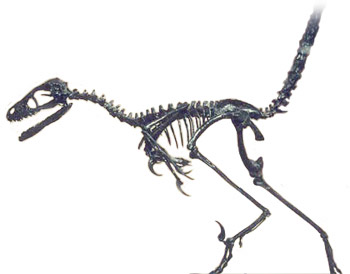
-
History as EndI was judging him harshly? It is a good thing to have more Ideas than you know what to do with. Had his mind been a quiet shallow pool, the D of I and more would not have been written.
Jefferson was a man of many parts -- a "renaissance man" -- with 360º of interests. Nobody (save me and thee, and even thee...) can be consistently superior in all aspects. -
Israel killing civilians in Gaza and the West BankI know nothing about American Indian languages.
varying per one source from one tribe to another more than Chinese to English. — tim wood
Side note to side note: Not surprising at all. The 13,000 years (+ or - a millennium) the aboriginal people occupied the Western Hemisphere alone, is plenty of time to develop barely related languages. Indo-European produced languages as mutually incomprehensible as Urdo and Gaelic over 5,000 to 8,000 years, and this in a smaller period of time than passed in the Western Hemisphere.
It's quite possible that the proto-indiginous people carried more than one language group to start with. Though they were native to NE Asia, they had mixed with a well-travelled central Asian people who also mixed with proto-Europeans (all this promiscuous mixing over millennia). Europeans and Indigenous Americans share a large genetic inheritance from the central Asian people. ***
*** A Short History of Humanity: A New History of Old Europe (2021) by Johannes Krause and Thomas Trappe. Krause is a scientist (archeogenetics at a Max Planck Institute), trappe is a science writer. -
History as EndThomas Jefferson is a fraught topic from any angle. Take his reputation as a splendid architect. I read a thorough history of Jefferson's work on Monticello several decades ago -- sorry, can't remember the author. One might picture Thomas the architect Jefferson carefully planning the house, executing the construction, then living in it happily ever after. Not so! The house was never done. Jefferson would periodically rip out finished parts and redo them. His family had to put up with construction for much of the time. If divorce had been easier back then, he probably would have lived by himself.
On the one hand, he fashioned a hidden door-closing device (nice feature) but installed narrow steep stairways that were not at all charming. The smallish square windows in some of the second floor bedrooms are at floor level, and while the big dome room is interesting, it probably wasn't very usable -- very narrow stairway access, extremely hot in the summer, inconvenient window height, etc. The exterior has a splendid appearance; none of the rooms inside the house were the same shape--lots of odd angles and sizes. Still, it was a pleasant place to live, one would think.
Jefferson apparently had more ideas in his head than he knew what to do with. -
History as EndAll history is myth, designed to reveal ideals and enforce ideology. It is a political tool. Objective history is a video tape of events, no events prioritized, no events nterpreted, and no commentary provided. We embue with new meaning when we interpret. — Hanover
Henry Ford thought that history was bunk. You are right. History is designed to convict those who did not live up to the stated ideals as directed by current ideology, Yesterday Thomas Jefferson was a national hero and all-around renaissance man; today he's a white supremacist, slaver and a rapist. He still wrote the D of I, but that's now part o the prosecution's case. Political tool, absolutely.
Frederick Wiseman has made a series of films like those you describe: His camera observes people going about their day in various institutions--mental hospital, emergency room, welfare office, high school and numerous other places. There's no narration, no comment, no interpretation provided. The films are a history, not the history.
History books are of necessity more "A HISTORY" than "THE HISTORY". One book won't reveal the past fully, so one has to compare and contrast versions. No guarantees, of course, that one will form a coherent picture of the past, or an 'approved' picture of the past. -
History as EndSome years ago I asked some very bright high-school students from one of America's better high schools just a few questions about American history. According to them, the American Civil War occurred in the 1920s, "Didn't it?" — tim wood
I used to worry about otherwise advantaged students not knowing when major events happened, like the Civil War, or not knowing big events happened at all -- like the holocaust. History matters to people who study or teach history, and to a few others. I think history is important, but it obviously isn't critical knowledge in a lot of fields. How much history does a dentist or an accountant need to know?
Does know the sequences of dates make people better citizens? Maybe. It's probably more important that people understand the difference between the messy truth and the official national narrative. It isn't just the USA. Every country has a messy history overlaid by a cleaned up national narrative. The truth is exclusive neither to the chaos of history nor to the museum-grade national narrative.
1776 or 1619? Either, neither, both. -
The Postmodern era: Did it happen?Two years later, Britain ceded India. Not a coincidence — Kenosha Kid
Bear in mind that Indians had been organizing efforts to rid themselves of the British Raj since before WWI. It was an item on their agenda about which both Moslems and Hindus agreed. At the end of WWII Britain was bankrupt; some food rationing continued for 9 years after the end of the war. They were in no position to enforce the terms of empire, especially a global empire of increasingly restive independence movements.
No doubt, though, there were people in GB who thought GB should get out of the empire business, for reasons military, economic or moral. -
The Postmodern era: Did it happen?Empires started shedding their colonies in self-disgust. — Kenosha Kid
Self-disgust had nothing to do with it. Empires shed their empires because they could not hold on to them any longer. Then too, the natives were getting restless, never a good thing for the regime.
I am grateful that I got out of town before the wave of postmodern shit arrived. -
The importance of psychology.It's been about how people should be, and how they might become that way if they aren't so already. — baker
And psychologists have certainly done a fine job on that project! -
The importance of psychology.I'm not happy, not happy at all that I had to do your homework for you. — TheMadFool
Maybe an antidepressant would help?
BC

Start FollowingSend a Message
- Other sites we like
- Social media
- Terms of Service
- Sign In
- Created with PlushForums
- © 2026 The Philosophy Forum