
-
The Unraveling of AmericaThe rationale, as stated by the mayor, Jacob Frey, is that the police withdrew (on orders from HQ) to avoid a violent confrontation which might result in deaths by gunshots.
The rationale wasn't altogether mistaken. Had the on-duty contingent of police stayed and prevented the mob from entering the precinct station, almost certainly somebody would have gotten hurt -- on both sides. However, the police at the fifth precinct station faced a worse mob 24 hours later which had just torched a bank, post office, filling station, and some other buildings, and they stayed on their roof, fully armed; later (90 minutes or so) they were backed up by a contingent of national guard troops. The 3rd precinct officers could also have been backed up (by the guard, sheriffs, other police officers, or the fire department (people don't like getting wet).
It was a damned-if-you-do, damned-if-you-don't kind of situation. While certain elements within the mob led the destruction, the demonstrators as a group played a strong supporting role in the destruction. There had been 3 days worth of "fuck the cops", "cops are killers", and "destroy the police" rhetoric being spoken, graffitied, and chanted. I watched the protestors/mob/rioters, whatever they were, wind themselves up on Wednesday afternoon. By nightfall they were at a fever pitch. THAT is why the police were avoiding a confrontation. Then the burning started. -
The Unraveling of AmericaThe Rolling Stone article is quite a laundry list of dirty linen. I'll speak to Covid 19, with a local application. That first:
Minnesota and Minneapolis have a good track record of economic stability and progressive policy that has stood us in good stead. On May 25, we began a high-speed unravelling which has left holes in our reindeer knit sweaters. The rioting, arson, looting, and demonstrating that happened after Mr. Floyd was killed owed a great deal to a lack of cogent policy and strong leadership.
Things turned really bad when the police abandoned the Third Precinct building. I'm sure the cops felt picked on, being the target of 3 days of demonstrations, but really: why would quite adequately armed police back off from a not particularly large demonstrating crowd? What the police demonstrated (disingenuously, actually) was a sickly unwillingness to use force to protect a $10,000,000 city asset (the cost of the building which was torched).
Their precinct abandonment was more or less accurately interpreted as, "Hey -- the police are gone; it's open season!" Within a few hours of the police withdrawal, the riot started, along with the arson, burglary, and general wrecking. It was a colossal failure of leadership within the Police Department, and within the (pretty much liberal) city government. Not only the police left, but so did the fire department--whose fire suppressing capacity was sorely needed. Hundreds of millions of dollars of damage was done in just a few hours.
COVID-19
The failure to mount an effective public health response to Covid-19 was the result - again - of the absence of a cogent plan and effective leadership. What happened in the United States is the direct result of "getting government off our backs" as the conservatives like to say. Trump certainly didn't have to lead the charge. There is an agency (CDC) well stocked with people quite capable of responding to pandemic and epidemic disease, but they have to be unimpeded in their exercise of public health measures. They were VERY MUCH impeded and interfered with.
We have been here before. When AIDS appeared under another semi-demented conservative president, something similar happened at the federal level: inept action or no action at all, and a lack of cogent policy. By the time the government came to terms with the fact of AIDS it was way too late to stop it. It took 15 years (1981 to 1996) to come up with a reasonably effective and tolerable treatment.
Same thing in 2020: Trump has (apparently) acknowledged that Covid-19 is a real problem. But with 5 million cases in the country and 162,000 deaths here, nothing that could or should have been done in the beginning will be effective now. We are in even more uncharted territory, currently pinning a lot of hope on the as yet non-existent safe and effective vaccine.
Bad leadership and stupidity is entirely sufficient to cause unravelling. -
Where do babies come from?So is the developing brain simply following genetic rules. — Benj96
My guess is that the developing brain does follow genetic rules, but that's not the whole story. For one thing, the mother's body is also following genetic rules, and her execution is likely to have some effect on the fetus. For instance, a slight increase of hormones might tip development in direction A, B, or C... If the mother drinks and smokes (the criminal pregnancy) alcohol and various products of combustion may affect the fetus. Obviously, using hard drugs won't help the fetus either. Diseases can interfere with the fetus.
I don't know whether fetal brains are much influenced by the environment outside the womb. Does hearing Mozart affect the fetus? Some people think it does (no idea, myself). What about punk rock?
So, yes: DNA is followed. But there is more to it. And it stays that way for life. DNA governs the brain, but lots of other stuff also affects the brain. -
The relationship between rhetoric and the artsAnd is the composer of the music you liked practicing rhetoric on you by way of notes?
I have some difficulty applying the term 'rhetoric' to music or abstract art. I can imagine drama or novels, poetry--the verbal arts--employing rhetoric effectively. In the TV drama MAD MEN, Don Draper displays his advertising campaigns (which are sometimes very artful in the way advertising works can be) with rhetorical force. The show writers didn't invent one very effective piece--Eastman Kodak did--where Draper presents the slide carousel (a carousel of color as Disney later put it).
Hmmm, I guess in a broad way a lot of our creative activity involves rhetoric, including music. -
How do we know if we are nice people?A regular Jesus you are. Have you considered announcing your deity status or at least sainthood? I can see a new religion growing up around you: Hanoverism. For instance, guys wearing 5 layers of pants so that they could make big sacrifices several times a day before ending up in holy commando style.
It would be an unusual religion, of course, featuring a liturgy of snarky comedy performed by pantless practitioners. Going out for the day stark naked would be an act of necessary piety in order to create the need for pants-off-your-ass donations, as well as shirts off your back, shoes off your feet, etc. -
How do we know if we are nice people?If we're honest with ourselves, the internal monologue of our minds is often very different to the words we speak out into the world or the actions we do. — Benj96
Some people think there isn't more to the internal monologue than idle mental chatter; I don't believe that.
Freud, and others, proposed a 3 layer model: id, ego, superego. In addition he described the unconscious and conscious mind. There is a lot more to Freud's theory, and you don't have to accept any of it. It is, however, a useful model.
The id is composed of our most basic, persistent, powerful, and quite often most socially unacceptable desires-the rampant sexual, self-aggrandizing, physical and emotional hungers. The superego represents the internalized societal standards for proper behavior--opposite from the id. The task of the ego is to mediate the id and the superego. The subconscious might be considered the residence of all the emotional turmoil we experience.
From Freud's POV, we are a mess of wishes, urges, drives, aspirations, fears, hopes, desires, etc. that are NOT compatible with polite society. Most of us, most of the time, are able to keep a lid on the simmering mess and meet social requirements for politeness, propriety, customs, etiquette, other people's feelings, the law, and so on. We have occasional lapses when unedited thoughts are expressed, bad behavior is displayed, and naked desires or fears are displayed.
In Freud's view, "niceness" is achieved by channeling the destructive power of the id into socially acceptable and constructive activity. Raw sexual energy which might prefer to fuck whoever wherever whenever can be channeled into intellectual achievement or meeting social expectations. This isn't a rare thing -- lots of people do it every day, all day.
Freud was a pessimist. To put it plainly, he didn't think happiness was in the cards. -
Disenfranchisement and the Social ContractI voted "no" because in most cases violent protest is counterproductive. There are cases in extremis where violence could certainly be justified, such as the assassination attempt on Adolf Hitler. It failed (Hitler survived the bomb), and the group involved was executed. A revolution (1917, Russia) may well involve violent protest, but if successful, the heroes and villains change places.
people of color, appear to feel a sense of disenfranchisement, that the US government has failed them on myriad levels (systemic racism, lack of social mobility, no nationalized health care, insane income inequality, the excesses of capitalism, etc.) — Aleph Numbers
The title of the thread, Disenfranchisement and the Social Contract, got lost very quickly.
The US Government and Capitalism didn't fail blacks -- they intended that blacks (and other undesirable minorities) should get the short end of the stick, and they have.
Some will raise objections that there is no such thing as a social contract to start with. I think there is a social contract, embodied in custom and law. Just because it exists, a social contract doesn't have to benefit everyone. For instance...
Our social contract has proscribed whites and blacks from occupying housing in close proximity to each other. Guilt-burdened liberal types may strive for housing integration, but most white folks are reasonably content with the arrangement. The social contract works for them, pretty much.
In practice, our social contract called for removal of Native Americans from the land which we wanted to occupy. We succeeded, and most people (other than Native Americans) find little reason to think they should give the land back. The social contract is working as intended.
The founders of America, the first drafters of our social contract, were not very fond of poor people--whether they were white or not. They didn't like poor people in England either, and even though they allowed poor people to migrate to the colonies (cheap labor), they still didn't like them. They considered our poor forebears "white trash" and have generally arranged things so that poor white trash (PWT) never were in a position to take over.
As it happens, the rich white trash (RWT) were very successful in their efforts. Even poor white trash find it difficult to imagine overthrowing their rich white betters, even though they--PWT--theoretically could.
Keeping blacks poorer than whites (for the most part) turns out to be a considerable comfort to PWT, and who cares what poor blacks think, anyway.
Our social contract has a sharp, jagged edge. The Golden Rule it is most decidedly not. -
Disenfranchisement and the Social ContractI remember hearing about the study that showed that the US is an oligarchy. — Aleph Numbers
More a plutocracy, I think. — Ciceronianus the White
Very much a KAKISTOCRACY right now. Government by the worst--i.e., Donald Trump (with other kakistocrats waiting in the wings)

-
Anti-AuthoritarianismYes, it's important to disambiguate terms like "authority" and "authoritarian". Thank you.
I was very inspired by Emma Goldman's writing, some 40 years ago. Also inspired by anarcho-syndicalists, and various strands of anarchist / socialist thinking. The trouble with all of these movements is that they existed on paper almost exclusively, not in reality. There are a few anarcho-syndicalists around--associated with the IWW. But they are so few that it doesn't matter.
One can (so I am told) be a solitary monk and do good things (like pray) but being a solitary anarchist, anarchy syndicalist, industrial unionist, or for that matter, a solitary Neoliberal is pointless. Even being a solitary monk or a solitary Lutheran has severe limitations. We are made for community, for work, play, thinking, and mating -- all that stuff -- TOGETHER. Same for being gay; being the only gay guy in the world is very troubling; fulfillment comes in finding others of the same kind.
I was a member of a leftist party of two or three dozen people for some 20 years. We were as ineffectual as everyone else on the far left, but at least we weren't flat-out solitary marxists.
There are a few thousand Americans (maybe enough to fill a soccer stadium) who are seriously interested in socialism, anarchism, and the like. We all insist on our various narrow programs and methods. Too bad, but we can't get together and be community, because we all insist on our individual group's direct pipeline to the truth. -
Biden vs. Trump (Poll)I voting for Biden, but holding my nose. It is essential to get Trump out of office in November, just as it will be essential to get Biden out of office 4 years later. Bad choices. Bernie Sanders is a more attractive politician, but like most of the candidates, he is too old. So is Trump. So is Biden.
-
Anti-AuthoritarianismI'm of a strange sort of syncretic political that is neither revolutionary, radical, nor reformist and, yet, all of them at the same time, or at least, was. — thewonder
Strange indeed. I think you are utilizing too many labels in your thinking. Pick a label, any label -- communist, neoliberalism, libertarian socialist Pacifist, crypto fascist, or Republican Assholes, and one finds that they really don't fit the intended target all that well [which I don't like because it irritates my discomfort with excessive ambiguity.]
I am an anti-authoritarian whenever the powers-that-be are getting on my nerves, but otherwise I don't see that big a problem with a fair amount of centralized power and authority. We humans are an unruly lot, and it takes a certain amount of centralized power and authority to keep a lid on, and prevent us from wrecking the means of our existence.
All that said, we could certainly do a lot better for ourselves and for the world. We have to find a way of prying the Republican Assholes, crypto fascists, neoliberal death cults, and so forth from their ensconced positions in office. -
PrivilegeThis assumes the work of evil manipulative geniuses. A better explanation is that whites simply chose to move. — Hanover
The "conspiracy" was entirely open and well documented.
- restrictive title covenants including bans on selling homes to blacks and Jews in both urban and suburban settings
- explicit (in writing, found in FHA documents from its creation in the 1930s, and in effect until SCOTUS ruled them unconstitutional, restrictions on lending or selling to blacks in urban and suburban locations
- zoning rules which established urban 'sacrifice areas' designated for black residents (aka redlining)
There is ample public documentation; this isn't the work of your conspiratorial evil geniuses, unless you were referencing southern Democrats who, in the 1930s and 1940s, burdened housing law and policy with explicit racial restrictions. These same extra ++ conservative senators also moved to keep domestic and agricultural workers (largely black people) from coverage by Social Security.
The significance of housing discrimination plays out in the many aspects of life that is heavily influenced by housing policy -- education, for example, and wealth. The white families that bought new housing in the 1930s-1960s in the suburbs were able to use their growing housing equity to further improve their and their children's lives.
Blacks housed in new rental housing (those big high rise housing projects in Chicago, St. Louis, and other cities) were, of course, unable to accumulate equity. The high rises were generally neglected by the responsible city/county agencies, so... they gradually fell apart. [Some cities took good care of their high rises, and they are still going strong.] The Pruitt (for blacks) Igo (for whites) project in St. Louis deteriorated unusually fast -- not because of poor construction, but because of predation by metal recovery gangs (who ripped out working plumbing, resulting in floods in the building), and the usual gang warfare. The blacks who moved into the buildings thought they were really good housing, and LIKED their units. Still, the implementation of Minoru Yamasaki's design was poor. (Yamasaki also designed the World Trade Center I and II.)
Any of these books will explain much to you:
- The Color of Law: A Forgotten History of How Our Government Segregated America
- Manufacturing Decline: How Racd the Conservative movement crush the American rust belt
- Mapping Decline: St. Louis and the Fate of the American City
- Abandoned in the Heartland: Work, Family, and Living in East St. Lous
- Pruitt Igoe (Images of America)
- Stuck in Place: Urban Neighborhoods and and the end of Progress toward Racial Equality
- The Origins of the Urban Crisis: Race and Inequality in Postwar Detroit
- New Deal Ruins: Race, Economic Justice, and Public Housing Policy
- Chicago Race Riots, July 1919
- Detroit City Is the Place to Be: The Afterlife of an American Metropolis
- Not in My Neighborhood: How Bigotry Shaped a Great American City [Baltimore]
- Demolition Means Progress: Flint, Michigan and the fate of the American Metropolis
- Tear Down: Memoir of a Vanishing City
- When American became Suburban
- Crabgrass Frontier: The suburbanization of the United States
- Evicted: Poverty and Profit in the American City [Milwaukee]
- The Ghosts of Johns Hopkins: The Life and Legacy that Shaped an American City [Baltimore]
- Once in a Great City: A Detroit Story
- When Affirmative Action was White: An untold history of racial inequality in the Twentieth Century
-
PrivilegeWhy would anyone want to be treated like blacks are treated on a bad day in the criminal justice system?
One of the benefits of having some sort of privilege (wealth, education, good environment, etc.) is that one isn't subject to the worst indignities available. It isn't my privilege that is wrong; it's the way the criminal justice system treats blacks that is wrong.
I'm not so wealthy, so white, so educated, and from so good an environment that I haven't gotten the crappy end of the stick on more than a few occasions. I think I have a pretty good grasp of how blacks have been subjected to not only the criminal justice system. Further, I have a pretty good understanding of how black poverty and disadvantage has been engineered and maintained by contemporary (20th century) systems of real estate, banking, city zoning, urban "renewal" (negro removal), education, and so on.
The "white privilege" of working class/middle class people like me (and a couple hundred million other white folks) isn't the cause of discrimination against black people; it's the relative result. it isn't white privilege that puts more than 1 in 4 black men in prison (According to the Bureau of Labor Statistics, at current levels of incarceration a black male in the United States today has greater than a 1 in 4 chance of going to prison during his lifetime, while a Hispanic male has a 1 in 6 chance and a white male has a 1 in 23 chance of serving time).
The coordinated 'management' or 'control' of black people grows out of the logic of slavery and post-civil war suppression and exploitation of blacks.
Over time the consequence was a black population that was deemed essential to industry (off and on) but personally irresponsible and dangerous.
All that was engineered. It didn't happen by accident. Who did it? The usual suspects: powerful ruling class operators who had and have the capacity to write housing policy (back in the 1930s and following), for example, that was as much about race as it was about square footage and construction codes. It was no accident that whites were sent to new housing in the suburbs, and that blacks were sent to new rental high rises in the city. The policy was to keep the races separate. Putting blacks in even quality rental housing helped insure their lack of wealth later on.
It was no accident that housing segregation increased after WWII. The federal government coordinated segregation by financing policy and housing codes. State, federal and local planners, zoning boards, city councils, county governments, and states followed suit. So did real estate companies, banks, S & Ls, construction companies, developers, et al.
It is stupid for us white folks to beat ourselves over their heads for having "white privilege". Our "privilege" is just people's misfortune. If white folks want to do something useful, we can at least try to change the way this fucking society works, and stop nattering about our dubious "privilege". -
PrivilegeIs privilege a burden from which one needs to be relieved? Why would anyone in their right mind wish to relinquish their privilege?
I've got a little privilege here, got by luck, got by effort, got by the good graces of low-cost state university education, got by immigrants, got by the subjugation of a few aboriginal peoples.
Celebrate my privilege a little? Sure. Give it up? Nah. -
PrivilegeHow actually privileged are poor white trash? Definition: White, but broke for the last dozen generations; lacking in education, job skills, or helpful social connections. Down and out. Uncultured, untutored, untaught. Lumpen.
They may think themselves better-by-way-of-skin color than middle class blacks, but nobody--white or black--would consider them "privileged" or would want too much contact with them.
Real privilege requires wealth--either wealth in hand or wealth in usable heritage. A monk may have taken a vow of poverty, but he has access to a great store of cultural wealth. An indigent person, minimum 5th generation of poverty, like as not has a access to a far poorer store of cultural wealth. Real wealth, usually gained in the dirty pits of wealth accumulation, provides the power to project privilege. No wealth, no projection of high status.
Getting wealth is a game with a stacked deck. Major accumulation usually requires access to capital, or requires useful inventiveness. Bill Gates, for instance, had both--else he would not have become a titan of software. It takes privilege to gain access to capital. To paraphrase scripture: Those with privilege get more privilege. Those without privilege lose what little they thought they had. -
Why aren't more philosophers interested in Entrepreneurship?Maybe "business' is just to... I don't know, real and substantive, down to earth.
The following statement is certainly not true for everyone interested in philosophy, but it IS true of some: some philosophers are not rooted in their own bodies or in the material world. They yearn for the abstract 'other world'.
In my opinion, philosophers need to be well grounded in the physical world of their mammalian bodies -- including their mammalian brain -- and the sensory environment to which the body is very sensitive. Get grounded before you get into too much abstraction.
Acceptance of one's embodiment and groundedness can be difficult to achieve.
I am now departing for a week on the north shore of Lake Superior. I'm taking along plenty of printed matter so I don't have to be too embodied and grounded in cold lake water and skin-frying sunshine, hordes of mosquitos, and all that hideous physical stuff. -
Is silencing hate speech the best tactic against hate?I question the wisdom of fighting hate by silencing hate speech. This silencing includes banning, deplatforming, PC culture, cancel culture and all that stuff. — DingoJones
I also question whether those tactics have a significant effect on ideology, as practiced, as thought, as written and read. And even if it were effective, I still don't approve of these practices.
Is silencing hate speech the best tactic against hate? — DingoJones
A communist, socialist, or anarchist could easily run afoul of hate-speech suppression during a rant about the ruling class, about rich people, about people with lots of real power. As it happens, the banners, deplatformers, PCers, cancel cultists--that whole crowd--come from the quasi-leftist side of town. That's my home address, too, but I still disapprove.
In an open society--which is what we supposedly have--it is permissible for Neo-Nazis to march around. Lots of people don't like it, but the ACLU was right to defend Neo Nazis when they wanted to hold a rally in Jewish Skokie, Illinois. (This was back in 1978; apologies for referencing ancient history.). White Supremacists, a group recently concocted in the minds of quasi-leftists and racial activists, should have as much right to air their views as Neo-Nazis, BLM activists, defenders of illegal immigrants, and so on.
What I really, really dislike about banning, deplatforming, PC culture, cancel culture, and so on is that it is too crude to be useful. Portraits of "white supremacists" have been drawn with nothing more subtle than paint rollers, where sharp pencils are in order. Who, and what, exactly, is a white supremacist? Or a transphobic? Will the real fascists please state your party platform? Abolishing whole police departments (composed, in Minneapolis, of 900 officers) because a small minority of them are brutal thugs, is another example of crude thinking.
REAL CHANGE, if that is what we really want (and I'm not convinced we do) won't involve reorganizing the symbolic and linguistic deck chairs on an ill-fated Titanic. It will involve fundamental changes in the industrial and financial core of society. The monumental pile of wealth belonging to Warren Buffet, Bill Gates, and a few thousand other very rich people, will have to be redistributed; production for profit (first and foremost) will have to be shifted to production for people's needs [hey, I can use a paint roller too!]. All this involves massive change which will be resisted most vigorously. -
Is silencing hate speech the best tactic against hate?Today on National Public Radio The World program, the name of the Washington Redskins was deemed unsayable. It wasn't unsayable just a week ago on NPR. I'm fine with changing the name of the Washington team, or other teams whose names belong to groups of people. But some principled people are against censorship of any kind, for any reason. I'm more in agreement with opposition to censorship than support for it.
The trouble with censors is that they tend to have fairly broad definitions of speech they don't like, which provides them with considerable latitude in decided what to censor. You want to ban very specific words, like 'fuck' for instance? Fine. Make a list of words that you want censored and we can talk about it. But "hate speech" can be whatever you don't like. That just leads to another kind of tyranny. -
Black Lives Matter-What does it mean and why do so many people continue to have a problem with it?I don't have a Black Lives Matter lawn sign, bumper sticker, or pin and won't be getting one. I'm white; maybe I have a touch of white supremacy, or something... I don't know. At any rate,
Racial histories, giving racial groups undue significance or irrational objectives and emotions, identity politics, so silly. — Judaka
Yes, I agree with that; on the other hand, a not-overly-sympathetic white guy can see that black people have consistently been discriminated against--maybe not all individually--but as a group, certainly.
Working people--black, white, and brown--have been the recipients of exploitation and discrimination across the board. That's the nature of capitalism: exploit, accumulate, conquer, rule. When you are broke, you are broke -- and it means very similar things whether one is black or white. Black people have been aggregated in certain places more than white people (by segregation), so they are more visible in their suffering. -
Crypt payments for hosting and... moderators?I've always thought that most of O K L A H O M A was a petroleum soaked shit hole. It's a good thing Oscar Hammerstein II never ventured out there. Had he, the play would have been about oil patch roughnecks, whorehouses, oil wells, and grease all over everything. Probably would have gotten bad reviews in the New York press and never made it on to Broadway from Off Off Broadway.
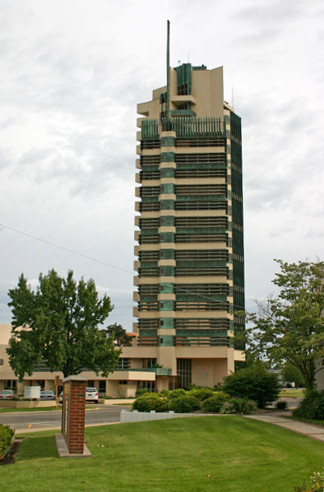
There is, by the way, a nice Frank Lloyd Wright building in Bartlesville, OK--the Price Tower, which started out as an office building and is now a hotel.
-
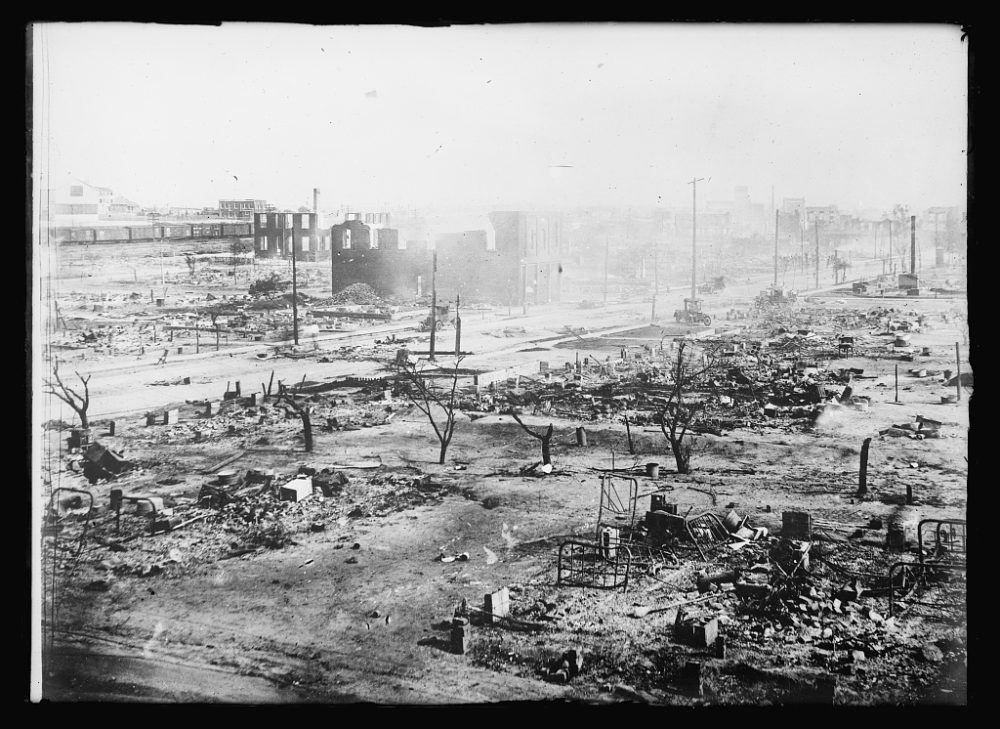
Crypt payments for hosting and... moderators?There was a huge pogrom / race riot / arson and bloody massacre in Tulsa, OK on May 31/June 1, 1921. Read about it here.
About 300 blacks were killed, the large and prosperous black Greenwood community was burnt to the ground, and many were injured. There was even some straffing from the air--a little WWI tech brought to bear on the situation.
In the aftermath of the white attack on Greenville, there was some national news coverage, which quickly faded, and then there was silence. Nobody--white or black--wanted to talk about what happened, out of fear and shame. There were several unmarked mass graves that have not been found, and a few that have.
An investigatory commission was set up recently to finally investigate the event.
There were very large race riots in several cities around the time (2 or 3 years either side) -- Chicago, East St. Louis, Detroit, and so on. -
Culture wars and Military Industrial ComplexJust wanted to go on record, here.
I heartily loathe the military industrial, corporate business culture of not just the US, but of much of the world. It's various devious, detrimental unto diabolical designs are loathsome in their entirety. I've spent quite a bit of time since the mid 1960s thinking about the MIC. -
Culture wars and Military Industrial ComplexHow important do you think those numbers were in the Civil War compared to how important they are to modern warfare. — Athena
An interesting side, here: During and after the civil war, there was considerable difficulty identifying how many, from what company, from what state, and names of dead soldiers. There was no system of identification. Beginning to solve the problem of identifying soldiers (dead or alive) was a major impetus to the growth of the Federal Government. If benefits were to be paid, accurate information was needed
I think the problem is a failure to understand the Military-Industrial Complex. — Athena
Sure, because the MIC is co-extensive with the mid-20th century culture on to the present. That's an immense amount of complexity to get one's head around. Just for example, people who are dithering about the militarization of police departments are not always aware that the drive to load up your local police with tanks is coming from the Pentagon, not from your local police station.
Why are we singing the national anthem before pro-football or pro-baseball games. Because somebody in the pentagon thought that would be a good idea.
The US was basically a nation of innocent children living for a love of God. While the Prussians who took control of Germany were living for the love of military might. — Athena
Come now, Athena! The US has never been innocent. No other country has either. Let me divide this up: There are the leaders (from the Mayflower on down), there are the gung ho followers, (the core group--not too large) then there are the masses.
The English Colonies, and then the US, has pursued some highly guilt-producing practices: mass genocide conducted against the Aboriginal peoples, enslavement, wanton disregard of civil rights, ruthless exploitation, waste, fraud, abuse, and so on. The leaders and core group set the policies and the masses are roped into supporting and/or carrying out the policies.
When we talk about nations--Germany, Burma, Liechtenstein, the United States, whichever... we might want to avoid using language appropriate to morally responsible agents. Nations don't have friends; they don't have morals. They have interests, and they tend to pursue their best interests.
George Washington, Abraham Lincoln, Robert E. Lee, Teddy Roosevelt, Warren Harding, Dwight Eisenhower, JFK, LBJ, Nixon, on down to Donald Trump are, for better and for much worse, moral agents who are responsible. I'm a responsible moral agent; you're a responsible moral agent. The pentagon, as such, is not. General Motors is not. The chair of the Joint Chiefs of Staff (some moral agent) IS. So is the CEO, CFO, CETC. of General Motors.
I also write too much verbiage, so I'll stop here, and start again. -
Culture wars and Military Industrial ComplexThe MIC and the NDEA is one of your abiding concerns, and it isn't altogether misplaced. However... The NDEA did have some democratizing effects by enabling people to attend college who otherwise would not have been able to afford tuition, housing, and books. My siblings were beneficiaries of NDEA grants, as were many of my fellow students. Me too. All that was back in the late 1950s and mid sixties.
Don't overlook the insidious effects of VA education benefits that sent many, many former soldiers from WWII (and later) to college.
I quite agree that the Military Industrial Complex (MIC) was. is, and probably will remain alive and well. I would like to quarrel with your chronology and widen your target aperture.
In focusing on the post WWII MIC, you are overlooking some other malignant influences: Don't forget about rampant capitalism: exploitative, often ruthless, anti-union, and focused on necessary (from their perspective) class warfare (which is what their anti-unionism is about, among other things). The manipulation of the public got a big boost in the work of Edward Bernays (1891-1955) the 'father of public relations'. Bernays was the nephew of Sigmund Freud.
The "bigger half" of the MIC is big business, the globe-circling ouroboros, infinite tail-swallowing snake. When a handful of capitalists (literally, less than 11) hold more wealth than 1/2 of the global population, you are dealing with something pretty powerful. Not to mention there are another couple thousand inordinately wealthy individuals out there, protecting their interests.
But getting back to the NDEA: Wasn't one of the benefits of the NDEA and VA education benefits a tidal wave of students (and income) that lifted all university departmental boats? Were not the humanities and/or liberal arts departments in much better shape after WWII on into the 1970s, then they later became (put on shorter rations at best)?
Another concern you have is
With the focus on technology came specialization and the Behaviorist Method of education which is also used for training dogs. — Athena
Sure, simple conditioning works better for training dogs than having long discussions with them. I've had long discussions with my very smart dog, and I can report that it didn't improve her behavior one wit (she was, of course, a very good dog).
It happens to be the case, like it or not, that human beings, dogs, monkeys, rats, and crows share many neurological characteristics. That's why we also learn in ways not much differently than other animals. Psychology's first big (and successful) project was to understand how we learn. So it is that the methods of the rat lab became the 'image of psychology'.
In saying that, please note, I am not equating a human mind with a dog's mind. The scope of human mental activities is far vaster than a dog's, and our brains are far more complex, and utilize additional methods of learning, knowledge acquisition, imagination, and so on and so forth.
Hey, Athena: I think we share a lot of discomfort, dissatisfaction, and disagreement with the world as it has been made. My disagreement here is that there are just more villains than the Military Industrial Complex. -
Culture wars and Military Industrial ComplexAs well they should! After all, it is well known that English majors reading Milton leads to nothing but trouble.
-
The Human ConditionPeople singing about liberation and bringing peace to the people but then they just do the most heinous shit. — Lif3r
At the heart of the human condition is a contradiction: we have had, do have, and will have both good and bad impulses at work at the same time. That is just the way we are. You don't like it; I don't like it; nobody likes it; BUT that is how we are.
Most of the time, most people try to keep the bad impulses under control. Unfortunately, the environment we live in often makes that difficult. Still, even the best environment for humans will not bring about perfection -- just less douchebaggery. Or would that be douchesacerie, in French? -
Is there a culture war in the US right now?BLM is legitimately described as a working class group, pretty much, in terms of their demographics and many of their aspirations. Their espousal of "trans rights" is hard to square with anything. "Trans rights" has, for some reason beyond me, become a major cultural enterprise. Bizarro world.
-
Is there a culture war in the US right now?There is a culture war going on now in the United States, because a culture war has been going on here since the getgo, 1620, or there about.
How could that be?
The American colonies were set up for the benefit of the ruling class of England, and required the suppression of both aboriginal culture (yea, their very existence) and the cultures of those brought here to labor--to do the hard work for others making the money. White indentured workers and black slaves both got bad deals, though the blacks got a considerably worse deal.
The on-going exploitation of white labor, black slaves, and later black and white labor (never mind the genocide of the aboriginals) has been de-emphasized in favor of the story of triumphant bourgeoisie progress up to and including the present moment.
Resistance to the oppression of workers crops up regularly; so far, the working class has been unable to gain the upper-hand over the ruling class. Black Lives Matter is one more chapter in the efforts of working people (this time primarily blacks) to get out from under the heavy hand of the bourgeois capitalists.
This will not be the last chapter, rest assured. -
CoronavirusMutations happen — ArguingWAristotleTiff
Viruses mutate regularly -- true. Generally these mutations are very minor and do not prevent a given test from recognizing the virus. Why? Because the surface proteins on the virus would have to mutate quite a bit before a typical test would fail to recognize it.
HIV mutates all the time, but the HIV tests still detect it.
Is your son at particular risk of contracting Covid19? Has he been symptomatic? Is he taking the recommended mask-wearing and physical distancing advice?
Just out of curiosity: once "they" come up with a Vaccine with maybe a 25% protection, but not really sure of the long term side affects other than defying death, are you going to be at the front of the line?
And, AND those who do not get in line for a year? Are they going to be labeled "anti vaxer"? — ArguingWAristotleTiff
They'll be labeled antivaxxers IF they practice non-vaccination for reliably preventable and serious infectious diseases, like measles, polio, influenza, and so on.
Whether to take a Covid19 vaccine involves a very standard risk calculation: is the expected risk of the vaccine greater than the risk of serious infection (and illness) by Covid19? People make these risk calculations all the time: Is the risk of an auto accident driving 300 miles worth the pleasure of seeing a ball game? Is the risk of sexually transmitted infections worth the satisfactions of unprotected sex? Is the enhanced flavor of unpasteurized goat cheese worth the risk of a very unpleasant gastrointestinal infection?
I had influenza in 1968--a particularly bad strain; it made me very sick. I've had pneumonia, and that was pretty bad. So, I consider the risk of a vaccine less than the risk of a combo Covid19 / pneumonia infection, plus the additional adverse consequences of the infection.
A younger person in robust health MIGHT conclude that the disease isn't worth the risk of a vaccine. Of course, the person in robust health and youth might end up being an exquisite corpse. -
What's been the most profound change to your viewpointWelcome to The Philosophy Forum!
The key idea about which I have changed my mind is the existence of God, and associated religious ideas, such as the divinity of Christ. This occurred over a period of time and was more or less complete by 1990. Since then I have developed a materialist approach to understanding reality (to the extent that I do).
Another major change was the embrace of gayness, going beyond reluctant self-acceptance. This process was completed in the early 1970s.
I moved from a fairy conservative view of life to a much more liberal - on to a more radical stance.
Now that I'm in my 70s, the importance of these changes has receded. I belong to a Lutheran congregation, but this is for purposes of social contact, not faith. I'm the oddly atheist member. I'm still gay, of course, but being gay isn't especially important anymore--being 74 and out of the loop.
Karl Marx is more important now than in the past, though my commie support group is largely (and literally) dead.
All this was over by the time I found the first Philosophy Forum (now defunct), so I can't claim that The last or current TPF changed my thinking a great deal. One of the things that bothers me about some posters is that they do not see to grant sufficient importance to the body and to the emotions. Some posters seem a bit like the caricatured huge brain supported by a very diminutive body.
How about you? What changing thinking have you experienced? -
Is Not Over-population Our Greatest Problem?Over-Population is part of the environmental crisis which the power elite ignore to everyone's peril.
If the population must be decreased (say, owing to massive food shortages) then nature will reduce the population. If continued production of greenhouse gases makes it difficult for species to live, then nature will remove the species -- including us, possibly.
I prefer that we take the initiatives necessary to secure our survival, but if we don't, life won't go on for us.
I'm not at all confident that we will succeed on our own behalf. A surprise viral pandemic eclipsed global warming, and then racial outrage eclipsed the pandemic, for... we shall see for how long. We have to keep our eyes on the ball if we expect to succeed at survival. -
Fashion and RacismI believe that black people do intentionally dress in a way to intentionally appear intimidating more often than white people. — Pinprick
Vestis virum reddit. Clothes make the man.
Men, women, blacks, whites--all of us, dress to express self, culture, aspiration, politics, class, and so on. There is nothing new about this, though the actual clothes change from time to time. Many people aim for an intimidating edge in their clothing. Upper class women in Manhattan have been observed deploying aggressive maneuvers with accessories for the purpose of intimidation. The business suit, the power tie, the black leather jacket, beards, long hair, short hair, no hair, tattoos, piercings, et al.
There are likely distinct features of black public presentation. Why wouldn't there be? Black culture has features distinct from white culture or any other culture. The way a black man might choose to project the image of power will depend on his particular milieu. To some, the "thug look" is intimidating; to others it makes for an easy dismissal of the subject.
To draw a comparison: Gay white men have deployed distinct features of public presentation. 50 years ago, working class clothing and mustaches were de rigueur among gay men. Some gay men preferred a heavy motorcycle gang vibe. At other times, other places, gay men chose radically different types of clothing.
Clothing is a form of communication to which some attention should be paid. Be prepared for relativism. An outfit that I might consider the height of stupidity, you might consider very subtle. -
Communism is the perfect form of governmentGiven human error and greed removed, ANY system of government would probably work pretty well. The problem is, though, human error, greed, sloth, and various other tendencies are always present, screwing up all attempts at a better mass society.
Is there a way to make people better, so that better societies can exist? Maybe, but progress toward "better humans" is slow and incremental with retrograde developments along the way.
in mass societies such as exist now, it's a balancing act to avoid too much control and not enough control. -
Nobel (Woe)ManBecause reproduction is free for a male, and costly and dangerous (and in the worst case, fatal) for a female? From the point of view of spreading their genes, a male has no reason not to reproduce with every female they possibly can. — zookeeper
I don't have a time machine, but I suspect sexual activity hasn't always been the free-for-all it currently seems to be.
For one, humans have lived in social groups for a long time. We were hunter-gatherers in a sparsely populated world for... hundreds of thousands of years--much of our homo sapiens history. It is not a huge stretch to suppose that there were social limitations on what both men and women might do. We evolved in social groups, not as lone operators. There weren't hundred, thousands, of potential partners in the hunter-gatherer bands. They just weren't that large.
Survival was precarious. Survival was not a sure thing. In hunter-gatherer groups, reproduction was perhaps not free for any of the adults, "not free" in the sense that too many children would be hard for the adults (male and female) to feed.
The whole animal kingdom isn't loaded with males running around mating promiscuously. In some species, yes; in other species, no. One of the limitations on male promiscuity is female mating-willingness. Because in many species, females are choosy about mating the male would be very lucky to achieve promiscuity. Another factor is population density: there just aren't enough animals of a particular species in one area to allow for male promiscuity. (Probably more true for larger fauna than smaller,)
When and where we have achieved high population density (cities, complex urban societies) my guess is that male-promiscuity opportunities are higher than in the distant past. Maybe we are projecting present conditions into the Stone Age. -
Self professed insanity: a thought experiment.As @Nils Loc noted, "insanity" isn't a psychiatric diagnosis. It's a very outdated term.
Whether people are diagnosed with major mental illnesses or have more or less normal mental status, some people are 'trapped inside their own heads'. They have not noted the degree to which their behavior is problematic to themselves or others. -
Argument: Why Fear Death?Just for fun, here's a random thought I came up with — Wandering-Philosopher
What makes you think your thought was random? Was there a random voltage fluctuation in your brain that caused that thought to occur? A cosmic ray striking a raw nerve?
Since life is often hard work, and by its nature inherently meaningless — Wandering-Philosopher
Life is a lot of work, for sure, but what makes you think it is [a] inherently meaningless? How did you arrive at that conclusion -- both the meaninglessness, and the inherentness?
why fear death? Because ceasing to be cannot be any scarier than the trials and tribulations of living. — Wandering-Philosopher
A stronger statement might be "Being dead wouldn't be any worse than not being born."
(Accepting all viewpoints and counterarguments) — Wandering-Philosopher
There's the difference between death and dying. Woody Allen said that he wasn't afraid of dying; he just didn't want to be there when it happened.
Obviously, one reason people fear death is that they have absorbed too much of the over-heated literal heaven/hell business of Christianity. -
What defines "thinking"?The kind of unconscious activity I was referencing goes on all the time and is often high level. Most people have had the experience of "sleeping on a problem" which yesterday seemed insoluble; upon waking up the solution was apparent. Just one example.
-
Systemic racism in the US: Why is it happening and what can be done?The most powerful (by dint of brute power) and the richest members of the elite are multinational, China, Europe, and North America contain most of the multi-billionaires.
-
Systemic racism in the US: Why is it happening and what can be done?Do you really think there is some kind of consistent coordination amongst the super rich and politically powerful? — Marchesk
Yes, to some extent. The elites have common financial interests (and competing ones, as well), and common issues with respect to governance, taxation, and so on. Do they get together to discuss how to manage the world's populations so that they stay on top? Probably not, but as a low level prole I can only guess. -
Systemic racism in the US: Why is it happening and what can be done?The institutions that have managed the collection of prejudices which have valued and devalued one person from another are the core and center of society. In this country, the elites of business, government, education, religion, education, entertainment and so on are key. They maintain prejudices not merely because they are hateful bastards. Prejudices keep us proles from uniting against them elites.
The prejudices the elites maintain are revisable, editable, reformable, without dislodging the control of the elites, or their ultimate purposes of control. So, here we are today, June 15, 2020; the Supreme Court has affirmed that anti-discriminatory employment laws cover GLBT people. Does that mean that gay and lesbian people are now part of the elite? No, indeed! Other credentials are required: lots of money, the right pedigree, the right race, the right presentation, etc. I'm a 74 year old gay man. I've seen my status in society improve steadily since, say, Stonewall in 1969. But I don't have much money or a great pedigree, though I am white. I don't have the right friends in high places and my political ideas are way way out in subversive left field. No elite dinner parties for me!
Suppose tomorrow all the police departments were defunded, Trump, the Senate, the House, and all 50 states committed themselves to eliminating racism in 5 years (please don't try holding your breath) would you then be equal to the elite? No you would not. You would still need the large amount of money, the right pedigree, the right presentation, the right contacts, education, and so on. You'd still be some kind of a prole, like just about everybody else.
The elite's primary project is to remain the elite and keep the rest of us on edge with each other so we don't turn on them! They are good at this. They've been doing it for centuries, all over the world.
BC

Start FollowingSend a Message
- Other sites we like
- Social media
- Terms of Service
- Sign In
- Created with PlushForums
- © 2026 The Philosophy Forum