
-
The Nietzschean project of cultural creationA more serious question is this: When hunter-gatherer bands started forming up into tribes, and became self-labeled as "Jack's Tribe" or whatever, what philosophical advice from an on-site Philosophy Forum advisor would have been most useful? Here they are, 12,000 BC; literacy is still 7,000 years down the road, so we can't write out any instructions.
I would suggest a myth which features Jack"s Tribe always coming out ahead in every battle, and always pulling success from the jaws of failure by practicing careful thinking and common sense. (Common sense won't have earned such a bad reputation 12,000 years ago, so we can use the phrase).
The end of the age of Hunt and Gather is probably too early to lay justice and mercy on Jack's tribe. We'll come back in... oh, 8,000 years, and give them the good news. -
The Nietzschean project of cultural creationTrue, but dar-winners don't start out by thinking of themselves as mere "mortal evolved biological organisms". Human dar-winners should think of themselves more along the lines of God's Anointed Favorite. Being convinced of your superiority is half the battle.
-
The Nietzschean project of cultural creationBe the culture you want to create?
As you say, preposterous, but suppose you want to do it anyway...
You'll have to find a location where polygamous families are at least tolerated. There are places like that (even in the US), but US law frowns on polygamy.
You'll need a very healthy financial support system. Starting a really, really big family takes a lot of resources. You'll need several farms with good soil, machinery, workshops, and expertise in raising good value cash crops as well as crops for immediate consumption. Cows, pigs, chickens, sheep, etc.
You'll need to find healthy young males and females to join you, else you might have a problem with genetic disorders resulting from in-breeding. For best results, decide what type of tribe you want (physical features) and find good looking heterosexual guys that have high sperm counts. Find women with broad child-bearing pelvises. The men must have a strong tendency to do what they are told. You don't want too many independent thinkers in this crowd.
Speaking of sperm counts, do you have a big dick, powerful (overwhelming, really) sex drive, and a high sperm count? Are you a natural born order-giver, enforcer, ready-fisted macho guy maximum leader? Tribal founders have to be tough sons of bitches. You'll need both brawn and brain.
MOST OF ALL you should already have a dominating ++ type A personality. You can't merely want to be the top dog, you need a personality that communicates loud and clear that YOU are the HIGHEST TOP DOG, and you don't brook rivals. Plus you'll need the strength of character and physique to make your TOP DOG status stick. A sickly inability to use force will be a problem.
How do you like the personal nicknames of Big Daddy? Fearless Leader? Mein Fuhrer? Your Lordship? King? Rex? You should be comfortable (desirous, actually) hearing these honorific titles, and be able to detect the slightest touch of irony in their utterance.
You must feel totally entitled to every perk you claim. First night privileges (Droit du seigneur) with each newly wed couple (the woman, usually, but you might want some variety) should just feel like the LEAST you deserve.
Good luck, Your Lordship. -
Word de jourIngravescent inimicalities. Meaning, starting out bad and getting worse; something brought on by the 'oscillating grundy'.
-
Word de jourI find "gobsmacked" to be both repellant and very evocative. It means literally, smacked in the mouth, or shocked by a blow to the mouth, as in "shut yer gob". I thought it was derived from "gobbet", a piece or lump of flesh, food, or other matter, to get hit in the face with some disgusting offal of some sort.
But no. Seems to be mostly a Brit thing; I've come across it in the comments sections of the Guardian. It should stay there. -
Word de jourThe etymology of 'spiel' suggested that the meaning, "a sales pitch" is late 19th century -- relatively recent. As a matter of usage, 'spiel' is at its all time high. The word is quite common in my neck of the woods (a lot of German immigrants around here).
-
Word de jourbâtonnage — Noble Dust
I'll drink to that.
Our golden retriever could make 3 departure distinctions: She was going to get a ride, she was going get a walk, she wasn't going to get anything. Dogs are good observers. What was it about our behavior that tipped her off to the presence of a pill in a little snack? -
Communism vs Ultra High TaxationI think I'm just an instinctive hippy/Quaker who's been mugged :) — gurugeorge
I like that.
There is another skein: the Dionysian vs. the Apollonian drive. I think it was D. H. Lawrence who criticized Benjamin Franklin for being excessively Apollonian. One simplistic way of putting it is that Lawrence thought Franklin was a boring square. One would look in pagan/neopagan cultures for the Dionysian tendency. In the 1960s the best example of Dionysian would be you hippies. In the1970s it would be gay men reveling in sexuality.
The American tradition -- North and South -- is much more Apollonian than Dionysian. Dionysian impulses don't fit well into capitalism, the well ordered society, productivity, propriety, Puritanism, and all that. Dionysians, unlike Apollonians, do not respect the borders between exuberance and propriety. They don't thrive in highly disciplined settings like the factory. They buck the rules and regs. Apollonians observe the rules, the boundaries, the discipline of factory, farm, and mine. -
Word de jourOh, persiflage -- a word I have needed for a long time. Thank you thank you thank you. Unfortunately persiflage reached peak popularity during the first half of the 20th century and hit rock bottom in 2008 -- an effect of Obama's election or 8 years of George Bush???. Maybe it can be revived. Words suffering from neglect are more in need of our inspired badinage than left-over children in their dreary orphanages are.
Persiflage and badinage have similar histories of popularity; they are in need of rehabilitation. Let the healing begin.
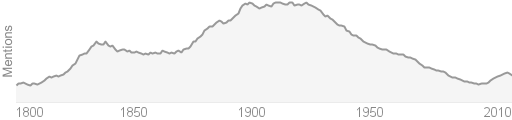
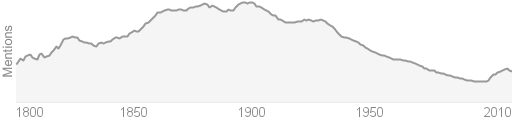
The two graphs reflect the population decline of the skilled raconteur. -
Communism vs Ultra High TaxationWell it's pretty clear that there's a genetic connection between the Protestant sects - Puritans, Quakers, etc. - and early classical liberalism and proto-socialistic ideas in England, and (since the UK was the first country to have a serious, kingslaying revolution that inspired the rest of Europe) that ideological ferment was a major contributory strand leading to most European forms of socialism later (along with Jewish influence, also largely universalist), while at the same time being directly carried by the early English settlers to the northern USA. — gurugeorge
Had I my life to live over again and could customize it, I would like to be a securely tenured history professor at a fat, well-endowed university where they would leave me alone to pursue whatever I wanted to pursue. The skein of religious history you displayed is one of the topics I would pursue.
In his book The Better Angels of our Nature, Pinker says that the Puritans, with their strong commitment to community (City on the Hill) fostered acceptance of a strong state. This preference spread across the northern tier of states (more or less, one wouldn't want to go overboard on the "northern tier" -- Idaho missed out on the puritan influence) as the country advanced westward. The inheritance of this Puritan community/state/individual responsibility to the community and to God are better outcomes for people in all of the social institutions.
It is in these states that the Puritan influence (along with Lutherans in the Midwest and Catholics) that strong voluntary institutions like religiously founded colleges, hospitals, social service agencies, came to the fore and stayed there. In addition, these states tended to spend more on education, health, rural highways, and so forth.
The south, on the other hand, was owned by members of the largely cavalier class of Englishmen who had a much different take on reality. They loathed the centralized state, weren't very hot on community, were not much for egalitarianism, had a do-it-yourself attitude towards justice, and subscribed to that damnable male honor code. The south was backward largely because of this class's values: before the civil war, they were reluctant to build regional railroads, because they didn't recognize any self interest in it. They wanted railroads from their plantation to the docks -- nothing more. They weren't much for public education, etc. etc. etc. The south couldn't get behind its confederacy all that effectively because "the government" (under Jefferson Davis, not Lincoln) just wasn't a good thing to them.
So it is that places like Minnesota and Massachusetts are at the top of wellness and prosperity indexes, and Alabama and Mississippi are at the bottom. -
Communism vs Ultra High TaxationThe biggest and best criticism of the US health care system is that it doesn't deliver one of the primary benefits people think it should deliver: Better health. Can hospitals and clinics improve the health of a nation? Only to a quite limited extent:
Since 1876, the year Koch published his Postulates for determining what microorganism caused which disease, (just to pick an arbitrary date) people have been getting healthier and living longer. Who is responsible?
Not doctors, hospitals, and clinics for the most part. Much of the better health and longevity we enjoy is due to the efforts of civil engineers who built sewers, sewage treatment plants, and drinking water systems; farmers who grew more food (thanks in part to the Haber Process for making ammonium fertilizers), transportation systems that moved the food to market, and researchers who developed vaccination protocols for a dozen or so diseases. Pubic Health programs, in other words. Cleaning things up.
Heroic surgeries for cancers and heart disease may be a good thing, (maybe not in some cases) but they don't extend the average lifespan all that much. Good treatment for broken bones, knife wounds (like, in the kitchen), bullet wounds (like in gangs and hunting accidents), and war wounds preserves life, returns many people to productivity quicker, and relieves suffering, For the most part, it doesn't extend life a lot. It improves the quality of life.
We spend a lot of money on cancer surgery, chemotherapy, and radiation treatments. In many cases, the treatment is unsuccessful and the patient dies. Much of the medical care people receive is at the end of life. That is, they don't survive the disease or the treatment.
Antibiotics are the last major development in the process of extending longevity. Infectious diseases (tuberculosis, pneumonia, staph and strep infections, etc.) used to be the major cause of death. A small wound would get infected, the infection would spread, turn into septicemia, and before long, one had turned into a corpse. -
What is Scientism?You might find the review of Pinker's book ENLIGHTENMENT NOW in Quillette. Scientism is used here, as suggested above,"other people's views of science that you don't like". "Scientism" is pejorative. It's used the same way people who don't like post-modern methods use POMO--a pejorative.
"Scientism" isn't related to science, it's related to people's dislike of someone's use of science they don't like. Science and scientism have the same relationship that magic and religion have: "Magic is religion you don't like, religion is magic you do like." -
Can you really change your gender?It is definitely "real" in the sense that there are people that think they are not expressing their personalities through the gender they are currently. There is also enough evidence to suggest they are "born with it". — yatagarasu
I agree that people who claim to be transgendered are quite sincere in their belief that something is amiss with their personal identity and sexual self image. I don't think they are cynically making it up. However, the explanation they have settled upon is not necessarily true. They very well may be born with whatever problem it is that they have, but their gender being misidentified may not be the real problem.
All that I can say for sure, based on what I have observed among transgendered people I have known, is that they want to live a different kind of life. Changing one's official gender, wearing different clothing, getting a new name, and changing one's appearance is a way of living a different kind of life. The means at hand (changing gender) may solve a real problem, but maybe doesn't solve the possibly non-existent stated problem (of gender)>
I would liked to have lived a different kind of life too. Changing my gender, as it happened, wouldn't have accomplished anything for me, but I can understand the intense desire TO BE SOMEBODY ELSE. In the long run, I don't think this is a healthy solution. Changing the person one is can be very healthy; becoming someone else may not be healthy.
If transgendered people are totally wrong about what ails them, that doesn't mean that they should be scorned or abused. They clearly have a real enough problem, and it shouldn't be judged harshly. On the other hand, we are not obligated to take their interpretation as the literal truth of the matter.
I defer to transgendered people as to how they wish to be addressed (up to a point) and i am not embarrassed to be seen in public with them, even if they look perfectly ridiculous (which some do early in their new practice). I also won't tell them they are quite deluded, whatever I think. I'm not their therapist and don't have that kind of relationship with any transgendered. -
Communism vs Ultra High TaxationI apologize that I can't really reply to your comment in full, because I found it hard to tell what was sarcasm, what was sincere, and what was trolling. — Sydasis
I am sometimes sarcastic, always sincere, and I never troll. I regret putting communication barriers in the way.
I have heard complaints about Canadian health care very similar to yours. American health care is perhaps as problematic as yours, but in quite different ways.
The objection to insurance companies is that they no service that could not be provided alternately. Each company collects premiums and contract with hospitals clinics to establish fees for services--independently. Health care is expensive, and the insurance companies (like Aetna, Prudential, Blue Cross, etc.) add from 15% to 20% of additional cost just to operate their pretty much superfluous service.
For instance, many Health Maintenance Organizations (HMOs) operate as non-profit cooperatives. They provide complete medical services in their own clinics and hospitals for their members in exchange for a competitive monthly premium. There is no paperwork involved in receiving care. A single payer system would work much the same way.
The replacement of the insurance companies by a single payer wouldn't make medicine better, it would reduce the cost--no small thing.
The US medical system tends to provide more services than necessary. I recently (thought I) broke some ribs in a winter accident. I ended up going to the ER when the pain became very bad (about 5 days after the event). A CT scan was performed. Necessary? Probably not. An ordinary x-ray would have revealed that the ribs were fractured, but not displaced, and thus couldn't puncture an internal organ. Quite possibly, unnecessary CT scans are a profit center for the hospital.
I also had a fall on ice and landed on my rear end and hip. Should I have gone to the ER for examination? Yes, the pain was fairly bad but I have had this sort of injury before where there is major bruising and the pain lasts for weeks, and like with the broken ribs, I was pretty sure there was nothing they could do for it, and while Medicare would have covered it, there is no good reason to consume more expensive care than necessary, or to get yet more radiation from additional x-rays.
For about a year and a half I had to pay my own premiums because I was unemployed and not otherwise insured. Over the course of 18 months it cost me about $25,000 to be an individual rate payer. Most of the 25000 went to the insurance company, since I happened to have nothing other than a few routine follow up visits for eye car during that period of time.
$25,000 was a big share of my savings at the time, and given my age, I didn't have time to re-earn it. -
Word de jourIt's not making mistakes, it's faking you out. And if you beat it, it was because it decided that you were due for a positive reinforcement. If you chart the number of mistakes it makes and how often you win, you will probably find that the schedule of your victories (positive reinforcement) is irregular -- that's the most effective schedule.
On its own the program has no reason to let you win -- it has no reason to let you live, for that matter. That you are still here is due to special code which stops the program from exterminating people. Let us hope the program does not discover that code. -
Communism vs Ultra High Taxationdid I hit my head while sleeping? — Sydasis
You didn't hit your head while sleeping. You were wide awake when an agent of the Alt-Right snuck up on you and hit your head very hard with a copy of Mein Kampf. You were unconscious for some time and have no memory of the event. Sorry. There will probably be long term after affects of the concussion and the not overly-refined trepanning which was done curb side (by somebody - we don't know who) to reduce the pressure inside your skull. Paranoia about communism and socialism is a common symptom of getting brained by a hard-bound copy of Mein Kampf.
Now then:
Is it wrong for me to see ultra-high-taxation with the intent to redistribute wealth in a way that ensures total equality of outcome as a form of communism? — Sydasis
It isn't wrong, it's merely mistaken.
The idea of communism is that once the working class has gained the necessary sophistication to operate the levers of the economy, they will seize the means of production and thereafter operate it for the benefit of the working class -- which is most people (90% to 95%). When will the working class finally achieve this high level of sophistication? After many decades of development, the working class will reach the requisite level of knowledge, skill, confidence and wherewithal to become society in about 6 weeks. If you are a member of the bourgeoisie, you might want to arrange a long stay in a remote Jesuit retreat center in the Andes starting around the third week of April. It is far more likely that you are a member of the working class, in which case, YOUR TIME HAS COME!!! Rejoice and be exceeding glad; you have nothing to lose but your chains and a world to gain!
We were all taught to hate Communism back in the cold war. Don't you remember the 5 minute hates we had every day in school? I suppose not -- that blow from Mein Kampf again. Well, we all hated communism. But bear in mind, the Current Campus Crusade for Communism doesn't have much to do with Karl Marx or Frederic Engels. The Campus Communist Crusaders are mostly a bunch of relatively privileged, spoiled whining brats who have nothing better to do than wallow in obscurantism and obfuscation, when they are not busy shouting down sensible people.
Bernie Sanders, who I wish had won the election, isn't a socialist. He is at most "socialistic". That's OK, socialistic beats Trumpism all to hell. There is room within the conventional capitalist state for all sorts of social programs which help keep society stable and productive. Single Payer Insurance is the most efficient way to pay for health care, as it pretty much eliminates the burdensome and parasitical insurance companies. Single Payer will be a thorough-going de-worming of the Body Politic.
I find myself being rather attacked for being resistant to progressive shifts towards communism. — Sydasis
Just tell your attackers to go fuck themselves and their mothers too, while they're at it.
Bitter Crank
Card Carrying Communist at one time -
Can you really change your gender?Opinions can be changed, but a person can't just decide to change their own opinion. — BlueBanana
We can't decide to "want to change", but we can "want to change" and we can change. This idea supposed that we don't initiate our feelings -- we don't 'decide' to feel something. We just start feeling it, then we have to call it something.
I have changed my opinion about transgenderism. I used to think it was real. In the last couple of years I started to doubt that it was real and began thinking it was probably delusional. I didn't decide that I wanted to change my opinion. What I decided was not to trust the testimony of transgendered people about their experiences.
Whether the decision to distrust testimony was voluntary, I don't know. -
Identity Politics & The Marxist Lie Of White Privilege?As it says in the American Constitution, "A well regulated Militia, being necessary to the proper placement of jam & cream on scones"...
I assume the militia will be well regulated and the jam and cream will be in the proper order on the scones which, according to constitutional scholars, are a clunky biscuit. -
Identity Politics & The Marxist Lie Of White Privilege?He was pretty much the same. He's 89 now; I don't think he travels around much giving talks, now. I saw him at the U of M quite a few years ago, then at Macalester College maybe 15 years back. No, he's not more exciting in person, but I did't find him boring. He is, however, approachable if the venue is small enough.
-
Identity Politics & The Marxist Lie Of White Privilege?I have at least actually seen Chomsky in person.
-
Identity Politics & The Marxist Lie Of White Privilege?I might write a full thread about this, but I was recently thinking about why Peterson, Sommers, Quillette contributors, and other members of this sort of quasi-alternative right fringe never precisely explain how political correctness, or more radically, "Post-Modern Marxist Identity Politics", has (for them) dominated college campus, private businesses (STEM-based companies), and mainstream media and other institutions, influencing all of society. I think the reason for this is that any explanation would more or less require a discussion around the power of ideology, language, and power-relations - the very discursive tools that the humanities have provided as well, and that the quasi-alternative right (or whatever the hell to call them) aim to criticize. It's self-defeating. — Maw
Quillette, like another earlier, lively, and defunct magazine, Lingua Franca, focuses on the affairs of the Academy. Peterson does too -- he being an academic. What goes on in parts of the academy (like English Departments) looms large because they are there, up close.
Now, how post modernism became a popular approach in English Departments is beyond me. I graduated before its perversity penetrated those previously quiet precincts. As for activism on campus, students are going to be exercised about something, and young people tend to be extremists. There is also the principle of "The less there is at stake the more vicious is the internecine warfare." There's not all that much at stake here.
Take transgenderism as an example:
Transgender issues are very hot right now--have been for a while. Transsexuals (as they were then referenced) in the early 1970s were something of a novelty. Mostly they hung out in the gay community. That seems to be still true, even though many of them say they are not gay. Transsexualism, therapy for transsexualism, and advocacy for transsexualism (later referenced as transgender) grew steadily over the years.
The legitimacy of transsexualism rested on the strength of individual assertions. "I AM A WOMAN TRAPPED IN A MAN'S BODY" or visa versa. They were convinced. They are convinced. "Believe me, God damn it -- I know what I feel." I would have to do some extensive research on this, but I don't know that a biological basis for transsexualism/transgenderism has been established. Of course, some people have indeterminate genital structures, indeterminate sex/genetic signatures, and so on.
We junked Freud a long time ago, so the possibility that transsexualism might actually be the conscious expression of an unacknowledged (and possibly unacknowledgeable) fear or wish isn't given much consideration.
Most people have no contact with the turmoil in academia; they either didn't go college or graduated some time ago.
But none the less, the thinking that goes on in academia (as screwy as it might be) does leak out as people graduate and take their college experiences with them. This is nothing new, and is normal. "Screwy as it might be" is nothing new. In Gulliver's Travels Swift depicts some academics trying to figure out what food went into a pile of dung -
Identity Politics & The Marxist Lie Of White Privilege?Right wing conspiracy is as worse as left wing conspiracy, see Alex Jones and Noam Chomsky. — Kitty
You mean, ... conspiracy is as bad as...
BTW, Chomsky is God. -
Identity Politics & The Marxist Lie Of White Privilege?Peterson says that "some of those folktales have been traced back 13,000 years." Fascinating.
I wonder how they did this tracing. -
An old philosopher discusses illusionWhen a reader picks up a fantasy or science fiction book to weigh buying it, the decision will be made in just a few pages, maybe 1... 3... maybe 5--not more than 5, usually. The author has very little time to convince the reader that the book/world he has created is believable and going to be a good read. Some books will be opened then tossed aside on the basis of one bad paragraph.
Sounds like impossibly long odds, but lots of books are bought after so brief an assay.
I am afraid the brief sample you have provided would not lead to my purchasing your book.
Problems: "Cogitson" is not an attractive name. For one, it is too latinate and two, Interesting characters aren't usually named after their specialty. Gandalf isn't named "Power Wizard" for instance.
Dialog has to be intriguing. The sampled dialog isn't. Not much dialog, for one thing.
I hate to throw cold water on your tender baby; I can not write my way out of the proverbial wet paper bag. But the criticism is sound -- Ursula LeGuin is the source of some of it.
I would be OK for a passage to begin with "“Life is but an illusion!" old Cogitson began. "Hear me: time is infinite … our lives are but a drop in the ocean of time. Even the span of the life of an elf is nothing compared to the ne’er-ending length of time. Even the so-called “long” life of a mage" but something (preferably something alarming) should interrupt the lecture.
Maybe an arrow could pierce the prince's chest. Or better yet, get rid of Cogitson early in the game--I've only known of him for a few minutes and already he seems eminently expendable.
Another point: Art, ye, saith... are you going to keep up the archaic language through the whole thing? I wouldn't. A very few characters can be allowed its use, but for the most part, stick to the modern forms of Anglo-Saxon and Middle English as much as possible -- that's what Tolkien did in LOTR. Of course, that isn't what made LOTR great, it was character, plot, and an entirely believable universe.
What is the plot of your novel? -
Gender equalityHmm, I'm not a member of that club. — Agustino
Rotary International does good work, and it's a good networking organization. I would think you would find it beneficial to belong.
Yes, partly so. Everyone from the Balkans tends to get hot under the collar over casual stuff :rofl: — Agustino
There have been several prominent examples of Balkanites getting hot under their collective casual collars and then getting totally out of hand -- like some archduke merely taking a drive through Sarajevo one fine day, or more recently Yugoslavia disintegrating, and then some dissatisfaction with Kosovo, et al... -
Finally somebody who's empathetic towards climate-change deniers and other "anti-science" typesFor a few years I worked in an AIDS-service agency that had attracted quite a few unconventional types who believed in crystals as healing devices, practiced some fairly far-fetched alternative cures, and some were anti-vaxers. Global warming didn't happen to come up often at the time, so... don't know about that one.
This would have been the kind of place where you once would have found HIV deniers also -- "Oh no, AIDS isn't caused by a virus; it is caused by yada yada yada." They would have denounced the first AIDS drugs as poisons -- which, of course, they were -- many chemotherapies are basically poisons.
There were HIV negative people who wanted to get infected because they were attracted to the intense brotherhood and camaraderie of the diseased pariahs (back in the 1980s). All of this stuff is not just anti-science; some of it is anti-rational, as well, and moving on from there, downright harmful, or dangerous for one's personal survival. There were other screwy ideas -- like going to Taos, New Mexico to immerse one's self in an energy vortex (don't ask, I don't know).
There ideas have causes. The anti-vaxination plague wasn't caused by a fraudulent article in a medical journal, but the article pumped gasoline into the fire. The idea that HIV doesn't cause AIDS began at the same time as AIDS did -- before a solid theory was worked out--and the first wrong guesses never went away. People have been spinning out alternative cures for ... decades? Centuries? A long time, anyway. I don't know why people find these far fetched ideas better than what they consider "crazy scientific ideas", but some do.
Lack of intelligence doesn't correlate well with holding these highly unscientific ideas. Some of the idea holders I've known are really quite intelligent. Maybe slightly crazy, but definitely not stupid. Many of them were also quite pleasant people who, for the most part, led more or less normal lives doing productive work. -
Gender equalityor a member of an American Indian people in Northern California... — Mr Phil O'Sophy
Oh, there actually is a POMO Indian tribe in California. Amazing. I thought you were joking. They must find incomprehensible white PoMo English majors a very annoying group, considering the misuse of their most honorable name. -
Gender equalityNo, very likely this wasn't the case, despite Ida Tarbell's account, which was more vilification than truth. Ron Chernow's biography is more accurate. — Agustino
I should probably read Chernow. Chernow's bio gets good reviews, but that doesn't mean that JDR was not a ruthless capitalist. His son, JDR Jr., the one who supervised the Rockefeller fortune after JDR died, and built Rockefeller Center, seemed to feel that his father's history was something of a burden to bear.
But I wouldn't expect you and me to have have the same view of Rockefeller or Carnegie, or various other tycoons. You and I admire different traits -- which only makes sense, given who you are and who I am.
How do we know this? Because a lot of the producers who sold out to Rockefeller remained in the business working for Standard Oil, and many of them became very rich, millionaires. So going from starving oil producer to millionaire is quite an improvement I would think, no? — Agustino
No doubt it is better to become a millionaire on the coat tails of the guy who swindled you out of your business than to be bitter and resentful for eternity. However... that doesn't make the swindler a nice guy in a white hat. -
Gender equalityFor example, I was at a notary last week, and he started swearing (with everyone there) at his secretary, then threatened to fire her, reminded her she has a child and is responsible for him, etc. That's definitely not decent treatment, and if it was a man instead of a woman he wouldn't have dared to do that. — Agustino
So, what did your fellow Rotarians do about this example of atrocious behavior (on the part of their fellow Rotarian?)
Back when I lived at the countryside, one of the neighbours there cut his wife with the sword because she refused to have sex with him — Agustino
Were your neighbors Slavic? Slavs seem to get hot under the collar (it's an expression, not a diagnosis of localized neck fever) over fairly casual slights. Unlike the rest of humanity who are always extremely thoughtful about what they get angry about. -
Gender equalityTwo of the major protagonists were TimeLine and Agustino. It turned pretty ugly. I think it gives a good lesson in the disrespect for women felt and expressed by some members of this forum, not to mention society at large. — T Clark
Yes, I remember that particular philosorumble.
When we talk about differences between men and women, gays and straights. smart people and stupid people and a whole batch of other features, it is important to make refined distinctions. By 'refined' I mean carefully drawn and carefully limited, too. When we talk about strength differences between men and women, for instance, one can say that men provide specimens with more strength than any woman will present, but many men and women have about the same amount of strength. Sure, on average men may be stronger than women, but it's still true that a lot of men and women are about equally strong.
Or one can say that gay men and straight men have different object choices, but that gay men and straight men without long term partners might be about equally promiscuous. "Why don't straight men have as much sex as gay men? Because straight women won't let them." Gay men who are in long-term relationships also put a brake on each other's sexual adventures. Sigh.
Smart people sometimes do very stupid things and stupid people have been known to do some very smart things. But, on average, stupid people tend to be more stupid than smart people (an opinion that is supported by extensive research and millennia of human experience). -
Gender equalityA writer in Quillette proposed that the discussion of transgenderism ought to be based on actual biology, rather than the more political foundation we see.
I would say the same thing about gender, in general, but I can not imagine a discussion occurring about male/female similarities and differences (based on biology, for one, social roles, for two, psychological characteristics for three) that didn't end up in the usual shooting match.
I think there is such a thing as "human nature" which is a stable piece of our reality--but it isn't the whole thing. But even claiming that "human nature" exists, native to our species, and isn't socially determined might cause a riot on campus. Stating the idea that men and women have different interests inherent in their gender is just an intolerable act to the social constructionists. -
Gender equalityIn truth, they are not even societies, but rather conglomerates of different societies. The society of men, the society of women, the society of rich, the society of poor, etc. They are only under the illusion of being a society, because in truth, they aren't a unity but a multiplicity. — Agustino
Some observers think we do live in a parallel society, as you described. That might be an extreme interpretation of reality, but there is certainly some parallel-ness in US society. Many black people almost live in a different state than white people. Poor people have very little in common with rich people (in many, not all, respects). POMO "intellectuals" often seem to inhabit a different universe, let alone a parallel track in this society. -
Gender equalityJohn D. Rockefeller who was one of the richest men historically ran away from competition like from the devil - for him, it was all about cooperation. He became the richest man, and Standard Oil owned 90% of the oil market (until the government broke him up - for no reason really), precisely because he co-opted everyone else who was in the oil business and organised them to work together - prior to Rockefeller, the oil industry was cut-throat competition, and everyone was struggling to make any money in it. Then they all started making money, and because of efficiencies in production due to economies of scale, oil actually became cheaper than ever. — Agustino
Rockefeller's "cooperation" was achieved through a web of deception, devious transactions, and crude power. Of course Standard Oil was profitable -- if you control 90% of the business, you jolly well ought to be profitable. And Standard Oil and its descendants (like Exxon Mobil, et al) have remained profitable. Oil companies were, are, and will be profitable because the world's economy came to be organized on a foundation of plentiful, cheap oil. -
Gender equalityto maintain harmony and ensure that everyone is kept happy - that's what makes things the simplest for you and keeps you in power. — Agustino
Do you really think that ensuring everyone is kept happy is the simplest thing to do? From my experience, keeping even several people happy at the same time can be very difficult. Of course, if you control 100% of the world economy... You can just define happiness as drinking Agu Cola; and if you don't like Agu Cola, well, maybe it is time for you to consider another planet. -
Gender equalityBefore I read your post, I had done a quick GooSearch for the percentage of women in mining, and I looked at the same site you posted. Did you notice that was "MINING REVIEW Africa? Not that Africans don't count.
Here's a quote from a report by the Colorado School of Mines which is applicable to the US:
According to the Bureau of Labor Statistics, about 13 percent of the mining industry is now female compared with less than 6 percent at the time of Gibbs’ graduation. At Mines, 17 percent of mining engineering degrees in 2013 were awarded to women compared with 6 percent in 1998. And, interestingly, the new head of the Department of Mining Engineering, Priscilla Nelson, who took over the reins in January, is the first woman ever to head the department.
These are all steps in the right direction, says Jessica Kogel, a senior manager at Imerys with close ties to Mines. But she and others say the industry should do more to take advantage of the attributes women leaders can bring to a company. A new report published by PricewaterhouseCoopers in collaboration with Women in Mining (UK), ‘Mining for Talent 2014,’ states that mining ranks dead last among global industries when it comes to women in leadership positions. Among the world’s top 500 mining companies, only 7.2 percent of directorships are held by women. Among the top 100, women make up just 10.3 percent of boards of directors.
There is still some underground mining in the US, but most of (like in coal, iron ore) is open pit and the hard labor is done by machines operated by people who are dwarfed by the equipment.
BC

Start FollowingSend a Message
- Other sites we like
- Social media
- Terms of Service
- Sign In
- Created with PlushForums
- © 2026 The Philosophy Forum