
-
Systemic racism in the US: Why is it happening and what can be done?Yes, they're both Coopers. :)
Woman who called cops on Black man birdwatching in Central Park faces charges
Melanie Schuman, Theresa Waldrop; CNN; Jul 2020
Amy Cooper Faces Charges After Calling Police on Black Bird Watcher
Jan Ransom; The New York Times; Jul 2020
There is something refreshing about this. Denial of privilege. That "enough is enough already".
I'd (personally) temper my balefire on the offender a bit, but hopefully this will tell the privileged to f__k off.
-
Kalam cosmological argumentCorrect me if I'm wrong but if we grant that there is a cause for the universe, this cause has to have at least some godlike qualities right? — PhilosophyNewbie
Who knows. Are, say, relativistic quantum fields "godlike"?
Depending on some details, I wouldn't say so. -
Kalam cosmological argumentYeah @PhilosophyNewbie, you expose a special pleading fallacy.
What you list is W L Craig's argument.
Craig then proceeds to somehow make this cause "divine" (of his own flavor, too), which mostly looks like a sleight of hand move.
(1) is ampliative:
1. whatever begins to exist has a cause of its existence
2. every causal chain began to exist (and there's a finite amount of them)
3. therefore causation has a cause of its existence
There's one more cause than all of them?
Spacetime is an aspect of the universe, and "before time" is incoherent. Causation is temporal, and "a cause of causation" is incoherent.
If there was a definite earliest time (or "time zero"), then anything that existed at that time, began to exist at that time, and that includes any first causes, deities, or whatever else.
If there's an "atemporal cause" of the universe, then there's no sufficient reason that the universe has a definite age (like 14 billion years). The argument violates the principle of sufficient reason. (Isn't (1) a special case thereof?)
"Atemporal" mind (and decision making and thinking and action) is incoherent in the first place. Anything "atemporal" would be strangely inert and lifeless.
Something's amiss somewhere. Craigian cosmology doesn't seem right anyway. -
Idealism pollI'd completely forgotten this old thread. I'll just toss another comment in.
There's a trap in your question. What does 'independent' mean? 'There anyway', right? We know the moon and the earth pre-date h. sapiens by billions of years, it doesn't make any sense to say they exist only in the minds of humans. But the subtle question is this one - what is it, that provides the perspective of 'before' such and such an event, and the units in which the measurement of that duration is made? Where does that judgement reside? — Wayfarer
I'd think your mere existence is independent of my mind (might be a bit rude/arrogant to claim otherwise). Same deal with the rest. The judgement may be ours, should we do that. The judged has no existential dependence on whether we judge it or not, the judged is not the judgment. It's our judgment that's the adjustable part. And that's not a trap in the question.
Right, the great physicists of last century did discuss such questions. I'd say, though, that raising their discussions by giving them the same weight as their physics, can be a bit misleading. That's not to deflate them, just to avoid inflating them. -
0.999... = 1Do you understand that for an "equation" to be at all useful in honest mathematical practice, the right side must necessarily represent something different from the left side? If not, the equation would be a useless tautology. — Metaphysician Undercover
So you're not talking mathematics, or even logic for that matter, don't understand the formal expressions. (Which was observed earlier I guess.) Still going downhill. In a manner of speaking, proofs explicate tautologies.
prove that numbers are objects — Metaphysician Undercover
Prove? Objects? The numbers are already operands in the procedures. There isn't anything to round off (you claim (that you believe)), but do it anyway. Inconsistent. What exactly are you rounding off if not 1/9 π √2 etc? Recycle.
I guess you don't believe in pocket calculators, which do not list kilograms, claws, or square miles, for example (cf mentioned invariance). You should at least understand what you're talking about before objecting and proclaiming (vast) conspiracies. :D References have been posted.
Sarcasm, ...? :) -
0.999... = 1That's not true — Metaphysician Undercover
It is.
"the procedure proves what the procedure is supposed to", here, here, ...
Inconsistent. Recycle.
It becomes harder for @InPitzotl and @jorndoe to walk away the more they invest — Banno
You're right. Isn't the adventure into @Metaphysician Undercover's Wonderland oddly fascinating though? :) I guess it becomes trite after bit.
contradictory and infertile — Banno
By the way, @Metaphysician Undercover, despite having been given references, you may of course ask for definitions of definitions of ... but I doubt anyone is going to teach you elementary school material on up. If you don't (or won't) get it, then so be it. -
CoronavirusI guess it's nothing new, but see for yourself:
• Visual evidence of how face masks work
• Visualizing Speech-Generated Oral Fluid Droplets with Laser Light Scattering -
0.999... = 1We've been through this already, application is different from theory — Metaphysician Undercover
Your previous side-track doesn't really matter much here; it's about the numbers, 1/9 π √2 ... By rounding them off, you've already admitted them. Denying them is hence inconsistent; you wouldn't have anything to round off in the first place.
"the rules of mathematics" are not invariant — Metaphysician Undercover
Saw the word "invariant" and took it for a ride? Having five fingers on each of your two hands means having ten fingers on them, not none, not a dozen. 5 + 5 = 10 = 2 × 5 (and 5 < 10 by the way). Notice how that goes for toes and claws as well? Whether yours or mine or the Pope's? You don't mysteriously get a dozen fingers in that case. That's what's meant by invariance here, + - × /, and what you tried to dismiss with a casual handwave. Oh, also, √2 × √2 = 2 (and 1 < √2 < 2), irrespective of your rounding, so there. ;)
"One" only submits to being a multitude when it is applied to a thing which can be divided — Metaphysician Undercover
As mentioned, whatever your "One" is, this is something you've added here, much like I added distaste for pizza with pineapple. Your "One" apparently does not figure as the number 1 does in arithmetic.
Stick to the topic. -
0.999... = 1As seems to be the case often, you don't seem to be able to express your point very well, and you leave me wondering what you're talking about. — Metaphysician Undercover
Not much to it.
have to round off pi — Metaphysician Undercoverto round off at some point, carry it to two decimals, three, whatever — Metaphysician Undercoverif there are issues with similar division problems we simply round things off (like with pi, and some square roots, and other division problems) — Metaphysician Undercover
What exactly are you rounding off to decimal notation...? 1/9 π √2 ... You already acknowledge those numbers that you round off, only to go ahead and deny them. Inconsistent.
Numbers in the abstract are quantities of whatever we may want to examine, where the rules of mathematics are invariant (e.g. division) or otherwise set out. Whatever that "One" you mention is, it's apparently not among them, perhaps like distaste for pizza with pineapple. That's something you've added here.
So, I ended up thinking that you're no longer talking mathematics. -
0.999... = 1, so neither convention nor honesty works...? Now what?
Meanwhile, we all understand that half a dozen is six, and what's meant by a third of the area of the lawn, so that works fine (presumably for you as well). But of course, we don't speak of a ninth of dislike for pizza with pineapple, at least not without some further clarification.
have to round off pi — Metaphysician Undercoverto round off at some point, carry it to two decimals, three, whatever — Metaphysician Undercoverif there are issues with similar division problems we simply round things off (like with pi, and some square roots, and other division problems) — Metaphysician Undercover
That is, there's something to round off. Seems you've already presupposed what you want to deny. (The division procedure isn't really the problem here.) -
Why does entropy work backwards for living systems?Earth's biosphere rides on sunlight, and disperses energy just the same, from photosynthesis, through food chains, ever onwards.
While the Sun blazes, we're bathed in free energy that can do work (Earth isn't isolated), for better or worse.
What appears as temporary accumulation on one scale may be dispersion on another, though of course things can be more complex.
(Actually, isn't some of this stuff elementary school material...?)
(y) -
0.999... = 1Meta has revealed that one cannot subtract from a whole. Subtraction only works if you have more than one individual. And division leads to the heresy of fractions. — Banno
:D We're no longer talking mathematics. (An acute case of ∞-phobia?) Maybe we could call it metamathonomy or something.
There is no such thing as one half, unless it is a half ofsomethingwhatever/anything (hence an abstract quantity) — Metaphysician Undercover
As an aside,
... doesn't seem right. You can be both honest and wrong.The criteria for truth is honesty. — Metaphysician Undercover
So, @Metaphysician Undercover,
- A ninth is a contradiction concealed by smoke and mirrors (in metamathonomy)? (A ninth kilometer, a ninth of three dozen, ...?)
- And there's a largest natural number? And a smallest positive rational number? (The division procedure somehow becomes invalid for "too small" numbers?)
- And ...?
Your replies are vague and hard for me to understand. That the procedure proves what the procedure is supposed to prove is not the issue. — Metaphysician Undercover
Mentioned procedure just writes 1/9 as 0.111... (in the common decimals). You have to understand what you're objecting to first. -
Can something be ''more conscious'' than we are?Something could be "conscious of more" than we are.
-
Postmodern Philosophy : what is it good for?Postmodernism is good for showing what not to do. ;)
Might have some utility in literary commentary I s'pose. -
0.999... = 1This is what I disagree with. Instead, I think that one divided by nine is an impossible procedure, provable by induction. — Metaphysician Undercover
And yet 1 is deductively provable. even went through the troubles of outlining the start of a proof by induction. Thus, your disagreement ain't right.
What we can't do here, is write down 0 decimalpoint and endless 1s on paper. And we don't have to, because we can reason about 1/9 nonetheless as shown, like we can for other numbers.
Is writing down 0 decimalpoint and endless 1s on paper the whole of your troubles/denial here?
(Don't confuse/equivocate base 10 algorism, decimal representation, and numbers; it so happens that 1/2 = 0.5base 10 (decimal) = 0.222...base 5, artefacts of procedures.) -
0.999... = 1So, @Metaphysician Undercover, am I to understand that you agree (or understand) that
1. the arithmetic procedure gives 0 decimalpoint and endless 1s (provable by, say, mathematical induction, reductio, whatever)
2. say, , and
? -
0.999... = 1
Hmm... No pattern recognition...? Odd.I'm sure my intuition is quite different from yours — Metaphysician Undercover
Nope. Arithmetic works fine regardless of notational conventions.Doesn't the second statement directly imply the falsity of the first? — Metaphysician Undercover
Intuitions and conventions aside ...
We can prove things about switching 1/9 to decimal form without doing it (↑ stands on its own).We can prove that all the procedure does here is give us 0, decimal point, followed by endless 1s.
And we can prove that without writing down 0, decimal point, followed by endless 1s — it's an artefact of the procedure, and the proof involves mathematical induction and such.
Doesn't really matter much whatever anyone makes of it, that's how the arithmetic works.
You understand...?
I wonder, do you ever balance checkbooks, file taxes, etc? :)
(Side note: like @fishfry, I don't know if intuitionist mathematics blocks anywhere, but offhand I kind of doubt it.) -
0.999... = 1I don't see your point. — Metaphysician Undercover
It would seem so. Your comments are still off topic.
Back to the topic here:
We can prove that all the procedure does here is give us 0, decimal point, followed by endless 1s.
And we can prove that without writing down 0, decimal point, followed by endless 1s — it's an artefact of the procedure, and the proof involves mathematical induction and such.
Doesn't really matter much whatever anyone makes of it, that's how the arithmetic works.
That was the topic brough up, though we can prove more than just that (repetend length is 1).
But, proof or not, this should be intuitively clear. You understand? If yes, then you're free to suggest a means to communicate this unambiguously, or you can follow typical conventions like . -
0.999... = 1The "unending 1s" indicates that there is a remainder — Metaphysician UndercoverP2. No matter how many 1s you write — Metaphysician Undercover
You misunderstand — this is about the procedure, not about writing.
Go back, think about the procedure instead.
In fact, we can go much further, though it requires some abstract thinking, e.g.: Repeating decimal (Wikipedia)
Hm regarding abstract thinking, in analogy: suppose we want to prove p; then by some other means we find that we can prove that p can be proven; well, then we're done with our initial task (unless we're curious). -
0.999... = 1As a matter of representing numbers, wouldn't most be fine with 9/9 = 9 × (1/9) = 9 × (0.111...) ? — jorndoe
So, @Metaphysician Undercover, I picture you sitting down with a piece of paper and a pen, and start writing out 1/9 using the simple mathematics you were taught in early elementary school, subtraction remainders repeat all that... 0.1 ... 0.11 ... 0.111 ... and, presumably, you catch on after a short while. "My god, it's full of 1s." (Is Strauss appropriate here?)
It's a fairly simple procedure (incidentally, one that I've had to implement on a computer to calculate digits of π, like many before me).
The interesting part is now what we can prove about that procedure without even keep running it: following the procedure just results in unending 1s.
Kind of dull I suppose, repetitive, something that most elementary schoolers catch on with quickly, but, anyway, the proof sure saves a bit of paper, so we'll then just write that as "0.111...".
Conversely, once we take the opposite approach, rewriting this result concisely as a sum and a limit, we can also prove that we end up with 1/9 — consistency within the mathematics. (y)
By the way, if you really want something more concise about the numbers themselves, a constructive approach, then maybe check the doc Michael posted, looks neat to me anyway. -
Does Philosophy of Religion get a bad rep?Are you sure about that? What's a synthetic a priori proposition ? — 3017amen
Yep, no gods in any logic courses that I recall.
Maybe that word, "God", is just so watered down that it can be made to match anything for the occasion? Or maybe Banno was right?
I stand corrected , it's more than 75%. — 3017amen
So, still not substantiated.
Of course I was right. — Banno
Seems confirmed. Caught in the act. Bullshitting for the occasion or lying. Either way ... well, have a good weekend y'all. -
Does Philosophy of Religion get a bad rep?I can appreciate some of this stuff, .
Does not the truth of things speak for itself if we are open to it? — Dharma and Religion - वेद Veda
The Bible, the Quran, and Craig downright denies pluralism, however. -
Does Philosophy of Religion get a bad rep?Check all these nifty numbers ...
If you study enough philosophy, you will see that 90% of all domain's invoke or posit God's existence — 3017amenover at least 75% of the philosophical domains invoke God's existence [...] It's invoked in ethics, epistemology, logic, metaphysics, and contemporary philosophy — 3017amenIt's invoked in ethics, epistemology, logic, metaphysics, and contemporary philosophy.
True or false? This is really philosophy 101. — 3017amenGod is posited in 75% of philosophical domain's — 3017amen
90% ... 75% ... must be a study rounding up the statistics somewhere ... where'd ya' get'em all from, 3017amen?Cosmology, metaphysics, phenomenology, ethics logic , existentialism and epistemology/conscious existence.
All of those domains at some juncture, posit God as the standard axiomatic criterion. — 3017amen
Some random spot checking on the IEP and SEP sure doesn't come to 3/4 let alone 9/10. (haven't checked answersingenesis.org :wink:) I don't recall having taken a logic course that posit any gods either.
Maybe that word, "God", is just so watered down that it can be made to match anything for the occasion? Or maybe Banno was right?
Either way, let's see the statistics. Proof, please. Set the record straight. (y)
(FYI, here are other numbers, that are substantiated.) -
Does Philosophy of Religion get a bad rep?End of grade Tests. What kids in my school from grades 3-8 at the end of the
school year. We just finished ours after 3 days.
Man, I can't wait till those fucking eogs are over! — Urban Dictionary: eog -
Does Philosophy of Religion get a bad rep?I ceased replying for a while because my interest in philosophy is distracting me of what I should be doing-- study my physics and chemistry exams! — DoppyTheElv
Philosophy can be a rabbit hole, should prolly' get back to your exam prep. ;)
But I have to ask. What should someone get from these statistics? That theism is a bad/irrational wordview to have? — DoppyTheElv
The stats aren't all that important. Religious (dis)beliefs or absence thereof is personal, something people have to figure out on their own accord. Anyone is free to believe whatever (just not free to do whatever). Scour the literature, spot the crud. ;) Offhand guess, you'll learn more from physics and chemistry.
, just pointing out your raving, something ir/religious alike might do. -
Does Philosophy of Religion get a bad rep?Here's a real statistic, FYI:
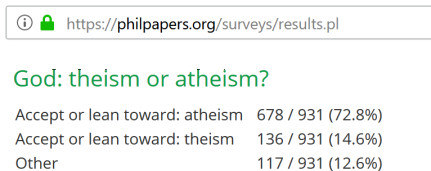
What do philosophers believe? » Appendix 1: Detailed survey results (Bourget, Chalmers; Springer; Dec 2013)
I suppose, next, 72.8% of academic philosophers are "fanatical atheists", @3017amen. :roll:
Give it up, raving on with mis/disinformation doesn't do anyone any favors. -
God Almost Certainly ExistsCan you disprove the existence of unicorns for me please? — Devans99
They do exist — in children's stories and fantasies.
Unless that's what your god is supposed to be, the onus probandi still remains in your court (along with the increasing fallacy-count).
Have you been there then? Which holiday agency was that? — Devans99
The other day. A dull place. Inert and lifeless. Half a star out of five. -
God Almost Certainly ExistsFeeling so special that you think the universe was fashioned with you in mind is self-elevation and personification.
As an aside, you can never prove that God does not exist! — Devans99
There's that fallacy once again, repeated unabated as if never having been pointed out before.
Comments suggests you started out with the divine fallacy.
Start over. Try something more defensible. (Could at least respond to prior replies.)
(Besides, both "deliberate" and "act" are loaded, indicating where you started rather than where you ended.)
You somehow wish to show an "atemporal deliberate act" of a unique, thinking, living superbeing deity...? :D
Here atemporal is inert and lifeless at best.with strangely "atemporal causes", I'd sort of expect an infinite universeSo demonstrate this atemporal change, it's your argument (and presumably you don't want to add more appeal to ignorance or special pleading).... -
God Almost Certainly Existsanalogy to causation — 3017amen
"Seek the thread and you shall find."
(sorry, too lazy to start finding the links to the comments) -
God Almost Certainly Exists@Devans99, you don't get to brush established theories aside with a hand-wave because they don't accommodate your belief.
-
God Almost Certainly ExistsHello, @Devans99?
As (also already) mentioned, your and my belief don't matter; sorry, but we don't get to tell it all what it is, rather we adjust our belief accordingly.
Quantumatics and relativity are established (already posted an example).
You're free to keep re-re-repeting your assertions, call the subject matter experts names, and dismiss established theories with a hand-wave, none of which make your belief so.
If that's the extent of your investigation, then maybe the opening post is sort of not really in good faith? :-/ -
God Almost Certainly ExistsThe origin of the universe is a macro question — Devans99
Nope.
Why do you think extrapolation sufficiently far back is increasingly problematic, and why we cannot extrapolate to a singularity (of infinite density and temperature)?
Because once things become sufficiently small, quantumatics become increasingly pronounced, and we have no established unification.
Finite and unbounded is plainly impossible. I'm not even going to waste my time reading that link. — Devans99
Rejection by title-reading? :D As mentioned earlier, these ideas have been expounded upon to some extent by Hartle and Hawking. -
God Almost Certainly ExistsI do not believe in random — Devans99I don't call those answers. — Devans99
Whatever you or I believe has little bearing on the truth of the matter. Our beliefs are the adjustable parts, and so we adjust our beliefs to it all, we don't adjust it all to our beliefs. No manner of repetition here can somehow compel it all to be so.
I cannot. — Devans99
And yet you've been presented with alternatives to your assertions, a few of them by now.
Indefinite Causal Order in a Quantum Switch (Goswami, Giarmatzi, Kewming, Costa, Branciard, Romero, White; APS; Aug 2018)
(also ... the Casimir effect, virtual particle pairs, quantum fluctuations, radioactive decay, spacetime foam/turbulence, the "pressure" of vacuum energy, Fomin's quantum cosmogenesis (successors), Krauss' relativistic quantum fields, ...)
And you still haven't responded to a number of other points (though you have re-re-repeated your beliefs a few times).

Finite yet unbounded. Is that some sort of joke? — Devans99
No. (FYI, the link is the earliest reference in the literature I know of.) -
God Almost Certainly ExistsYou still have not answered the puzzle question! — Devans99
Yes. Twice now. -
God Almost Certainly ExistsGod is both timeless and within time (temporal/a-temporal) all at the same time — 3017amen
@Devans99 wants to show an atemporal god "outside" it all.
One that strangely acted deliberately and timelessly to create the universe.
Nonsense, yes, I know, but that seems to be @Devans99's belief...err aim.
So that's the topic here.
jorndoe

Start FollowingSend a Message
- Other sites we like
- Social media
- Terms of Service
- Sign In
- Created with PlushForums
- © 2026 The Philosophy Forum