
-
Study: Nearly four-fifths of ‘gender minority’ students have mental health issuesCould mental problems come about from bullying, discrimination, scorn, ostracism, self-doubt, systematic attempts to dehumanize, disassociation, perhaps even persecution in some cases/societies, ...?
Seems likely. -
The Subjectivity of Moral ValuesThe objection to my objection would be that if Reason sets out what is right, then one ought do as reason proscribes. You remain free to choose not to follow reason, but you ought not. — Banno
Wouldn't that render moral agency sort of redundant, "morals" sort of an extraneous word? -
Would there be a God-like "sensation" in the absence of God or religion? How is this to be explainedI once asked a similar question, except more "symmetrical" if you will:
- In case one of the common religions is right (about their deity), then what would it take to think otherwise?
- Conversely, in case they're wrong and there aren't such deities, then what would it take to believe otherwise?
What does it take to be wrong about deities? -
What do you think of the mainstream religions that are homophobic and misogynous?Edward Feser and other Christians have published quite a bit against homosexuality.
-
Quod grātīs asseritur, grātīs negāturThere are apologists making fair $$$s on catering to adherents (a bit like earning off confirming their biases). Those folk also arrange talks, debates and whatnot, often with a price tag for participants.
Also, when was the when was the last time you heard a priest/imam/puja (or even parent) conclude a sermon with "Oh, by the way, we don't know"? (That might actually be considered blasphemy.) :)
Out in real life, the preached-indoctrinated-proselytized is typically presented (implicitly or explicitly) as the be-all-end-all truth of it all. In general, with elaborate, mutually inconsistent messages, allegedly of the utmost importance for all man-kind (all genders).
This sort of thing goes further still.
Mark my word, if and when these preachers get control of the [Republican] party, and they're sure trying to do so, it's going to be a terrible damn problem. Frankly, these people frighten me. Politics and governing demand compromise. But these Christians believe they are acting in the name of God, so they can't and won't compromise. I know, I've tried to deal with them. — https://en.wikiquote.org/wiki/Barry_Goldwater
Not just fundamentalists.
Suggest you good folk take Gouldean magisteria — and that evidence is irrelevant — to the streets and the apologists. Until then let's have some more Hitchens'ses around (that you can ad hominem at here on The Philosophy Forum). (y) -
Quod grātīs asseritur, grātīs negāturHitchens was just someone that called out all the mutually inconsistent preachers indoctrinators proselytizers on their elaborate superstitions.
And this stercus is your response, @alcontali? :) Won't do.
Hey, let's have another Hitchens challenging them all.
If assertions are intended to persuade, then you'd want relevant justifications, yes?
I'll venture to guess that most occasionally go by the razors, whether intuitively, implicitly or explicitly. -
Quod grātīs asseritur, grātīs negāturThe razors aren't axioms in a formal deductive system, as others have pointed out.
They're rules (of thumb) on par with the asserted.
If assertions are intended to persuade, then you'd want relevant justifications, yes?
I'll venture to guess that most occasionally go by the razors, whether intuitively, implicitly or explicitly.
Formal axiomatic systems go by provisional axioms.
It just so happens that some such systems have been rather useful/successful, otherwise we wouldn't have kept them around.
Therefore, Hitchens' approach in which he arbitrarily rejects starting points, is just a cheap slogan that he could use and abuse to reject pretty much any knowledge claim. The late, dead Hitchens was a rhetorical attack dog, with a strong emphasis on the word "dog". May his carcass rot in hell. — alcontaliIt is just that I do not like people like Hitchens, whose only goal in life is to discredit and otherwise viciously attack other people. Hitchens was a cherished accomplice of Satan. Richard Stallman said about Steve Jobs: "I am not glad that he is dead but I am glad that he is gone." About Hitchens, I rather abbreviate all of that to "dead and gone", and we wouldn't want it any other way. — alcontali
What nonsense. :roll:
If your "poor victims" didn't preach indoctrinate proselytize mutually inconsistent superstitions day in and day out, then there wouldn't be a whole lot of Hitchens'ses around to disabuse those postulates.
And without those (initial) postulates there wouldn't be much to discuss in the first place (they carry the onus probandi). -
Donald Trump (All General Trump Conversations Here)Incidentally, I just returned from vacation in Denmark.
My ma wants California.
Not really the topic of chat much in those parts, just a casual grin.
Don't even recall seeing anything about it on the news, though I didn't watch TV that much.
Wasn't aware there'd been some sort of official comment.
But my ma wants California. -
Reflections on RealismIf we are, on the other hand, referring to the possibility of a reality consisting of things-in-themselves, apart from how they are experienced, if that's what we mean by objective reality, then objective reality is not experiential. — luckswallowsall
Depends.
You cannot experience another's self-awareness (or you'd be them instead), so, unless you go by solipsism, there are already things always just over the horizon.
Feel free to call them ding-an-sich if you like.
Individuation, self-identity, ..., already always presupposed one way or other, or our chat loses meaning.
Shouldn't conflate ontology and epistemics.
But experiences occur like whatever else; the "subjective versus objective" thing can be misleading. -
Reflections on RealismI would say I observe a world that depends on my mind and on other minds — leo
So you're rehashing the old attempt to justify (subjective) idealism. :meh: -
Reflections on RealismAristotelian-Thomistic moderate realist — Dfpolis
Substance dualism included?
Substance dualism seems like a sort of "natural intuition" perhaps because of whatever gaps (Levine's explanatory gap, Chalmers' consciousness conundrum, with a nod to Princess Elisabeth of the Palatinate, ...).
It's a non-explanatory assertion, though, doesn't really bridge any gaps, batteries aren't included.
The numinous, wholly other, seems susceptible to the interaction problem, but maybe that's different. -
Reflections on Realismmonstrous caveat — Mww
Monstrous?
If (what we call) refraction turned out plain wrong (like Aristotle's theory of motion), then we'd perhaps discover something else.
what would a swimmer out of water look like? — Mww
I wasn't part of the photo-shoot, but more in one piece, like the swimmer themselves presumably would report? :) -
Reflections on Realismwhat do we call these different types of reality? — Galuchat
Not sure.
Maybe phenomenological versus empirical in some cases, subjective versus objective in others, fictional versus real in others still?
Existentially mind-dependent: hallucinating, thinking, imagining, memory recall, conceptualizing, fantasies, (day) dreams, phantom pain, headaches, love, denial, ...
And (typically) not: the perceived, the Sun, dinosaur bones, ...
Headaches are real enough. -
Reflections on Realismwe can know that there are no real pink elephants in someone's apartment when they're hallucinating a pink elephant in their apartment, because other people can see that there are no pink elephants, we can tell this via instruments, as well, and we know a lot about how matter behaves and can behave, what's required for there to be an elephant in an apartment, and we also know a lot about how brains work, including how they work on LSD (if that should be the case in this instance), etc — Terrapin Station
(y)
We could differentiate "exist" and "real" (in part) like so:
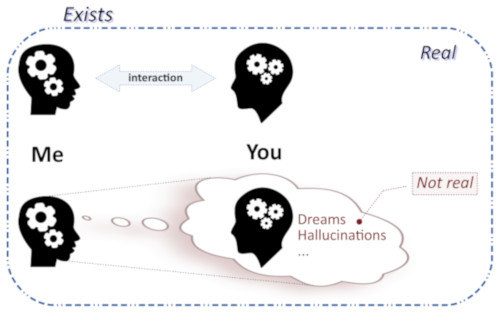
The bottom "You" would be like those pink elephants.
No elephants were harmed during this event. — Disclaimer -
Reflections on RealismThe mentioned mental constructs, re: space, time, points of reference, are not of the same larger world as the experienced; they are the necessary conditions for it. — Mww
An ontological hierarchy of sorts?
The perceived world depends existentially on spacetime, which in turn depends existentially on the perceiving mind?
All optical illusions are hallucinations from empirical misrepresentation, but some hallucinations are purely logical faults given by understanding itself. In the former, judgement usually reconciles the defect and its cognition is modified, [...] — Mww
I'd just say that swimmers in water look different than swimmers out of water.
(At least we do have some understanding of what's going on with refraction, reflection and such.)

-
Reflections on Realism(emphasis mine)
A transcendental idealist says that some things are empirical experience and other things are mental constructs. Sense data are by their nature from outside reality. Space and time and frames of reference are mental constructs or inside projected outside. Did I get that right, @Mww? — Noah Te StroetePretty much covers it, yep. — Mww
@Mww, would you say that mentioned mental constructs are part of the same larger world (outside reality) as the experienced?
If so, then @Galuchat's inquiry seems to indicate a need to differentiate among hallucination and perception, yes?
Are hallucinations real? — GaluchatYes. They are real experiences potentially informing us of the reality of some neurological disorder. — Dfpolis
I suppose, like synesthesia and phantom limbs perhaps.
That seems to converge on some sort of ordinary realism, surely not mental monism (idealism).
The mere existence of hallucinations and perception is not really in question (or so it seems to me), yet they're different, and the difference would then be the perceived (which includes other people). -
What is Mind? What is Matter? Is idealism vs. materialism a confusion?I believe we could have no knowledge of them or know anything about them. — Noah Te Stroete
How would you know that I'm self-aware?
You can't experience another's self-awareness (or you'd be them instead).
Doesn't mean you're the only one that's self-aware, though.
Confusing epistemics and ontology leads to the dark side.
We know about other things by interacting, not by becoming them. -
The HARDER Problem of ConsciousnessWell, individuation (self-identity, self-awareness is essentially indexical) is inherently part of it.
You're apart from the rest/others, yet interact with it all.
You don't have to become something/someone else to know thereof (in which case you wouldn't be the same individual any longer anyway), right?
Furthermore, whatever we all are, we're still parts of the same larger universe/environment, with regularities, similarities and differences alike, sufficiently regular/similar that my neighbor can meaningfully interact with their dog and Armstrong could walk on the Moon.
Interaction at one end is part of my constitution (identity), which, in turn, is rendered as personal experiences (like noumenistic occurrences of qualia), though of course none of this explains their particular format. -
The HARDER Problem of ConsciousnessIt's not a problem if you're down with dualism, or you're an idealist. — Marchesk
Right, they'll just say that qualia etc are fundamental (cf atomic) in the first place.
Given what we already know, I'm not sure how much explanatory force there is in that, though.
On a separate note, synesthesia seems to muddle things up further. -
What is logic? How is it that it is so useful?We could start in the simple with identity.
Without identity, what would these comments mean?
Indeed, meaning presupposes identity.
That's not to say these comments are all meaningful, but, hey... :) -
Original sin and other Blame narrativesYahweh getting a fit over an apple and cursing us forever is obviously creative story-telling.
What about the boars beavers goats rabbits squirrels etc that suffer and die from cancer and malocclusion, what did they ever do?
According to creationists it's all different "kinds" anyway.
Nasty fellow that Yahweh character of the stories.
Well, creationists "kind" is (also) ignorant nonsense:
- in a small part of a ring species, x and y can have offspring (⇒ same "kind"), and y and z can have offspring (⇒ same "kind")
- all the same "kind" (transitive relation)
- yet x and z cannot have offspring (⇒ not the same "kind") ⚡
- hence "kind" is incoherent nonsense
-
Is “Water is H2O” a posteriori necessary truth?My 2 ¢s.
H2O is a model of water.
And such a successful one that we occasionally use the two interchangeably.
Even though the model is not the modeled. -
Is the trinity logically incoherent?the element of Gnostic influences upon the Pharisees and the early Christians make it more complicated — Valentinus
Good historical comments, though I don't think Christianity was any particular single movement in the first centuries after Jesus had departed.
Greek philosopher Celsus (~ 175) noted the numerous, zealous Christian cults and factions, fighting more or less everyone (including their rival Christians), and their refusal to cooperate with, even debate, others.
Emperor Theodosius I (347-395) officially decreed them "dementes vesanosque" (demented lunatics) in 380 — everyone but the Roman Catholics of course, now rubber-stamped by Rome.
With Emperor Constantine (272-337), organized efforts to fight others and unite all under Roman Catholicism (i.e. under Rome) got underway, backed by the empire, in an attempt to strengthen the empire — something Tim Whitmarsh called "seismic" as far as history goes (heck, Catholics use the language, Latin, to this day).
The Romans tried to deal with the cesspool of cults, countryside preachers, resentment/dissidents, etc, of Middle Eastern antiquity, in their brutish ways, and Christianity, in the form of Catholicism, eventually came out on top.
And then a few centuries later, Muhammad emerged, and yet another religion hit the market.
And [for] their saying, "Indeed, we have killed the Messiah, Jesus, the son of Mary, the messenger of Allah." And they did not kill him, nor did they crucify him; but [another] was made to resemble him to them. And indeed, those who differ over it are in doubt about it. They have no knowledge of it except the following of assumption. And they did not kill him, for certain. — Quran 4:157 -
Why do atheists ask for evidence of God, when there is clearly no such evidence?All effects must have causes - the first cause is at a base of a pyramid of causality - all effects do have causes. Only the first cause, being beyond time and thus beyond causality does not have a cause. — Devans99
So you abandon the principle of sufficient reason.
An "atemporal", "eternal" cause of a universe that has a definite age (like 14 billion years) or a definite earliest time, is incompatible with the principle of sufficient reason, since such a cause lead us to expect an infinite age of the universe — there's no sufficient reason the universe is 14 billion years old and not some other age, any other age in fact.
That fine I suppose, but what does it entail? If the "reason" part of the principle is taken to be a generalized notion of "cause", then abandonment runs contrary to your statements above.
An indefinite past history does not run into this problem, like unbounded not infinite ("edge free"), or infinite.
Of course effects have causes, that's typically what we mean by those terms. They're events, which, in turn, are subsets of changes, i.e. temporal. "Atemporals", on the other hand, if there be any, would be inert, lifeless; "abstract objects" are the closest that comes to mind.
An object is abstract (if and) only if it is causally inefficacious. — Abstract Objects (Stanford Encyclopedia of Philosophy) -
‘I Think Therefore I Am’ - How Far Does It Lead?Strictly speaking, pondering cogito ergo sum implies that thinking exists.
And, deductively, that's about it, according to Gassendi (1592-1655).
Thinking cannot be doubted, since doubts are thoughts.
Not that there's any reasonable person that doubt the existence of "I" (themselves) or others ...
I've heard it called the Cartesian curse, solipsism. -
What influence do we/should we have?There are all kinds of people out there promoting preaching indoctrinating proselytizing their fancies every day.
When their religious faiths spill over into politics, public life, school curricula, impact others, etc, then it becomes a problem.
I'd say sometimes showing them wrong is called for.
Want to Become an End Times Prophecy Scholar? (Christian Newswire) :roll:
Brunei to punish gay sex and adultery with death by stoning (Ben Westcott; CNN; Mar 2019) :death: -
Space Is Expanding So It Can’t Be Infinite?∞+1=∞ — Devans99
... is illogical.
As mentioned, ∞ is not just one of your ordinary numbers, that you can stuff into ordinary arithmetic.
That would be the illogical part, not ∞. -
Space Is Expanding So It Can’t Be Infinite?1) Reality is logical
2) Infinity is not logical
2) Conclusion: The size of the universe is part of reality so not infinite — Devans99
Nitpicking, I'd say ...
1. we employ logic to understand reality
has served us well; for that matter, meaning presupposes identity
2. if ∞ derives a contradiction, then ∞ is illogical
and this is not the case in general; we have some examples of veridical paradoxes, which goes to show that ∞ can have counter-intuitive implications, and that's not the same as illogical; that said, there are some cases where we take a derived ∞ to indicate a problem; dealing with ∞ requires special care
3. who knows what exactly is real or not; reality does not have to abide by our thinking
- Infinity is not a number — Devans99
∞ ∉ R (not among the reals, requires different treatment)
∞ requires special care, different treatment than our usual numbers, sort of like a quantity that's not a number. -
Can a tautology break the law of non-contradiction?, as mentioned by , you can't get A ⇒ ¬A
3. ¬A ⇒ A
4. ¬A ⇒ ¬¬A (contraposition of 3)
5. ¬A ⇒ A (double negation elimination)
so your 4 is wrong. -
God exists, I'll tell you why.Poor Cantor, depressed, bipolar, suicidal, ... :confused:
, Perez' paper isn't about Cantor's "Absolute Infinite" (which is nonsense), but alleges to disprove Cantor, Church, Gödel, Turing and others, where their writings provided eminent insights.
Don't go all ad hominem when you'd have to address/justify Perez' paper (which is nonsense).
Anyway, @DingoJones asked for bad math, and coming up with some examples isn't all that hard.
Pseudomathematics (RationalWiki) -
Space Is Expanding So It Can’t Be Infinite?2. It is expanding — Devans99
Or everything in it is shrinking...? -
God exists, I'll tell you why.What would be an example of unsuitable math? — DingoJones
Maybe ...
British computer scientist's new "nullity" idea provokes reaction from mathematicians, Wikinews, Dec 2006
Addressing mathematical inconsistency: Cantor and Godel refuted, J A Perez, Feb 2010
Bible Codes, K Sean Proudler, Jun 2014 -
Is truth actually truth? Absolute truth is impossible.Suppose it's true that I posted this.
What's the difference between it being absolutely true and true?
Nutn' really. It's not like it becomes less true without "absolutely".
Suppose I uttered "There was snow at the peak of Mount Everest the other day".
What, then, would it take for my utterance to hold?
Snow up there of course, regardless of what you or I may think. -
Realism or Constructivism?Too bad . :confused:
Furthermore, there's an inconspicuous sleight of hand move in P1
we cannot possibly conceive of an unexperienced world — Ernst von Glasersfeld
Presumably "we" refers to us, humans at large, like other forums members, including when not conscious. Yet, as per
others' self-awarenesses are already inherently unexperienceable parts of the world. In fact, we only learn of others' self-awarenesses (indirectly) via experiencing (interacting with) others' "physical" bodies, thus others' self-awarenesses are further removed than "physical" bodies ("an unexperienced world"). There's more to the world than what meets the eye it would seem, t'would perhaps be a bit arrogant/self-elevating to assume otherwise anyway. Ontics ≠ epistemics. Others' self-awarenesses are like a kind of noumena. As far as I can tell, this stuff is related to self-identity, individuation and indexicality.1. I cannot experience your self-awareness (I'd then be you instead)
Anyway, I don't think Glasersfeld's (and Kastrup's) metaphysical constructions are particularly ... ehh constructive, outside of mental gymnastics. -
Realism or Constructivism?I admittedly did not read the whole document. :meh:
P1:
we cannot possibly conceive of an unexperienced world — Ernst von Glasersfeld
1. I cannot experience your self-awareness (I'd then be you instead)
2. by P1 we cannot possibly conceive of other self-awarenesses
3. P1 degenerates into solipsism and is therefore a performative contradiction
Does that work?
By the way, I came across one of Glasersfeld's partners in crime recently:
Conflating Abstraction with Empirical Observation: The False Mind-Matter Dichotomy
Bernardo Kastrup
Nov 2017
> Context • The alleged dichotomy between mind and matter is pervasive. Therefore, the attempt to explain matter in terms of mind (idealism) is often considered a mirror image of that of explaining mind in terms of matter (mainstream physicalism), in the sense of being structurally equivalent despite being reversely arranged. > Problem • I argue that this is an error arising from language artifacts, for dichotomies must reside in the same level of abstraction. > Method • I show that, because matter outside mind is not an empirical observation but rather an explanatory model, the epistemic symmetry between the two is broken. Consequently, matter and mind cannot reside in the same level of abstraction. > Results • It then becomes clear that attempting to explain mind in terms of matter is epistemically more costly than attempting to explain matter in terms of mind. > Implications • The qualities of experience are suggested to be not only epistemically, but also ontologically primary. > Constructivist content • I highlight the primacy of perceptual constructs over explanatory abstraction on both epistemic and ontic levels. > Key words • Idealism, physicalism, pancomputationalism, anti-realism, hard problem of consciousness, epistemic symmetry, explanatory abstraction, levels of abstraction.
« 41 » The pervasive but unexamined assumption that mind and matter constitute a dichotomy is an error arising from language artifacts. Members of dichotomies must be epistemically symmetrical and, therefore, reside in the same level of abstraction. Physically objective matter – as an explanatory model – is an abstraction of mind. We do not know matter in the same way that we know mind, for matter is an inference and mind a given. This breaks the epistemic symmetry between the two and implies that mainstream physicalism and idealism cannot be mirror images of each other. « 42 » Failure to recognize that different levels of epistemic confidence are intrinsic to different levels of explanatory abstraction lies at the root not only of the false mindmatter dichotomy, but also of attempts to make sense of the world through increasingly ungrounded explanatory abstractions. — Conclusion
Someone claimed that Kastrup thereby proved idealism (mental monism).
Yet, as far as I can tell, all this stuff is susceptible to the usual problems. -
The Climate Change Paper So Depressing It's Sending People to TherapyWhile we're at it:
A World Without Clouds
Natalie WolchoverA state-of-the-art supercomputer simulation indicates that a feedback loop between global warming and cloud loss can push Earth’s climate past a disastrous tipping point in as little as a century.
Quanta Magazine
Feb 2019 -
The Climate Change Paper So Depressing It's Sending People to TherapyBeing informed isn't helping anything until it informs some action — unenlightened
:up:
Let's get to it! — unenlightened
:up:
Already on it. -
The Climate Change Paper So Depressing It's Sending People to TherapyCame across this one:
There's so much CO2 in the atmosphere that planting trees can no longer save us
Rob Ludacer, Jessica Orwig
Business Insider
Oct 2018
Alarmist panic isn't helping anything/one.
Being informed is a good first step, though. -
Moore, Open Questions and ...is good.The Trolley problem (and whatever variations) is good for some and bad for others.
Apparently it is good and bad. Or undecidable?
jorndoe

Start FollowingSend a Message
- Other sites we like
- Social media
- Terms of Service
- Sign In
- Created with PlushForums
- © 2026 The Philosophy Forum