
-
What are you listening to right now?Who the heck ever Forney are, they've now released a "Stud Master" record, that'll destroy your record player.
Stud Master

-
Illusive morals?No, really it's not. — Barry Etheridge
I apologize for the simplfication with that comment. -
Illusive morals?Did the discussion turn religious?
Regarding the subjective versus objective thing, let me just ask what it's like to be you, the reader? [1]
You may describe it so others can relate, even though "being you" will always be out of reach for others to experience (barring genuine telepathy I suppose).
Cutting it short, self-awareness is more-or-less noumena (though not all noumena are necessarily self-awareness). [2]
So what? It's just a consequence of onto/logical self-identity (the 1st law, the law of identity).
In that particular sense, subjective versus objective is a real partition if you will, except still part of a larger environment/context. A focus on subjectivity is self-emphasis.
It seems to me that morals are (at least in part) subjective, with respect to mind-dependence, as argued in the opening post. Yet, surely that's still real?
Have a good weekend everyone.

[1] cf Nagel
[2] cf Kant, Brie Gertler (with whom I personally disagree) -
Illusive morals?So, in summary,
human existence is objective,
our moral attitudes and sentiments are part of us,
thus our morals are objective?
If ought (pre/proscriptive propositions) cannot be derived from is (descriptive propositions), then it seems we start out with ought (independently of is)?
(getting late here, but please carry on) -
Illusive morals?Anyway, with this thread I intended to shed some light on the odd gaps
- reduction to self-interest versus social behavior
- subjective versus objective
Maybe @apokrisis is right; mostly mental masturbation (pardon my French). -
The kalam/cosmological argument - pros and consHm had hoped for some more direct objections to the pros and cons of the opening post.
Anyway, I guess this is how these discussions tend to go. :) -
Illusive morals?Be authentic. — MongrelLove and do what you will. — Mongrel
Well, why do we have (secular) law?
Why wouldn't suppressing an impulse to punch my boss be authentic anyway? :)
Indoctrination can also play a role in behavior, be it for good or bad (pun intended).
A degree of empathy can likely be cultivated (or taught), though even empathy might be reducible to self-interest.
Perhaps a more interesting question is then: how do we learn, understand and rationalize morals and moral behavior, as social matters?
I experience morality viscerally. — Mongrel
I guess I do as well, to an extent.
For me there's more to it, though. -
Illusive morals?You want maximum personal freedom - but within a global context which is stable enough, integrated enough, to underwrite that very freedom. — apokrisis
Right. Analogous to this old document (translated to English):
Article IV - Liberty consists of doing anything which does not harm others: thus, the exercise of the natural rights of each man has only those borders which assure other members of the society the enjoyment of these same rights. These borders can be determined only by the law. — Declaration of the Rights of Man and of the Citizen of 1789
Social (or societal) sustainability, and a degree of cooperation, is kind of implicit for a society to flourish, which also tend to be a benefit for individual members.
Taxes are what we pay for civilized society. — Oliver Wendell Holmes Jr
Perhaps the objective versus subjective dichotomy is sort of missing the point, or is a misleading line of inquiry.
________
Declaration of the Rights of Man and of the Citizen of 1789; Wikipedia article
The Universal Declaration of Human Rights of 1948; United Nations -
The kalam/cosmological argument - pros and consThings have existence, it's an attribute, a property of things, they exist. — Metaphysician Undercover
Maybe?
How can you have a thing already, except it doesn't "have existence"?
Predicate ontologization or existence as ground?
Something's amiss.
Formally, where φ is a predicate (no unrestricted comprehension), x is a variable, and S is a set, existential quantification is properly written as
∃x ∈ S [ φx ]
The ∃ and φ symbols are not interchangeable. Going by Quine, to exist is to be the value of a bound variable, x in the expression.
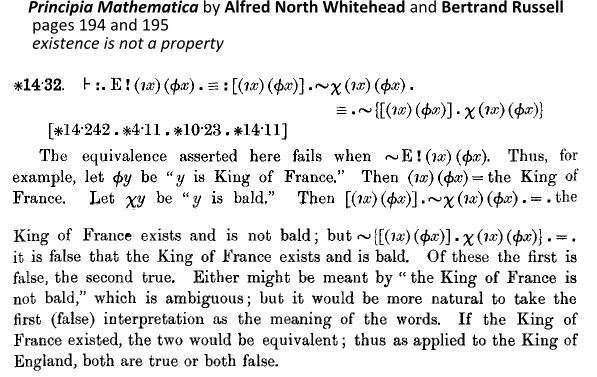
-
The kalam/cosmological argument - pros and cons@Metaphysician Undercover ... which is to assume some sort of "free will" and that they're first causes. That's fine, you just have to sufficiently justify this hypothesis, and that they're "impossible to observe , or prove". (Can there be multiple first causes anyway?)
Believe whatever, but free will is notoriously strange (and controversial) in philosophy and other disciplines.
Theism tends to take substance dualism serious, where the mind part is associated with "soul" (or "otherworldly spirit"), which is thought to somehow inhabit and move (worldly) bodies. Some notion of "free will" is thought to reside in this "eternal" soul, as a kind of first cause, or an origin, in part. With this line of thinking, mind and free will are made to escape explanation, even in principle, since they're asserted fundamental, and, as such, inexplicable in terms of anything else.
Yet, religious substance dualism still cannot resolve Chalmers mind-body problems, cannot derive qualia, for example, and also runs into the interaction problem. It's a bit like simply deferring one mystery to another (proposed) mystery, and call it a day; it all seems suspiciously self-elevating or incredulous. Leaning on scientific findings, soul ideation of this nature, might be explicable as a result of introspection illusions, that are subject to an inwards self-blindness necessitating cognitive non-closure (exhaustive self-comprehension may not be attainable).
• Free Will Bibliography; Justin Capes; PhilPapers
• What Neuroscience Says about Free Will; Adam Bear; Scientific American; Apr 2016
• Free Will; Psychology Today
• Free Will; SEP article
• Free Will; IEP article
• Free will; Wikipedia article -
The kalam/cosmological argument - pros and consLet me just expand a bit upon
2. if some God of theism created the universe from something already existing, then whatever comprise the universe "always" existed, perhaps "eternally" (to the extent that's meaningful), and we might as well dispose of the extras, i.e. said God
from the opening post, like creatio ex materia (or creatio ex deo).
An act is temporal, speaking of "to act" is only meaningful by presupposing temporality. (Can relevant counter-examples be presented?)
If said God created the universe out of something pre-existing, something as "old" as God perhaps, but merely transformed this pre-existing something into the universe, then spacetime (or temporality at least) could not merely be an aspect of the universe (the "created"), and said God could not be (wholly) atemporal, which runs contrary to the hypotheses.
if there was a definite earliest time (or "time zero"), then anything that existed at that time, began to exist at that time, and that includes any first causes, gods/God, or whatever else
There was no time at which something atemporal ("outside of time") existed. The atemporal never existed, never can.
I'm not sure how the hypothesizers can (pretend to) make sense of this? -
The kalam/cosmological argument - pros and consYet another side-track in continuation of some previous comments.
In the NPR article below, Devinsky (of NYU) mentions the example of love. Consenting couples often declare love for each other, thereby confirming love across people, an untold number of people at that.
And when Love speaks, the voice of all the gods
Makes heaven drowsy with the harmony. — Berowne (Love’s Labour’s Lost)
And that's a common example of purely phenomenological experiences (identity).
We already know of all kinds of conditions — drug induced epic experiences, synesthesia, mild epilepsy, schizophrenia, whichever hallucinations and illusions, ... Homo sapiens is hardly the perfect perception-organism. And cats jump at shadows. A reasonably strong epistemic standard is warranted here.
________
• The serotonin system and spiritual experiences; Borg, Andrée, Soderstrom, Farde; PubMed, NCBI; Nov 2003
• Are Spiritual Encounters All In Your Head?; Barbara Bradley Hagerty; NPR; May 2009
• The Spiritual Brain: Selective Cortical Lesions Modulate Human Self-Transcendence; Urgesi, Aglioti, Skrap, Fabbro; Jan 2010
• The Sensed-Presence Effect; Michael Shermer; Scientific American; Apr 2010
• Listening to the inner voice; John Hewitt; Medical Xpress; Dec 2013
• Argument from inconsistent revelations; Wikipedia article -
The kalam/cosmological argument - pros and consTo seek "otherworldly" supernatural explanations, is to extend causation for the occasion.
Causation is temporal, and spacetime is an aspect of the universe, which is how we know causation in the first place.
It would then be natural to ask for sufficient and relevant (non-hypothetical) examples of violations of causal closure, in order to justify such extended causation (no special pleading please). -
The kalam/cosmological argument - pros and consStevenson always only claimed to present evidence that 'suggests the possibility of re-birth having taken place'. I think it does that. — Wayfarer
Fire up a new thread. Present your thinking on (justification of) it. Add a vote. (Isn't that what the site is for anyways?) -
The kalam/cosmological argument - pros and consHere are a couple discussions on Stevenson's stuff, with both pros and cons:
- '20 cases suggestive of reincarnation' (2007); International Skeptics Forum
- Ian Stevenson’s Case: Are We ‘Skeptics’ Really Just Cyni (2013); The Skeptics Society Forum
And a couple references:
- Pseudoscience and the Paranormal (2003) » Reincarnation; Hines Terence
- Ian Stevenson (1918-2007); The Skeptic's Dictionary
Not that my own opinion matters much, but, without further information, I'm with Sagan; here's what he wrote in The Demon-Haunted World (1997), full snippet attached:
Maybe some undiscovered reptile left over from the Cretaceous period will indeed be found in Loch Ness or the Congo Republic; or we will find artifacts of an advanced, non-human species elsewhere in the solar system. At the time of writing there are three claims in the ESP field which, in my opinion, deserve serious study:
[...]
(3) that young children sometimes report the details of a previous life, which upon checking turn out to be accurate and which they could not have known about in any other way than reincarnation
[...]
I pick these claims not because I think they're likely to be valid (I don't), but as examples of contentions that might be true. The last three have at least some, although still dubious, experimental support. Of course, I could be wrong. — Carl Sagan
Feel free to open a new thread if you think Stevenson proved supernaturals. -
The kalam/cosmological argument - pros and cons@Wayfarer, you don't have to be a "die-hard materialist" to come to such conclusions. :)
(Not that it matters much here, but I'm not in particular, whatever your impression may be.)
Admittedly it's been a long while since I read up on Stevenson's stuff, was going by memory alone.
Will have to check that "morphic resonance" stuff once time permits. -
The kalam/cosmological argument - pros and cons@Wayfarer, there are also many reports of alien abductions (and who-knows-what else).
None independently confirmed though, like abductions being examined, recorded and witnessed by outside, credible parties.
They're purely phenomenological experiences.
- non-identity: say I have a chat my colleague, then my experiences of my colleague ≠ my colleague, others may also experience the colleague on their own (phenomenological and empirical)
- identity: say I have a headache, then my experience of the ache = the ache, others don't have my headaches (phenomenological)
It would seem alien abductions belong in the identity category.
They're part of the experiencer when they occur, and nothing else (possibly related to sleep paralysis or mild epilepsy or something, well, unless they're hoaxes).
They still exist, they're just entirely "subjective", mind-dependent, much like hallucinations or dreams, which is not to say real abductions couldn't occur of course, but give it an honest evaluation please.
Humans aren't exactly perfect organisms, introspectively or otherwise. -
The kalam/cosmological argument - pros and consWhat would, theoretically, count as supernatural? Something non-physical? Then, given Hempel's dilemma, what counts as non-physical? — Michael
Not sure I could say ahead of time.
The alleged miracles of Lourdes? Noah's flood?
It seems a prerequisite that a mind, and perhaps will, have to be behind something for it to be considered supernatural (e.g. witchcraft and sorcery, possessions, divine miracles and creatio ex nihilo, telepathy and -kinesis). Perhaps irreducibility (to something else) is also a prerequisite.
Was just trying to look up the Catholic church's prerequisites for miracles, but didn't find them.
May have to be exemplified before an assessment can be made. -
The kalam/cosmological argument - pros and consI always took God on a leap of faith. — Marty
Honesty. It matters. (Y) (was about to hit "Like", but this will have to do)
And the freedom to entertain such beliefs are non-negotiable (in my opinion).
I'll just note on the side that various theisms can engender behavior that has impact beyond voluntary adherents (sometimes alienation from parents/peers, sometimes fatal, sometimes directed indoctrination, sometimes just within one sect/cult/denomination, ...). And sometimes actions are justified from their (interpretation of their) various scriptures, with notable social consequences. Therefore these beliefs warrant examination on this account alone. -
The kalam/cosmological argument - pros and consWhere we don't already have an explanation, supernatural explanations should have long ago been eliminated by a "We don't know what the natural explanation is yet, but we're working on it" response. — Terrapin Station
Yeah, some of those supposed explanations tend to be arguing from ignorance, and this is also where mentioned personification of the unknown can play a role.
Can anyone give a non-hypothetical example of something supernatural, magic, witchcraft, ...?
Poor examples include the horrible Salem witch trials a few centuries back (though apparently still going in Saudi Arabia, 2013, 2016); Noah's flood; possessions and exorcisms; most miracles that's been examined; ... How about telepathy or telekinesis (by will alone)? :D -
The kalam/cosmological argument - pros and cons* (4) seems arbitrary; it seems to be a non-sequitur. What would actually follow is "Therefore there was some-we-haven't-the-faintest-idea-what that was the cause, where somehow unspecified it would make sense to say that the cause in question was not a part of the universe." — Terrapin Station
You're right, as also noted by @Michael.
The central part of the argument is 1-3, which has the form of an ordinary syllogism.
4 should have been separated out, instead of my paraphrase. -
The kalam/cosmological argument - pros and consthe naive argument that the physical sciences have somehow eliminated the need to a 'supernatural' explanation, is not actually borne out by the current state of science, which feel compelled to appeal to 'alternative' supernatural explanations, such as the existence of infinite universes — Wayfarer
Neither naïve, nor eliminated, respectively.
Paraphrasing someone I don't recall, perhaps alluding to magical thinking:
quite a few supernatural explanations have been supplanted by natural explanations throughout history, little or no natural explanations have been replaced by supernatural explanations
Looking through the history books, break-throughs and striking advances have been conspicuously absent in theology, markedly in comparison to other endeavors, and professional theologians have been at it for centuries. Wouldn't it be cool to see news headlines with "Theologians make new ground-breaking discovery"? :D
Do you think modal realism (Lewis) and the many-worlds hypothesis (Everett) are supernatural...?
The Incredible Shrinking God; Skeptico; Dec 2008 -
The kalam/cosmological argument - pros and consI am reporting back with the findings :D It's not that I can't believe the pink elephants - it's that I don't want to believe it, and I can't make myself want to believe it. — Agustino
Excellent, thanks. :D
We need more samples for the experiment.
I found that honest belief in the elephants didn't come about as a matter of exercising "free will", sort of justifying that sometimes at least "seeing is believing".
On the other hand, I also believe there's snow on the peak of Mount Everest, and that there are exoplanets, though less "seeing", and more thinking, is involved.
"There was a pink elephant on the street"; SP. Kiwiyum; 1m:58s youtube; Jul 2012 -
The kalam/cosmological argument - pros and consIt seems if the cosmological argument proves the universe to be contingent it necessarily implies there's something beyond the universe. — Marty
I thought the task was to show a (unique) first cause, like Craig, and then (perhaps) that the first cause is necessary?
can you give me examples of where propositions are fuzzy and ambiguous? — Marty
The principle of sufficient reason is just not unconditional. As per earlier posts, you can find examples to which the principle does not apply, so you have to rule those out before applying it.
- the principle of sufficient reason cannot apply to existence ("everything") without circularity, since otherwise the deduced reason would then not exist, which is contradictory
- 2+2=4 may be another example, as suggested by @Wayfarer, which converges on the strange Platonic realm of old
- thus, before applying the principle to some x, you must ensure x is not one such example (this is usually simple enough, or reasonable, for ordinary everyday trivialities)
- unconditional application can be misapplication, and has a logical structure of "everything and then some", which violates the first law, the law of identity
- if the whole universe is everything, then the principle cannot apply to the universe
- you must first show that the whole universe is not everything, or, more accurately, that the principle applies to the whole universe
-
The kalam/cosmological argument - pros and cons@Wayfarer
Neither modal realism (Lewis) nor the many-worlds hypothesis (Everett) are particularly necessary, and remain more controversial than "problems". They're just speculation, pending research, until they can be verified/falsified. You could perhaps add M-theory, except a good lot of theoretical research has been put into this one.
Yeah, fine-tuning works best without modal realism and many-worlds, so maybe there's an odd sort of competition going on? Which do you think has the best chance of becoming verified/falsified (or scientific) anyway...?
Here's more theorizing, but at least it's not magical thinking:
- Every black hole contains a new universe: A physicist presents a solution to present-day cosmic mysteries; Nikodem Poplawski; May 2012
- No Big Bang? Quantum equation predicts universe has no beginning; Ahmed Farag Ali and Saurya Das, via Lisa Zyga; Feb 2015
Still a side-track from the opening post. Kick off a new thread?
jorndoe

Start FollowingSend a Message
- Other sites we like
- Social media
- Terms of Service
- Sign In
- Created with PlushForums
- © 2026 The Philosophy Forum