
-
Why should we worry about misinformation?
My advice if you really want to see what group dynamics is like, is lead a group in some way. Organize a trip with a few close friends, then organize a trip with 30. Its night and day. "Rules" are necessary. And that requires some type of enforcement mechanism or governance. Done right, it creates respect and greater freedom within the group. Done wrong its a power trip and abuse. But not done at all? Its unorganized chaos where little gets done.
I appreciate the story and advice. But is it any strange wonder that it involves children? A paternal outlook is a prerequisite to authority and undergirds the notion that other adults need to be governed as if they were kids.
The problem with collective action is well-enough known. There are too many conflicting interests among the individuals involved. But to insert a class of masters and institute coercive mechanisms in order to make it work is simply to put one or more persons interests over the others, and to exploit the rest in order to achieve those interests, which to me is immoral. Far better is it to find others with a common interest and coordinate and cooperate voluntarily.
A carefully crafted bill that penalizes peddling knowingly false information for profit would curtail some of the outright falsehoods that have taken off in the social media age. But I also agree with you 100% that it must be carefully crafted. While it would be simpler to dismiss the issue for fear that a lack of nuance would cause more harm, the law can handle nuance well if the right people are behind it.
That’s the problem. Who would you choose to decide what is true and false, and punish those who deviate from it? -
US Election 2024 (All general discussion)
I like it. But no scientific experiments needed; she’ll be sure to tell you all about it. But I am a little disappointed there is no accompanying Baden cartoon. -
Why should we worry about misinformation?
Interestingly, for Aristotle democracy is inherently unstable, especially in the direction of populism. So is a democracy that is safeguarded from "threats to democracy" still a democracy? Is democracy a threat to democracy?
The irony here is that calls for censorship meant to safeguard democracy from threats to democracy are themselves a threat to democracy, and this seems fairly uncontroversial. At the end of the day a kind of theocracy with science or some other truth-approach at the helm is not democracy.
It appears there are two-brands of "democracy" in conflict, the one that favors the power of the people, the other that favors the institutions that have arisen in representative democracies, for instance elections and parliaments and the credibility of those in power. It's an interesting conflict. -
Why should we worry about misinformation?
That isn't to say that freedom isn't worth fighting for, or even dying for, but freedom is a function of what we can allow ourselves in the absence of existential threats to our existence. If you value freedom, then consider if the United States were indeed run by verifiable fascists. We would undoubtedly have even less freedom than we might have had had we suppressed portions of the media to prevent such a takeover. Do you actually think that the fascists wouldn't come for those that are reporting on truth once taking power? Everything except the accepted propaganda would be suppressed for being disinformation. Are you so naive, NOS, that you think you, as a gay vampire, would be unaffected?
Of course the fascists would, so it makes no sense to afford them the power to do so. One of the best ways to avoid fascism is to not do what the fascists do, which in your idea is to suppress portions of the media to prevent such a takeover.
Their suppression is a gift to them. Note the Weimar fallacy, that had the Nazis been censored they wouldn’t have risen to power. The Nazis were routinely censored. Goebbels, Fritsch, and Julius Striecher were imprisoned for hate speech. Their publications were shut down (one hundred of them in Poland alone). Hitler himself was banned from speaking. Censorship did not help in the one instance where it should have. When Hitler debated Otto Wells regarding the Enabling Act he reminded Wells of how much he was censored, and this justified for him the passing of that law. They used these pre-existing laws to further suppress the opposition. -
Why should we worry about misinformation?
I wish this were the case, but its often not true. Especially when someone is in a powerful position and the law does not punish them for their transgressions. If it were so easy to punish such things, why would there be a call for the law? There is a call for the law because society is currently inadequate at addressing these issues alone. We don't touch things like comedy, parody, or opinions, because its clear these things are not meant to be authorities on information. But when someone pretends to be an authority on information, when they clearly know what they are peddling is false, we're seeing in real time that there is a minority majority of society that cannot handle it.
Well, we don’t have any say in the matter whether things like comedy, parody, and opinions are touched because we are not the authorities on such matters. So I think it’s a mistake to pretend that “we” in the grand sense, or society as a whole, have some sort of say.
I think the problem you often run into on these forums with your worldview NOS4A2 is your ideals are viewed through the lens of a very small community. Rules and massive societal regulations and laws come about as communities build. This is not a corruption, it is a necessary thing that must happen to assist with new community problems. It is actually natural for governments to form as societies grow. Show me a society of a several thousand people in a small living space without a government. It doesn't exist.
Your other problem is that you see that government can be corrupt, therefore it must be corrupt. Or that its corruption is beyond a minimal sense. Government is a tool, and like any social tool, if wielded right, it helps society. How do you think we're able to speak our minds without getting shot by our neighbors? A free society requires the management of resources and broad human conflicts.
I appreciate the critique. Thank you.
But in my defence the very small community I view it through is me. I only have one pair of eyes. The fact that you or anyone else are afflicted with the same limitation, and cannot view the world nor speak about it through anyone’s lens but your own, puts the very idea of a community lens into immediate doubt. I just don’t know enough people of any given community to see or speak for them, and I’m sure that is the case for most.
It’s just not true that rules and massive societal regulations and laws come about as communities build. They are imposed by very few individuals on the much wider society, and one can compare the amount of legislators at any given time to the amount of the rest of society in order to confirm this.
It is the history of states that leads me to believe governments are naturally corrupt. It’s an anti-social institution, an exploitative monopoly by its very nature and organization. As a rebuttal, I have a problem with the belief that as soon as a species of moral exemplars gain power, and use the government to help society and not themselves, it will no longer be. History attests to the opposite, and I would implore you to compare it against what I would call a dangerous hope.
Which is why you build a government with safe guards and anti-corruption measures. Free and frequent elections. Rights, etc. The problem is that the peddling of false facts is corruption of the free market of ideas. It has long been ruled that yelling "Fire!" falsely in a theater to cause a stampede for your own amusement is not defendable. Why then should people peddling false information for their own gain in other areas suddenly be off limits? Corruption does not just apply to government. It applies to every single person.
I’d love to get together with you and build safeguards and anti-corruption measures, but like the vast majority of human beings we do not have the power to do so. And it has long been overruled that falsely yelling “Fire!” in a crowded is indefensible, and was never a binding dictum in any law or otherwise. It’s just a popular analogy. -
Why should we worry about misinformation?
To that, do you see an issue with creating laws that prevent outright deception and lies to people on public platforms? Or should we allow people to deceive others without any risk? The law already forbids revenge, violence, and other forms of 'community regulation'. Can the community properly regulate purposefully deceptive facts with less harm then careful laws and the courts?
Yes, deception is terrible and immoral. It hurts being deceived, and further, to act on a false belief could lead to very real harm. More often or not this leads to some sort of penalty for the deceiver, for instance the loss of credibility, and as a result, the social and economical fruits that come with it.
Recall what Jaspers said. Both censorship and freedom will be abused. The question is, which abuse is preferable? Censorship leads to both the suppression of truth and its distortion, while freedom leads only to its distortion. Censorship is absolute, while distortion can be straightened out by freedom itself. -
Why should we worry about misinformation?
Misinformation is just false information. Under its heading falls satire, irony, fiction, exaggeration, miscalculation, and so on. The threat is not only too broad, but as it turns out, not that threatening at all. We’ve lived with some degree of it just fine for the entirety of human history, generally speaking.
But worse, the institutions commonly used to penalize misinformation have historically been the greatest progenitors of it. -
Why should we worry about misinformation?
That seems to me to be a stupid idea, not well thought out at all, because if lying is universal and comprehensive your authorities would be subject to lie. And that’s a common argument for free speech and against censorship that maybe someone who doesn’t understand it hasn’t pondered before: who decides and enforced what is true and what is false? Personally I can’t think of any people, alive or dead, fit for such a task.
But you’d be happy to know that the jailing of journalists is on the increase since such measures have been adopted.
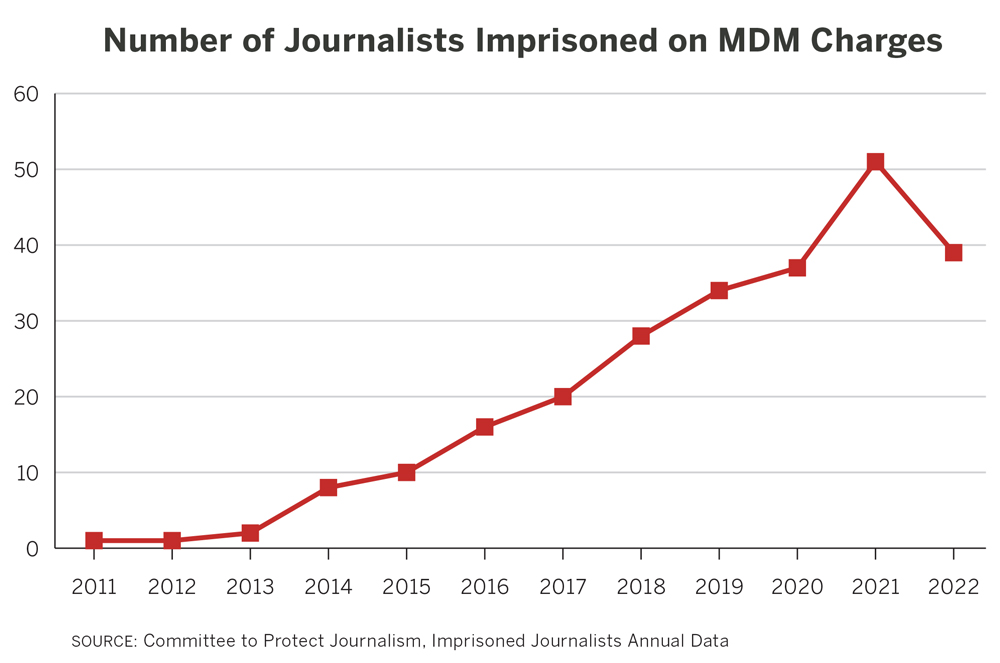
https://www.cima.ned.org/publication/chilling-legislation/ -
Why should we worry about misinformation?
Good points.
I note that many of the fears over misinformation mention the threat to some amorphous, ill-defined order. Both China and the EU have this in common. From the EU, “The risk of harm includes threats to democratic political processes, including integrity of elections, and to democratic values that shape public policies in a variety of sectors, such as health, science, finance and more.” Or for China it threatens to “undermine economic and social order”. It’s clear to me that it is a threat to the state. Therefor, digital authoritarianism and the control of information is required. -
Why should we worry about misinformation?
The dictum has long ago been overturned, and so is no longer binding or relevant to first amendment jurisprudence. “Immanent lawless action”, not “clear and present danger”, is the dictum used today. -
Why should we worry about misinformation?
It's not a mistake and your response is disingenuous. There is no freedom of speech beyond what protections government or other institutions provide. Are you suggesting there should be? Are you suggesting people shouldn't be held accountable for what they say? Are you suggesting there should be no consequences for libel or slander? Are you suggesting the government should get involved in protecting freedom of speech beyond what they already do? What exactly are you suggesting?
It is a huge mistake to equate an amendment to a constitution with the principle or right it is meant to protect. It’s nothing short of circular. The first amendment doesn’t protect the first amendment.
All I have suggested is that there should be no law to suppress misinformation. I thought that was obvious, since I’ve said as much.
As I asked before, are you suggesting that people shouldn't be accountable for what they say? That I shouldn't be able to sue you if you lie about me in a way that causes me harm? If that's what you mean, you should be clearer. It would involve a radical rewriting of civil law in the US and every other country in the world. Is that what you think is needed?
They should be held accountable, and the best way to
do so is to counter their falsity with truth. The history of censorship and free speech attests that censorship is not the answer.
Another false statement. The article you linked to identifies no country in North and South America or western Europe except France and Italy that have potentially significant restrictions. Indications of people being put in jail are primarily located in authoritarian countries in Africa and Asia. Is that it? You're worried about press freedom in Burkina Faso?
You've just made up this whole issue so you can paint your preferred right-wing political cohort as unjustly persecuted.
It has Canada, Mexico, and Brazil in there. But see I don’t need to counter your misinformation with censorship. More information suffices. But yes, I worry that free speech is being stamped out worldwide. If you don’t, that’s fine.
Gavin Newsome just passed a law combatting deepfakes.
https://www.nytimes.com/2024/09/17/technology/california-deepfakes-law-social-media-newsom.html -
What is ownership?
Societal structures these days stipulate that the land is owned by the state. Concepts such as jurisdiction, eminent domain, national sovereignty, and so on, indicate this ownership. So in a way the system is more manorial and feudal than legal.
I gravitate towards a more Lockean theory of property, that resources and land are an extension of the body and life. Given that man needs both resources and land in order to survive, he is therefor entitled to have some, so long as everyone else is entitled to the same. It’s not clear how this should be determined, but if a man works on land and resources, and in a way mixes himself with it, it ought to be his. -
Why should we worry about misinformation?
I agree. "Misinformation", by definition, is tantamount to falsity. But in practical use it is used to counter information those in power do not like. Any argument from any Western philosopher, like JS Mill or Bertrand Russel should suffice to refute such nonsense, but here we are. -
Why should we worry about misinformation?
Whenever this subject comes up, someone points out that freedom of speech, the First Amendment here in the US, only applies to government action. It doesn't limit what individuals, corporations, or institutions can do about your or my speech. It's not against the law to fire someone or ask them to leave your house if you don't like what they say. Certain kinds of speech, e.g. slander and libel, can also be addressed under civil law. If I sue you for something you said, that's not a violation of free speech as it is usually manifested. Here in the US, slander and libel are not crimes.
So... I don't see anything wrong with what the authors of the article wrote, at least as you've described it.
Freedom of speech is not the same as the first amendment, I'm afraid, so its a mistake to equate the two. That's fine, it's a common error.
I've described what's wrong with the argument further along in the post.
In the US, there are no "legislative prohibitions" against defamation and so-called hate speech. I'm not familiar with the laws regarding false advertising. I assume it is considered a type of fraud. As far as I know, it is still addressed in civil rather than criminal proceedings.
The US isn't the only country in the world. At any rate, this isn't about the United States and its legal system.
Actions, including speech, have consequences. If those consequences harm someone, it may be appropriate for the harmed party to take the speaker to court. Do you have a problem with that?
I do have a problem with that. The consequences of speech, for instance, is air and sound coming out of the mouth. To be fair, I'm willing to subject myself to a test if you wish to promote your harm theory. Let's see which injuries you can inflict on me with your speech.
Do you have specific examples in mind of "authorities" putting the kibosh on someone's politically incorrect speech? If not, what's your kvetch? How about that - "kibosh" and "kvetch" in the same response.
I put a link in the original post. It's old, so it may be out of date, but it shows how people and journalists around the world are being placed in jail on the premisses you advocate. I'll place the link below.
Poynter- A Guide to Anti-misinformation Actions Around the World. -
Why should we worry about misinformation?The guy who worships one of the greatest defenders of free speech is now pooh-poohing it. Beautiful.
-
Why should we worry about misinformation?
Many harmful human rights abuses have been committed on such a premise.
Do you personally need someone to decide for you what you can and cannot read, what you should and shouldn’t believe, and so on, especially when such entities have been the greatest historical purveyors of misinformation? -
Why should we worry about misinformation?As a supplementary to the above, I’ll insert this quote from Karl Jaspers on censorship.
Now on censorship.
The public sphere forbids it. Only when it violates criminal code, like with slander and so on, there should be penalties.
But freedom of the press faces the objection that:
It does not promote enlightenment, but confusion.
It gives free reign to incitement against the government and the existing order.
It fosters discontent and mistrust.
It permits mockery of belief and authority
It not only gives the opportunity for truth but concerted lies and deceit.
Common interests that do not want knowledge, for example, produce public deception.
Therefor it is concluded that censorship is good and necessary.
People have to be protected from pernicious, corrupting influences, and truth withheld for one’s own good.
The answer:
Such arguments presuppose an immature people, whereas the desire for press freedom presupposes a people capable of maturity. In no way are we all mature; none of us are entirely mature; we’re all on the road to maturity.
But at every level, individuals, whether farmers or general laborers, general managers, chauffeurs, or professors, are more or less politically wise. This isn’t due to the level, but individual. We’re all human beings, and to repeat, we’re only ever on the road to maturity. It’s always human beings who censor what others are allowed to say publicly.
Censorship doesn’t make anything better. Both censorship and freedom will be abused. The question is simply: which abuse is preferable? Where’s the greater prospect? Censorship leads to both the suppression of truth and its distortion, while freedom only leads to its distortion. Suppression is absolute , but distortion can be straightened out by freedom itself.
The greater prospect is that, within and through the turbulence of opinions, truth can still crystallize in man by virtue of his innate sense of truth and the self-correction of critical publicity. Every other road leads to the downfall of truth for sure. The exclusive road is indeed no guarantee of success, but there’s hope.
Both freedom of the press and censorship put truth in danger, but again, which is the greater prospect? Which is the more honorable, appropriate for man? Only the path of freedom. -
US Election 2024 (All general discussion)
Relaying the concerns of voters is what politicians should do and is entirely moral. It’s not Trump bringing up specific communities and subjecting them to any degradation. He never mentioned where they were from, who they were, that they were a “specific community”. So that’s a lie. -
Donald Trump (All General Trump Conversations Here)
He does a lot of long-form interviews, podcasts, rallies, so one can get a fairly good judge at competence. Weasels can bring up one or two lines that they find nuts, and sometimes rightfully so, but when compared to the millions of other things he says their portrayal turns out to be false. Kamala does zero interviews. -
US Election 2024 (All general discussion)
You follow the lack of concern for people exemplified by your Leader. Amplifying lies is not moral behavior, especially while holding a large megaphone.
Yet when Biden, Clinton, the FBI, the media, or Kamala does it you’re silent. Your concern is so sporadic it shows up only when it benefits you. -
US Election 2024 (All general discussion)
Falsely protecting them does nothing for the concerns of everyday voters who live there. Springfield is not a sanctuary city and when an estimated 20,000 people show up in a town of 60,000 rumors are the least of your worries. The damage is done and it’s the administration’s fault. -
Donald Trump (All General Trump Conversations Here)
Well, she’s been in the second-most powerful position for a few years now and has absolutely nothing to show for it. I’m banking on people realizing that. -
Donald Trump (All General Trump Conversations Here)
I know you don’t catch any US political ads over there but they are at least hitting her on those angles in adverts. But the Trump campaign doesn’t have the reach the Harris campaign has, what with the media, the government, and Hollywood backing her, so I fear it is an uphill battle. -
Donald Trump (All General Trump Conversations Here)
The whole optics thing is quite funny, that she needs a smaller podium so she doesn’t appear nearly a foot shorter than her opponent. So they actually made her a smaller podium. And this appears to be true given the size of the video framing in which she did her cringy gesticulations. Man, political theater is so interesting. -
US Election 2024 (All general discussion)Much ado has been made about Trump’s comments about Springfield, which they claimed led to a series of supposed bomb threats. The idea is that Trump says something, bad things happen, in a form that goes “before this therefor because of this”. Biden himself expressed his horror.
https://amp.theguardian.com/us-news/2024/sep/13/springfield-ohio-bomb-threat
It turns out all 33 of these threats were hoaxes from overseas. The media’s incessant reporting on the topic appears to give those who would wish to hoax Americans an angle of attack, in this instance fake bomb threats in Springfield Ohio. Hilarious. -
Donald Trump (All General Trump Conversations Here)Is this affidavit real? Russian disinfo? A scam on gullible Trump supporters?
This account says he has procured a sworn affidavit from an ABC whistleblower that they rigged the last debate, up to and including working with the Kamala campaign to taylor the event in her favor.
I was pretty certain during the debate that it was rigged, but I don’t believe the affidavit. Although, it isn’t completely out of the ordinary for those wedded to the establishment to rig these sorts of things. Recall in 2016 when a CNN and DNC apparatchik gave Hillary Clinton the questions before a townhall. The J6 inquiry hired the president of ABC to turn their inquiry into mind-numbing propaganda. The DNC emails (which have gone missing from Wikileaks since Assange’s release) revealed the incestuous relationship between the DNC and the press. -
Donald Trump (All General Trump Conversations Here)Look at this from NBC:
Trump dispenses with unity and blames Democrats after apparent second assassination attempt
Former President Donald Trump and his allies are fanning political flames after his Secret Service detail thwarted what is, according to the FBI, the apparent second attempt to assassinate him in less than 10 weeks.
In a message posted to multiple social media platforms Monday, Trump accused his opponent, Vice President Kamala Harris, and President Joe Biden of taking "politics in our Country to a whole new level of Hatred." He said their rhetoric is responsible for threats and violence against him, even though they routinely denounce political violence and did so on Sunday.
https://www.nbcnews.com/news/amp/rcna171218
Not a day has gone by where Trump hasn’t been vilified, so this comes off as quite silly. What’s worse, he has been portrayed as some sorcerer capable of dividing the country, stoking tensions, “fanning political flames”, and increasing the threat of violence with his words and tweets. Meanwhile the entire media industrial complex, his opponents, including the Whitehouse, all of whom have far greater power and reach, are completely innocent. -
Donald Trump (All General Trump Conversations Here)Another apparent assassination attempt.
https://www.cnn.com/politics/live-news/trump-harris-election-09-15-24/index.html
We’re reaching peak anti-Trumpism. The moral panic only escalates until the absurdity is realized or the threat is neutralized. -
Perception
And this is where you're making a mistake. Visual sensations are events in the body (specifically events in the visual cortex). Depth is a characteristic of visual sensations, and so it seems as if there are coloured objects outside the body. But this is as misleading as phantom limbs.
Do you believe the colored objects themselves are events in your body? Or just the color?
You appear to be under the impression that visual perception is fundamentally different to other modes of perception, such as pain, smell, and taste. It really isn't. Each perceptual system simply involves different organs responding to different stimuli eliciting different types of sensations.
No, I think color and pain are fundamentally different. You seem to think they are fundamentally the same. -
Perception
We need to change how the object reflects light because the wavelength of the light that stimulates the eyes is what determines the type of colour sensation elicited.
Pain is a sensation, it hurts to put my hand in very hot water, I add cold water to reduce the temperature, and so I no longer feel pain when I put my hand in.
I’m trying to figure it out I just don’t understand how a sensation can have the property “color”. It isn’t clear what if anything we’re talking about with the phrase “color sensation”. We can’t point to it, examine it, or even think about whether it is the kind of object that is able to have such properties in the first place. So how can one verify whether such a thing even exists?
I don't understand what you're trying to say here. Do you accept that pain is a sensation? Do you accept that a bitter taste is a sensation? I am simply pointing out that colour is another type of sensation, specifically a visual sensation. This may not be "common sense", but common sense does not determine the facts, and in this case common sense conflicts with the scientific evidence. I trust the scientific evidence.
If you want to reject the scientific evidence in favour of common sense then go ahead, but it's the less rational position to take.
I think of sensations as events in the body, but colored object appear outside of it. I’ve never seen or felt or tasted a colored sensation before.
I know common sense isn’t its own argument, but I don’t know how to deny that the colorful things outside my brain are not colored. And I am presented with evidence every moment of my waking life that objects, not sensations, have the property “color”. I don’t think believing what one is told or accepting an argument from authority is particularly rational, so I’ll go ahead and continue to believe what I do. -
Perception
We just use those things to change the way an object’s surface reflects light. That does not suggest that colour is a mind-independent property of the object’s surface.
Why would we need to change the properties of the object if color is not a property of the object?
Perhaps you could explain which (if any) of these you believe:
1. “the apple is red” means “the apple reflects ~700nm light”
2. The apple is red because it reflects ~700nm light
3. The apple reflects ~700nm light because it is red
I don't know the correct answer but all of them seem good enough for me.
Yes there is. Dreams, hallucinations, variations in colour perception (e.g. the dress), and studies such as this. This is why James Clerk Maxwell in On Colour Vision (1871) said "it seems almost a truism to say that color is a sensation".
Very few examples and most if not all of them are the result of a body in a state of sleep, deprivation, or hallucination. The body is no doubt fascinating but it’s just not enough for me to doubt common sense, personally.
Besides, sensations aren’t red any more than the word “red” is. Sensations or experiences do not have any properties to begin with. If we are to abandon common sense and the world for pseudo-objects and things without properties we're going to need much more than that. -
Perception
Objects outside the body just reflect different wavelengths of light. This light causes one type of colour sensation in humans and another type of colour sensation in dogs.
But their location suggests that the color is outside the body, not inside. What we do with paints, phosphors, pigments, suggest that the color is out there among the surfaces of the objects these adjectives are meant to describe. On the other hand, there is no indication color sensations exist.
No it’s not, it just isn't what you claim it to be.
It sure looks like it is. Yours neither looks like it is nor makes any sense.
Your reasoning is akin to arguing that because pain is not a mind-independent property of fire then it is not useful and a distortion and a fiction to feel pain when we put our hands in the fire.
But I'm speaking about vision. Pain is no doubt located in the body, but it isn't clear that color is. So it is a false analogy. We'll stick to color since that's what the thread is about. -
US Election 2024 (All general discussion)Trump plans to end taxes on overtime if elected. Who would've thought he'd fight for the American worker?
"As part of our additional tax cuts, we will end all taxes on overtime," Trump said in remarks at a rally in Tucson, Arizona. "Your overtime hours will be tax-free."
https://www.reuters.com/world/us/trump-says-he-will-end-all-taxes-overtime-2024-09-12/
Kamala's political triangulation suggests she will be stealing this pledge in due time. -
Perception
It's clearly useful to visually distinguish objects which reflect 400nm light and objects which reflect 700nm light. Colour sensations is how we do that.
I don't see how it is useful to distort the picture with a fiction.
It's not that either humans or dogs (or neither) is seeing the "correct" (mind-independent) colour when looking at an object that reflects 500nm light; it's just the case that 500nm light causes different colour sensations for humans and dogs.
A fiction is something invented or untrue. Color is a fiction. So it follows that the less color the less fiction, and therefor more accurate. Given that the dog sees a less variety of color according to your spectrums, and color is a fiction, it follows that the dog sees less fiction. Isn't that so?
My opinion is the opposite: that the dog is less-equipped to see the world, not only because it has only a fraction of the cones we do, but because it sees less of the world as a result.
I don't think color is a sensation because sensations occur within the body, while colored objects occur outside the body in a space independent of the mind.
NOS4A2

Start FollowingSend a Message
- Other sites we like
- Social media
- Terms of Service
- Sign In
- Created with PlushForums
- © 2026 The Philosophy Forum