
-
Free Will and Other Popular Delusions, or not?
Ouch! That sounds like cynical Fatalism. Whatever happened to the romantic Fatalism of the Greeks? :gasp:What if one cannot learn because the will has become much too fixated? Doom. — PoeticUniverse -
Question about the Christian Trinity
I don't have enough personal experience with Jewish theology to answer that. But it's clear that Orthodox Jews and Muslims are dogmatically opposed to any partition of their Atomic (indivisible) God. My general impression is that Jesus was a Jewish mono-theist. But some of his non-Jewish followers wanted to deify Jesus as the super-natural risen-from-the-dead Christ, just as some early Buddhist sects began to deify him, after his very human death.I read your article. So Jews would say the Trinity was pagan and although there is 3 in God there is not three persons? Is this how modern Jews see it? — Gregory
Although Jesus and Siddhartha never claimed divinity directly, "great men" have often been deified, in retrospect, by their disciples. They found easy acceptance of such notions, because they were surrounded by Polytheists, who found it intuitive to envision their gods in human form. It's fairly common in history for human heroes to be regarded, by sycophantic acolytes, as either embodied gods themselves, or sent by the gods to save their suffering people. Even the pre-monotheism (pagan) Hebrews seemed to view their savior Moses as god-like. Actually, only after the return from Babylonian captivity, did the remnant of Jews become fervently monotheistic. :pray:
Monotheism vs Trinitarianism :
Serious critics of trinitarian doctrines are nearly always fellow Abrahamic monotheists.
https://plato.stanford.edu/entries/trinity/judaic-islamic-trinity.html
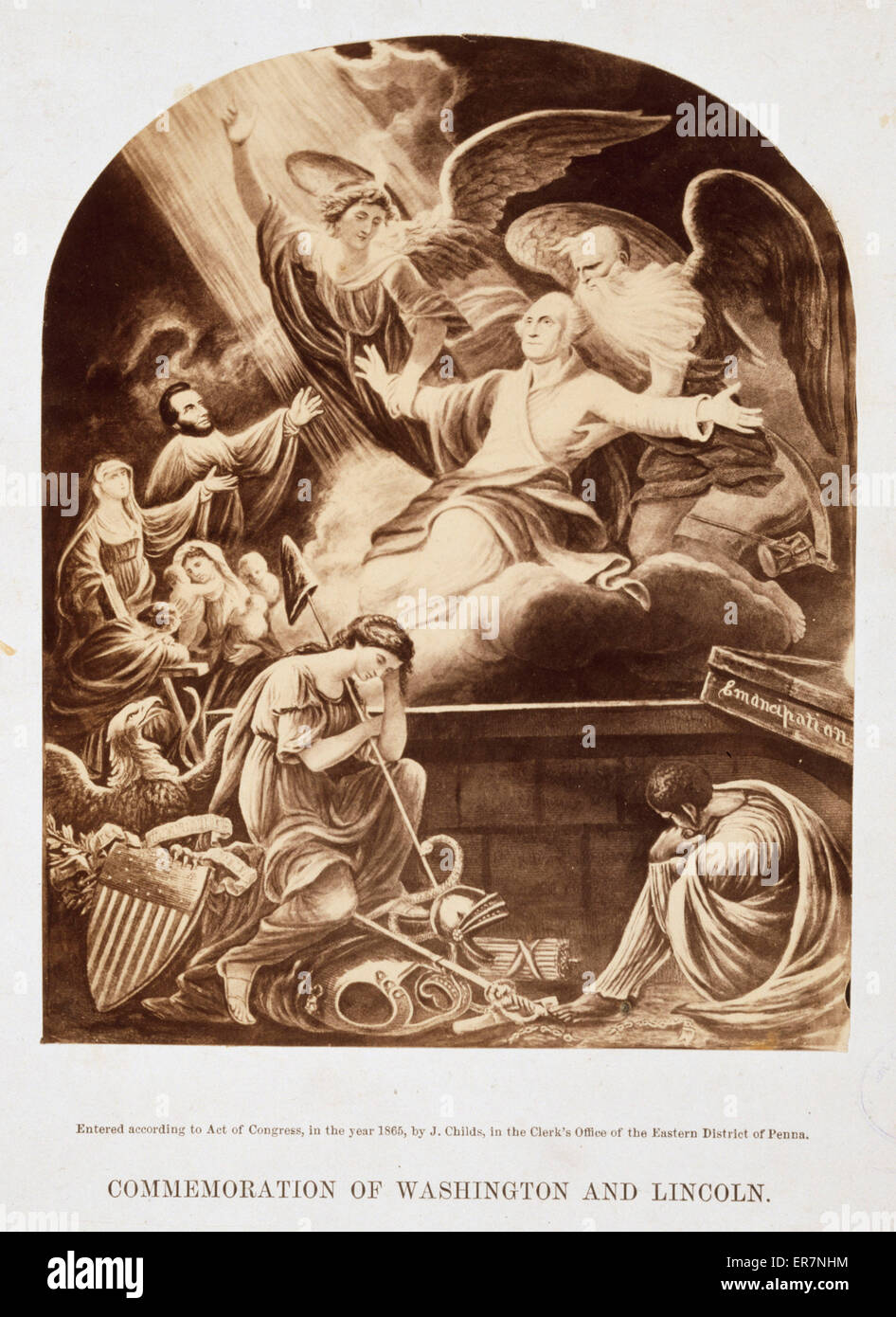
The Apotheosis of Washington :
Name of a painting in the rotunda of the capital building.
"The Apotheosis of Washington depicts George Washington sitting amongst the heavens in an exalted manner, or in literary terms, ascending and becoming a god (apotheosis)."
https://en.wikipedia.org/wiki/The_Apotheosis_of_Washington
the idolization of Moses :
God says to Moses, “see, I make you as God to Pharaoh,”
https://newpolity.com/blog/moses-and-the-battle-not-to-be-god
WASHINGTON ELECTED TO GODHOOD
-
Question about the Christian Trinity
Yes. Trinity seems to be a common mystical metaphor for unity within multiplicity. But, I prefer the concept of Unity as Holism. :smile:Another point to recall is that there are threefolds in many different religious traditions. — Wayfarer
How Ancient Trinitarian Gods Influenced Adoption of the Trinity :
https://www.ucg.org/bible-study-tools/booklets/is-god-a-trinity/how-ancient-trinitarian-gods-influenced-adoption-of-the-trinity
Jewish Numerology (Gematria) :
In their eyes the number 3 was considered as the perfect number, the number of harmony, wisdom and understanding. ... It was also the number of time – past, present, future; birth, life, death; beginning, middle, end – it was the number of the divine
https://wno.org.uk/news/three-is-the-magic-number -
Free Will and Other Popular Delusions, or not?
So, you are a Drone controlled by Fate, or a Cyborg doing the Will of the hive? And your Artistry and Poetry are done un-consciously by an AI program. All this time I thought you were a regular guy. :joke:Free won't decisions aren't free of the will either. No decisions are made in consciousness; consciousness reflects the brain product that has already finished and took time, plus even more time has passed while the representation in consciousness was being built and woven into the flow. — PoeticUniverse -
Free Will and Other Popular Delusions, or not?
Yes. I call it "FreeWill within Determinism".5. How appealing is being semi-autonomous? We have free will but only in a limited sense. — Agent Smith
Free Will versus Free Won't :
Since the question of conscious choice is integral to the notion of morality, Shermer asks if we are indeed free to choose our actions. Some secularists claim that human behavior is pre-determined by an unbroken chain of cause & effect stretching back to the Big Bang. Nevertheless, no one actually believes that he is a mindless zombie driven by ancient urges. So, Shermer intoduces the concept of “Free Won't”. In our contingent world, humans are never totally free to make unconstrained moral choices. Only an agent outside of our space-time world would be perfectly free. But a current theory of how the brain works is based on a business corporation. Normally, most decisions are made on lower levels, then relayed to a decider-in-chief at the top, who only exercises veto power to stop processes that are already in motion. This modified determinism model was made necessary by recent experiments indicating that conscious decisions are delayed reactions to subconscious motives. Those computer-like cause & effect processes present go/no-go options for the conscience to allow or deny. That's why human behavior is unpredictable, as compared to natural agents. For us, a fork in the causal path is an opportunity for creative, or moral, action.
Note -- Michael Shermer is editor of SKEPTIC magazine. -
Question about the Christian Trinity
Yes. Physicsts must believe in a non-empirical invisible Field that is the essence of empirical Reality.Wave-Particle duality — Gnomon
Nor a wavicle, either, but a quantum field. — PoeticUniverse
Note -- just kidding. Since I believe that invisible Information is the essence of reality, accepting the metaphor of a mathematical field is no problem. But it makes me hungry for breakfast. :joke:
Alice laughed. 'There's no use trying,' she said. 'One can't believe impossible things.'
I daresay you haven't had much practice,' said the Queen. 'When I was your age, I always did it for half-an-hour a day. Why, sometimes I've believed as many as six impossible things before breakfast. ” ― Lewis Carroll -
Free Will and Other Popular Delusions, or not?Oh, I see.[/quote]
It's a miracle! The blind now see. The question remains though : see what?
Did you take the red pill, or the blue? :cool:

-
Question about the Christian Trinity
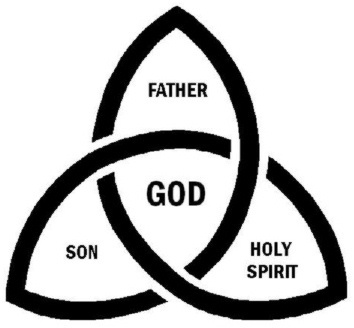
That 3-in-1 doctrine was a rationalization of a logical contradiction. It was thought necessary to resolve some arguments among early Christians from different streams of Jewish and Apostolic influence. Some interpreted Father & Son literally, as two beings. But the abstract Jewish doctrine of divine unity (Monotheism) would not allow God to share god-hood with anyone else. Ironically, Yawheh was originally a son of El, in Hebrew theology. So, the Trinity was an attempt to justify Polytheism within the larger context of Monotheism.So the trinity is the idea that somehow God, Jesus, and the Holy Ghost are separate, but one. — Pinprick
And one result of that miraculous conception was to multiply sub-deities in the form of Christian Saints, playing the role of Roman gods. Consequently, Trinity -- like wine as the blood of Christ -- must be accepted metaphorically in one sense, and literally in another. Most people seem to be flexible enough in their beliefs to juggle such counter-intuitive notions, even though they don't really understand them.
Ironically, atheist Physicists must do a similar juggling act with Quantum non-mechanics, such as Wave-Particle duality, and Quarks as 3-in-1 sub-particles, that are never seen separately -- unlike Superman, who is never seen together with Clark Kent. In super-nature, and quantum probability, all things are possible. :razz:
POLYTHEISM BY ANY OTHER NAME WOULD SMELL AS FISHY

-
Free Will and Other Popular Delusions, or not?
Again, my coinage of a new spelling for an old concept goes right over the reductive head. Since, by "Meta-Physical" I mean the non-physical (e.g. mental) aspects of reality, I am thinking of changing the spelling to "Menta-Physical", to indicate that I am referring to subjective Ideas, not objective objects, Nor to super-natural spooks. For example, Genes are physical, while Memes are Menta-Physical : physical substrate but mental (imaginary) expression.Not meta-physical. The will does as it has come to be. Time is fundamental as motion/movement/causality since there was no stillness stopping everything. Consciousness came to be along the way since before life there wasn't any; same with life. The notion of a self is the result of experiencing. No mysteries left. — PoeticUniverse
That invisible-but-knowable mind-stuff (ideas ; information) was the subject matter of Aristotle's second volume of On Nature. In the first volume, he presented the then-current state of physical science --- as known by direct sensory observation, without modern sense-enhancing technology. And then, in the subsequent (meta-) volume, he discussed the contemporary philosophical opinions about the natural world, which included Ideas, Speculations, Concepts, Theories, and Principles. Those were known only by introspection, or by exchanges of memes (words). Although some of his idealistic notions, such as "Form", were presented as-if realistic, like the Buddha, he was trying to avoid speculating about anything beyond the reach of sensory experience (i.e. super-natural). Yet, he lumped our sixth sense of Reason (nous) and Introspection (mental imagery) under the general heading of "phusis" (nature), which materialistic moderns interpret as "Physics", but not "Psychology".
Human "Will" is completely natural, but it is, by my definition, Menta-Physical. Reductionists typically try to reduce everything to its material substrate. But, that cannot account for Holistic phenomena in human culture. One such immaterial concept is "Health", which is derived from the root for "Wholeness". Another is "diet", which does not refer to any particular food, but to a generalized notion. All philosophical and scientific "Principles" are generalizations, that are never found in Nature, but only in human Culture. Likewise, all universal concepts, such as "the Universe", do not refer to any particular thing, but to a system that we can comprehend only in metaphors and analogies with physical objects.
So, the future-oriented Will is an emergent property of a physical Brain, sophisticated enough to generate a Menta-Physical (nee Meta-Physical) rational Mind. It's not a material object, but a motivating mental concept. And those who can't distinguish the difference, are shooting at a will-o-the-wisp. :joke:
PS___No mysteries? When did you achieve Enlightenment and Omniscience? Should I address you as "Bhodi"? :wink:
PPS___The original Buddha typically avoided speculations about supra-mundane concepts, except such principles as "Nirvana", which could be interpreted as a mundane state-of-mind, not a heavenly realm. Ironically, modern Buddhists do attribute super-natural feats to all bodhisattvas,
The Five Marks of the Mental :
features that set characteristically mental phenomena apart from the characteristically physical phenomena. These five marks (intentionality, consciousness, free will, teleology, and normativity)
https://www.frontiersin.org/articles/10.3389/fpsyg.2017.01084/full
The Soul as Intellect :
Controversy surrounds almost every aspect of De Anima, not least because in it Aristotle characterizes the active mind—a topic mentioned nowhere else in his entire corpus—as ‘separate and unaffected and unmixed, being in its essence actuality’ (chôristos kai apathês kai amigês, tê(i) ousia(i) energeia; DA iii 5, 430a17–18) and then also as ‘deathless and everlasting’ (athanaton kai aidion; , 430a23). This comes as no small surprise to readers of De Anima, because Aristotle had earlier in the same work treated the mind (nous) as but one faculty (dunamis) of the soul (psuchê), and he had contended that the soul as a whole is not separable from the body \
https://plato.stanford.edu/entries/aristotle-psychology/active-mind.html
Note -- In my thesis, the human Mind is also a form of Energy, in the sense of EnFormAction.
MYSTERY IS IN THE MIND
UNCERTAINTY IS IN THE MIND, AND IN PHYSICS

-
Free Will and Other Popular Delusions, or not?
Oh, I see. You put the apple of a FreeWill vs Determinism context together with the mention of a "meta-physical" orange, and concluded "metaphysical determinism". As a Compatiblist myself, I am not a proponent of that particular line of reasoning (see Fatalism below). Instead, I was suggesting that human Reason could be an emergent "meta-physical" (mental not physical) Cause of forging a new link in the physical chain of Causation. The ability to choose between probabilistic options, is a determinant of the subsequent branch of contingent causation. In other words, Reason is your get-out-of-bondage-to-Fate-free-card.Where did I say anything about "metaphysical determinism"? — Gnomon
Context + this:
"What caused you to become a compatiblist? Did you have the option to reach a different conclusion? Can you trace an unbroken chain of causation beck to the Big Bang? Or was your own reasoning ability a meta-physical Cause of your decision?" — Gnomon — 180 Proof
FreeWill is not an "illusion", it's a worldview. It's a meta-physically (memes, not genes) evolved belief system that allows creatures with reasoning ability to statistically predict the future course of events, and to make rational choices instead of knee-jerk reactions to current events. FreeWill is not self-deception, it's Self Determinism. :nerd:
Note 1. In the blog post prior to the one linked in the OP, I discussed the connection between scientific Reductionism, and the ancient worldview of Fatalism. There, I said :
Another divergence in our philosophy is between Determinism, narrowly defined, and FreeWill, as the ability to choose based on rational evidence rather than on fatalistic necessity. But Determinism is a belief and a premise, not an objective fact. And Determinists typically assume a linear chain of physical causes only. Yet they ignore the influence of feed-back loops in the human mind, which become the non-physical Causes we call "beliefs". The behavior of lower animals might result from external influences only. But the human mind is able to interrupt the flow of physical causation with feedback loops that insert new learning links in the chain (creative ideas). When those new links are perceived as different from our beliefs and preconceptions, the mind begins to look for a way to get back on course. Which is known as "Reasoning".
Note 2. Then, in the following blog post (caused in part by the prior post) I said :
After those scenic side-tracks, he finally gets around to “unpacking free will”. For his analysis, you can read the article. Here, I’ll only mention a couple of points. 1) “Trying to account for choice at the level of neurons . . . wouldn’t provide any causal account”. That would be like looking for Meaning in the circuits of a motherboard. 2) “Voluntary behavior . . . Is an emergent phenomenon at the level of the entire organism embedded in physical reality”. That’s what I call “Holism”, or “Systems Theory”. Finally, he looks at “Freewill as Phenomenal Experience”, and says “Although this naïve view has largely been abandoned by serious thinkers, it can still be useful : what difference does it make if you believe that free will is an illusion? Would you no longer make any choices at all?”. In his considered opinion, “free will is a puzzle but it is not an illusion”. To that, I say “amen”.
In short, fatalism is the theory that there is some destiny that we cannot avoid, although we are able to take different paths up to this destiny. Determinism, however, is the theory that the entire path of our life is decided by earlier events and actions.
https://www.mytutor.co.uk/answers/10942/A-Level/Philosophy/What-is-the-difference-between-determinism-and-fatalism/
Risks are problems of contingent causation; they are problems due to unforeseen or uncontrollable causal processes instigated by human action
https://www.jstor.org/stable/40878435

-
Free Will and Other Popular Delusions, or not?
Where did I say anything about "metaphysical determinism"? I had never heard that label until you brought it up. Apparently, you are labeling my apples as oranges. . . . Sir. :joke:Deterministic – a non-metaphysical concept which compatibilists assume – does not mean what determinists (or indeterminists) mean bymetaphysical determinism. You're confusing apples with oranges again, sir. — 180 Proof
Hard determinism (or metaphysical determinism) is a view on free will which holds that determinism is true, that it is incompatible with free will,
Note -- "Determinism" is metaphysical in the sense that it is a philosophical conceptual construct, not a physical object. FWIW, I accept that the general assumption of an unbroken chain of Cause & Effect is true, and how the real world works. However, from my Enformationism perspective, the self-reflective human mind, with self-generated will-power (intention ; agency), is an emergent Cause, as an added link in the cosmic chain of events and priors. Hence, limited local Free Will is compatible with general universal Determinism. I'll have more to say about that in another post. :smile:

-
Aether and Modern Physics
Yes! But, unlike material stuff, mathematical "stuff" is a conventional idea, that only mathematicians can fully appreciate. The rest of us just have to take their word for it, that such invisible stuff is out there in the abstraction we call "Aether". But, that's OK. In my personal worldview, mind-stuff is "the only stuff there is". What I'm referring to is "Information". Which, like Energy, is known as a Causal Force only by its Effects on tangible matter. Otherwise, like Aether, it's un-touchable and un-seeable. But, we can imagine it in terms of material metaphors such as the "fabric of space", or as-if it's a "grid of lines" drawn on the surface of a topological warped plane in space..Stuff? They are the only stuff that there is. — PoeticUniverse
So, in my view, it's all-information-all-the-time-everywhere. But, like Energy, raw Information can be converted into "material "stuff" that our physical senses can detect. Those us educated in the conventional concepts of modern physics, take those invisible "things" for granted. But a person from the jungles of New Guinea, might think you are talking about ghosts : the invisible & intangible spirits of departed ancestors, who now live in a parallel world. Talk about "primitive" notions! :joke:
PS__Both the primitives and the moderns accept the wisdom of their experts (shaman or scientist) about such unseen "stuff".
Information :
Claude Shannon quantified Information not as useful ideas, but as a mathematical ratio between meaningful order (1) and meaningless disorder (0); between knowledge (1) and ignorance (0). So, that meaningful mind-stuff exists in the limbo-land of statistics, producing effects on reality while having no sensory physical properties. We know it exists ideally, only by detecting its effects in the real world.
Aether is the spacious swarthiness of the skies
Of illusive hopes of finding the illumined providence
Riding on mythologies through the routeless night streams
Marooned man clutching godly stones of earthly dreams . . . .
https://www.poemhunter.com/poem/aether/ -
Free Will and Other Popular Delusions, or not?
What caused you to become a compatiblist? Did you have the option to reach a different conclusion? Can you trace an unbroken chain of causation beck to the Big Bang? Or was your own reasoning ability a meta-physical Cause of your decision? FWIW, I am also a compatiblist. However, if we both have free thought, you may not agree with how I arrived at my summation of the pertinent causes of Freedom Within Determinism.Volition is, like every other nonlinear dynamic system, deterministic. (Btw, introspection is illusory, and I am a compatibilist.) So what question/s are you trying to raise with the OP? — 180 Proof
My FreeWill questions are expressed in the linked blog post. For example : "Is FreeWill Fake Agency?" ; " is it Self-deception or Self-determinism?" Several other questions are addressed by the author of the SKEPTIC article. For instance : " “Voluntary behavior . . . Is an emergent phenomenon at the level of the entire organism embedded in physical reality”. That’s what I call “Holism”, or “Systems Theory”.
A link to the article is in the blog post. For those who may be on the fence, the second page of the blog has links to more detailed discussions of the perennial Free Will vs Determinism controversy. :smile:
Is FreeWill Fake Agency? :
http://bothandblog7.enformationism.info/page26.html -
Aether and Modern Physics
I was using the colloquial term "spooky" in the same sense as Einstein's "spooky action at a distance". He wasn't denying that something physical was going on, just noting that it was counter-intuitive. Likewise, a mathematical "Field" has the same physicality as an imaginary "Ghost". It's a concept in a mind, that is used to explain some mysterious features of Reality. Scientists have concluded that something invisible & intangible is affecting the propagation of light through "empty" space.Nothing spooky here: the elementary physical matter are the quanta directly; thus what is primary is physical. — PoeticUniverse
By giving a Latin or Greek name, they make it seem more scientific and less mysterious. And the Effect is definitely physical and measurable. But the presumed Cause remains a mental concept with no physical properties. Aristotle proposed four kinds of causes. And a mathematical Field of relationships may be imagined as a "Material" Cause, minus the matter. And physicists use that notion as-if it is an "Efficient" Cause, even though the Zero-Point Vacuum Energy is merely Virtual : i.e. Potential.
So, an invisible Field is a plausible cause of physical behavior, for those who view the world through the lens of a physical Paradigm. But a Ghost is also a plausible Cause of physical books falling off shelves, for those whose Paradigm includes the possibility of non-physical causation. Personally, I'm more likely to accept the physical explanation. But I have to admit that a Cause with no sensory evidence is "spooky". :cool: -
Aether and Modern Physics
Thanks. I saved it for future reading. :smile:You might like this — Wayfarer -
Consciousness, Evolution and the Brain's Activity
I agree. But I also use another term to describe the relation of Mind to Brain : it's the meta-physical "Function" of the Brain's physical mechanism. In a machine, its function is the relationship between Input & Output. Like a computer, the input is Raw Information, and the output is Processed Information : Meaning. That is, the value relationship of the input data to the Self. An isolated Brain-in-a-Vat is non-functional and meaningless, because it has no Self to relate to. Ironically, the self-image is a metaphor or symbol of the body, and also a non-physical function of the brain-mind machine.I think the interesting philosophical question is the sense in which the mind - I'll use that term instead of 'consciousness' - is a product of the brain. — Wayfarer
One of the most common uses of "function" is to describe a mathematical relationship between X and Y. It's a Ratio, and that's the function of a brain : to rationalize -- to reason. But none of those qualities is literally or physically in the brain. They are however, the result of physical activity in the body/brain as a holistic system. So such functions are not located in any particular area of the cerebrum. You might say that "Mind" is non-local. Which may be why some thinkers use quantum metaphors to describe it. However, those who claim that the Brain is the Mind are confusing the metaphorical reference with the concrete referent --- the physical mechanism with its non-physical function. :nerd:
Note -- In my usage, "Meta-Physical" is equivalent to "Non-physical", but in a positive instead of negative sense. "Non-physical" could be interpreted as "Un-real", But Meta-Physical merely denotes that which is beyond the range of our physical senses and instruments. But not beyond the reach of rational inference. Such functions are knowable only in terms of an implicit connection between observed Output and deduced Input, or vice-versa. In the processing of Information the output has changed in ways that are meaningful to a rational mind.
Example -- the function of an automobile is Transportation from A to B. But where is "T" itself located, and what is it made of? Hint -- it's an idea.
Relationship : non-physical connection ; correlation ; communication ; proportion ; contingency : dependence ; an imaginary invisible link between people or things -
Aether and Modern Physics
In the book I'm currently reading, The Single Simple Question . . ., the author Peter Carter says, "Although scientists no longer use the term, it turns out that there's something like the ether after all. Only the name has been changed to fields". But the concept of "Fields" is just as spooky as the empty-space notion of invisible intangible essential "Aether". He quotes physicist Sean Carrol, "the fields themselves aren't made of anything --- they are what the world is made of".Could aether be the factor that integrates phenomena of quantum mechanics and general relativity, the observation of which would finally provide us with a realist interpretation akin to the one Einstein sought? Can experimental designs and instrumentation ever become advanced enough to register such a medium, and what does current physics suggest about the chances of this substrate existing? — Enrique
That's what you might call "an insubstantial substance". But, in my Information-centric thesis, I call it "Potential", which is not a thing, but merely the power to Actualize things. Of course, that's not a scientific definition, merely a philosophical concept. It's analogous to the usual definition of "Energy" --- not as a physical substance, but as an Aristotelian "primary substance" --- the ability or capacity to do work. Which is merely the power to cause Change. We can't define it by what it is, but by what it does.
So, scientists have not been able to do away with the necessity for some kind of potent nothingness. Ironically, that's hardly an empirical "realist" concept, but more like a hypothetical "idealist" notion. We know the Aether must exist in some sense, but we just can't put our finger on it. So, we define it with as-if metaphors. :nerd:
In physics, aether theories (also known as ether theories) propose the existence of a medium, a space-filling substance or field as a transmission medium __Wiki
In Greek mythology, Aether was the personification of the upper sky, ... thought to be the substance that allowed light waves to travel through empty space.
Empty Space = Free Space = Aether :
Some claim that empty space has no physical properties, but if you eliminate the notions of permittivity and permeability from Maxwell or Einstein's equations, ratios on which the existence and behavior of all fields entirely depends, the theories will completely fall apart. Some believe in the reality of nothingness, that empty space as such is real, and accept that notion as an integral part of their physics, but can't even ascribe any physical properties to it.
https://www.linkedin.com/pulse/empty-space-free-aether-laurent-r-duchesne
Primary Substance :
"Aristotle’s metaphysics of potentiality/ actuality, substance/accidents, matter/ form, essence/ existence, and four causes/ causal powers is increasingly recognized as the framework underlying the physical and biological sciences, . . ."
https://askaphilosopher.org/2019/08/13/aristotles-substance-and-accident/ -
The Internet is destroying democracy
Yes. Right now, the primary ethical regulator of major social media is the court of public opinion, led by investigative journalists. But that still leaves it up to the companies to self-regulate, or to deflect criticism with a brand-name change (e.g. Meta, nee Facebook).The problem with constitutions and Bills of Rights is: who's going to uphold them? How are they to be policed? And if social media companies transgress where are they to be convicted? — Tim3003
An early attempt to supervise the net was the US Telecommunications Act of 1996. And there are some spotty attempts to codify Cyber Law. But we still don't have a world-wide central authority, other than the various voluntary Internet Standards & Protocol organizations. The UN could possibly establish a global clearing house for standards and regulations, but it is often internally divided over political concerns,
So, those who favor Net Neutrality might object to any government influence. Yet, some kind of non-governmental organization (NGO) might be sponsored, but not controlled, by the UN, Anyway, I'm glad it's not up to me to grab the cyber-tiger by the tail. Fortunately, there are many minds, better informed than mine, that are focused on the core problem of Democracy : how to regulate, not dictate. :smile: -
What is metaphysics? Yet again.
Hey! I didn't mean to offend you with my non-comprehension of your "via negativa" speculations. That approach is just as valid as my "via positiva" for conjectures beyond the scope of empirical science. It just doesn't fit my personal amateur methodology. I'm sure that lots of philosophers, including the Buddha, respond to ineffable topics with negations and koans. Even in my thesis, I admit that negations can carry Information. For example, "Zero" and "Infinity" are words & symbols that stand-in for that which is unknowable, yet meaningful. Apparently, you don't grok my Enformationism worldview either. And that's OK. I'm aware that it's an abstract & holistic concept that's hard to wrap your mind around. Merry Holidays to you! :cool:Well, I'm keeping my word, I've made my last attempt to discuss my speculations with you, Gnomon. — 180 Proof

Nassim Nicholas Taleb defines Via Negativa as, “The principle that we know what is wrong with more clarity than what is right, and that knowledge grows by subtraction.
https://coffeeandjunk.com/via-negativa/ -
What is metaphysics? Yet again.
My problem with Sherlock's eliminative method is that, to be as certain as he seemed to be, you must begin negating from a position of Omniscience. Otherwise, you could omit something important from your list of necessities. Remember, the Butterfly Effect is predicated on a few seemingly minor differences in initial conditions. Sherlock's "deductions" from first principles were actually inductions from limited evidence and unprovable assumptions.'If we eliminate (negate) the ways the actual world necessarily could not have been or cannot be described, then what remains is every way the actual world – phase space – possibly could have been or can be described.' — 180 Proof
For example, presumably an omniscient Creator or Programmer of the actual world, would consider all possible forms, and then actualize only the "best of all possible worlds", as Leibniz claimed. In that case, what we know as Reality is already the result of a cosmic sifting process, but still full of conditional possibilites. That's why statisticians, whose job is to eliminate uncertainty as much as possible, begin by plotting a few known points, and then interpolate a Normal curve, from which they make their best guess predictions. Yet, those carefully aimed forecasts rapidly succumb to randomness over time & space.
Thus, for those of us who are not omniscient, we are faced with the mind-boggling mega-zillions of Possibilities that remain in a world of zillions of Potential combinations of physical & metaphysical interactions. For me, that would be a daunting task. I have no way of knowing all the "ways the actual world could not have been". So, I have to begin my investigation into Reality from a position of limited personal knowledge (plot points). And most of that "knowledge" is general & vague, instead of specific & precise. Consequently, my Normal Curve -- plotted from a few points of positive evidence -- has many degrees of possibility (phase space) in which to go wrong.
Therefore, unlike Sherlock, my attempts to see beyond the Big Bang, would not present a high degree of confidence. So, all I can say is that it works for me right here and right now. But I could be wrong. Absolutely wrong. Which is why I have to qualify my deductions (or inductions) as merely reasonable guesses. And your guess could be as good as mine, as long as the reasoning is not mis-aimed by false premises : initial assumptions. That's why philosophers are not prophets. They can only compare a variety of personal guesses to see what they have in common. On this forum, our range of worldviews is wide, but we are forced to view them in the light of skepticism & critical thinking from different perspectives. That said, I can see some overlap in our personal paradigms, but the non-intersecting parts are still a bit fuzzy. :cool: -
What is metaphysics? Yet again.
I get the feeling that you are talking down to me, but not dumbing-it-down enough. I'm not a Pro, merely an amateur cogitator. I have no formal training in Philosophy, and most of my reading has been in hard Science, not fashionable ideologies. So, when I refer to a technical philosophical issue, I have to paraphrase it in my own words, in order to understand it. Teach me as-if I'm a six year old. :cool:Pro-tip: as much as and whenever possible, for clarity's sake, avoid sumarizing in your "own words". A thesaurus and philosophical dictionary don't bite. — 180 Proof
"If you can't explain it to a six year old, you don't understand it yourself.”
― Albert Einstein -
What is metaphysics? Yet again.
Obviously your are not swallowing what I poke at you, and vice-versa. So, what might cause two intelligent people to have a "failure to communicate"? That is the ultimate question for Philosophy. But the most common cause is a clash of worldviews or attitudes, in which words have different meanings, and motives are contradictory. I think our worldviews are not so different, but both of ours seem to be custom-made, so we're comparing apples and oranges. :joke:so, yeah, "obviously" you've not familiarized what I've spoon-fed to you. — 180 Proof
-
What is metaphysics? Yet again.
Good questions! I don't pretend to know the answer to those un-verifiable metaphysical conundra. All I know is that an Aristotelian First Cause is logically necessary to explain the existence of our contingent cause & effect world. So, I adopt the Aquinian Necessary Being as the axiom of my Information-based worldview. Whatever that non-contingent Entity might be, it serves as the "Eternal Basis of All". Or as Tillch so eloquently phrased it : the Ground of Being --- the eternal foundation of the space-time structure we call Home.The G*D Mind who programmed the universe is still a 'God', even if not infinitely smart. How is it there as the Eternal Basis of All, it thus necessarily having no input? What memory does it have to work with? What relations of concepts would it have to use in order to sort out thoughts? How could it make plans? What source would it use for making a universe out of? What purpose would it have? — PoeticUniverse
Unfortunately, anything prior to the initial Act of Creation (Big Bang : Birth Pang) is not subject to empirical verification. However, using normal philosophical methods of inference, I can establish a few logically necessary qualities of the Programmer of those initial conditions, and the evolutionary development of emergent features. For example, a primary characteristic of the presumptive FC is the creative power (Potential) to enform a new physical world from nothing but Cosmic Power, Which in my information-centered thesis I call EnFormAction (Meta-Physical Energy ; power to give form to the formless). If that notion sounds far-fetched, it is supported by logical argument and scientific evidence in the Enformationism thesis.
Most cosmologists agree that, for anything to exist in Space-Time, something must be Infinite & Eternal. But they typically think of that "something" as Natural Laws & Energy, which are not things but concepts. Yet, as a philosopher, not bound by the rules of space-time, I can conjecture into the un-bounded void beyond the Big Bang beginning. And I have various names for the eternal nothing that gave birth to something : i.e. everything in our world. And one name for that non-physical non-thing is Enformer : the creative power to convert Potential into Actual.
Most alternatives to a god-like Cause assume (without evidence) that Natural Laws and Constructive Energy have always existed (eternal Potential). And I agree, except that I call the mathematical "laws" of Nature : LOGOS. And the ability to "do work" (cause change) is what I call EnFormAction (the power to cause changes in Form). Moreover, I define "Form", not as a physical shape, but as the mathematical structure of each real thing. That's my interpretation of Plato's posited Source of all real things. If the logic of math & reason has always existed, rather than evolved, you could infer that it must be "infinitely smart", in the sense of encompassing all Possibilities.
By definition, any First Cause must have causal "input" in order to encode the criteria for a new world, in the form of initial conditions (constants, definitions) and rules for interaction (natural laws). That's why I use the metaphor of a Programmer to describe the FC. Our world was "born" with all the genetic information (constants & laws) necessary to compute a universe from a sub-atomic-scale dot of data. So, the data input was the program we call "Nature", which is currently running (evolving) on the self-creating self-organizing "machine" we call our World.
The "memory" (temporary repository or register) for all that calculating (energy exchanges) is Matter, which takes on physical forms as defined by the program criteria. Another theory of cosmic memory is the imprint of physical changes and energy exchanges on the gravitational field (see link below). I don't know much about such things. But, it's usually assumed by scientists and philosophers, that every change in the world leaves a trace (encoded information) behind. Long ago, I read an excellent sci-fi novel that was based on that notion. And that was long before the LIGO observatory detected gravitational waves from distant galaxies.
The "relations of concepts" you question, would be what we call the Logic of Nature, which we know primarily in terms of abstract Mathematics. But we also imagine natural relations in terms of Space & Time, which are metaphysical concepts, not physical things. We perceive such abstractions in terms of metaphors, that only exist as mental images. That's why we can only communicate our ideas about such non-entities in the form of Meta-Physical Metaphors.
How could the presumed Creative Cause "make plans"? Presumably, in the same way human minds create imaginary scenarios, and then plot a course to make it real. The best laid plans of gods and men, oft go awry. Unless, the planner is an omnipotent programmer, with the power to control how the universe gets from Now to Tomorrow, from Input to Output. By inputting criteria into initial conditions and laws, that guide the world to compute an answer to the Programmer's question. I don't know what that question was, but it is the reason we are here in space-time. And the answer to that reason is the "Purpose" of this experiment in evolutionary programming. All I know is that it seems to involve increasing complexity & organization of matter & energy & mind.
In the Real world, each physical effect must be preceded by a physical cause. Except, when the cause is an idea in a mind. That's often called "the power of ideas", or "agency", or "creativity". So, the notion of a mental (meta-physical) Cause is not so far-fetched. Yes, I'm aware of the notion that even creative ideas can be traced back to a chain of physical causes, but what if the First Cause was the metaphorical pool-shooter, standing outside the pool table (physical universe)? That aiming Agency is the "Source" of all information in the world, which is also the source of all forms in the world. Ironically, in the Enformationism thesis, the Cause is also the Effect, in the sense that the Enformer is both transcendent & immanent. It consists of Potential Information (power to enform), which is a shape-shifting force similar to Energy, which is the "source" of Mass and Matter.
The bottom line of all this speculation is that, like the immaterial human mind, the Meta-Physical Mind of the Programmer exists in the form of Creative Power (EnFormAction) : which is both the Enformer and the Enformed, both the Creator and the Creature. A philosophical label for such a Power Input, which is also the Output, is PanEnDeism. Look it up. :smile:
EnFormAction :
Ententional Causation. A proposed metaphysical law of the universe that causes random interactions between forces and particles to produce novel & stable arrangements of matter & energy. It’s the creative force (aka : Divine Will) of the axiomatic eternal deity that, for unknown reasons, programmed a Singularity to suddenly burst into our reality from an infinite source of possibility. AKA : The creative power of Evolution; the power to enform; Logos; Change.
http://blog-glossary.enformationism.info/page8.html
LOGOS : abstract mathematical rules of relationships, that we call Logic or Reason. What we call "Mathematics" is simply Symbolic Logic as we imagine it metaphorically. Those rules determine how real things fit together into a holistic Structure.
Causality is an abstraction that indicates how the world progresses. So basic a concept that it is more apt as an explanation of other concepts of progression than as something to be explained by others more basic. The concept is like those of agency and efficacy. For this reason, a leap of intuition may be needed to grasp it
https://en.wikipedia.org/wiki/Causality
How the Universe Remembers Information :
Nonetheless, physicists are on the hunt for evidence of an observable “memory effect” left behind by gravity that could soon be picked up in a lab.
https://nautil.us/issue/69/patterns/how-the-universe-remembers-information
How is time an abstract concept? :
Time is a abstraction, a filing system used to arrange events and memories into a logical system of cause and effect. Per relativity, space and time are not discrete entities, but a single construct called spacetime.
https://www.britannica.com/science/space-time -
What is space
"Space" and "Infinity" are not physical things that can be stretched or compressed or divided. Instead, both are ideas about things (i.e. their relationship). Astronomers are using a metaphor when they talk about the "expansion" of space, or when Einstein presented the notion of "Block Space-Time". For example, in imagination, you can take a knife and carve a chunk of Space into a million pieces, and they will all be the same size as the chunk : infinite or zero. That's because Ideas are Meta-Physical, not Physical ; Ideal not Real ; Relative not Absolute. :smile:Space and infinity are some of my favorite ideas, — Gregory -
Consciousness, Evolution and the Brain's Activity
FWIW, I'm guessing that Consciousness -- a Meta-Physical effect of brain processes -- does not directly affect the brain that produces it. Instead, we become aware of our private nonverbal thoughts, when we either convert them into conventional words (as in "I told myself" ; internal narrative), or hear ourselves saying those words (i.e. aural feedback), or see how others react. For example, there is an old saying : "how could I know what I think, until I hear what I'm saying?" (see quote below) :smile:Here, I was conjecturing that if consciousness can effect the physical activity of the brain, then since the brain is a physical object, consciousness would need some physical mechanism to effect it. — tom111
PS__This notion of feedback implies that the Brain normally operates on auto-pilot. But, when we objectify our subjective thoughts, in words or deeds, we can take over control of the system by provoking a reaction from the physical brain. That feedback loop is partly physical (neural network) and partly meta-physical (i.e. meaning, significance to me).
PPS__I suspect that people who have an "internal narrative" are Introverts, who are constantly observing their own thoughts. By contrast, Extroverts need to hear their thoughts & feelings reflected back by other people. Those in the middle of the continuum probably do it both ways. Either way, it's a feedback loop that influences the brain with it's own thoughts. .
“How do I know what I think until I see what I say?”
― E.M. Forster
Fun fact: some people have an internal narrative and some don't
As in, some people's thoughts are like sentences they "hear", and some people just have abstract non-verbal thoughts, and have to consciously verbalize them
https://ruinmyweek.com/weird/internal-narrative-vs-abstract/ -
What is metaphysics? Yet again.
I apologize, if I misinterpreted your intention. I didn't intend to the un-charitable, but I was shooting in the dark, so I might have missed what I was aiming at. Obviously, you are referring to a philosophical or theological approach that I am not familiar with. Perhaps, because I have no background or formal training in such esoteric topics. However, I looked-up "apophatic" and now I almost see what you meant by "negative metaphysics". It's trying to describe an ineffable being or concept by listing examples of what it is not. I was vaguely aware that medieval mystics used such reverse poetry to describe the deity they experienced subjectively --- in objective terms that always miss the target, but draw a circle around that empty place. :smile:That's an uncharitable reading to say the least. I've proposed an alternative / complementary way of 'doing metaphysics' not unlike negative (apophatic) theology is an alternative / complementary to positive (cataphatic) theology. — 180 Proof
Apophatic :
The apophatic tradition is often, though not always, allied with the approach of mysticism, which aims at the vision of God, the perception of the divine reality beyond the realm of ordinary perception
https://en.wikipedia.org/wiki/Apophatic_theology
OK, you have denoted that which is not of concern to your philosophy. But I'm still not sure what is in the Black Box, whose contents you are describing without opening. If it ain't "Religion and Mysticism" what is it? Is there a common name for it, other than arcane terms like "Apophatic". I understand Terrence Deacon's notion of the "Power of Absence", but in the absence of some positive information, I'm at a loss to imagine that which is not there. I fail to see what "human facticity" has to do with Metaphysics, except in the sense that it is the common human perspective on that which is not Physics. I need you point in the direction that I should look, in order to see what you are seeing. :cool:Wrong. Also, "Religion and Mysticism" refute themselves and globally are uncorroborated by – inconsistent in manifold ways with – both human facticity and the natural world. They are not targets of my speculative concerns. — 180 Proof
Note -- FWIW, I call my Black Box neither Religion nor Mysticism, but merely "philosophy".
OK. So you're not seeing what I'm seeing. That's no reason to give-up. That's philosophy, I'm willing to keep shooting in the dark until I finally hit some target, even if I don't know what I'm aiming at. But, what you call "proselytizing" is what I call "explaining what I'm talking about". Maybe you need to do more proselytizing, If you want to bring me into the fold. :halo:Your "thesis" doesn't hold up under either philosophical or scientific scrutiny, sir. And when you're presented with my "disruptive" alternative, you're so busy proselytizing that you uncharitably read my proposal (re: negative ontology ↪180 Proof
) and fail to even question its premises in the context of (western) ontology. — 180 Proof
Apparently, we are both occlusive in our 'splaining. I don't know what you are talking about, and you don't know what I'm talking about. But, maybe, if we keep "throwing mud" on the wall, some of it will eventually stick. Teach me. :joke:they occlude as much as, or more than, they clarify. — 180 Proof

PS___I have learned the hard way to not assume that posters will click on my links. That's why I usually try to summarize, in their words or my own words, what the link means. -
What is metaphysics? Yet again.
I'm not likely to start a thread on such a broad topic, and one that is outside my limited range of expertise. But I'm happy to discuss specific examples of Neologisms and technical jargon. For instance, my usage of the baggage-laden word "metaphysics", with a revived ancient meaning, is essential to understanding the neologism of "Enformationism". Most discussions on internet forums merely recycle old ideas expressed in conventional terms. But, if you have a novel idea, especially a whole new worldview, it would be self-defeating to use words carrying obsolete meanings. :smile:If you want to start a new thread about the use of new words, I am likely to participate, although I will be out of town with no computer for three days. — T Clark
A neologism is a relatively recent or isolated term, word, or phrase that may be in the process of entering common use, but that has not yet been fully accepted into mainstream language. Neologisms are often driven by changes in culture and technology.
___Wiki
Philosophy is Meta-Physics :
"As for a super-natural realm, however, can we ever hope to know about a realm not open to the inquiries of science? If it is beyond our physics, then it's metaphysics --- philosophy again."
___Peter Carter, MD
The Single Simple Question that Challenges All Convictions
Note -- The author seems to advocate Secular Humanism, as opposed to conventional religions. His challenging question is "does every event have a cause?" If so, then a trickle of Free Will is lost in the flood of Causation. However, he inadvertently raises the same "get out of jail free" exception that I use to justify my own notion of "FreeWill within Determinism". :joke: -
What is metaphysics? Yet again.
Yes. But my thesis is based on 21st century science, with strange concepts that didn't exist eons ago. Which necessitates the use of novel tech terms, even though it falls into the 2 & 1/2 millennia old category of Metaphysics, (according to my reading of Aristotle). Ironically, Shannon's "Information Theory" deliberately gave a new meaning to an old word. So, when I refer to the original conventional meaning (e.g. meaning in a mind, not digits in a computer) I have to contrast it with the entrenched technological notion. So, for convenience, I have added a growing number of pertinent definitions to the thesis glossary over the years. For example, "meta-physics", if taken literally, should be self-explanatory, And here's one I didn't coin, that I may add eventually just to deny that my thesis implies : Acosmism. (That arcane term was used by 180proof). :smile:in which people are still talking mainly about the same phenomena that have been discussed for a thousand or more years — T Clark
PS__a good example of novel philosophical coinages is A.N. Whitehead's Process and Reality. which is on the same basic topic as my thesis. I had a lot of difficulty reading it, because it didn't have a glossary of neologisms, So, I feel your pain. But I persevered. :joke: -
What is metaphysics? Yet again.
Oh yes! My head is "bloody but unbowed", as a result of encounters with anti-religionistas. But my thesis necessarily crosses the line, because traditional religions in most cultures were based on the philosophical & scientific memes of their time. I have no problem with the philosophical basis of Hinduism, it was insightful for its era. But I see no philosophical reason to bathe in the polluted Ganges, It's just an ancient cultural practice that some feel compelled by religious loyalties to continue. Likewise, I appreciate the philosophical foundation of Buddhism, but I don't follow any of its tradition religious rituals. For example, I studied Meditation long ago, but it was a secular form. :smile:There's a very sensitive sub-topic around this point - the boundary between metaphysics, philosophy and religion are somewhat hazy and it's easy to find yourself crossing it whenever this subject is discussed. — Wayfarer
Some would consider my behavior to be somewhat religious, but with my Fundamentalist family and relatives I tread lightly. I do have a concept that I call "G*D" in the thesis, but it's not a lordly tyrant in the sky. Instead, it's more like Spinoza's Nature sive Natura, or Plato's Logos, or Lao Tzu's TAO. I used to attend meeting of a local Deist group, but they split between the religious and secular factions. :nerd:My approach is somewhat religious, but not the way my grandad (for instance) would have understood. — Wayfarer
I agree with Nagel's hope that their is no "God" (in the Biblical sense). But, have never been able to find a reasonable alternative to a First Cause, that is necessarily preter-natural, in the sense of existing prior to the beginning of our natural world. But it's not "super-natural" in the sense of Greek super-hero gods, or a heavenly humanoid. If believing in a First Cause or Necessary Being makes me religious, I'm guilty. But I have no motivation to impose any doctrine on anyone. My posts on this forum are for self-development, not for evangelism. :cool:IN ANY CASE, what I'm wanting to say here is that there is a strong implicit prohobition against certain kinds of ideas associated with religion, which is well articulated by Thomas Nagel: — Wayfarer -
What is metaphysics? Yet again.
Surprise! I have already written an essay on that very topic. I get blow-back from lazy posters who don't care enough about philosophy to learn new ideas. They seem to want their philosophy expressed at an eighth-grade level. IMHO Philosophy is supposed to be disruptive. And my thesis in particular is intended to shake-up old hand-me-down notions and definitions of cutting-edge topics. :smile:Philosophers often coin new words for novel or technical concepts. — Gnomon
That's true. Sometime you and I can have a discussion about why I think that is an unnecessary and disruptive practice. — T Clark
Why Coin Tech Terms? :
The practice of using words that can't be found in a dictionary makes reading more of a challenge, and may seem pretentious. But, such coining is common for scientific and philosophical writings that explore uncharted territory off the current maps. One reason for using novel words is to avoid old biases. Well-known words usually have collected a lot of baggage over the years. And some-times, the meaning of common words has evolved into a sense far from the original context & connotation. But the primary reason for using a special label for a technical definition is so the writer can control its meaning precisely.
I have offered several alternative definitions. Can't you find one that doesn't offend your sensibilities. What motivated you to start this thread? Did you hope for a nice simple list of precisely-defined dos & don'ts. That's not philosophy, but propaganda or dogma. Philosophy, and especially subjective Metaphysics, is always open to interpretation. So, what's your interpretation of "my concept" (Enformationism), if it's not "Meta-Physics", as I defined it in the thesis : non-physical ; immaterial)?I don't reject your concept. I object to your use of "metaphysical" or "meta-physical" to name it. If I might paraphrase a wonderful statement from Cartuna from a different discussion: — T Clark
Regarding Cartuna's post, scientists don't do "Metaphysics" by any name. But for idea-dissecting philosophers, that's all they do. Although some like to think they are practicing hard Science, when they argue endlessly over the meaning of words. Science is necessarily Reductive & Analytical & Precise. But Philosophy is necessarily Holistic & Synthetic & Vague (General, Universal, Moot). :cool:
Note -- Aristotle's "Categories" in The Metaphysics volume, are inherently general and non-specific.
Feynman on Philosophy :
A person talks in such generalities that everyone can understand him and it's considered to be some deep philosophy. However, I would like to be very rather more special and I would like to be understood in an honest way, rather than in a vague way. ___Richard P. Feynman
Was Richard Feynman a philosopher?
Ben Trubody finds that philosophy-phobic physicist Feynman is an unacknowledged philosopher of science.
https://philosophynow.org/issues/114/Richard_Feynmans_Philosophy_of_Science -
What is metaphysics? Yet again.
I got the implicit dismissive message of "negative metaphysics" : apparently it's intended to ban Metaphysics (i.e. anything non-physical) from philosophical discussion. But I still don't get a positive understanding of why you would want a gag order on Philosophy (see PS below). Since modern Science took over the role of Naturalism after the Enlightenment era, all that Philosophy has left to study is the non-physical aspects of the natural world. Namely Concepts (ideas. minds, consciousness), Essences (form, mathematical structure) and Universals (qualia), which are all "unreal Xs" in your outdated definition of Metaphysics, but are important topics in my 21st century definition of Meta-Physics. That's the study of preter-natural features of Reality, in the sense that Mind is the "more-than" of Holism. It is something in-addition-to Brain matter. So the Brain is Natural, but Mind is preter-natural (i.e Cultural).As the links in my previous posts show I've addressed (my conception of) negative metaphysics – proposes eliminating necessarily unreal Xs as an alternative in contrast to positing categorical (e.g. Platonic) constructs of necessarily real "essences", "universals", etc – in our exchanges quite a few times over the last couple of years. — 180 Proof
Of course, some disingenuously try to place Mind under the heading of Physics, because it is a Function of a brain, knowable only by another Mind. That's why you can't place Consciousness or Reasoning under a microscope or create it in a Cyclotron. That's not the kind of thing that Physicists, Biologists, or Chemists study. So why would you want to negate the only remaining subject matter of philosophical investigation? (see PS below) Meta-Physics is inherently subjective, hence it is literally "un-real" in any objective sense. Aristotle tried to avoid the Ideal implications of his own metaphysics. But ironically later philosophers realized that he was in denial, because his de-idealized notion of "Form" is itself only an abstract idea about reality, not a real thing itself. Moreover, all Functions (e.g. Mind) are knowable only by rational Minds, not physical senses. (See The Trouble With Psychology below).
My Enformationism worldview is indeed Idealistic (unreal) in the sense of asserting the value of Ideas in a world of human Culture. But it is also Realistic in the sense that it does not deny the value of Material objects to denizens of Nature. Take away non-physical ideas, and Culture vanishes from the world. And along with Culture, Science itself would disappear from the world. And Technology would revert to apes pounding nuts with rocks. :nerd:
PS__ I can guess the answer to my own question above : you want to ban Metaphysics, because of its association with Religion and Mysticism. Me too! That's why I want to bring it back under the broad umbrella of Classical Philosophical Science by labeling it "Meta-Physics". Although the topic is inherently Subjective, I try to keep it grounded in Objective science as far as possible.
In metaphysics, a universal is what particular things have in common, namely characteristics or qualities.
https://en.wikipedia.org/wiki/Universal_(metaphysics)
Qualia are the subjective or qualitative properties of experiences. ... Qualia have traditionally been thought to be intrinsic qualities of experience that are directly available to introspection. However, some philosophers offer theories of qualia that deny one or both of those features.
https://iep.utm.edu/qualia/
Idealism in sense (1) has been called “metaphysical” or “ontological idealism”, while idealism in sense (2) has been called “formal” or “epistemological idealism”. The modern paradigm of idealism in sense (1) might be considered to be George Berkeley’s “immaterialism”, according to which all that exists are ideas and the minds, less than divine or divine, that have them.
https://plato.stanford.edu/entries/idealism/
The journal embraces a broad and dynamic definition of the preternatural, since the ... strongly encourages submissions covering cultural traditions worldwide.
https://www.psupress.org/Journals/jnls_Preternature.html
The trouble with Psychology :
With respect to science, human psychology faces an immense obstacle posed by its focus on the mind. Human psychology is defined as "the study of the mind, occurring partly via the study of behavior", but the mind is not a physical organ, it's an abstract concept, and measurements of the mind's state are indirect and subjective (by way of a subject's verbal reports, for example). This makes psychology, as defined, a branch of metaphysics, not physics.
https://arachnoid.com/trouble_with_psychology/index.html
GAG on Philosophy

-
What is metaphysics? Yet again.
As Wayfarer noted, I explicitly differentiate between the common definitions, and my peculiar information-based usage of that traditional philosophical term. Philosophers often coin new words for novel or technical concepts. If you don't accept my proffered concept, that's on you. But, If I am not making my meaning clear, I guess the fault is on me, for trying to add some novelty to the worn-out phrases of philosophy. :joke:My only complaint has been your confusing misuse of the word "metaphysics." As for your ideas themselves, I don't have strong feelings either way. — T Clark -
What is metaphysics? Yet again.
I still don't grok your alternative method of "negative metaphysics", nor the assertion of "Impossiblism" or "immanentism". So, I'll reply by comparing my worldview to the -isms below. I don't expect it will change your mind or attitude, but it may help you to see where I'm coming from, instead of the -isms you try to pin on me. Although this clash of -isms does sometimes sound like a doctrinal religious dispute, that is not my intention. :smile:
Holism and FreeWill, versus Reductionism and Fatalism
When you accused me of being a woo-mongering New Age nut-case*1, I began to realize that a significant difference in our worldviews might be characterized as Reductionism vs Holism. You may not be aware that the man who wrote the book on the modern concept of Holism was in no sense a New Ager. Instead, he was a South African general, statesman, naturalist, and philosopher. His 1926 book, Holism and Evolution, was a treatise on the philosophy of Western Science, which he saw had veered so far toward a reductive perspective that it couldn't see the forest for the trees. My worldview is not New Ageism*2, but it is a form of scientific Holism or Systems Theory. :nerd:
Holism and Evolution :
The holistic approach to life has had such a far-reaching impact in the world that most people assume it grew out of some Far Eastern practice.
___review of book by Jan Smuts
https://www.amazon.com/dp/B00VISSWR6/ref=dp-kindle-redirect?_encoding=UTF8&btkr=1
Another divergence in our philosophy is between Determinism, narrowly defined, and FreeWill, as the ability to choose based on rational evidence rather than on fatalistic necessity. But Determinism is a belief and a premise, not an objective fact. And Determinists typically assume a linear chain of physical causes only. Yet they ignore the influence of feedback loops in the human mind, which become the non-physical causes we call "beliefs". The behavior of lower animals might be caused by external influences only. But the human mind is able to interrupt the flow of physical causation with feedback loops that insert new links in the chain (creative ideas). When those new links are perceived as different from our beliefs and preconceptions, the mind begins to look for a way to get back on course. Which is what we call "Reasoning". :cool:
Feedback Loops :
The human brain is a negative feedback loop system. This means that whenever there is a difference between what a person experiences in reality that is different from the ideal set point established by this person’s brain, an urge to behave to correct the situation is created by the brain.
https://www.funderstanding.com/brain/brain-biology-a-negative-feedback-loop-system/
Every Effect has a Cause, but not all causes come from the environment. When faced with an incongruency, humans are able to "leap" to a conclusion that seems reasonable, in light of our prior beliefs of what ought to be true. So, what seems reasonable is not just pure Logic, but also depends on (determined by) any prejudices, premises, and presumptions in our belief system. And those beliefs are not in any sense physical objects. Instead, they are meta-physical causes of our mental behavior. You might say that beliefs are indirect causes of behavior, because they result from feedback loops in the chain of incoming information. Those information loops add to the complexity of a simple linear cause & effect system. But out of the apparent chaos comes the novel (butterfly) effect that we call "Free Will".
Philosophers don't usually do physical work with their hands, but with their minds. They do non-physical (meta-physical) work with their cognitive faculties. But Reductive thinkers assume that Mind = Brain, because they focus on the parts (neurons) instead of the whole system. Mind is not a mass of concrete neurons, it is instead the abstract Function of the whole body as a complex system. Like a computer, the Brain seldom makes logical errors, but the Mind often gets side-tracked into irrational beliefs. Unfortunately, some of those non-physical concepts (e.g. Qualia) may be what you think of as Essentialism. But, actually it is merely Synthetic thinking as contrasted with Analytic thinking. And the synthesis is Mental instead of Physical, so it is knowable only by exchanging Ideas or Memes. The exchange is via a physical Medium, but the media is not the Message.
Holistic (synthetic) thinking is a common characteristic of New Age philosophies. But in practice, they also include particular inherited beliefs, such as those in Eastern religions. Such woo-ish notions as Wandering Souls, and Weaponized Chi*3, are not inherent to Holism. But Reductionists tend to lump them together with the Holistic worldview. So, for clarity, I will sometimes refer to my personal paradigm of Science as "Systems Theory", in hopes of losing the mystical baggage. :pray: :halo:
Systems theory is an interdisciplinary study of systems as they relate to one another within a larger, more complex system. The key concept of systems theory, regardless of which discipline it's being applied to, is that the whole is greater than the sum of its parts.
https://www.onlinemswprograms.com/social-work/theories/systems-theory-social-work/
Holism as an idea or philosophical concept is diametrically opposed to atomism. Where the atomist believes that any whole can be broken down or analyzed into its separate parts and the relationships between them, the holist maintains that the whole is primary and often greater than the sum of its parts.
http://abyss.uoregon.edu/~js/glossary/holism.html
Note -- you might say that Holism multiplies the parts
PS__Science is expected to be Analytical, but Philosophy is supposed to be Synthetical.
*1 I was not offended, because I have come to expect expectoration during a philosophical exchange of spittle.
*2 Not that there is anything wrong with New Ageism as a personal worldview. Only as a coercive religion would it impose woo on you.
*3 The notion of "throwing Chi" like a flame thrower is not characteristic of Eastern Religions, but of SuperHero movies.
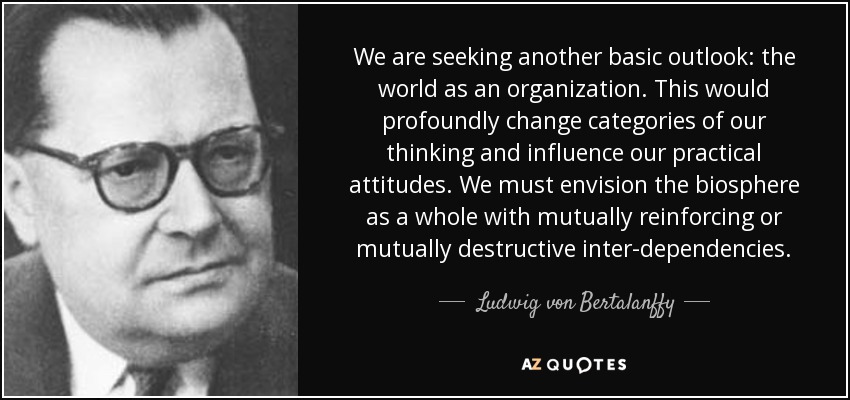
Ludwig van Bertalanffy : GENERAL SYSTEMS THEORY
-
What is metaphysics? Yet again.
Your idea of "meta-physics" may have value in philosophical discussions, but it isn't "metaphysics" as we normally use the word. We've been through all this before. I don't think we'll get anywhere going through it again". — T Clark
Since, in my wordy posts, I haven't been able to convince that there is another way to define "Metaphysics", here's a less verbose version : :chin:
Physics is about analyzing a system into pieces and parts (practice).
Meta-physics is about generalizing pieces & parts into systems (theory). -
What is metaphysics? Yet again.
Sorry, Aristotle gave a definition of "soul", so perhaps I mis-spoke. Anyway, his notion of Entelechy sounds like another word for the motivating animating vital force of the world. Some Physicalists and Realists on this forum don't mind reifying metaphors into material forms. :smile:I don't associated the idea of the 'world soul' with Aristotle in particular, but definitely with the idea of 'animating principle'. — Wayfarer
Reify : make (something abstract) more concrete or real.
The Platonic doctrine of the world soul was rejected by aristotle.
https://www.encyclopedia.com/religion/encyclopedias-almanacs-transcripts-and-maps/world-soul-anima-mundi
Entelechy :
the realization of potential.
the supposed vital principle that guides the development and functioning of an organism or other system or organization.
Note -- apparently I expanded that narrow notion to include the Cosmic Organism. Doesn't that make sense? I suppose he "rejected" Plato's ideal soul, because he was trying to be a Realist, instead of an Idealist. But, I don't see anything necessarily Ideal about the concept of directional momentum in the expansion of a Singularity into a Cosmos. Of course if you try to explain how that teleology came to be programmed into a speck of Potential, that might get Meta-Physical, in the sense of probing beyond the physical boundary of our world. But physicists do that with Inflation and Multiverse theories. So, why not philosophers? :wink:
Information - Consciousness - Reality :
He then offers two ways of understanding this dynamic world : in Aristotelian terms as “the entelechy of existence”, and the metaphor of “the rhizome of reality”. Later, he mentions a more technological way to think of reality, as a mathematical structure forming “the software that connects us, that enables all distributed systems, including life itself”. However, he seems to think of this evolving complexifying mechanism as more like a living cosmic organism.
http://bothandblog7.enformationism.info/page18.html -
What is metaphysics? Yet again."genetic information" and "entelechy".
I have referred to both of those ideas in my thesis. For example, I describe what Plato called Ideal FORM, in terms of Generic Information. That label is intended to include metaphysical Memes as well as physical Genes, as carriers of Information. In my thesis, both fall under the heading of EnFormAction.
Whereas Aristotle may have imagined "entelechia" in terms of an animating World Soul, I prefer to describe that teleological force in Nature as positive "Enformy", to replace the made-up label in Physics : "Negentropy". Although it sounds dismissive, just giving it a name is an indirect admission of a mysterious positive force, driving Evolution toward some unknown future state. And despite attempts to denigrate Metaphysics as "supernatural", Entropy is as natural as Energy. It just happens to be defined in terms of Information Theory, instead of Thermodynamic Theory. :smile:
Information is Generic in the sense of generating all forms from a formless pool of possibility : the Platonic Forms.
http://bothandblog2.enformationism.info/page29.html
An entelechy is an internal force or principle that drives a being toward its destiny.
https://en.wiktionary.org/wiki/entelechy
Enformy :
In the Enformationism theory, Enformy is a hypothetical, holistic, metaphysical, natural trend or force, that counteracts Entropy & Randomness to produce complexity & progress.
http://blog-glossary.enformationism.info/page8.html
Because of the "Hard Problem" of Consciousness, Physics has no good explanation for the existence of Memes in the world. It's a "cultural analog" to Genes, but the evolutionary leap from molecules lto Genes, and from Genes to Memes are not explained by the analogy. So, it remains an "explanatory gap" to be filled by some Potential. But, was that pre-real potency physical (particular) or meta-physical (general)? The latter is a "Meme of the Gaps" solution to a philosophical mystery. It assumes that concepts are not made of Atoms or Bosons.
Just as genetic information is encapsulated in a protein form, a meme requires a physical medium (e.g. neuron) -- but the meaningful content of the capsule is not physical. it's relational, like Mathematics. So, what is Math made of, if not Information (the power to enform)? That's a rhetorical question, I already know the usual "it's all physical" answer, as a term of Faith in Science. :cool: -
What is metaphysics? Yet again.
Did you meet Elon Musk out there?crap — Gnomon
My Space Vacation: — PoeticUniverse
I was pleasantly surprised to see how much enthusiasm there is on the forum for this contentious topic. Especially after it petered-out at least twice before. The expressed opinions seem strongly divided between Science & Pseudoscience, or between Physics & Metaphysics, with some fer it, and some agin it, and only a few on the fence.
However, the intention of my thesis was to bring Metaphysics back into the fold of Science, if not exactly Physics. But centuries after the "Enlightenment", the gap is still wide, among those who care enough to even argue about Ideal concepts that have no immediate effect in the physical world. Metaphysics won't make your cell phone work, or put food on your table. But deep thinkers seem to think it's important to think about such non-things. To some, it's a vermin to be eradicated with rat poison, while to others it's the creamy icing on the worldview cake. :smile: -
What is metaphysics? Yet again.
Which includes those imaginary Quarks and Gluons, and all invisible Forces for that matter. But hey, icky & gummy crap can be used to stick & glue things together. :joke:…added up to a heck of a lot of crap! — PoeticUniverse
"Gluon :a subatomic particle of a class that is thought to bind quarks together."
"We now postulate that the particles carrying this force, called gluons," -
What is metaphysics? Yet again.
I must have missed your explication of that method. Can you summarize it for me? In what sense is it beyond physical"? Do you have a name for it?I've proposed an alternative method of metaphysical speculation to the mainstream (i.e. Platonic) method you've undertaken. — 180 Proof
My "metaphysical speculation" necessarily goes beyond Physics, because The Scientific Method doesn't address "ultimate questions". Moreover, my alternative Philosophical method is a combination of both Platonic Idealism and Aristotelian Realism. For example, Ari applied Plato's notion of Ideal FORM to real things. " Aristotle famously contends that every physical object is a compound of matter and form". And that is exactly what I'm doing with an "alternative" definition of "InFORMation". Whatever he meant by "form", it's clear that it's different from "matter". “by form I mean the essence of each thing and the primary substance” In my usage, Information is the "essence" of material things. And by that I'm referring to the immaterial mathematical Structure, that our minds interpret as Geometry & Topology (i.e. Shape or Form). That Essence is Ideal in the sense that it exists as an Idea in a Mind, which makes it as real as anything else in our mental & mathematical models of reality. :smile:
Metaphysical speculation is, simply put, the pondering of ultimate questions about the universe. https://miuc.org/the-value-of-metaphysics-and-of-metaphysical-conversation/
That may be true of Shannon's definition of "information", as an empty carrier of meaning. But in my usage, and that of credentialed physicists, such as physicist Paul Davies, Information is both Causal and Meaningful. He edited a book by a dozen scientists & philosophers entitled "From Matter to Life: Information and Causality". So, if he is correct that Information has Causal powers, then that causal process is what we call "Work". :wink:"Information" is not "Work". — 180 Proof
In the process of Enformation (change of form) the brain burns energy to Change (en-form) the state of neurons. Note -- I resurrected an "obsolete" form of the verb "to inform" in order to emphasize the en-ergy aspect of the process. To En-Form is to cause a change of Form. Which is what Energy does. However, in my thesis, Energy is not "physical", but "meta-physical" ; not in a spiritual sense, but because it is knowable only by mental inference from its effects on matter, so we can't detect energy directly. We infer, or imagine, the invisible Cause from observation of physical changes in matter. :chin:Explain why a physical brain [i[physically[/i] "burns a lot of" physical "energy" — 180 Proof
Energy is the relationship between information regimes
https://physics.stackexchange.com/questions/22084/how-is-information-related-to-energy-in-physics
Almost all the forms of energy are invisible
https://www.quora.com/Why-are-most-forms-of-energy-invisible-to-the-naked-eyes-while-we-can-see-heat-as-fire-for-example-What-make-some-forms-seen-and-other-not
Hmmm, interesting! I suppose you mean that Anti-idealism is Realism. But I could call it "Naive Realism". And my alternative would be "Information Realism". :cool:anti-idealism isn't necessarily physicalism — 180 Proof
Naive Realism :
In social psychology, naïve realism is the human tendency to believe that we see the world around us objectively, and that people who disagree with us must be uninformed, irrational, or biased.
https://en.wikipedia.org/wiki/Na%C3%AFve_realism_(psychology)
Information Realism :
This abstract notion, called information realism is philosophical in character, but it has been associated with physics from its very inception.
https://blogs.scientificamerican.com/observations/physics-is-pointing-inexorably-to-mind/
PS__I'm enjoying your challenges to my thesis. It helps me to weed-out errors in reasoning, and to find different ways to describe counterintuitive and non-mainstream concepts. :joke: -
What is metaphysics? Yet again.
Close only counts in horseshoes and hand-grenades. A Quark is invisible and un-measurable, so in scientific terms it's only a theory (information) in a mind. Since it only exists as three-in-one, it's only as real as the Holy Trinity. :joke:Indeed, they are all close to nothing, as expected, being so minuscule, but 'close' is not nothing and so there is no "nothingness" to treat… — PoeticUniverse
Quarks are probably not made of anything more fundamental. The idea that everything has to be made of something else is not true. Light is not made of anything else, neither is gravity.
https://physics.stackexchange.com/questions/16048/what-are-quarks-made-of
Note -- all those "nothings" are "made" of Information (the power to enform, to create forms).i.e, Intentional Energy. Is that such a crazy notion?
Gnomon

Start FollowingSend a Message
- Other sites we like
- Social media
- Terms of Service
- Sign In
- Created with PlushForums
- © 2026 The Philosophy Forum