
-
Alternatives to 'new atheism'
Does that appear a little unsettling to you? Feel free to specifically ask me a question if you care to... -
Alternatives to 'new atheism'
Yep, you got it Poetic Universe!!
You know someone said that all things are relative in life.... and your sentiments speak to that.
in a similar way it kind of reminds me of the law of attraction...know what I mean Vern LOL!? -
Alternatives to 'new atheism'
Sure in logical terms it's called positive atheism.
For example when an atheist makes a statement to declare that God doesn't exist they put themselves into an analogous ontological argument conundrum (and dubious position of defending same).
I'm sure you're familiar with purely a priori reasoning... . Deductive logic won't get you there. It's inductive logic and reasoning that is not only essential to science but also to many aspects of living life aka the human condition. -
Evolution, music and math
My musical theory and performance experience without sounding big headed is pretty extensive (I was a music Major and I also play by ear, which is basically easier than reading music LOL).
Anyway I get the idea of what comprises the language of music is partly mathematical. However thrown in the mix is also a subconscious phenomenon. -
Alternatives to 'new atheism'
Right on my brother !
Yeah there are so many threads going around in my head I don't know where to begin. I feel strongly about doing the tree of life new paradigm thread, so I'm torn right now. I want to make a case and not just ask a question since I feel really strongly about the need for us to embrace more of a so-called sophisticated thinking/process. People have been damaged emotionally from Fundy interpretation.
Anyway my short response to your comment is that in my studies and travels and experience there are more clues tipping the scales towards a suggestion of a designer universe than not.
Thank you again! -
Alternatives to 'new atheism'
For sure there are exceptions. I'm not denying that. I probably should have clarified appropriately.
However in this instance, 911 comes to mind . We know that was a result of religious extremism or fundamentalism... .
The common element (to both sides) is human sentience. Einstein was quoted that essentially if it was not for that component of human existence there would be no religion.
Personally, I would advocate for Spirituality instead. -
Evolution, music and math
Another great point! Being in the engineering field and a musician (not to mention a part time athlete) 'language' kind of captures a large part of it.
I am going to be thinking about the so-called essence and existence of language, logic and phenomena there of....
My initial thought is that there is a metaphysical component to each language. -
Natural vs Unnatural
I'll just make one salient point and you can run with it. The Christian Bible has misinterpreted and mistranslated or otherwise is in error on its conclusion to essentially judge & discriminate against LGBT.
Example: at the time the Bible was written phenomena such as ambiguous genitalia babies were either not historically recorded or ignored. Again we need new paradigms... . -
Alternatives to 'new atheism'
Ironically enough I was contemplating doing a new thread called the dangers of extremism: atheism versus fundamentalism.
Meaning unfortunately if you are a positive atheist then one could argue that you've become or are considered an extremist, much like the fundamentalist. On the surface I know that sounds a bit disparaging however when you put yourself in a position of declaring a God doesn't exist, then it would be considered just another form of a religious belief system/Religion.
So when you asked the question whether there are any logical strategic arguments to support your cause, that's what you're left with. -
Adam Eve and the unjust punishment
Would you or anyone care if we explore a possible 'new paradigm' ( in another thread perhaps ? ). Not that it's necessarily a new paradigm mind you, in our discussions we did nevertheless uncover other concepts relative to the tree of life such as: good and bad, finitude, temporal-ness, self-awareness, humility, imperfection, et.al.
The following is an example of what's already out there which is all part of our concerns I think:
"In the past historians of religion and other students of myth (creation narrative) thought of them as forms of primitive or early-stage science or religion and analyzed them in a literal or logical sense. Today, however, they are seen as symbolic narratives which must be understood in terms of their own cultural context. Charles Long writes, "The beings referred to in the myth – gods, animals, plants – are forms of power grasped existentially. The myths should not be understood as attempts to work out a rational explanation of deity."[22]
I don't mind starting a new thread and propose a more healthier perspective (and how it squares with judgment), something along the lines of :
The tree of life: a proposed paradigm? -
Evolution, music and mathJust checking in, and I'm not ignoring any one. Thank you for your contributions...I'm still pondering this... .
Indeed I am having difficulties squaring the idea that abstract human attributes were needed to survive.
Accordingly, what has much intrigue in history are those born with mathematical and musical genius. -
Can something exist by itself?
Yeah it's a so-called vexing problem being pretty much insoluble. There is a thread in the Philosophy of Mathematics forum here that is quite long, where you could find some more information.
In the end perhaps it's like evolution versus creation. Or once again if one were to choose not to dichotomize it it could be thought of as a little of both. Kind of like in the ground where we discover oil and then we make products out of it.
In any case I simply follow what theoretical physicist Paul Davies posits in his book The mind of God, which is I believe mathematics always existed out there in a platonic sense. Which I think would be another one of those synthetic a priori statements like 'every event must have a cause' LOL. -
Adam Eve and the unjust punishment
Will certainly wait for Bitter Crank's answer to your concerns. There is one item where I share your concern. Accordingly I had a similar issue that I posed to Gnostic Bishop but didn't really get his take on it.
The notion of 'ignorance is bliss' is the starting point I think, then we might could parse it from there... .
For example we do know that in our every-dayness/tension of existence we encounter thoughts of say worry or fear so that we can in turn resolve them. In those instances, would it be better for us not to have that type of awareness, is the question.
The answer is probably more no than yes. Which simply implies that the tree of knowledge could be yet another metaphor that makes the distinction between higher forms of intelligence versus lower forms/other animals. Nothing more nothing less. Nothing else to read into it. -
Objective Morality vs Subjective Morality
Sure, we can safely say our consciousness breaks many rules from say formal logic. For instance, statements about self-reference is one unresolved paradox.
Accordingly, and since we're talking morality, I will defer to existentialist philosopher-psychologist A H Maslow who deserves much of the credit here. At the risk of repetition from other threads, formal logic and computers and most mathematical formulas are more A or B to function properly. Human life and conscious existence is more A and B to function optimally.
Your last paragraph I would not be on the same page. The reason is that most truth's are both objective and subjective viz. our perceptive cognitive thought process. In part, the reason simply lies in the subject/object
phenomena.
But I'm thinking you might be aware of that... -
Adam Eve and the unjust punishmentNot a useful leading supposition that well promotes continuing communication, but demotes. "
I agree, but too many philosophers engage in extraneous double speak. They figure the more words one uses, the more important they may look & feel. Hey, would that happen to be one interpretation known as original sin ? -
Adam Eve and the unjust punishment
PU, this is what I previously said and I quote:
"I can unequivocally state, but not prove to you, that transformation and revelation exists in consciousness."
Please share what is true or false with that statement? Really !
You said "Saying true or false to unknowable unshowables is not honest."
So are you saying my experiences are simply that, my experiences? And if so, why is that "dishonest'? -
Adam Eve and the unjust punishment
"No.
Jesus said, "Perhaps people think that I have come to cast peace upon the world. They do not know that I have come to cast conflicts upon the earth: fire, sword, war."
LOL, man you got to give me something harder than this LOL!
What were the conflicts largely based upon? Self inflicted? Here's a clue: Human volitional existence.
Mmmm and throw in a little bit of human Ego, and there you have it!!!! -
Adam Eve and the unjust punishment
I can appreciate you sharing your wisdom about half truth's.
To this end, I will take the challenge and ask you: What I'm about to say is a false. Is that a true statement?
Or more specifically, the belief in Jesus is both a Subjective and Objective truth. Is that a true statement?
Or how about this (phenomenology); I had a religious experience yesterday. Is that a true or false statement?
What do you think about our belief systems? And please save us from a bunch of political double speak. This is simple logic LOL! -
Adam Eve and the unjust punishment
I share in some of both your thought processes', however, I only have time to take issue with one element.
In Christianity there is a conscious phenomenon called Revelation. In keeping with the notion of volition/volitional existent beings, to choose as Pascal did to spiritually accept a higher ideal in order to gain wisdom...is that not a virtue?
Are you negating the benefits of such?
I can unequivocally state, but not prove to you, that transformation and revelation exists in consciousness. (Being in the engineering field and a musician), I've tried to make sense out of both sides of my brain viz. our existential existence, and agree we are logically barred from a cosmologic worldly vision. And so both of you seem to think, as I, that Jesus is the better model to follow?
Can we can agree that Jesus was a Pacifist?
Can we agree he would not endorse extremism (both politically far right or far left) or otherwise in Religion? -
Adam Eve and the unjust punishment
Hello GCB! I see that you are a little upset, from what I can infer from your posts to me (& other's).
I'm intrigued with Gnosticism. I propose to take that same level of energy and use it to help those of us who wish to raise the bar, and maybe tweak some of those aforementioned doctrine's, dogma's, precept's and/or paradigm's if you will.
That being said, as a Christian Existentialist I have come to believe Christianity does not devote enough apologetic's to spirituality. Accordingly, what is your take? In history, do you feel that church politics overruled the value of what Gnosticism had?
Obviously you are part of the spiritual realm often referred to as the collective consciousness. Please share your thoughts on, if we had a do-over, what would YOU do differently? -
Adam Eve and the unjust punishment"And another naive judgement that death/mortality is a ‘bad’ thing..."
If I might add, that death/mortality is the existential fact of life. However, that's in part what the issue is here... . While true the Saviour is here for redemption purposes subsequent to the fall, it doesn't explain the initial judgement that we were supposedly born into. Particularly that which the Fundies posit.
So I question that there is no amount of logic that explains that concern... (?) It's kind of like the notion of who's responsible for reparations... .
So I say quit waving the Fundy flag judging mankind and make an educated renewed paradigm. Isn't it simpler to say something along the lines of " the interpretation of the allegory is that we are not perfect beings". -
Adam Eve and the unjust punishmentAnd I will make my case even further persuasive. Think about it, the Catholic Bible includes the book of Sirach (part of the Wisdom books) which is a wonderful book in the old testament. But it's deleted and omitted from the Baptist King James Bible.
Someone please square that circle for me -
Adam Eve and the unjust punishment
"This makes the punishment unjust especially since God is supposed to be omniscient and omnibenevolent. God should've known we didn't get it and he should've been kind enough to forgive us. If we bring omnipotence into the picture then additional problems arise because he could've easily pressed the reset button."
This is a great point, and that is what I am frustrated over. I believe this is one error and inconsistency in the Bible.
Let's be a little more intuitive and give ourselves credit. Meaning, think of it this way during early church politics certain things could have been intentionally left out and or misread or mistranslated.. Please everyone think about that for a moment. Does everybody remember the history associated with the Lost Gospels?
Again it doesn't mean we have to throw the baby out with the bathwater either.
The Bible was inspired by God but it's a human construct right? Let's be a little more sophisticated about this and give ourselves more credit and use our God-given (Kantian) intuition. -
Adam Eve and the unjust punishment
Please send me a PM and I'll be happy to try and schedule that in, I'm on the east coast.
This is not a political statement either. The original OP posited the concept of unjust judgement. I certainly could be missing something but my concern would be too much emphasis on being advocates for God's judgement and guessing the mind of God. Why not focus more energy on an interpersonal /inspirational relationship with The Man called Jesus.
As the story unfolds isn't that one main reason why God 'sent him' as a relatable ontological personal-being? And isn't being human what makes Christianity so relatable to the human condition? Trying to extrapolate how God is going to judge people insites anger and old world extremism...after all 9/11 was religious extremism in action.
Ok I'm done now! -
Adam Eve and the unjust punishment
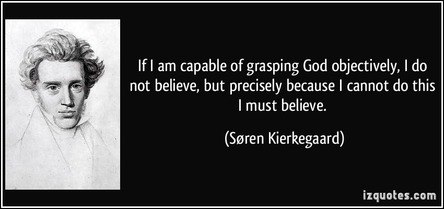
LOL, yep it's no secret I'm highly critical of the Fundies. In many ways religion needs a new paradigm as the sciences and humanities have uncovered a lot since the Book was first published if you will. The fundies are caught up in the old paradigm of dichotomizing their apologetic's too much. As Kierkegaard said there is danger with too much either/or. And if you don't know something, just say you don't know; don't let your ego get in the way! LOL -
Adam Eve and the unjust punishment
Your point with respect to the fundamentalist view is well taken. But that's problematic and the source of religious wars and/or extremism.
Why couldn't the interpretation be more Existential. Meaning the tree of knowledge being representative of the human condition which includes simple finitude/lack of perfect wisdom and temporal existence? It makes no sense to punish volitional existent beings for no reason.
It makes better sense for humans to recognize their finitude and seek Revelation in this case through Christianity.
Unlike the Fundy's, as a Christian Existentialist I do not I think the Bible is a 'perfect book' yet I do not throw the baby out with the bath water either. -
Adam Eve and the unjust punishment
GCB, I don't want to mis-read some of the banter. Taking it purely from face value, are you saying that it's prudent to have eatin from the tree of knowledge in order to gain wisdom and the like, or are you saying ignorance is bliss? -
Adam Eve and the unjust punishment
I agree with your notion of self-awareness for sure! It could almost be substituted metaphorically: the tree of self-awareness (self-consciousness & conscience).
One strange question relates to nakedness though. The author/interpretation could be extended to mean or represent nakedness as being equal to unawareness, yet if one were to take it literally, then why use the term naked?
Accordingly, we so find ourselves embarrassed or shameful by actually being naked [me, not so much] in public, but do we really understand why? While it is true, young children can be on a beach or by a pool naked, yet at some point we decide to make them either aware or they naturally become self aware that it is bad.
Of course there are other significant impacts relative to psychology/self-esteem (and to a lesser degree philosophy) which all seem mysteriously contradictory. Maybe I need to re-visit my inner Sigmund Freud... -
Adam Eve and the unjust punishment
Your interpretation brings to mind two thoughts; one being fear based, and another relating to self awareness of having wisdom or knowledge.
Consider a child who is naïve about many things. Consider that naivety in the face of the concept 'what he doesn't know won't hurt him' paradigm (or as adults).
It could follow that with knowledge comes pain. That with awareness comes emotional pain. (Not to mention what other's have said about the interpretation of our temporal existence; finitude, mortality and death-physical pain sort-a-speak.)
And so how that relates to the concept of fear based behavior is interesting. If we are to fear reverence (God), how do we develop that fear? I'm thinking that as the OP suggested earlier, that somehow awareness of wisdom or knowledge in and of itself imparts or results in a sense of fear too. Otherwise we are just naïve and go about our business care free. The tree of knowledge then becomes a bitter sweet concept viz. the joy that wisdom imparts, but the pain it brings about accordingly.
I think some other's have alluded to that as well... -
Can something exist by itself?
Awesome analysis I must say (along with the other contributions)!
I'll add to the mix of things : Mathematical Realism v. Idealism.
The question is, does math exist by itself where it is discovered from time to time by us, or did we create it?
Thus:
"The question has engendered two positions: mathematical realism, which states that math exists whether we do or not, and that there is math out there we don’t know yet, and maybe never can. This position may require a degree of faith, since, “unlike all of the other sciences, math lacks an empirical component.” You can’t physically observe it happening. Anti-realists, on the other hand, argue that math is a language, a fiction, a “rigorous aesthetic” that allows us to model regularities in the universe that don’t objectively exist. This seems like the kind of relativism that tends to piss off scientists. But no one can refute either idea... yet. The video above, from PBS’s Idea Channel, asks us to consider the various dimensions of this fascinating and irresolvable question." -
Adam Eve and the unjust punishment
Unfortunately no one person can answer the question as to why we are barred from perfect wisdom here. (I wish I could!) Accordingly, from an Existential point of view:
Ecclesiastes 8 English Standard Version (ESV)
8 Who is like the wise?
And who knows the interpretation of a thing?
A man's wisdom makes his face shine,
and the hardness of his face is changed
The interpretation there could be in spite of that said, we must have hope and engage with a smile. What are our choices otherwise?
As far as the 'dangers' of seeking perfection as you say; from a pathological point of view:
•As a person you are not okay as you are.
•No matter what you achieve, the feelings of satisfaction are temporary. There is always more to do, be, accomplish.
•Things are either black or white- no vaguely defined area of in between or close enough. Things in your life are either right or wrong, good or bad success or failure
•You believe that only by making everything perfect on the outside will you feel peace and serenity on the inside.
•If you continually achieve, acquire and look good doing it, you will be successful and happy.
•When things go wrong or you do not achieve at a certain level, you have failed.
•Effort and intention are not enough. Results must be productive and successful. Focus is on product, not process.
•You are extremely competitive about almost everything.
•You feel secretly judgmental of people who fall short of perfection.
•You imagine others admire and value you only for your high level of achievement and production.
Pragmatically or ethically speaking, I will say enjoy a bit of heaven everyday and incorporate moderation where possible. When a mathematician computes perfectly then returns to the ordinary life of striving, we too can engage in moments of wisdom, joy and resulting pleasure by focusing on good rather than bad (evil). We are capable of having Maslonian peak experiences that make the 'tree of life' worth living. -
Adam Eve and the unjust punishment
High marks to you my friend!! I could not agree more with your analysis! I wish the fundamentalist's would take heed!!!!!
Now let me go and try to answer Mad Fool's great questions.... -
How Do You Do Science Without Free Will?
I'm happy to learn you're seeing a little of that now. I think the salient point to be made is that those characteristics of human nature are unique. Similarly, to answer your concern about whether your life depended on it, I doubt you would spend time working out mathematical formulas,/theories if you were caught up in that.
And oddly enough, the ability to perform mathematics is also unique to us as humans too. Not only does it not confer any biological advantages, the knowledge of mathematical formulas (laws of gravity) are not exclusive to or required for eluding falling objects and avoiding danger.
In summary, my point is that we are unique creatures indeed. It begs the question of why we have these abilities if survival in the jungle didn't require it (?). -
How Do You Do Science Without Free Will?
I'm not exactly sure, are you wondering now?
Clue: physical science theories' always use synthetic propositions because they make statements about the facts of nature that can be tested. In layman's terms, isn't that a sense of wonderment? -
Emphasizing the Connection Perspective
Ok no worries. You came across as if there were no mysteries or using your words "no hard problems" associated with our consciousness. I just wanted you to support your belief. -
Emphasizing the Connection Perspective
LOL! Ok I'll offer two different examples/ propositions viz. our consciousness and maybe you'll be able to answer them:
The ball is red and the ball is green. Is that logically impossible?
Love is an objective truth. Is that a true statement?
This statement is a lie. Is that true or false? -
Adam Eve and the unjust punishment
Great question, but a vexing problem nonetheless (aka: the problem with evil).
I take a different view. My interpretation is that the tree of knowledge is an allegory/extended metaphor over fact that we are barred from perfect wisdom here. Evil/sin= lack of perfection.
I don't think of it as an Ontological evil being. Instead I think of it in other metaphorical ways. For instance, like an Aristotelian maxim of moderation, the 'better choices' you can make in your life, the more likely you won't suffer bad consequences. Or like the law of attraction theory; you reap what you sow. You can choose to do good or bad and you suffer or benefit accordingly. (Or even being barred from the 'perfect laws' of the universe.)
And so I think the interpretation is awareness of the aforementioned temporal nature that we have, including how volitional existence effects our happiness. -
Rhetorical Questions aren't questions at all. How stupid is that?
Interesting question (no pun intended)!
I can think of it this way. Rhetorical questions are kind of like being passive aggressive. All in a nice way off course.
Sometimes you can't be too direct with someone for fear they may get offended about a sensitive topic. So you say the same thing passively, yet still get your point across. Then when it comes to rhetorical questions, you can always preface or qualify the question by saying..'.this is not a rhetorical question intended to insult you however my concern is that why can't you see…...' That sounds like what you did right? -
How Do You Do Science Without Free Will?
I think Mmm is right, me saying God caused the big bang would be synthetic a priori. Nevertheless, guess what....that's why we have natural sciences that objectively measures phenomena, along with those important assumptions no less ( synthetic propositions are required to do natural science) !!
3017amen
Start FollowingSend a Message
- Other sites we like
- Social media
- Terms of Service
- Sign In
- Created with PlushForums
- © 2026 The Philosophy Forum