
-
What is real? How do we know what is real?
Not likely.I imagine you’re unlikely to be a Rorty fan — Tom Storm
I rather think his influence will outweigh your heart beat.I like my chances against Rorty since I still have a heart beat — Count Timothy von Icarus
Weighing in on "But there are either facts about what is "truly more useful" or there aren't" is a good move. I was going to point out that this again presumes a merely binary logic, but your response covers that. -
What is real? How do we know what is real?
Sometimes it is better to go with a clear stipulation than to muddle around in ambiguity.Yes, that the one sentence explanation of essences you've offered is metaphysically insubstantial — Count Timothy von Icarus
If what you mean by "one sentence explanation of essences you've offered is metaphysically insubstantial" is that it doesn't lead to the confusion of forms or triviality of what makes it what it is, then I will take that as an advantage to the stipulation.
And it doesn't presume nominalism.
You're not keen on taking up any of the seven counterpoints I made? Good, that'll save time. -
Demonstrating Intelligent Design from the Principle of Sufficient ReasonNo — Relativist
Ok. Then we'll leave it there. Seems you haven't followed what I wrote anyway, so I'll cut my losses. -
What is real? How do we know what is real?Let's emphasis what is being argued. It's is not that there cannot be one monolithic Explanation of Everything, one explanation that encompass in a consistent binary logic everything we know from physics and biology through to love and relationships.
We might be able to produce such a system. But we do not have such a system now. Nothing like it. And there are reasons to think it pretty unlikely that knowledge could be presented in this way without loosing quite a bit.
What is being argued is the lesser point, that we might do well not to assume that there is such an Explanation of Everything, even if we don't know what it is.
This seemed to go missing in our earlier discussion, Tim, about Logical Nihilism.
FIrst, some comments on a few specific points.
Here the principle of noncontradiction is being used as a wedge. But making use of non-contradiction is already presuming one logical system over others. Non-contradiction does not apply, or is used quite differently, in paraconsistent logic, relevance logic, intuitionistic logic and quantum logic, for starters. Perhps your argument holds, and if we presume PNC then there must be One True Explanation Of Everything (the caps are indicative of a proper name - that this is an individual). But to presume only classical logic is to beg the question. It is to presume what is being doubted. As is the shallow response seen before - I thin form Leon rather than you - that these are not real logics; it presumes what is at questions - that there is only one real logic.So if "One Truth" (I guess I will start capitalizing it too) is "unhelpful," does that mean we affirm mutually contradictory truths based on what is "useful" at the time? — Count Timothy von Icarus
The very existence of these non-classical systems shows that rational discourse can persist without universal adherence to PNC.
A better point is your "Orwellian Nightmare":
Quite so. And this is an excellent reason to keep a close eye on those power relations, and to foster the sort of society in which "might makes right" is counterbalanced by other voices, by compassion, humility, and fallibilism. You know, those basic liberal virtues. How much worse would a world be in which only the One True Explanation Of Everything was acceptable, uncriticised?As I mentioned earlier, a difficulty with social "usefulness" being the ground of truth is that usefulness is itself shaped by current power relations. — Count Timothy von Icarus
Pluralists can accept many truths within different practices - physics, literature, religion, without affirming logical contradictions. But this doesn’t mean that "2+2=5" and "2+2=4" are both true. Pluralism has limits, governed by coherence, utility, and discursive standards.
I think this a much more wholesome response than supposing that some amongst us have access to the One True Explanation and the One True Logic.
seems to be thinking along similar lines. Thanks, Tom. I wonder who else agrees? -
The Forms
Take a look at the contents of the SEP article on Metaphysics. It contains two sections:
2. The Problems of Metaphysics: the “Old” Metaphysics
2.1 Being As Such, First Causes, Unchanging Things
2.2 Categories of Being and Universals
2.3 Substance
and
3. The Problems of Metaphysics: the “New” Metaphysics
3.1 Modality
3.2 Space and Time
3.3 Persistence and Constitution
3.4 Causation, Freedom and Determinism
3.5 The Mental and Physical
3.6 Social Metaphysics
It does this becasue what metaphysics is changed somewhat dramatically with the advent of both modern physics and modal logic.
To restrict oneself to the "old" metaphysics is to do oneself an injustice. -
The Formscan you sketch-out --- informally --- what "formalized" Modal Logic has to do with Platonic Forms — Gnomon
Modal logic became involved in this thread as soon as it was supposed that things have essences, and we asked what an essence is.
There is a clear way of talking about essences, as those properties had by an object in every possible world in which it exists. We can deal with the consequences of essences using this stipulation.
There are other ways that folk use "essence", and very often they choose not to define it in anything like as clear a way as the above. Now that is fine, so far as it goes. It leaves open the question of what an essence is, and also the question of how the way they are using "essence" fits in with the clear stipulation given by modal logic.
Now since the stipulation of essence as "those properties had by an object in every possible world in which it exists" is consistent with a consistent modal logic, we know that it is consistent.
We can't say that about other proffered definitions.
Unless we can compare them to the modal definition.
But to do that, one has to first have a grasp of modal logic.
So one issue here is, if platonic forms are the "essence" of each... thing..., is it just that the platonic forms set out or embody the properties held by that thing in every possible world?
If so then we can drop the theory of forms and get one with this conversation in modal terms.
and if not, then what more is it that forms contribute to essence?
And it has proves difficult to get a clean answer to this question. -
Demonstrating Intelligent Design from the Principle of Sufficient Reason, is it worth my time to reply? There's a lot in your post, which I appreciate, but as a result there are multiple issues to discuss. Is there a point in my proceeding? Are you open to attempting to express your ideas in a more standard form? Let's look at just the first point.
You introduce "autonomous" and "dependent". Perhaps we can get more clarity by sticking to truth functional operatives.1. An OG exists autonomously. This means without dependencies of any kind (causal or otherwise). If it had such a dependency it could not be the OG — Relativist
So you have here something like that nothing implies an OG; that nothing else has to be true in order for an OG to be true. That is, for any fact p, both p and ~p imply the OG.
This gives us (p v ~p)⊃OG. That is, regardless of what other states of affairs hold, OG will be true. Stated otherwise, OG is a necessary truth. So you do not need to show that OG is necessary, since you have assumed it. ☐OG. See the tree proof.
All that just for Point one.
Now look at point two.
2. For an object, X, to be ontologically contingent, there must be some C that accounts for X, but C could have accounted for ~X. Example: assume quantum collapse is not determinate, and C is a quantum collapse in which X emerged. X is contingent because C could have collapsed to Y. I express this as:
C accounts for (X or Y), or more generally: C accounts for (X or ~X). — Relativist
Here you have C⊃(X v ~X). Now (X v ~X) is a tautology, and so necessarily true. If the consequent of an implication is true, then the whole implication is true. That is, ☐( X v ~X), and so ☐(C⊃(X v ~X)).
So again you do not need to demonstrate that C⊃(X v ~X) is necessary. You have assumed it. But you cannot conclude that C is necessary. Nor that it is contingent. See the tree proof.
Take care here. Contingency is not the same as possibility. An object that is not contingent may also be impossible.3. If an object is not contingent (as identified in #2) then it is necessary. — Relativist
Here we run into the problem of what it is for A to cause B. IF it's just A⊃B, then all sorts of things we would not usually call causes will count as causes. So "cause " is not often understood as "implies".4. Compare this to the outcome of a deterministic law of nature: the law: C causes X. Because it's deterministic, it means: C necessarily causes X. If C is contingent, then there X inherits this contingency (whatever accounts for the contingency of C, also accounts for the contingency of X). — Relativist
We do not know if C is necessary or contingent or impossible.
So you cannot get to your point five.
But that doesn't matter, since you assumed that OG is necessary at step one.5. An OG is not contingent because there is no C that accounts for the OC (that would entail a dependency - see#1). Therefore it exists necessarily. — Relativist
What this shows is that you haven't proved ☐OG, but assumed it.
Now, was that worth my time? -
Demonstrating Intelligent Design from the Principle of Sufficient ReasonYep.
I'd caution agains attempting to show that there is an inconsistency in Meta's logic. He may simple add ad hoc hypotheses in order to escape.
But also, his premise, p(x)⊃□p(x) does not lead to an inconsistency within the logic.
it does lead to modal collapse. There can be no modal statements in such as system.
p(x)⊃□p(x) says that nothing can be other than it is. It describes a world in which there is no change.
Also, p(x)⊃□p(x) ↔︎□p(x)⊃p(x), so all truths are necessary truths. All truths in this system are necessary, and all falsehoods are impossible.
There are no counterfactuals, no contingency and as a result, there can be no free will. Given that maintaining free will was one of the reasons Meta gave for adopting this system, that's a big problem for him. Look out for the ad hoc reply.
So his system is consistent, but useless for any sort of modal reasoning, and leads directly to fatalism. -
Demonstrating Intelligent Design from the Principle of Sufficient Reason, , you have been continuing your discussion here, independently of thel parallel discussion of modality. I'd like to bring the two back together.
If we presume the accepted modal logics with a possible worlds interpretation, what can we say about ontological grounding and the principle of sufficient reason?
First let's look at the idea of ontological grounding. What we want is for an explanation as to why the world is as it is, and not some other way. If something could have been otherwise, it cannot explain why something is necessarily the case. So any ontological grounding must be necessary. But then it would be the same in every possible world. And in that case, it could not explain why this world is as it is.
Hence any explanation strong enough to constitute an ontological grounding must thereby fail to explain why the world is as it is.
Next, the principle of sufficient reason. Much the same argument holds here. Either the sufficient reasons are necessary but too weak to explain why the actual world is as it is; or the reasons explain why the world is as it is, but are contingent, and so are insufficient to explain why out of all the possible worlds, this is the actual world. -
What is real? How do we know what is real?Yep. A ways back. Perhaps he hasn't changed his mind.
I'd take a different path, more in line with looking at use, but taking on some of Searle's other work on status functions and collective intent. -
What is real? How do we know what is real?Well, perhaps recent experience has led me to appreciate Way's integrity, at least compared to others hereabouts. Might leave it at that.
-
What is real? How do we know what is real?I'll pay that.
On the proviso that their disagreement is coherent and well defended, and that they talk to the criticisms presented. As indeed, you do.
Others are not so obliging. -
What is real? How do we know what is real?
No. But I did.I didn't say 'we' — Wayfarer
The result? You can happily indulge in the idiosyncratic use of "philosophical perspective" that you envision, but others need not agree. -
What is real? How do we know what is real?it still leaves me wondering whether we can coherently say something is water in some logically possible world if we were to remove its defining characteristics. — Janus
In some possible world, water has none of the characteristics it has in our world.
But we know that water is H₂O, so that characteristic could not be removed and water still be water. But this is a metaphysical impossibility, not a logical impossibility. Logically,, assuming rigid designation, we can posit a possible world in which water has none of the characteristics it has in the actual world.
But that would be doing something a bit different. It is logically possible to describe a world in which a substance that is not H₂O is called ‘water’ and has none of the characteristics of actual water. But in doing so, we are no longer talking about water, strictly speaking, under rigid designation.
That is, if we call a substance that has nothing in common with water, "water", perhaps all we are doing is misusing the word. -
What is real? How do we know what is real?Or, a philosophical perspective that you can't fathom. — Wayfarer
If we can't fathom it, then we have no basis on which to think it a philosophical perspective... :wink: -
What is real? How do we know what is real?A nice summation. — Janus
Thanks.
So we have a group of distinct, though not unrelated items: actual, real, existing, being...
Possible worlds give us a neat way to talk about what is actual. In the space of possible worlds there is one that is of particular interest, because it is the one in which we happen to find ourselves. But of course, actual is an indexical term, like "here" or "now". It picks out the world of the speaker in a given context. For someone in another possible world, actual refers to their world.
Propositional calculus gives us a neat way to deal with "exists" using quantification. " to be is to be the value of a bound variable" and so on. "Unicorns have horns" vs. "There exists an x such that x is a unicorn and x has a horn." There are not actual Unicorns, yet unicorns have horns. The question "Do unicorns exist?" drops by the wayside.
An account of what is "real" was given earlier in this thread. It's not real, it's counterfeit; it's not real, it's an illusion; and so on. Unicorns are not real, they are mythical.
Numbers exist, since we can quantify over them. U(x)(x+0=x).
Are they actual? well, there are numbers of things in each possible world, even if that number is zero. They do not seem to be within possible worlds so much as a way of talking about the stuff in possible worlds. Like the law of noncontradiction, they are part of the framework in which possible and actual are set out.
Are they real? Some of them. Others are imaginary. -
What is real? How do we know what is real?Yep. Some folk - @Wayfarer might not mind me including him here - make a leap of faith to some spiritual position or other. To my eye it's unjustified, and not needed.
We can just get on with it. -
What is real? How do we know what is real?
This is the question of reference? How is it that "water" refers to water, and nothing else?The question I have right now (which may be resolved after reading the article) is this: if we want to say there is a logically possible world in which water is not H2O, on what other basis could it be said that it would count as being water? — Janus
The big change in thinking that was consequent on Possible World Semantics was the rejection of the previously ubiquitous description theories of reference. These held that a name refers to an individual in virtue of some description that serves to pick out that individual and no other. This approach was found to be indefensible in the face of modal interpretations, because whatever description was offered, it had to work even in those possible worlds in which the description failed to pick out the relevant individual.
And example might help here. Supose that all we know of Thales is that he was from Miletus and claimed that every thing was water. Then on the description theory, "Thales" refers to whomever is the philosopher from Miletus who believed all was water.
But supose that in some possible world, Thales went into coopering, making barrels of all sorts, and never gave a thought to ontology. But some other bloke, also from Miletus, happened to think that everything was made of water.
Then, by the description theory, "Thales" would not refer to Thales, but this other bloke.
There are numerous other examples. The upshot is that most philosophers who care now reject description theories.
So there is no basis for such reference, and instead there is talk of a chain from our use of "Thales" to refer to Thales, back through time to when Thales said such odd things, but not dependent on what he said or any specific facts about him. You and I refer to Thales becasue the people we learned about him referred to Thales; and they in turn referred to Thales because the people they learned from did so; and so on back to when Thales was a lad. "Because", hence this is called the "casual" theory of reference.
Now there are subtleties involving reference to kinds, such as water, compared with the individual in the example given, but the principle is much the same. We can talk about water because we learned what water is from our teachers, and they in turn from theirs. And so the reference to "water" is independent of any description, including finding out that water is H₂O.
On this account, the basis is a casual chain stretching back through time rather than any particular attribute of water.
Something like that. -
Disambiguating the concept of gender...the issues of locker rooms... — Jeremy Murray
Yes! Poor locker room design is the issue. Why do we have locker rooms that force us to differentiate on the basis of our genitalia? If the issue is modesty, why not have individual cubicles? -
Disambiguating the concept of gendernot to lear — Banno
Same question: puzzling that other folk should have a say in which loo someone chooses to use at all.
I blame urinals. They are the reason the cue is so much shorter for the men's, but one needs the appropriate equipment to use them.
Ban urinals, I say! More space for cubicles, no need to differentiate rooms on the basis of the contents of folk's underpants.
And teach people not to leer. -
What is real? How do we know what is real?I went back over the thread in order to work out why we are talking about modal logic when the topic is "What is real?".
There were posts from many folk: , , , , the usual suspects.
I found this:
Perhaps the very urge to ask “why is there something rather than nothing?” is a kind of metaphysical craving that misunderstands the role of explanation. Explanations work within the world—given that things exist, why does this or that happen?—but they break down when we try to apply them to existence as such. The impulse isn't deep; it’s a confusion of category. — Banno
and then this:
...if any role for intuition and understanding is ruled out and reason is 100% discursive, you have an infinite possibility space of possible "games" and no reason to choose one in favor of any other. The authority of reason itself rests on intuition and understanding. — Count Timothy von Icarus
Two examples amongst many, but they maybe give an indication of the tension that has kept this thread going . So I'll restate my line of thinking here. The question is "What is real?"; and the answer suggested is that "real" is a term that depends on it's contrary in order to achieve meaning - it's not real, it's counterfeit; it's not real, it's an illusion; and so on. The response is something like "No, I don't mean that, I mean what is really real, in an absolute sense". And the reply is that it is not clear that "what is really real" makes any sense at all, and if it does, then it's sense needs explaining.
We do have an "infinite possibility space of possible games", and we can choose whichever suits our purposes.
Note the "we". Not "I". It's about a conversation, not about what you do in private.
Asking "What is really real" supposes that there is One True Answer, rather than a whole bunch of different answers, dependent on circumstance and intent and other things. There doesn't seem to be a good reason to hold such a monolithic view. -
Disambiguating the concept of genderDefinitely simpler. — frank
Cost a lot less?
Taken up less time?
Been less of an embuggerance?
Doesn't it seem odd to you that in "our" culture, issues of manners are taken to the highest court?
Why this lavish interest in the contents of other people's underwear? -
Disambiguating the concept of genderDon't you find it unsettling that this issue needed to go to your highest court to be settled?
Might have been simpler if folk just butted out of other people's business, don't you think? -
The Forms
yet...I learn best by trial & error, and question & answer, and self-teaching methods. — Gnomon
but I'm not familiar with Kripke, and Modal Logic is over my head. Aristotelian Logic is more like common sense (the actual world) to me. — Gnomon
You said that you are not willing to put any effort into understanding modal logic.
So...
...misunderstands modal logic, but in order to see why, one needs first to understand modal logic. And you have said that you are unwilling to do so.Like Multiverse and Many Worlds models of abstractly logical possibilities, his Modal Reality does not seem to be in danger of empirical falsification or actual contradiction — Gnomon
Ok. Cheers. -
Disambiguating the concept of gender, I remain puzzled as to why other folk should have a say in which loo someone chooses to use at all.
The reasons given so far are peripheral. -
Demonstrating Intelligent Design from the Principle of Sufficient ReasonThe point is that nothing is the same in different worlds. — J
...on the counterpart interpretation. If one accepts rigid designation, then there are things that are the very same in different possible worlds. Which is the advantage of Kripke over Lewis - when we ask "what if this post had been about the weather?" we are talking about this post, in the actual world and in another possible world. -
Demonstrating Intelligent Design from the Principle of Sufficient ReasonHanover clearly agreed with me, — Metaphysician Undercover
Not so much, it seems.
But also, if what I have said erroneous, as you supose, then they are not my errors, since all I have done here is present the Kripkean view that is the established interpretation of modal utterances.
So my my view, but that agreed to by the body of people who have looked into such issues.
Some of them even read books about logic, unlike you. -
What is real? How do we know what is real?We don't know where, say, that the value of G (6.6743 x 10^-11 m³ kg⁻¹ s⁻²) may have been slightly different, sits in the diagram above - a logical possibility to be sure; but not logically necessary, one presumes? So Metaphysically necessary or physically necessary? I don't see how either follows.
The appropriate response is that we lack sufficient information. -
What is real? How do we know what is real?The fact that it is logically possible that those ratios and standards might be different only goes to show the emptiness of pure logic. — Wayfarer
Why? -
Australian politicsI wonder how much more rain will be needed until the Nats and their supporters realise there is a climate problem.
-
What is faith
I never though otherwise. I wasn't aware that this was a potential bone of contention.I can’t seem to make you believe that I think there are non-theological ways to understand and act on, faith. — Fire Ologist
Simply becasue that is the argument I was pursuing....why is it that everything else you bring up about faith has to do with fathers murdering their children and fools acting without evidence or reason? — Fire Ologist
I'm not going over it again. Good to see you struggling with the conceptualisation, though. Keep going.So - how is faith “neither good nor bad” as you said before? — Fire Ologist
There's a lot in this. An ideology is another example of a belief that is not to be subjected to scrutiny.Right, I wouldn't say it's always religion, but it's always ideology, which includes religion. Ideologies are like religions in that they are faith, not evidence, based. — Janus
That might be down to the what your question was phrased, since Janus/ answer seemed quite relevant.Don’t you see how none of what you just said addresses what I asked? — Fire Ologist
Pretty fucking rude. So atheists are none of them "moms and dads, loving their kids"?Religious people, generally, are softies, to the core. Lots of moms and dads, loving their kids. Not many thoughts like you are all having. — Fire Ologist -
What is real? How do we know what is real?Imagining impossible worlds — Janus
Might be worth a new thread. Recently, in another thread, @Hanover drew attention to a SEP article on the topic. But as many folk - present company excepted - are having trouble with possible worlds, impossible worlds might be too much.
Yep. But we are going to have to introduce more terms. There's a hierarchy of possibilities:I have no doubt a physically impossible world could be imagined — Janus
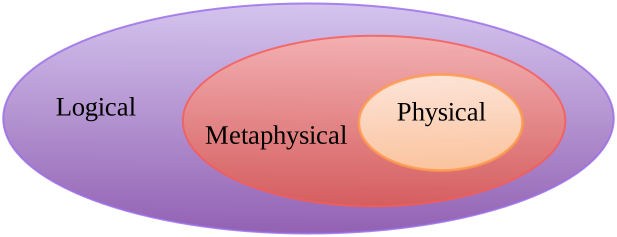
So physical possibilities are metaphysically and logically possible. Metaphysical possibilities include all physical possibilities and a few other possibilities, and are all logically possible. The space outside the logical possible is that of the logically impossible.
Is there a possible world in which water is not H2O? — Janus
There's a logically possible world in which water ≠ H₂O. But there is not a metaphysically or physically possible world in which water ≠ H₂O. That water=H₂O is a metaphysical fact, not a logical fact. It should be apparent that once we agree that water=H₂O, we rule out the possibility that water ≠ H₂O.
In order to consider worlds in which water is not H₂O, you have to reject ☐(water=H₂O), or reject the rigidity of those terms. That is, you are working outside the circle of metaphysically possible words.
Formally, this sort of thing is dealt with by access relations. So you from logically possible worlds we can get to metaphysically possible worlds, and from there to physically possible worlds, But not so in the other direction.
When you imagine a world with round squares, you are imaging something outside the circle of hat is logically possible. Sure, you can't bring to mind an image of such a thing, but we might be able to world out some of the consequences that would follow from there bing a round square, if we had at hand a suitable counterpossible logic; if there is such a thing.
The Stanford article from which I stole the image has more on this sort of thing. It takes tome to grasp these ideas, however the result is a consistent picture of nested possibilities and impossibilities. -
Australian politics
Keeping us on the main page highlighted the calibre of the brilliant folk on this thread, no doubt leading many casual visitors to become members.
But it is comfortable in the Lounge, if a bit out of the spotlight. -
Australian politicsThe conditions and policy directions accepted in these negotiations may tell us more about which scenario will out.
-
Australian politicsWe've been moved to the Lounge. Less people, more comfortable chairs?
Apparently the Libs and Nats are back together again already.
Until next week? -
What is faithThat is a misrepresentation of what I have said. I have pointed out that religious ideas can lead to evil acts. I've argued that theology deriving from Scripture has no place in a philosophy forum. I have questioned the moral standing of those who believe in eternal damnation. But I have not argued that all religious folk are morally decrepit.
-
What is faith
Yes. And this interpretation stands. Indeed, the two interpretations are not obviously mutually exclusive.It has such poor resolve I find — Hanover
You might also find intolerance of atheism hereabouts, if you look. It won't be hard to find.
Banno

Start FollowingSend a Message
- Other sites we like
- Social media
- Terms of Service
- Sign In
- Created with PlushForums
- © 2026 The Philosophy Forum