
-
On eternal oblivion
Once one is dead, one is no longer a player, as it were, and so inevitably things cannot go in one's favour. The particular interests that make you who you are will inevitably dissipate in your absence; the papers you wrote will no longer be cited, the events in the lives of your dozens or hundreds of descendants will not have relevance to you, and what belonged to you will belong to others or end up in landfill.I would not much like what seems likely to come after — Janus
That's what it is to be a ghost. -
Donald Trump (All General Trump Conversations Here)An excellent analysis by Alan Kohler: To make America great, Donald Trump is undoing its greatness as global stock markets fall
In the name of making America great again, Trump is undoing the very things that made America great. -
On eternal oblivionI quite agree.
This is a different topic to "eternal oblivion", which is not something to be feared. One might not be anxious about being dead, so much as about how one gets there.
And then there is the considerable discussion about whether being dead amounts to a bad thing, in that it deprives one of ongoing experiences. I'd like to know what happens next, although I expect I would not much like it. -
Depression and 'Doom and Gloom' Thinking vs Positivity: What is 'Self-fulfilling Prophesy' in Life?
Have a read of Confirmable and Influential Metaphysics by J. W. N. Watkins, or see the old thread.
Myths that are "haunted universe doctrines", are an inevitable influence on our lives, their logical structure preventing their being either confirmed or falsified. "although these doctrines cannot be proved or refuted they can be criticised and weighed". -
Meinong rejection of Existence being Prior to PredicationNice. Like Ross Ryan.
But he is not Pegasus. Pegasus is mythical, so any real creature claiming to be Pegasus is a con. -
The world as ideas and matter in Ideal RealismWhat you are describing appears to be a novice version of transcendental idealism.
is right to ask you how it can explain both the consistency of your perceptions, and how it is that we overwhelmingly agree as to how things are. -
On the existence of options in a deterministic worldThis realization is due to neural processes in the brain. — MoK
Not quite. That realisation is neural processes in the brain. It is not seperate from yet caused by those neural processes.
And a babe's brain is pre-wired to recognise faces and areola. -
Thoughts on DeterminismPart of the problem here is that it remains very unclear what "determinism" might mean. Indeed, the presumption that physics is deterministic is almost certainly mistaken.
Further, you do not know what you will do next. -
The United States of America is not in the BibleA brute fact is a fact you can't explain with deeper more fundamental facts. — flannel jesus
It would be better to say that a brute fact does not have any further explanation.
it's not just that the explanation is not available to us, but that things just are that way.
Don't worry - there was more involved in banning Sandwich. You are safe. -
On eternal oblivionAs Wittgenstein pointed out, being dead is not something that will happen to you; when you are dead, there is no longer a "you". Death is no more a part of your life than the space two inches past a ruler is part of the ruler.
-
Kicking and DreamingDo we in fact know that the dream precedes, or grounds, the kicking? Might it not be the case that my legs kick for some independent, strictly neurological reason, which then causes me to dream about kicking, in the same way that a full bladder causes me to dream about urination? — J
Daniel Dennett proposed that we don't dream, that we do not have an experience over a period of time while asleep, but that rather a memory of dreaming is confabulated on waking. Dreams are not lived but merely recalled as if they had been.
Not likely, given other empirical evidence, but curious. -
The United States of America is not in the BibleOne can still interpret that his/her country somehow appears in the Bible. — Zebeden
"Confabulate" would be a better term. -
Bannings
He communicated to me several papers, published in English and Spanish, mostly on quantification and individuation, which he was able to defend at length. He is a competent philosopher.
Unlike others hereabouts.
But his banning was perhaps inevitable. A shame. -
Quine: Reference and Modality"To be a bound variable in modal logic is to entail a choice of some necessary predicate(s)" — J
This seems to presume a fixed domain - that the very same things exist in every possible world. If that is not presumed, then there might be bound variables that belong to possible but not actual individuals. ∃x◊P(x) might be true in some possible world, yet not in others. In which case it's not true that the bound variable x is necessarily P. There are possible worlds in which nothing is P. -
Quine: Reference and ModalityWater just is the stuff made out of H₂O. The two terms "pick out" the very same stuff. There's nothing ontologically or epistemologically puzzling in our using two words to refer to the same thing, is there?
And of course we might have done otherwise. We might have used the word "gold" for a group of different metals, but as it turns out we use it only for samples of that metal which has 79 protons in its nucleus. Did we discover, or did we stipulate, that it is "gold" that has an atomic number of 79? When scientific knowledge advances, are we changing the rules of our language, or are we uncovering facts that were already true? - but these are not mutually exclusive. We might arguably be doing both. In discovering that gold has 79 protons in its nucleus, we thereby changed the way we talk about gold.
What introduces necessity or possibility is the way the domain is interpreted as much as which properties are involved. -
Quine: Reference and ModalityMore on the conflation of necessity and analyticity:
but this is wrong. It should be:"Attributes, as remarked earlier, are individuated by this principle: two open sentences which determine the same class do not determine the same attribute unless they are analytically equivalent."
Attributes, as remarked earlier, are individuated by this principle: two open sentences which determine the same class do not determine the same attribute unless they are necessarily equivalent. -
Ontology of TimeA field of study is not a mathematical or physical field, yes. Nor is it a field of wheat.
In so far as
would pretend to a physical field, not an area of study or a paddock, it is muddled....the whole of existence is reducible to the patterns of excitation of the one universal field of subjectivity. — Wayfarer -
Quine: Reference and Modality
So this is a long argument setting out w "the only hope of sustaining quantified modal".
The page referred to just before your quote...
The Aristotelian notion of essence was the forerunner, no doubt, of the modern notion of intension or meaning. For Aristotle it was essential in men to be rational, accidental to be two-legged. But there is an important difference between this attitude and the doctrine of meaning. From the latter point of view it may indeed be conceded (if only for the sake of argument) that rationality is involved in the meaning of the word ‘man’ while two-leggedness is not; but two-leggedness may at the same time be viewed as involved in the meaning of ‘biped’ while rationality is not. Thus from the point of view of the doctrine of meaning it makes no sense to say of the actual individual, who is at once a man and a biped, that his rationality is essential and his two-leggedness accidental or vice versa. Things had essences. for Aristotle, but only linguistic forms lnave meanings. Meaning is what essence becomes when it is divorced from the object of reference and wedded to the word. — p.22
Quine's view of Aristotelian essentialism, it seems. So what is the "reversion to Aristotelian essentialism"? That some of the properties of a man are necessary, and some contingent.
What Smullyanis proposes (back a few paragraphs) is very close to Kripke's rigid designation. Quine would reject this on the grounds that some description must be associated with any proper name in order to "fix" it's referent. This wasn't rejected until Donnellan and Kripke's discussion of the topic, a few years later.
Quine's text is not helped by the juxtaposition of necessary and contingent, and the association of analyticity with necessity.
So let's be a bit pedantic and oppose necessity with possibility, and define these in terms of possible worlds, while also and distinctly opposing the analytic and the synthetic, such that the analytic is understood by definition while the synthetic is understood by checking out how things are in the world.
And as for contingency, let's leave it aside until we have a better foundation.
How's that looking?
is, then, what musty happen if modal logic is to avoid the issues with quantification that Quine raises - in this Quine is more or less correct, and the strategy Kripke adopts is pretty much the one Quine sets out - there are properties of things that are true of them in every possible world."must be seen..." — J
Whether these properties are "essential" is another question. -
Ontology of TimeMatter of fact, I've got one now. — Wayfarer
A hard-earned thirst?
Seems to me you are looking for a veneer of scientific credibility, which is odd. But in the end it's the bit where folk want, incoherently, to detail the ineffable, in this case the subjective. -
Ontology of Time
...for the whole of existence is reducible to the patterns of excitation of the one universal field of subjectivity. — Wayfarer
That's not an analogy. Not a metaphor. -
Australian politicsWe could explore natural disasters, like the closing of King Island Dairy. — Banno
King Island Dairy to continue after Saputo finds new owner for assets -
Ontology of Time"Morphogenetic fields" cause me some amusement because it suffers much the same issues as "Subjective field". Morphogenetic fields could not specify a value at every point in the space. It commenced with Gurwitsch attempting a mathematical analysis that did involve a vector field, but this fell apart, replaced by a model of differentiation involving gene expression and differentiation by transcription and growth factors - specific proteins.
But at least Gurwitsch understood what a field is. -
Quine: Reference and Modality↪Banno I like the bead illustration as a guide to intension/extension. — J
I'm please.
I chose it also in order to draw comparisons to PI§42 regarding simples. What is the simple here? What are the individuals? We treated the beads as the individuals. I left out the string entirely; the domain might have been set to {beads, string}. I might equally validly have treated the colours as individuals - that the domain was {blue, red}. What counts as an individual in the domain is stipulated.
No, you didn't. I had intended to come back to this. It needs a longer post delving into the context. Next post, maybe.I might have missed a response somewhere — J -
Ontology of Time
-
Ontology of Time
You are welcome to produce an alternative definition of "field" that does not invovle a value at every point in a space.Dogmatic? Me? — Wayfarer
But if you do, you will not be able to claim that your field is anything like an electric, gravitational or other physical field.
And your analogy or metaphor or whatever it is will thereby lose any validity. -
Ontology of TimeI find it odd that you are insisting on the silly scientism of explaining subjectivity in terms of fields.
An almost complete backflip. -
Ontology of TimeBalls.
Here's were you invited my comment:
Kastrup puts it much better than I could:
Under objective idealism, subjectivity is not individual or multiple, but unitary and universal: it’s the bottom level of reality, prior to spatiotemporal extension and consequent differentiation. The subjectivity in me is the same subjectivity in you. What differentiates us are merely the contents of this subjectivity as experienced by you, and by me. We differ only in experienced memories, perspectives and narratives of self, but not in the subjective field wherein all these memories, perspectives and narratives of self unfold as patterns of excitation; that is, as experiences.
As such, under objective idealism there is nothing outside subjectivity, for the whole of existence is reducible to the patterns of excitation of the one universal field of subjectivity. Therefore, all choices are determined by this one subject, as there are no agencies or forces external to it. Yet, all choices are indeed determined by the inherent, innate dispositions of the subject. In other words, all choices are determined by what subjectivity is.
— Bernardo Kastrup
@Banno — Wayfarer
To which I replied:
Dreadful stuff, seeing as you asked for my opinion. The phrases "unitary and universal" and "bottom level of reality" and "prior to spatiotemporal extension" ought set one's teeth on edge; they are vague to the point of incoherence. The magic hand wave of "The subjectivity in me is the same subjectivity in you" contradicts the very use of terms such as "subjective" from which it derives.
Wayfarer, you do not have my memories, nor I, yours. That's kinda what "subjective" is. It is not shared.
The science you castigate and beg to become more "subjective" functions exactly because it works to overcome subjectivity by building on what we do share.
This is what I tried to explain on our little walk. — Banno -
Ontology of TimeThe fundamental level of self-awareness that characterises beings. What would remain if you had complete amnesia and forgot who you were. — Wayfarer
Not a field. -
Ontology of TimeWell, I've presented a counter case to your notion of "field" for several pages now. If you have not followed that, there's not much more to be done.
Let's do it again. A field has a value at every point in the space it describes. That is what a field is.
Subjectivity does not have a value at every point in some space. Indeed, it is not the sort of thing that can have a value. Moreover, from what I can work out, Wayfarer and others agree with this.
Hence subjectivity is not a field. — Banno
Reply to that, if you would, instead of changing the topic. -
Ontology of TimeYour question is a nonsense. You want a shared subjectivity that is also private.
-
Ontology of Time...There is nothing left here, for the field to consist in. — Banno
You cannot know what the subjective "patterns of excitation" in someone else are, let alone they are the same as your own. -
Ontology of TimeThis bit:
is exactly wrong.The subjectivity in me is the same subjectivity in you. — Bernardo Kastrup
We differ in "experienced memories, perspectives and narratives of self"... so what is left that is shared? What are those "Patterns of excitation" that are not "experienced memories, perspectives and narratives of self" and which also do not have a value?We differ only in experienced memories, perspectives and narratives of self, but not in the subjective field wherein all these memories, perspectives and narratives of self unfold as patterns of excitation — Bernardo Kastrup
There is nothing left here, for the field to consist in. -
Ontology of TimeLet's do it again. A field has a value at every point in the space it describes. That is what a field is.
Subjectivity does not have a value at every point in some space. Indeed, it is not the sort of thing that can have a value. Moreover, from what I can work out, Wayfarer and others agree with this.
Hence subjectivity is not a field. -
Ontology of TimeYou limit "field" to "a physical quantity" — Metaphysician Undercover
No I. and not to "physical" but to "quantity". That's the definition of "field" in science and mathematics. -
Quine: Reference and ModalityMuch the same move is seen in Kripke's Identity and Necessity, where this lectern is necessarily made of wood. It's not that a lectern could not have been made of ice, but that by this lectern we only pick out the wooden one. Our language game is set up so that if we are talking about any lectern not made of wood, then we are not talking about this lectern.
-
Ontology of TimeSo far as explanations go, saying that something is an example of a field exactly becasue it does not meet the criteria for being a field is... odd.
-
Ontology of TimeSo your description of the "field of consciousness" is apt becasue it does not match the definition of "field"...
Others seem to think that this works. But you will have to forgive me if I continue to be sceptical. -
Quine: Reference and ModalityPart Four.
Quine reiterates his argument, further extending it to attributes. To be extensional, one ought be able to substitute equivalent terms without altering truth values, but Quine argues that this does not work in modal contexts. Hence for Quine modal contexts are "intensional".
One way to think about the distinction between intensional and extensional contexts is that a predicate in an extensional context refers to the very objects picked out, while in an intensional context the predicate refers to the attribute doing the picking...
Suppose this is our domain...
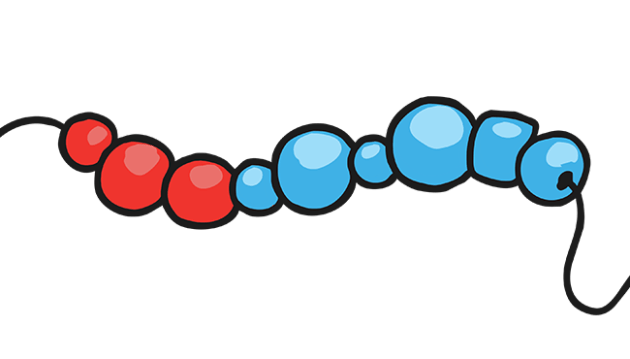
We can give the beads proper names by numbering them from left to right. The beads are 1,2,3, 4,5,6,7,8,9. Intensionally, the red beads are those for which "having the attribute red" is true. Extensionally, red = {1,2,3}. it just is those beads.
Quine takes the example
and the identity(39) The attribute of exceeding 9 = the attribute of exceeding 9
and constructs the falsities(24) The number of planets = 9
andThe attribute of exceeding the number of the planets = the attribute of exceeding 9
(40) (∃x)(the attribute of exceeding x = the attribute of exceeding 9)
Attributes, as remarked earlier, are individuated by this principle: two open sentences which determine the same class do not determine the same attribute unless they are analytically equivalent.
For those beads, that a bead has the attribute of being red is discovered by looking to see what colour the bead is. It is therefore not analytic, but synthetic. Being a member of {1.2.3} on the other hand, is analytic. Being red and being a member of {1,2,3} are not the very same.
Notice also {1} might have been blue. But it would still be a member of {1,2,3}.
For Quine, any attribute might have been otherwise, and so for Quine there are no essential properties. But every item in the domain is a bead; so while it is possible for 1 to have been blue, it is not possible for 1 not to be a bead and still be 1. 1 is necessarily a bead, and not not necessarily red. Being a bead is part of the (Aristotelian?) essence of 1, but being red is not.
Of course, Quine would point out that we arbitrarily limited our domain to beads. And he would be correct. What counts as an essential attribute is decided not by examining the beads, but in the linguistic act of setting up the domain. Essence, then, is an arbitrary part of the language game.
Banno

Start FollowingSend a Message
- Other sites we like
- Social media
- Terms of Service
- Sign In
- Created with PlushForums
- © 2026 The Philosophy Forum