
-
Is the real world fair and just?Ok. That's the pop understanding of "naturalistic fallacy".
I'm not enamoured with the description of "nature red in tooth and claw", with the emphasis on competition. I think it a culturally driven narrative. Studies of ecosystems also tell a story of cooperation. This is the bit of @apokrisis' account that perhaps has value.
The naturalistic fallacy in philosophy "is the claim that it is possible to define good in terms of natural entities, or properties". Saying that the good is what is pleasurable, or what makes the greatest number of folk happy, and so on.
Again, I'd analyses this in terms of direction of fit. Saying how things are - that they induce pleasure or happiness - is very different from saying how they ought to be. -
A Case for Moral Anti-realismDo (a) and (b) mean the same thing? — Michael
The linked paper sets out an account that shows how sometimes uttering "I promise to do this" is placing oneself under an obligation. They are not the same thing. -
Is the real world fair and just?
Hmm. I'm wondering what you think the naturalistic fallacy is. It is not an appeal to nature.While I don't want to invoke the naturalistic fallacy, it's hard for a human to look at nature and think that we inhabit a fair world. — Tom Storm
You probably agree, but I thought I'd check. -
Is the real world fair and just?
It's your thread, so your response is welcome.If he is an Immanentist regarding abstract concepts --- God being just the most common example --- any reference to something transcendent may be meaningless to him. — Gnomon
I would not describe myself as an "immaterialist". I've argued that what are sometimes called abstract concepts are better understood as institutional facts. They manifest our intentions, so to speak. The "our" here is important. And the issues involved are complex.
I think the issue you raised in the OP can best be thought of in terms of direction of fit. The term comes from Anscombe, but has been developed by others, including Searle.
There are two directions of fit. The first is that we find the things around us to be in such-and-such a way. We can set out how things are in our theories and language, changing our minds to match what is going on around us. This is more or less the process of science. The second direction is that we can change how things are to make them as we want. We alter how things are in order to match our theories and language. This is not the province of science so much as of ethics.
We can change the words we use to set out how things are. And we can change how things are to match the words we use.
I take this to be what lies behind ideas such as Hume's guillotine and the is-ought problem and the naturalistic fallacy.
So a description of how things are, even if complete, does not tell us what we ought to do about it. -
Is the real world fair and just?
I'm sorry if the image shows you nothing. For others, it shows the difference between equal and fair. There is considerable literature on this topic - you might be familiar with John Rawls and Martha Nussbaum. But of course these are but two in a multitude.But you have to clear up why your saccharine image illustrates anything in the first place. — apokrisis
Your trivialising them does not do you proud.
The question then is "What do we do?". Answering that might well involve being clear about what is "balanced, fair, equal and just".This is a quite normal political question. Any fool would say we want a society that is balanced, fair, equal and just. The question then becomes well which version of a society is that which you have in mind? — apokrisis
My repeated question to you is, how does thermodynamics help us here?
And while you have presented an interesting account of why economics might benefit from considering thermodynamics, you have not explained how this helps with equity, fairness or justice, nor shown how physics helps with the ethical problems commonly discussed hereabouts, such as antinatalism, run-away trams, and keeping promises.
There are profound and important issues here that remain unaddressed by mere thermodynamics. -
Is the real world fair and just?
I've been thinking along similar lines since my last reply toIs unfairness or injustice really just the product of human action? — L'éléphant
Human actions are what we have control over, and so we ask what we should do.There’s also a sort of latent animism in some of our expressions in that we do attribute intent to things around us as well as to people. — Banno
The only way in which we can "address those that are the products of the natural world" is by human action.So do we only address those unfairness caused by human actions? Or do we also address those that are the products of the natural world? — L'éléphant -
A Case for Moral Anti-realism
Well, yes. Except that your rendering misses the direction of fit. That is, "I promise to answer you" places me under an obligation to answer you, and "I promised to answer you" entails that I am obliged to answer you.Are you suggesting that "I promise to do this" means "I am obliged to do this"?
Are you suggesting that "I promise to do this" entails "I am obliged to do this"? — Michael
Yes. In promising you place yourself under an obligation. It's much the same as "I promise to answer you but I will not answer you".Is "I promise to do this but I am not obliged to do this" in some sense a contradiction? — Michael
See Searle, "How to promise, a complicated way"
More than that. "Promises exist" means that there is an illocutionary act that involves placing oneself under an obligation. Such an act occurs in the world, not in some other domain.Does "promises exist" mean the same thing as "people say something like 'I promise to do this'"? — Michael
Not seeing any ambiguity. -
Is the real world fair and just?Try this:
First up, logic does say that balance is what emerges from the very possibility of a dichotomy or symmmetry breaking. If you have a dividing, this in itself brings the further thing of a mixing. There has to be a unity of opposites as the final result. The action going both its way has to arrive at its own equilibrium average state.
So forget good and evil for a moment. This just is the logic where a symmetry-breaking must play itself out to become a symmetry-equilibrating. The wrinkle then is that the equilibrium balance is then itself a new ground of symmetry – now raised a level – that can once again be broken and equilibrated.
Hierarchies of structure can arise in openly growing fashion as each level of symmetry-breaking below it becomes some closed and stable balancing act.
This is a tricky kind of causality to contemplate. It is not the reductionism of "cause and effect". But it was already where metaphysics started with Anaximander and his pre-socratic cosmology.
So there is a general metaphysical model of division and its balancing. And then the further possibility of stacking up these "phase changes" on top of each other in hierarchically complexified fashion. A rich cosmos can emerge from its simple dichotomous origins.
And then we get to the vexed issue of good and evil. Which is problematic because it replaces the complex systems causality of the natural world with the polarised story of a cause and effect world. A mechanistic viewpoint. Instead of a pair of actions that are complementary – as in a dichotomy or symmetry breaking – we have just a single arrow from a here to a there. There is a high and a low, a good and a bad, a wonderful and an awful. There is a place to leave behind and a place to approach.
So we have now the reductionist causality that seeks to encode reality in terms of a one-way traffic system. If you discover that two directions exist, one of the ways has to be the correct way, the other thus the opposite of the correct.
But the systems approach says the only way anything is caused to exist is by it going in both its directions in a symmetry-breaking fashion, and the place that this dichotomising "leaving behind" then approaches is the symmetry-equibrating thing of its overall dynamical balance. A holistic state of globalised order ... which then can be the ground of departure for yet another rung of hierarchical complexity in the form of dichotomising~rebalancing.
So in terms of human moral social order, good and bad would be arrows pointing between some lower level and some next step level of stabilised equilibrium balance. The arrows wouldn't be the simple and brutal monotonic ones of reductionism. One path mandated and the other path forbidden. The arrows would point the way from one state of naturalistic balance to the next more complexified state that might be attained.
The lower level isn't intrinsically bad as it has proven itself to be a stable platform for some kind of higher aspirations. But the goal is to break it as symmetry so as to step up to some higher equilibrium state – that likewise is good to the degree it can prove itself a stable platform for steps even beyond that.
So in that organic or thermodynamic context – which moral discussions can at least dimly grasp in terms of a Maslovian hierarchy of needs – good is to be building community to a degree of stability that creates the potential of further steps, and evil is the back-sliding destabilisation of the teetering house of cards that already exists as the relatively stabilised platform on which we stand.
Good~evil is tarred jargon as it does speak to the simplicities of reductionist models of causality. But we can sort of get what the terms are getting at from a systems perspective and its ecosystem style, richness constructing, hierarchical complexity.
There is no need to climb an endless ladder of complexity or goodness of course. But for a natural system that must exist in an uncertain and destabilising world, there is a value in maintaining a potential for taking next steps as situations demand. We have to be able to step up because there is a reserve to spend.
This trade-off between stability and plasticity in organisms that live and act is certainly yet a further wrinkle in the whole causality deal. But who says metaphysics has to be simpler than it actually is? — apokrisis
It seems that all of this might indeed be the case, and yet we still would not be able to say if the real world is fair and just, or if it isn't.
Yet you seem to think that this somehow answers .
How? -
Is the real world fair and just?What you are not answering is which equilibrium do you have in mind? Gaussian or scalefree? — apokrisis
I'm happy for you to choose. After all, it's you who claim that they are relevant. -
Is the real world fair and just?Clean out your ears. — apokrisis
More spit. Much as is to be expected on your history.
Have you read the story of the emperor's new cloths? I think folk hereabouts are not too keen on your garment. -
Is the real world fair and just?That's all very clever, but tells me very little.
Are you claiming that the difference between fair and equal is the same as the difference between a normal distribution and one that follows a power law? If so, then some further explanation is needed. If not, then what are you claiming?
So far as I can see you have yet to explain the supposed connection between fairness and thermodynamics - you've just made the claim that they are connected, again.
More generally, there is a difference between what is the case and what ought be the case that also remains, so far as I can see, unaddressed. I know I have made this point to you previously, and I take it to underpin much of the comment on your posts at Pragmatism Without Goodness and elsewhere.
Supose science demonstrated beyond reasonable doubt that the universe is such that thermodynamics is a model of self-organising growth, or whatever it is you are espousing. How does this tell us what we ought do?
I've tried to hand you a simple example, for you to show us how this would work. How does it show us that we ought share the boxes in this way? You can choose another example, if this is too difficult: Why ought we keep promises? How does thermodynamics help with the trolly problem? How do scale-free equilibrium distributions apply to antinatalism?
You advocate pragmatism - show how thermodynamics helps with practical issues. -
Is the real world fair and just?...justice as transcendent truth independent of its material basis — apokrisis
Not something I recognise. Of course justice takes place in the world.
I'm just pointing out that it is not obvious how thermodynamic considerations enter in to the situation pictured here:
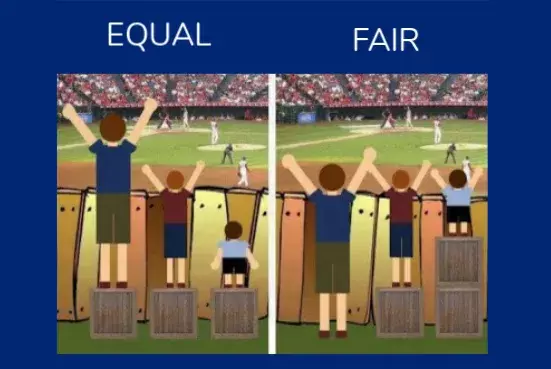
The boxes seem quite material, their distribution being the issue. Nothing here appears transcendental, but it's unclear how you are using that word. -
A Case for Moral Anti-realismThere is nothing that exists beyond the act. — AmadeusD
Well, seems to me that the obligation exists beyond the act of making the promise. That is, to make a promise is to place oneself under an obligation.
Now that obligation is not physical. It is not "floating around". But it does exist.
But it is a mistake to think of the promise or obligation as "nothing, of itself." It is a promise, it is an obligation. So "...the promise was a singular act and quite clearly doesn't exist as 'an' anything" Isn't right, either - the promise exists as a promise; as the undertaking of an obligation.
So to this:
If both parties forget about the promise, what is it that they have forgotten about? Not nothing. They have forgotten about the promise. Hence, there is a promise to be forgotten about, and again the promise exists.if both parties to a 'promise' forget that it was made, the there aren't even these brain states and te claim that the 'promise' still exists becomes risible to the point of perhaps being an indicator of sillygooseness. — AmadeusD
I gather that you would like to argue that promises are brain states? What would that look like? Is the promise the brain state in the head of the promiser, or the promisee? Or both? What about those who hears about the promise - is the promise the sum of all the brain states of everyone who has heard of it?...brain states... — AmadeusD
Or is the promise a similar structure that each and every person that has heard of the promise has in their brain? Could that be made coherent?
And what ab out written promises, or audio recordings - are these also promises? And how does the promise move from one page to another? If it is a physical state, then the nature of that state is quite irresolute.
The promise seems to be something quite apart from any such physical state. Isn't it more a construction, put together by people using language to get things done? Isn't it a way of undertaking an obligation in a social and linguistic context?
But why shouldn't we talk of such things as existing? Along with money, property, friendship, and so much more. We live in a complex of social constructs. -
A Case for Moral Anti-realismMeh. Your last dozen posts have had no philosophical content whatsoever. Mere invective.
Here again is what I have argued: People make promises. Therefore there are promises. Therefore promises exist.
I'll offer you now the opportunity to agree with this. -
The Principle of Double EffectNot much here with which i might disagree. Certainly the ass will not starve, so it chooses.
-
A Case for Moral Anti-realismI've never denied the existence of "abstract objects" - although I would not use that term! You are very confused.
See for example the thread on Searle where I present his discussion of the construction of social reality. Social reality consists in what you call abstract object.
And the thread on Austin, in which the hegemony of the physical is overturned.
Or the threads on Midgley, where talk of what you call abstract objects is central.
:roll: -
A Case for Moral Anti-realismAnother half-statement from you,
Your implication is that abstract objects do not exist. The backdrop here is presumably a belief that only physical objects exist. This is simply muddled.
"There is an x such that x is a promise" is true. Therefore promises exist.
Nothing in this says that promises are physical objects.
Again, really, really basic stuff. Not everything is a physical object. -
A Case for Moral Anti-realism
-
A Case for Moral Anti-realism
You are really not very good at this. I read the whole post, and chose the bit that was most ridiculous. Your claim is that there are no promises. That speaks volumes for your comprehension of the discussion here. It shows us why we should not pay heed to you on this topic. Your repeated vindictive and lack of substance reinforce the opinions already expressed by .If you can only read three words out of a post... — AmadeusD -
The Principle of Double EffectYour approach here is quite obtuse. You appear to be pretending that going to this trough, rather than that, is not making a choice... An odd way to think about it.
No principle can be used by Buridan's Ass to choose which trough to go to. Yet it would be irrational not to make the choice. Therefore it is sometimes rational to make choices that are not governed by principle. -
The Principle of Double EffectFor no particular reason. — Leontiskos
Indeed. No "principle" led to choosing this trough and not the other. -
The Principle of Double EffectDon't over egg your pudding. Which trough the beast heads towards is arbitrary, and a decision that must be made.
Demonstrate why, rather than values being needed in order to choose between conflicting principles...In that case one must still provide principles for the interaction of those values. — Leontiskos -
The Principle of Double EffectDo you mean algorithmic, or rational? — Leontiskos
Algorithmic. Following an explicit rule.
Or principle.
Buridan's Ass will die unless it makes an arbitrary decision. So sometimes it is rational to make arbitrary choices....if we make unprincipled decisions then we are not being rational. — Leontiskos
Why not instead think about morality in terms of values?...one cannot think about morality without principles. — Leontiskos -
Is the real world fair and just?
So justice is not reducible to thermodynamics.The physical analogy between a Fair & Just distribution of social states, and thermodynamic equilibrium (balanced measure) is a philosophical metaphor, not to be taken literally — Gnomon -
A Case for Moral Anti-realismFolk hereabouts regularly confuse something's existing with something being known to exist. — Banno
-
Is the real world fair and just?yep.
There’s also a sort of latent animism in some of our expressions in that we do attribute intent to things around us as well as to people. -
The Principle of Double EffectSure. There are cases in which one does not have the answer before one encounters the problem. That's kinda my point. Making decisions is not always algorithmic.
-
Is the real world fair and just?Well, I suspect that will go along with your scientism. Of course, I don't think it is I who is not in the game. You do not appear to even see the ethical considerations. But my posts only elicit more spit. I'll leave you to it.
Edit: just to be clear, here are my two contributions to this thread:
- Fairness is not found in the world, it is found in what we do about it.
- The way things are does not determine what we ought do about them.
-
The Principle of Double EffectWell, the interminable nature of discussions of trams and trolleys might show us how easily any principle can be undermined. Principles seem reasonable when used to explain one's actions post hoc, and yet folk can dream up convolute circumstances too difficult for any given principle. (This is more than just a technical problem for undergrads; it is part of the way language, and hence thinking, works. see again Davidson's A nice derangement of epitaphs.)
Foot points out that “It is not always rational to give help where it is needed, to keep a promise, or even… always to speak the truth”
Which to my eye serves to somewhat undermine deontology as a feasible approach to ethics.
The problems with taking Catholic Doctrine as worthy of taking into account in one's ethic considerations have become fairly explicit in the last few decades.
My present inclination is to "reject the demand that moral actions fit with a preconceived notion of practical rationality" - SEP
It's just more complex than that. Hence, again, doing ethics might better be seen as seeking growth rather than seeking rules to govern our behaviour. -
Is the real world fair and just?
To which I might only add that ethics may be of more help here than physics. For while physics tells us what is the case, ethics acknowledges that we might well make things otherwise.Hence, the necessity for a moderate philosophical attitude toward the extremes of Good & Evil. :smile: — Gnomon
Not that analysis is wrong. But maybe not quite right, either. -
The Principle of Double EffectYep.
Nuh.The Principle of Double Effect is utilitarian. — I like sushi
It's much more complex than that. If anything, it's Catholic...
Not a strong recommendation in my opinion. -
A Case for Moral Anti-realismSeems pretty clear.
Yep. Folk hereabouts regularly confuse something's existing with something being known (believed, shown...) to exist.We do not require evidence for existence. — Tobias
It's very basic stuff.
Banno

Start FollowingSend a Message
- Other sites we like
- Social media
- Terms of Service
- Sign In
- Created with PlushForums
- © 2026 The Philosophy Forum