
-
CalculusWhat's the epsilon which is too large for convergence as determined by the standard epsilon-N construction for the series (1/n)?
-
Marx's Value TheoryLong break, but the next section is short: 3. Transition from the General form of value to the Money form (form D)
The universal equivalent form is a form of value in general. It can, therefore, be assumed by any commodity. On the other hand, if a commodity be found to have assumed the universal equivalent form (form C), this is only because and in so far as it has been excluded from the rest of all other commodities as their equivalent, and that by their own act. And from the moment that this exclusion becomes finally restricted to one particular commodity, from that moment only, the general form of relative value of the world of commodities obtains real consistence and general social validity.
The particular commodity, with whose bodily form the equivalent form is thus socially identified, now becomes the money commodity, or serves as money. It becomes the special social function of that commodity, and consequently its social monopoly, to play within the world of commodities the part of the universal equivalent. Amongst the commodities which, in form B, figure as particular equivalents of the linen, and, in form C, express in common their relative values in linen, this foremost place has been attained by one in particular – namely, gold. If, then, in form C we replace the linen by gold, we get,
In passing from form A to form B, and from the latter to form C, the changes are fundamental. On the other hand, there is no difference between forms C and D, except that, in the latter, gold has assumed the equivalent form in the place of linen. Gold is in form D, what linen was in form C – the universal equivalent. The progress consists in this alone, that the character of direct and universal exchangeability – in other words, that the universal equivalent form – has now, by social custom, become finally identified with the substance, gold.
In terms of the algebraic structure of value, the money form is a particular instance of the general form of value - namely when a privileged representative has emerged which takes on all the social functions of the universal equivalent. IE, expressions of value are now expressions in terms of a particular commodity - the money commodity - and the customs of value expression have become associated with that commodity.
Gold is now money with reference to all other commodities only because it was previously, with reference to them, a simple commodity. Like all other commodities, it was also capable of serving as an equivalent, either as simple equivalent in isolated exchanges, or as particular equivalent by the side of others. Gradually it began to serve, within varying limits, as universal equivalent. So soon as it monopolises this position in the expression of value for the world of commodities, it becomes the money commodity, and then, and not till then, does form D become distinct from form C, and the general form of value become changed into the money form.
This transforms the nature of the commodity which functions as money, it becomes the lubricant of exchange and the unit of value expression.
The difficulty in forming a concept of the money form, consists in clearly comprehending the universal equivalent form, and as a necessary corollary, the general form of value, form C. The latter is deducible from form B, the expanded form of value, the essential component element of which, we saw, is form A, 20 yards of linen = 1 coat or x commodity A = y commodity B. The simple commodity form is therefore the germ of the money form.
At this point, when the social customs of valuation have concentrated around a particular commodity: the money commodity, the expression of the value of a commodity in terms of that money commodity is called the price form. This grounds the possibility of the usual functions of money -a medium of exchange (the regulator of the social customs of exchange; goods and services for money or money for goods and services) a measure of value (expression of one commodity's value in the money commodity), a standard of price (the ascription of a unit to every valuation facilitating calculations and transformations of relative price magnitudes) and a store of value (any pile of commodities is equivalent to a pile of gold). -
Peter Woit on the state of scientific cosmologyWe don't really have to fear current learning algorithms taking over the activity of theorising. We don't even have to fear them taking over predictive modelling; one of the constraints of big data is that it's big, most of the time we don't have the raw amounts required for AI to form good predictive models. In the cases that we do, too, the current buzzwords (fields?) of 'machine learning' and 'deep neural networks' often produce models which can't be interpreted on their own terms - in terms of their innate parametrisations, the relational structure of data values they arrive at - and they don't distinguish between exploitable correlation and causal efficacy.
If you throw a line which associates weight with height and a line which associates empirical measurements of weight with empirical measurements of literacy rate of different countries jammed into a spreadsheet column, and they really are lines, a good machine learning algorithm will make excellent predictions of height using literacy rate, forgetting that this is just an accidental relationship. Theory and less data rich inference techniques still dominate research and evidence based policy for good reasons, and will do so until someone can accurately measure everything in the universe and put it into a spreadsheet... -
On solipsism.
Baden took the words from my mouth. There's nothing wrong with it, it's just that there's not much to chew on. -
Is Idealism Irrefutable?
Not read it, it's been on the pile for a while. Though so have most books I've heard of. I summarised my perspective recently in a PM to @StreetlightX, I would be surprised if Street couldn't give you some nice input on the book!
(1) ontological materialism; paying attention to dynamism, becoming and individuation. A summary of this standpoint might be a focus on studying how systems become imposed on or emerge out of assemblages; genesis of structure and structure of genesis.
(2) a methodological rejection of idealism, foundationalism and correlationism; refused givens, thought is tailored through conceptual links which aim at and are embedded in a contextually circumscribed real indifferent to its conceptualisation
(3) methodological pluralism - anti-architectonic thought; the phenomena should dictate not just what we think but how we think; ontologies and epistemologies produced are always regional and topic specific respectively. -
Is Idealism Irrefutable?It doesn't mean, as the quote I provided above says, that the Universe sprang into existence only when it became perceived; what I think it means is that, any coherent or meaningful statement about what is real, always must include or assume the existence of an observing mind, which synthesises all of the data and percepts into a meaningful whole within which the statement about the reality of anything is real. And this manifold of perceptions, judgements, and so on, is what constitutes 'the world'. But that is a philosophical, not a scientific, observation - science assumes the reality of a mind-independent world, which it can safely do. It's only when it then treats that as a metaphysical principle, and not a methodological assumption, that the problems begin! (And that is quite compatible with Kant's declaration that one can be both an empirical realist and a transcendental idealist, for which see this blog post.) — Wayfarer
Disclaimer: revisiting After Finitude makes me suspect that the following is a very poor exegesis of the argument, and probably should instead be taken as a bodge inspired by the argument towards the broader theme of speculative materialism in ontology, at least insofar as I understand it. Ho hum, I'm glad this isn't peer reviewed.
Broadly speaking, since your position largely follows correlationist tropes Meillassoux deals with in After Finitude, I'll continue my exegesis of his critique rather than writing my own with my own idiosyncratic concepts.
I would not be so sure that the thought I quoted is consistent with Meillassoux's project; rather, he seeks precisely to demolish the idea of the conditioning subject within it that appears as given within every apprehension. While you have positioned your idea as essentially Kantian in nature, it is only Kantian in heritage. Thought of the regularity in nature has obviously changed through the history of philosophy; from the atomists who dared to think the being of nature and its regularity speculatively - as attempts at conceptualising the real, to the 'Copernican turn' from Kant onwards which grounds the possibility of empirical science through the (transcendental) regularity of our perceptions. Though the post Kantians expanded the emphasis on finitude (a lot), the critical correlationist argument is codified in Kant (but best exemplified in early Wittgenstein and Heidegger). So, for Meillassoux, there is a transformation which occurs to thought of the real in the change from speculative metaphysics to the critique of reason which has a dual character.
(1) The annihilation of the ability to conceive of absolutes; laws, regularities; in the real (even the real of ideas) except through the indexing of their conception to the reciprocal relation of the subject and being/world. This position encourages thinking the existence and behaviour of entities as extrinsic to all conception, but their being remains given within apprehension. This has an effect of denying the autonomy of the real.
So, dually:
(2) Meillassoux would rather reinvigorate conceptualisation of the real by insisting upon our capacity for reasoned engagement with it. This space of questions requires a metaphysics under which the real is treated with autonomy from humans; which is to joyfully affirm that our metaphysical conceptions are motivated by the real precisely to the extent our concepts are sensitive to its dynamics.
The elevation of finitude by introducing the exterior of thought - its topics and targets - to the interior of the human apparatus of conception denies the autonomy of the real which thought tracks in the same breath it reduces such thought to the category of intuition beyond critique; since all thought now suffers from its finitude rather than simply having its relation to being constrained by it. We can see these dualities as associated with poles of skepticism (1) and dogmatism (2), in which the annihilation of the absolute produces dogmatic intuition as much as it produces an excess of skepticism about our ability to think the real.
As he puts it:
We thereby grasp that what is at stake in a critique of the de-absolutizing
implication (viz., that if metaphysics is obsolete, so is every form
of absolute) goes beyond that of the legitimation of ancestral statements.
What is urgently required, in effect, is that we re-think what could be
called ‘the prejudices of critical-sense’; viz., critical potency is not necessarily
on the side of those who would undermine the validity of absolute
truths, but rather on the side of those who would succeed in criticizing
both ideological dogmatism and sceptical fanaticism. Against dogmatism,
it is important that we uphold the refusal of every metaphysical absolute,
but against the reasoned violence of various fanaticisms, it is important
that we re-discover in thought a modicum of absoluteness – enough of
it, in any case, to counter the pretensions of those who would present
themselves as its privileged trustees, solely by virtue of some revelation.
So, philosophy can and should concern itself with a real indifferent to its conception, and perhaps raise that indifference to a methodological principle for a speculative metaphysics about it. ;) Against dogmatism emphasise contingency, against skepticism emphasise that contingency's necessity.
@macrosoft this is part of the response I'd give to you on the 'thread' you suggested, but tracing the reinvigoration of metaphysics by emphasising the autonomy of the real (viz; becoming) and our ability to track it with good concepts takes a lot more effort than this exegesis. -
Is Idealism Irrefutable?It was just an off-the-cuff comment above, obviously meant in jest. — Terrapin Station
Well then, I'm sorry for lumping you in with every other joking dismissal of continental philosophy as 'fashionable nonsense'. I'm glad that you have some amount of appreciation for it. -
Is Idealism Irrefutable?
Because a well reasoned attack on continental philosophy would be a good thread and stronger support for your position than simply antagonising me. -
Is Idealism Irrefutable?
If you have a good argument that all continental philosophy is worthless, incoherent nonsense perhaps you should start a thread on the topic rather than throwing spitballs at me. -
Is Idealism Irrefutable?
Oh no, I was asking for textual evidence for your attribution of 'I study them because I like them and that's the only reason anyone ever studies continental philosophers' to me. We should stop this exchange now before it becomes even more of a pissing contest. -
Is Idealism Irrefutable?
Quote me where I said that they're worth studying because I like them. Stop putting words in my mouth. This in group/out group bollocks you're doing with analytic and continental philosophy is complete bollocks, and has been bollocks since it started. Pathetic. -
Is Idealism Irrefutable?Well, and likewise, "Are they really saying something of worth/are they really worth studying just becasue they're well-entrenched in the field, where generation after generation studies them just because the generations before did?" — Terrapin Station
Hah. The only reason they're respected is that they're entrenched in the field! You can reject literally any scientific discourse with this. You can do the same thing with the analytics and the ancients. Is the only reason we still study Plato because his ideas are entrenched in the field? Is the only reason we still study Frege because his ideas are entrenched in the field? Come on, this is lazy argumentation and you know it. -
Is Idealism Irrefutable?A beautiful book, but hardly the last word. I think Meillassoux is subject to some of the criticisms above. Have you looked into his other work? He insists on the possibility of a resurrection of the dead. I refer to Harman's critical anthology, Philosophy in the Making. He seems like a strange theologian after all. I don't mind this. I say bring on the creative thinking. But he might not be your ideal go-to retort here in light of that. — macrosoft
Yeah, I've not read his other works, just secondary literature on them. Even in After Finitude things get exceptionally chaotic. I dislike that in untethering time from experiential temporality through the arche-fossil argument he also untethers becoming from forming stable structures. But I think the arche-fossil stands alone as an excellent argument against a strict dependence of being upon an observer situated within it.
So the claim he's attacking with that argument is what he sees as a phenomenological undermining of the distinction between primary and secondary qualities. Soil can be damp to the touch, dry, dense, lightly packed, and these depend somewhat on how the soil is interacted with; making them secondary qualities. But it has pH, a certain profile of carbon, hydrogen, oxygen, nitrogen and phosphorous in it, it traps a given amount of air; chemical composition and the like are primary qualities of the soil.
A more sophisticated reading of pH and chemical composition will reveal that pH and chemical composition only manifest as a property in relation to our mental models of the soil; even the primary qualities require a particular mode of apprehension of the soil in order to show up. In this sense, the exhibition of the soil's mind-independent properties are still undermined on a meta level by the mind-dependence of their model upon human conduct. In the discussion between @macrosoft and @Wayfarer, 'human conduct' is 'the observer' which needs to be seen as part of the mental models; the observer takes the role of a containing and conditioning unit upon their observations, which is contrasted to the supposedly passive role the observer plays in scientific measurement (ignore QM for now, that discussion's largely irrelevant to the arche-fossil).
These sophisticated readers, those who know the true nature of primary qualities; that while they appear as mind-independent they are still counterfactually conditioned by the interaction of thought with their object, are called correlationists by Meillassoux. They are called this because they make being reciprocally depend on the subject in all senses relevant to interaction between the two, and the subject reciprocally depend on being in all senses relevant to the interaction between the two.
At this point, imagine that one of these sophisticated readers is a hobbyist digging for dinosaur fossils and they find one! Great luck! Unfortunately, things which predate the coupling of subject and being are not good for an ontology which necessitates their coupling. In one sense, the correlationist says, the dinosaur fossil predates humanity - in another, more profound sense, it does not; all interactions with it generate interpretations which are derivative of our phenomenological condition. The fossil appears as prior to the suture between the subject and being only because it is already within that suture as one of its interactions.
Which is rather strange, is it not? Something which predates the very coupling of human subjects and our world is nevertheless denied expression of its being until we come along and save the day; allowing the universe to 'talk to itself' in the only register fit to recognise its dynamics, the thoughts, speech and words of humanity. The creature which produced the fossil still died, it still obtained sustenance during its life, it was still a process of evolutionary development coupled to ecological constraints, and it was such prior to anything we had to do with it. Which is to say, the creature did not depend in any sense upon the reciprocal relation of subject and world in humans; it predated them.
The effects of this move, locating the reciprocity of being and subject within history are quite profound. This move transforms the transcendental coupling of subject and world into an event which occurs in history; the transcendental (like the ideality of space and time) becomes a transcendental for-humans, and the novel ability to use this 'for-humans' is also an invitation to think being as ultimately indifferent to any of our comportments; even the transcendental structures underlying reasoning and apprehension. The distinction between primary and secondary qualities now makes sense again.
Staying away from the continentalists is a good idea in general. :yum: — Terrapin Station
It's not a hard argument. Maybe if you studied who you're having trouble with more generously, and used more secondary literature, you'd have an easier time. Ask yourself, is it really likely that they are all saying nothing of worth simply because you do not understand them? -
Is Idealism Irrefutable?And (no big deal) but right away you read me out of context and lumped me into a group of your 'bad guys,' the 'bad guys' who think scientists are the 'bad guys.' I think we both agree that it's boring to be and see such cartoons. I am striving to avoid one-sided perspectives (such a striving is a decent description of philosophy itself.) — macrosoft
I'm still quite sure that there is an anti-'scientific metaphysics', through the opposition of scientific reductionism to some kind of ontological holism, operating in the response you had to Wayfarer. I had two choices really, one was to focus on that theme I saw, the other was to go through my usual response to this kind of thing, rehearsing the arche-fossil argument from Meillassoux; which you should look up if you are unfamiliar, it's an attack on Hegel (afaik) as much as it is an attack on Heidegger. I have no interest in going through it for the umpteenth time though. The book it's in is 'After Finitude'.
So yeah, apologies for a hasty reading of you. -
Is Idealism Irrefutable?
Eh, seems I was hasty in my skim-reading, I thought we were currently having the 'science is reductionist' debate rather than the other one we have, 'observer in science'. Second time's the charm.
'Cant's see the forest for the trees' usually connotes the need for part-whole aspect shift. The connotation in @macrosoft's post was that the observer and their theories should be seen as part of a corpuscle with the rest of reality and its behaviour; observer/'the rest' and theories/behaviour sharing a structural symmetry. If you'll permit a metaphor, the structural symmetry reflects reality along the axis of the observer producing theories, perceptions, intuitions. It also reflects the observer along the axis of reality highlighting that theories, perceptions and intuitions are themselves only insofar as they are indexed to an observer; what nature displays depends on what we ask and how we ask. It's easy to forget that theories, perceptions and intuitions aim at the real through the first reflection simply because the second one when taken alone displays theories, perceptions and intuitions as human productions.
Scientific inquiry exhibits the first, targeting the real with well posed questions, whenever it deals with its topic with sufficient finesse and relevance of content; a well posed question is a conceptual opening for nature to fill. Scientific inquiry exhibits the second when dealing with how theories produced through targeting the real operationalise; checking if the question is well posed or whether the data relevant for that question it is sufficiently strong and precise. Need both, and every competent researcher does both. -
Is Idealism Irrefutable?Except that science still does frequently don the (lab) coat of moral authority. — Wayfarer
I don't really know what you're talking about. How does moral authority come into asking questions about nature, social systems etc?
Ecology question: 'Has the reintroduction of wolves in Yellowstone Park reduced the number of their prey species?' Where does moral authority come in in answering that question rigorously? -
Is Idealism Irrefutable?I agree. 'Qualitative' is nice. For me semantic holism is a key insight at the moment. Or in folksier terms, we don't see the forest by staring at individual trees. And as we look out on the forest(s), we ourselves are 'forests' with both a history and a future that exists as possibility. We aren't passive truth-detectors, though this is a role that we can include in a wider itself-non-passive project. — macrosoft
Not that I've payed much attention to the discussion, but this seemed nice to reply to. Underlying this (and @Wayfarer's post to which it responds) is a belief that scientific inquiry is necessarily reductive. To be sure, we can point at some reductive points in science; eg intelligence = IQ, mental health = absence of DSM category, but on the whole it need not be. Linguistics can and often does take a holistic approach, behavioural economics does too, even something as 'component driven' as climatology (in terms of focusing on spatiotemporal gradients of weather indicators) still runs aggregate simulations with full knowledge that results of any specific model are unlikely to represent the manifest behaviour of the climate.
The thing to look for is inappropriate reduction, as it is usually an oversimplification. Oversimplification isn't a necessary constituent of science, it produces bad science. To a good approximation the Earth is flat, to a better one it's a sphere, to a better one it's an oblate spheroid, to a better one it's very close to an oblate spheroid with randomised and fractal topographic development on and near its surface. Similarly, ecologists need not look at an ecosystem as an interacting system of components alone, they can look at the effect integration of one component into the aggregate of the others produces.
Even the study of evolutionary development, regularly accused of being reductive on the forum, is a myriad of interacting forces. Genes, contexts of gene expression, developmental landscapes. Evolutionary development raises questions like 'will the wolves of Yellowstone Park reduce the selection pressure for increased root-soil interaction surface area on riverside plants?', in which you have a larger ecosystem (Yellowstone) manifesting in several smaller ones - the ecology of wolves, the ecology of riverside plants, the erosion brought about by increased herbivorous population - then asking a question of their interaction (wolves decreasing herbivore numbers, decreasing plant consumption at riversides, perhaps influencing root behaviour) and then as a result of that interaction trying to figure out how it would influence the phenotypes and genotypes of riverside plant species found there.
The important thing to look at here is a non-reductive account of causal structure. We have 'fundamental units' at all levels interacting with 'fundamental units' - which is to say speaking of those fundamental units at all is somewhat of a category error. So, ecosystems shouldn't be analysed with such a reductive notion of causality, evolutionary development shouldn't be analysed with it either. And goodness knows, they usually are not.
The myth that science is necessarily reductionist needs to be put to rest, it's well past its bed time. -
Why should anyone be surprised at GOP voter suppression?
Whether the dirty tricks are legal or not, what matters is that they'll get away with it. No one in the GOP will go to jail for what they've done. If there are no effective legal means of combatting vote repression, then I'm sure rules can be bent or new rules can be made. There's a reason why America is founded on amendments. It's not so that all principle can be sacrificed on the altar of an idealised representation of political process.
What the GOP's actions reveal (and they've been at it for a long time) is that the supposedly pure process by which justice is administered to America is pretty easy to subvert for horrible ends. It should be subverted for noble ones.
For once I agree with @Hanover, the dems are a being a bunch of lunatic whiners. -
Why should anyone be surprised at GOP voter suppression?
Giving up when challenged with a dirty trick is exactly what will bring this scenario you fear about quicker. Retaliating to restore decorum is only passive when it's done terribly; IE when it's not done at all. The opponent is motivated, reasonably unified on their goals, and plays dirty. No wonder they're winning. What I'm surprised with is that lying down and rotting is seen as the height of virtue; no, the only moral response to this. -
Why should anyone be surprised at GOP voter suppression?
This imagined future with pristine preserved institutions would also have no voter presence aside from the lobbyists, who already get mostly what they want. The only message this sends is that the decorum of the political process must be preserved even if it goes against the interests of those it governs.
Maybe we should play chess some time. Let's have a rule where your pieces behave like queens and can put you in check, don't worry decorum insists that it's always your turn to move first. You want to play by this rule too? Pah, do you really want to stoop to my level? Ok, no you don't. Then get used to losing.
Unfortunately, everyone who matters has already gotten used to losing so much they're completely alienated from the process. The meek will inherit the earth and so on, simply because they have their principles. -
Why should anyone be surprised at GOP voter suppression?
I wish their opposition would be more ruthless. Unfortunately maintaining decorum against an opponent who doesn't and won't is a terrible strategy. -
Bannings
It's a shame he couldn't reign in his asshole flamer tendencies. I imagine the mods together have deleted at least 50 of his posts recently. -
BanningsSpeaking purely philosophically, it seems somewhat questionable that, as philosophers, we should accept the utter wrongness of Nazism as a matter of faith without making any attempt to see all sides of the question. I'm less interested in Naziism specifically than I am in the fact that assumptions we take to be obviously true are not always so. That's what interests me about Naziism, it is almost universally assumed to be wrong, bad etc, which tends to raise philosophical suspicions. — Jake
I believe we operate from the position that we've already seen through white nationalism and judge it accordingly. There's no scientific backing to the superiority of whites (genetics reveals that all race differences are purely social artefacts), any differences in intellectual capability have almost all of their variance controlled for by societal mediators, ethnic replacement is just stupid - only people who aren't in their right minds would equate immigration of non-whites to genocide of whites, the idea that Jewish leftists control everything is ridiculous on both fronts never mind together... And so on. This applies as much to Jim Crow and the klans as it does to the Nazis and the contemporary populist right. -
Marx's Value Theory
Yep! That comes later. The account so far tries to give a meaning to value pertaining to commodities, how they can come to have prices, how one magnitude of a commodity can be worth a different magnitude of another and so on. The creation of profit for Marx, as you diagnosed, comes from selling the product of someone's labour for more than its cost of production; this is termed the extraction of surplus value by exploitation. The worker's lack of ownership and inability to determine what happens to what they produce is called alienation. Alienation and exploitation make sense upon the background of a societal division of labour in the production of commodities, and a system where needs are met through purchase of goods and services. All together that gives whoever owns the product of the worker's labour more value than they started with and sets up a feedback loop that by and large keeps people as workers if at any point that don't have much money. -
Is Economics a Science?The most damning indictment I can think of for economics (which, surprising anyone who regularly reads my posts, includes Marxist perspectives on it) is that analysis which uses theory interpretively is typically consigned to be retrospective, and even when central tenets (like rational agents having symmetry of loss functions around zero) are strongly contradicted (just a link to prospect theory in general, Kahneman and Tversky are highly productive authors on the topic), the theories which use those strongly contradicted statements rarely change. For 'balance', you can see Marxists using the results of his value theory without the labour theory of value or an eye for updating it. Stiglitz famously said he predicted the 2008 recession despite saying it would occur far later prior to it. Apparently saying 'there is a housing bubble which will burst at some point' is sufficient to predict 'the housing bubble will burst fully in 2008 and begin in late 2007', despite the first being a much larger composite hypothesis.
The focus on retrojection rather than projection in economics and how central tenets and predictions can be contradicted but derived models using those tenets are still used in the circumstances we know they don't represent well suggest that economic research programs are typically degenerate; fitting fact to theory where it's important rather than theory to fact.
This isn't to say everything produced in economics is wrong, just that predictions by theoreticians and applied practitioners (the aggregate skill of skilled investors produces a coin flip on gain vs loss and 0 net gains, so much for their savvy intuitions) are rarely seen as important when wrong, just important when right. -
Marx's Value TheoryThe next subsection 'The Interdependent Development of the Relative Form of Value and the Equivalent Form of Value' sets out the conceptual character of the progression from elementary to expanded to general forms of value. It is not, strictly speaking, a historical account, its emphasis is more on stating how the elementary form can expand to the expanded form, then how the expanded form can condense itself into an equivalence relation of commodities.
The degree of development of the relative form of value corresponds to that of the equivalent form. But we must bear in mind that the development of the latter is only the expression and result of the development of the former.
I think this is a bit of conceptual book keeping, the idea of one thing expressing its value in another is conceptually (and historically) prior to both being seen as equivalent expressions of value magnitudes. This means that the elementary relative form of value is as old as exchange, and the others occur as historical developments suggested by possible social developments of exchange networks prima facie compatible with the elementary form; though that compatibility still allows room for social and metaphysical tensions inherent in the more developed value forms with the elementary form which is their basis.
The primary or isolated relative form of value of one commodity converts some other commodity into an isolated equivalent. The expanded form of relative value, which is the expression of the value of one commodity in terms of all other commodities, endows those other commodities with the character of particular equivalents differing in kind. And lastly, a particular kind of commodity acquires the character of universal equivalent, because all other commodities make it the material in which they uniformly express their value.
As said many times before, the primary or isolated form of relative value is obtained by dealing with specific pairs of commodities which are exchanged within a social system of exchange. The individual pairs of Xs and Ys such that (X is worth Y) and (Y is worth X) together are considered as separate relations of trade; these are incidental in character, and the relation which binds X to Y alone does not have to share the same character as that relation which holds between A and B when they too are traded. The aggregation of these trade relations together with no additional structure; when a social system of exchange becomes the means by which most needs, wants and utilities are satisfied and apportioned; is the character of the expanded form (without restriction to one commodity).
The antagonism between the relative form of value and the equivalent form, the two poles of the value form, is developed concurrently with that form itself.
The first form, 20 yds of linen = one coat, already contains this antagonism, without as yet fixing it. According as we read this equation forwards or backwards, the parts played by the linen and the coat are different. In the one case the relative value of the linen is expressed in the coat, in the other case the relative value of the coat is expressed in the linen. In this first form of value, therefore, it is difficult to grasp the polar contrast.
Form B shows that only one single commodity at a time can completely expand its relative value, and that it acquires this expanded form only because, and in so far as, all other commodities are, with respect to it, equivalents. Here we cannot reverse the equation, as we can the equation 20 yds of linen = 1 coat, without altering its general character, and converting it from the expanded form of value into the general form of value.
Finally, the form C gives to the world of commodities a general social relative form of value, because, and in so far as, thereby all commodities, with the exception of one, are excluded from the equivalent form. A single commodity, the linen, appears therefore to have acquired the character of direct exchangeability with every other commodity because, and in so far as, this character is denied to every other commodity.[26]
Marx's reference to the inability to 'reverse the expanded form' without changing its' general character' refers to the duality referenced before between choosing a representative from an equivalence class and presenting those things which are equivalent to it. The first takes an equivalent network of commodities and maps it to a particular equivalent, the second takes a particular equivalent and maps it to its network of commodities which allow that equivalent's relative value to be expressed.
Formally speaking, the previous characterisation in terms of choosing a representative is a function which maps an equivalence class of commodities to a single one of its members, and presenting those things which have their relative value expressed in the representative choice is taking that function's pre-image from the representative element.
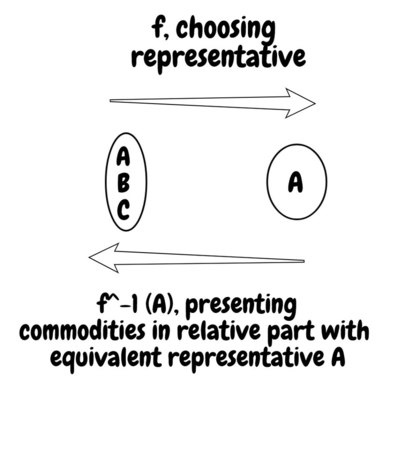
Fixing a specific type of commodity whose amounts uniquely represent every value equivalence class renders that commodity as a universal equivalent.
The commodity that figures as universal equivalent, is, on the other hand, excluded from the relative value form. If the linen, or any other commodity serving as universal equivalent, were, at the same time, to share in the relative form of value, it would have to serve as its own equivalent. We should then have 20 yds of linen = 20 yds of linen; this tautology expresses neither value, nor magnitude of value. In order to express the relative value of the universal equivalent, we must rather reverse the form C. This equivalent has no relative form of value in common with other commodities, but its value is relatively expressed by a never ending series of other commodities. Thus, the expanded form of relative value, or form B, now shows itself as the specific form of relative value for the equivalent commodity.
With reference to the previous discussion about whether X is worth X, Marx agrees that it alone does not assure the expression of the value of X, and also agrees that it is a tautology. Even when X is worth X however, the value expressive part of the relation for the universal equivalent; the set of commodities which serve as the above pre-image; is the total expression of relative value for the universal equivalent.
This means that the expanded form is contained within the general form (with its universal equivalent and transitive closure properties) precisely as the relative form of value for the universal equivalent. -
What is the opposite of 'Depression'?Many companies would just love to hire manic people at first, if they would stay that way with that positive upbeat. But usually it leads to burn out. — ssu
It's a sad state of affairs when suffering from a debilitating mental disorder which often upheaves someone's entire life looks a lot like being an ideal job applicant. -
Common Philosophical Sayings That Are Not True
And I nearly put 'God exists' in the academic list, you lot won't let me get away with anything. ;) -
What is the opposite of 'Depression'?Also, mania can zip through those pleasant conditions you mentioned into psychosis, which can be very horrible for people to experience. — Bitter Crank
Yeah. I can see why my list of things could seem like I actually approved of mania. I've been manic before (clinically), it felt like a lot of fun at the time but it was still pretty destructive. -
What is the opposite of 'Depression'?I don't really think it's a useful question to ask 'what's the opposite of depression?', but if I'd have to guess I'd say mania. Unipolar depression has a lot of things which are inverted in mania:
Depression - socially isolating oneself, feelings of isolation and persecution, no motivation or energy, loss of interest in sex, flattened affect.
Mania - lessened social inhibitions, feelings of love and togetherness, heightened motivation and energy, sexual promiscuity, heightened affect. -
Common Philosophical Sayings That Are Not TrueI don't know where the boundaries of philosophy are, so I've included some common sayings from IRL 'meaningful conversations':
Things which are almost certainly wrong:
Commonplace:
Opinions are subjective.
Art is subjective, science is objective.
You can't doubt it, it's scientific fact.
Atheists must be immoral.
Abortion contradicts the sanctity of life.
Islam is a religion of violence/peace.
Christianity is a religion of violence/peace
Judaism is a religion of violence/peace.
The left has cultural hegemony.
Naziism was a form of socialism/communism.
Because (group X) has the same legal status as (group Y) systematic injustices regarding X and Y do not exist.
Scandinavian countries are socialist.
China is communist.
Bitches be crazy.
More academic:
Moral responsibility is undermined by determinism.
The invisible hand serves the common good.
Quantum mechanics proves free will.
Rationality is just maximising a utility function.
Human learning is governed by stimulus/response correlation over time (operant conditioning).
Things which aren't necessarily wrong but are often crackpot dogwhistles:
Everyone is entitled to their opinion.
That's just your opinion.
Let's agree to disagree.
It is what it is. -
The Hyper-inflation of Outrage and Victimhood.Having a full discussion about these issues is a very large undertaking because of their loaded complexity, but to put in brief: institutional power structures service and disservice individuals far less rigidly on the basis of race or sex than inter-sectional theorists would have us believe. This is a thread I wrote regarding the issue of racism in police violence against blacks, which would constitute a spared injustice privilege for whites in the eyes of an inter-sectional feminist. That specific alleged privilege is loaded with complexity, engenders outrage when accepted, and is difficult to explore and discuss (exploring and discussing the entire gamut of privilege would be unending). I actually reject that discriminatory institutional practices are the main perpetuators of demographic inequalities in contemporary western society. For example, for white inmates and impoverished white families, there is no institutional lever they can pull to elevate themselves; the concept of white privilege to them, is quite alien. In a nut shell, I think the main error is confusing raw statistical outcomes with intent or design in institutional practices. I contend that impoverished white families are having about as hard of a time escaping poverty as impoverished black families are having, and the main forces which actually keep them poor have very little, if anything, to do with race or gender or identity. By assuming from the get go that all statistical disparities are caused by discriminatory institutional practices we're disregarding the many other circumstantial factors which contribute to contemporary statistical outcomes, in all their exhaustive complexity. — VagabondSpectre
I broadly agree with what you're saying here. Intersectionality without paying attention to class misses an important source of variation in opportunities which cuts across and intersects other important identity categories. Viewing political activism solely through the lens of group identity without any attention to political economy is pretty bad, and is precisely the image I have in my mind of the 'outraged victim mentality' referred to in the OP.
In a nut shell, I think the main error is confusing raw statistical outcomes with intent or design in institutional practices.
In the vulgar form of 'any injustice results from an institutional disparity' I agree, but I don't really think this is representative of intersectional thought. The entire point is to avoid reductionism of an account which renders that account unrepresentative for some groups of people.
But that doesn't mean I believe there isn't a place for focussing on social issues that don't, at least at face value, relate to political economy meaningfully. I definitely think it's important to challenge norms when they're discriminatory or even just unpleasant for some of those involved.
Also ironically, I generally see people getting butthurt over intersectional discourse as part of this politics of outrage. Some nebulous group of people without a modicum of objective social power dislikes my universal humanitarian outlook because it problematises 'universal' views on humanity is destroying discourse/society/politics! Is there really a better example of finding strange things to be a victim of? -
The Hyper-inflation of Outrage and Victimhood.Also, I dont turn to intersectionality, am I a close minded ass? — DingoJones
That remains to be seen. It's possible to be blinkered in some areas and not blinkered in others. I imagine that you're not particularly blinkered here because you seem to agree with intersectionality when it's presented with some amount of finesse, and not reduced to (what I see as a largely imagined and unrepresentative) 'horde of brown people' and their allies (as BC satirised it). -
The Hyper-inflation of Outrage and Victimhood.@VagabondSpectre, I've not responded with quote breakdowns because I want to respond to the general points you make rather than try to perform some LOGICAL DESTRUCTION OF AN ENEMY.
It doesn't seem likely to me that a major reason why Occupy failed was intersectionalism. It looks to me that it failed because it had lots of complaints but almost no tangible political goals, and it lost its momentum to move towards those goals by failing to exploit whatever asymmetries of organisation they could. They experimented like the small 60 and 70's communes, which had already failed to produce an anticapitalist politics for similar reasons.
Whenever someone is excluded based on their identity, it makes sense to ask in what contexts are they excluded, and why they are excluded. Even if we grant that the concerns of white cis men are diminished in relevance compared to anyone outside of that category in intersectionalist movements and circles, it doesn't mean that white cis men are excluded from anything else. The 'divisive rhetoric' doesn't so much divide the populace as unite us into causes along identity lines. You can't have it both ways; that the rhetoric is divisive but nevertheless produces a unified front of outraged sheeple from all backgrounds.
Another major point, which I'm surprised that you're not tackling given how you've researched intersectionalism and privilege, is that privilege is a structural property rather than agent based one. The popular sense of privilege is rooted in two different types of privileges: spared injustice privileges and unjust enrichment privileges. Spared injustice privileges are like the disproportionate number of blacks in prison - white people and neighbourhoods are largely spared this injustice. Unjust enrichment privileges are like the rising tide failing to raise all boats when an economy grows - the rich get richer and the poor get poorer and this isn't fair.
So we can't say that me, personally, as a white bloke, mistreats blacks, women and other identity categories just because I'm white. It's more statistically that I have less shit to deal with.
Regardless of how much effort I put into my arguments and how reasonable they appear, the selection criterion referenced in the OP will allow anyone to say 'yes, but this is quite reasonable, we weren't talking about that'. The people who believe in this stuff generally aren't idiots you know, most people aren't. -
The Hyper-inflation of Outrage and Victimhood.Intersectionality is an attempt to make people from all backgrounds heard on a methodological level. It has a generous intention of equality and inclusivity; so that we can try and better our societies to foster equality of opportunity.
Is it so surprising that a methodology which seeks to give voice to patterns of suffering related to identities appears as a weapon? The intent here is violent in a sense, it is to destroy unfair practices!
When people of similar background get together and articulate their experiences, commonalities are noticed. Eventually this filters through to public discourse if there are open channels. Hence our modern and enlightened rejection of prejudices like sexism, racism and transphobia. A good account of life requires reaching out to it.
Two things. First, perhaps a differentiation between intersectionality and weaponized intersectionality. If all you mean is listening/understanding people, then Ill just keep calling that listening/understanding to people and you can call it intersectionality. If the idea is to listen to people based on the immutable characteristics like race or gender then I think its at best naive to the reality of how that is being used as a weapon by the aforementioned victim/outrage movement/culture. — DingoJones
Differences based on background (1) predate intersectionality as an idea and (2) must be seen as changeable for activism concerning them to make sense. If you look at race and gender from a biological lens alone it's a bit different. For race there's less genetic between group variation (say, black vs white) than within group variation so 'racial differences' are pseudoscience. Gender seen biologically is essentially sex, and we know that humans are both sexually dimorphic and that human genitals have lots of different rarer forms. When we're talking about race and gender, we're not talking about them in either of these senses. We're instead talking about them as historically specific, contingent social facts.
There's a top down component - structural issues like availability of appropriate medical care for trans people and the mentally ill, ghettoisation and so on. Things which are systemic properties with multifaceted causes, contributing factors and which require pluralistic strategies of redress.
But there's a bottom up component too - 'what's your experience like at the doctor's regarding that you're trans/schizophrenic?' etc. The top down bit and the bottom up bit actually have very similar content - one expresses the other. The major difference between them is that it's a lot easier to ask questions of people when trying to form representative accounts of how people like them are treated. Contrasted to how hard it is to intuit structure top down without formative experiences. -
The Hyper-inflation of Outrage and Victimhood.Intersectionality is nothing more than a call to listen to people's testimony from different backgrounds to learn about those groups. Nothing essential about this call changes when those groups are typical social demographics.
Intersectionality is rooted in noticing that people from different backgrounds tend to have different experiences and think differently.
Put in a bit of effort to listen to people's perspectives, exposing yourself to backgrounds from a different part of the system we're all in and maybe you'll notice structural differences.
Bell Hooks was not pro-slavery or authoritarian in political standpoint. You'd think that people who allegedly spend their time obsessing over how any application of power marginalises others would be quite opposed to authoritarian politics.
The problem with that is that things like race or sexual orientation are not nearly as strong an indicator as the actual individuals traits. You get much more mileage asking about peoples experiences based on their actual experiences rather than the experiences you think (or even they think) they have had based on their race, gender or whatever other immutable trait they might posses. — DingoJones
You:You get much more mileage asking about peoples experiences based on their actual experiences rather than the experiences you think (or even they think) they have had based on their race, gender or whatever other immutable trait they might posses..
I agree entirely! This is precisely why you ask people what they think. That's how we end up noticing social patterns when we're not part of them. Why would you ever think I would disagree with this so much that it's a counterpoint?
You say its simple, but that is becuase you have made it that way, you just judge everything through the lense of immutable traits, a label that satisfies some but is not actually all that accurate (only in the most superficial ways). People are much more than these immutable traits, but if one views them as individuals then that will greatly hamper the outrage agenda and virtue signalling VagabondSpectre is talking about here. — DingoJones
No. Some parts of people's backgrounds are pretty innate; say having autism. Most of our socialisation, however, isn't. What matters is how people are treated. Why on earth, again, would you think that I treat identities as immutable? Why would you think that being committed to basic testimony gathering methodology entails all of this?
Also, your anecdotal experience of how you are treated by certain kinds of people (whom I would just call people, your specificity seems totally irrelevent to me) is not really addressing whats being discussed here. — DingoJones
It's supposed to undermine the idea that people who believe in intersectionality are belligerent and unresponsive to cis white blokes. It's a case of not everyone is like that, and no part of believing in intersectionality commits one to behaving like a close minded ass. People turn to intersectionality precisely to try and avoid being a close minded ass. -
The Hyper-inflation of Outrage and Victimhood.You have to understand that identity becomes credential; belonging to a marginalized group means you should get to speak first because your lived experiences directly reflect the systemic colonialism and patriarchy, and that is the boogieman we're here to fight. White men feeling like they are entitled to speak before other people is a part of the racist system that keeps women and people of color oppressed; white men don't actually have the right to speak publicly about the issue of racism or sexism because by definition they are a part of the problem. — VagabondSpectre
Let's imagine that we're trying to find out about something that happened in our social circle one night. It makes sense to ask people who were there.
Let's imagine that we're trying to find out about how people from different backgrounds feel about stuff. It makes sense to ask them.
Let's imagine that we're trying to find out about the possibility of really different experiences from different backgrounds. Yeah, still makes sense to ask them. They might even reveal things that we wouldn't even have thought of, maybe even couldn't in some cases.
How about assessing working conditions in an office? Let's ask all the people. Should we only ask men when sexual harassment of women is one of the reasons the office is being externally assessed? No, that's freaking stupid.
Why does it make sense to ask the people who were there and experienced stuff we wanted to find out about in any of the cases above? Well, because we want to know what events are relevant to them, if there are any patterns in those events, and how those events propagate through time - how they might stay as norms and so on. Fundamentally, the analysis of social circumstances begins with testimony of those people in them. Structure comes later.
So what's intersectionality? Really. It's the apparently outrageous idea that since people from different backgrounds often have different experiences, it makes sense to get their testimony about it before trying to find any underlying patterns.
It's that simple. If I wanted to find out about how second generation black immigrants are treated with regard to their national identity here in Trondheim Norway, I'd probably do well to start with asking members of that group. Turns out, for some reason me as a balding, stocky migrant temp worker with a ginger beard actually gets asked 'Are you Norwegian?' less than all second gen black citizens I've spoken to. Hm, I wonder how this relates to perceptions of national identity and racial stereotypes.
Applying intersectional methodology is nothing more than common sense applied to using testimony to study social circumstances. It does not mean that a person is automatically right in their descriptions of those social circumstances.
Also btw, as a cis white bloke, the intersectional feminists and trans folk I've spoken to have always been very receptive to my ideas, and they usually have something interesting to say. Especially postcolonial feminists. Maybe it's you?
fdrake

Start FollowingSend a Message
- Other sites we like
- Social media
- Terms of Service
- Sign In
- Created with PlushForums
- © 2026 The Philosophy Forum