
-
A new argument for antinatalismA non-existent person can't deserve anything. — Bartricks
Ok— so there goes your argument.
A baby doesn’t deserve or not deserve anything either. Deserve in this context is meaningless. That you don’t want to believe that, despite multiple people explaining it to you, is your issue. -
Donald Trump (All General Trump Conversations Here):lol:
A corporate statist defending the Great One. How shocking. -
A new argument for antinatalismThe more I think about it, the more this entire thread looks like a giant expression of resentment towards one’s parents because life didn’t turn out how one wanted it.
Kill yourself and/or don’t have kids. Stop forcing your therapy onto others. -
A new argument for antinatalismIt is self-evident to virtually everyone that if a person has done nothing, then they do not deserve to come to any harm. — Bartricks
It’s self evident that if a person has done nothing, they deserve the chance to live.
I guess that settles it. Self evidence.
That's not remotely controversial. — Bartricks
Yet several people — including myself — have rejected it for many reasons. :chin:
Which premise do you think is false then, eh? — Bartricks
:lol: Is this a nervous tic?
Your reason tells you that if someone has done nothing they deserve to come to harm???? — Bartricks
Deserves got nothing to do with it— to quote Clint Eastwood.
They don’t “deserve” anything. Things happen in life — some things we call pain others pleasure. Both are part of life. To argue one deserves to live a harm-free life is exactly the same as saying one deserves non-life — which is exactly what you’re advocating anyway. You try to take a long way around in an attempt to justify it using what’s supposed to pass for “logic,” when in reality it’s a concocted premise designed to reach the conclusion you want: don’t have kids.
So all this talk about “deserve” and “harm free” rests on nothing but fantasy. Which you’re welcome to hold — I have no issue with that.
For others, life is very good indeed—despite your value judgments about what’s “deserved” or what’s good or bad. Your feelings do not a universal moral principle make.
If you deserve a harm free life, you’re free to kill yourself. That’s a personal choice. -
Climate change denialThe temperature data fits the climate change hypothesis alright, but what/where are the other hypotheses? — Agent Smith
Early on there were many hypotheses — natural cycles, water vapor, and a host of others. These hypotheses have been abandoned.
Also the predictions made over several decades have now become true— in fact the effects have taken place quicker than expected, for example in the melting of the ice caps and severity of draughts.
This is why the idea is so widely accepted. But now it’s completely obvious to the point where even fossil fuel companies acknowledge it publicly. All one has to do is check the global temperature averages which break records year after year. -
The Ultimate Question of Metaphysicsit contains the same error that is common to all metaphysics: it ignores, or forgets, the involvement of the subject in the question. — Angelo Cannata
Just as this statement ignores the fact that the notion “subject” is equally silly. -
The Ultimate Question of MetaphysicsThinking about this the other day and finally the question that trumps all questions hit me. Why is there something rather than nothing ? — Deus
Well you’re not alone! :smile:
I recommend Heidegger’s Introduction to Metaphysics for an analysis of this question. Fascinating, in my view. -
A new argument for antinatalism
I’m not “fighting” anyone. If someone presents an argument, I’m interested in understanding it. This one happens to be unconvincing — and probably not worth questioning much more, given the responses.
But there I go taking for granted— wrongly, I’m sure — that you’re truly interested in an answer and not simply posturing, as nearly every interaction with you has demonstrated.
Habits die hard. Do go on about how authoritarian I am, etc. -
Climate change denial
Biodiversity collapse is exacerbated by climate change, as you know. Whether it occurs without a rapidly changing climate -- probably, but certainly not to the degree it is. So I'd still place the greater emphasis on lowering emissions, as that will benefit biodiversity collapse greatly. Other solutions to the biodiversity issue are more than welcome. -
A new argument for antinatalismThey deserve no harm and they deserve a happy life.
And they won't get that. — Bartricks
People live happy lives all the time, despite there being harm. So this statement is ridiculous.
True, they won't get "no harm" -- because harm is part of life. But it's equally absurd to claim life ought to be harm-free...which you do, without further explanation, support, evidence, or logic.
They deserve a harm free happy life. That is not what they are going to get. So it's shitty to do that - to create a person who will deserve far, far more than they can be given. — Bartricks
According to you and your peculiar notion of what is "deserved" in life -- namely, the impossible.
Even if you said something like "everyone born deserves to have enough food to eat," that would be at least coherent. Arguing for a "harm-free life" is like asking for a triangle with 2 sides. You never wanted a triangle to begin with. Likewise, you simply don't want life -- because a "harm-free life" is complete fantasy. Your own personal fantasy -- fine. But why come here and try to convince others not to have kids because of your own bizarre interpretation of life? -
A new argument for antinatalismIf you think it is as solid as air, tell me which premise is false. — Bartricks
Why do you keep asking people this when, once someone does tell you which is false, you simply declare it to be self-evidently true?
The line of your debate:
You: "Don't say x, y, or z -- only tell me which premise is false!"
Interlocutor: "Premise k is false."
"No, premise k is true."
"How?"
"It's self-evidently true."
"I don't see any reason to believe it."
"That's because you're an idiot." -
A new argument for antinatalism
The problem is that it's not even an argument, because it's not interested in persuading anyone and doesn't support itself in any way other than "this is a self-evident, undeniable truth" and then making up a story.
Which, by the way, is exactly what religious minded people often do. "God commands us to do x" or "God says x about y," and go on to construct a complicated narrative with corresponding proscriptions for everyone else. Yet at the heart of the matter is simply "I believe in God."
So it is for at least this line of antinatalism.
A person who hasn't done anything doesn't deserve to come to harm.
That's not controversial. You think it is. It ain't. — Bartricks
I think it is, yes. You declaring "it ain't" isn't an argument.
Since most people do seem to prefer existence despite the harms, it doesn't seem right to solely focus on preventing harms. — DA671
Exactly. Why not make the opposite argument, only with joy/happiness?
It's because the entire argument rests on a fantasy about life being good only if there's no harm. Which is impossible so, in other words, life is bad. -
A new argument for antinatalismSo yes, a fabrication of humans, but like any linguistic practice, definitely has its fuzzy boundaries. — Isaac
Definitely.
Yes. That is the most interesting question. It dogs all antinatalist arguments. Why are we reducing harm when there's no one around to benefit from the lack of harm? Harm is something to reduce so that someone can enjoy the lack of it, not something to reduce just because. I was talking in another thread, coincidentally, about the fetishisation of philosophical questions. I think this universal harm-reduction is just such a fetishisation. It's not a feeling anyone actually has, it's a principle it is possible to have and so people, of a certain ilk, will try it on, so to speak, like dressing up in Cowboy costume, just to see how it feels. — Isaac
Yes, and beyond that take it as part of their identity. Many people -- myself included at times -- want to take a generally good principle and universalize it, when every specific situation is almost always more complicated. I see this mistake in a broad range of activities, from monetary policy to poker playing. -
A new argument for antinatalismThese are metaethical issues. If you're going to reject my argument by embracing some form of individual or collective subjectivism about morality, you're welcome as then you'd also be committed to concluding that the Nazis did no wrong. — Bartricks
I don't accept subjectivism, nor that the Nazi's did no wrong.
They're ethical issues and metaethical issues, sure. If you don't want to defend your argument, that's OK. But you started this thread, and put forward an argument. Then you continued, over and over again, to complain about how no one was challenging your premises. I'm doing exactly that: engaging with the argument by challenging one of your premises.
Antinatalism is a normative theory, not a metaethical theory. So if you are forced to stray into metaethics, you've lost. — Bartricks
:smile: It would do you well to put down these sophomoric ideas about "debate," rules of debate, syllogisms, fallacies, and whatever else you've picked up from your reading or classes.
You made a statement. I didn't make the statement -- you did. So the onus is on you, if you care to persuade anyone (which I assume you do -- otherwise why bother posting in a public place?), to defend and support your statement. You don't "win" anything by default, simply by declaring a category error.
Here is the statement: "Innocents deserve a harm-free life."
That is what is being challenged, and that is what you need to flush out and support. If you can't do that, just say so. If you simply fall back on "It's self-evident, and doesn't need justification," then do so -- and we can end the conversation there. Because in that case I can say the opposite, declare it is also self-evident, and go on my merry way without having to waste any more time.
Moral properties are God given, but that's no premise in my argument. My argument requires only that one recognize that persons are created innocent and that an innocent person deserves no harm (and that it is wrong - other things being equal - to create injustices). Those claims are not reasonably deniable. — Bartricks
And yet that's EXACTLY what I'm denying, and why your argument fails to convince me. So what are you going to do about it? Simply declare me "unreasonable"? Insult me? Give up? Again, that's fine. I will simply remain completely unconvinced and go on knowing that your argument rests on nothing but personal whim about what life "should" be.
Or you can support it further. Can't be explained further? That's fine too. In that case we've reached an impasse, and I can with equal support make the claim that life, although it involves harm, is good -- and therefore creating life is good. -
Climate change denial
Sure. Here's a brief overview I wrote not long ago:
In explaining climate change, for people who are truly interested in learning about it, I always like to start with an easy experiment: you can take two glass containers -- one with room air and one with more CO2 added, and put it in the sun, seeing which one heats up the fastest. Easy, simple. In fact, Eunice Foote did exactly this experiment in 1856:
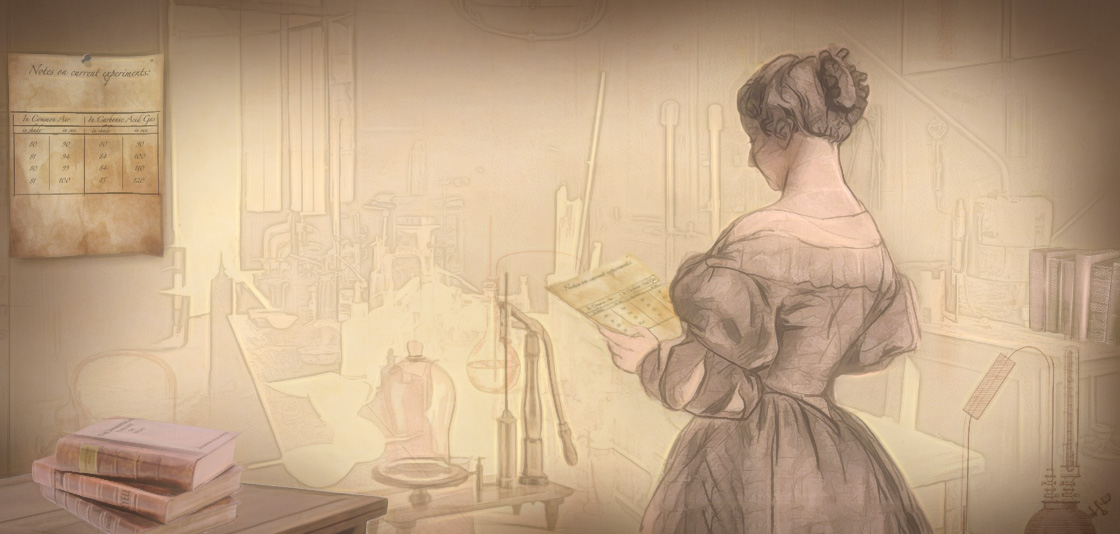
Then we can ask: How much CO2 is in our atmosphere? Since trees take in CO2 and most living organisms let off CO2, there's always fluctuations. So the next thing would be to look at the CO2 concentrations in the atmosphere, measured all over the Earth -- starting in the Mauna Loa Volcanic Observatory in 1958 and expanding from there.
What do we see? Concentrations go up and down a little, naturally, every year, because there are more leaves on trees in summer in the Northern Hemisphere than in winter. Yet the average rises every year, leading to the famous Keeling Curve:
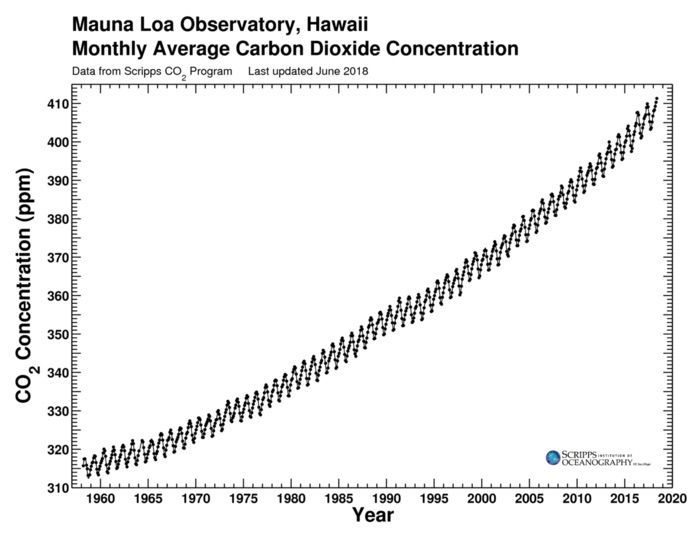
That's just from 1958 to the present. When you look at the concentrations over the last 800 thousand years, an even more interesting trend emerges:
https://climate.nasa.gov/climate_resources/24/graphic-the-relentless-rise-of-carbon-dioxide/
That's 412 parts per million currently, and the last highest level was about 350 thousand years ago at 300 ppm, before modern humans were even around.
So we know (1) that CO2 is a greenhouse gas and (2) that there is a lot more CO2 in the atmosphere now than in the last 800,000 years.
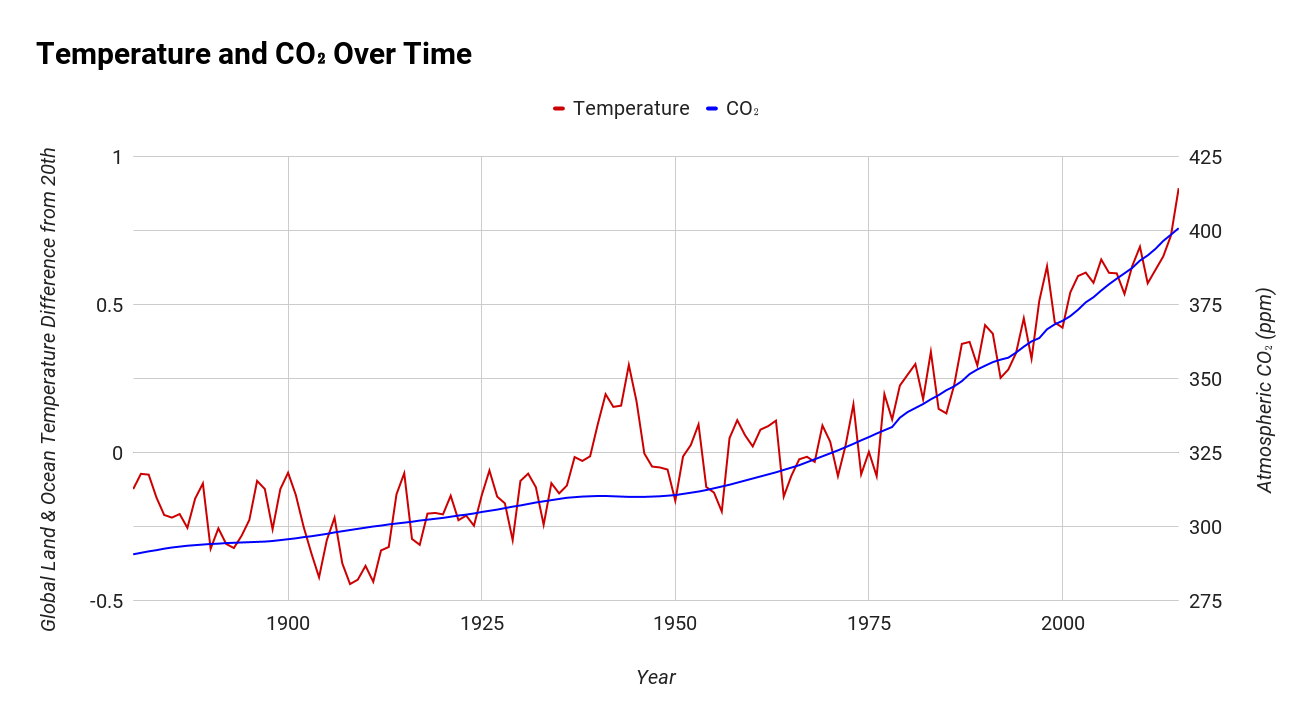
One would think the planet would be warming, giving these two facts. So now we'd have to look to see how temperatures have fluctuated over time, and if increases in temperature correlates in any way with increases in CO2. Is there a correlation?
Turns out there is.
Over 100 years:
And over 800 thousand years:

Then the question becomes: why is this happening? Where is all of this extra CO2 coming from -- and in such a relatively short period of time?
The answer to that question is because of human activity, especially since the industrial revolution. As world population increases, and more trees are cut down (for fuel, houses, and to make room for raising livestock), there is less of a carbon "sponge."
But on top of this, we're also burning things. Burning wood puts CO2 into the atmosphere. Cows and other livestock also release a lot of methane, another greenhouse gas.
But of course it's not only wood and not only livestock. The main culprit, it turns out -- and why the industrial revolution was mentioned -- is fossil fuel: coal, oil, and natural gas. These are carbon-dense objects, and when burned release a huge amount of CO2. Multiply this burning by an increasing population, year after year for over 150 years, and it becomes very clear where the excess CO2 is coming from.
So human activity is the driver of rapid global warming.
Lastly, so what? What's the big deal about increasing the global temperature by just a few degrees?
I think the answer to this is obvious once you realize how only a few fractions of a degrees has large effects over time, which we're already beginning to see. The melting of the ice caps, sea level rise, an increase in draughts and wildfires -- all happening before our eyes, as every year we break more heat records.
In my opinion, I think it's undeniable that this is the issue of our time and those of us who aren't in denial should at least put it in their top 3 political priorities and act accordingly. -
Climate change denialClimate change (due to CO2 emissions), is it falsifiable? — Agent Smith
Yes.
What predictions have been made by climate scientists in re climate change? — Agent Smith
Lots.
"Extreme weather" is just too vague for me and others too I presume. — Agent Smith
Climate isn’t weather.
If you’re truly curious, there’s thousands of options to study it and mountains of evidence. -
A new argument for antinatalism
Apologies. I’m trying to engage mostly with the OP. I view your argument as a separate one. Although interesting, I haven’t had the time to give a careful reading. -
A new argument for antinatalismo deserve something does not mean others are obliged to give it to you — Bartricks
Ok. But who decides what's deserved? That doesn't fall from the sky, I assume. It's not God-given. So who decides? Who decides what is deserved? You?
You want to argue from the Platonic realm of ideas -- that the laws of logic dictate it, etc. But clearly that's not working. If this is something that's as self-evident as you make it seem, it should be able to be shown and proven and as demonstrable as Newton's laws or mathematical theorems. You haven't done so yet.
What you have so far done is made the statement "this is what is deserved," and claimed that you take it as a self-evident truth. Well, OK, that's fine -- if that's what you believe, then you're 100% correct, logically and consistently, in not creating life. Who's stopping you from not having kids? Who's even arguing that you SHOULD have kids (certainly not me!)? Be happy.
But if you're going to try to make normative claims which apply to others -- like me and others on this forum -- and cast moral judgments, or attempt to persuade people not to do something, then you have been, if you pardon me, a very poor advocate. Why? Because from what I've read -- including with myself earlier in this discussion -- you're dismissive, condescending, sarcastic, and adversarial -- often to the point of contempt. That's no way to try to persuade others to stop making moral mistakes. If you have the better argument, show it. Demonstrate it. Don't hide behind Logic 101 accusations of "fallacies" and other rhetorical nomenclature; try to meet people where they are and walk them through it. Otherwise you give the appearance of being intellectually and emotionally immature, or worse: an utter fraud. You can do better than that.
So again I repeat the question above in a rephrased way: Why should *I* believe (or "think" or "conclude") that life should be completely and totally absent from harm? And why is harm the focus? -
A new argument for antinatalismSo the argument that we have a duty to avoid harm befalling innocents cannot be derived from the intuition that innocents do not deserve harm. They don't deserve harm, but they don't deserve non-harm either. — Isaac
An interesting way to put it. While I agree with it, I would further argue that they don't deserve anything -- beyond what human beings think they deserve (or don't deserve). And the answer to that question (What do human beings deserve?) is so personal that to try to find a general, abstract principle about it -- that is, one that applies in all or even most situations -- is a fool's errand.
If a person believes that a human being deserves the powers of invisibility, or the ability to fly, or telepathy or, as Bartricks does, to live a pain-free existence -- which are all impossible -- then that person should not have kids. God bless them -- may they be happy with that choice.
The interesting question for me is why they have that belief to begin with. Why is the expectation an unobtainable one? It's like asking for a square with three sides. If living a pain-free existence is the only just existence, then sure: existence is unjust. But that's a rigged game, so to speak -- rigged to draw the same conclusion over and over again. Why? Because life includes pain -- it's part of the phenomenon of being alive.
That's why I say it's a fundamentally negative (eschewing the word "pessimistic") view of human life. It says: human life is a mistake and it is unjust because there's pain (including, especially, the pain of "innocents" -- which everyone is admittedly born). Thus, better not to be born than to be born; better not to create life than to create life. That's what leads to beliefs like "innocents deserve no harm of any kind." which then get presented as if it's a logical law of nature or "self-evident truth." It isn't; there are further assumptions upon which it rests. -
A new argument for antinatalismBut in any case, that's your assertion. If you feel your parents owed you something -- specifically, a life free of any harm whatsoever, that's your business. But it's just that -- an assertion.
— Xtrix
No, it's not an 'assertion'. It's a 'conclusion'. — Bartricks
It's a belief, whether you call it an assertion or conclusion. That life should be harm-free is a belief. I see no evidence to support that belief one way or another, and you've offered none.
That doesn't make it "wrong" or inconsistent. It just makes it unconvincing...at least to me.
I don't believe life should be harm-free. I don't view that as a good, or something more desirable than life as it is.
I view life as it is as a good; and life as it is includes suffering. Thus, suffering is ultimately good too.
I would distinguish between necessary and unnecessary suffering, perhaps. But that's a different discussion.
The only relevant consideration is whether my conclusions follow from premises that are self-evident — Bartricks
Which they clearly aren't. If they were, I'd be agreeing with you.
If you create a person who deserves a harm-free happy life, and you do that of your own free will, then you owe them that. — Bartricks
They don't deserve a harm-free life. Harm-free lives are impossible. If that's what they deserve, then it's impossible to give it to them -- and so you get to your conclusion is one step.
Rather, they either (1) deserve life, as it is, or they (2) don't deserve life, as it is.
There's no third option. That's a fantasy. So given how things actually are, we're back to square one.
Now, I could assert: every person born deserves angel wings and the power of invisibility. That's impossible too, but we can fantasize about it. But I wouldn't use the fact that life falls short of that fantasy as a reason not to have kids. I could, I guess, but I think that'd be ridiculous.
I think it's equally unconvincing to argue you shouldn't have kids because life falls short of some harm-free fantasy.
--
Now, once more, in the pizza example James deserves something - a pizza.
The people in the pizza place can't give James what he deserves, because they only have shit pizzas.
So what ought they have done? Ought they have advertised cheese pizzas and let people order and pay for cheese pizzas - thus generating a deservingness of cheese pizzas - when they know full well that all they can possibly give people are shitted-upon pizzas?
No. Join the dots. Ought you procreate? No. — Bartricks
See above on why this analogy fails.
You know that if you procreate you'll be creating someone who'll deserve a harm-free happy life. — Bartricks
No, I don't "know" that. I don't believe that. I don't accept that. That's what I've been telling you for a while now.
They don't deserve a harm-free life. That's a made-up premise, or assertion, or conclusion. It's a belief -- and one that I'm well aware you hold. I do not hold that belief.
You don't have to procreate. If you procreate you know you'll be creating someone who'll deserve a harm-free happy life. You also know that you can't possibly give them that - the cupboard only has lives that have shit on them in it and you know full well that anyone you bring into being will have to live one of those slightly shat upon lives (and you know as well that some will have really really shitty ones...but let's not get distracted by that highly morally relevant consideration because my argument - my one - doesn't require that to be the case....just an itsy bitsy bit of shit will do). So you ought not to procreate, then, yes? You'll be creating a desert of something you can't provide. — Bartricks
This is a good illustration of why the analogy fails, as I outlined in the previous post above. You're equating the "shit" with "harm," as I highlighted. And that's where it breaks down. Why? Again: because harm is part of life. Or, to shift to your analogy to make it accurate: shit (harm) is part of the pizza (life). To expect life without harm is like expecting pizza without dough or a triangle without three sides. It's impossible. One doesn't say "I didn't order this three-sided thing -- I ordered a triangle!" Mutatis mutandis, life and harm.
So the question, once again, comes down to:
Should you create life or not create life?
Is life good or is it bad?
Is it worth being born, or not worth being born?
I answer all of the above in the affirmative. It is worth it, yes; it is good. Despite suffering, despite death, despite pain, loss, and heartache. I'd do it all again if I could, and I'm grateful for the chance -- grateful to my parents, grateful to the universe. If I were Christian or Muslim, I'd be grateful perhaps to God or Allah. But hey, that's me.
Does that mean I'll actually have kids? No. But there are other reasons involved in that, much more personal, subjective, value-laden, situational, and complicated -- reasons that far exceed the attempted generalized abstractions of this thread. And, I beg your pardon, also far more interesting. -
A new argument for antinatalismThe analogy is an extremely good one. Why? Because it models the relevant features. James orders a cheese pizza. And that means he now deserves to get one. THe relevant feature here is not the pizza, but the fact that James 'deserves' to receive a cheese pizza. — Bartricks
OK. But how is this relevant to life? No one says "I'll have one life, please" -- and then, because there's suffering in it, is indignant. They don't say: "This isn't what I asked for! I asked for life!"
You see why the analogy fails?
Shit is not part of pizza. If shit WERE a part of pizza (like dough is), you have no right to be upset that shit is on your pizza any more than you would that pizza is made of dough. That's simply part of the pizza.
It's true that in the real world, shit is NOT part of pizza. So you'd be right to be upset -- it's not what you ordered.
Let's bring it to life. By this analogy you're trying to characterize my argument as: "Just ignore the shit and look at everything else on the pizza." That's not what I'm arguing -- whether about pizza or about life. Life contains suffering and pain. I'm not saying "ignore the suffering and focus only on the joy," I'm saying life *IS* pain and it *IS* joy. You cannot have one without the other, they're both part of the term and phenomenon of "life" itself. Pain cannot be removed without removing life.
Back to the pizza. Shit is not part of pizza. Suffering is, however, part of life. If you ask for life, you're asking for suffering. If you ask for pizza, you're asking for dough. If you don't want suffering and you don't want dough, then you don't want life and you don't want pizza -- which is perfectly fine. You could ask, "Why?" and the answer would be: because I don't want suffering or I don't want dough.
The analogy fails because you're equating "shit" with harm in this analogy. To expect a pizza without shit on it is perfectly reasonable; to expect life without shit (harm) in it is like expecting a triangle with 2 sides -- insane.
What does the person at the restaurant say? Well, they say what you were saying. They say "but its mainly pizza - there's only a bit with shit on" — Bartricks
That's not what I'm arguing at all.
So, James deserves a cheese pizza. Not a cheese pizza with some shit on it. A cheese pizza. — Bartricks
True.
And an innocent person deserves a harm-free life. Not a life with some harm in it. A harm-free life. — Bartricks
No, because there is no such thing as a harm-free life. That's impossible, as you've agreed. That's like asking for pizza without dough. If the pizza shows up with dough, that's to be expected. Likewise, a life with suffering is to be expected -- it's simply part of it. Like death -- a part of life.
We can imagine a life without harm or suffering, sure. Concepts of heaven, for example -- or some other kind of perfection, ideal, paradise. But those are based on human conceptions of perfection and goodness, and they will vary.
It's like "deserving" a triangle with 2 sides. Well, that's impossible. A triangle has three sides. If you ask for a triangle, and you're upset that it shows up with 3 sides -- that just means you misunderstood what a triangle is.
Triangles comes with three sides. Life comes with suffering. Pizza comes with dough.
You either want these things or you don't.
The rest is superfluous and I'll skip it. -
A new argument for antinatalismThe question is whether life is worth living even though there is suffering. If the answer is yes, then it's perfectly fine to have kids if one chooses to. If the answer is no, then the human species should become extinct -- yes? Which I'm not saying is illogical -- it's logical if you accept the premise, as the Buddhists do, that life is suffering and suffering should be eliminated. — Xtrix
That's not the question. — Bartricks
Humor me and answer it anyway. What do you think? Is life worth living or not?
If so, why? And why deprive others of this worthy experience? Why make an exception of yourself? -
A new argument for antinatalismThe argument in the OP does not assume that life is not worth living. — Bartricks
Yes it does. If it’s worth living — meaning it is, on the whole, a good — then it’s (in general) worth having kids. Despite the fact that it doesn’t happen to fit your definition of what’s “deserved.”
If life isn’t worth living — in this case because there is suffering, and no baby deserves any suffering whatsoever — then we shouldn’t have kids.
There's really no way around it, as a matter of logic. Otherwise you have to basically say, "No, life is wonderful and I'm just as happy as you are and want to go on living -- totally worthwhile as an adult; but not as a baby, which I was too at one point."
So life is good and worthwhile and a blessing, if you're grown up (like us), but it's still a mistake to have kids -- and it was still a mistake for our parents to have us?
It's contradictory, I'm afraid.
Either it's a mistake to have kids -- in which case, if that's your view, YOU are mistake. You should not have been born. Or it's not a mistake.
You seem studiously to be ignoring the actual argument made and addressing different ones. No premise of the argument I made assumed that life is not worth living. — Bartricks
I have addressed that premise multiple times and, thus, the argument.
And yes, it does assume life isn’t worth living. You’re simply not seeing it because it’s a few assumptions removed from the point about “deserving no harm.” I’ll keep trying, but ultimately there’s little I can do if you’re not willing to acknowledge it.
It doesn’t “refute” the argument, incidentally. I think this is partly what you’re thinking. But I don’t view pessimism as a refutation. If you don’t like the word pessimism— fine. We can use another term or phrase.
But if life is worth living — then it’s worth living in spite of the “unfairness” or “undeservedness” of suffering.
Otherwise you’re contradicting yourself.
But you already said you believe your own life was a mistake— and you fault your parents for it. But it’s still wonderful and worth living? How does this get reconciled?
Because if it’s worth it for YOU — despite being born innocent and having to endure suffering — then why is it NOT worth it for a future human being?
It's not about how worthwhile it is for someone living a life to continue living it. — Bartricks
Why is it worthwhile to continue living it when there’s undeserved suffering involved?
Using slaves to build the pyramids: wrong. You: "so we should destroy the pyramids?" — Bartricks
Not at all. Quite the opposite, in fact.
It assumes that innocent people do not deserve to suffer - that's not a 'pessimistic' assumption, it's a conceptual truth that in no way indicates any pessimism on the part of its asserter. — Bartricks
It’s not about “deserving” anything. That word is a value judgment. It’s saying “suffering is bad for anyone born.” Ok, fine. But life is both suffering and happiness, pain and pleasure — they’re two sides of the same coin. So by saying they don’t deserve any pain, then they don’t deserve any life — because it’s impossible to live pain-free or suffering-free. It's not as if suffering is something that can be removed -- as if it's an evil imposed on what would be perfection. It's not a flaw, it's simply an aspect -- a part. And a part you ultimately believe should prevent us from choosing to have kids.
So again, this is the premise I’ve been arguing against from the beginning. It rests on nothing but your assertion and value judgment. Why you choose to say this instead of “no one innocent deserves life” is unknown, but that’s what you’re saying: no one should be born because life contains suffering and suffering is undeserved. No one should have pizza because it contains dough, and I don't like dough.
What if I were to argue instead: we should have kids because every kid deserves to experience joy? True, I’m ignoring suffering with this statement — but it’s as equally valid as yours, which ignores joy.
Again— what’s so terrible about suffering?
Since it’s part of life, they DO “deserve” to experience suffering -- because life is amazing!
It assumes that innocent people do not deserve to suffer - that's not a 'pessimistic' assumption, it's a conceptual truth that in no way indicates any pessimism on the part of its asserter.
It assumes that harm that befalls an innocent is undeserved. Again, in no possible way is that a pessimistic assumption.
It assumes that life here will visit some harms on anyone who is brought here. That's not pessimistic. You accept it and everyone accepts it who isn't totally nuts.
Again: the reason you have to construe me as a pessimist is in order to be able to persuade yourself that some kind of psychological flaw explains my antinatalism rather than it being the logical implication of some extraordinarily plausible premises. That's wishful thinking. — Bartricks
Alright then -- forget pessimism. I retract that. It's clear to me your argument is predicated on it, but you don't agree. Fine. Makes no difference -- I was hoping you'd just acknowledge it, because I don't believe it has any bearing whatsoever on the truth or falsity of the argument, any more than saying "the glass is half empty" is somehow refuted because it emphasizes emptiness instead of fullness. But so be it.
Let's try to parse your argument out without references to pessimism, based exactly on what you said above.
First, let's be clear with our words so we're not talking past one another. I am using "harm" as synonymous with words like "suffering" and "pain" -- which are simply part of life. You seem to be fine with that, as you haven't indicated it's inaccurate.
Second, the word "deserve" is unclear. It implies being entitled, owed, or worth-of something. But according to who? When someone gets a stomach ache, does it make sense to say they "deserve" a stomach ache? If we talk like that, we're assuming a human being making a judgment about whether or not that person "deserves" this or not -- maybe they ate an entire cake and we feel they "deserve" what they get, etc. But those are human value judgments; moral judgments; judgments that involve notions of "good" and "bad," and particularly of justice, in the sense of what is deemed fair or unfair. When it comes to facts of the world, it's not always useful to talk in terms like these. The tree got struck by lightning -- did the tree deserve it? I throw a rock into a pond -- does the water deserve to be disturbed? No one can step outside of life, so how you judge what's deserved or undeserved, fair or unfair, is dependent on your own perspective. That's essentially a truism.
So see if you agree with this: it is unjust for an innocent to suffer. This is just a different way of saying what you're saying above, in my view -- can we agree on that?
Lastly, "innocent" is a bit strange. Innocent of what, and who decides innocence?
With semantics out of the way, let me rephrase your premises a bit:
(1) "harm that befalls an innocent is undeserved" = It is unjust for an innocent to suffer.
(2) "life here will visit some harms on anyone who is brought here" = Suffering is an inescapable part of life.
That's all you've said so far. I'm not assuming the conclusion yet, I'm not attributing anything to pessimism. To be crystal clear: what I'm challenging is premise (1).
OK? -
A new argument for antinatalismAgain this is worth repeating— and was ignored:
The question is whether life is worth living even though there is suffering. If the answer is yes, then it's perfectly fine to have kids if one chooses to. If the answer is no, then the human species should become extinct -- yes? Which I'm not saying is illogical -- it's logical if you accept the premise, as the Buddhists do, that life is suffering and suffering should be eliminated. — Xtrix -
A new argument for antinatalismImagine you order a pizza and pay upfront.
The pizza that is delivered has a shit on it. You phone up the restaurant to complain that what they delivered is not what you ordered, that it has a shit on it and that you did not order the shit.
The restaurant says "but is it not a lovely pizza? Have you tried part that doesn't have shit on it? It's delicious"
Would you think that's a good response - have they understood your point? — Bartricks
In that specific case, no. I don't think it's a great analogy though. Why? Because we're talking about something much bigger -- we're talking about life. So what if the pizza were the size of the world? Would the fact that there was shit on it negate all of that pizza?
Your analogy is a good one in terms of proportion. By that I mean it would hold true for life if, say, we knew 95% of it would be agonizing pain. In that case, sure -- no person deserves that. That's a serious question which often arises, in fact. If the baby is known to have a disease where there is prolonged suffering which will inevitably end in death, parents have to make the decision about whether to terminate (out of compassion). In this case, it would be like taking the opposite stance to my thought experiment about seeing the future.
But life isn't all shit. It's not all pizza, either.
Well I don't fault my parents for having me, either. I guess that's more relevant. In fact I owe them a debt of gratitude for bringing me into this wonderful world, even though the price of admission is also suffering and death.
— Xtrix
That's question begging. You don't owe them a thing. They owe you. They owe you a happy harm free life - which is something they can't even come close to providing. — Bartricks
Which no one can provide.
But in any case, that's your assertion. If you feel your parents owed you something -- specifically, a life free of any harm whatsoever, that's your business. But it's just that -- an assertion.
I could just as easily assert that what they "owed" me was life -- a ticket to this world.
But out of curiosity, do you fault your parents for bringing you into the world? But your argument, you should.
— Xtrix
Of course. If I didn't, I would be a hypocrite, but my argument would be no less sound for that. — Bartricks
Why do you fault them? I thought you just said you weren't a pessimist and assumed -- just as I do -- that there were all these joys. So if life is good, as I think, then it's a good thing they brought you into the world -- and you should be grateful to them, not faulting them.
But of course you fault them because you don't think life is good. You think life isn't good. And you think life isn't good because there's suffering -- even the slightest bit of suffering.
I just don't interpret life that way. Perhaps it's more dispositional.
But rather than assume, I'll just ask: Do you believe life is, on the whole, a good?
Misses the point: antinatalism is a normative view: a view about what we 'ought' to do. So, by just insisting that it's 'just a matter of choice' you once more beg the question. — Bartricks
It's not begging the question. I'm not assuming my conclusion in what I said. I'm simply saying that there is no universal normative claim that can be made. Why? Because it ultimately rests on whether you believe life is good and worth living -- or not. Is the glass half empty or full? If you think empty -- for whatever psychological reasons -- then you most certainly should not have kids.
If you're trying to convince others that they should not have kids, then you need a better normative argument than simply "Life is bad because there's pain." So far you've not done so. You've tried to invoke logic, but a major premise is an assertion based on, again, your general attitude and interpretation of the world and what you think the world "owes" you and what life "should" be (namely, free of harm). But since that world is impossible, life is therefore ultimately an evil -- and we should put an end to having kids and perpetuating the meaningless, harmful cycle.
What I'm saying is that some kind of "logic" doesn't dictate this,
— Xtrix
Yes it does. I am showing that it does. There are umpteen good arguments for antinatalism, of which the one in the OP is an example. That's why it's a respectable philosophical position that has an increasingly number of defenders. — Bartricks
But you really haven't shown that. If you had, I would be in agreement. You can assume I'm just an idiot who can't follow you -- fine. But otherwise, you need to argue better. I think it's a fool's mission though, because you've already revealed a premise as entirely dependent on a fundamental judgment of life. And there's nothing I can do about a fundamental judgment of life.
So far you have said nothing to suggest any premise in my argument is false. You are pointing to other considerations, but not saying anything to challenge any of my argument's premises. — Bartricks
You keep repeating this, so I'll keep repeating myself as well: I'm challenging the second premise. This premise: that babies deserve a life free of harm.
That's the premise I'm challenging.
Why do they deserve that which is impossible?
— Xtrix
Are you saying that one can't deserve the impossible? — Bartricks
No, I'm saying: Why do they deserve the impossible? Viz: Why are you claiming that they "deserve" something which is impossible?
So essentially the argument rests on this perspective: because there is suffering, life is bad.
— Xtrix
No. — Bartricks
Yes, indeed. As I've continued to show.
There is no pessimistic premise in my argument. — Bartricks
There is. It's the premise I mentioned above. The premise I'm challenging.
They say "Why so pessimistic? Most of the pizza does not have poo on it and those bits - the majority - are delicious!"
That'd be crazy, yes? They've missed your point. — Bartricks
Yes, they've missed your point. And?
Your point is that you deserved to be given a pizza that had no poo on it whatever and was entirely delicious. — Bartricks
"Deserve" has nothing to do with it. Maybe I did deserve it from someone's point of view -- who cares?
The point is that it's not what I ordered.
So relate that to life. What are you arguing with this analogy? You want to deny that you're arguing that "Life is bad because there's suffering." Yet this analogy is saying "This is not what I ordered -- doesn't matter if the rest of it is good, I didn't order the bad." Which, again, just assumes your premise of "there should be zero suffering." There should be no harm, there should be no poo -- because we didn't order/consent to either.
But what if the person said, "Yeah, I'll take the pizza with shit on it. Better than the alternative -- which is starving to death." Yes, that may not be what you choose -- fair enough. But that's not a moral argument -- whether about having kids or eating the pizza.
I don't consider life to be a pizza with shit on it.
You are mischaracterizing my view as "pizza with poo on it totally bad" and just ignoring that my point is that if one has ordered a poo-free cheese pizza and one is given a cheese pizza with poo on it, then you have not received what you deserved. — Bartricks
Yes, you have no received what you ordered.
That has nothing to do with life. Why? Because you're not born saying "I'm ordering one life with NO harm whatsoever please," as you would with pizza. The shit is part of life. It would be like saying "I'll have one pizza with no dough please." That's part of the pizza. Either you want a pizza -- which includes dough (not shit), or you don't want a pizza. Either you want life (which includes pain/death), or you don't.
You're misusing the word incoherent. — Bartricks
No, it's completely accurate: incomprehensible.
I am not claiming that a happy harm free life is possible. I don't think it is. That's why one ought not to procreate!! — Bartricks
Exactly. Which is pessimism.
One should not procreate because there is harm.
Thus, harm renders life bad -- or, to put another way, UNWORTHY OF CREATING. In other words, the human species should die out -- which is the outcome of antinatalism. Life is a mistake, humans are a mistake.
You keep wanting to claim it's not pessimism, but that's exactly what it is. Which is fine -- but at least be honest about it. Don't hide behind "logic" and "premises" and throw around Rhetoric 101 terms like "begging the question" and "strawman," as if this entire argument doesn't rest on anything other than your own views on what is "deserved" in life and what a "good" or "worthy" life would be (namely, impossible -- i.e., harm-free).
Now, you're reasoning "Oh, well as it is impossible for me to give anyone a pizza without poo on it, that's what I'll give people, even if they order cheese pizzas and not cheese and poo pizzas" — Bartricks
No. First, one doesn't "order" anything in life. If you feel, as an adult making a choice about whether to have kids, that bringing a life into the world where harm is inevitable is enough of a reason not to bring a life into the world, then that's your own business.
Again, the proper analogy is: expecting a pizza which is impossible. Not one without "poo," but one without dough. But dough is what makes it a pizza. So either you want a pizza (which means dough), or you don't.
To be clear: your pizza analogy fails because suffering is part of life. Poo is not part of pizza.
Now, what DEGREE of suffering? Again, that's a serious question -- and one where perhaps your analogy would be suitable. In abnormal circumstances, where there is excessive pain and suffering, the question about whether to bring a life into the world becomes much more relevant.
And when I phone up and say "why the bloody hell does my pizza have a poo on it!!" you don't reply "but it's mainly cheese and only a bit of poo - stop being so pessimistic, the non-poo bits are lovely" — Bartricks
You're not pessimistic because you dislike suffering. You're pessimistic because you allow suffering to negate life.
Antinatalism, as a normative stance, argues that human beings should not have kids. That's nothing more than negating -- literally negating -- life, and exterminating the species. And somehow that's not pessimism?
If you think that because there's even the slightest pain involved in being alive, that this fact negates everything else -- which is what you're arguing, really -- then that is indeed pessimism.
— Xtrix
That's NOT pessimism. — Bartricks
Yes, it is.
If suffering negates life, that is pessimism. It is saying that life is (despite some "good things," as you claim) bad -- and thus, unworthy of continuing -- and it is bad because suffering exists. This is what you're advocating.
Again, everything I am saying is entirely consistent with whatever rosy outlook you have. — Bartricks
Not a rosy outlook -- just not one that claims because any kind of suffering exists whatsoever, that life is ultimately bad, negated, and not worthy of continuing.
rather than to the fact that solid arguments lead to it. — Bartricks
I'm an antinatalist because it's where the arguments lead. — Bartricks
The arguments aren't solid or compelling in the least. It rests solely on the premise "one deserves a life with no harm." There's no evidence supporting this -- it's simply asserted. Fine. Leave pessimism out of it, if you wish. That premise is, at best, unconvincing.
If it's convincing to you, again -- don't have kids. Be well. I won't even speculate on the psychological underpinnings of it. It's just entirely unconvincing to me. To say the argument is "solid" and that's what leads you to the conclusion -- despite "not being a pessimist"...well, if you say so! -
A new argument for antinatalismThey deserve much, much more than this. That's part of the point. They deserve no harm whatsoever. Not some harm and some benefit. No harm. Ziltch. Nada. No harm. — Bartricks
Says you. But think about it for a minute. NO harm? What does that mean? Is that possible?
No. So, again, in essence you're saying: there should be no kids because life contains suffering.
I think that's a very weak argument -- not wrong, really, but very strange to me. You mean to tell me that if you could see in the future and your kid, say, created a utopia on earth -- or discovered the cure to diseases, or revolutionized philosophy or science or music...but stubbed his toe a few times...that you would say "Sorry, he deserved no pain whatsoever; zero, zilch; thus, I'm not having this kid." Obviously we cannot see into the future...but for the sake of argument, would that actually be your conclusion?
My claim is not at all pessimistic. Assume I think life here is everybit as wonderful as you do. — Bartricks
OK.
My claim is that innocent persons deserve none - none - of the harms it contains and much much more of the happiness that it contains. — Bartricks
Yes, I understand. You've said that multiple times. What I'm saying is that this is completely incoherent. Why? Because you cannot have "none" of the harms without negating life completely. If that's truly your criterion for the morality of having a child, then there should be no kids -- ever. So the statement "much much more of the happiness that it contains" is moot, even if we agreed about it. Life -- whether happy or not -- cannot exist without suffering.
That's not remotely pessimistic. My claims are about the morality of procreation. Whatever joys you think life here contains, assume I think it contains them as well. That way you won't mistake me for a pessimist. — Bartricks
Fine -- but you've already negated life. You assume all the joys exist, but you will not pass those joys on to another life because suffering also exists. How is that anything other than saying "Suffering refutes life"? And how is that anything but pessimism? That's Schopenhauer's stance, as you know -- and many Buddhists.
I don't use "pessimism" pejoratively, by the way. It's simply a worldview. -
A new argument for antinatalismYes, an innocent person is born deserving no harm at all and positively deserving a happy life. So, they are born deserving a harm-free happy life. — Bartricks
Well what of happy lives that are NOT harm-free (like, I would argue, my own)?
In other words, what if an innocent person -- a baby -- deserves to live a happy life? Sure, I agree with that. But happiness doesn't simply mean "zero pain whatsoever," as you know.
So I would separate the two. There's harm-free, which is impossible, and there's "happy" (and here I take happiness in the Aristotelian sense), which is possible (even if rare).
So I take your "positively deserving a happy life" seriously. I think that's true, sure. But you cannot possibly have a happy life without suffering...thus, a "harm-free happy life" is an oxymoron. As if "harm-free life" in general, incidentally.
Thus, any happiness - any benefit - that accrues to them is default deserved, just as any harm is default undeserved. — Bartricks
Is a stomach ache "deserved" or "undeserved"? Is being in love "deserved" or not?
Those terms really don't apply, in my view. But if we are talking that way, then it's a personal choice. Does my (potential) child "deserve" to be born or not? That's the question -- and the answer depends on what you think of life. If you think life is, on the whole, a good -- then yes, have kids. If you think it isn't, then don't.
If you think that because there's even the slightest pain involved in being alive, that this fact negates everything else -- which is what you're arguing, really -- then that is indeed pessimism.
Deciding to have kids rests on many factors and is very personal. But the one you offer about "undeserving harm" is rather unconvincing. If it convinces you, great. But you're in a philosophy forum, and putting forth an argument for "anti-natalism," which has implications not just for you but for others. If a major premise of yours rests solely on your personal interpretation of life, then you shouldn't be altogether shocked if many aren't persuaded. -
A new argument for antinatalismBecause you need to argue that something I've said above is false, not just straw man me by insisting that I'm some sort of pessimist. It's not a pessimistic argument at all. You do realize it goes through even if our lives here contain much more happiness than pain? Yes? — Bartricks
I'm not arguing it's false. It's a personal choice. Just like saying "There is suffering, so life is refuted" is a choice. It's a perspective. Is it "wrong"? No, I just don't hold it myself. I don't agree -- I don't see it that way.
So yes, it does come down to perspective. It's not a matter of logic. The premise you mention about "deserving" a harm-free life is just another way of expressing the perspective mentioned. Is it true? Sure, if you see only suffering. But I ask about joy and you are silent. -
A new argument for antinatalismThat one shouldn't be born because life isn't harm-free.
— Xtrix
Why are you expressing it like that? It's not about you - the one who has been born. You don't have an obligation not to have been born - how would you discharge that? Go back to when you didn't exist and stop yourself coming into being? — Bartricks
Well I don't fault my parents for having me, either. I guess that's more relevant. In fact I owe them a debt of gratitude for bringing me into this wonderful world, even though the price of admission is also suffering and death.
It's not about you either, incidentally. But out of curiosity, do you fault your parents for bringing you into the world? But your argument, you should.
What I am arguing is that procreative acts - which are not performed by the one who is created by them - subject an innocent person to a shit load of undeserved harm and that generates moral reason not to perform such acts. — Bartricks
Yes, I know. So don't have kids -- that's your choice. What I'm saying is that some kind of "logic" doesn't dictate this, it's a personal matter which largely depends on whether or not you believe life is worth living. This is why I keep mentioning pessimism. But I respect that point of view -- it's consistent. As I said before, many Buddhists hold this view and I hold them in high respect.
The conclusion is that procreative acts are wrong - default wrong - because they create massive injustices: they create an innocent person - a person who deserves a happy harm-free life - and do not provide the innocent person with what they deserve. SO, they create injustice: they make the world a more unjust place. — Bartricks
Why do they deserve that which is impossible? Do they not deserve joy as well, and to be part of a beautiful and wonderful world despite their being death and some pain? Isn't it equally relevant to say "innocent unborn beings deserve the chance to experience joys"? In that case, not having kids is immoral. Now I'm not arguing that, but it could be argued just as consistently.
Again -- it's a personal choice based on a personal view about the world. If you think that because life is not harm-free we should not consciously choose to reproduce, then you're saying, essentially, that life is a mistake. Why? Because, again, life inevitably involves suffering.
So essentially the argument rests on this perspective: because there is suffering, life is bad.
But what if life is an ultimate good, despite there being suffering? -
A new argument for antinatalismWe're all born innocent. So, according to you, none of us deserve harm. Right?
— Xtrix
Not when we're born, no. — Bartricks
OK, sure. But most babies are born crying out of the womb. It's not the most pleasant process. So right away there's harm -- in fact a traumatic experience. But that's the price of admission to this wonderful world.
One could argue that every innocent "deserves" to be part of this wonderful world and to experience joy, and to deprive them of that is immoral.
Unless of course you don't think it's a wonderful world...which is why I mentioned pessimism.
We are default obliged not to create undeserved harm, yes? If doing x will create some undeserved harm, then we have moral reason not to do x, other things being equal. — Bartricks
And what of joy? Why so much emphasis on harm?
Again, what do you mean by harm? Pain? Suffering of any kind? Something more specific?
Procreative acts subject an innocent person to undeserved suffering - shit loads of it. Thus we have moral reason not to perform those acts, other things being equal. That just follows as a matter of logic.
Do you disagree with any of that? — Bartricks
Indeed I do. What part? The part about suffering.
Nothing is "deserved" or "not deserved," those terms are ambiguous. Do kids "deserve" to be born or not is the better question.
The question is whether life is worth living even though there is suffering. If the answer is yes, then it's perfectly fine to have kids if one chooses to. If the answer is no, then the human species should become extinct -- yes? Which I'm not saying is illogical -- it's logical if you accept the premise, as the Buddhists do, that life is suffering and suffering should be eliminated. -
A new argument for antinatalismRelevance? You've CONFIRMED one of my premises. Which one are you challenging? — Bartricks
That one shouldn't be born because life isn't harm-free.
What follows is that all the harm mentioned in 3 is undeserved. — Bartricks
You posted this with the title "A New Argument for Antinatalism." I assumed that you want to say more than simply "harm is undeserved."
But OK, have it your way. What I'm challenging, then, is (2). This is why I made it personal -- which you claim is irrelevant. I was innocent at birth too, and I'm very glad to part of life -- which, yes, hasn't been harm-free. Whether I "deserved" any harm or not is incoherent -- harm is a part of life. Joy is too. Do I "deserve" joy?
Again -- what's so awful about "harm"? What do you mean by "harm"? Abuse? Torture? -
A new argument for antinatalismI was born innocent too. There have been many harms in my life — like with any life. But I love life and continue to prefer being here to the alternative. I’m glad I got the opportunity. I still had to think about having kids — but not using the fact that they will not live a harm-free life as a criterion.
— Xtrix
How does any of that address anything in my OP? Your first line just confirms one of my premises. The rest is entirely irrelevant. — Bartricks
It's not irrelevant. You're making an argument that innocent people don't deserve harm. Fine.
We're all born innocent. So, according to you, none of us deserve harm. Right?
So none of us should have been born. Why? Because "harm" is simply a part of life. It's impossible to imagine a life without harm of any kind.
So it was a mistake on our parents part, just as it would be a mistake on our part to have kids. It's an immoral act.
Where have I misunderstood? -
A new argument for antinatalism
I didn't make that argument, nor did I say you made that argument. I'll quote myself:
What’s so terrible about suffering and harm and pain? — Xtrix
This is addressing your argument.
All people (including me, as mentioned above) were born innocent. All people suffer in life to some degree. Suffering is part of life. Pain is part of life.
So the argument goes:
(1) All people are born innocent.
(2) Innocent people deserve no harm (which perhaps you can define further, but I view as "suffering").
(3) Life inevitably includes harm/suffering.
(4) Thus, bringing innocent lives into the world when you know they will suffer is unjust/morally wrong.
If you mean something different when you say "harm," fine -- but that needs clarification.
What I'm saying is that this entire argument rests on a pessimistic view of life. Suffering doesn't refute life. -
A new argument for antinatalismThey deserve an entirely harm-free happy life. — Bartricks
I was born innocent too. There have been many harms in my life — like with any life. But I love life and continue to prefer being here to the alternative. I’m glad I got the opportunity. I still had to think about having kids — but not using the fact that they will not live a harm-free life as a criterion.
What’s so terrible about suffering and harm and pain? It’s part of life, and without it there’d be pure boredom.
I’m glad I was born, and glad I’ve been lucky enough to experience some pain and suffering — but also joy and pleasure.
Your position betrays a pessimistic view of life. I’m not sure if using pessimism to justify not having children is all that new, incidentally. -
A Newbie Questions about Wittgenstein’s Tractatus Logico-PhilosophicusIf you only knew how much this sentence characterizes the state of modern humanity. — schopenhauer1
Actually it does, yes, since reducing everything to computers — including the human mind— and the human being to a machine is a pretty good characterization of “modern humanity.” -
Is there a progress in philosophy?question without real value or use --for me, of course-- the answer to which is more than obvious — Alkis Piskas
If the answer is obvious, you’re already wrong. -
A Newbie Questions about Wittgenstein’s Tractatus Logico-Philosophicus
I have to say that I was never much impressed with the Tractatus. The very first proposition, that the “world is everything that is the case” is fine, but immediately starts going into “facts.”
Facts are interpretations based on human perceptions and perspectives and, more importantly, are a product of a certain mode of experience— one where we’re looking at the world in an entirely different way than we are in our average state of habit. Who gives a damn about “facts” when you’re late for work or in love?
So much time spent on “facts.” Just more of the analytic tradition which wants to ultimately reduce everything to logic and mathematics (it’s the influence of science). Not relevant, and not even that interesting. Useful in developing computers, I suppose. -
Climate change denialI think we all agree as human beings, with few exceptions, that it would be nice if the species survived and that our kids and grandkids had a habitable world. We also agree that there's a lot of people in the world, that there will be even more in the future, and that we have finite resources -- metals, oil, gas, etc. Only so much land, so much potable water, so many trees, etc.
Given that simple commonality, we can achieve a lot. We have the solutions, too. They're right there. We don't even have to sacrifice all that much. Public transportation, electric cars, heat pumps, electric lawnmowers, solar panels, less meat consumption, etc. etc. A more sustainable world is possible.
So what is getting in the way? There are no simple answers, but there are a range possibilities which vary in importance and explanatory power.
One is cost. Another is feasibility of scale. A big one is the profit-motive, and the fact that those in power want to keep their power (and status). Another is a failure of vision and values, a kind of nihilism and short-term thinking that's infected the minds of those in power -- both in business and in government. Yet another is the force of habit, the "This is how it's always been done" syndrome. Lastly, and not exhaustively, is the melding of governments with corporations to the point where you cannot distinguish one from the other.
So depending on how we prioritize these obstacles, we can formulate where we want to direct our civic energies. For me, it's the state and local level in the US. Not simply changing my own lifestyle, as has been promulgated by the fossil fuel industry, but building solidarity and community. I include in this, of course, unionizing. Which seems far removed from climate change, but it isn't. If more workers are unionized, they can create a crisis both for the employers and for the politicians. Strong unions are what tilted the scales in the 1930s, and it has that potential to do so again. It's one of the most powerful weapons the majority of Americans (who are wage-workers, blue or white collar; working or middle class) -- the bottom 80 or 90% -- have to truly fight back against the corporate takeover of government. Not simply protesting -- although that's important. Not voting -- although that's important. Not even mobilizing.
But true organization. And that can only happen on the ground at the local level. Our obsession with the national news drama distracts us from this, because there's little we can do about it besides vote every 2-4 years. If that's all we do it's exactly like the "solutions" presented to climate change: change your lightbulbs and recycle. In other words, complete nonsense. All while the rich get richer and the planet continues to burn (and people die of opiates, and kids become increasingly obese, and education is de-funded in favor of privatization, etc etc.).
So that's a rant, but it's worth talking about the entirety of this problem and the solutions that are staring us in the faces. -
Climate change denial
Interesting. There's a lot of things going on technologically that is hopeful. The question -- as always -- is whether we get there in time, and just how much damage has to occur beforehand. -
On the Existence of Abstract Objects
I was just reading about him on Wikipedia. Oddly, recently died on the 4th (perhaps that’s why you mentioned him?).
Anyway — I like some of what the article is citing him as saying:
Bernstein diagnosed a serious issue that affects much of modern philosophy as it oscillates unendingly between two untenable positions; on the one hand, the dogmatic search for absolute truths, and on the other, the conviction that “anything goes” when it comes to the justification of our most cherished beliefs and ideas. According to Bernstein, what underlies this predicament is a deep longing for certainty, the urge “to find some fixed point, some stable rock upon which we can secure our lives against the vicissitudes that constantly threaten us.”[10]
This is what he calls the Cartesian anxiety, a mostly unacknowledged existential fear that seems to lead us ineluctably to a grand Either/Or: “Either there is some support for our being, a fixed foundation for our knowledge, or we cannot escape the forces of darkness that envelop us with madness, with intellectual and moral chaos”.
Although in philosophy this Cartesian anxiety mostly shows up in the discussion of epistemological issues, Bernstein is pointing to something much deeper and universal with this notion, something that permeates almost every aspect of life and has serious ethical and political consequences.
This strikes me as important. It does seem that Descartes has caught us in these endless debates about minds and bodies, subjects and objects, and a search for “truth” in the form of certainty: some permanent, undeniable foundation upon which our lives make sense.
Nietzsche and Heidegger definitely start chipping away at this. Pragmatism does too, to a degree. Freud and Marx have interesting things to say about the world as well, but from very different perspectives altogether. I still say Heidegger is the source, though, even of Bernstein.
Mikie

Start FollowingSend a Message
- Other sites we like
- Social media
- Terms of Service
- Sign In
- Created with PlushForums
- © 2026 The Philosophy Forum