
-
Free Markets or Central Planning?For me trade is good because it is the only means with which I can buy and sell goods and services. — NOS4A2
I know what trade means. I'm asking why it's good. Your answer: "trade is good because it's trade."
Nevermind -- go back to sleep, as usual.
Or do you expect things to fall in your lap? — NOS4A2
Wealth isn't a zero-sum game so you shouldn't have much to fear save for your own envy. — NOS4A2
Can't help dragging out tired slogans from your brainwashed cold war youth, can you?
Yes, it must be that I am envious of wealthy people and expect things to "fall into my lap." :lol: -
Free Markets or Central Planning?Well, it's funded with increased taxes and mandates insurers to accept those with preexisting conditions without extra charging. — litewave
Yes, when it should have done what the people wanted, and joined the rest of the civilized world: universal health care or, at least (and as promised), a public option. Neither of which happened, thanks to the pressure from insurance companies. -
Free Markets or Central Planning?I honestly think a decentralized planned economy sounds much more appealing than a centralized one. If you go by the libertarian socialist lines of thought loosely organized communities can probably determine what they need and what to produce more than a central government — Albero
I generally agree, but this gets back to the debate the framers had in the 1780s. Given our current economy, you cannot avoid disaster without a central bank.
What the real problem is isn't markets, but ideology -- namely, our current conceptions of capitalism. Socialism and communism -- and slavery, and feudalism, etc -- had markets. Markets existed in ancient Greece and Rome.
What we have suffered under since the 70s is free market fundamentalism. Ideas like the "efficient market hypothesis," and things to that effect. All of it has lead to exactly the facts we see around us: huge income inequality, stagnant real wages, loss of unions, more precarious work, gig economies, corporate consolidation, stock buybacks, shadow banking, government bailouts, etc. -
Free Markets or Central Planning?Trade has been an important aspect of humanity since time immemorial. — NOS4A2
So has rape. I didn't ask about its ubiquity or its history.
It's probably hard-wired into our DNA. Whether good or bad its just what we do. — NOS4A2
And I'm asking: "What's so good about it?" Or is it good at all? Plato and Aristotle had some things to say about them, things which were far different from people you often parrot -- Milton Friedman, Ayn Rand, Hayek, etc -- had to say about them.
Market fundamentalism has destroyed this country over the last 40 years. Right along with shareholder value theory and trickle-down economics. All in the name of "freedom" and "individualism."
Meanwhile, the only result is the very wealthy have gotten wealthier. And they can always count on the false consciousness of people like you in continuing to defend it. -
Free Markets or Central Planning?And rose again in the 1970s, and which has dominated corporate and political governance ever since. From the boardrooms of Wall Street, to Capitol Hill, to the White House, this ideology of "free enterprise" has prevailed.
— Xtrix
Interspersed with collectivist stuff like Obamacare — litewave
Obamacare isn't "collectivist." Obama was a neoliberal as well. Notice what the country really wanted -- a public option -- was quickly removed from the table. Obama is just as much dominated by this free market ideology as Clinton. -
Free Markets or Central Planning?The idea of free markets was destroyed even earlier, in 1929. — litewave
And rose again in the 1970s, and which has dominated corporate and political governance ever since. From the boardrooms of Wall Street, to Capitol Hill, to the White House, this ideology of "free enterprise" has prevailed. To stop our historical analysis with the crash of 1929 and its aftermath is incomplete.
What's so great with central planning? — ssu
Nothing whatsoever -- in fact I'm against it.
In fact, the real question is why are the most successful and wealthy countries mixed economies? — ssu
Some of the poorest are also mixed economies. Why? Because nearly every economy in the world is mixed -- from China to India, to Japan and New Zealand, to Canada and Belize.
Start with the facts, not ideology. — ssu
That's exactly what I did, by pointing out that the choice between centrally planned economies and free market economies is a false one. -
Free Markets or Central Planning?The great thing about "markets" are that they represent the space in which goods and services can be bought and sold. Without markets there is no such space. — NOS4A2
And what's so great about buying and selling things?
I choose free markets because I cannot think of anyone or any group, past or present, with the knowledge and foresight to plan any economy. Only I know what goods and services I need to purchase, and therefor only I am the one competent enough to make that decision. — NOS4A2
But we already have a planned economy. It's planned internally, in the corporation, and by massive intervention by the state in the form of subsidies and bailouts. It's planned -- it's just planned by the wealthy. The "decision" you give is an illusion. The public largely favors public transportation, which isn't an option. Your choices are between Ford, Toyota, GM, etc. The largest voting bloc in the US are independents -- yet we get the "choice" of two factions of a business party.
Your ideas reduce the individual to be a consumer/chooser of what's presented to him. That's a mistake, in government and in business. -
Should the state be responsible for healthcare?You're saying that per founding principles, the US govt doesn't fund healthcare. — frank
The US government has no national healthcare service, but yet it helps with the cost for poor people (medicaid), the elderly (medicare), children and the disabled. This money -- taxpayer money -- goes to directly into the private healthcare system: to doctors, hospitals, and pharmaceutical companies. So in the sense that the state "should" mostly serve private wealth -- then yes, having no national health service is based in the principles enunciated by Jay, Madison, et. al.. and is in my view a disgrace.
It's irrational that we allow something as fundamental as healthcare (especially life-saving drugs) to be in bed with private ownership, with not even a public option. That's a monopoly of private owners, funded largely by taxpayers. That's like saying education should consist only of privately owned schools -- which, in my estimate, would be in some ways less detrimental than our current healthcare system, at least in terms of deaths (although you can certainly die from ignorance).
Similar things happen in national defense. This is one of the more egregious examples. There's another privately owned monopoly on something that the taxpayers fund, at the tune of $703.7 billion dollars in 2021. Directly into the hands of Boeing, Lockheed Martin, Raytheon, General Dynamics, etc.
Behind these companies are "owners," which are just people with a lot of money, who can afford to be major shareholders and who stock the boardrooms and executive suites. It is to these people that our collective taxes are ultimately destined, to say nothing of the subsidies, tax breaks, infrastructure and defense, and the well being of millions of their employees which the state provides.
It's a wonderful set up. If you're wealthy.
You're referring to the govt's bias toward protecting the wealth of the wealthy. :up: — frank
Indeed. -
Climate change denial
Right now we’re essentially option 4. That’s the problem.
Preparation for more frequent disasters is barely beginning. Every year will see more of these wildfires and extreme temperatures from this point on, until it gets to the point where everyone has to wake up or die.
Rock bottom.
But by that point, we may not have time to turn it around. It may already be too late if we started tomorrow. That’s a hard fact to face, but it’s true. I really wish we weren’t gambling about this.
The coronavirus is an excellent parallel. The distrust in government has spread everywhere: the church, science, journalism, the media, teachers, education generally, advertising and business. They’re all treated with an equally skeptical eye, and that’s a mistake.
A particular consequence is manifested in widespread misinformation about the vaccines, a distrust of vaccinations, the medical community, the pharmaceutical industry, and even doctors.
What would you expect the outcome to be? Exactly what we’re seeing. Now what if COVID were more deadly? Then that mistrust will not only get them killed, which is sad enough, but many others as well who they infect. That’s happening now, but at a small scale. I can’t imagine what a larger one would look like. But that’s probably coming.
Climate change is slower and even less visible, and yet has the potential to be far more deadly. Far less media coverage, too. We’re gambling with this as well. -
Climate change denialDespite problems with nuclear power, we need all hands on deck at this point, and nuclear emits no CO2.
-
Climate change denialHave to say what a meteorologist said about this. He firmly believed that an an ice age is coming and climate change (global warming or the greenhouse effect) is coming too. The first one in perhaps 50 000 to 500 000 years and the other one is happening just now. — ssu
The claims about a coming ice age have been debunked, as I mentioned. This article is a good summary. -
Madness is rolling over AfghanistanUntil the very structure of American political existence is altered - the structure of material incentives and compulsions - is changed, appealing to 'values' and 'morals' is a lost cause. — StreetlightX
My statement about what I hope to see shouldn't be interpreted as what I believe will happen. I'd like to see our modern state capitalist system dismantled altogether, I'd like to see the electoral college abandoned, etc. I have no illusions that these things will come to pass in my lifetime, or perhaps ever. There's a good chance we wipe ourselves out before that.
My point was that the level of popular dissent for military action -- especially major military action -- has increased since the Vietnam war. This may sound ridiculous, but look at the scale of Afghanistan compared to Vietnam, and look at the protests surrounding the invasion of Iraq in 2003. Far more resistance than what Eisenhower, Kennedy, or Johnson received. True, it wasn't reported much in the media, but it was there. That's a significant difference.
I think the sentiment (reflected by polling) is clear that Americans view the Afghan war (which was supposed to be the more "just" war and which had more support than Iraq) as a failure. Like I said, I don't know if a lesson was learned from this, or how it will play out when the US decides to invade another country, but I doubt very much it helps the government's credibility. -
Climate change denialPLEASE stop embarrassing yourself. — Rxspence
Perhaps take your own advice. Roy Spencer, like yourself, is a climate denier— and has also taken money from fossil fuel companies.
There were plenty of scientists who were bought by big tobacco too. This is nothing new. You’re welcome to continue on with your denial if you wish, given your lack of answer to my question generally means you’re unwilling to learn about this topic. So be it. -
Madness is rolling over AfghanistanIt's cynicism all around. Again, the overwhelming affect seems resignation and impotence, not resistance. And especially not compared to the anti-war movement against Vietnam. So I'm really not convinced by this point that popular resistance is more charged. If anything, it seems far less so. — StreetlightX
I see a lot of cynicism and defeatism too. But take the protests over Trump's "muslim ban," or the Women's March (the largest in US history), or earlier in the decade with the Occupy Movement. BLM also had some of the biggest demonstrations on record. There have also been plenty on the right -- hell, they just sacked the Capitol.
How any of that energy will look in response to the next war crime, I don't know -- but there are still reasons to think it would be significant. Perhaps not if the crime is on par with Grenada, of course, but even there I would hope more than before. Baby steps, I guess.
Has the end of the Afghanistan adventure prompted the kinds of questions Geuss asks above? Still no. Americans don't learn. They won't. — StreetlightX
Some Americans have, at least more than other decades. Will enough of them to make a difference? I fear not. -
Madness is rolling over AfghanistanIn the 50s perhaps, but the anti-war sentiment that grew during Vietnam was legendary and historical. Perhaps the filter though which I understand the scale of those movements is through rose colored-glasses, but if there's a difference in popular resistance it strikes me as exactly the opposite today. — StreetlightX
I don't think you're wearing rose-colored glasses. I think the anti-war movement of the late 60s was indeed legendary and historical. Nothing like that had occurred before in the United States, even if we count the isolationist resistance during WW1.
But I don't see today as being exactly the opposite, in part because of the scale of US crimes. At the time when the anti-war movement gained steam, as you know, there were hundreds of thousands of troops in Vietnam, thousands of American casualties and hundreds of thousands of Vietnamese deaths. I don't think any such levels would be tolerated today. It's a disgrace that we tolerate any war crime, no matter the degree, but it's still a fact that the scale has been less and the propaganda has been much more sophisticated (which is an indicator of popular sentiment). JFK didn't need any real justification for ramping up troops, for example, because no one cared. No president would be able to get away with that today, in my view. I could be wrong about that, but I think the memory of Vietnam and the general distrust in government still lingers.
What dribs and drabs of any anti-war movement in the US today remains cloistered in it's own little issue-hole, and while everyone is now crawling out of the woodwork when the stakes have evaporated, Afghanistan was more or less a matter of resignation among the population than any sort of resistance, as far as I can tell. — StreetlightX
Many Americans were in favor of invading Afghanistan because it was in the wake of 9/11, when everyone was scared and completely irrational, in part because they were told that there was a direct connection between this military action and the 9/11 attack: that Bin Ladan was operating out of Afghanistan, with the help of the Taliban, and so we needed to go in and kick ass. So of course everyone rallied around that, as they felt it was just. They should have known better even then, given it was a obvious war crime, but I'm perhaps more understanding of their acceptance.
By the time of Iraq, only a year and a half later, there was much more protest -- even with the false claims of WMDs and Saddam's connection with 9/11. A lot of this protest wasn't reported, but it was there.
And this translates to the fact that the the Afghanistan post-mortem that everyone is conducting has barely been made to bear on America's other existing forever-war in Iraq. — StreetlightX
I think both wars have now proven, in nearly every American's mind, to be utter failures, went on for decades, wasted resources and lives, and in the case of Iraq at least were done under false pretenses. That's the sentiment out there, on the left and right -- in my estimation. Which is why you even had Trump talking up what a disaster they've been. You correctly point out that they have not been disasters, but giant successes for those in charge of making the decisions (corporate interests), but I doubt many Americans see that. What they do see (now) is that both wars were morally wrong, in the same way Vietnam was, and that in each case we were told it was a noble cause -- like a WW2 -- and were lied to. I'd argue that this is still significant.
So when I say that Americans have hopefully (and I stress that word) learned a hard lesson, it's about these smaller scale military actions and their pretexts.
I'd like to see the population get to the point where almost nothing the US military does is supported. But whether we get to that level of dissent and whether it manifests in mass demonstrations, I couldn't say. But this disaster is unlikely to help war hawks. -
Climate change denialNo one disputes climate change!
It is only anthropomorphic that they challenge. — Rxspence
No one disputes this either. In the same way no one disputes that the Earth is round.
Roy Spencer — Rxspence
A very famous climate denier and fraud, unfortunately. As has been well documented. So is this the major source of your information about the topic?
You are an open book, you have no desire to bring people together by insulting them. — Rxspence
I haven't insulted you.
I am 64 and was in college when the articles I quoted came out. — Rxspence
There are no such articles. Your memory is incorrect. What you're citing is a myth often repeated in right-wing media and elsewhere, claiming that scientists in the 70s were warning about a coming ice age. This has been debunked many times. Also, no one was claiming there were only a "12 years" left to solve the climate crisis in the 1980s. Absolutely no one. It was only beginning to be widely understood at a high degree of certainty at that point.
Which is why you can't cite any of the sources.
Have you done any reading on this topic at all? I ask seriously. If not, I have a question: are you willing to learn about it? If not, there's no sense in continuing.
— Xtrix
I ran a Nursery from 2000 to 2006 — Rxspence
Okay, but that answers neither of my questions. One can run a nursery, or even be a botanist, and still know next to nothing about quantum mechanics, or in this case climate science. So far you've repeated a number of denialist slogans and referred to a well-known climate denier, Roy Spencer. That doesn't tell me you've read much on this topic from the overwhelming majority of climatologists who have studied this all their lives. It's at least worth a minute to see what they have to say, rather than exclusively trust and listen to what you would call "skeptics" (and I would call denialists). -
Madness is rolling over AfghanistanIndeed. I'm generally against war, but can't we at least start with an honest and frank cost-benefit analysis--beyond how much military suppliers will make? Congress should be a much more tight-fisted grantor of largesse to the military. — Bitter Crank
True, but this industry has essentially bought the politicians. There are also other interests involved. The military contractors like Boeing and Lockheed Martin make fortunes, but there's also the most obvious motivation of the energy companies.
If there weren't resources to extract, or some other economic reason for invasion, then we wouldn't invade. It's that simple. The government doesn't care about anything it says it does -- about spreading freedom or slowing communism or "defending" itself or liberating the women or any of the many pretexts used over the years to justify (to themselves as well) the purely predatory nature of these decisions. -
Madness is rolling over AfghanistanAnyone who expects America to 'learn a lesson' has not learnt the lesson that Americans don't learn lessons. — StreetlightX
Street, I can always count on you to put me in the terrible position of sounding like Stephen Pinker.
But you agree, I think, that there are differences between the American invasion of South Vietnam and Gulf/Iraq Wars in terms of popular resistance. There was none whatsoever in the 50s. There was resistance to the Gulf and Iraq Wars -- clearly not enough, but it was there. In other cases, like the early 80s protests against "intervention" by the Reagan administration in El Salvador and Nicaragua is another example, which was abandoned and driven underground. Etc. Much different than under Eisenhower or Kennedy. I attribute that to the memory of Vietnam and the anti-war movement.
It disappears when the money making potential dries up, and boy has the money making potential not dried up.
Or put differently: the lessons to be learnt from Afganistan are not moral. They are political and economic. — StreetlightX
Yes, but moral as well. Political and economic power is fragile, as you know, and without the consent of the population it's very limited, especially in a semi-free country like the US.
In the 1950s no one cared about what the government was doing in Vietnam, and today far more people do. That matters to the government, especially if there's mass protests. So you have to try even harder to convince them - - through propaganda -- that it's moral, righteous, that we're on a "war against terrorism," that we're going after those who attacked us because they "hate our freedom," and so on. I'd argue this is the moral component, and has indeed changed -- it's less successful than it was a few generations ago.
We'll see how this increased dissidence manifests, if at all, when the US decides to invade its next country. I'm not very hopeful about that. -
Madness is rolling over AfghanistanThe US invasion of Afghanistan was, from the beginning, a war crime.
The parallels to Vietnam are striking. Both invasions, both war crimes, both devastating to the invaded country, and both treated by the media as "blundering efforts to do good." Not morally wrong, but "mistakes."
I hope the American population once again learns a hard lesson. With Vietnam, the claim was that we had to defend against the spread of communism. With Afghanistan, the spread of terrorism. Perhaps we'll begin to understand that there will always be pretexts for war, and always ulterior motives (particularly the resources of the countries being invaded, or the boon to defense contractors).
Reich gets it right here:
"Total stock returns for the five biggest defense contractors since September 2001:
Boeing: 974.97 percent
Raytheon: 331.49 percent
Lockheed Martin: 1,235.6 percent
General Dynamics: 625.37 percent
Northrop Grumman: 1,196.14 percent
These defense stocks outperformed the stock market overall by 58 percent during the 20-year war in Afghanistan, lining the pockets of defense executives and shareholders as hundreds of thousands perished. The only winner here was the military-industrial complex." -
Madness is rolling over AfghanistanWhat do the people of Afghanistan want? Why doesn't this get discussed? I don't hear much about it.
-
Climate change denialYour misdirection of the discussion — Rxspence
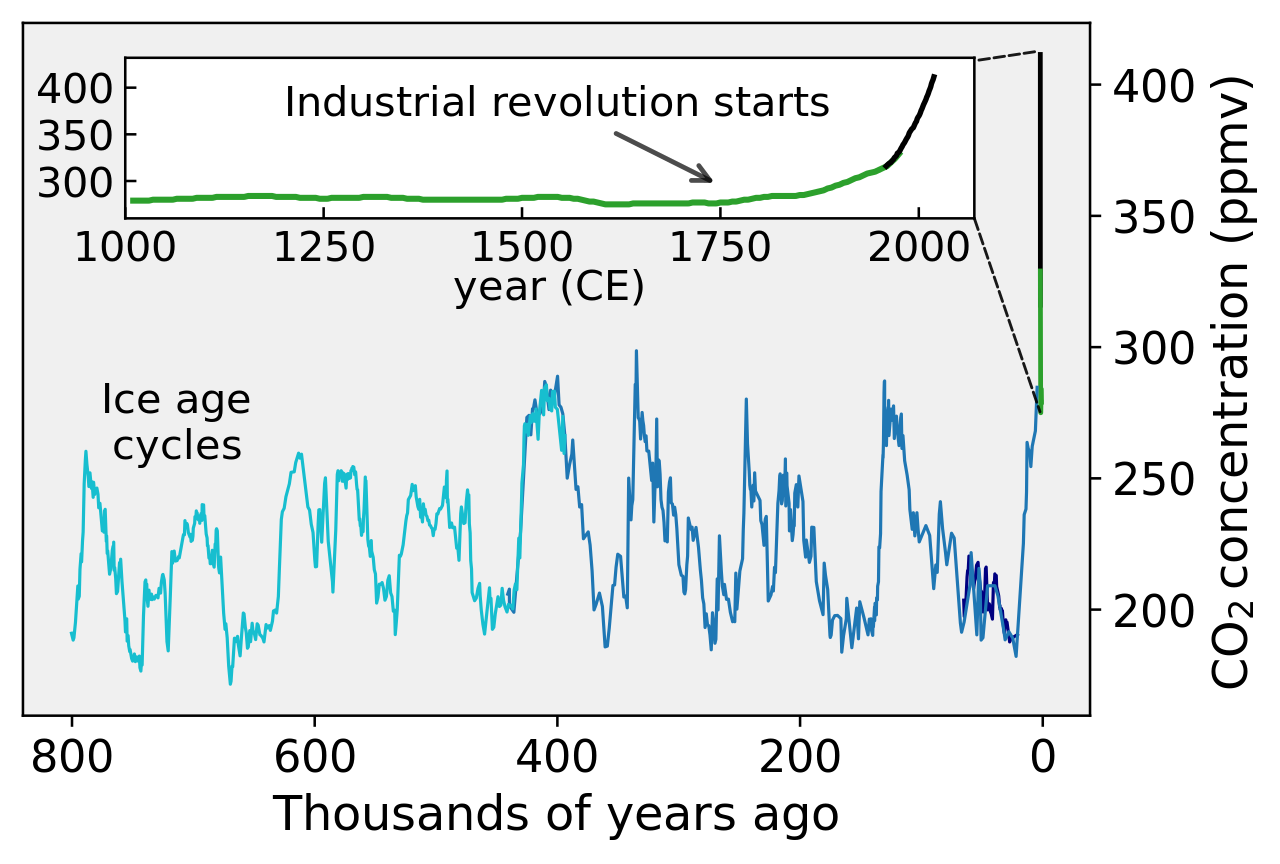
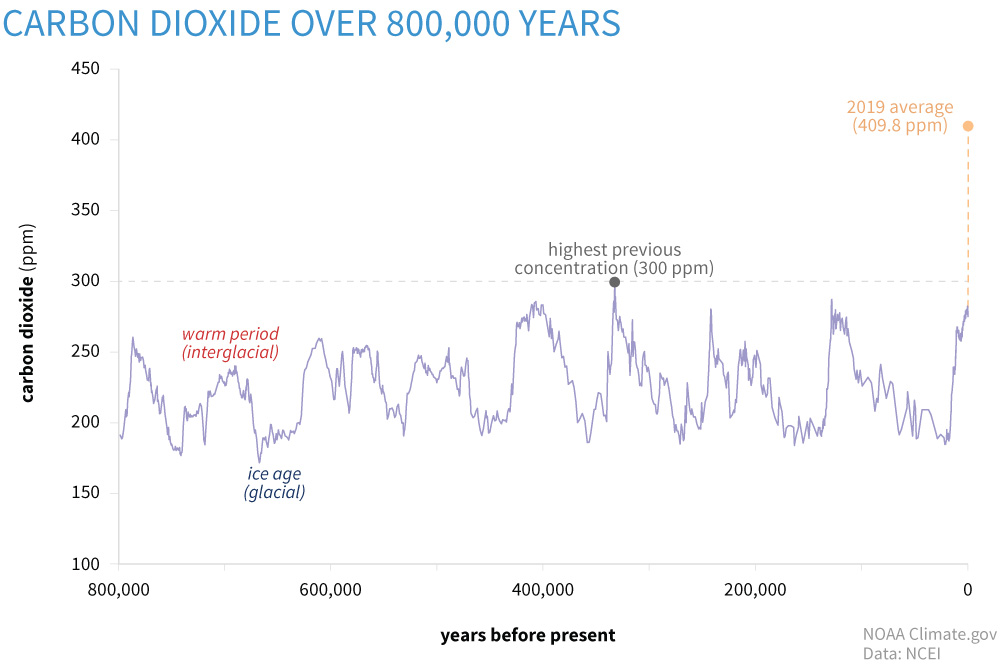
It's not a misdirection at all. It's exactly the point: CO2 has increased to levels not seen in 800,000 years. Temperatures have risen accordingly. The effects are already being seen, as has been predicted for years now. What they are finding out is that the predications were far too optimistic.
It's a hard thing to face, but putting our heads in the sand will do nothing. This problem can be solved, and we have the tools to solve them. Like with the coronavirus, we have solutions. It's up to people and the people they elect to face reality, follow science, and make the right decisions. If the science is rejected in favor of conspiracies and misinformation -- for political reasons -- then this only exacerbates the problem. -
Climate change denialIn 1983 the bold headlines in the Newspaper read "ICE AGE COMING" — Rxspence
What newspaper? No scientific journal was saying an ice age was coming. This claim has been debunked for years.
In 1984 "GLOBAL WARMING" 15 years to live if we don't change!! — Rxspence
No one said this in 1984. Literally no one. You're making this up.
In 1994 "GLOBAL WARMING" 10 years an we will be beyond hope!!! — Rxspence
No one said this in 1994. You're making this up.
I'm not taking either side — Rxspence
There are not two sides. There's the fact of climate change, and there's denial. If denial is a "side," then you have clearly chosen that side -- based solely on what you've said so far. It appears you've been exposed almost exclusively to denialist media, my guess being conservative media.
I'm saying you don't want to solve the problem,
you just want to divide people and take their money!! — Rxspence
You don't know anything about me. Making a claim like this is absurd.
I have no desire to divide people, and in fact the opposite: we need everyone to solve this problem. Repeating slogans about "taking people's money" does you no credit. -
Climate change denialI am neither political or a new member. — Rxspence
You are being political. Climate denial is political. Much like the tobacco industry propaganda, the fossil fuel industry has used social issues to associate with the science in an attempt to discredit it. But the science is clear.
Your denial is political, ultimately, even if you are not a political person. I don't expect you to acknowledge this or agree with it, but it's true.
There are many scientists that do not agree and denial of funding is the main reason
they are not herd. — Rxspence
Actually, climate deniers are better funded that most climatologists, and are heard far more than the vast consensus. This is one of the byproducts of "equal time" and "both-sides" that we often hear.
Scientists who "do not agree" are a minority, but are disproportionately heard and funded -- why? Because fossil fuel companies seek them out. They're usually not climate scientists, either. Plenty of good studies about this.
Nurseries produce co2 to help plants grow. — Rxspence
Have you done any reading on this topic at all? I ask seriously. If not, I have a question: are you willing to learn about it? If not, there's no sense in continuing. -
Climate change denialCan anyone name one thing in the Creation that does not change? Is not the climate an element of the Creation? Therefore, how is it that a person [other than a "Phobic-D" type personality] would view climate change as unusual? — 1 Brother James
There is no argument about climate change.
12.000 years ago there was an ice age, it has been warming since that time in history!
The purpose of political parties and religion is to divide people, create fear of the other group,
and fundraise. — Rxspence
Interesting that my post would elicit a political response, given by two "recent" members.
Yes, climate is an element of creation. Nuclear weapons are elements of creation. Should we not be cautious about them? Should we not understand the science beyond them, and the severity of the consequences if left unchecked?
The issue is not the change, but the rate of change. Yes, the climate has changed throughout a long history -- 4 billion years or so. But modern human beings have only been around about 200,000. In that time, but especially the last 12,000 years since the invention of farming, CO2 and warming haven't occurred to this degree. When you flash forward a few millennia to when scientific instruments were used deliberately to measure CO2, in the late 1800s, you have a very definite trend. Easy to see:
-
Climate change denialWorth taking a look around.
* A huge fire in Siberia is casting out smoke for 3,000 miles.
* Greece – burning.
* California – burning.
* Oregon – burning.
* Historic flooding in Germany and Belgium.
* Italy just experienced the hottest European day ever.
* July 2021 is the hottest month ever recorded.
* Drought and extreme weather disturbances are cutting food production, increasing hunger and raising food prices worldwide.
* Rising sea levels threaten Miami, New York, Charleston and countless coastal cities around the world in the not-to-distant future.
The above is from a Bernie tweet, but it's a good synopsis. This isn't the world I remember from the 80s and 90s, or even the 2000s. We've wasted 30 years thanks to the same stall tactics the tobacco industry used and which the fossil fuel lobby is now using.
Krugman has two very good articles in the Times worth a read as well:
Who Created the Renewable Energy Miracle?
The Bad Economics of Fossil Fuel Defenders
Of course, these facts won’t change Republican minds. It’s painfully obvious that politicians opposing climate action aren’t arguing in good faith; they’ve effectively decided to block any and all measures to ward off disaster and will use whatever excuses they can find to justify their position.
Why has the G.O.P. become the party of pollution? I used to think that it was mainly about money; in the 2020 election cycle Republicans received 84 percent of political contributions from the oil and gas industry and 96 percent of contributions from coal mining.
And money is surely part of the story. But I now think there’s more to it than that. Like pandemic policy, where the G.O.P. has effectively allied itself with the coronavirus, climate policy has become a front in the culture war; there’s a sense on the right that real men disdain renewable energy and love burning fossil fuels. Look at the dishonest attempts to blame wind farms for Texas blackouts actually caused by freezing pipelines.
In any case, what you need to know is that claims that taking on climate change would be an economic disaster are as much at odds with the evidence as claims that the climate isn’t changing. — Paul Krugman -
The Structure of The Corporation"What conceptions of wealth drive today's economic activity — James Laughlin
A good question, yes. Related to the structure of a corporation, indirectly.
I'd argue the predominant conception of "wealth" is one based in material accumulation -- in this case, the accumulation of capital. That's seen as wealth, and wealth is a means to power.
Today, there is also the tendency to regard nationalization and privatization of industries and services as efforts aimed at redistribution. This is not so at all. — James Laughlin
It mostly only results in concentration of wealth. — James Laughlin
Which is redistribution, and which is what we see. The policies of neoliberalism -- small government, deregulation, privatization, etc. -- have lead to a massive redistribution from more egalitarian (50s, 60s) to extreme inequality. RAND corporation published a study on the numbers, and it's in the tens of trillions. -
Democracy at Work: The Co-Op ModelYou'd get the same response here selling time shares in Narnia. — Cheshire
Actually the response has been quite good. You and NOS must be misunderstood defenders of truth. :wink: -
The Structure of The CorporationThe solution you are offering is an old one. Basically, force companies into being their own labor union or something of the sort. — Cheshire
No no. I don’t want to do anything of the kind. It’s true I value labor unions, but I don’t want to force anything. I’d like removing, in fact, some laws and regulations that are anti-union and anti-worker. But this isn't about coming in with guns and forcibly taking things over -- at least not in my thinking.
Fundamentally I want the business world to continue being capitalist if they want to, but to change the ideology back to managerialism and away from shareholder primacy, strengthen good unions, and open the space for more cooperatives. I think this is the most realistic option we have. The ultimate goal in the long term would be to dismantle illegitimate power structures altogether -- but that can't and won't happen overnight, or even in a few generations.
The era of managerialism saw the highest growth rates, and worker wages keeping up with productivity. Also has much higher union membership. This was before the financialization of the economy happened and big banks doubled in size. There’s no reason we can’t get back to that era. -
The Structure of The CorporationYou are right about the fact a problem exist, but what's needed is an innovative solution that functions with the rest of the economic forces in play. — Cheshire
Yes, of course. Just like what happens now. But those solutions aren’t working— which is why you mentioned “innovative”, I’m sure, and with which I agree. I think we need innovative solutions too. I’m trying to promote some of those solutions (again, not my own).
To be concrete: if wages at a company are low (compared to comparable work elsewhere), this puts them at a disadvantage— they’re more likely to have higher turnover rates, worse morale, lack of applicants, reputational damage (especially true these days where you can research a company online before applying, including worker reviews), etc. On the other hand, there are budgetary constraints — pay the workers too much, and the company may get squeezed or even put into debt, given that profit margins aren’t always the same.
It’s a complex situation, no doubt. The problem, according to research I cited by Lazonick and others, is that these decisions are being made on the basis of shareholder primacy theory. That is:
(1) under the idea that the shareholder is the owner (or partial owner) of the company (which we talked about, but let’s assume that’s true);
(2) thus the responsibility of the board of directors is to prioritize the shareholders’ aims;
(3) and that what shareholders want is to make a profit.
Therefore the responsibility of the company is to make a profit for shareholders. As you know, this was basically Friedman’s title of his famous 1970 article.
I agree with Lazonick that this is a problem. We’re seeing record profits and stagnating wages because most of the profits have been spent on buybacks and dividends— and why? Not because businessmen are evil and don’t care about their employees or community, but because this theory tells them this is what one's duties are.
More importantly, they mistake this theory for the law, and this is a myth. There’s no legal basis for shareholder primacy.
So in the end, it’s a matter of a “bad religion,” so to speak, and one that isn’t working for anybody, except for a handful of people in the short term — as can be seen when this "neoliberal era" (roughly 1980-today) is compared against the era from 1949-1979. It's a matter of ideology, which is why I've argued elsewhere (in "The State, Church, Corporation" thread) that the real power isn't necessarily in Washington or Wall Street, but in the Church of Neoliberal Capitalism. -
The Structure of The CorporationIt wouldn't make sense to say a companies profits go to wages, because those aren't profits by definition. — Cheshire
True, wages aren’t profits. When I said that I was thinking it would be clear I meant a raise in wages— i.e., giving the workers more— but fair enough.
In fact, all profits go to dividends or retained earnings or a reduction in retained earnings from treasury stock transactions. — Cheshire
No. Profits can be reinvested in the company by building new factories, buying more equipment, renovation, research, etc. They can also go to increasing worker salaries, to dividends, or to stock buybacks.
The answer is: stock buybacks. That’s where the profits are going. 94% go to this or dividends. Doesn’t leave much for the peon workers. At least since the 80s, thanks to Reagan’s administration— operating on the assumptions proposed by Milton Friedman. -
The Structure of The Corporation(5) Where do the profits mostly go, in today's typical fortune 500 company?
(a) Infrastructure (factories, buildings, equipment)
(b) Workers wages, benefits
(c) Expanding the workforce (hiring)
(d) Dividends
(e) Stock buybacks
(f) Paying taxes
(g) Advertising
(h) Lobbying
(i) Research and development (creating new products) — Xtrix
I meant to put numbers on the answer:
Percent of earnings (2007-2016)
55% stock buybacks
39% dividends
6% everything else
https://www.brookings.edu/wp-content/uploads/2016/06/lazonick.pdf -
Democracy at Work: The Co-Op ModelConfusing having a vote with ownership, control and autonomy is little more than casuistry in my mind. — NOS4A2
True -- as is also true when we vote for politicians. But that's a step above having no vote whatsoever. Furthermore, I'm not confusing the two. In worker co-ops, the workers are the "owners" (meaning they are their own board of directors). Plenty of real world examples; very successful (despite US laws making it much harder to form).
Mondragon (of Spain) is usually a standard example. A lot to learn from them. They're worker owned and partly worker managed (meaning they also hire outside mangers).
The problem is, unlike yourself and 180proof, I am incapable of envy and don’t feel entitled to owning someone else’s business. — NOS4A2
No one is talking about envy or owning someone else's business. This is a matter of corporate governance -- how corporations are organized. There's no reason why workers shouldn't have more say in decision making (including where the profits go) -- i.e., on the board of directors -- since they are also major stakeholders in the company (along with bond holders, shareholders, the community, etc). There's also no reason that workers who run the factories can't also own the factories (for example, given the option to buy a plant that the corporation chooses to close).
Besides, corporations aren't legally "owned" by anyone.
Just the fact that your instinct is to consistently argue against anything that would be beneficial for workers, society, or the environment, is why I repeat the sentiment, however harsh, that this old, destructive ideology you embody needs to die off with you and your ilk. Because it's apparent you're never going to wake up -- the Cold War propaganda has too much of a hold on you. -
Currently ReadingA History of America in Ten Strikes
Erik Loomis
The Epic of Gilgamesh - the most ancient recorded story — Pantagruel
And an awesome story, too. Should be required reading. -
Realizing you are evilMost people see themselves as good. This is just not the case. I think we are born with both potentials but tilt towards evil. Anything too add? — Caleb Mercado
Yes: what is meant by “good” and “evil”?
Before that’s answered, we’re talking passed each other. -
The Structure of The CorporationOk, your response above was good and I got it. We avoided here stupid misunderstandings and bickering. (We will leave that to the future issues and topics :wink: ) — ssu
Appreciate the kind comments. Caught me on an off day— I’m sure I’ll be back to being an asshole soon enough.
This transforms the corporation from being lead by founders to a high paid caste of professional leader-employees taking over the corporation. The corporations becomes dis-attached from humans as owners. Large family owned corporations are rare, even if there are those still. — ssu
Right, and even private corporations are fairly rare.
Once a company goes public, it’s not as if every decision changes with the aim of maximizing stock prices and dividends. The Microsoft and Apple examples are good ones — who knows how they look in 15 years or so? -
The Structure of The CorporationGood, so a worker-owner is a nonsense term by your own reasoning. — Cheshire
Not nonsense, just legally wrong. But it's true, I do use it to refer to workers (rather than shareholders) being the "owners" of the company, because that's the conventional view and common language. But yes, legally speak it's not correct.
The shareholders are not the owners of corporations.
— Xtrix
This doesn't make sense. I assume you mean here that the shareholders aren't in charge of corporations. — ssu
I know, it's a weird one. I had difficulty with it at first, but this isn't my own theory -- I'm basing this on legal scholarship. The late Lynn Stout of Cornell has good work on this. Here's Richard Booth:
https://scholarship.kentlaw.iit.edu/cgi/viewcontent.cgi?article=3350&context=cklawreview
Yes, the shareholders aren't legally in charge of the company. They are also not the legal owners. To make it easier to talk about, we speak about "share of ownership" and things like that, but it's legally erroneous. I myself didn't realize how prevalent this mistake is, in fact.
The ordinary argument goes that as the shareholders elect the board of directors, they have the ultimate power. This is perhaps what you call "The shareholder primacy theory" or am I mistaken? — ssu
You're exactly right. It's absolutely dominant -- which is partly why this is so hard to talk about.
Here again I'm talking about legality, not what happens in practice. You would certainly think that, because shareholders have the power to vote in board members, that they just vote in people who share their views, and vote themselves in -- and that's true. But it's also more complicated than that, because rarely is one person or company the controlling shareholder.
I think the reason boards actually DO act in accord with what shareholders supposedly want is precisely because of the shareholder primacy doctrine. It's on par with a system of belief -- one that's become entrenched in boardrooms and the business world generally.
Here's Stout, who explains it better: https://www.youtube.com/watch?v=k1jdJFrG6NY -
The Structure of The CorporationOh, so the meaning of ownership changes when your position changes. — Cheshire
No.
All of a sudden that legal sense in regards to legal liability and direction of assets is a hologram. — Cheshire
No. Shareholders being the owners of a corporation is a hologram.
Which is it? Is a corporation owned or not by actual people. — Cheshire
A corporation is not owned by anyone; a corporation, by law, as a legal person, owns itself. Persons, legal or otherwise, cannot be owned -- at least since we got rid of slavery. -
The Structure of The CorporationThe shareholders are not the owners of corporations. Neither are the board of directors, who run the company. The board of directors, although elected by shareholders, have no legal obligation to do what the shareholders want, and often don’t. There are plenty of court cases about this as well.
— Xtrix
Fascinating. Now, tell me how they are different than worker-owners? — Cheshire
Well compare Microsoft to Mondragon, for example. Both corporations. One (it's claimed) is owned by shareholders, the other (also claimed) by workers.
What does it look like in reality? The major difference is that the board of directors in the former are elected by shareholders -- more shares, more votes, and so the major shareholders (usually other large corporations, asset managers, occasionally very wealthy individuals, etc) vote in the directors (technically, although in reality the directors basically elect themselves due to almost never being voted against). In the latter case, the workers are their own board of directors.
It's the board of directors where the major decisions get made about the allocation of resources, the distribution of profits, whether to hire or fire a CEO, whether to give to charities, etc. But that's simply not the same as "ownership." You can't own a legal person. You can certainly control it, run it, manage it -- and that's what really matters anyway.
The shareholder primacy theory is an old one, and for the last 40 or so years has dominated academia (where it came from), journalism, the business world, and popular culture. But it has no basis in law, and has been a complete failure economically -- for investors (shareholders), for corporations themselves, for employees, for the community, and for the environment.
There's plenty of references, if you like. -
The Structure of The CorporationThey are legal entities; that is not a person. — Cheshire
I’ll repeat: corporations are legal persons, not real people.
https://en.m.wikipedia.org/wiki/Legal_person
Look no further than Citizens United to get a clear view of what the Supreme Court thinks of it as well.
The board is elected by the shareholders dumbass — Cheshire
That has nothing to do with ownership, dumbass.
aka the owners of the company. — Cheshire
The shareholders are not the owners of corporations. Neither are the board of directors, who run the company. The board of directors, although elected by shareholders, have no legal obligation to do what the shareholders want, and often don’t. There are plenty of court cases about this as well.
What they can’t do is steal from the company. That’s illegal. -
The Structure of The CorporationThey are economic entities. Not people. They do not own themselves otherwise a majority shareholder couldn't control them. — Cheshire
They are legal persons, not real persons. And they do own themselves, legally. That’s not the same thing as running itself, which is done by real humans. Mostly the board of directors and CEO.
Mikie
Start FollowingSend a Message
- Other sites we like
- Social media
- Terms of Service
- Sign In
- Created with PlushForums
- © 2026 The Philosophy Forum