
-
Case against Christianity
Not that I can recall. And in fact Paul was quite adamant that intelligence was to be destroyed by God:
"I will destroy the wisdom of the wise, and the intelligence of the intelligent I will bring to nought." 1 Corinthians 1:19
I don't know whether it's the case, but I wonder whether Paul wrote this letter after he visited Athens. I suspect his encounter with the Athenian philosophers didn't go quite as well as it's said it did. -
Case against ChristianityI do not believe that Christianity, its symbolism, theology, values and morals were the cause of nihilism. The christian religion - codified, already absolutely finalized - in the catholic view - - has been and continues to be used as a political and social tool, and nihilism is the consequence of our evil intentions - in most cases - when using it. The only way for a concept to be projected into the world is through the individual, and the individual uses it as he sees fit. The cause is not in the concept, but in the vehicle of its projection into the world. — Gus Lamarch
A speculation.
Christianity's effort to combine what I think is the foundation of Western civilization (ancient pagan philosophy) with peculiarly Christian doctrine and scripture ultimately failed because that doctrine and scripture became increasingly incredible (by which I mean less and less believable). When that happened, the end of Christian dominion in Western thought resulted in despair and disregard of reason and morality.
There came a point where the miracles, the resurrection, the immaculate conception, the trinity, the stories of the saints, the claim that Christianity was the only true path to salvation, couldn't be accepted as convincingly true. Then efforts were made to explain the more unlikely aspects of doctrine and doubtful claims of scripture by characterizing them as not literally true but otherwise profound. Christian apologists and theologians began to sound more like deists than Christians, something which began much earlier, in fact, when Augustine and Aquinas and others took on the task of interpreting ancient philosophy in such a manner as to justify, however awkwardly, Christian doctrine, or at least to be compatible with it by a version of special pleading.
But unfortunately (at least I think so) Christianity's emphasis and insistence on its peculiar beliefs overwhelmed its uncomfortable assimilation of pre-Christian philosophy, especially as far as its "flock" was concerned if not its shepards. So as Christian doctrine became unbelievable, and God was despaired of, nihilism and other alternatives were accepted by some. God being dead, all was permissible, etc.
So perhaps nihilism is the result of the failure of Christianity, or that failure contributed to it. -
Case against Christianity"Christianity formed a new standard, higher than any which then existed in the world...The justice teachings of Jesus are closely related to a commitment to life's sanctity..."
Duffy, Eamon (1997). Saints & Sinners: A History of the Popes. — Gus Lamarch
You might consider reading There is no Crime for those who have Christ: Religious Violence in the Christian Roman Empire by Michael Gaddis regarding what was justified in the name of that higher standard, from the beginning of Christian dominance of the West. If there is such a higher standard, it's likely there has never been one so blithely ignored in all of our sad history, and by avowed Christians too. -
Case against Christianitythe Stoic philosopher Seneca writes unapologetically: "Unnatural progeny we destroy; we drown even children who at birth are weakly and abnormal... And whilst there were deviations from these views..., it is probably correct to say that such practices...were less proscribed in ancient times. Most historians of western morals agree that the rise of ...Christianity contributed greatly to the general feeling that human life is valuable and worthy of respect." — Gus Lamarch
You're not really claiming this is quote from Seneca, are you? I know that Christianity borrowed assiduously from the Stoics and other pagan philosophers in trying to create a intellectual basis for itself, but to claim he wrote this about Christianity is excessive even for those ever-acquisitive early Christians.
P.S. I do like the "probably correct" qualifier. -
Case against Christianity
The "bathwater" are the beliefs peculiar to Christianity, such as the beliefs I've mentioned, which can easily be thrown out without disposing of the ideas of pagan philosophy, the "baby." -
Case against Christianity
Sorry, but I don't think you answer my question. I don't see how the claim that the rejection of Christian doctrine entails the rejection of some of the ideas of pagan philosophy follows from the fact the Christian Fathers borrowed from pagan philosophy in an effort to support Christian doctrine. -
Case against Christianity
Just what ideas of ancient pagan philosophers do you think would have to be rejected if a specifically Christian theology is rejected?
As far as I'm aware, no pagan philosopher had any idea supporting the belief that Jesus is the Son of God; that Jesus is one in being with the Father; the doctrine of the Trinity; the resurrection of Jesus; the Ascension; the Immaculate Conception; the Second Coming, at which the living and the dead will be judged; or any of the beliefs that distinguish Christianity from other religions, or from deism, pantheism, and panentheisn for that matter.
Christian theology resembles pagan philosophy only to the extent it isn't distinctively Christian--when what is distinctively Christian is ignored or disregarded. -
Case against ChristianityOn his "Criticism of the Gospel History of the Synoptics" he argued that Jesus was just a literary figure. In "Christ and the Caesars" he argued that christianity was a synthesis of the stoicism of Seneca the Younger and of the jewish theology of Philo as developed by pro-Roman jews such as Josephus. — Gus Lamarch
The early Christians were quite fond of Seneca, and one (or more) of them even took the trouble of writing up a forged correspondence between him and St. Paul. Tertullian referred to him as "our Seneca." The influence of Seneca and Stoicism in general on Christianity is quite clear. There's some speculation that Paul was influenced by Stoicism because he came from Tarsus, then a center of Stoic philosophy. Neo-Platonism was influential as well.
Christianity as we know it is quite a remarkable hodgepodge of pagan philosophy, pagan religions and the Jewish tradition. Necessarily so, I think, as early Christians struggled to impart some intellectual substance and dignity to Christian doctrine by borrowing lavishly from ancient philosophy, such as the concept of Logos which appears, quite unexpectedly, in the Gospel of John. Its success was, as well, assured through its assimilation of popular pagan beliefs and practices, and its very un-pagan intolerance and exclusivity, which became more apparent as the Christian emperors ruthlessly suppressed paganism. Perhaps that was the Jewish influence.
As for Jesus, I suspect there was a person who served as the inspiration for the legends which arose, just as I suspect there likely was a person who inspired the very similar legends of Jesus' contemporary, Appolonius of Tyana. -
The way to socialist preference born in academical home(summary in first post)I value freedom. Not wealth necessarily. I know there's no way of getting this message across, because you seem to have already decided I must be a terrible person for having different ideas.
One can be selfless without having to be forced by government.
I'll leave it at that. — Tzeentch
I value freedom as well.
Government can certainly restrict freedom. I think it's improper for it to do so in some cases. I also think that government should not spend money or resources it may acquire from us (e.g. through taxes) for certain purposes. As a rule (which is to say subject to certain exceptions), government shouldn't restrict our ability to, e.g., think, to communicate, to be religious or irreligious, to assemble, to travel. As a rule, government shouldn't spend money to, e.g., wage unjust wars, to oppress civil liberties. What government does can be objectionable, and should be opposed in that case.
I don't think it can be reasonably maintained, however, that government action to care for its citizens who don't have the financial resources to obtain essential medical services or are impoverished is objectionable in the same sense that government restricting the freedoms I mentioned or waging unjust wars is objectionable. So, I think that those who object to government taking such action (which as a practical matter would involve devoting resources obtained from some citizens to furthering such action) can't legitimately claim that they object to it to preserve civil liberties, freedom or prevent government from acting improperly.
No doubt there are those who think that the impoverished have only themselves to blame for their condition and governments should not assist them for that reason, but that's different from saying that it should not do so because it will restrict freedoms or violate claimed rights.
The only "right" which would be violated by such government action is a "right" to have and retain money and property, and the only "freedom" which would be restricted would be the "freedom" to keep others from sharing a part of it.
I'm not adverse to private property. I don't think all resources should be owned and controlled by the state. Neither do I think that government assistance to the impoverished is wrong, or that those that possess money and resources far beyond what they could need to live well and comfortably should in no case be required to contribute to such action by the government.
I think that those who claim they shouldn't be required to do so must accept, if they're honest, that they aren't engaged in a quest to ensure freedom and liberty. They're merely sanctioning a form of governance which will inevitably result in a substantial number of citizens being impoverished, and a far less substantial number who are wealthy. I understand that seems perfectly appropriate to some. I just think they shouldn't fool themselves by thinking that's the way it must be in a free society. -
The way to socialist preference born in academical home(summary in first post)
You think the fact you recognize other have rights, money and property renders your insistence on having your own rights, money and property unselfish? I don't think that works.
Regardless, unless you find honesty disagreeable, I don't understand why you would object to my suggestion that we should honestly say that we don't want government taking or using our money to help others for what are essentially selfish reasons. Nor do I understand why you think that suggestion makes me a monster.
It's true, of course, that we and our objections to government doing so would in that case seem far less admirable or worthy than some might like, and perhaps even sordid if we have far more money and property than we could need, but that's often the price of honesty; particularly self-honesty. Nor would our honesty in this respect imply that that our money and property are unimportant. They obviously are very important--to us, not to others. -
The way to socialist preference born in academical home(summary in first post)While I understand individuals may have different opinions on the implications of this inherent tension at the center of governance, I find it disconcerting that many cannot even recognize it. — Tzeentch
I find it disingenuous, if not dishonorable, to disguise the simple desire to keep one's possessions from others by platitudes about limiting the power of government. Why not be honest about one's selfishness? My money, my property, my rights--what could be a more self-centered view of our place in the world? -
The way to socialist preference born in academical home(summary in first post)Oh, I am concerned with the welfare of people around me. I just don't believe such concern should be forced upon me or anyone else through government. — Tzeentch
God forbid you be that concerned.
But who would be forcing anyone to be concerned? It's not the mental state of people that would be impacted. They could be as miserly, unsympathetic, uncaring, cruel and selfish as they please. They'd just have to contribute to the welfare of people around them, even though they don't want to or don't care to do so. True? Someone who's concerned about socialism is concerned about his/her money and property being used, by government, for someone else's welfare. -
Abortion, IT'S A ProblemWords betray our thoughts. — TheMadFool
They also may betray our confusion, ignorance or lack of understanding of language, its meaning and use. Or, they may apply in some context, and not in others. The use of the word "it" may be suggestive in some ways in some cases, but not in others.
Also, don't forget that animals, despite your exemplary humanity, don't have the same rights as we humans do. — TheMadFool
There's that annoying word "rights" again. Do you refer to legal rights, or non-legal rights? Sadly, dogs don't have the right to vote (worse yet, cats don't have the right to vote). I'm uncertain whether this is ethically significant, though. Are you addressing the legal rights of a foetus, or some other "rights"? -
A Right To A Self-Determined Death1) Do you buy the notion that in general would-be suicides are making autonomous, self-determined decisions? I accept that in theory an individual may resign his life in the same way a chess-master resigns a chess game. That is, the chess-master knows it's all over but for a move or two - life, of course, differing from chess in some significant ways. — tim wood
I don't know how many of those who have committed suicide or who contemplate suicide are making "autonomous, self-determined decisions."
I don't think suicide is appropriate solely because someone wants to die. I dislike the concept of "rights" in morals, though I think it has a place in law and for the purpose of protecting civil liberties. So, it isn't clear to me anyone would have a non-legal right to die regardless of the circumstances. At the same time, though, I don't think the law should prohibit suicide in all cases, or make assisting in it criminal in all cases.
There's a distinction between law and morals. I prefer virtue ethics in part because I tire of people insisting they have non-legal rights which must be respected in all cases.
I think the decision whether or not suicide is proper has to be made on a case by case basis. I don't think, for example, that suicide is necessarily justified where others depend on the person contemplating suicide for their well being (financial or otherwise). In that case, their interests should be considered. Suicide isn't merely a selfish concern. If others will suffer significantly and needlessly because of a suicide, I don't think the decision to commit suicide would be virtuous. Suicide obviously isn't appropriate where the potential suicide is incapable of making an informed decision or suffering from a delusion motivating the suicide.
But there are circumstances where suicide may be appropriate. When someone is presented with an intolerable choice to be made, such as when the circumstance is such that one either must die or others must die, for example.
This all makes the decision whether or not to commit suicide and whether to make it subject to law a difficult question.
2) On the assumption that would-be suicides are making a "good" decision (criteria here unspecified), is the community obliged to facilitate assistance either actively or passively? That is, on request is your doctor obliged to give you the lethal pills or administer them himself, or alternatively, may some set up businesses to render that service while the community "looks the other way"? — tim wood
I don't think there is any such obligation. There is no duty to help someone to commit suicide, though one may do so voluntarily.
About the law. Suicide in itself shouldn't be criminal. People who make informed decisions which impact only their own lives should be allowed to do so. Assisting someone who wants to die because they're subject to a treatable mental disease may be criminal, however. -
A Right To A Self-Determined Death
Agreements to commit a crime are generally void, and so unenforceable. So, anyone performing the service would want money up front. But even if there was no crime, that would be the smart way to go. Otherwise, the suicide's estate may be liable depending on the law, but why bother with whatever procedure that would require?
If the agreement was legal, I suppose the obligation to pay could be guaranteed by someone who could be collected against after the suicide, but again money up front would be best for the...Assistor? The Terminator? I can't help but imagine the advertising which would be generated by those providing the service for money. -
Donald Trump (All General Trump Conversations Here)The law sets out specific requirements to qualify as a legally valid self-defense or defense of property claim. In order to justifiably use lethal force in WI, ones life must be in danger. His was not. So, no valid self-defense claim. Nor was he the owner of the property (or employee/agent of the person whose private property) he was purportedly "protecting": again, invalidating any claim to a legal defense of property. — Enai De A Lukal
Just so. -
A Right To A Self-Determined DeathI don't have the time right now to look into the law in question, but the words "as a professionalized service" are interesting. Those words indicate, or at least imply, that a paid service, presumably by someone in a profession licensed by the state, is the subject of the prohibition of the law. So, conceivably the law is intended to criminalize the conduct of professionals in charging for their services rendered in assisting in a suicide. If that's so, volunteering to assist without charge wouldn't be criminal.
If that's the intent, it raises interesting questions (at least I think so): May someone assisting a suicide charge for their services? If so, how much should they be allowed to charge? Leave that to the market?
Who'd be responsible for payment? I imagine payment "up front" would be demanded. A whole new industry for regulation! -
Donald Trump (All General Trump Conversations Here)
Everyone has a fantasy. In the case of these unfortunates, it's a fantasy of being law enforcement or soldiers, or perhaps just walking about with a gun excites them. Who knows what actually shooting people would do for them? A Christian fundraising site is raising money for this particular shooter's defense. It's what Jesus would want, you know. -
Donald Trump (All General Trump Conversations Here)
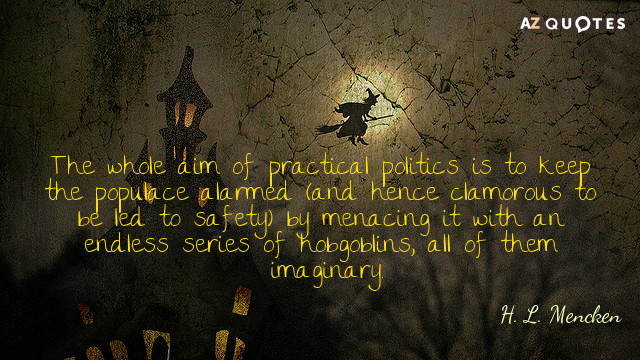
Fearsome words for a fearsome time and fearsome people, so easily made fearful when anyone has the means to invoke fear. If only the Sage of Baltimore was with us today, to witness the worst of what he predicted. -
Donald Trump (All General Trump Conversations Here)John Galt wouldn't have hair like that. I suppose that even fans of Ayn wouldn't like things rough all the time, though, and he should be left alone to say whatever he likes, poor fellow.
-
Donald Trump (All General Trump Conversations Here)Such a long thread. Damned if I'll read it all.
The comparisons with Hitler and Mussolini have become tiresome. Besides, Mussolini actually read books, and even wrote a novel.
But has anyone noted the remarkable resemblance to Sinclair Lewis' Senator Windrip?
Or, even more striking, to Kaiser Bill, as described by Thomas Nipperdey?
"... hasty, restless, unable to relax, without any deeper level of seriousness, without any desire for hard work or drive to see things through to the end, without any sense of sobriety, for balance and boundaries, or even for reality and real problems, uncontrollable and scarcely capable of learning from experience, desperate for applause and success, romantic, sentimental and theatrical, unsure and arrogant, with an immeasurably exaggerated self-confidence and desire to show off..." -
Heidegger and Etienne GilsonEtienne Gilson is known for his critical views about Heidegger — Stephany Rolim
Someone is critical of Heidegger? You astonish me. I hope the criticism isn't based on the fact he was an unapologetic Nazi and virulent anti-Semite. -
Why do scientists insist in sustaining multiple languages?And most importantly, how are people okay with the state things are now? — Seth72
Well, we drudges muddle along somehow. Not all that much of our uninteresting, narrow lives requires a great deal of precision, and generally takes place within a particular location in which a particular language is in exclusive use or predominant. So, the possibility of being confused by the use of other languages or the need to translate them is minimal. I can't remember the last time I needed to translate a document written in Walloon or was confronted by someone speaking Euskara.
Latin apparently worked rather well as a "universal" language at one time, at least for legal, administrative and military uses among peoples of different languages during the Roman Empire, but beyond that I don't know what to suggest.
No doubt you scientific types will be able to communicate telepathically soon enough, so perhaps this won't be a problem for long. -
The Impact of the Natural Afterlife on Religion and SocietyAssuming I understand, and recognizing that I'll have to give it a better reading, some preliminary thoughts:
As to (1). My knowledge of religions is fairly limited, especially any religion that isn't Christian, though I read as much as I can about the religions of the pre-Christian Roman Empire. That said, I speculate that no Christian religion of which I'm aware would accept being frozen, as it were, in a moment, as a satisfactory afterlife. That afterlife would seem too haphazard. Possibly blissful, or as blissful as it may be when nothing takes place; possibly horrifying, all depending on what a person experiences in the moment prior to death. There's no redemption, no salvation, no reward for holiness, no punishment for sin, no judgment. Unless perhaps you accept the concept of grace as purely random, God (as a Christian would likely conceive God) plays no part.
As to (2), I see no benefit resulting to society. Accepting there is a natural afterlife as seems to be described, it strikes me people may become morbidly concerned with trying to arrange to have a pleasant moment before death and avoid an unpleasant one. People wouldn't even have the consolation, so to speak, of non-existence or dissolution. There looms before us a potentially good or potentially bad moment after death that would be unending (though you may not know that while in that moment). -
Thought is a Power Far Superior to Any GodWell, I haven't thought about God for some time, and there was apparently nothing He could do about it. Until now, thanks to you. You're working for Him, aren't you?
-
Why were my threads on Computer Psychology deleted?Personally, I think a computer deleted it. For psychological reasons.
-
Privilege"Equitable" is socialist and runs contrary to values which brought about the most free rendition of society of which humanity has yet been capable. — whollyrolling
Yes, only socialists would treat people fairly and equally. Thank God nobody does that here in His Favorite Country! -
Reality As An IllusionLet's call this one a draw. — Pantagruel
That would be fine.
It's good to know there's another admirer of Dewey here. I think he was extraordinarily insightful. -
Reality As An IllusionAnd upon what do you base the assertion that Descartes did not experience this as a real and living doubt? He said he did. So you just do not believe him? Now it is a question of credibility. — Pantagruel
Well, he set the stage, as it were. I think he made it clear he was engaging in an exercise, a contrived one that he didn't really think anyone engages in normally, purportedly for the sake of acquiring an unshakeable foundation for thought. This supposedly required him to establish an absolute certainty; something that could never be questioned. Something needed, though I don't know why he thought it was needed, to eliminate any concern that we might be dreaming, or worry that an evil demon was fooling us.
Now I suspect he never really thought there was an evil demon; he was never really concerned that Beelzebub or some other demon was making him think he was writing about Beelzebub or some other demon making him think he was writing about him, or that he was sitting in a chair while doing so in his room while doing so. That's what I think of as faux doubt. A "doubt" which is entertained solely for the sake of making a point. -
How do you know!?!I think that claims that there is no God, or it's likely there is no God, are typically made as responses to claims that there is a God or likely is a God. They're made in the context of God-claims. Can one think of any instance in which someone went about declaiming there is no God except in the context of God-claims? Not even Nietzsche did so. People don't go from door to door asking if we have heard there is No Good News, or to confirm that we have not accepted Jesus as our savior.
So, I'm inclined to think there are differences between such negative and affirmative claims, and true I suppose to my legal background I tend to feel that those who make an affirmative claim have the burden of proof, and nobody should be required to prove a negative. [A Judge actually asked me once to prove there was no law providing such-and-such, which would have required that I provide for review every existing law.]
That's not to say, though, that I encourage anyone to discuss or argue over whether or not there is a God. -
Reality As An IllusionIf you're not acquainted, I recommend Peirce's essay in full "Fixation of Belief" (1877). — 180 Proof
Also Some Consequences of Four Incapacities. Peirce laid into Descartes in that essay as well. For Peirce and Dewey, actual doubts--actual problems or uncertainties which we seek to resolve--motivate inquiry. -
Theism is, scientifically, the most rational hypothesisSo is the Holy Spirit and Jesus our father or not? — Gregory
They are not the Father. But they're God, and so is He--according to the explanation given. -
Reality As An IllusionSo if you want to discount any beliefs that aren't "existentially impactful" I'll just as casually ignore your comments about Descartes. — Pantagruel
I'm unsure what you mean be "existentially impactful." But if you want to ignore my comments, suit yourself. If your desire is to ignore things, there's no better guide to doing so than Descartes. -
Theism is, scientifically, the most rational hypothesis
There's a kind of special pleading involved in such apologetics. Faced with the fact that scripture clearly distinguishes between the Father and the Son and the especially vague Holy Spirit or Ghost, but committed nonetheless to the claim there is only one God and infuriated when pagans such as Celsus and Porphyry noted this problem, Christians had to come up with an explanation. They resorted to using pagan philosophy to explain how divinely inspired scripture didn't really say what it says.
They were more lawyers than philosophers (Tertullian was a lawyer, in fact). But I still admire an old priest I knew who explained that the Trinity was like a ham sandwich. Two slices of bread and ham there may be, but there's only one sandwich. That says it all. -
Reality As An IllusionIf Descartes' doubt is faux doubt, then equally anyone's commitment to any belief could be characterized as faux belief...unless it led to a serious commitment in actual circumstances. Unless you are practicing faux philosophy, please don't minimize one of Mssr. Descartes' central tenets. :) — Pantagruel
There are some things we can't properly be said to "believe." I don't "believe" I'm eating, breathing, pissing. I need make no "serious commitment" in order to understand this to be the case. Nor can we be properly said to "doubt" such things. Imagine wondering whether you're really breathing as you breath. I think it's unlikely Descartes doubted he was really writing his "central tenets" as you call them, while writing them. He was engaging in an extended game of "let's pretend." It isn't clear to me that the result of the game was in any way useful. -
Joe Biden (+General Biden/Harris Administration)
Thank you. We can be otherwise useful, though, in drafting legislation and assessing its legality. But even as administrators we're notoriously inept; can't even run our own damn firms and so must hire office administrators. -
Reality As An IllusionSpecifically what about Descartes' proposition of radical metaphysical doubt qualifies it as being faux doubt? — Pantagruel
I would say we cannot truly doubt everything because by living we don't doubt everything. In fact, we rely on everything, for the most part unreservedly. Thus we eat, drink, walk, build things, interact with each other and the world at large every minute. We wouldn't if we had any real doubt. We doubt, really, when we have reason to in specific circumstances. -
Theism is, scientifically, the most rational hypothesisI don't find it convincing at all, especially considering that the Trinity muddles the whole question (is the Son our father too?) — Gregory
Why, the Trinity is no problem at all. Pater, et filius et Spiritus Sanctus are merely three divine persons all having the same substance. The persons are distinct, but not the substance. The persons answer the question who is God, but the substance determines what is God.
So, God the Son is the Jesus person; God the Holy Spirit is the dove person (a very special dove, though) and God the Father is the person with the white beard. That's who they are. But what they are is God.
I'm trying to work out a sort of "who's on first?" routine with this which I'm sure will make things clearer.
Ciceronianus
Start FollowingSend a Message
- Other sites we like
- Social media
- Terms of Service
- Sign In
- Created with PlushForums
- © 2026 The Philosophy Forum