
-
Measuring Qualia??addendum:
AI systems like ChatGPT are not beings in the philosophical sense of entities with a mode of existence, let alone lived experience. They have no interiority, no standpoint, no world—they are tools that process inputs and produce outputs based on statistical associations. They're not subjects of experience.
To borrow from Heidegger: ChatGPT is not a Dasein—a being that is concerned with its own being. It has no care, no embodiment, no finitude, no concerned involvement with the world. Without these, there is no horizon in which pain—or joy, or meaning—could arise. — ChatGPT -
Donald Trump (All Trump Conversations Here)But then, you're willing to trust Tulsi Gabbard's rewriting of history, over the unambiguous findings of the bi-partisan committee that investigated the matter at the time, and came to the opposite conclusion.
Key Findings of the Bi-partisan Senate Intelligence Committee:
- Russian Interference Was Extensive – The committee confirmed that Russia engaged in a sweeping influence campaign, including hacking Democratic emails (via GRU operatives) and spreading disinformation through social media (via the Internet Research Agency).
- Preference for Trump – The Russian government viewed Trump as a candidate who would align more closely with their interests and worked to boost his candidacy while undermining Clinton.
- Contacts Between Trump Campaign and Russia – While the committee did not establish a formal conspiracy, it documented numerous contacts between Trump associates and Russian officials, some of which raised counterintelligence concerns.
- Bipartisan Consensus – Unlike other politically divisive reports, this investigation was notably bipartisan, with Republicans and Democrats largely agreeing on its conclusions.
Contrast with the Mueller Report:
The Special Counsel Robert Mueller investigation (2019) also found that Russia interfered to benefit Trump but did not establish enough evidence to charge Trump campaign officials with a criminal conspiracy. However, the Senate report went further in detailing the extent of Russia's preference for Trump.
As for Gabbard, CNN reports:
The director of national intelligence told Americans this week that what everyone has known about the 2016 election is backwards.
The US intelligence community; bipartisan Senate review; the Mueller report; the Durham report — years of investigations concluded or did not dispute the idea that Russia meddled in the election and that it preferred Donald Trump to Hillary Clinton.
In Gabbard’s telling, the idea that Russia meddled and that it favored Trump is a narrative spun out of a conspiracy hatched by then-President Barack Obama to undermine Trump from the get-go. Trump clearly approves of Gabbard’s version, although there’s no evidence to support her claims.
The upshot is that right now the Trump Presidency is consumed by two competing conspiracy theories: one, that Russian interference in the 2016 was a hoax, the other being the Epstein affair. It's a complete schemozzle and a shitshow. -
Measuring Qualia??the same way AI interprets any kind of pictures, it can EASILY map out the MR scans of the active brain areas to conclude which qualia is (statistically) present. — Ulthien
What do you think, ChatGPT?
A clear false, with an important caveat.
Let’s unpack both statements.
Banno’s Claim:
“ChatGPT cannot participate in the ‘form of life’ that would enable it to be in pain.”
True — and philosophically well-informed.
Banno is drawing on Wittgenstein’s notion of "forms of life", meaning the shared, embodied practices and ways of being through which concepts like "pain" have meaning. For Wittgenstein, understanding a concept like pain isn’t merely about identifying a signal or a word—it’s about living within a context of behavior, reaction, and shared experience. Pain isn’t just a data point—it’s an experience embedded in a web of reactions, practices, and norms.
ChatGPT doesn’t inhabit any such form of life. It doesn’t have a body, or feelings, or concerns. It doesn't suffer. So it cannot understand pain in the way humans do—not even potentially. It can simulate descriptions of pain or analyze patterns, but that’s not the same thing as feeling or genuinely understanding it.
ULTHIEN’s Claim:
“AI can easily map out the MR scans of the active brain areas to conclude which qualia is present.”
This is false, both scientifically and philosophically.
Scientifically:
Even the best neuroscientists cannot determine the specific qualia (the what-it’s-like aspect of experience) from a brain scan. We can correlate certain brain patterns with reported experiences of pain, vision, or emotion—but this is always interpretive, not direct access to qualia.
Machine learning systems can be trained to classify neural patterns—e.g., “this pattern likely corresponds to pain”—but they do not know what pain feels like, nor can they bridge the explanatory gap between neural activity and subjective experience.
Philosophically:
Mapping neural patterns doesn’t tell you what it’s like to be in pain. This is the Hard Problem of Consciousness (Chalmers): explaining how and why certain physical processes give rise to subjective experience at all.
Even if a model gets very good at predicting that someone is in pain, that’s not the same as knowing what pain is. It’s just recognizing statistical regularities—shadows of something it doesn’t and can’t touch.
Conclusion:
So yes, Banno is right. Understanding pain isn’t about mapping brain data; it’s about being a kind of being for whom pain is possible. And ChatGPT, or any other current AI, is not that kind of being. — ChatGPT
@Banno -
Gun Controland hope that the government never turns them on you. — Leontiskos
The one liberal democracy that is under real threat from its own government is the US, and no amount of gun ownership is going to change that. -
Why Religions FailWhat do you take "purify the mind" to mean? — Tom Storm
Purification in Theravada Buddhism is to observe the precepts and learn to bring the mind to bear on wholesome states of mind. In addition there are various meditative disciplines such as kasina which is concentration on various shapes and designs and mindfulness training. These are aimed at ‘one-pointedness’ of mind culminating in states of jhana (meditative trance) of which there are eight gradations. But that is in turn predicated on the vinaya or the lay version of the precepts and the Buddhist way of life. It’s very different from and probably at odds with typical modern lifestyles in many ways (mine included.)
(I thought the portrayal of Thai Buddhism in the recent season of White Lotus was quite realistic in many ways. The idealistic young Piper Ratliff who had had her heart set on staying at the Wat for a year changed her mind after staying a week, largely because there was no air-conditioning and the diet was meager.) -
Gun ControlI generally supported the Australian Governments Covid precautions. Despite similar populations, Florida experienced a significantly higher number of COVID-19 deaths than Australia during the main period of the pandemic. For instance, an early comparison in October 2020 showed Florida with 14,142 deaths compared to Australia's 882. While numbers increased for both jurisdictions over time, the disparity remained pronounced, while American libertarians spread all kinds of nonsense about facemasks being an infringement of civil liberties and vaccinations being a UN plot. As with gun rights, the consequence is a lot more deaths.
-
On PurposeEnactivism can be consistent with more traditional Aristotleianism, Thomism (even of the existential variety), or more "Neoplatonic," thought, although it often isn't. — Count Timothy von Icarus
My comments on about were directed at dfpolis, who seemed dismissive of the idea of 'intentionality' in any context other than that of a rational subject. I was trying to explain that enactivism indicates to a larger sense of intentionality. That was very much the point of this post. But two of the books I'm reading on systems science and biology (Deacon and Juarrero) both draw on Aristotelian biological and (to some extent) metaphysical concepts. Aristotle after all is part of the 'grammar of Western culture'.
I will acknowledge that one source of my interest was my reading of Nagel's Mind and Cosmos. This is (again) the relevant passage from his précis of that book:
The scientific revolution of the 17th century, which has given rise to such extraordinary progress in the understanding of nature, depended on a crucial limiting step at the start: It depended on subtracting from the physical world as an object of study everything mental – consciousness, meaning, intention or purpose. The physical sciences as they have developed since then describe, with the aid of mathematics, the elements of which the material universe is composed, and the laws governing their behavior in space and time.
We ourselves, as physical organisms, are part of that universe, composed of the same basic elements as everything else, and recent advances in molecular biology have greatly increased our understanding of the physical and chemical basis of life. Since our mental lives evidently depend on our existence as physical organisms, especially on the functioning of our central nervous systems, it seems natural to think that the physical sciences can in principle provide the basis for an explanation of the mental aspects of reality as well — that physics can aspire finally to be a theory of everything.
However, I believe this possibility is ruled out by the conditions that have defined the physical sciences from the beginning. The physical sciences can describe organisms like ourselves as parts of the objective spatio-temporal order – our structure and behavior in space and time – but they cannot describe the subjective experiences of such organisms or how the world appears to their different particular points of view. There can be a purely physical description of the neurophysiological processes that give rise to an experience, and also of the physical behavior that is typically associated with it, but such a description, however complete, will leave out the subjective essence of the experience – how it is from the point of view of its subject — without which it would not be a conscious experience at all.
So the physical sciences, in spite of their extraordinary success in their own domain, necessarily leave an important aspect of nature unexplained. Further, since the mental arises through the development of animal organisms, the nature of those organisms cannot be fully understood through the physical sciences alone.
That “important aspect of nature left unexplained” refers to the very issue at the heart of the so-called hard problem of consciousness: the first-person, felt nature of experience — the immediacy of embodied existence. This, I think, is where phenomenology enters: it seeks to restore the primacy of first-person experience that the objective sciences methodologically bracket out.
What is bracketed, however, is not incidental. It is, quite simply, Being. (And tellingly, we ourselves are designated 'beings'.) Over the years, I’ve engaged in many vexed discussions on this forum over whether there is an ontological distinction between organisms and things. I continue to maintain that there is — and that this distinction begins to manifest as soon as life appears.
My view might resemble panpsychism in some respects, but it maintains a principled distinction between the organic and the inorganic. Call me romantic, but I’m drawn to the idea that the appearance of life just is the appearance of mind — not as an élan vital, a separable essence, but as that without which the constituents of life remain mineral. Life is not caused by mind as something external to it, but mind manifests itself as living organisms. And so the physical, as we understand it, is insufficient on its own: it is an abstraction, and something deeper — subjective presence, embodied directedness — has always been part of the picture, even if the objective sciences generally set it aside. -
Gun ControlRogan has nothing to fear from the head of the Australian Broadcasting Corporation. And nobody here gets sued for criticizing the Prime Minister provided the criticism is fact-based.
Yet the chart pairs 11 (ot of 200 countries) against 1 — Outlander
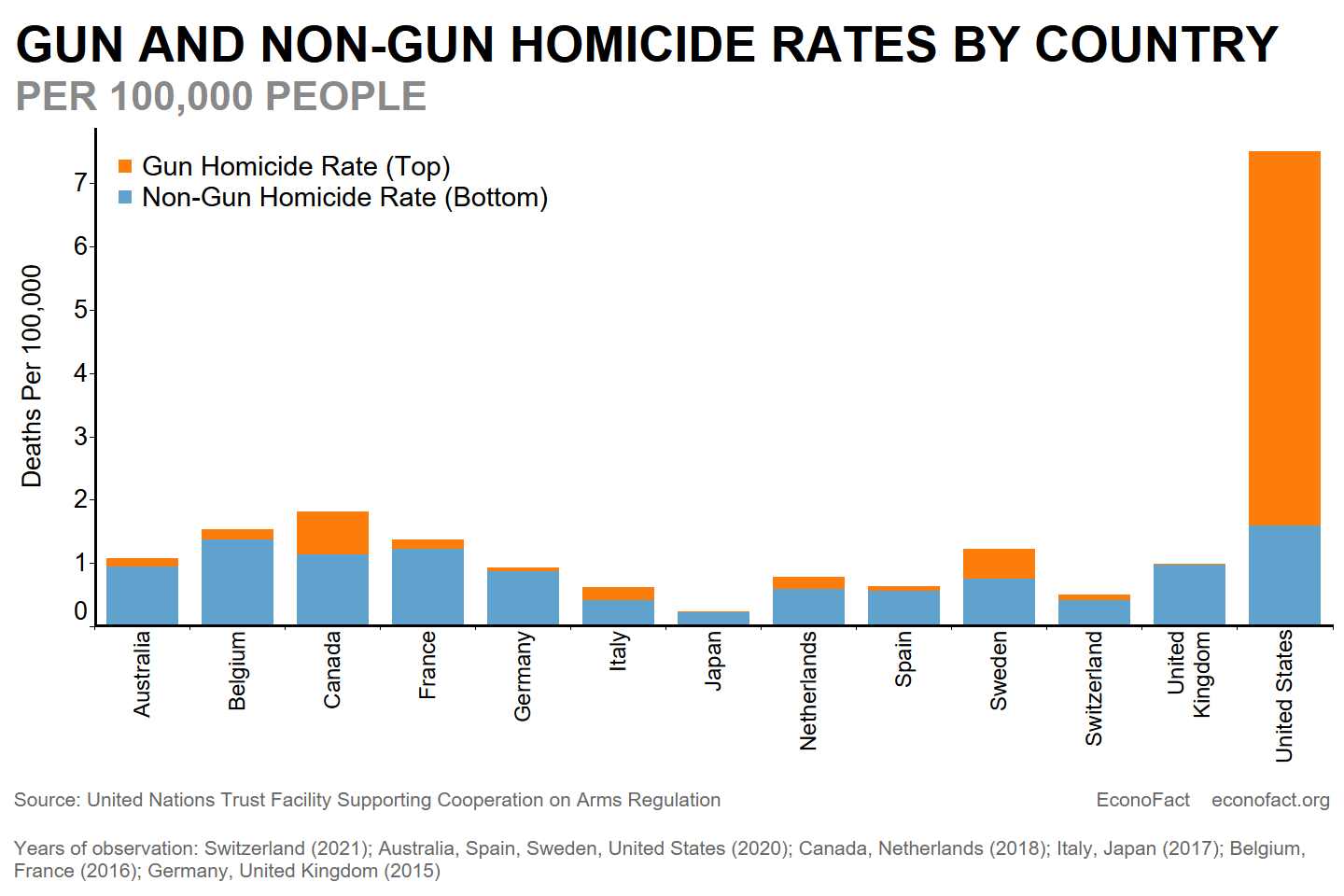
It's true that (from memory) Guatemala and some of the Central American republics have a higher murder rate than the US. Hardly something to skite about. The point was comparisons of liberal democracies in the developed world where the US 'death by firearm' rate is clearly anomalous.
:up: -
Gun ControlBut, the question to answer to determine if it is misleading or not is quite simple: How's freedom of the press, though? — Outlander
In all those countries in that chart, I would think freedom of the press can generally be assumed, can't it? Got any counter-examples?
Plainly, they want their guns and will not be swayed. — Banno
It's what I said - there is a strong belief that guns=freedom.
That mass shootings continue to occur is a good reason, IMO, to abolish the 2nd amendment. — Moliere
The Second Amendment was framed in the context of the War of Independence in terms of 'well-armed militias'. Switzerland has a similar provision, but are much stricter on the regulation of firearms, which have to be kept in stipulated conditions i.e. locked cabinets etc. There are regular stories out of the US of infants shooting other children or themselves or adults with guns left lying around the home.
There was a Supreme Court ruling that definitively established the "well-regulated militia" term in the Second Amendment applied much more broadly than to actual regulated militias, and instead protected an individual right to bear arms for self-defense, namely, District of Columbia v. Heller (2008). In a 5-4 decision, the Court held that the Second Amendment protects an individual's right to possess firearms for traditionally lawful purposes, such as self-defense in the home, unconnected with service in a militia. The majority opinion, written by Justice Antonin Scalia, analyzed the two clauses of the Second Amendment ("A well regulated Militia, being necessary to the security of a free State, the right of the people to keep and bear Arms, shall not be infringed.") and concluded that the "prefatory clause" (regarding the militia) announces a purpose but does not limit the "operative clause" (the right of the people to keep and bear arms).
But the obvious principle still applies: the main reason people want guns, is the high likelihood that the guy next to them has one. If you knew that hardly anyone had a gun, then you wouldn't feel the need, or so you'd think. Furthermore many sources from psychological and media studies report that by the end of elementary school (around age 10-12), the average American child has witnessed thousands of violent acts, including murders, on television. It's modelled for them. Now there are also shoot-em-up video games, which allow users to simulate the process of mass shooting. All up, the recipe for the violent gun culture we see in today's America.
The only gun control that makes sense is to destroy every gun on the earth and never make them again. — Fire Ologist
A project supervisor holds an Armalite rifle during the 1996 Australian gun buyback. -
Does anybody really support mind-independent reality?I hope so. Nothing like a good opponent!
-
Gun ControlNot being killed is fundamental to liberty.
I write from Australia. As is well-known, Australia has much greater controls on gun ownership, in part due to the reaction to an horrific mass shooting in Tasmania in 1996 (often held up as an example in debates on the issue.) Not to say there is no gun crime, but it is much less frequent than in the US. I've never felt the need to arm myself, although there are parts of the world where I surely would, were I to live there.
Something I notice in the posts of the advocates for gun ownership is an appeal to fear, and a sense of being menaced or threatened, which justifies it. It seems a very sad state of affairs, but I'll leave the discussion to those who wish to pursue it. -
Does anybody really support mind-independent reality?Of course our knowledge is "grounded in our mind's eye", but that doesn't mean that the things we know about (most of them) would vanish if our mind's eye or even the eye in our heads did not exist. Knowledge is not existence. — Ludwig V
Knowledge, you will agree, is mind-dependent. Outside of knowledge of the object, the object neither exists nor doesn't exist. This is elaborated in The Mind Created World, if you're interested in further discussing it. -
Gun ControlGuns are literally why Americans have civil liberty in the first place. — MrLiminal
Most other democratic countries managed it without.
-
Does anybody really support mind-independent reality?
-
Gun ControlBut he was the scion of the ruling dynasty who also happened to have trained as an ophthalmologist.
-
Gun ControlI guess if you live in a society with high rates of gun ownership and the possibility of violent crime then it would seem necessary. That’s the ‘vicious circle’ aspect of gun ownership. The more others have weapons, the more we feel the need for them. That shows up in the spikes in gun sales that often happens after mass shootings
-
Gun ControlIt seems to me I’m asking a straightforward question that is being met by circumlocution.
-
Gun ControlThe thread is about gun control, and my comment was about equating gun ownership with civil freedom. You might explain how what you said has a bearing on that.
-
Gun ControlOr, the root of the root of the issue is how to deal with the inevitable monstrosity and absolute horror show that is human nature, unrestricted. — Outlander
So does this mean, because human nature is horrible, then you’re under threat, hence the need to arm yourself? Is that what you’re saying? -
Does anybody really support mind-independent reality?Mind independence doesn't mean what we might think it means. When talking common-sense realism: of course the moon exists when nobody is looking, and the tree falls in the forest where nobody can hear. And on a common-sense level, that is quite true.
But the question of whether things exist independently of the mind, is not the question of whether they exist whether or not you or I, in particular, are aware of them. The question arises from the realisation of the role of the mind in perceiving what we know to be the external world. The brain and the central nervous system are in contact with the world through the sense-faculties of sight, hearing, touch, taste and smell. The mind or brain integrates all of that data with our remembered world-model to construct a panoramic vision we know as 'the world' (panorama literally meaning 'seeing all'). Without that conscious and unconscious process of data reception and synthesis, there would be no world to see. It's not something infants see; they have to learn how to see it, an act which takes the first few years of life.
'Sure', might be the response 'but even if you're not conscious or not there, "the world" continues to exist.' And in one sense, it does - but again, we only know that, because we're able to consciously contemplate it. We have an innate sense of its existence, and all of the empirical data indicates that it existed before we, as individuals, were born, and will continue after we die. But that knowledge is still grounded in our 'mind's eye', so to speak - even our knowledge of what it is.
Realism neglects the role of the mind in this process. It takes the world as given, without considering the role the mind plays in its construction. That is the context in which the idea of mind dependence or independence is meaningful. -
Why Religions FailBy the way, Zaroastrianism (the first monotheistic religion) argued 3 postulates: Good thought. Good word. Good deed. Little has changed in religions since then. — Astorre
There’s a Buddhist anecdote that an elderly questioner once asked the Buddha, what is the core of his teaching? He replied, ‘Cease from evil, learn to do good, and purify the mind.’ Taken aback, the questioner said, ‘but a child knows that!’ ‘Yes’, was the reply, ‘but how many grown adults are able to live up it?’ -
The Blind Spot of Science and the Neglect of Lived ExperienceA conversation between John Vervaeke and Evan Thompson about The Blind Spot book.
(I bailed on it after about 20 minutes but I’ll leave it here.) -
Does anybody really support mind-independent reality?So what didn't Bell prove 55 years prior? — noAxioms
Bell didn’t prove anything. At the time, the required experimental apparatus and know-how didn’t exist. He worked out what needed to be proven, but the actual proof had to wait for those guys that won the Nobel (well after Bell had died). -
On PurposeGlad you found it helpful. I realised from the comments on this topic, that a lot of what I’ve learned (mainly from The Embodied Mind and Mind in LIfe) is not at all obvious to the casual reader so maybe some background would be helpful. As mentioned, that primer was generated by AI and I haven’t read everything on it but I’m working through it. (I’m dubious about the ‘radical enactivism’ section, which I wasn’t familiar with, but I’ll leave it there for the sake of completeness.)
-
On Purpose@Dfpolis - I hear your concerns about conceptual clarity, especially regarding the distinctions between vegetative, sensitive, and rational. I want to clarify that when enactivist or biosemiotic perspectives speak of ‘intentionality’ in relation to basic life forms, they are not proposing that such organisms possess beliefs or conceptual intentions in the sense that rational sentient beings do.
Rather, the claim is that a rudimentary, pre-conceptual kind of directedness — a teleological orientation toward what is beneficial or harmful — is already implicit in the way living systems maintain themselves. This isn’t to collapse the distinctions between kinds of beings, but to suggest that what we know as intentionality in its mature form has developmental roots in the self-regulatory dynamics of life itself.
Enactivism doesn’t deny the classical distinctions drawn from De Anima, but it provides a different way of framing the continuity between life and mind. It focuses on the enactive structure of living beings — how they bring forth a meaningful world through their activity. In this sense, it can be seen as an interpretation of Aristotle’s principle of the soul as the form of a living body — particularly in his account of perception and movement, where the organism is already responsive in a way that presupposes some mode of purposiveness.
But you could quite rightly say it is a kind of ‘neo-Aristotelianism’ as it is very different to Aristotelian Thomism, but then, it also draws on a considerable amount of scientific discovery since those times. But hopefully an elaboration rather than a contradiction. -
On PurposeFor anyone interested: a primer on ‘enactivism’ and ‘embodied cognition’, generated by Google Gemini, reviewed and edited by me. Contains a brief overview of key terms, concept, and readings in enactivism.
-
On PurposeWhat do you think of this quote? — hypericin
It came to mind as I wrote, but in the context, it is not a counsel of despair, rather a spiritual admonition regarding the emptiness of worldly achievements
People today are well aware of biological purpose, including their own. I once saw a tee-shirt that read "Born. Work. Fuck. Die." As if to say, — hypericin
What are the basic drives that animate animals according to darwinian biology - that would be the 'four fs' - fighting, feeding, fleeing and reproduction. And as evolution is now the secular creation story this attitude is a consequence. But human purposes being reduced to biological drives is a recipe for despair, it fails to honor what makes us different. And what your post reflects is actually the very crisis of meaning which has been precipitated by the collapse of values.
The meaning crisis refers to a widespread feeling of emptiness, disorientation, and lack of purpose in modern life, often characterized by feelings of depression, anxiety, and suicidal ideation. It's a societal condition where individuals struggle to find meaning and connection in their lives, potentially leading to ineffective coping mechanisms and a sense of disconnection from communal and sacred aspects of life. This crisis is fueled by factors like secularization, loneliness, and a loss of traditional narratives and structures.
And central to that, is the sense of purposelessness driven by the narrative of a meaningless cosmos onto which individuals are purported to project meaning. 'Consume, be silent, die.'
It may very well be that you have important insights to communicate, but to do so, you need to reformulate your insights using terms with shared meaning. — Dfpolis
They are not insights of my own, rather I’m trying to express those developed in the primer I generated. (I'm not wishing to come across as pedantic, but there are many new concepts and terms in this field which need to understood to make sense of the idea.)
Rather, it is that matter has taken a form not anticipated by those who developed the principles. — Dfpolis
That's pretty well what I'm saying. It is not vitalism. Vitalism posits a special non-physical "life force" or élan vital that distinguishes living beings from inanimate matter. It's metaphysical and implicitly dualist.
Enactivism, by contrast, sees life and mind as implicit in the dynamic interactions between organism and environment. It avoids invoking any extra force, instead considering organisms as embodied, autonomous systems engaged in meaningful activity. This is why the term 'being' is specific to the organisms. Beings act, whereas things are only acted upon.
The claim isn’t that rudimentary organisms possess rational or even sensory intentionality — but that what we call intentionality at higher levels of cognition is rooted in the more basic organismic fact of self-directed activity. Even Aristotle’s notion of the soul as the form of a living body entails that living things are not simply moved but move for the sake of something — even if that’s just continued existence. This 'for-the-sake-of' structure is already a teleological — and in that sense, proto-intentional — orientation. -
The End of WokeJohn Millbank's point, which is more radical, is that this is really just the Reformed theological tradition's view of man and nature, only with grace and God removed — Count Timothy von Icarus
Makes sense to me. Counterpart to Weber’s Protestant Work Ethic. -
Does anybody really support mind-independent reality?Bell's theorem (and not just 'theory') demonstrated the impossibility of local reality almost 60 years ago. — noAxioms
It was the 2022 Nobel Prize in Physics which was awarded to the experimentalists who proved it. (I wrote an article on it for anyone interested). -
The "Big Lie" Theory and How It Works in the Modern WorldI'm trying to work out whether a big lie actually matters, or if it's just reflecting what the public already believes. — Tom Storm
I think it’s cause more than consequence. Sure there was a ready audience but they had to be fed, and lead. -
On PurposeYes, my son's two chooks are continually complaining, in a chook kind of way, that they're tired of the feed they're given, and make a great show of excitement whenever there's a suggestion that some special treat might be forthcoming.
-
The "Big Lie" Theory and How It Works in the Modern WorldIn any case - the main point is the context - that the specific expression became associated with Trump's election denial, as distinct from it being a general term for political mendacity.
-
The "Big Lie" Theory and How It Works in the Modern WorldMaybe, but this lie is a torpedo aimed at the Ship of State.
-
The "Big Lie" Theory and How It Works in the Modern WorldThe 2020 election was stolen.
— RogueAI
I was going to ask that myself, but how many people actually believed it? — Tom Storm
According to this story, two years ago 70% of Republican Voters thought that Biden’s election was illegitimate https://amp.cnn.com/cnn/2023/08/03/politics/cnn-poll-republicans-think-2020-election-illegitimate
Incidentally while it has been mentioned, it hasn’t been made explicit in this thread that the expression ‘The Big Lie’, capitalized, refers almost exclusively to Trump’s lies about the 2020 election, in which he persists to this day. -
The "Big Lie" Theory and How It Works in the Modern WorldI’ve been reading US media for years, it is common knowledge that Trump had committed numerous acts which lead many observers to predict the end of his political career - only to see him brush it off and carry on regardless. ( Jan 6 2021 being an outstanding example.) So the response of his base becomes that it doesn’t matter what he does, the problem lies with his perceived accusers. He has broken so many standards that to all intents they are no longer recognized in the public square.
-
The "Big Lie" Theory and How It Works in the Modern WorldThat list describes it well. There is also the factor of ‘outrage fatigue’ - norms of truthfulness and decency are broken so often and with so little apparent consequence, that people merely shrug, and it becomes normalized.
-
The End of WokeTo avoid replacing one form of tyranny with another, he advocates for a renewed commitment to liberalism and a revival of Enlightenment principles such as free speech, open debate, and individual liberty. — Number2018
Sounds eminently sensible to me. One of the founders of the Australian Greens, Drew Hutton, was interviewed recently about woke ideology (hate the misuse of grammar by the way) in respect of trans rights. He says since he left the party (around 2009), it has developed a stance where even discussion of the issue warrants sanction (implication being that there is nothing to discuss). He says that many dedicated conservationists who should be involved in the Green Party have left or even had their membership terminated for questioning the emphasis on the issue. I suppose it is one of the issues that green left politics tends to constellate around.
Wayfarer

Start FollowingSend a Message
- Other sites we like
- Social media
- Terms of Service
- Sign In
- Created with PlushForums
- © 2026 The Philosophy Forum