
-
What is Logic?@Gnomon - I moved your comments about Law of Form to the new thread on that topic https://thephilosophyforum.com/discussion/14599/reading-the-laws-of-form-by-george-spencer-brown
-
Donald Trump (All General Trump Conversations Here)Good on you, I didn't, of course, as I'm not a US elector, but as you know, deeply interested (and concerned).
-
Thing-in-itself, Referent, Kant...SchopenhauerHow does he know he is right, and all Osho's followers were wrong? — Janus
As I am the 'he' in question, I'll refer to my previous response. It's a fact that vast populations can become victims of delusion - witness the Trump cult. But the fact that there are such delusions doesn't mean that effective political leadership is not possible. The constant complaint 'well, all religions disagree with each other, how can they all be right?' likewise. Agree that today's world is confused, chaotic, and full of contradictions. But that is not a philosophical argument, again it's just an appeal to common sense. -
Thing-in-itself, Referent, Kant...SchopenhauerNevertheless, unlike faith based entities (such as gods), there is evidence available for scientific knowledge which people who have education can access and verify and demonstrate to work. I suspect that aligning this testable, demonstrable, if arcane knowledge with faith can lead to conceptual problems elsewhere. Thoughts? — Tom Storm
That, again, this is based on a culturally-conditioned or stereotyped depiction of what such claims entail. Firstly, in current science, there are many huge interpretive conundrums, for instance the debates about string theory and the multiverse, and whether theories of same ought to be testable in principle. Then there's all the many debates about interpretations of physics, which I won't open up here other than by way of mention.
There is a kind of 'secular consensus' as to what amounts to common-sense knowledge, which underwrites a great deal of this commentary. What really irked me was the demand that 'intellectual honesty dictates' that I acknowledge that common-sense attitude as the arbiter for the truth or otherwise of Buddhist epistemology- exactly as @Leontiskos described. What came to mind is Heidegger's remarks about 'das mann'.
This has now drifted a long way from the intention of the OP, something for which I admit some responsibility. What actually caused me to venture into the field of the Buddhist epistemology was the discussion about the sense in which Schopenhauer's philosophy is 'soteriological', i.e. encompassing the possibility of release (mokṣa, as it is called in the Upaniṣad). To which the reply was
I think Schopenhauer too optimistic. There is no blissful escape. — schopenhauer1
So basically, I am asking, 'says who?' The nihilistic philosophers that @schopenhauer1 quotes from would naturally say that, but then, they're nihilists! All they demonstrate is regret for having been born. So I brought up that discussion of 'the Deathless' in one of the Buddhist suttas (here, for those interested) to make the case for there being, actually, 'blissful escape' (although it sounds a rather facile way of putting it.) -
Donald Trump (All General Trump Conversations Here)Finally, there's some momentum developing behind the claim that Trump ought to be declared ineligible for public office. I've long wondered how it could be possible for a candidate to stand for an election for which he refuses to abide by the rules or recognise judicial or constitutional authority. I mean, you couldn't get into a chess match or tennis tournament with that attitude, let alone be elected to the highest office.
Prominent conservative legal scholars are increasingly raising a constitutional argument that 2024 Republican candidate Donald Trump should be barred from the presidency because of his actions to overturn the previous presidential election result.
The latest salvo came Saturday in The Atlantic magazine, from liberal law professor Laurence Tribe and J. Michael Luttig, the former federal appellate judge and prominent conservative, who argue the 14th Amendment disqualifies the former president from returning to the Oval Office.
“The people who wrote the 14th Amendment were not fools. They realized that if those people who tried to overturn the country, who tried to get rid of our peaceful transitions of power are again put in power, that would be the end of the nation, the end of democracy,” Tribe told CNN’s Kasie Hunt on “State of the Union” on Sunday.
Luttig, who’s become a strong critic of Trump’s actions after the election, called for officials to look carefully at his qualifications for being on the ballot.
“All officials, federal and state, who have a responsibility to put on the ballot candidates for the presidency of the United States are obligated under the Constitution to determine whether Donald Trump qualifies to be put on the ballot,” Luttig said. — CNN -
Thing-in-itself, Referent, Kant...SchopenhauerThank you Leontiskos, you said it better than I did, that's what I was getting at.
-
Reading "The Laws of Form", by George Spencer-Brown.The pdf I linked won't allow quotes.
2. My keyboard does not have the cross symbol. — unenlightened
I think if you download said pdf and open it in an acrobat application, you can do a lot more with it, like copy text from it etc. I happen to subscribe to Adobe Acrobat Pro for about 30 bucks a month as I’m a tech writer (and it’s hellishly expensive to actually buy) and it’s a tool of the trade, but there are other PDF apps that allow you to copy text, which you might not be able to do inside your browser. Also, if you download a PDF and save it, you will find that MS Word can open it thereby converting it to text (although I don’t know how it would cope with all the special characters and typesetting in this particular text).
In respect of the Cross symbol, there *might* be some combination of characters that stands for it, although that’s totally off the top of my head. Worth researching it though.
I’m still um-ing and ah-ing about whether to really try and get into it, as my back-list is perennially full of ‘things I should have read already’. But that video series is golden - apart from the splendid voice, he’s a discovery in his own right, seems an exceedingly erudite and learned gentleman in the literary arts. -
Thing-in-itself, Referent, Kant...Schopenhaueryou should be prepared to argue for your position. — Janus
I tried, no joy. Past a certain point it becomes futile. Life's short, let's move on. ‘Intellectual honesty demands that valid knowledge be what I declare it to be’ :roll: -
Thing-in-itself, Referent, Kant...SchopenhauerWhat do you think about "something from nothing" in terms of physics?
— Gregory
I don't think much of it. There have been ideas from people like Lawrence Krauss 'A Universe from Nothing that posits just that. — schopenhauer1
Do you know the well-known story of David Albert's scathing review of Universe from Nothing and what happened afterwards? Apparently Krauss was absolutely enraged by it and fired off angry missives to the editors, before being gently advised by some of his professional peers to cool it. The offending paragraph:
The particular, eternally persisting, elementary physical stuff of the world, according to the standard presentations of relativistic quantum field theories, consists (unsurprisingly) of relativistic quantum fields. And the fundamental laws of this theory take the form of rules concerning which arrangements of those fields are physically possible and which aren’t, and rules connecting the arrangements of those fields at later times to their arrangements at earlier times, and so on — and they have nothing whatsoever to say on the subject of where those fields came from, or of why the world should have consisted of the particular kinds of fields it does, or of why it should have consisted of fields at all, or of why there should have been a world in the first place. Period. Case closed. End of story. — David Albert
Oh, and the closing para was pretty good, too (in light of the fact that Krauss' book was hailed a 'hammer-blow against Religion' by none other than Richard Dawkins):
I guess it ought to be mentioned, quite apart from the question of whether anything Krauss says turns out to be true or false, that the whole business of approaching the struggle with religion as if it were a card game, or a horse race, or some kind of battle of wits, just feels all wrong — or it does, at any rate, to me. When I was growing up, where I was growing up, there was a critique of religion according to which religion was cruel, and a lie, and a mechanism of enslavement, and something full of loathing and contempt for everything essentially human. Maybe that was true and maybe it wasn’t, but it had to do with important things — it had to do, that is, with history, and with suffering, and with the hope of a better world — and it seems like a pity, and more than a pity, and worse than a pity, with all that in the back of one’s head, to think that all that gets offered to us now, by guys like these, in books like this, is the pale, small, silly, nerdy accusation that religion is, I don’t know, dumb. -
Thing-in-itself, Referent, Kant...SchopenhauerThat is what you need to show. — Janus
I don't need to 'show' anything, especially as your only interest is polemical. I should have kept mum the first time around. -
Thing-in-itself, Referent, Kant...SchopenhauerOK but I will try and keep it brief.
You're appealing to sense-experience, empirical observation, or whatever you want to call it. At least be clear about that.
— Quixodian
I am not appealing to anything, rather I'm just saying that what is usually counted as knowable in the intersubjective sense is what is confirmable by publicly available observations, mathematics or logic — Janus
You're appealing to empiricism, even if you say you're not. It is not an accusation, it's a description.
For example, you apparently think enlightenment is intersubjectively confirmable: well, a great number of people thought and still think Osho was enlightened, but I bet you think he was a fraud. How do you establish the truth in cases like that, eh? How do you know Gotama was enlightened? The authority of tradition? — Janus
Consider the provenance of the word 'enlightenment' that is used in respect of Eastern religious practices. It had its origin with a British translator of Buddhist texts, who used it to translate the term 'bodhi', motivated by his belief that Pali Buddhism was compatible with the outlook of the European Enlightenment. He was late Victorian, and they had the belief back then that Buddhism was a 'scientific religion', which I don't think is held any more. I suppose it is not necessarily a poor choice of words, but it has unfortunately become somewhat commoditized, as something to buy, sell, or somehow get, which plays right into consumer economics. I perfectly agree that as a consequence, there are lot of bogus gurus and enlightenment scams in the marketplace. There are many traps, pitfalls and delusions associated with the entire quest. But your objection simply reinforces what I said about stereotyping, about your customary view of anything you categorise under that umbrella. As the aphorism has it, there would be no fool's gold if there were no actual gold.
how acupuncture really works is not known — Janus
It's nevertheless claimable under Medicare.
the fact that other cultures have their different faiths and beliefs does not entail that those faiths and beliefs are true or not true. We simply don't and cannot know, because they are not susceptible of publicly available evidence. — Janus
But the subject can be and has been rigourously investigated, so there are those who can and do know. There's a 'mindfulness training centre' at Oxford, for heaven's sake. This is an epistemological question - the question of whether the subject has a factual core, or whether it's simply conjecture, custom, or pious belief.
intellectual honesty demands that it be acknowledged that the belief is not grounded on empirical evidence, mathematics or logic, the only methods we have for intersubjective demonstration or proof. — Janus
Intellectual honesty demands no such thing. Or maybe it requires acknowledgement that this assertion is also culturally-situated and conditioned. It is what our culture takes as a criterion for 'valid knowledge' - as I already said. There are hundreds, or is it thousands, of generations of devotees and disciples across many cultures who have practiced these paths and discipines, producing works of sacred literature and art. These can be studied, interpreted, practiced, and the results ascertained for oneself. One of the attributes of Buddhist praxis is 'ehi-passiko', which means, basically, 'come and see for yourself'. Although, of course, that's all just religion.... -
Reading "The Laws of Form", by George Spencer-Brown.Oh, and I also thought, wonder what's on YouTube about this, and lo, a free, online course on G Spencer Brown's Laws of Form. (Beautiful English diction, by the way.)
-
Reading "The Laws of Form", by George Spencer-Brown.Golly, as I suggested this as a candidate for a discussion group, I ought to make some kind of contribution. :yikes: At the moment, the best I can do is link to the Wikipedia entry, which at least provides an introduction, but having suggested it, I notice this sentence in particular:
LoF's mystical and declamatory prose and its love of paradox make it a challenging read for all.
I don't know if it's really up my alley, what with its background in mathematics, but I feel that the more mathematically-literate members of the community might have an interest in it. But I will endeavour to absorb some of it, hopefully some spark of inspiration might be communicated. -
Thing-in-itself, Referent, Kant...SchopenhauerThe way I look at there is direct observation which can be personally inter-experentially and publicly intersubjectevly confirmed. — Janus
Which is what is generally regarded as empiricism. You commonly cite that position in these arguments, yet when you're challenged on it, you deny it:
I am not an Empiricist philosopher... — Janus
You're appealing to sense-experience, empirical observation, or whatever you want to call it. At least be clear about that.
Then there are beliefs about what cannot be confirmed by observation, mathematics or logic; that is those things we take just on faith. — Janus
But if you associate 'taking on faith' with religion, then you fall back on the faith/reason dichotomy which is writ large in our culture and which I say which leads to stereotyping. I think the way you're evaluating it is like this: that Buddhism is a religion; religion is not something that can be validated empirically; therefore it's a matter of faith.
But there are all kinds of things we know, without knowing precisely how we know them, or being able to demonstrate them empirically. Michael Polanyi, philosopher of science, spent his career teasing out such implicit or tacit knowledge - things that you know which cannot be easily explained because it's tied to your way of being in the world. For example, a skilled musician may have a deep understanding of how to play a complex piece of music which they can't explain, but only enact. Scientists have a great deal of performative knowledge and starting assumptions which are often not disclosed in their eventual writings. Much knowledge is rooted in our ability to recognize patterns, make judgments, and engage in practical activities without necessarily being able to provide a step-by-step, explicit account of how we do it. We often rely on tacit knowledge in everyday tasks without consciously thinking about it. Does all of that fall under the umbrella term of 'faith'? I think not. (Although, interestingly, one of the terms for spiritual practices in the Eastern lexicon is 'bhavana', which means, literally, 'becoming' - something along the lines of 'habits becoming character', I think it means.)
the inter-subjective verification that operates in empirical observations, mathematical proofs and logic — Janus
That is the so-called 'public square of the secular state'. It has its own criteria for what constitutes knowledge, but there are also historical and social factors behind that, in the vexed relationship between religion and science in Western culture. The reason/faith dichotomy is a strong undercurrent in all these debates, we see it here every day. But there are other domains of discourse - cultures which judge the matter by different standards, within which inter-subjective verification of such matters is intelligible. I'm not trying to persuade you to believe anything but trying to flush out the implicit basis, or maybe even bias, in such judgements. Notice how generally any assertion of 'higher knowledge' (jñāna) is categorised as 'mystical' or 'spiritual', which kicks it into the long grass, so to speak. But really in those cultures to which it is endogenous, such an understanding is quite prosaic. There is a cultural milieu in which it is intelligible, navigable and communicable - precisely what our culture is lacking. -
Is Philosophy still Relevant?Some who had "metaphysics" in their sights were only aiming at a particular tradition, but I should think that others really had metaphysics itself in their sights, and that it has not fared so well. — Leontiskos
Let’s not forget Auguste Comte. It was Comte, founder of the Social Sciences, who coined the term ‘positivism’. The ‘positive phase’ comes after the ‘metaphysical phase’ and superseding it, in effect. It is characterised by scientific approach and attitude, distinguished from the rationalism of scholastic philosophy with it’s search for ‘first philosophy’ now associated with ‘revealed truth’ and deprecated on those very grounds. And accordingly, the science in the Enlightenment was characterised by the determination to start from observable facts and hypotheses drawn from them and elaborated in mathematical form - which was to become the sphere of ‘natural philosophy’. Aristotle and his teleological philosophy were among the casualties of the ‘new philosophy’, whence the exaltation of the ‘purposelessness’ amongst the natural philosophers. Only that which could be accounted for by mechanical principles and codified in mathematical terms amounted to real science.
Welcome to modernity. -
What is Logic?:pray:
Very lucid explanation.
I’ve noticed ‘Laws of Form’ but when I tried reading it, found it quite daunting. Maybe we should start a discussion group on it. -
What is Logic?One of the responses to my question about the relationship of logical necessity and physical causation on Stack Exchange was as follows:
Wittgenstein famously states that (Tractatus Logico Philosophicus, proposition 5.1361) : "The events of the future cannot be inferred from those of the present." and "Superstition is the belief in the causal nexus."
Later (Propositions 6.37, 6.371 and 6.362) "A necessity for one thing to happen because another has happened does not exist. There is only logical necessity. At the basis of the whole modern view of the world lies the illusion that the so-called laws of nature are the explanations of natural phenomena. So people stop short at natural laws as at something unassailable, as did the ancients at God and Fate. And they both are right and wrong. But the ancients were clearer, in so far as they recognized one clear conclusion, whereas in the modern system it should appear as though everything were explained."
A Wittgensteinian answer to this question would that there is no such thing as physical causation as is generally understood in modern science, but that physical causation is an a priori intuition, which is useful for hypotheses, but which tells us nothing about the world in-itself or its meaning.
I have real trouble accepting this, but then, it is Wittgenstein, so who am I to question it? I myself have often appealed to the ‘illusion that the so-called laws of nature are explanations of natural phenomena’ in arguing against scientific realism but this response taken as a whole seems unreasonably sceptical to me. I mean, there are innumerable ways in which modern existence relies on what we understand as scientific laws (even if the term ‘law’ might be problematic.) It seems to me that Wittgenstein’s argument is similar to Hume’s in denying the necessity of inductive logic. I suppose it’s something to do with the fact that causality - a causing b - is neither deductively true nor directly observable. But isn’t this where ‘Kant’s answer to Hume’ is supposed to apply i.e. causality as being a necessary condition of reason?
I think where it seems wrong to me is that it presumes that because causation only pertains to the phenomenal sphere, then it says nothing about ‘the world in itself or its meaning’. I think that’s an unreasonable inference. But I’m interested in what others have to say about it. -
Thing-in-itself, Referent, Kant...SchopenhauerThat this meant something like a mystical/spiritual thing, can always be questioned and never proven. — schopenhauer1
It can be validated first person. The stages and states of realization can be verified inter-subjectively. The Eastern Gatehouse sutta is a dialogue between Buddha and Sariputta about ‘the Deathless’ and its attainment - that it can be ‘seen and known’ directly but that until it is seen thus it has to be ‘taken on faith’. But in western culture, a hard and fast division has emerged between what is categorized as faith and what is categorized as scientific knowledge. There’s nothing corresponding to ‘jñāna’ in our lexicon, so all that can be said (usually dismissively) is that it’s something ‘spiritual or mystical’. -
Thing-in-itself, Referent, Kant...SchopenhauerIf instead of saying ‘the thing in itself’, you were to say ‘the world as it is in itself’ or ‘reality as it is in itself’ or even ‘reality as it truly is’, I think it would convey the gist better. In Buddhist philosophy, one of the attributes of the Buddha is ‘yathābhūtaṃ’ which means ‘to see the world as it truly is’.
-
Thing-in-itself, Referent, Kant...SchopenhauerBut there’s no use denying the fact that we exist in the first place.
— Quixodian
Oddly enough, isn't that the kind of thing the ascetics question? Bundle theory and all that. — schopenhauer1
I see what you’re getting at, but the reality of there being an enduring self is not the same as reality of the plight of existence, even if they’re closely intertwined. (That is one of the main preoccupations of the Buddhist/Hindu dialectic.) The next chapter (6) of Schopenhauer’s Compass is about the genesis of the edition of the Upaniṣads that he had access to, which was a compendium put together by the brother of the Prince who had the Taj Mahal built (if memory serves). The compendium contained additions and interpolations by the translator from a variety of sources (including Yogācāra Buddhism). In any case, the key point as always is that the illusory realm of māyā is ‘seen through’ by the liberated ‘mukti’. -
Thing-in-itself, Referent, Kant...SchopenhauerI think Schopenhauer too optimistic. There is no blissful escape. But more interestingly, the fact that there are schools of thought regarding "escaping from life's suffering/Suffering (western/Eastern sense of the word), is telling about life in the first place and should be a warning about putting more people into it in the first place. — schopenhauer1
But there’s no use denying the fact that we exist in the first place. A coherent response to the human condition amounts to more than regret for being part of it. As I said before, it could be said that Schopenhauer and others recognise the cogency of the ‘first noble truth’, that to live is to suffer, but don’t grasp the further truth, ‘that there is an end to suffering’. In the parable of the snake, the Buddha says that grasping his teaching correctly is like taking hold of a snake the right way, otherwise it will turn and kill you.
I know the question I have for Schopenhauer - if will is blind, and the origin of everything, then how to account for mind? In Neoplatonism, nous is seen as a universal, but Schopenhauer seems to expunge it of actual intelligence, leaving only ‘striving’ or ‘energy’. So where in his scheme to mind/nous/intelligence originate? -
What is truth?I cannot step outside my mind to compare a thought in it with something outside it," is making the mistake of thinking that objectivity becomes equivalent to truth at the limit. — Count Timothy von Icarus
Actually, it's not making the mistake, so much as pointing out the mistake. I think the same can be said with the other passages I mentioned (although of course to really verify that would mean going back and looking at them in context.) I agree with every word in your cited text, but then it does capture the critical Kantian point. (I also note how thoroughly the phrase 'the view from nowhere' has become part of the lexicon, thanks to Thomas Nagel, I think.)
So when you say 'there is no reason to think that objectivity is actually equivalent with truth', then you're articulating the critical attitude, not the attitude of those for whom there is no criterion of truth other than objectivity - that being the naive realist!
And what of principles, which are necessary truths proven post hoc by but not derivatives of, empirical cognitions? — Mww
And where are such principles to be sought? 'Sense organs and the brain do not just register the world. Our minds structure our experience and our thought in fundamental ways’ (op cit). Perhaps correspondence is to be sought when the order of things corresponds with the order of thoughts. Could it be said that that concordance is neither ‘in the mind’ nor ‘in the world’ but ‘in our experience-of-the-world’? Which points towards coherence, rather than correspondence. -
What is truth?Some notes gathered from previous interactions on 'issues with correspondence theory of truth'.
According to (correspondence) theory, truth consists in the agreement of our thought with reality. This view ... seems to conform rather closely to our ordinary common sense usage when we speak of truth. The flaws in the definition arise when we ask what is meant by "agreement" or "correspondence" of ideas and objects, beliefs and facts, thought and reality. In order to test the truth of an idea or belief we must presumably compare it with the reality in some sense.
1- In order to make the comparison, we must know what it is that we are comparing, namely, the belief on the one hand and the reality on the other. But if we already know the reality, why do we need to make a comparison? And if we don't know the reality, how can we make a comparison?
2- The making of the comparison is itself a fact about which we have a belief. We have to believe that the belief about the comparison is true. How do we know that our belief in this agreement is "true"? This leads to an infinite regress, leaving us with no assurance of true belief. — Randall, J. & Buchler, J. - Philosophy: An Introduction, p133
Although it seems obvious to say, "Truth is correspondence of thought (belief, proposition) to what is actually the case", such an assertion nevertheless involves a metaphysical assumption - that there is a fact, object, or state of affairs, independent of our knowledge to which our knowledge corresponds.
"How, on your principles, could you know you have a true proposition?" ... or ... "How can you use your definition of truth, it being the correspondence between a judgment and its object, as a criterion of truth? How can you know when such correspondence actually holds?"
I cannot step outside my mind to compare a thought in it with something outside it. — Hospers, J. - An Introduction to Philosophical Analysis, p116.
Truth, it is said, consists in the agreement of cognition with its object. In consequence of this mere nominal definition, my cognition, to count as true, is supposed to agree with its object. Now I can compare the object with my cognition, however, only by cognising it. Hence my cognition is supposed to confirm itself, which is far short of being sufficient for truth. For since the object is outside me, the cognition in me, all I can ever pass judgement on is whether my cognition of the object agrees with my cognition of the object. — Kant, Lectures on Logic -
Thing-in-itself, Referent, Kant...SchopenhauerThat is to say, we done fuckd it up. It's too late for us — schopenhauer1
The difference between them and Schopenhauer is that his philosophy is actually soteriological - there is a possible escape from the futility of existence. Still reckon that's the aspect of his thinking you can't accept.
For me this raises the question as to whether the embodiment of an animal is not already the beginning of individuation. There seems to be the natural boundary determined by bodily sensation, between me and not me. — Janus
Totally with you on that. The appearance of the first organisms is the appearance of intentionality and the first glimmer of consciousness. The difference for h. sapiens is that we are aware of our existence in a way that animals are not, and it's a difference that makes a huge difference. -
Enlightened MaterialismFinding things meaningful is an evolved aspect of our psychology. — wonderer1
So, an appeal to evolutionary theory. But that is not really a philosophy, even though it's often taken as such - it's a biological theory, and viewing motivation solely through that lens is biological reductionism. 'People can perform extraordinary acts of altruism, including kindness toward other species — or they can utterly fail to be altruistic, even toward their own children. So whatever tendencies we may have inherited leave ample room for variation; our choices will determine which end of the spectrum we approach. This is where ethical discourse comes in — not in explaining how we’re “built,” but in deliberating on our own future acts. Should I cheat on this test? Should I give this stranger a ride? Knowing how my selfish and altruistic feelings evolved doesn’t help me decide at all. Most, though not all, moral codes advise me to cultivate altruism. But since the human race has evolved to be capable of a wide range of both selfish and altruistic behavior, there is no reason to say that altruism is superior to selfishness in any biological sense.' 1 This objection is similar to one made by Alfred Russel Wallace, who differed with Darwin on these types of questions.
I think that for most of us most of the time, finding things meaningful comes fairly naturally. — wonderer1
Good for them! But this kind of issue can't rest on pure happenstance. -
Climate change denialThere's no need to tell me to stop doing something that I haven't done.
-
What is truth?Naive realism, also known as direct realism, is a philosophy of perception that suggests that our senses provide us with direct and unmediated access to the real world. In other words, it asserts that what we perceive through our senses is how the world truly is, without any need for mental representations or intermediaries.
According to naive realism, when we see, hear, touch, taste, or smell something, we are perceiving the actual objects as they are themselves, and our perception is a faithful representation of the objective reality. This perspective implies that there is a one-to-one correspondence between our sensory experiences and the external objects that cause them.
Challenges to naive realism point out that our perception can be influenced by various factors, such as cognitive processes, cultural and individual differences, and the limitations of our sensory organs. Illusions, hallucinations, and other perceptual phenomena also demonstrate that our senses can sometimes deceive us or misrepresent reality.
As a result of these critiques, critical theories of perception suggest that our sensory experiences are not direct reflections of the external world but rather involve complex processes of interpretation, integration of sensory data, and cognitive filtering. These theories take into account the role of the brain, neural processing, and the mind in shaping our perception of reality ~ adapted from chatgpt response. -
Climate change denialWhatever else he might think, none of it warrants abuse. — frank
None of what I said constituted abuse. -
Climate change denialOne of the moderators continuously responds as if he has made that argument, even though he has repeatedly explained that he does affirm global warming. It's just confusion coming from the moderators for reasons only they might know. — frank
Not true. I pointed out that he adopts the pose that acknowledges climate change BUT then says that climate science and scientists have gotten it all wrong, and that nothing can be done about it, along with irrelevant and preposterous arguments to the effect that more people die from cold than from heat, that not everywhere on the planet is hot, etc. Plainly intent on muddying the waters.
Meanwhile in the real world
America’s wealthiest people are also some of the world’s biggest polluters – not only because of their massive homes and private jets, but because of the fossil fuels generated by the companies they invest their money in.
A new study published Thursday in the journal PLOS Climate found the wealthiest 10% of Americans are responsible for almost half of planet-heating pollution in the US, and called on governments to shift away from “regressive” taxes on the carbon-intensity of what people buy and focus on taxing climate-polluting investments instead.
“Global warming can be this huge, overwhelming, nebulous thing happening in the world and you feel like you’ve got no agency over it. You kind of know that you’re contributing to it in some way, but it’s really not clear or quantifiable,” said Jared Starr, a sustainability scientist at the University of Massachusetts Amherst and a report author. — CNN
See source for more. -
Thing-in-itself, Referent, Kant...SchopenhauerHe then is stuck on these ideas of Platonic Forms by way of the influences that book nicely lays out (Schelling, Bohme, Neoplatonics, and the rest). That is to say, he has a ready-made metaphysics that is in need of a new home. — schopenhauer1
I see your point, and yes it does do that. Maybe the brush that Schopenhauer paints himself into the corner with might actually be his atheism?
This seems to characterize the human animal. — schopenhauer1
I would prefer 'the human condition'. ;-) -
Enlightened MaterialismThat's arguable but, in any case, is not what I'm saying and an entirely different question, i.e., does life have meaning? — Art48
You seem to be speaking of nihilism as a sort of psychological condition rather than as a philosophical perspective. — wonderer1
In the exploration of the topic of nihilism, Nietszche is often cited, which puts me at a disadvantage as I am not well acquainted with his writings. But even in terms of general knowledge, his proclamation of the death of God is viewed as a kind of harbinger of the advent of nihilism, on the grounds that it undermines the basis of long-held and deeply-cherished beliefs and doctrines about the ultimate aim of life. There is a current of thought in modern scientific culture that life itself is a kind of chemical reaction, formed as a consequence of physical causes and operating according to the survival algorithm comprising the neo-darwinian synthesis. Life originates as a kind of biochemical fluke, and human beings an accidental by-product. Existentialist philosophers attempted to accomodate that, for example Camus and Sartre. I believe Heidegger also says quite a lot about it, although I'm not well-schooled in his writings either. Suffice to say, it surfaces as the widely-held feeling that life has no inherent meaning or significance, often accompanied with the encouragement to make the heroic effort to give it a meaning of your own.
It is unarguable that if it's a FACT that I cease to exist, then I'll never know I'm dead.Because I no longer exist. — Art48
That's certainly true from the egological point of view. But no man is an island. The human comprises layers of understanding, some of which are inherited from previous existences, and bequeathes causes which continue to manifest in the future. -
Thing-in-itself, Referent, Kant...Schopenhaueras poetic as this looks, as I indicated in that quote, it loses any explanation outside of theistic speculation. — schopenhauer1
I think 'theisitic' is the wrong term. Certainly, many a Christian critic of Schopenhauer would agree with his own self-professed atheism. If, as both Schopenhauer and the other sources say, insight into the One is only attained through a kind of ecstatic intuition, then that is something other than 'theistic speculation' (and indeed later chapters in Schopenhauer's Compass explore the inherent tension between his kind of pantheist mysticism and religious orthodoxy). The question of how and why 'the One' has become 'the Many' is indeed the central issue of all ancient and classical metaphysics, but I can't see how the various interpretations of those ideas culminate in 'mere assertion', even while acknowledging that I myself only have a very hazy understanding of the matter (although I am still continuing to educate myself in it.)
Would I be correct in surmising that your original interest in Schopenhauer was motivated by your oft-stated antinatalism, on the grounds that his pessimistic philosophy provides support for such views? And that digging deeper into what he said, finding ideas that seem to have religious implications undermines that interpretation?
You can superficially say that physics reveals a sort of "oneness" — schopenhauer1
There's a current title, The One: How an Ancient Idea holds the Future of Physics, Heinrich Pas. I dipped into it, but my reading list is already unmanageable. But suffice to say, the basic idea lives on. -
Climate change denial
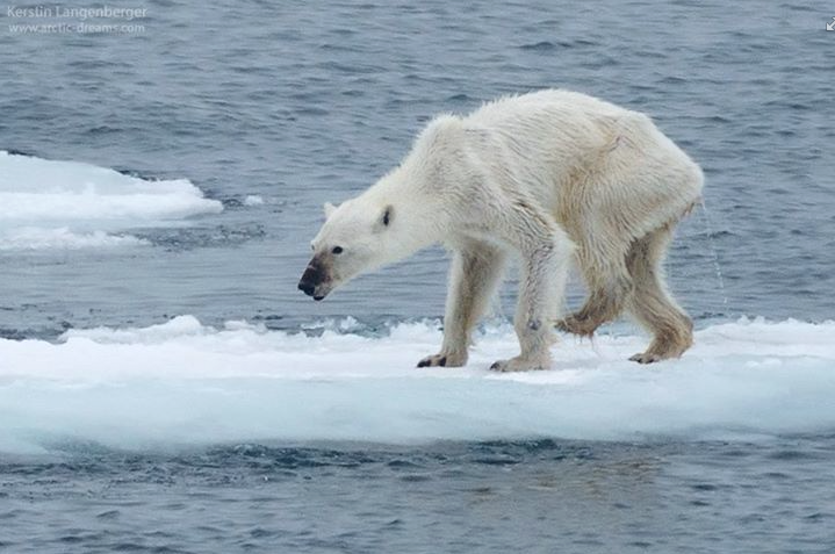
The commentary on this photo, dated 2015, was that it is a female who has to stay near to land to feed her young. As the pack ice that she would usually swim out and forage on has been radically depleted by (ahem) climate change there is insufficient food and she and her cubs are facing imminent death. One of many species threatened by climate change. -
What is Logic?But here is the big question: do we think that these are all different things? That we use the same word out of a sort of confusion? Or is there actually a similarity between these types of "logic?" — Count Timothy von Icarus
I posted a thread on stackexchange about the relationship of logic and causation. It turns out they’re different topics. Logic is the relationship between propositions whereas physical causation involves many factors. You can find the discussion here. The very first response notes that the ‘because’ of logical necessity is not the same as the ‘because’ of causation. And a lot hangs on this distinction, it turns out.
Another point is, apropos of the other thread on Schopenhauer - his ‘fourfold root of sufficient reason’ also differentiates between the logic ofbeingknowing (which approximates to what we are calling logic) and the logic of becoming (which approximates to physical causation.)
I personally am very drawn to your (3) - that there is a logic in order of things, as the Greek intuition has it. I think the issue with that is that it seems to contravene the naturalist assumption of there being no telos. But also notice that related to this concern, the whole concept of ‘natural law’ is nowadays called into question. See for example There are no laws of Physics. I *think* this mirrors a confusion, but I’ll leave it there for now. -
Thing-in-itself, Referent, Kant...SchopenhauerLet me know if you find anything. — schopenhauer1
That chapter contains the answer you're looking for, I think. There's a pretty generous preview in Google Books (in fact I could read the whole chapter online in Chrome, although when I tried it in Firefox it told me 'page not included in preview'.) in any case, I couldn't hope to summarize it as it is a very dense chapter.
The point about Urs Apps' book is that it really situates Schopenhauer properly in his milieu, describing his interactions with and reactions to the major figures in his orbit including Fichte and Schelling and others not so well known now. It also makes clear how much Schopenhauer was actually a quasi-mystic, in that his influences and teachers were very much drawing on Plato and neoplatonism and saw themselves as representing the grand tradition of true philosophy by returning to the 'unitive vision' or 'the vision of the One'. Hardly any of that comes through in modern treatments of Schopenhauer and of course it is mainly extinguished in what passes for philosophy today. Really an excellent book. I'm also going to track down Magnificent Rebels by Andrea Wulf, about the German romantics, an ideal companion volume, I think. -
Thing-in-itself, Referent, Kant...SchopenhauerIncidentally Chapter 5 of Schopenhauer’s Compass is titled Multiplicity and Oneness
-
Thing-in-itself, Referent, Kant...SchopenhauerAny answer belies some sort of theological implication and Schop certainly said he didn't believe in a telos of the Will. — schopenhauer1
I don't know if Schopenhauer really addess the origin of the subject and the principle of sufficient reason. I've about exhausted my knowledge of the topic, but if anything comes up in further reading, I'll let you know.
How much does Kant help? — plaque flag
Those passages you quote are from the Pali texts of Theravada Buddhism, 'Theravada' meaning 'way of the Elders' who claim to have preserved the original tradition most faithfully. They are addressed to monks, who have renounced hearth and home and live according to monastic rule. But as it happens, I first encountered Kant through T R V Murti, The Central Philosophy of Buddhism, which was about the later form of Buddhism, the Mahāyāna (around first century CE) of Nāgārjuna (sometimes dubbed 'the second Buddha'). It is a more, shall we say, cosmopolitan form of the teaching, where renunciation is more an inner state or skill - there are enlightened householders, such as the silk merchant Vimalakirti. The world of Mahāyāna Buddhism is an extraordinary kaliedoscope of philosophical ideas.
I should add, Murti's book is deprecated by later Buddhist scholarship due to its supposed Euro-centrism and intellectualism, but it was one of those books that was formative in my spiritual development - so much so I just shelled out thirty five bucks for a fresh copy to replace my withered paperback original. You can find a preview here where Murti compares Madhyamika (Middle Way) with Kant.
Wayfarer

Start FollowingSend a Message
- Other sites we like
- Social media
- Terms of Service
- Sign In
- Created with PlushForums
- © 2026 The Philosophy Forum