
-
Will Science Eventually Replace Religion?That they're parasitic on religion?
Auguste Comte, founder of sociology and inventor of 'positivism', also tried to found a replacement for religion. Comte's religion, which he called the "Religion of Humanity" or the "Religion of Man," was intended to provide a moral framework for a scientific society. It was based on the idea that human beings could achieve happiness and fulfillment by working for the betterment of humanity as a whole, rather than pursuing individual goals or selfish desires. Comte believed that this new religion should be centered around a "cult of humanity," in which the great thinkers, scientists, and social reformers of history would be venerated as saints. He proposed a system of rituals and ceremonies to celebrate the achievements of humanity, including a "Festival of Humanity" to be held on August 20th of each year. It never really took off, although there is still a 'Church of Positivism' in Brazil. -
Will Science Eventually Replace Religion?Religious thinking is always hierarchical thinking. — Janus
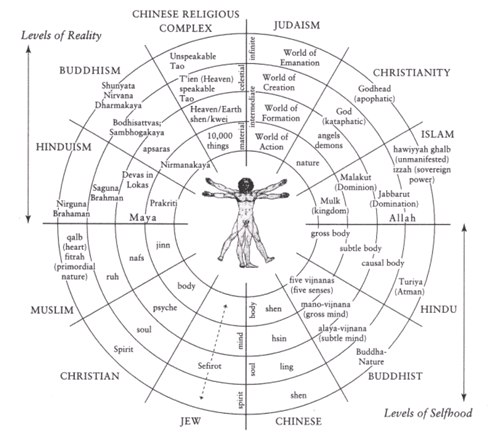
Huston Smith's depiction of the Great Chain of Being -
Will Science Eventually Replace Religion?I came into contact with the Theosophical Society through the Adyar Bookshop, which was an institution in Sydney until early in this millennium when it fell victim to Amazon. It was always staffed by kindly older ladies, as was the associated Adyar Library. I noted in my visits there that the membership was on the whole very aged, as the Society’s heyday was in the 1920’s. And it’s been on a downward trajectory ever since. The Victorian Theosophists were an eccentric lot and Madame Blavatsky often depicted as an outrageous charlatan. Nevertheless they were a fascinating milieu, at one stage there was a very well-appointed Theosophy House in the business district of Sydney, and their lectures were well attended. Then there was the discovery and promotion of Krishnamurti, so-called ‘World Teacher’, for whom an amphitheatre was constructed at Balmoral beach in Sydney (which in the end stood vacant, as he famously resigned from the organisation before appearing at it.) I will always retain some affection for them, they are a 'third way' outside of either religion or science as cultural institutions.
-
Replacing matter as fundamental: does it change anything?I wasn’t attempting to trivialize anything. All I meant was that the fact that living beings began to appear on the earth doesn't undermine the idea that consciousness might be concieved as existing as a latency or potentiality in the Universe prior to the appearance of simple organisms, which enable it to manifest, providing a way to conceive of it as a cause, rather than simply as a consequence or epiphenomenon. That writer you told me about, Søren Brier, seems open to that kind of perspective. Agree that may not be an empirical theory at least according to current naturalism. (Incidentally the Life's Ratchet domain name seems to have lapsed although I am aware of the book.)
-
Replacing matter as fundamental: does it change anything?Unlike biosemiosis, it can't pinpoint a moment when the latency became present in the Cosmos — apokrisis
You mean, ‘manifested’. -
Will Science Eventually Replace Religion?I will add, science itself has a parallel discipline - the point of the scientific method being to eliminate the personal, the idiosyncratic, the subjective, so as to arrive at a conclusion which does not depend on the observer. It is an austere discipline and its roots are very much entwined with the development of the Western intellectual tradition. But it also assumes at the outset, as one of the 'boundary conditons', as it were, that the domain of enquiry is objective, that it exists totally separately from us. That, I think, is the crucial step that occured with the 'scientific revolution'. Prior to that, in scholastic metaphysics, there remained a sense of the 'unity of knower and known' that is one of the fundamental motifs of the various wisdom traditions. You find it in Aquinas. But with Galileo and the ascendancy of the dualistic model which assigns primary reality to the measurable quantities of objects, then not only do you have a new scientific method, but also a fundamentally different way of being, which we're now so embedded in, that it is very difficult to be aware of it. It's the water in which we all swim.
-
Will Science Eventually Replace Religion?do you think I’m making sense in the above things regardless of god, certain values are non-negotiable? — invicta
I think you are, but it's an unwinnable argument, as there will always be counter-examples, such as those @Tom Storm has given.
When I studied Comparative Religion, the very first class was devoted to ‘defining religion’. Convinced this would be a simple task, we all sat around in small groups and canvassed ideas and came up with a list of what we thought would amount to a definition. To our surprise, the lecturer was able to demonstrate that every definition was incomplete or inaccurate. We couldn't, in the end, come up with a definition.
I was (and am) a theosophical type (small t), who believes that the different wisdom traditions portray profound truths, but they are very hard to grasp. They can't be explained in direct terms - that is why so much of their lore is couched in terms of myth, metaphor, and allegory. Ultimately they all demand that you become a different kind of being. Herewith a quote from a Catholic philosopher (I will add, I'm not Catholic)
Our minds do not—contrary to many views currently popular—create truth. Rather, they must be conformed to the truth of things given in creation. And such conformity is possible only as the moral virtues become deeply embedded in our character, a slow and halting process. We have lost the awareness of the close bond that links the knowing of truth to the condition of purity. That is, in order to know the truth we must become persons of a certain sort. The full transformation of character that we need will, in fact, finally require the virtues of faith, hope, and love. And this transformation will not necessarily—perhaps not often—be experienced by us as easy or painless. Hence the transformation of self that we must—by God’s grace—undergo “perhaps resembles passing through something akin to dying.”
You could find exact parallels to that text in Muslim, Hindu, Sikh, and Buddhist sources, were you to look. But it's not the property of any of them, in that it's not confined or limited to them. Let the world get rid of all of them - the requirement would remain. -
A potential solution to the hard problemI think it's essential to it.
As I said in my first comment, the question 'why are we subjects of experience?' is a strange question. It's tantamount to asking 'why do we exist?' The question is asked, 'why did consciousness evolve?' Humphrey quotes another philosopher to that effect:
As far as anybody knows, anything that our conscious minds can do they could do just as well if they weren’t conscious.
For some reason, this strikes me as manifestly absurd. Even very simple critters are conscious - obviously not rationally self-aware and self-conscious - but some level of consciousness is required for them to react to stimuli and survive, to maintain themselves in existence. It's what differentiates organisms from minerals. So the statement is completely self contradictory - 'a conscious mind could do what it does, even without the attribute that makes it "a conscious mind" '. And I don't know that the phenomenon of blindsight is a persuasive argument for that.
But if you phrase the question 'why do I exist?', it is a much more open-ended question than the question of why the brain is configured in such a way as to give rise to the sense of self. The way the question is addressed by Humphrey is from an objective point of view - how to provide a plausible account for the fact that humans and other higher animals have a sense of self, given evolutionary biology and neurology (which, surprise!, is because it provides an incentive to continue existing - which is, after all, the only answer evolutionary biology can give, as continuing to exist is the definition of what constitutes a living species.) But is that all there is to the question of the nature of conscious existence?
David Chalmers discusses Humphrey's earlier work in his book The Conscious Mind: In Search of a Fundamental Theory, saying that it fails to address the hard problem of consciousness, suggesting that Humphrey's approach is reductionist and that it relies too heavily on the assumption that consciousness is a mere byproduct of brain function (in other words, assuming what it needs to prove, or begging the question.)
I know that my objection is easily dismissed. The reductionist approach dismisses the whole idea of there being such a problem in the first place! But the question remains whether reductionism has addressed it or whether it's not really seeing it in the first place. (A different kind of blindsight, maybe.) -
A potential solution to the hard problemHow do you view the hard problem as concerned with “what it means to be”? — Luke
As the crux of the issue. Seems to me that Humphries addresses one aspect of the problem - what is the evolutionary rationale for this capacity? Why are humans and other higher animals aware of themselves? It's like 'yes, I can see how the mind produces reflexive awareness of its own inner states'. He talks about the internal systems that allow that, and how it enriches the state of experience, but the rationale for it is evolutionary - how this contributes to our adaptive ability. That's why, I presume, Daniel Dennett posted it, as it dovetails nicely with his evolutionary philosophy, But it doesn't come to terms with the issue of what it means to be - the kind of concerns that animate phenomenology and existentialism. It's a different kind of 'why' - there's an instrumental 'why', and an existential 'why', if you like. I think Humphries addresses the first, but not the second. (Some discussion of this in the comments on the Aeon article, I note.)
I don't want to say that say, what we call "Mars" is constituted (made of) something mental, I don't think it is. But I grant that whatever we know about Mars comes through experience. — Manuel
You're not alone. Albert Einstein was walking with his friend Abraham Pais one afternoon, when he suddenly stopped and said 'Does the moon cease to exist when nobody's looking at it?' He was asking exactly the same question. I won't address it here though as it's a derailer. -
Replacing matter as fundamental: does it change anything?All I ever see is folk saying consciousness is a fundamental simple of the Cosmos, but somehow the complex functional neurology of creatures with evolved nervous systems are needed to get it to the point of being able do stuff that gives evidence it exists. — apokrisis
How about, consciousness is a fundamental simple of experience? Even despite the fact that I comprise billions of cellular operations, many existing on a sub- or un-concious level, nevertheless the fact is I also possess subjective unity of experience. I don't learn about a pain in my foot by being informed of it.
Why do we attribute agency to evolution? Saying that evolution does things or creates things or produces outcomes? When the way natural selection acts is as a filter - it prevents things that are not adaptive from proliferating. Evolution pre-supposes living organisms which adapt and survive, but to say that evolution is the cause of the existence of organisms seems putting the cart before horse. I think there is a tendency to attribute to evolution the agency that used to be assigned to God. It's kind of a remnant of theistic thinking.
As regards consciousness being the product of an evolved nervous system - what about the panpsychist (or maybe even pansemiotic) idea that consciousness is an elemental feature of the Cosmos, that exists in a latent state, and which then manifests itself through evolution. Not that consciousness should be reified as some existing force that can be identified as a separate factor or influence. The lecturer I had in Indian philosophy used to say, 'What is latent, becomes patent'. I'm pretty sure this is conformable with C S Peirce's metaphysics also.
But the idea that it is real as a latency in the cosmos, taking form as organic life, at least addresses:
It is pretty obvious why consciousness is a bigger problem for anyone who thinks it arrived early in the Universe’s evolution. — apokrisis -
A potential solution to the hard problemI believe this misses the main crux of the article. It is not about “building” a sense of self, but about having one — Luke
What occurs to me, reading that article, is that what his model is describing is ego, the self's idea of itself. I don't think it addresses the aspect of the hard problem concerned with what it means to be.
No, by physicalism I mean everything in the world is physical stuff - of the nature of the physical - this means that experience is a wholly physical phenomenon. — Manuel
You could flip this perspective, you know. You're saying that, because we can't define the physical, due to the ambiguous wave-particle nature of matter and the other paradoxes of qm, that it could or must be the case that, if everything exists is physical then the physical must also include the mental. But what if we acknowledged that nothing is completely or only physical, on the grounds that what is physical can never be completely defined, and that what we experience as physical is instead the attribute of a class of cognitive experiences? -
Will Science Eventually Replace Religion?Both the Russian and Chinese Communist parties set out to eradicate religion, and to institute 'scientific communism', but both of them failed. (Since the fall of Soviet Communism we now have the appalling spectacle of the officially-sanctioned Russian Orthodox patriarchy blessing Putin's war crimes.) The Chinese Communist Party has made an enormous effort to discourage and control Christian sects within its borders, however it is growing faster there than almost anywhere in the world, from less than a million to more than 100 million in the last four decades.
-
Will Science Eventually Replace Religion?It seems that science is in need of religions’ values, ethics, and morals. Might science absorb values, ethics, and morals from religions? From purified religions, of course. — Art48
One philosophical point to consider in all this is the implication of David Hume's 'is /ought' problem and the difficulty of deriving the latter from the former.
I think one of the implications of his observation is that moral frameworks within which values are oriented are extrinsic to science. As it happens, due to the cultural context within which modern scientific method developed, there is, as it were, a residual moral framework that originated in the broader Christian worldview which had previously characterised Western culture, but such a framework can't be derived from science as such. There are no good or bad chemical reactions, simply things that just happen. And if you want to see what a modern, technologically and scientifically advanced culture that doesn't share the same historical orientation towards human rights is like, look no further than the PRC, where individual rights and social minorities are ruthlessly forced back into the imposed consensus.
One problem is, that 'religion' has itself become a kind of cliché or stereotype, the ossified remnants of myths and motifs that no longer possess vitality or relevance. The culture has outgrown its religious tropes. But think about this: we are surely approaching a period when renunciation ought to be valued because capitalist economics, based on unending growth, are nearing or surpassing their sustainable limits. And within what kind of cultural framework would a renunciate attitude, eschewing material gain and seeking the cultivation of wisdom, make sense?
Here I'm reminded of the famous counter-cultural classic, Small is Beautiful, by E F Schumacher, published in the early 70's on the basis of what he called Buddhist Economics. He believed that conventional Western economics was based on a flawed view of human nature, one that saw people as inherently selfish and materialistic. He believed that this view led to a focus on economic growth and the accumulation of wealth at the expense of other values, such as social justice, environmental sustainability, and spiritual well-being. He argued that Buddhist economics was based on an alternative view of human nature, one that recognized our interdependence with others and with the natural world. He believed that this view led to an economic system that was more equitable, sustainable, and in tune with our spiritual and emotional needs, working with nature rather than against it, and of valuing human relationships and the quality of life over material possessions. It also emphasizes the importance of mindfulness, compassion, and non-violence in economic decision-making.
Fifty years later, not much has come of his ideas, sad to say, but I bring them up, because they embody of kind of religious philosophy, in that the Buddhist worldview still incorporates a soteriology (a doctrine of liberation from the world). And I don't believe that science, or scientific naturalism, offers any such horizon of being, however conceived. (I sometimes wonder if dreams of interstellar colonization represent a kind of sublimated longing for Heaven.) In any case, for a Buddhist commentary on same, I will refer to a lecture given by translator-monk Bhikkhu Bodhi A Buddhist Response to Contemporary Dilemmas of Human Existence. It was a keynote lecture at a conference, so is a dense piece, and quite lengthy, but I find myself in substantial agreement with a lot of it.
The triumph of materialism in the sphere of cosmology and metaphysics had the profoundest impact on human self-understanding. The message it conveyed was that the inward dimensions of our existence, with its vast profusion of spiritual and ethical concerns, is mere adventitious superstructure. The inward is reducible to the external, the invisible to the visible, the personal to the impersonal. Mind becomes a higher order function of the brain, the individual a node in a social order governed by statistical laws. All humankind's ideals and values are relegated to the status of illusions: they are projections of biological drives, sublimated wish-fulfillment. Even ethics, the philosophy of moral conduct, comes to be explained away as a flowery way of expressing personal preferences. Its claim to any objective foundation is untenable, and all ethical judgments become equally valid. The ascendancy of relativism is complete. — Bhikkhu Bodhi
However, I'll also add as a counter to that, that there is a new kind of dialogue emerging between science and spirituality which eschews both religious dogma and scientific materialism, often inspired on the one hand by environmentalism and 'systems science' and even by the idealistic trend arising from 'the new physics':
Sigmund Freud remarked that ‘the self-love of mankind has been three times wounded by science’ referring to the Copernican revolution, Darwin’s discovery of evolution, and Nietszche’s declaration of the Death of God. In a strange way, the Copenhagen Interpretation gave back to humanity what the Enlightenment had taken away, by placing consciousness in a pivotal role in the observational construction of the most fundamental constituents of reality. While this is fiercely contested by what Werner Heisenberg termed ‘dogmatic realism’, for better or for worse it has become an established idea in modern cultural discourse (see e.g. Richard Conn Henry The Mental Universe.)
So the entire field is in a period of intense flux, as it ought to be, considering the tumultous nature of today's world. What is emerging is no longer the hard-edged materialistic science of the later modern period, nor the cliches and time-worn tropes of historical religion, but something that absorbs but exceeds both. -
Why Monism?I mentioned the book The One, by Heinrich Pas, earlier in the thread - see this Aeon essay by the author with a synopsis of some of the ideas in that book. (Also worth taking the time to peruse the reader comments and author responses.)
-
A potential solution to the hard problemThis is the question that the article proposes to address:
Why is there any such thing as what philosophers call ‘phenomenal experience’ or qualia – our subjective, personal sense of interacting with stimuli arriving via our sense organs? Not only in the case of vision, but across all sense modalities: the redness of red; the saltiness of salt; the paininess of pain – what does this extra dimension of experience amount to? What’s it for? — Nicholas Humphries
Isn't it rather a strange question? -
Replacing matter as fundamental: does it change anything?This is the Siegel’s neat point about alpha. It speaks to the fact that the Cosmos evolves into a dichotomous story of atoms in a void. — apokrisis
The issue is that the fine-structure constants are prior to anything evolving whatever. If they were different in some slight degree then there would be nothing to evolve. -
How ChatGPT works.does a thermometer experience temperature? — Banno
Do thermometers and computer systems warrant being kind? Are they subjects of experience? It seems perfectly obvious to me that they're not, but it's impossible to prove to those who say otherwise. It's a hard problem. -
How ChatGPT works.Horse's mouth:
Q: Is ChatGPT conscious?
A: No, ChatGPT is not conscious. It is an artificial intelligence language model designed to generate responses to user inputs based on patterns and relationships in the data it was trained on. While it can mimic human-like responses and engage in conversations, it does not possess consciousness or self-awareness. -
Replacing matter as fundamental: does it change anything?Think of a mathematical constant like pi, e or phi. Are they values or are they ratios? — apokrisis
They're ratios. And what I said was responding to
Nothing can exist except by being a system that marries Aristotle’s four causes in bottom-up “material” construction and top-down “immaterial” constraint fashion. — apokrisis
So, my reasoning went, if matter (matter~energy) represents the 'hyle' of hylomorphic dualism, what represents the 'morphe'? You said it yourself - immaterial constraints. And the point about the 'fine structure constants' is not that they're 'spooky' but that they're irreducible - no reason can be given for why they are just as they are (which is precisely what is meant by 'the naturalness problem'.) They are, as it were, the terminus of explanation. And furthermore, they are not in themselves physical - I can't ask you to show me one of them, as the demonstration would consist solely of mathematical arguments and proofs (which I'm the first to acknowledge I wouldn't understand). They are, in that sense, perceptible only to an appropriately-trained intellect; they are, in classical terms, intelligible objects.
I agree that C S Peirce may well have laid it out. And Peirce, as you well know, obtained to a form of scholastic realism.
The only end of science, as such, is to learn the lesson that the universe has to teach it. In Induction it simply surrenders itself to the force of facts. But it finds . . . that this is not enough. It is driven in desperation to call upon its inward sympathy with nature, its instinct for aid, just as we find Galileo at the dawn of modern science making his appeal toil lume naturale. . . . The value of Facts to it, lies only in this, that they belong to Nature; and nature is something great, and beautiful, and sacred, and eternal, and real – the object of its worship and its aspiration.
The soul's deeper parts can only be reached through its surface. In this way the eternal forms, that mathematics and philosophy and the other sciences make us acquainted with will by slow percolation gradually reach the very core of one's being, and will come to influence our lives; and this they will do, not because they involve truths of merely vital importance, but because they [are] ideal and eternal verities. — C S Peirce, Reasoning and the Logic of Things, HUP 1992
All I'm adding is that perhaps, even if only by analogy, such irreducible constraints may answer to that description. -
Replacing matter as fundamental: does it change anything?It's a philosophical point - that the value in question is invariant, doesn't change over time, has no units associated with it //and furthermore that it exists only as a measurement//. How is that an ad hominem? It doesn't detract from anything in the article.
-
Replacing matter as fundamental: does it change anything?
I do read Ethan Seigel's posts although I notice that he's been dropped from Forbes. He's a great explicator.
From that article:
Unlike [the] other constants, which have units associated with them, α is a truly dimensionless constant, which means it is simply a pure number, with no units associated with it at all. While the speed of light might be different if you measure it in meters per second, feet per year, miles per hour, or any other unit, α always has the same value. For this reason, it's considered to be one of the fundamental constants that describes our Universe.
Sounds awfully like 'an idea' to me.
(Apparently, 1/137 turns up in a wide range of contexts.) -
On order, logic, the mind and reality.what in the opening sentence of my last post isn't clear ... — 180 Proof
Nothing at all, but no need to go to any further trouble. -
Replacing matter as fundamental: does it change anything?Nothing can exist except by being a system that marries Aristotle’s four causes in bottom-up “material” construction and top-down “immaterial” constraint fashion. — apokrisis
I wonder if those could be conceived as analogous to the fundamental existence-enabling constraints identified in cosmology (e.g. Martin Rees' 'six numbers')? -
On order, logic, the mind and reality.This striving to reduce foolery (& stupidity) seeks to align expectations with reality as an adaptive habit, or, to use P. Hadot's phrase, as a daily spiritual practice. — 180 Proof
Then I can't see the point of you're introducing with ' Buddhism's "anicca", "anatta", "dukkha-karma"'. Are you saying that these are examples of the 'ruses or delusions' by which humans deny their own inevitable decay? -
On order, logic, the mind and reality.Is that so? Well, in other related dharmic traditions, I understand that it is 'detachment from the psychological habit of permanence' (e.g. anicca-anatta) that facilitates 'liberation'. — 180 Proof
To what end, though? The theory is, that ignorance is the attribution of permanence to that which is by nature impermanent, i.e. arising of thoughts, sensations, and one's sense of ownership and so on - clinging to what is impermanent. So it is ending the attachment to the impermanent that is the aim of the discipline.
All you're saying wisdom consists of is resigning yourself to the inevitable natural fact of death and decay, isn't it? 'Surrender' in the sense of abandoning hope of anything beyond that. Which is precisely what Buddhism describes as nihilism.
he rejected both the views of "nihilism" and "eternalism" as constituting obstructions on the path to liberation. — Janus
Eternalism is the belief that through the appropriate rituals and practices, one can return forever in favourable states of birth (including heaven) rather than seeking emancipation from the whole cycle of re-birth.
It seems plausible to think that acceptance of another world above this one was mainly on account of it being the authoritative dogma, as well as being motivated by fear of death and wishful thinking that there might be a world more perfect than this one. — Janus
In this case, the issue is one of accounting for, or explaining, why there is a 'natural order'. As you will probably recall, in Greek philosophy, there was a principle that the explanans has to be of a different order to what is explained. So, for example, the faculty of reason was thought to provide a higher level of explanation than sense-perception, because of its ability to discern causal factors not perceptible to the sense alone - that being the logos (according to Heraclitus and the Stoics), the reason things are as they are. This was the probable origin of the idea of 'natural law'. According to view there can't be a natural explanation for the natural order, because both explanandum (what is to be explained) and explanans (what explains it) are of the same order. -
On order, logic, the mind and reality.I never used the word 'blindness'. I simply said that the popular rejection of the notion of the divine origin of natural law is a factor in the debate.
-
Replacing matter as fundamental: does it change anything?Whereas in reality all you will end up with a heap of feces-smeared and broken typewriters. (Although I do sometimes wonder if they're not harnessed elsewhere, entering content via social media.)
-
On order, logic, the mind and reality.I didn't intend to imply wilful blindness but that could equally be said of your second sentence, as, at the time, the Christian worldview comprised a distillation of whatever historical wisdom and science the culture possessed. But, let's not get into that - my only point was that whenever a discussion about 'the order of nature' is entertained, a sub-text to that debate is the possibility or non-possibility of there being a higher intelligence.
-
On order, logic, the mind and reality.1). Let's assume that reality is ordered - consistent. Governed by laws and constants. (objective).
2). Lets also assume that the mind can perceive reality, receive data or input from it and store that data. — Benj96
I think it foolish to deny that there is an order in nature, but I also think that the answer to the question of why there is such an order, and what this order means or implies is not at all obvious. And also the question of whether natural order extends to the human order - the framework within which we make decisions about values or assign meaning. What the place of humans is, in relation to this order.
(A Christian philosophical view would be that this natural order is instituted by God, and the appropriate response is that of obedience to divine commandments, which I will leave aside in favour of philosophical analysis. However it should be understood as part of the background of this question as modern culture has been shaped by rejection of that view - it defines what not to believe for a lot of people.)
Then, we could say that the degree of awareness or logic vs delusion of an given individual = the degree in which their minds internal relationships and associations or paradigm parallels/falls into alignment with that of external reality.
Proof of such a case is in predictive value - such an individual would be expected to have immense foresight (prediction) ability, as well as memory (accurate recall) , as well as explanatory power (their logic paralleling the innate logic of an objective reality). — Benj96
Aren't you describing here precisely the enterprise of science? Is it not the discernment and quantitative analysis of the objective order of nature which science is engaged in, and which has given rise to immense control over physical conditions and accumulation of information? Doesn't science already create predictive, mathematical models of the behaviour of nature with unprecedented levels of accuracy?
'the business of philosophy' is primarily to reflectively discipline the human mind with study, dialectical engagement and praxis in order to gradually unlearn the maladaptive habit of 'denying the human mind's inherent disorder' while learning to be antifragile because of this fact. — 180 Proof
Would you consider the possibility that this 'inherent disorder' is what is designated by 'avidya' (ignorance) in Buddhist and Hindu philosophy? And that in those schools of traditional philosophy, it is precisely detachment from the imperatives of nature that provides the pathway to liberation (mokṣa, Nirvāṇa)? Whereas the identification with 'what decays and passes away' (in their terms) binds to the 'wheel of saṃsāra' (detachment from same being the aim of 'daily spiritual practice'). -
Replacing matter as fundamental: does it change anything?Ok, but it was just an example. It could be anything else. — Eugen
When you get down to 'fundamental constituents of existence', what are the choices? Any suggestions? -
Replacing matter as fundamental: does it change anything?if we replace matter with another substance, e.g. information, — Eugen
‘Information’ is not a substance (in the philosophical sense.) The word has no meaning without specifying what information is being referred to. -
Consciousness - Fundamental or Emergent ModelWhether consciousness can be explained in terms of physical processes is a different question than whether it or the physical (or neither) is ontologically fundamental. — Janus
How is it a different question? For the physicalist, the physical substrate is fundamental, consciousness is epiphenomenal. So explaining consciousness in terms of physical processes is at the same time making the claim that the physical is ontologically fundamental. After all, it's what physicalism means. -
Will Science Eventually Replace Religion?It might be worth mentioning Science and Non-Duality. This started as a conference in San Rafael in California in 2009.
The mission of Science and Nonduality (SAND) is to forge a new paradigm in spirituality, one that is not dictated by religious dogma, but that is rather based on timeless wisdom traditions of the world, informed by cutting-edge science, and grounded in direct experience.
They now have conferences in many other locations and a large number of recorded lectures and seminars on Youtube. Their web homepage can be found at https://www.scienceandnonduality.com/ and on youtube https://www.youtube.com/@scienceandnonduality -
Consciousness - Fundamental or Emergent Modelwhat does "fundamental" mean? — IP060903
It is about establishing a reduction base. The reduction base is the set of concepts, entities, or principles that are considered fundamental or basic to a philosophical position. It serves as the starting point for explaining and analyzing other phenomena or concepts that are deemed less fundamental or derivative.
In philosophy of mind, physicalists will argue that mental states can be reduced to physical states of the brain. In this case, the reduction base would consist of the physical entities and processes that underlie mental states, such as neurons, synapses, and neurotransmitters. Other phenomena, such as conscious experience or thoughts, would then be explained in terms of these more basic physical components.
Those opposing will argue that mental acts, such as speaking and reasoning, and perhaps even the very quality of subjective experience itself, cannot be explained in terms of physical processes. -
Consciousness - Fundamental or Emergent ModelConcepts might or might not be reducible to matter — Eugen
Trying doing that without employing concepts :wink: -
Consciousness - Fundamental or Emergent ModelDo processes such as metabolism, homeostasis and reproduction 'emerge from' simple lifeforms such as single-cell organisms? Or are those metabolic processes inherent to what makes them organisms in the first place? As soon as they die, they cease from being organisms and exist only as decomposing collections of elements. In that sense, life itself is irreducible, because as soon as it is reduced to its material components, it's no longer alive.
Snippet on the view of enactive or embodied cognition: Enactive cognition is a theory that suggests that the mind is not something that is contained within the brain, but is instead a process that emerges from the interactions between the organism and its environment. In other words, the mind is not just in the head, but is distributed throughout the body and the environment.
Evan Thompson argues that this enactive perspective on cognition is closely tied to the concept of life, because living systems are characterized by their ability to actively engage with and shape their environment. According to Thompson, the mind is not just a passive observer of the world, but is an active participant in the process of life. -
Consciousness - Fundamental or Emergent ModelA word on the cultural sensitivities of the hard problem of consciousness. David Chalmer's 1996 essay on that topic touched a nerve, because it had the gall to suggest there was something fundamental about consciousness which could not be explained in scientific terms as a matter of principle. Not because we didn't have the instruments, or we didn't have the concepts, but because of the very nature of subjective experience, of 'what it is like to be...'. The obvious foil for this argument was prominent materialist philosopher of mind, Daniel Dennett, who refuses to acknowledge that there can be anything about human nature which is beyond the purview of science. Dennett, you see, is an exponent of 'scientism', which is the view that the scientific method is the only reliable way to acquire knowledge about the world and that any knowledge that cannot be obtained through the scientific method is either trivial or not worth knowing. So there's a 'culture war' going on here, between those who suggest 'dualism' or some sense in which the mind is spookily not amenable to guys in white coats, and the guys in white coats.
-
Consciousness - Fundamental or Emergent ModelThe questions are:
1. Is the logic of the model correct?
2. There is an alternative to this model, i.e. a model in which ''absolutely anything you could think of" is not fundamental, but it is neither 100% reducible nor strongly emergent?
3. Does this model apply to any type of reality? I mean, if instead of matter we assume that the most fundamental thing is an immaterial computer or information, does this change have any impact on the model? — Eugen
The problem with this OP is that the 'model' is not well expressed. The phrase "absolutely anything you could think of" is a place-holder for "whatever you think consciousness to be" - but you might just use the word "consciousness". So you're really just asking, is consciousness (whatever you consider that to be) fundamental, or is it not?
You then bring in weak and strong emergence. These can be summarised as:
Weak emergence refers to the idea that mental properties or states can be explained by the underlying physical processes, but grants that the explanation is complex and cannot be reduced to the physical processes alone. In other words, the mental properties or states are emergent in the sense that they are not predictable solely from knowledge of the physical processes, but they can be ultimately reduced to physical processes, by means as yet unknown.
Strong emergence refers to the idea that mental properties or states cannot be explained by the underlying physical processes because they are ontologically distinct from them. In this view, mental properties or states are not simply the result of physical processes, but arise from some other, presumably non-physical source.
The debate between weak and strong emergence is an aspect of the broader mind-body debate, which concerns the relationship between mental states and physical or neuro-physical processes. While weak emergence is more widely accepted among philosophers of mind, others say that strong emergence is necessary to account for the subjective nature of conscious experience. The counter to that is that strong emergence is incompatible with scientific explanations of the mind, and that weak emergence is a more plausible account of mental properties and states.
Yet others reject the idea of emergence altogether, saying that a physicalist account of subjective experience can never describe or capture "what it is like" to be the subject of experience (e.g. David Chalmers). In Mortal Questions, Thomas Nagel criticizes the idea of 'emergence' because of the impossibility of specifying the relationship of conscious states with the supposed physical constituents that are supposed to cause them. Do they supervene on those processes, or are they independent of them? How can we explain the causal relationship between mental and physical states if they are ontologically distinct (i.e. of basically different kinds)? It is easy to assume that neurochemical interactions cause thought, but demonstrating the nature of that causal relationship remains elusive.
That out of the way, hereunder is my basic stance on the question. Consciousness is fundamental not as a constituent of objects, but as the ground of cognition. And as all objects appear within cognition, objects (and their relations) appear for us. The million-dollar question is whether those objects are real independently of our cognition of them, or whether their reality is imputed to them, by us, on the basis of our experience of them. That is the vital point to understand, because in my view, the idealist argument is not that objects are composed from some mysterious mind-stuff as a constituent, but that whatever reality we impute to objects is dependent on our cognition of them. See the difference?
The view that the reality of objects is 'constructed' or 'constituted' by our cognitive acts is now quite commonplace amongst cognitive scientists and philosophers. One example that has been discussed here recently is the cognitive scientist Donald Hoffman (see here and here), but there are many others with different attitudes and interpretations. But all of them, at least, acknowledge the constructive role of consciousness. -
A Summary of the "Tractatus Logico-Philosophicus"Swap you, I’m on grandparent duties :scream:
Wayfarer

Start FollowingSend a Message
- Other sites we like
- Social media
- Terms of Service
- Sign In
- Created with PlushForums
- © 2026 The Philosophy Forum