
-
Emergence
If there is no view from nowhere, there are views from somewhere.If there is no view from nowhere, then "what" is happening? Can one speak of this? — schopenhauer1
The cogito is happening: I think thus am, and the world appears to be as well; as well as its phenomenological reduction: our subjective experience at (as much as "of") the world is happening. We are part of the world, historical like it, physical like it.
From this it follows quite a few things, including that science is happening, as a human effort to make sense of our subjective experience at the world.
Science that can study, document, test and try and understand emergence.
Make sense? -
Nothing to do with Dennett's "Quining Qualia"
Okay, a brave attempt at a summary, but you stayed at safe distance from Dennett's actual argument, only evoking his "intuition pumps" without trying to summarize any of them, so the argument is not transparently described. Let me try and fill in some blanks.Dennett argues fairly convincingly(by my lights anyway) against the ineffability, intrinsicality, privacy, and direct apprehensibility of the properties of conscious experience, and in doing so effectively grounds his rejection of qualia. It's worth noting that he does all this by offering physicalist explanations of actual counterexamples(intuition pumps) that are germane to historical notions of qualia/quale. In doing so, he shows that the properties of personal experience that make personal experience what it is, are not special in the sort of way that proponents of qualia claim. — creativesoul
First, I agree that the broad intent of Quining Qualia is to disqualify qualia as a useful concept. This implies that according to Dennett, philosophical concepts can have clear-cut qualities, and that these clear-cut qualities are accessible to our consciousness, that we can assess them logically and objectively. In other words, it assumes that concepts can be unambiguously defined, assessed and critiqued, which is a false premise. No philosophical concept worth its salt can be defined without ambiguity, and the concept of Qualia is no exception. (And in fact the paper later recalls Wittgenstein's skepticism regarding the possibility of a private language…)
Which is why concepts are hard to kill. They resuscitate in far less than 3 days. The zombies here are not us but them concepts. Which is interesting because you can crucify them again and again, usually on a cross made of other concepts. Such as the concept of intuition used by Dennett here. But these other concepts are no less likely to be doubted and poked around, they have not been vetted as well-defined by anyone…
For Dennett, intuition is evidently some kind of humor or juice that can get pumped up. So let’s scan through his pumps.
Intuition pump #1 (watching you eat cauliflower) openly pleads for the existence of qualia. Dennett says he cannot “isolate the qualia” but still hates that taste of steamed cauliflower…
IP#2 pleads for the qualia of wine taste to be an important enough motivation to conceivably drive the design and construction of wine tasting machines. I hope Dennett is not suggesting that the machine could enjoy wine, nor that we should produce wine so that machines can drink it?
The moral of IP#3 and #4, as per Dennett himself, is that no intersubjective comparison of qualia is possible, even with perfect technology, and therefore qualia are ineffable and private after all.
IP#5 and 6 (the neurosurgical prank and alternative neurosurgery) plead for our capacity to notice a discontinuity in qualia. If qualia did not exist, the subject would perceive no difference at all.
Intuition pump #7 (Chase and Sanborn the coffee tasters) seem to imply that qualia are subjective and private, but that memories of qualia are often unreliable, and that tastes changes over time.
In IP #8 (the gradual post-operative recovery) some scientists have objectively and verifiably inverted poor Chase’s qualia. When Chase reports otherwise, they insist that they did so even and that Chase is incorrect. Therefore the scientists affirm the objective existence of qualia, because you cannot change something that does not exist, and then insist that you did change it... That Chase reports otherwise is neither here nor there; it could simply be due to him trying to fool the scientists.
Intuition pumps #9 and 10 are closer to everyday experience. #9 is about acquired tastes like beer and IP #10 is about that fact that phenol-thio-urea tastes very bitter to some, and is tasteless as water to others. This proves that tastes can evolve, and they can depend on people: I don’t find bitter what you find bitter, apparently. But IP 10 also proves that tastes are genetically mediated, and hence have been selected throughout evolution. This means that a qualia such as “bitterness” are a product of our biology, which is an objective fact, and this fact lends them objectivity. Qualia can be studied through genetics, for instance, as in the case of phenol-thio-urea.
IP#11 (the cauliflower cure) is equivalent to IP#7 (Chase and Sanborn). Dennett’s experience of cauliflower is dramatically affected (for the better) after he eats a pill. He feels a strong qualitative change but since he cannot say if he was wrong before or what, he concludes that the taste of cauliflower does not exist (but now he likes it a lot…).
Intuition pump #12 (inverting spectacles) is about a well-known phenomenon: after wearing inverting spectacles (up is down and vice versa) for several days subjects make an astonishingly successful adaptation and seem to see things normally. It is similar to IP #8 where Chase's taste buds have been unethically inverted, but it is more real and less gross. Similarly to IP8, the scientists studying this know very well that the spectacles are inverting visual perception. So like IP8, IP12 proves only that qualia are real, objective, scientific phenomena.
Intuition pump #13 (the osprey cry) is about the difference between a verbal description of an osprey cry and hearing it. “So that's what it sounds like, I say to myself, ostending--it seems--a particular mental complex of intrinsic, ineffable qualia. … [but] from a single experience of this sort I don't--can't--know how to generalize to other osprey calls. Would a cry that differed only in being half an octave higher also be an osprey call? ” So first he understands a qualia then he wonders about how many of them ospreys he would need to hear to know the qualia of the osprey cry…
IP #14 (the Jello box) is a confused way to ask once again “whether your blue is my blue, your middle-C is my middle-C” and is thus similar to IP #1: qualia can differ from one person to the next, and are thus highly personal and subjective.
IP #15 (the guitar string) speaks of our capacity to disentangle harmonics in a guitar note or notes in a chord. “The difference in experience is striking.” And later: “you are still responding, as before, to a complex property so highly informative that it practically defies verbal description.” It’s is hard to leave this IP without an intuition that musical beauty is indeed complex and ineffable, even if it can be – as in this case – further broken down into sub-elements. And that’s the point he is trying to make of course, but you still cannot verbally describe fully the sound of a guitar, while you can still recognize it, even after this IP. Even if a sound can be broken down into its components, and perceived as such, even if a patch of color of your computer screen can be broken down in red, blue and green dots, even if qualia can be broken down in elementary qualia, that doesn’t make the elementary qualia any less ineffable.
So as per the paper’s “intuition pumps”, qualia are ineffable, subjective and personal, but also objective, scientific phenomena. They are economically important (and thus wine tasting machines are potentially profitable). They can be very beautiful. And they sometimes force even those philosophers who doubt their existence to give up forever on steamed cauliflower... -
Deep SongsOh mercy, mercy me
Things ain't what they used to be
Where did all the blue skies go?
Poison is the wind that blows from the north
And south and east
Oh mercy, mercy me
Oh things ain't what they used to be, no no
Oil wasted on the oceans and upon our seas,
Fish full of mercury
Ah, oh mercy, mercy me
Ah things ain't what they used to be, no no
Radiation under ground and in the sky
Animals and birds who live nearby are dying
Oh mercy, mercy me
Oh things ain't what they used to be
What about this overcrowded land
How much more abuse from man can she stand?
-
EmergenceSo at what epistemic level is a non-viewer based emergent event happening. — schopenhauer1
This is a contradiction in terms, because "epistemic" implies a viewer. More generally, there is no such thing as a view from nowhere. -
What is Dennett’s point against Strawson?
And how is "7894785327954" not an equally "reasonable" answer, in the absence of any empirical fact? You lost yourself in a sea of empty speculations now...Say we have an unknown quantity - how many red coins there are in a jar. You say 30, others say 35, Dennett comes along and say 0 and everybody tries to claim he's not even addressing the question. 0 is a perfectly reasonable answer to the question — Isaac -
Nothing to do with Dennett's "Quining Qualia"Just another one for the fun: the Munker illusion:

Figure 1. Rectangles A, on the left, look much darker than the rectangles B, on the right. However, rectangles A and B reflect the same amount of light.
It works with colors too.

Figure 2. The two rectangles on the right look much darker than the ones on the left. However, they are of the same actual tint. -
Nothing to do with Dennett's "Quining Qualia"
Read the thread... please try to understand the points being made. The trick is to get out of your denial mode of thinking, to open your mind to new ideas. You can do it.Read the text. — Isaac
One of the points that has been made is that Dennett is ambiguous and equivocating. In this text he does not actually put forth a clear argument that one could address, but smokes and mirrors. Go and read his text, and try and summarize what it says. I predict you won't be able to. -
Nothing to do with Dennett's "Quining Qualia"The problem has been solved, to my satisfaction at least. Qualia can't easily be isolated from other qualia, and talking of them as simple objects (e.g. "the color red") is a gross simplification. Rather, there are many different color perceptions than can be classified as "red", depending on the circumstances. Colors and other visual effects are nevertheless demonstrably effective (they work for us), distinct from objective reality, and predictable/replicable to a degree. So maybe Swanson's take on qualia was a bit simplistic (?) but they do demonstrably exist as something stable and predictable, if defined as "the way things look to us."
The term is a bit jargony but I can see if no precise substitute. "Sensations" could work but it's kind of vaguish.
I would like to thank and for their contribution to this thread. You guys are amazing! -
Nothing to do with Dennett's "Quining Qualia"Qualia are defined as the way things appear to us. If things are distinct from how they appear, stubbornly so, then there is some demonstrable stability and reality to "the way things appear to us".
-
Nothing to do with Dennett's "Quining Qualia"Let's call it the Marchesk-Olivier argument for the existence of qualia. :-)
The key point is that the illusion doesn't go away, it is stable and replicable, not just a fleeting moment of illusion: a stubborn one. Optical illusions are also universal: everybody seems to see the same illusion. This means we have some reason to assume that you see more of less what I see, that your qualia is my qualia, because even when their are 'wrong', they seem to coincide. -
Nothing to do with Dennett's "Quining Qualia"Exactly. Thanks for the green peg illusion and for outlining the argument. I think it's quite strong because it's empirical.
-
Nothing to do with Dennett's "Quining Qualia"Seen one constructed illusion, seen ‘em all, right? — Mww
Right. The point being that the image you are seeing is at an obvious, demonstrable variance with objective reality, but that this variance doesn't go away no matter how often you are shown the image and convinced empirically of your illusion. The illusion is stubborn, it is replicable, and therefore I must conclude that our visual cortex can create an image that has some stubborn reality in it, I can recognise the optical illusion if I know it, but can't chose to not see it, and yet it is markedly different from the objective image sensed by our retina.
Ergo qualia sunt. -
Nothing to do with Dennett's "Quining Qualia"There is something stubborn about optical illusions. Even when you understand your perception error intellectually, it doesn't make the subjective (and factually false) impression less glaring. Like in this one, where you see a bulge in the center of the checkers board, but in actual fact all the lines are straight:
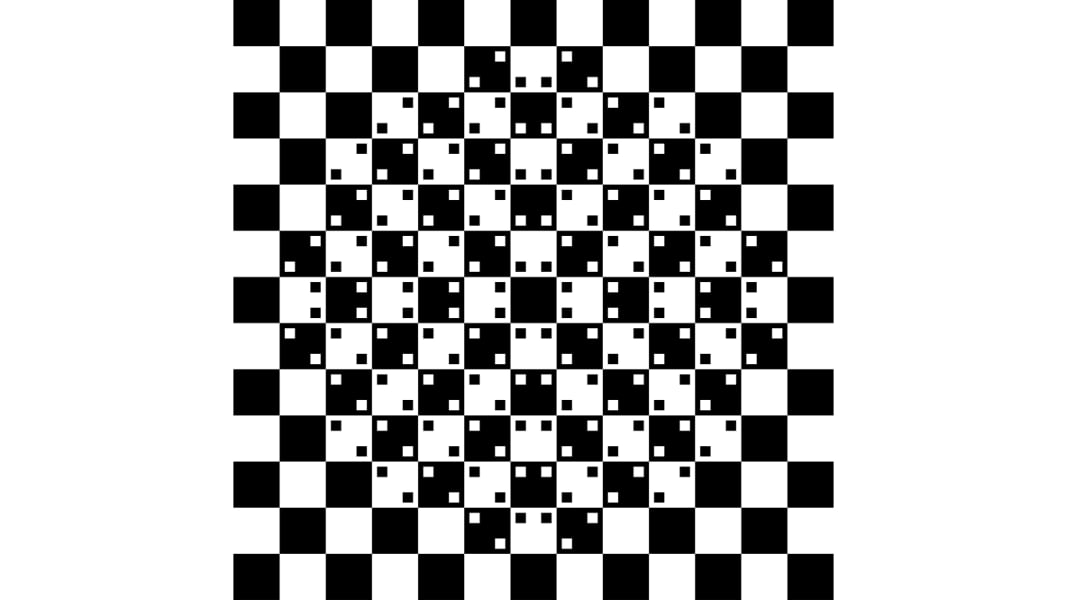
... or here, where he background is a color gradient and progresses from dark gray to light gray. The horizontal bar appears to progress from light grey to dark grey, but is in fact just one color:

-
What is Dennett’s point against Strawson?Yes, by and large agreed. If we could have the same kind of consciousness without a brain, we probably wouldn't have a brain... Vice versa, if we could function just with a brain and without consciousness, i.e. if a Dennett zombie was actually possible rather than just a mind experiment, then we would probably all be Dennett zombies. Nature does not build things for no good reason.
-
Nothing to do with Dennett's "Quining Qualia"
You didn't get the memo? Pretty pictures don't exist, Drake. Their concept was found too hard to define by Dennett, so they were cancelled.I don't see qualia, I see pretty pictures. — fdrake -
Nothing to do with Dennett's "Quining Qualia"
The illusion is that you perceive the A square as markedly darker than the B square, while in fact they are of the exact same shade of grey... (I actually had to check on MSPaint by sampling each hue, and I can confirm that they are the same)Is it, really? Where, exactly, is the illusion? — Mww
I already knew that our visual systems compensates for light color and intensity but still, this is pretty incredible. -
What is Dennett’s point against Strawson?NO one is saying that consciousness does not come from the brain. — Philosophim
Let me say it, then: we don't know for a fact that consciousness comes only from the brain. It could emerge from the entire nervous system, or even from the entire body. -
Deep SongsLots of nice tunes and inspiring lyrics in the thread... :-) Thank you guys.
Now a question for everyone, not just Americans:
-
Deep Songs
I never saw the morning 'til I stayed up all night
I never saw the sunshine 'til you turned out the light
I never saw my hometown until I stayed away too long
I never heard the melody until I needed the song
I never saw the white line 'til I was leavin' you behind
I never knew I needed you until I was caught up in a bind
I never spoke "I love you" 'til I cursed you in vain
I never felt my heart strings until I nearly went insane
I never saw the east coast until I moved to the west
I never saw the moonlight until it shone off of your breast
I never saw your heart until someone tried to steal it, tried to steal it away
I never saw your tears until they rolled down your face
-
What is Dennett’s point against Strawson?
Indeed, which is far more than you can say for anything in 'Quining Qualia'... :-)Yes, you could conceive that... then you could test it — Isaac
You asked for speculations in this post, remember? If you didn't want then, you shouldn't have asked for them....then we wouldn't have to just sit around making uninformed speculations... — Isaac -
What is Dennett’s point against Strawson?My entry:
... because of the mise en abyme allowed by our two brains talking to one another.
— Olivier5
...and that's an answer. — Isaac
Why yes, one possible answer among many.
By the way, the fact that we have two interconnected brains (left, right) rather than one can be used to solve the "Cartesian theater" paradox. Instead of an infinite regress of theater viewers, you can conceive of just two viewers sharing notes and impressions. -
What is Dennett’s point against Strawson?Biologists stole your concept of life? Did you report them to the police?
-
Nothing to do with Dennett's "Quining Qualia"Nice dress, isn't it?

Élisabeth Louise Vigée Le Brun: la Baronne de Crussol -
EmergenceOk, I wouldn't limit emergence to that just yet... but fair enough. — ChatteringMonkey
And you'd be right. I'm talking of what it takes for emergence to build up over time. Ocean waves are emergent but they don't last, and they don't grow upon one another. -
EmergenceI agree with the criteria that an emerging "thing" or phenomenon must be more than the sum of its parts, must exhibit novel properties that its parts did not exhibit. But I am trying to see what that implies in practice. It implies - me think - a capacity for small emerging events to build up to something bigger, hence emergence needs to be somewhat cumulative and self-sustaining over long periods of time.
Emergence is a small step, and then another small step, and another one, cumulatively adding up to a journey. -
EmergenceLet's explore a few examples. I primarily have life in mind, but it may be useful to look at a few non-biological emerging structures to test the criteria of self- maintenance.
1. A stalactite: it "emerges" from a cave ceiling by the slow accretion of limestone and other minerals brought by percolating water. The emergence of a stalactite takes thousands if not millions of years to happen. The cave environment shields the phenomenon from wind erosion and other entropic forces. So it doesn't need to be self-maintaning, but it is self-sustaining because flowing water will tend to follow an already formed bulge in the ceiling, precipitating its minerals at the tip of the bulge.
2. A river: it's an earth topographic structure "emerging" from water erosion over a raised area of land. Here too the phenomenon is self sustaining: water flowing digs down the river bed (typically) so the structure remains more or less there, stable in spite if the fluctuation in water flow. An ecosystems develops around it. Sometimes the river dries up for a period in summer; and sometimes it floods the plains around it. The banks can get eroded or built up by silt, so the bed of the river evolves over time.
So self-sustainance is a better criteria than self-maintainance because it doesn't exclude purely physical emerging phenomena. -
EmergenceI guess I should say, at what perspective is this happening? — schopenhauer1
The scientific perspective, as far as I am concerned. -
EmergenceIt is just arrangement of matter. Solid, liquid and gaseous phases are well known physical concepts about how atoms "connect" or not with one another.
-
Emergence
Good question. I suppose that various chemical bonds and forces would need to exist between components, bindings them in certain ways, for an emerging object or form to have any solidity. So one level of solidity is chemical.At what level is solidification happening? — schopenhauer1 -
What is Dennett’s point against Strawson?
Because schopenhauer1 is not a zombie, in the sense that he has got something called subjective experience. He maintains a difference between subjects and objects.I'm asking why it isn't even addressing the question, as schopenhauer1 claims. — Isaac -
Emergence
I suspect there is no qualitative difference here, that "strong emergence" is just what a billion years of "weak emergence" looks like.↪Olivier5 ↪ChatteringMonkey ↪schopenhauer1 ↪magritte
What if we worked toward a basic definition and then conquered Chalmers strong and weak emergence? — frank
I would add a few criteria, as follows:The IEP puts it this way:
"If we were pressed to give a definition of emergence, we could say that a property is emergent if it is a novel property of a system or an entity that arises when that system or entity has reached a certain level of complexity and that, even though it exists only insofar as the system or entity exists, it is distinct from the properties of the parts of the system from which it emerges. However, as will become apparent, things are not so simple because “emergence” is a term used in different ways both in science and in philosophy, and how it is to be defined is a substantive question in itself."
Structural strength: for an emerging form to perdure at all, the form must be structurally cohesive and/or self-sustaining. Otherwise the slightest perturbation in the environment would erase the form. A structure that emerges and then vanishes (like the waves in the OP) is not building up any emerging property over the long term. It emerges and then goes back to zero, and so does the next wave.
Cumulative: for emergence to go anywhere over the long run, it needs to build upon past emergence. So to qualify as real emergence, a structure or form has to maintain some of its structural gains over time (criteria of structural strength), long enough for another emerging form to happen, AND this new emerging form has to build upon the previous one (i.e. be cumulative).
Self-maintainance: because of entropy, an emerging form is generally subject to degenerescence and destruction. In order to satisfay criteria of structural strength and cumulativeness, an emerging form must therefore be able to repair itself, otherwise it is not going to last long enough for cumulative emergence to happen. -
Nothing to do with Dennett's "Quining Qualia"
That could explain why Dennett rarely makes any sense: his intuitions are simply mistaken.Dennet's argument is that our intuitions are mistaken, — Isaac -
Nothing to do with Dennett's "Quining Qualia"
I don't know that this is a fact... Our eyes resemble cameras quite a lot. They have an aperture, a lense and a photosensitive surface on which the image is captured.We're really nothing at all like cameras, you know? — Srap Tasmaner
If you are not color-blind, you can distinguish a green from a red, or a dark red from a light red, or a movie in colors from a movie in black and white. How you spot the difference, if not through some qualitative difference in what you see? -
You Can't Die, Because You Don't ExistWhat, you mean in some very fleeting way, for a small moment, in some small corner of your mind? — bongo fury
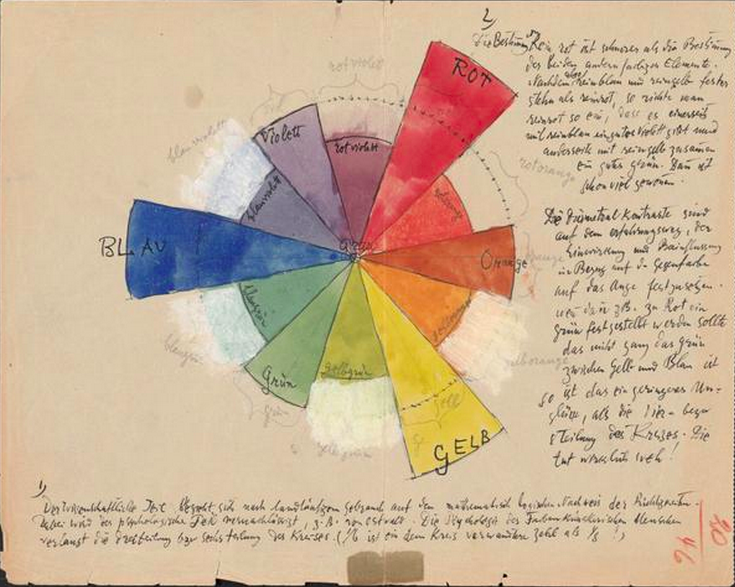
I suggest you ask yourself why you don't expect anyone to mistake a horse-shapped cloud for a real horse. What is the essential difference between the two, you think?


Olivier5
Start FollowingSend a Message
- Other sites we like
- Social media
- Terms of Service
- Sign In
- Created with PlushForums
- © 2026 The Philosophy Forum