
Comments
-
You Can't Die, Because You Don't ExistNot unless you mistook it for a horse, which you didn't. — bongo fury
Who said I didn't? -
What is Dennett’s point against Strawson?We open a philosophy journal tomorrow with the headline 'Hard problem solved - we have an explanation of why we seem to have first person experiences'. What might the abstract read? 'We seem to have first person experiences because...' — Isaac
My entry:
... because of the mise en abyme allowed by our two brains talking to one another.

-
Emergence
It's turtles all the way down, there's no elementary level of matter and energy that I can see. "Simpler" and "smaller" do not mean "more causal".What atoms and elementary particles are the most basic "simples" (as the term is used in philosophy circles) — schopenhauer1 -
You Can't Die, Because You Don't ExistIt's an illusion created be your perspective. It's only when seen from a certain angle that it looks a bit like a horse. If you see the same cloud from 100 km away it would look nothing like a horse. It's like the constellations, a matter of perspective.
-
Emergence
Sorry to interject but I think this is a concept that may require some attention, as well as the reverse concept of "bottom-up causation"."top-down causation" — schopenhauer1
When I hit on a nail with a hammer, and the nail is driven down a plank of wood, can I say that the hammer head is accumulating kinetic energy, and that it transmits this energy to the nail? Or should I rather think that the atoms of the hammer head are accumulating kinetic energy and transmitting this energy to the nail atoms? Or should I instead say that the wave function of the hammer head elementary particles is interacting with that of the nail elementary particles? And at a smaller level, what about the quarks of my hammer? Are they the ones doing all the work or what?
I think that scale is in the eye of the beholder. We should avoid the assumption that there is a privileged scale at which causation happens. Causation happens at all levels at once because all levels coexist in one reality. Up and down in this context are best understood as metaphors for scale of observation, not for causation channels. -
Abiogenesis.Bacteriophages can even reanimate/ resurrect dead bacteria — Benj96
Source?
Part of the difficulty lies within developing a concrete definition of “life” or “living systems” in the first place. — Benj96
There are many, but the one I prefer is the capacity of a structure to repair and replicate itself.
Re. abiogenesis, there are two leading hypotheses: 1) the cosmic soup (a form of panspermia) and the RNA world. There are not mutually exclusive. In fact a lot of the complex molecules recently found in space seem related to RNA.
The RNA world hypothesis solves a long lasting conendrum: DNA cannot replicate without proteins catalysing the reactions involved, and yet those proteins are coded in the DNA that they help replicate, leading to a chicken and egg paradox. -
Nothing to do with Dennett's "Quining Qualia"
Why thanks, glad you liked it. Who said philosophy is the capacity to marvel?This is just lovely. What an excellent post. — Srap Tasmaner -
Nothing to do with Dennett's "Quining Qualia"But what is emerging into what? How? — schopenhauer1
What is emerging is a functional structure. How is the core of the problem.
Embryology has made progress and so has evolution theory, but neither can fully explain ontogenesis or phylogenesis, respectively.
Generally, in biology, the process of creating a new structure involve folding a line or a surface onto itself to create a 3d structure, like an origami. In other words, your "epistemic cut" often looks like an invagination, an indentation, a wrapping. A fold. The folding is automatic. The archetypical example is the folding of proteins, in which a chain of amino acids folds into a functional enzyme:
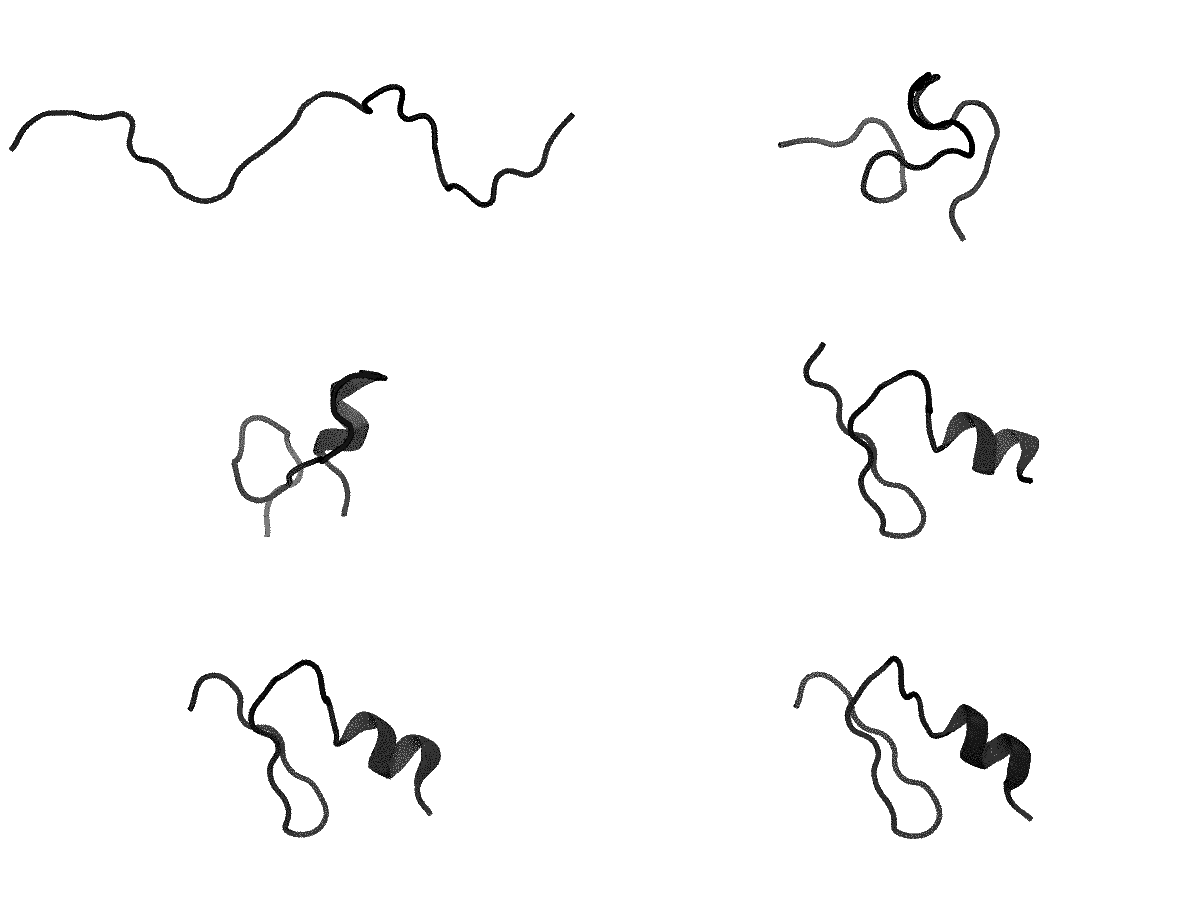
There is something fractal in this capacity to create structures with lines, or surfaces:

Flower blooming
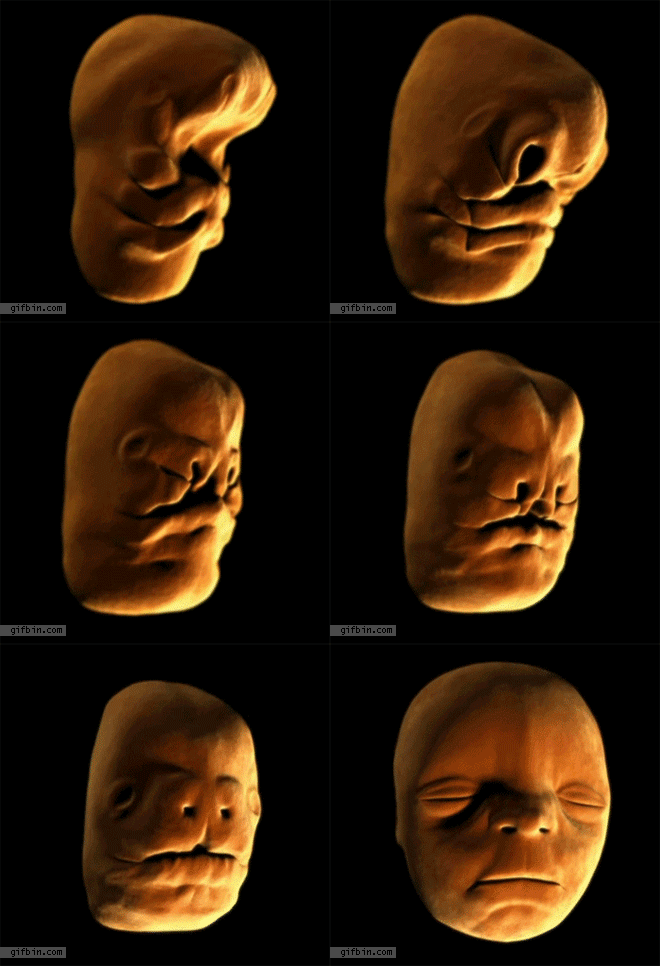
Embryonic development of the human face
In all cases, note the rather surprising approach: the seemingly infinite production of new flowers at the core of the inflorescence, the apparent absurdity of the face development. This is what emergence does look like: it's not designed and built like a human architect or an engineer would have done it. It grows, a certain growth is happening, that leads in surprising ways to a familiar structure (a plant, a flower, a face).
In summary, a line folded many times can create a structure. This would be how the DNA linear code can produce a 3D organism. Nowhere in that DNA code can one find a map of the individual it belongs to. It just codes for self-folding proteins, who act upon each other and their environment in ultra complex feedback loops to produce a biostructure.
Emergence is a self-folding origami.
In biology, the short answer is through feedback loops. The classic example is a thermostat that can regulate a room temperature. Life is essentially a set of feedback loops, at all levels, everywhere. From the biochemistry to the cell to the organism to the ecosystem and back (of course!). Note that once again it is some kind of folding, but not a topologic one this time: a folding of causality, a causal fold.how is it that downward causation or top-down causation works without a viewer? — schopenhauer1 -
Nothing to do with Dennett's "Quining Qualia"
The now classic answer is: when the whole is more than the sum of its parts. That is to say, when there is a discernable and somewhat functional structure to the thing. A car for instance is far more than a pile of parts. It's a structure made of parts. Assembling those parts in the right manner for the final structure to work as a car requires skills, tools and work. When you lose a part (eg a wheel), it usely results in the car becoming dysfunctional and needing repair and part replacement.At what epistemic level do tornados exist? Everything we know about emergence happens within the epistemic framework of a "viewer". Without the viewer, what is it from something to move from one level to another? What does that even look like? — schopenhauer1
Likewise, a living being is far more than a pile of atoms: it's an extremely complex structure made of atoms. This structure is able to maintain itself in spite of losing parts (molecules) all the time, by absorbing other molecules from its environment: you perspire, you drink for instance. To a degree, a living organism / structure is self repairable.
A car has been built and repaired, but a living being hasn't been "built" by anyone (in a Darwinian outlook at least - I trust we share such an outlook). So in the case of the living being, the bio-structure emerges somehow, as an extension of one (or two) other living organism, in the form of some seed. Darwinism avoids infinite regress here: evolution is then seen as the slow emergence of life, over at least 4 billion years, which ultimately gave rise to individual x of species y. Note that by and large, ontogenesis follows phylogenesis, so the emergence of an animal from a egg recalls the emergence of its entire biological ancestry. -
What is Dennett’s point against Strawson?
It is already. Biology cannot be reduced to physics.the theory of evolution, if it is to explain the existence of conscious life, must become more than just a physical theory. — Thomas Nagel -
Nothing to do with Dennett's "Quining Qualia"
Is there something you are trying to explain? If yes, what others are trying to explain is kinda secondary.I'll freely admit I've never been entirely clear on what philosophers want of an 'explanation' such that it satisfies their criteria for one.
— Isaac
Neither have philosophers... — Banno -
You Can't Die, Because You Don't ExistSometime when you look at clouds you see patterns in them: eg a horse head, a cross or a dick. But this pattern is not real in the sense that you projected it onto a random shape of water vapour seen from a random angle. It looks like a pattern but it is not one. There's no horse in the clouds.
-
The definition of knowledge under critical rationalismAlso, one can form beliefs in a top-down way as well, hearing the beliefs of others expressed first, being told that something is so, and then perceiving nothing to the contrary (or else doubting the reliability of those perceptions) and so affirming the belief, without having yet observed anything that would have organically compelled one to believe. — Pfhorrest
No one can be compelled to faith: hence (each generation of historians have experienced this) the passionate character, the bitterness, the infinitude of the discussions triggered by such hypercritical assumptions: we can not 'get through', and no argument can prevail.
Henri Irénée MARROU, De la connaissance historique, Éd. du Seuil, coll. Points Histoire, 1975. -
Nothing to do with Dennett's "Quining Qualia"
Both bitter and sweet, obviously...For a start, the coffee would undoubtedly signal one response to maybe' sweetness' in one part of the olfactory system, and another to maybe 'sourness' in the occipital system in response to say labelling (the label 'Bitter Coffee' for example). so which one would be 'the way it tasted to me''? — Isaac
https://en.m.wikipedia.org/wiki/Taste -
What is Dennett’s point against Strawson?But I don't see this act of self knowledge as another self. It is just the self looking at itself. Self awareness. — EnPassant
There is always a distance between the observer and the observed, even when you observe yourself. That would be why being self-conscious is a problem while acting, speaking publicly, or driving. The part of you observing yourself is not doing the deed, it's observing it, and thus your self is not entirely committed to doing the deed, not 100% in action. The more accurately you try to observe yourself doing something, the less resource you allocate to doing the thing. So observing yourself can be detrimental to the efficacy of your public speaking, or car driving, or whatever action you are trying to observe yourself doing. While acting, one has to be in the act, fully, in order to get optimal results.
The observer cannot be the observed. This would be impossible, even when you observe yourself.
Therefore, self-awareness is never direct and never perfect. -
The definition of knowledge under critical rationalismHow would one prove that a particular belief is positively true? I don't think that can be done, there will always be an element of doubt, however small.
Knowledge is a fuzy set, in constant revision and revolution. -
What is Dennett’s point against Strawson?
Rationality is a means to an end, though, and the end, the goal, is always emotional. Even the love of wisdom is a form of love.rationality needs to be ultimately controlling the wheel. — Philosophim -
What is Dennett’s point against Strawson?When facts fail, only emotion will prevail. — Philosophim
Emotions are not a bad thing. They are just another way to think, in fact. -
Nothing to do with Dennett's "Quining Qualia"I mean, concepts are tools for thinking. If a plumber decided to let go of wrenches because he can't really understand wrenches, and moreover wrenches don't exist therefore nobody else can use them, and in the same breath would question the existence of water and tubes, would you hire him?
-
What is Dennett’s point against Strawson?
To the naïve, self-denying materialists, yes. Which is why they fail.True, but to the materialist it is all essentially physical. — EnPassant
I am reading Phenomenology of Perception by Merleau-Ponty and liking his perspective on this question. What I am temporarily left with is that our perception of our own perception (what he calls transcendental or reflexive perception) will always remain imperfect, partial, because when we reflect on our own perception, when we are theorizing our perception, we are not the one who is perceiving anymore, we take a step back from him. This creates a distance, an alienation with our "being at the world", our "being perceiving".If I say 'I am experiencing red' what do I mean by "I"? It seems to me that a good definition of the 'I' would help things a lot. It is not possible to reconstruct the I from physical systems, information, and experiences so what is it that is having these experiences?
It looks a bit similar to Gödel's incompleteness theorems.
This effort to perceive perception is nevertheless at the core of his project. He says that in doing so we create the theoretical possibility for another self, that could be looking at us... And thus he turns the cogito onto itself:
Cogito power 1 (Descartes): I perceive, therefore I exist, therefore the world exists (at least as something I perceive). The status of "alter egos" (other minds) is unclear, assumed but not proven.
Cogito power 2 (Husserl and Merleau-Ponty): I perceive myself perceiving, therefore I am a "being at the world*time". This means that I am in the world and bound to perceive it, a historical living being produced by and for the world, essentially a relational, intentional being, and finally, I am a perceiver who can be perceived by other perceivers, just like I can perceive myself perceiving. -
What is Dennett’s point against Strawson?It comes to much the same thing. — EnPassant
Ii don't think so. Life is much more than physics. -
What is Dennett’s point against Strawson?
As the thread creator, I grant you the freedom to talk about whatever you'd like to talk about here. But for me, what is interesting is NOT to shoot down concepts like clay pigeons... I see no point in that. I am more interested in talking about reality, e.g. the objectivity and effectiveness of colours, as well as their beauty. You or Dennett can tell me till atheist kingdom come that I'm using improper concepts, it means nothing to me until you are able to provide better concepts, i.e. an alternative. Concepts are tools, not gods. Unless you can give me a better set of tools, I'm going to use the ones I have.I think this conversation is on the wrong thread, but briefly - there's a substantial difference between "something objective and operational about colours as we perceive them" and claiming there's such a thing as the subjective experience of 'blueness'. — Isaac -
Nothing to do with Dennett's "Quining Qualia"
As I am wont of pointing out, the obvious problem with that is that Quine was mindlessly referencing some kind of stuff when he said that, by using the words "reference" or "dismiss" or "inscrutable"... :roll:Dennett wants to do to qualia what Quine did to reference: conclude that due to inscrutability, we can dismiss it. — frank
And this is what passes for philosophy in analytic quarters: utter conceptual confusion.
We use the concept of qualia like we use any concept: instrumentally, opportunistically. People who don't want to use it are welcome not to, and people who want to use it are expected to be able to define it, somewhat. But to try and dismiss or erase a concept is just ridiculous. Philosophy has nothing to do with shooting down concepts. That's a waste of time.why do we need to talk about qualia? — frank -
What is Dennett’s point against Strawson?Because that is what body is really, a physical context in which experiences are framed. — EnPassant
"Physical" does not really work here. The body and brain are biological. Life is already far more than just "physical". It's about information. Your body is made of information, and that's why it can die. -
Nothing to do with Dennett's "Quining Qualia"
Right on. Quining Qualia is one big straw man.If denying the lone quale is our goal, then we won... against whoever its champion was. — frank -
Deep SongsI remember when
I remember, I remember when I lost my mind
There was something so pleasant about that place
Even your emotions have an echo in so much space
And when you're out there, without care
Yeah, I was out of touch
But it wasn't because I didn't know enough
I just knew too much
Does that make me crazy?
Possibly
And I hope that you are having the time of your life
But think twice
That's my only advice
Come on now, who do you
Who do you think you are?
Hahaha, bless your soul
You really think you're in control?
Well
I think you're crazy
Just like me
My heroes had the heart
To lose their lives out on a limb
And all I remember, is thinking
I wanna be like them
Ever since I was little
Ever since I was little it looked like fun
And there's no coincidence I've come
And I can die when I'm done
But maybe I'm crazy
Maybe you're crazy
Maybe we're crazy
Probably
-
What is Dennett’s point against Strawson?
I'm just trying to keep us grounded in empirical data here. Kids can learn to name colours, predictably so, and these colours they name seem to correspond well to some objectively measurable wavelengths of electromagnetic waves. There is therefore something objective and operational about colours as we perceive them.What seems to happen with consciousness, perception, free-will..basically anywhere where neuroscience might have some input, is that the response is to vehemently assume our first blush reckoning about it must be right and then filter all the data through that. — Isaac -
What is Dennett’s point against Strawson?There's no 'awareness of blueness' — Isaac
And yet we all can agree than certain cars are blue, and others not. -
Nothing to do with Dennett's "Quining Qualia"
Indeed. Especially when the writer keeps casually and carelessly using concepts that he also contends are meaningless. This can only lead to confusion.Translation of talk about nothing into talk about something often take some trouble — Nelson Goodman: Sights Unseen
If there is no such thing as "how the taste of cauliflower appears to Dennett", why does Dennett dislike the taste of cauliflower?
How come I personally hate beetroot in any and all preparations, and how come I can spot that particular horrendous taste of beetroot in a mix of tastes eg mashed with other tubers? -
Nothing to do with Dennett's "Quining Qualia"Question for those who have actually read the paper and whose intelligence wasn't insulted by it (for some odd reason):
Apparently Dennett doesn't like the taste of cauliflower. He writes:
Intuition pump #1: watching you eat cauliflower. I see you tucking eagerly into a helping of steaming cauliflower, the merest whiff of which makes me faintly nauseated, and I find myself wondering how you could possible relish that taste, and then it occurs to me that to you, cauliflower probably tastes (must taste?) different.
How can he possibly dislike something that by his own reckoning doesn't actually exist? -
Nothing to do with Dennett's "Quining Qualia"Do you correlate introspection/reflection and equilibrium with a particular organ (e.g. seeing with eyes or feeling with skin)? — Merkwurdichliebe
The vestibular system, in vertebrates, is part of the inner ear. In most mammals, it is the sensory system that provides the leading contribution to the sense of balance and spatial orientation for the purpose of coordinating movement with balance. Together with the cochlea, a part of the auditory system, it constitutes the labyrinth of the inner ear in most mammals.
Neural pathway of vestibular/balance system
As movements consist of rotations and translations, the vestibular system comprises two components: the semicircular canals, which indicate rotational movements; and the otoliths, which indicate linear accelerations. The vestibular system sends signals primarily to the neural structures that control eye movement; these provide the anatomical basis of thevestibulo-ocular reflex, which is required for clear vision. — Wikipedia
I doubt it, seriously. One reason is that human beings are quite opaque to themselves, able to hide things from themselves. There are such a thing as unconscious thoughts and this pleads against immediacy.Self-awareness is immediacy itself, and not a faculty that mediates existence — Merkwurdichliebe -
Nothing to do with Dennett's "Quining Qualia"Then, I suppose, you don't subscribe to the five senses tradition. How many senses have you identified? — Merkwurdichliebe
Seven, with the sense of equilibrium.Yes. To our own sensing, to our own perceiving, and to our own thinking. — Merkwurdichliebe
You access these (reflexively) through some sense, in my view, through self-awareness, rather than directly. -
Nothing to do with Dennett's "Quining Qualia"The difference between a property of an object and an object is pretty big. " — fdrake
Not sure what you mean here. To taste sweet is an objective property of sugar? Not really. When you say"The sweetness of the coffee I had today", it's not about a coffee you didn't taste, is it? You had it. -
Nothing to do with Dennett's "Quining Qualia"To perhaps illustrate it further: if we allow ourselves to do the usual thing we do, like go from: (1) "The coffee I had today tasted sweet to me" to (2) "The sweetness of the coffee I had today" to (3) "My subjective experience of sweetness from the coffee I had today", we actually describe the experience with different logical structures. — fdrakeIt's pretty clear that these don't mean the same thing; (1) is a relationship between object level entities in a domain (me, coffee), (2) is a relationship between an object level entity in a domain and a property defined over some unspecified domain (me, coffee property) and (3) a relationship between a property of me and an object of the domain (property of me, coffee). — fdrake
There's no real difference between the three, it's all a language trick. Expression 1 sounds objective but what does "tasted sweet" mean, if not some relation between the coffee and you (as in 2), and what is this relation, if not a sensation, the "sugar quale"? And what does "to me" mean, if not "in my mind"?
Note that:
A. You could objectively and scientifically measure the concentration of a specific sugar (in this case saccharose) in your coffee, verifiably so.
B. You can somehow perceive this concentration of sugar by tasting your coffee, and you are (I trust) able to sense if there is too little, enough or too much sugar for your personal taste. Your subjective assessment is probably going to align decently well with an objective measurement mentioned in A. This means that your 'perception' (or 'percepting' or 'sensation' or 'quale' or whatever you want to call it) is quantitative, and not just qualitative.
C. The taste of sugar is described almost universally as quite distinct from others, such as the taste of salt, and generally pleasurable within limits. This is probably related to its survival advantage (sugar is energy) and to the fact that our tongue includes taste receptors demonstrably able to sense five taste modalities: sweetness, sourness, saltiness, bitterness, and savoriness (also known as savory or umami).
All this indicates that there is such a thing as the taste of sugar. -
What is Dennett’s point against Strawson?Best post I ever read here so far, so I gave you the palm. :-)
Hence the mistake of pan-psychism is one of extension: it's not all matter that is infused with some amount of 'consciousness'; but all life. Biology should be taken seriously by philosophers.Matter as described by physics and chemistry has no intrinsic function or semantics. By contrast, biosemiotics recognizes that life begins with function and semantics. — Howard Pattee -
Deep SongsI beg to differ... :-) Love Beggars Banquet and even Their Satanic Majesties Request.
Been speaking about them colors on another thread. Here's a (not so deep) masterpiece for me.
Olivier5
Start FollowingSend a Message
- Other sites we like
- Social media
- Terms of Service
- Sign In
- Created with PlushForums
- © 2026 The Philosophy Forum