
-
Perception
You asked me "what's the difference between hallucinating red and the mental percept that 620-750nm light ordinarily causes to occur."
The mental percept that 620-750nm light ordinarily causes to occur is the mental percept that occurs when we hallucinate red. That is why it's hallucinating red and not hallucinating green or voices. But it is an hallucination because it is caused by something like drugs rather than 620-750nm light stimulating the eyes. -
PerceptionNotice that the shades of red are red? Do you suppose that the shades of pain are painful? No; the items in the first are red, the items in the second are not pain. — Banno
I don't even understand what you're trying to say here. That I can't see pain when I look at that chart? Obviously, because pain is felt, not seen. That I can't feel pain when I look at that chart? Obviously, because looking at things doesn't tend to cause pain.
But if you visited me in person then you could show me "shades" of pain by first punching me, then breaking my finger, and then having me put my hands in a bowl of bullet ants.
What, exactly, would any of that prove? It certainly wouldn't prove that pain is not a mental phenomenon. And so showing me a bunch of images that I see to be red doesn't prove that colours are not mental phenomena. -
PerceptionAnd yet, overwhelmingly, we agree as to what is red and what isn't. — Banno
And we agree as to what is painful and what isn't.
As always your arguments are non sequiturs. -
The Liar Paradox - Is it even a valid statement?If "this sentence" is referring to "this sentence contains fifty words", then this is a case of self-reference, and being a case of self-reference is meaningless. — RussellA
No it’s not.
In that event, this sentence, ie the sentence "this sentence contains fifty words", contains fifty words. — RussellA
No it doesn’t. It contains five words and so is false. -
The Liar Paradox - Is it even a valid statement?"Jack is tall" is making the claim that "Jack is tall" is true IFF Jack is tall — RussellA
It's not. Here are two propositions:
1. It is raining
2. "it is raining" is true iff it is raining
(1) and (2) do not mean the same thing. (1) is true iff it is raining but (2) is true even if it isn't raining. -
The Liar Paradox - Is it even a valid statement?
1. This sentence contains five words
2. This sentence contains fifty words
(1) is true and (2) is false. It's not complicated. I don't understand the problem you have. -
The Liar Paradox - Is it even a valid statement?Otherwise, the sentence "this sentence has fifty words" would be making the claim that "this sentence has fifty words" has fifty words. — RussellA
Yes? And the sentence would be false. -
Perception
When this neural activity occurs when asleep we call it a dream. When this neural activity occurs when awake but not in response to optical stimulation we call it an hallucination. When this neural activity occurs when awake and in response to optical stimulation we call it a non-hallucinatory waking experience. — Michael
Did you even read the comment you quoted? -
PerceptionHence, if they all include "the mental percept", and yet they are distinct, then it only follows that the notion of the "mental percept" is inadequate/insufficient for explaining those differences. — creativesoul
The differences are explained by the cause of the mental percept, as I literally explained in the comment you quoted. -
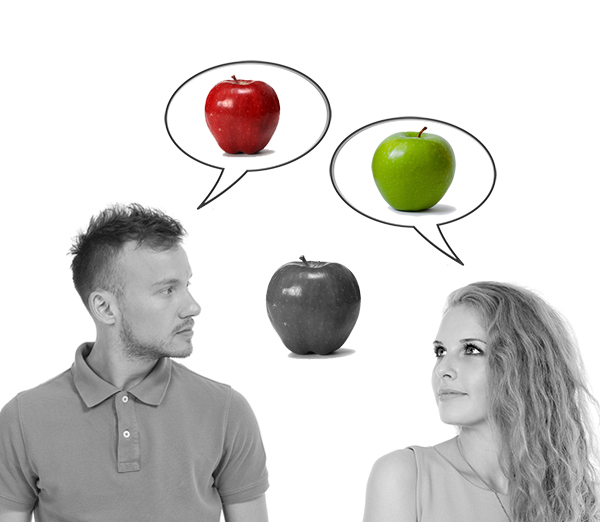
PerceptionSupose that we all do see colours differently, and named them accordingly - so what Lionino sees as red, you see as blue, and you both use the name for what you see. This is to take @Michael's suggestion literally! If @Lionino were to ask for the red pen, you might say "There is no red pen here, but there is a blue pen, and from past experience I know that Lionino is content for me to pass the blue pen when he asked for a red. At the least, it shuts them up.' — Banno
The suggestion is that I am on the left, Lionino is on the right, and that the colour we each see the apple to be is a mental phenomenon, falsely projected onto the apple. The apple does not really have the property that it appears to have.
The fact that I pass Lionino the apple when he says in our non-English language "flurgle nurgle blurgle" is utterly irrelevant to the issue being discussed.
-
PerceptionThe question, then, is how it came to be that you learned these words? — Banno
How have I come to learn the meaning of the word "pain"? -
PerceptionCan you pass me the red pen in your hand? Can you pass me the pain in your hand?
These are quite different. — Banno
You cannot pass me pain or colours. -
PerceptionIt doesn't have to be left there, if you like. So long as it is noted that we do agree that tomatoes are (sometimes) red, and that a theory which cannot account for this is thereby inadequate.
So any theory that claims colour to be a something in an individual's head, and no more, is inadequate. — Banno
The question is "do objects like tomatoes, strawberries and radishes really have the distinctive property that they do appear to have?". Any interpretation of the proposition "the tomato is red" that does not concern the appearance of the tomato is a red herring.
But also, we agree that stubbing one's toe is painful, but pain is nonetheless in the individual's head, and so your claim above is also a non sequitur. Our words can, and do, refer to mental phenomena, and we can agree which things are causally responsible for that mental phenomena. -
PerceptionIf... — Banno
Yes, and so we engage in further examination. We do not simply leave it at “we agree that tomatoes are red.” -
PerceptionWell, there are red tomatoes, and one way of saying that is that some tomatoes have the property of being red. Not sure what what it means to further ask if they really have the property of being red... — Banno
If "the tomato is red" means "the tomato looks red" and if the word "red" in the phrase "looks red" does not refer to a property of the tomato then tomatoes do not have the property that they appear to have.
Instead we have a case of eliminativism, subjectivism, and projectivism, as opposed to naive realism, reductionism, or dispositionalism. -
PerceptionAgain, take a look at the SEP article, which sets out a few of the problems with eliminativism and some of the alternatives — seven main theories each with many variants. — Banno
And if you were arguing for one of them then we could have a meaningful discussion. My problem is with your approach to the problem. Our concern is with perception, not with language, which is why the phrasing in the question presented above is important: "do objects like tomatoes, strawberries and radishes really have the distinctive property that they do appear to have?".
This is not answered by saying that we use the word "red" to describe tomatoes. That we agree that tomatoes are red is a red herring. -
PerceptionWell, we still have the hard problem to contend with here. — Harry Hindu
Yes, because we don’t have an answer yet.
If colors are not parts of pens, then how can they be parts of neurons, or neural processes? — Harry Hindu
If pain is not a part of knives then how can it be a neural process?
Your question doesn’t make much sense.
Was it using ONLY one sense? Did it involve ONLY using your senses? — Harry Hindu
Sense and reasoning. -
Perception
This is the issue:
If someone with normal color vision looks at a tomato in good light, the tomato will appear to have a distinctive property—a property that strawberries and cherries also appear to have, and which we call “red” in English. The problem of color realism is posed by the following two questions. First, do objects like tomatoes, strawberries and radishes really have the distinctive property that they do appear to have? Second, what is this property? (Byrne & Hilbert 2003: 3–4)
The question "do objects like tomatoes, strawberries and radishes really have the distinctive property that they do appear to have" is not answered by saying that the word "red" can refer to different things. Your entire approach to the problem is misguided.
The two main positions with respect to this problem are colour eliminativism and naive colour realism. Physics and the neuroscience of perception support the former over the latter. -
PerceptionThere is a physical meaning of 'red', 'blue', 'green' that is used in physics. — Lionino
And that is not relevant to the question "do objects like tomatoes, strawberries and radishes really have the distinctive property that they do appear to have?".
This isn't a question about language use. -
PerceptionI have replied before that the question is badly posed. — Lionino
I understand it just fine, as do I suspect most laymen, scientists, and philosophers of colour. Try reading the first section of the SEP article. -
PerceptionNow, talking grammar. Of course, you will then say that no molecule is bitter, bitterness is a perception. That is correct, but that is because that is the only possible meaning that 'bitter' may take. However, that is not the case for colours, 'blue' may very well take on a physical meaning. It would be otherwise if 'binding to the bitter taste receptor' was a current, chemical usage of the word 'bitter', but it is not. What I am saying can be attested in dictionaries. — Lionino
The question "do objects like tomatoes, strawberries and radishes really have the distinctive property that they do appear to have?" is not answered by saying that the word "red" can refer to different things.
Speaking of biology, there are many molecules that may bind to bitter taste receptors. One part ot the causal chain that typically gives us the perception of bitter taste is the binding to the respective receptor, whatever molecule binds to it. Being able to bind to the receptor is a common property of those molecules, and that ability breaks down to their molecular structure, they either have it or they don't. — Lionino
This amounts to the claim that the property that all objects that appear to be bitter have in common is that they cause a bitter taste.
I'm fine with that, but it isn't taste realism (as the sister to colour realism).
If all you can say is that the property that all objects that appear to be red have in common is that they cause a red sensation then that amounts to colour eliminativism. -
PerceptionIt does follow if we do not admit ex nihilo regularities. That is, as soon as we accept that everything has a cause, and that our senses at least sometimes are caused by outside objects, the commonality of some senses will have a cause in common — some would call this a universal, platonic or not. — Lionino
No it doesn't. See for example the science and complexity of bitter taste:
Compounds that are perceived as bitter do not share a similar chemical structure. -
PerceptionAll those fruits have a property in common, otherwise we would not see something in common in them. — Lionino
That does not follow, and nor does it follow that if they have a property in common then this common property is the property that they appear to have in common.
This problem isn't one that can be solved by a linguistic analysis of how the word "colour" is used; it requires scientific study of tomatoes, the human body, and phenomenal consciousness. -
Perception
If someone with normal color vision looks at a tomato in good light, the tomato will appear to have a distinctive property—a property that strawberries and cherries also appear to have, and which we call “red” in English. The problem of color realism is posed by the following two questions. First, do objects like tomatoes, strawberries and radishes really have the distinctive property that they do appear to have? Second, what is this property? (Byrne & Hilbert 2003: 3–4)
These questions are not answered by saying that we sometimes use the term "red light" to refer to 700nm light and that tomatoes and strawberries reflect 700nm light. -
Perception@Banno Do you have a digital copy of Searle's Seeing Things as They Are? I seem to recall that you agree with his theory of perception?
I ask because according to this:
Searle presents the example of the color red: for an object to be red, it must be capable of causing subjective experiences of red. At the same time, a person with spectrum inversion might see this object as green, and so unless there is one objectively correct way of seeing (which is largely in doubt), then the object is also green in the sense that it is capable, in certain cases, of causing a perceiver to experience a green object.
This seems consistent with what I have been arguing, and so I want to see for myself if the author of the above is reading Searle correctly. -
Perception
The percept that occurs when we hallucinate red is the percept that occurs when we dream red is the percept that optical stimulation by 620-750nm light ordinarily causes to occur.
Or if you prefer, the neural activity that is responsible for dreaming red is the neural activity that is responsible for hallucinating red is the neural activity that optical stimulation by 620-750nm light ordinarily causes to occur.
When this neural activity occurs when asleep we call it a dream. When this neural activity occurs when awake but not in response to optical stimulation we call it an hallucination. When this neural activity occurs when awake and in response to optical stimulation we call it a non-hallucinatory waking experience. -
PerceptionI'm not arguing for direct realism because it doesn't need an argument. — frank
It needs the support of physics and the neuroscience of perception, which it doesn't have. It's not the sort of thing that can be proved a priori or just assumed. -
PerceptionThe absurdity of this should be plain. How do you tell that you are experiencing red? Well, because you know what "the colour red" is. So what is the colour red? Well, it's the experience of red. And what is the red in your experience? Why, it's the colour red, of course... — Banno
It's no more absurd than saying the same thing about pain. Pain is the experience of pain. -
PerceptionMore likely that they had not given consideration to the difference. — Banno
I doubt anyone who would not give consideration to the difference is going to be asking for a linguistic analysis of the word “colour” in a discussion entitled “Perception”.
He’s most likely asking the simple question that I am answering. -
PerceptionThat is, it seems to me that the question is about the use of the word "red" rather than about the appearance of red. — Banno
Except he says “the colour ‘red’” and not “the word ‘red’”.
I think it more likely that he is misusing quotation marks than misusing the word “colour”. To give him the benefit of the doubt, he’s saying “the colour referred to by the word ‘red’”, with his use of the word “colour” referring to a type of visual appearance. -
PerceptionOn this view you're advocating for, you're clearly stating that there is no difference between seeing, hallucinating, and dreaming. — creativesoul
I didn’t say that. I was only saying that the percepts that occur when dreaming red and hallucinating red are the percepts that ordinarily occur when 700nm light stimulates our eyes. That's why they're all referred to using the word "red".
It's certainly not the case that a red hallucination percept is a blue dream percept is a green waking percept.
Dreams, hallucinations, and non-hallucinatory waking experiences differ in what causes these percepts to occur. With dreams it's internal processes when asleep, with hallucinations it's internal processes when awake, and with non-hallucinatory waking experiences it's sensory stimulation when awake. -
PerceptionWhich was what? — frank
We know how things affect the world and so can know about a thing from its effect.
Perhaps a different analogy is more helpful. A blind man can know that he is eating an apple because he knows what apples taste like, but the taste of an apple does not resemble the apple or any of its properties. An apple’s taste is a phenomenological consequence of the apple’s chemicals interacting with the tongue’s sense receptors.
Sight isn’t special. Visual sensations (such as colour) need not resemble their cause. -
PerceptionOh, I quite agree. Odd that you think this worthy of mention. — Banno
You have previously said that colours are both appearances and something else. Except by this you just mean that the word "colours" can be used to refer to both appearances and something else.
But the use of the word "colours" to refer to this something else is of no relevance to the question asked by the OP. It is clear in context that he is asking about the appearance. And physics and the neuroscience of perception support colour eliminativism over naive colour realism with respect to this question. -
PerceptionYep. "colour" has different senses. — Banno
And only the sense relevant to the question being asked is relevant, not any other sense. It is clear in context that the OP isn't asking if light or atoms reflecting light is mind-independent, and so any use of the word "colour" or "red" that refers to light or atoms reflecting light is irrelevant.
I am pointing out that "red", in the sense of the colour word, does nto refer to a single thing. — Banno
The single thing is a type, not a token. -
Perception
You seem to be intentionally misrepresenting my position, so I'll try an even simpler approach.
The term "colour" is also used to refer to the way quarks and gluons interact through the strong force, but that use is irrelevant to the question asked by the OP, and to the philosophy of colour in general. -
PerceptionIf your theory does not explain the way we use the word "colour" then what grounds could there be for your claiming it to be about colour? — Banno
I addressed this with the example of the Morning Star, but perhaps you need a simpler example.
If you ask me if bats are blind, and if in context it's clear that you are asking about the flying mammal, then I don't need to talk about anything else that is referred to using the word "bat", e.g. the club used in baseball.
Why shouldn't we use the same word to refer to multiple, different things... indeed this seems to be exactly how colour words are used. They refer to multiple things that are quite different. — Banno
I also addressed this before. The question "is the colour red mind-independent?" is not the question "is anything referred to by the term 'colour red' mind-independent?". Perhaps you need to re-examine the distinction between use and mention.
The question "is the colour red mind-independent?" is using the singular compound noun "colour red" to refer to a single thing, and then asking if that thing is mind-independent. Unless they provide greater clarification, you need to make a reasoned assumption as to what that thing is. It's clear in context that the OP isn't asking if 700nm light is mind-independent, or if a micro-structural surface that reflects 700nm light is mind-independent, but is asking if that sui generis, simple, qualitative appearance named "red" is mind-independent.
In other words, it's clear in context that the OP is asking which (if either) of realist color primitivism and color eliminativism/subjectivism provides a correct account of colour appearances. -
Perception
I believe in the existence of a Geiger counter despite the fact that experiences might not resemble their cause for the same reason that you believe in the existence of radiation despite the fact that Geiger counters do not resemble radiation.
Your very supposition, that if experiences do not resemble their cause then experiences cannot be "trusted" is a non sequitur and barely coherent. -
PerceptionIs there some reason you can't just answer my question? Why do you trust your senses? — frank
I already have. Why won't you answer my question? Why do you trust a Geiger counter to tell you the local level of radiation? It doesn't resemble radiation at all. -
PerceptionWhy do you trust your senses if what they show you may or may not resemble what's in front of you? — frank
Why do you trust a Geiger counter to tell you the local level of radiation?
Michael

Start FollowingSend a Message
- Other sites we like
- Social media
- Terms of Service
- Sign In
- Created with PlushForums
- © 2026 The Philosophy Forum