
-
The Naive Theory of ConsciousnessYour premise is wrong. So the argument that follows is already dead in the water.
-
The Naive Theory of ConsciousnessTo begin with, to evolve is what life does, — Metaphysician Undercover
Evolvability had to itself evolve by distinguishing itself from development. Replication with difference had to become distinct from homeostatic repair.
So "to begin with", the difference between the two started off vague. Calling it either evolution or development would be difficult at the first ribosomal state of abiogenesis.
But as soon as life started to establish any repair or replication capacities, the dichotomy rapidly strengthened as life had to be able to do both things – homeostatically rebuild itself, but also creatively replicate itself with a judicious measure of "requisite variety".
Your habits of thought just aren't atuned to the subtleties of biological causality. You are being too reductionist in thinking evolution explains everything. -
The Naive Theory of ConsciousnessEvolution is one thing. Development is the other. Salthe covers this nicely.
-
The Naive Theory of ConsciousnessCheck Scott Kelso perhaps. His Dynamic Patterns models this kind of stuff in equations…
https://www.researchgate.net/publication/224982322_Dynamic_Patterns_The_Self-Organization_of_Brain_and_Behavior -
The Naive Theory of ConsciousnessThe problem is that the microphysical is known to be prior in time to the larger and more complex physical "whole" — Metaphysician Undercover
Nope. Only reductionists think that way.
As Stanley Salthe puts it, hierarchically organised systems come to be the contexts of their own microphysics. That is what Peircean semiosis is all about.
...constraints from the higher level not only help to select the lower level-trajectory but also pull it into its future at the same time. Top-down causality is a form of final causality’
(Development and Evolution 1993, p.270) -
About algorithms and consciousnessI am interested in the transition from unconscious algorithmic thinking to conscious thinking. — Ypan1944
In neurobiology, this is just the transition from habitual to attentional level brain processing. The brain is set up to predict its world so well that everything that happens can be dealt with in a routine "fire and forget" fashion.
That pre-filtering of awareness is then how the surprising, the significant, the unrecognised, can get selected for the more intensive post-processing of attentional thought – the higher level figuring out that takes about half a second, and recruits working memory, the prefrontal cortex, a general whole brain "gestalt" form of fitting pieces of a puzzle into place.
So while it is fine to use computer jargon as helpful metaphor, the brain is not actually algorithmic at any level. It is not a Turing Machine or Finite State Automata.
What the brain really does is forward model its world in the way now described as Bayesian Mechanics. If you want neurobiology's rigorous alternative to familiar Turing Machine computation, this is the "algorithm" that the brain expresses both at its "unconscious" habit level, and "conscious" attentional level....
https://royalsocietypublishing.org/doi/10.1098/rsfs.2022.0029#d1e5377 -
The Naive Theory of ConsciousnessIn any case it's not my job to define 'experience' by fiat. The definition, or concept of consciousness, I take to be a given. — bert1
Of course you do. You can speak the words. But you can’t tell us what you mean. That would be to provide an actual argument in this forum.
I'm not sure, but I'm considering the possibility that all causation is psychological, or at least reducible to the psychological. So the difference that consciousness makes is that without it, nothing would happen at all. I've been meaning to start a thread about that for a while to think it through, but haven't got to it. — bert1
Jesus wept. -
The Naive Theory of ConsciousnessHolism and its downward causation should resolve your confusion. The whole shapes its parts in accord with its global desires. The parts reconstruct that whole by expressing that desire at the microphysical level of falling together rather than falling apart.
So the genome encodes the necessary directions. The metabolism ratchets the flow that maintains the resulting fabric of the organism. -
The Naive Theory of ConsciousnessThe organism is defined by its capacity for such agency or intentionality. As a bare minimum, an organism must have the kind of modelling relation with the world that counters the prevailing entropifying tendencies of that world.
As I said, step one to even being an organism and hence expressing agency is to be able to direct the metabolic traffic in the direction of continuing to fall together and so resist falling apart.
Are these things that hard to understand? :confused: -
The Naive Theory of ConsciousnessConsciousness is the capacity to experience. — bert1
Define experience in a way that could break out of your hermeneutic circle.
What are its measurables from the microphysicalist perspective you want to take as a Panpsychist?
What useful role does consciousness play outside of “experiencing”? In what sense is it causal precisely? -
The Naive Theory of ConsciousnessHence — bert1
You are so low effort. This is where you identify the explanatory gap in terms of how a switch fails the task of connecting model to world in pragmatic fashion. Where are the unaccounted causes at this microphysical level of analysis? -
The Naive Theory of ConsciousnessChalmers is not hypostatizing, he is not imputing substance to consciousness. — hypericin
A great technical point. But isn’t he? He does jump around in what explanation he actually would favour. Sometimes it’s consciousness as a property of information - or finite state automata. Sometimes it is dual aspect monism where consciousness is a fundamental property of material being, like charge. Yet always it is as a substantial property - something that inheres in something with definite substantial being.
His logic leads him to need to site consciousness in microphysics somehow. But even physics is confused whether it’s essential substance is entropy or information. Chalmers just swims along with that conventional confusion. His answers don’t really stray very far from monism. He just wants to shoehorn dualism into his monism and so “close the explanatory gap”. :lol: -
The Naive Theory of ConsciousnessThe usual excuses and promises. You either have an argument or you don’t.
-
The Naive Theory of ConsciousnessThat is certainly the important half of it. But to close the explanatory gap, the informational story has the be unified with the entropic story. And that is what has solidified over the past decade with the biophysics.
So meaning is the difference that makes a difference. That then leads to the notion of the mechanical switch that could be on or off, and that then is the informational difference that is also a physically meaningful difference.
Or even more meaningful as a mechanical device is the ratchet. A ratchet is a switch that embeds a direction. It channels the physics of the world in some desired fashion.
And when you get down to the level of enzymes and cell metabolism, you can see a network of switching behaviour, a system of nano-ratchets, that have the physical effect of constructing the living body - a complex of molecular reactions that intrinsically is falling apart as fast as it comes together. But genetic information is the secret sauce that ensures that it keeps falling together slightly faster than it can fall apart.
So biology is something new when it comes to physics. It operates semiotically. It creates a system of regulation that can use mechanical devices - molecular switches and ratchets - to maintain desired states of material order.
Neurons then extend that trick by ensuring behaviour at the organismic level is ratcheting its environment in ways that help the body to continue to hang together rather than do the other thing of fall apart.
So the microphysical basis of cognition is not simply an abstract notion of meaning as informational bits. Each bit has a physical cost associated. Each bit is also a ratcheting choice. Matter is being moved in an organismically desired direction by a code-controlled switch.
Hence no explanatory gap. The molecule can be a message. Unity is found in the Janus-faced switch that has its feet straddling the divide between the genetic and neuronal models and the falling apart entropic world that the models are instead quietly ensuring keeps falling back into the material patterns that we call bodies and selves. -
The Naive Theory of ConsciousnessHe's talking about self-consciousness, the kind of self you can be aware of and introspect, I believe. — Srap Tasmaner
I’m not a fan of Damasio. Only read his first book. But the answer is simple enough.
Conciousness is what brains do. As modelling, as semiosis, it is neurobiological awareness and self-hood. It is characterised by being “locked into the present tense, the immediate world”. An animal can of course have intentions and expectations, recognitions and plans. But it is being driven by the immediacies of the passing moment.
So this is as far as biology gets with the informational codes of genes and neurons. A sense of self that is firmly rooted in the present and intensely aware of the world in relation to that self, but not aware of objectively being that thing of “a self”. The animal just lives it’s selfhood. It lacks the resources to objectivity that selfhood as a “thing”.
Humans then have the further semiotic codes of words and numbers. We exist as social and now techological creatures because of language and logic. These are tools for objectifying our selfhood. We now have constructed social and technological contexts within which we model ourselves as selves living lives in the moment, but then also living in pasts and futures as actors in social dramas.
So humans are conscious in a far more complex way. We objectivise our subjectivity. We construct a narrative around out being - cultural narratives about perhaps being sensing souls inhabiting meat puppet bodies. Or whatever tale helps organise us as the social creatures we are.
Introspection is thus a learnt and language scaffolds skill. We learn as infants to pay attention to our own actions, feelings, plans, impulses, so as to be able to self-regulate and act within the accepted constraints of our social contexts.
Animals just live nakedly as selves in their environmental contexts. Humans double up their world model so that we are social beings in physical environments. Our behaviour has to make sense to us as bodies in the physical world, and also as actors in the social space we carry around with us everywhere we go. -
The Naive Theory of ConsciousnessIt does feel like something to do that, but not because doing that peculiarly necessitates feeling like something. It feels like something because panpsychism is true. — bert1
The usual assertions sans support. :yawn: -
The Naive Theory of ConsciousnessIt would be nice to have an argument rather than a bald assertion.
-
The Naive Theory of ConsciousnessWhat do you make of the emphasis on the 'first person' point of view that started this discussion? — Paine
Semiosis says our pragmatic modelling constructs the self as it constructs the world. This is the essence of its notion of the Umwelt.
So in chewing my food, I manage not to chew my lips and tongue. At the level of subconscious neural habit, I am alive to this difference. I can forward model the muscular actions I make when chewing to know where my tongue should be at a microsecond and millimeters scale as my apparently unthinking molars and incisors come chomping down. Food is then the helpless “other” which is getting masticated with no such ability to self-preserve its state of material organisation.
My mouth operates with a first person subjectivity even when I feel I am at my most thoughtless, eating lunch while reading a book. It is only when this forward model - the one that anticipates the world as flashing teeth crisply othered from masticated food - breaks down do I find that I am indeed in sudden pain and having to pay attention to the torn skin of a bitten tongue tip or side of the cheek.
The pain is a useful semiotic sign. It forces me to be careful until the damage has had some chance to start to heal.
So again, even in the most mundane of cognitions, the othering that separates self from world is an intrinsic part of the model itself. The division into first person and third person is the very basis of how the Bayesian Brain “computes”.
It is not a tacked on Cartesian representation that leaves the self as the mysterious experiencing homunculus of dualism. It is the enacted model of a semiotic relation where world and self co-arise as our experiential condition.
Self starts where the world leaves off, and vice versa. One is characterised by its goals and anticipations. The other is characterised by being the third person subject to this first person sense of intentionality. -
The Naive Theory of Consciousness...the point being that his opponents ‘will have to give us some idea of how the existence of consciousness might be entailed by the physical facts’, — frank
But it is Chalmers who owes us an account of why we should believe in his blithe assertions about “micro-physical facts”.
He treats these epistemic constructs - facts as understood from a classical physics perspective - as if they can indeed do real ontological work, as in proving p-zombies are conceivable.
But biosemiosis now has the better facts of biophysics.
https://thephilosophyforum.com/discussion/comment/68661
This makes Chalmers’ entire argument obsolete - like debating angels on a pinhead. The micro-causes of life and mind have now been demonstrated to be micro-semiotic rather than micro-classical physical.
The Nate Hagens paper I linked to then shows how the argument pans out at the macro-biosemiotic level - the human fossil fuel-driven super organism currently consuming the planet.
It you want to try to re-run the Hard Problem when stacked up against a proper explanatory model of both the micro and macro, then be my guest. -
The Naive Theory of ConsciousnessBut Peirce also includes idealist and vaguely spiritual sentiments that you yourself are inclined to reject — Wayfarer
Schelling was even worse. But every generation of rationalists has to struggle to rise above the various irrationalities taken for granted in their time.
Folk used to have the cultural sureties of the Church to make peace with. Nowadays it is the physical reductionism you so bitterly detest.
And the Hard Problem is a reductionist thesis. For those in mind science, the Hard Problem is indeed just one of those social fixations you have to learn to get along with. It is easier if you seem to agree, and just get on with your own thing.
But actually read Schelling or Peirce rather than latch on to the odd phrase here and there. -
The Naive Theory of ConsciousnessCalling it a neural model doesn't explain anything, though? Its like when Dennet calls it an illusion. HOW and WHY are a bunch of atoms able to, together, create a model of the world that manifests itself as such a thing like the sensation of pain? — Francis
Study the goddam theory.
https://royalsocietypublishing.org/doi/10.1098/rsfs.2022.0029#:~:text=Bayesian%20mechanics%20involves%20modelling%20physical,are%20coupled%20to%20that%20environment. -
The Naive Theory of ConsciousnessBut it has a broader remit than science, because its concerns include the subjective realm, it doesn’t stop at the analysis of objects and forces. — Wayfarer
Scientific method implements the pragmatist metaphysics that took the problem of subjectivity seriously. It starts by accepting the Kantian limits on knowledge.
So if we are "only modelling reality", then science is how we make the best of that situation by creating a general rational approach to the causal narratives we are wont to spin.
Science has the remit of working within the Kantian limits. Peirce fleshed that out as methodological practice.
That includes consideration of the human condition and its discontents, few of which are amenable to a strictly scientific formulation, and also where in the general scheme of things humanity belongs (from a broader perspective than is provided by evolutionary biology.) — Wayfarer
The human condition is perfectly explainable by systems science. Exhibit A would be Nate Hagens's superorganism work...
https://www.researchgate.net/publication/339604726_Economics_for_the_future_-_Beyond_the_superorganism -
The Naive Theory of ConsciousnessPanpsychism is not the conclusion of the p-zombie argument. — frank
You are talking nonsense. Chalmers uses the the p-zombie argument to arrive at the precise variant of panpsychism which he holds as doing the least violence to his classical notion of "microphysics" – the notion that is now defunct since biophysics discovered what is actually going on in biology at that physical scale.
The conceivability argument is an epistemic argument against materialism, starting with an epistemological premise and proceeding to a metaphysical conclusion.
...Materialists do not just curl up and die when confronted with the conceivability argument
and its cousins. Type-A materialists reject the epistemic premise, holding for example that
zombies are not conceivable. Type-B materialists reject the step from an epistemic premise to an ontological conclusion, holding for example that conceivability does not entail possibility.
...If panpsychism is correct, there is microexperience and there are microphenomenal
properties. We are not in a position to say much about what microexperience is like.
...I think that constitutive Russellian panpsychism is perhaps the most important form of
panpsychism, precisely because it is this form that promises to avoid the problems of physicalism and dualism and to serve as a Hegelian synthesis. In particular, one can argue that this view avoids both the conceivability argument against physicalism and the causal argument against dualism.
https://consc.net/papers/panpsychism.pdf -
The Naive Theory of ConsciousnessBut why is any experience at all correlated with that? — bert1
Always the same refrain. And always the same answer.
I provided you with a counterfactually-framed theory – "consciousness" is a neural model of a world with "us" in it. There is no life or mind – no organism – without this general natural thing of a neurobiological modelling relation, a process of semiosis that produces a felt Umwelt.
So now you have to give a good counterfactual reason for why it wouldn't "feel like something" to be modelling the world from a point of view. Where is the scope for reasoned doubt.
The fact you simply don't understand the science is not a reasonable source of such doubt. -
The Naive Theory of ConsciousnessOh, and who? — Wayfarer
Zombies go back to GF Stout in the 1930s as an argument against epiphenomenalism. Chalmers retreaded them as “philosophical” zombies. That is, to legitimate a new epistemic line of attack … which he then didn’t follow through to the right conclusion.
G. F. Stout argued that if epiphenomenalism (the more familiar name for the ‘conscious automaton’ theory) is true,
it ought to be quite credible that the constitution and course of nature would be otherwise just the same as it is if there were not and never had been any experiencing individuals. Human bodies would still have gone through the motions of making and using bridges, telephones and telegraphs, of writing and reading books, of speaking in Parliament, of arguing about materialism, and so on. There can be no doubt that this is prima facie incredible to Common Sense (Stout 1931: 138f.).
https://plato.stanford.edu/entries/zombies/
The right conclusion, IMHO, is that what folk claim as a special problem for theories of consciousness is simply the general problem of all epistemology. Our understanding of reality - the pragmatic modelling relation we have with it - fails when theories run out of counterfactuals.
Theories have to have facts that can properly support them in the sense that those same facts can be known to be otherwise. Falsified, in short.
So we can chase the feeling of seeing red all the way down to the neurobiology of opponent channel processing. A cone cell switches on when it exposed to dominantly “red” spectrum, and then signals the opposite when exposed to dominantly “green” spectrum. A neural correlation for reported experience is available in a way that makes complete explanatory sense.
But then the next step - why does that red response “feel” just like red at that moment, and not anything else - can’t be answered, as the “anything else” is not being presented as a counterfactual of some further level of neural mechanicsm.
The theory has run out of road as a matter of its logical construction. And that is a general epistemic issue all theories share.
We can ask cosmology, “Why anything? Why not just nothing?”. It seems like a “gotcha” for the same reason.
To compound the methodological confusion, folk who push such rookie epistemic doubt then like to invent their substitute counterfactuals, like suggesting particles must have feels … even if in principle of course that could never be detected. Or brains are occupied by spirits … even if in principle no material evidence of spirit stuff could ever be recorded.
So science - as pragmatic reality modelling based on counterfactual logic - accepts its epistemic limits.
All the Hard Problem acolytes simply fail to understand that what they gleefully parade as the special problem for consciousness studies is just the usual problem for all rational epistemology.
They use this misunderstanding to push theories like Panpsychism - theories that are formally constructed in the mould of “theories that aren’t even wrong” - and also as an excuse not to invest time in contemporary theories of mind based on semiotics and the modelling relation. -
The Naive Theory of ConsciousnessBecause macro characteristics/properties emerge from micro characteristics/properties. — Patterner
As someone who studied both neurobiology and systems science, I can say that what we know is that life and mind are properties of systems that are biosemiotic. They have the new thing of internal codes with which to form an organismic modelling relation with their environments.
So the basic trick of it all is currently understood science. Genes and neurons result in “Bayesian brains” that model the world in predictive fashion. The reason it feels like something to be conscious is that we are busy modelling the world - a world in which our self is the enactive anchor of that model.
Any discussion of the hard problem has to deal with the current best theory as it stands. But studying contemporary neurobiology is so … hard. :roll: -
The Naive Theory of ConsciousnessNo ontological conclusions are being drawn from it. — frank
Panpsychism is an ontological claim. The “evidence” is that standard physicalism or functionalism fail to explain consciousness - which is an epistemic claim. -
The Naive Theory of ConsciousnessYou don't get academic tenure for that, — Wayfarer
You’d be surprised. Bums on seats matter.
I've come to realise the cogency of the 'philosophical zombies' argument, having always dismissed it up until now. — Wayfarer
And who did Chalmers nick that from?
The point of the argument is that if there were a creature that looked and acted like a human being, there would be no empirical way of telling whether they were subjects of experience or not. — Wayfarer
But why spin this epistemological argument as if it were a ontological one?
Why jump from arguing that a flesh and blood person could in fact be a secret zombie to the conclusion that fundamental particles must therefore have the feels? -
The Naive Theory of ConsciousnessChalmers proposes the concept of "naturalistic dualism" as an alternative to traditional Cartesian Dualism. — Wayfarer
It's still dualism. And it still relies on confusing people by treating qualities as quantities.
...but which may not be fully explicable within physicalist scientific frameworks. — Wayfarer
It doesn't even make metaphysical sense. :grin:
Yes, it's annoying that he's gone on to become a tenured academic at New York University, author/editor of half a dozen anthologies on philosophy of mind, and that rarest of things, a well-known philosopher. You'd think we could have expected something better from a Bronze Medallist at the International Mathematics Olympiad. — Wayfarer
I've never denied his talent for climbing the greasy pole of popular opinion. He gives the crowd what it wants. -
The Naive Theory of Consciousnessspin and charge are two separate properties of particles. — Francis
Separate but connected. Spin breaks local chiral symmetry and charge breaks global translational symmetry. So an electron combines the two in that it is a handed fermion that can then exchange photons as translational momentum.
The point being that the account of a "fundamental particle" is to be found in the patterns of geometry rather than in the qualities of material substance. An electron is a fundamental structure of relations that emerges due to a context of constraints.
Physics thinks in terms of form rather than matter now.
Physicists have actually managed to model the behavior of some particles by separating them into "quasi-particles" in which one has the spin and one has the charge. — Francis
Appealing to topological order only reinforces the point I just made. It demonstrates that "particles" are emergent regularities of nature that result from symmetry breaking. -
The Naive Theory of ConsciousnessMatter has causally relevant "properties" anyway you slice it. — Francis
But the quantum spin that stands behind EM charge is a geometric property more than a material one, wouldn’t you agree? The geometric structure of intrinsic spin is both what the quark and lepton share, as well as what makes them different. -
The Naive Theory of ConsciousnessHe thinks it's a property, like spin charge and mass — bert1
Yep. That's the weasel argument. We happily accept the idea of a physical quantity – a measure of "stuff" or substantial being, such as charge. And so the linguistic trick is get us thinking of a quality – qualia – in a similarly physicalist and countable way. Little jolts of experience like the feeling of red or smell of a rose flashing through the mind.
The sleight of hand works as our folk metaphysical notions of physical quantity are as suspect as our ones about mental qualities.
Something fundamental like charge is treated as if it were like a measure of some fluid stuff that flows. It is already pictured and talked about in an overly concrete fashion. Then Chalmers takes that folk physics and applies it to the mind as if consciousness is also a quantity of this atomistic stuff called qualia, or isolated flashes of experience.
'Reification of consciousness' is definitely a problem, but it is not Chalmer's problem. The root of reification is 'reify' meaning 'to make a thing out of', from the Latin root Res, 'thing'. And it was Descartes that designated the mind as 'res cogitans', literally a 'thinking thing' (not even thinking being.) This has had many profound and deleterious consequences, crystallised in the depiction of the mind as 'the ghost in the machine'. — Wayfarer
But Chalmers was a big hit because he was "making it respectable to be a Cartesian dualist again". That was literally the gleeful response of the philosopher sat next to me when Chalmers gave the hard problem talk that made his name.
Descartes may have wanted to locate this special experiencing spirit stuff in the pineal gland of the brain. Chalmers agreed that was silly. But then said well maybe its somehow located in "physical information" or is another "dual aspect" property of particles, like charge.
He became hand-waving when pressed. It was enough that he could convince an audience that dualism could still be treated as a respectable possibility in metaphysics. People were entertained for a few years there. And the "quantum consciousness" folk found it useful in their attempts to get some traction.
A sociological side-show in other words. -
Density and InfinitySeems like you can make the argument that with an infinity of objects each surrounded by an infinite amount of separation (as why not?), the resulting density would be infinitesimal.
-
DNA as a language.I find it particularly interesting that RNA is an intermediate between DNA and protein. Not random I'd imagine. Maybe this is the primordial species? How might RNA behave more like a protein than DNA does? We must do some research I think. — Benj96
The story on this has become clear in the past decade. RNA was the starting point as it could function both as a genetic code and also as a protein-like construction material. It was poor at both jobs as it was an open length of code that also wanted to curl up into shapes. But it was the start that then led to the crisp division of labour – DNA for coding and protein for building.
This evolutionary story is fossilised in the very structure of the ribosome – the enzyme that glues amino acids together to make protein strands according to a genetic recipe. The core bit of the ribosome is its circular entrance or tunnel. That is still made of a loop of RNA. The tunnel is the original bit of kit that allowed life to get started by gluing amino acids and other stuff together in strands. It would just grab molecules out of the surrounding soup and gum them together in any old junk order.
All this gunk-producing RNA had to do was be the template that reproduced itself. Then some of this gunk it was producing had to be useful in making it easier for the replicating RNA to do that more efficiently. Things could snowball from there.
The modern ribosome not only still retains its RNA origins, but all the extra protein that has got tacked on to make it a proper molecular machine also got added in fossilised fashion. The protein that first extended the tunnel is of the most primitive type. Then all the fancy later evolutionary extensions are constructed with later more sophisticated protein forms.
Loren Williams tells the story well.
-
The motte-and-bailey fallacyI think the difference is that in a strawman the act is to simplify and ridicule, but in this case the act is to retreat to something solid and simple. — Christoffer
I agree. Arguments ought to have this hierarchical logic where you "retreat" towards first principles to defend the secondary views you may derive from them. The global axioms grounds the particular local applications of them.
Where the motte-and-bailey image fails is that in a serious argument, both sides would be going back to basics this way.
In the trans women example, the axiomatic basis on one side would seem to be that biological truth trumps cultural fiction. On the other, it would be some version of the reverse.
The stepping back by one side ought to be an invitation to the other to take up the challenge of defending the reverse in good old dialectic fashion. -
Replacing matter as fundamental: does it change anything?You mean, ‘manifested’. — Wayfarer
Let’s not trivialise something this amazing - the discovery that a convergence zone of physical forces allowed semiosis to become a thing on a watery planet some 10 billion years into the Universe’s existence.
Life and mind could only have existed because there was this remarkable intersection of lines…
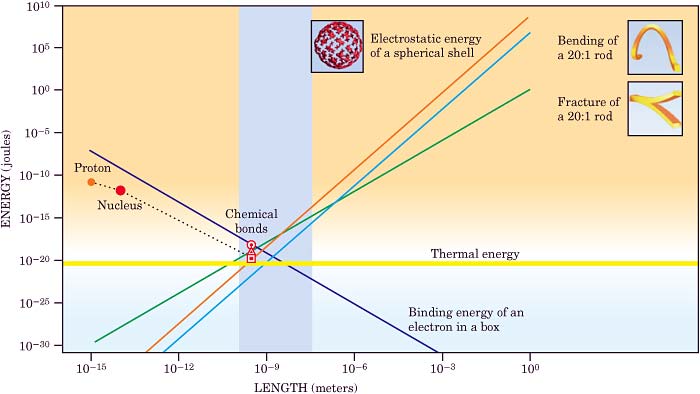
So contrast this level of hard evidence for the metaphysical claims biosemiosis might make with the wishy-washy pretentiousnes of Panpsychism.
Something like this had to be the case to close the causal gap and conclusively put paid to the Hard Problem’s “causal gap”. The natural philosophy route really came up trumps.
As I explained…
As outlined in this paper - http://www.rpgroup.caltech.edu/publications/Phillips2006.pdf - and in this book - http://lifesratchet.com/ - the nanoscale turns out to a convergence zone where all the key structure-creating forces of nature become equal in size, and coincide with the thermal properties/temperature scale of liquid water.
So at a scale of 10^-9 metres (the average distance of energetic interactions between molecules) and 10^-20 joules (the average background energy due to the “warmth” of water), all the many different kinds of energy become effectively the same. Elastic energy, electrostatic energy, chemical bond energy, thermal energy – every kind of action is suddenly equivalent in strength. And thus easily interconvertible. There is no real cost, no energetic barrier, to turning one kind of action into another kind of action. And so also – from a semiotic or informational viewpoint – no real problem getting in there and regulating the action. It is like a railway system where you can switch trains on to other tracks at virtually zero cost. The mystery of how “immaterial” information can control material processes disappears because the conversion of one kind of action into a different kind of action has been made cost-free in energetic terms. Matter is already acting symbolically in this regard.
This cross-over zone had to happen due to the fact that there is a transistion from quantum to classical behaviour in the material world. As the micro-scale, the physics of objects is ruled by surface area effects. Molecular structures have a lot of surface area and very little volume, so the geometry dominates when it comes to the substantial properties being exhibited. The shapes are what matter more than what the shapes are made of. But then at the macro-scale, it is the collective bulk effects that take over. The nature of a substance is determined now by the kinds of atoms present, the types of bonds, the ratios of the elements.
The actual crossing over in terms of the forces involved is between the steadily waning strength of electromagnetic binding energy – the attraction between positive and negative charges weakens proportionately with distance – and the steadily increasing strength of bulk properties such as the stability of chemical, elastic, and other kinds of mechanical or structural bonds. Get enough atoms together and they start to reinforce each others behaviour.
So you have quantum scale substance where the emergent character is based on geometric properties, and classical scale substance where it is based on bulk properties. And this is even when still talking about the same apparent “stuff”. If you probe a film of water perhaps five or six molecules thick with a super-fine needle, you can start to feel the bumps of extra resistance as you push through each layer. But at a larger scale of interaction, water just has its generalised bulk identity – the one that conforms to our folk intuitions about liquidity.
So the big finding is the way that constrasting forces of nature suddenly find themselves in vanilla harmony at a certain critical scale of being. It is kind of like the unification scale for fundamental physics, but this is the fundamental scale of nature for biology – and also mind, given that both life and mind are dependent on the emergence of semiotic machinery -
Replacing matter as fundamental: does it change anything?Why does socially constructed change the fact that there is a sensation any more than the rods and cones? — schopenhauer1
You get taught to see that a postbox is red rather than merely being able to see the postbox easily because your neurology is designed to dichotomise small hue differences into striking shape-revealing differences.
So the brain "looks through" the redness as all that is is a way to really emphasise the fractional wavelength differences that can give away something ecologically important like a ripe fruit among green foliage. This was the reason primates added a third cone to their vision – to create an exaggerated visual boundary between red and green so that hidden shapes would pop out.
But human society turns it around. It makes use of red as a hue that really forces itself on our attention for these 10 million year old reasons. It paints postboxes in the easiest to spot visual differences. And it creates a whole vocabulary of descriptions for red hues, making us even more conscious of how we might think and react to the "colour itself". Through culture, we learn to objectively notice what nature never designed us to do. That the world is full of colours as well as shapes.
Then along come philosophers pushing warmed-over theistic beliefs about eternal souls and heavenly rewards. They too all gravitate to talking about colours when they want to motivate arguments about Hard Problems and ineffable qualia.
Colour perception just seems so arbitrary once you pull the trick of completely ignoring the role it actually plays in the ecology of perception.
If you put blinkers on, the horse doesn't stray.
The terrain is matter not experience and the map is semiosis, but where’s the experiential aspect? — schopenhauer1
I'm bored with explaining the same thing again and again. The model is a model of the self in its world. It is an Umwelt.
You need to think more deeply about how the "map/territory" thing is just Cartesian representationalism all over again. The real thing and its mental image.
Semiosis stresses the three-way relation where the map is the sign that is pragmatically interpreted.
Does it get you where you want to go? Great. Were you moving in the real world or a Metaverse simulation? Well was there a difference that made a difference?
Haven't you come across the Noumenal Problem yet? :rofl:
apokrisis

Start FollowingSend a Message
- Other sites we like
- Social media
- Terms of Service
- Sign In
- Created with PlushForums
- © 2026 The Philosophy Forum