
-
This Forum & PhysicalismNothing in the real world submits itself to "formal treatment". Formal systems are pure theory. — Metaphysician Undercover
Formal systems can be supported by acts of measurement. That makes them useful as models of the world. -
Why are things the way they are?You are trying to make an argument by claiming a definition. So, yeah nah.
-
This Forum & PhysicalismDoesn't this imply that life forms running in rewind would be increasing local entropy, — Count Timothy von Icarus
No. The sun’s radiation hits the earth at about 5900 degrees K and is then re-radiated into outer space as some cooler frequency. The energy is scattered into a much greater number of infrared photons, hence it has more entropy.
Bare rock re-radiates it at about 330 K, while rainforest re-radiates it at about 290 K. So life contributes greater entropy than bare rock can.
On a side note, if you were an extra dimensional traveler watching our universe run in reverse, I wonder what the opposite of the Big Bang would be? "The Incredibly Slow Warm Up?" — Count Timothy von Icarus
The whole story had got more complicated since they found the universe is being accelerated by dark energy or the cosmological constant. There is an extra push that is adding to the conventional thermal arrow of entropy unwinding. So a gravitational collapse or contraction couldn’t now recover the Big Bang’s original low entropy condition in the way that folk used to imagine as a reversal of time.
Ironically perhaps, this does now guarantee an actual Heat Death as the opposite, or rather inverse, of the Big Bang. But that’s another story to do with anti-de Sitter holographic horizons and the effective end of time. :razz: -
Why are things the way they are?It doesn't. It's what we let it do mentally. And then afterwards say that it took the one of least action. In qft reality, it probes all paths, non-locally, zipping from one to another, in accordance with the probability weights of all paths. — EugeneW
Yeah sure. Which might be why my point was...
This is why the nonlocality in quantum mechanics, and the principle of least action that grounds physics in general, are such a metaphysical problem for the reductionist point of view. — apokrisis
...So reductionism depends on the presumption that locality rules. Yet reductionism also quietly depends on the nonlocality - or holism and finality - enshrined in path integral calculations and the principle of least action generally. -
Why are things the way they are?I could equally say that nothing is truly determined and caused, and that a claim that it is is also a relative judgement. — Janus
Indeed. And that is what I already say. The deal is reciprocal. Our notions of the determined and the random are the pragmatic limits which reality can approach with arbitrary precision. But reality can't finally become wholly either the one or the other, because then it would be leaving its grounding "other" completely behind.
Its a yin-yang kind of thing. :smile:

-
Why are things the way they are?So is quantum indeterminism describing knowledge of a system, or the system apart from any knowledge of it? — Harry Hindu
Doesn't that depend on your preferred interpretation? At the moment, the maths can't distinguish between a Copenhagen and a Multiverse point of view. So either the collapse of the indeterminism to classicality is an epistemic belief or an ontic fact. But all we can report is the maths works.
Nature happens and humans use general rules to help them make predictions for similar circumstances.
You seem to be engaged in anthropomorphizing nature and particles. — Harry Hindu
But I talk of constraints and habits rather than laws and rules when I am speaking for my own particular pansemiotic position on the Cosmos. I emphasise the immanence and self-organisation of Nature and point to how talk of laws and rules indeed falls into the usual dualistic bind of transcendent accounts.
So here you are critiquing a problem that reductionism definitely has, and which my systems approach would resolve. -
This Forum & PhysicalismLife forms slowly devolve into less and less complex organisms, sucking up entropy and breaking down complexity. — Count Timothy von Icarus
But it is the higher complexity life that transacts more entropy. The earth’s surface is measurably cooler where it is covered by a richer ecosystem. Breaking down the rainforests means less work gets done to break down the intensity of the solar flux.
So organic complexity can only exist in the positive direction because, overall, it works to break down barriers in the generation of entropy. It makes more mess than it makes order. -
This Forum & Physicalismbecause "mysterious tendencies" is the more general, and "entropic gradients" is the more specific. — Metaphysician Undercover
Statistical tendencies would be the more generic, mathematically speaking. Mysterious tendencies don’t lend themselves to formal treatment, just frantic hand waving. -
The meaning of lifeWhatever you might say is the meaning of life, let it be happiness, power or serving some god, it will never satisfy the human desire for a meaningful meaning. — Carlikoff
Humans are part of Nature and so are ultimately grounded in nature's thermodynamic imperative. To persist, thou shalt entropify!
But life and mind don't really see that as their meaningful goal. They see it as instead the definition of meaninglessness as they are evolutionary structures that instead persist by locally defying this more general Cosmic constraint on their existence. Life and mind exist by being able to exploit entropic gradients to their private advantage - extracting the work and material that build them into organisms.
So - skipping over the whole evolution of life saga - we arrive at Homo sapiens as creatures now informed by the trials and tribulations of juggling both genetic and cultural levels of selfhood. We have to persist as animal bodies - with all those biological level needs. And we must persist as workable communities - with all their social level needs.
What is meaningful to the self in either sense is flourishing. Surviving and thriving. Biologically and sociologically.
Hence Maslow's hierarchy of needs that runs from simple survival at the bottom to modern glorified notions of self-actualisation at the top.
An issue to consider is where this notion of self-actualisation comes from historically, and what good purpose does it serve in the modern sociocultural setting? It it the right ultimate goal, or a questionable frame of mind? Does it lead to flourishing - in a way that is also sufficiently lasting?
So the point is that meanings are evolved. They are ways to codify the practices that allow intelligent order to gain control over the forces of entropy.
But the proof of the pudding is the long run. The system of meanings that define some stage of human sociocultural development might not lead to long term thriving.
So the search for a meaning to life is really the search for the codified practices that could sustain life in some suitably long-run and flourishing way.
And if humans really represent intelligence, then we would be in the business of constructing our meanings. Participating in a communal fashion to make them, not always searching for them, or talking about them as some strange mass illusion. -
The Significance of PolarityOf course, polarity itself is limiting, at it only offers two possibilities, rather than many others. — Josh Alfred
A dichotomy is formally defined as that which is "jointly exhaustive and mutually exclusive". So a polarity is the successful reduction of some set of possibilities or pluralities to a dialectic relationship, or unity of opposites.
The whole point is to eliminate as many free variables as possible to arrive at the central structure of some symmetry breaking. It is the basic way that metaphysics has always reasoned.
Which gets me thinking that there must be something other than polarity with which to conceptualize decisions and dialect. — Josh Alfred
Well something further must ground a polarity as all the free possibility that gets cleanly divided by the laws of thought. To arrive at the bivalent Law of the excluded middle, one must have some the many lesser notions of categorisation that got discarded along the way.
Peircean logic added this third thing in the form of the notion of vagueness - that to which the bivalent Principle of Contradiction fails to apply.
So there you have a starting point in a uniform confusion. Everything going off in all directions without structure or pattern. And then this field of vagueness is what must develop into its mutually opposing polar limits.
So take some metaphysical dyad like the discrete~continuous, or chance~necessity. As paired bounds on possibility, the discrete and the continuous are categories that both directly oppose each other, and jointly make all more intermediate grades of connectedness or disconnectedness rather subsidiary.
All grades of connection and disconnection are either more towards one pole or the other. And it would only be precisely in the middle that things might turn vague as everything becomes neither the one, nor the other, in any counterfactual way.
Same with chance and necessity. In being exactly opposed - defined in terms of being absolutely unalike in character - they bound all other lesser intermediate states. And this all the lesser intermediates states can be measured in terms of how far they sit towards one or other pole of the single metaphysical spectrum.
So polarity was the general metaphysical trick to discover what might be the natural, self-defining, measures of reality. It was what paved the way for the development of science by tying the notion of metaphysical quality to that of methodological quantification. -
This Forum & PhysicalismBut my interest in Information is as a philosophical notion. — Gnomon
So more intuitive than mathematical? What is gained by sacrificing full rigour here?
It is the mysterious tendency for aimless energy to occasionally create the stable, but temporary, patterns we call Matter, Life, and Mind. — Gnomon
Energy is a scientific notion justified by Noether's theorem and the conservation symmetries of a closed system. So energy doesn't even "exist" outside of there being a potential difference to be dissipated.
Talk of "mysterious tendencies" need to be replaced by talk of entropic gradients, and then even about self-bounding systems - such as Big Bang universes that are their own cooling~spreading heat sinks.
Note -- In thermodynamics, what I call "Enformy" (philosophical concept) is known as "Negentropy" (physical term). — Gnomon
Yep. But negentropy doesn't just float about as an aimless tendency either. It can only be rigorously defined when counterfactually opposed to entropy as part of the one system - that has the finality dynamical persistence rather than the contingency of "temporary stability".
Would you like to volunteer for the job of Information Semilologist? — Gnomon
I am simply arguing that this job is being done. It is the systems science tradition, starting with Anaximander and Aristotle, proceeding though Hegel, Kant and Peirce, becoming a general view in modern science - at least as evidenced by dissipative structure theory, condensed matter physics, biosemiotics, hierarchy theory, enactive psychology, infodynamics, etc.
Of course telling your own tale in your own words is fair enough if you just want to arrive at your own synthesis of where modern science has got to. :up: -
Why are things the way they are?The more narrowly you can constrain the initial conditions set-up, the less scope there then is for any quantum surprises. So the two ends of some story of "cause and effect" are tied together, even if you would want to argue that the quantum uncertainty infects the whole of this story in a nonlocal way.
Nothing is truly random and uncaused. Even that is a relative judgement.
This is the advantage of having the third logical category of vagueness to ground our notions of contingency and necessity. For an event to be random and uncaused, there would have to be a context that underwrote that as some definite counterfactual.
The throw of a die can only be random if the toss is suitably careless enough to ensure a lack of causality in our description of this as an "absolutely" contingent event. Likewise, the careful placing of the die so the winning 6 is shown stands as the counterfactual that makes the careless toss its acausal "other".
The Heisenberg uncertainty principle only makes this yo-yo story - the reciprocality of the random and the determined - mathematically explicit. You become radically uncertain about one side of the story - a particle's location - to the degree you gain certainty about the other, its momentum.
So to drill down below this division of reality into its locations and momentums, you would have to start talking of quantum vagueness. The realm of the virtual particle (which mysteriously only appear to come and go in swiftly and mutally annihilating pairs!).
So there are a lot of accounting tricks employed to maintain the notion of a local~global separation - a crisp dichotomisation of the possibilities - that extends "all the way down to the foundations of being". But eventually, foundational being must dissolve into the mists of a logical vagueness, an apeiron, where the PNC no longer applies.
Remember also that QM defined uncertainty as having a single concrete scale - the Planck scale, as scaled by Planck's constant, h. So that is the scale where quantum vagueness (or the quantum spacetime foam) would be broken in a quantum gravity theory. It is where the "thingness" starts in terms of being able to tell an energetic fluctuation apart from the larger world that is - counterfactually - its "acausal" context.
So if we are talking quantum indeterminism, the Planck scale defines both where this is maximal, and where it first even starts as something new to give a structure to the unbroken purity of the symmetry that is a vagueness.
And then QM has now glued on statistical mechanics to give the modern decoherence model. This now includes the impact of developing classical and thermal scale. The quantum indeterminism still exists, but its effective strength is diluted exponentially. And so a classically ordered world appears to emerge.
We recover a fully deterministic description - more or less. A world were dice and other games of chance can exist because it makes a counterfactual difference whether you throw objects about in a careless or careful fashion.
It is only when we return to the scale of the very small, or the very hot, that we start to see the world again with a greater degree of quantum coherence, because we have removed the decoherence that scaled the quantum vagueness out of sight, leaving only the classical dichotomy of the random~determined as the crisp division in our sight. -
This Forum & PhysicalismAnd my thesis interprets the ancient notion of "spirit" (psyche, anima, atman, elan vital) as various interpretations of Energy as Causation & Trans-form-ation. — Gnomon
The issue is then how do your recover what folk think they mean by meaning, consciousness, mind, intentionality, agency, etc, from an infodynamic perspective?
That is the next trick to close the loop.
Hylomorphic substance does reduce reality to the ur-dichotomy of free material possibility and the imposed constraints of form and purpose. Substantial being is a combination of what folk think of as the material vs the mental causes of existence.
And the modern infodynamic view - as a dichotomy of entropy and information - again reduces all reality to the same idea of radical "material" instability shaped by the Platonic inescapability of global rational structure. And while Aristotelan substance still seems rather material in the end, infodynamics (or dissipative structure theory) emphasises that we are talking about a process philosophy. Reality is a structured process of development where stability and coherence is what the Cosmos achieves by becoming a steady-state dynamical process.
But to be a success, this reduction to "atoms of form" has to incorporate more than just a process metaphysics to take the edge off the hard materialism (that wants to oppose itself to the fluffy idealism).
The one complete theory has to include all four Aristotelean causes. It has to cover off life and mind as more evolved levels of hylomorphism or infodynamics.
Which all, of course, leads us to Peirce, semiotics, codes and epistemic cuts. :grin:
But my general point is that system science has its version of a quantum gravity theory of everything. The theory isn't complete until it is the meaningfulness of signs all the way down, coupled to the meaningless of material contingency all the way up.
So, it's all Information/EnFormAction, all the way down. — Gnomon
Yes. And that is matched to? And the third thing that is a meaningful balance of the opposing forces of spontaneity and constraint is being explicitly offered in the theory where? -
Why are things the way they are?Can't see why that would be so, given Quantum indeterminism. — Janus
That is what quantum indeterminism describes - the impossibility of classically exact knowledge of a system's initial conditions, coupled to the possibility of also getting arbitrarily close. -
Why are things the way they are?Goals don't exist in the future, but are visions of the future in the present moment and it is always the state-of-affairs in the present that determine the future, not the other way around. — Harry Hindu
This is why the nonlocality in quantum mechanics, and the principle of least action that grounds physics in general, are such a metaphysical problem for the reductionist point of view.
How does a particle know which path between two points is the shortest, even before it sets out on its journey? How can nature be ruled by the finality of least action before anything has begun to happen?
Physics just plugs this global finality in as a law. And it uses integration - inverse differentiation - to make the calculation. It is then silent on how all this fits into a view of reality as being merely the sum of its mechanical (ie: material + efficient) causes.
The general is the illusion that other events can be the same as another event and therefore lead to the same effects. Similar states-of-affairs lead to similar effects, not the same effects. — Harry Hindu
That would certainly be my constraints-based view. Top-down constraints only add context to restrict the local degrees of freedom.
So as Peirce argued, Nature is fundamentally tychic or probabilistic. Constraints can only limit the spontaneity, the contingency, of any part. Determinism is achieved only in the limit.
The laws of quantum mechanics and thermodynamics build this into their generalised accounts of Nature.
So generality is just as real as particularity. And just as unreal in that each is a bounding limit on reality, and so something that can only be approached with arbitrary closeness, never actually realised.
If you could set up exactly the same circumstances twice, the outcome ought to be exact. But because you can't, you can only get arbitrarily close to making history repeat. -
Why are things the way they are?the Wikipedia article on the topic associates efficient cause with an Agent: — Luke
A carpenter is an organism and is indeed autonomous to the degree they embody all four causes. The carpenter can act with form, with purpose and with mechanical actions, like hammering and sawing, so as to craft the desired material outcome.
So you are confusing the wholeness of that definition of "an agent" with the part that is just the efficient cause - which is the immediate physical actions that bring about the material change (according to the constraints of form and purpose). So the agent in this sense is the carpentry, not the carpenter. The hammering and sawing is what caused the matter of the wood to become the form of the new chair that the carpenter wanted to sit on. -
Why are things the way they are?However, you are right that I had overlooked the causal account given by a final (or efficient?) cause. — Luke
Efficient cause answers the question of what particular event(s) conspired to trigger the observed result. So it sits with material cause (as the material potential which could be the substance partaking in the change) down at the "how" end of things.
After completely accounting for how the brain produces qualitative experiences, the question of why we have qualitative experiences could be accounted for in terms of god or evolution. It could then be asked why god or evolution exist, but these seem like further "how" questions. — Luke
Perhaps "how" and "why" are rather rough and ready folk terms when it comes to analysing causality? So the better thing to do is move on and only employ the technical categories of Aristotle's metaphysics?
Anyway, finality in the modern systems science view can be further broken down into the three categories of teleomaty, or material tendency; teleonomy, or biological function; and teleology, or consciously formed purpose.
So the Second Law of Thermodynamics - the demand that Nature must materially entropify - is an example of mere material tendency. It is kind of purposeful in a finality sense. It goes to the "why". But it is also a very weak notion of final cause by our usual human standards.
If you get the right causal language, causation should start to seem more common sense and not so dualistically divided between world and spirit, or whatever. -
Rasmussen’s Paradox that Nothing ExistsIt strikes me that cooperation and competition both require shared values. Without agreement on a larger system of practices , neither cooperation nor competition are coherent. — Joshs
Mmm. So still trying to talk past the triadic logic then.
The global coherence of the cooperation is only possible due to the local incoherence of the competition. Or more accurately, the system must both integrate and differentiate to exist in a definite dichotomous fashion.
So yes, there must be global integration. That is what underwrites the long-term persistence of the social fabric. And there must also be the moment-to-moment local differentiation. That is what provides the definite local degrees of freedom that give the system its creative capacity to keep adapting.
If all the parts of the system marched in lockstep, it would be a machine. But a society is an organism. It has to make mistakes if it is to learn. Individuals have to be free to fuck up royally in the most definite and binary fashion. They have to be able to be wrong - so they can counterfactually also prove to be decisively right ... in terms of what consequences result in from the acts so far as the overall cohesive stability of the social organism is concerned.
So contingency is hard-wired into the deal. It is a virtue to be black and white right or wrong as that is the "requisite variety" that any Darwinian process uses as its informational fuel.
Even if individuals act blindly, as long as the action is binary in its counterfactual definiteness, then it will serve to drive the evolutionary progress of the whole.
Being able to act at the level of a self-aware social agent is just an added advantage. One can start to work within a community of interest groups - the more complex thing of a nested hierarchical structure.
So in modern society, we are meant to be able to participate in many interest groups with somewhat different organismic identities - our workplace, our home, our pub, our football club, our library, our courtroom. And this becomes possible as we accept our identities as individuals wearing many different masks to suit the institutional occasion, along with our overall identity as "thinking and feeling human beings" operating within some overall notion of sovereign state and rule of law.
Relativistic approaches to ethics argue that there can be no ultimate agreement among disparate cultures on what constitutes a better social structure (Russia vs the West, or social conservatives vs liberals in the U.S.). — Joshs
Well if we weren't all constrained to live on the one planet with its hard entropic and ecological constraints, then we could simply let all the systems run and see which manages to persist the longest. Does social democracy win out in the long run, or ruthless neoliberalism, or autocratic empire, or whatever.
And even here, the answer from ecology is dichotomous, and hence about a dynamical balance.
Evolution is famously punctuated as ecosystems fluctuate between immature and senescent states. The two opposed ways of persisting as a dynamical system are either to have a high metabolic turnover and repair capacity - a bias towards youthful creative recklessness - or instead the opposite bias of being organised by wise, efficient, already well-adapted, habit.
Immaturity makes many mistakes but has the energy throughput to bounce back. Senescence makes few mistakes and is super efficient, but lacks the flexibility to recover from major perturbations. So one is flexible but wasteful, the other is economical but brittle.
So the systems view has no problem framing this debate. But it is triadically complex. It requires a grounding in the maths of hierarchy theory and dissipative structure.
In the U.S. there is wide disagreement over what makes us happy ( only some believe we need to “make American great again”). So the golden rule turns out to be as relativistic as the values that determine what we want to have done to us or in our name. — Joshs
Well all you have only shown is that it is possible for societies to think in the shallowest and most short-term fashion. Their application of the golden rule has one spatiotemporal horizon and not some other.
So it can be "completely correct" if one doesn't actually need to worry about peak oil, climate change, the breakdown of social cohesion, etc, etc.
And unfortunately for the rest of the world, the US is shifting away from its "American way" neoliberal globalism because it probably will do better in the medium term by turning in on its North American fiefdom.
It has all the advantages of geography and demographics to continue to flourish in energy and resource profligate fashion for another 50 years of so, especially now it has pinned down Canada and Mexico as captive trade partners, and secured its Asian alliances on the other side of the Pacific.
America has been great ever since the old empires burnt down their own homes in WW2. First it was great because of Bretton Woods and the establishment of King Dollar. The corporate America era.
Then it was great because globalisation meant the world could become its sweatshops and ecological dumping ground.
Next if will be great because it can retreat back into a North American sphere of influence where the Canadians provide the resources, the Mexicans the factories, and the US can keep doing its entropic thing until the poles melt and the skies catch fire.
Opposing the moral relativists are those who believe utilitarian consensus is possible. Their justifying metaphysics tends to involve some form of objective naturalism, providing the ground of correctness and consensus. — Joshs
Of course. If you have your pro and your con position, you have the two sides of your argument. The only thing that remains is to pick the winner and jeer at the loser.
Get back to me when you can see how the subjectivist and the objectivist are the two sides of the one coin. Then you will be starting to see where I am coming from.
[EDIT]: I didn't complete the point on your US example. What is consistent in the three versions of America the Great is the valuing of the immature stage of the canonical ecosystem life-cycle. American remains in pursuit of an eternalised youth where there is always energy to burn and every reckless mistake heals itself fast.
And that has been its self-identity since it founded itself on a heady mix of Enlightenment~Romantic ideals. The boundless human frontier, the world as constructed by independent genius.
So each stage involves a radical socio-economic shift, but only so as to continue in the same vein.
Trump and Bannon are speaking for something quite rational in its narrow self-interest when they seek to put an end to Davos-world and get on with Fortress North America - the empire right-sized for the next age of generalised environmental disaster and 10 billion people in resource conflict. -
Rasmussen’s Paradox that Nothing ExistsDoesn’t this swallow up and bury the mystery of sense? As in the ‘sense of a meaning’? Isnt the sense of any concept , fact , perception subject to constant contextual shift in its sense? Do we simply reduce sense and its transformations to biological causal processes, or does trying to ground sense in causal mechanisms just keep us trapped within the circle? Is it totalizing finality we need or endlessly rejuvenating creative wonder? — Joshs
Why do you keep insisting on reducing dichotomies to monisms? Haven't I spent enough time on explaining that they are the step towards the holism of a triadic metaphysics?
If you check back to my response to this OP, you will find that I argued the Cosmos must begin in the free possibility of a state of everythingness. So you have infinite creativity and fecundity right there.
And then the second part of the story is that this infinite potentiality must be constrained by a totalising structure for it to then have definite local possibilities, or fundamental and atomistic degrees of freedom. The formless must gain a general formative capacity for producing its informed materials.
So to get to your concrete plurality - the many contained within the one - we have to constrain a shapeless and pure creative potential in a way that it gains useful and cohesive form ... as localised variety playing the common game even as its pursues its individual trajectories.
I get that your idea of phenomenology demands you defend a Cartesian dualism where matter and mind are your fundamental categories of nature.
But as I say, such a metaphysics can never make sense as it only speaks to the division and not its resolution.
And to make your flawed metaphysics sound more appealing in every conversation, you must thus dogmatically oppose it to a monistic strawman and avoid engaging with the triadic position I always argue.
What are the moral implications of this totalizing univocal game? As ethical agents what should we strive for? I assume not just historically contingent, relativistic change?
Are there certain universals we should be guided by in our relations with others? — Joshs
Again, I have said the same thing so many times to you that it becomes tedious to have to repeat myself.
The systems view, the biosemiotic view, has a huge amount to say about such things. For instance, as I said, it shows why competition~cooperation is the natural dynamic driving any society. And it is hardly rocket science to draw the usual pragmatic moral imperatives from that.
So a successful ethical agent would be defined as an individual able to balance this dynamic in its most synergistic way. A win-win where the creative possibility is being invested in making a better social structure for all - and that better social structure being in turn one that would be capable of fostering exactly that kind of individual disposition.
Something like a modern social democracy, as enjoyed by the world's happiest nations. :razz:
So what have you got against golden rules like "do unto others as you would have them do unto you"?
Is this not a simple statement of reasonableness in your eyes? And is it not - on closer examination - exactly a systems science perspective? -
Rasmussen’s Paradox that Nothing ExistsBut who invented the rules? Can we invent new rules? — Joshs
If we can still find the freedom to imagine things being different, then we haven't arrived at the ultimate goal of the game - Platonic level, mathematical necessity.
So the game is to develop the "rules" to the point they self-evidently exclude all other possibilities. The game is precisely that kind you would call a totalising and univocal game - one that absorbs all plurality and contingency into the eternalised hardness of its irrefutable logical structure.
And it is indeed game over for plurality and contingency when the triadic structuralism of Peirce and systems science comes to include them as part of a larger dialectical logic. -
Rasmussen’s Paradox that Nothing ExistsI've come to a similar conclusion, but you've stayed in two paragraphs what had always taken me two pages, so I very much appreciate it. — Count Timothy von Icarus
:up:
I am a big fan of information theories, but this might be overselling its adoption in physics. I will admit that I'm not super up to date on recent papers, but it seems like through the late 2010s there were still a lot of people writing off information-based ontologies using either Bell's "information about what?" argument or calling it essentially crypto-logical-positivism (i.e. a way to slip in "only observations exist). I think both these critiques misunderstand the theories at a fundemental level, but they still seem fairly prevalent. — Count Timothy von Icarus
Is the glass half full or half empty? It seems both obvious that fundamental physics knows it needs to add thermodynamics to a view of nature that has been based on relativity and quantum mechanics, and that this is very much work in progress.
Statistical mechanics was welded on to QM to give us decoherence. In relativity, it has been all about black holes and holographic horizons for a few decades now. Particle physics has been influenced by condensed matter physics and its topological order for much longer.
So sure, there is a lot of nonsense out there where information is spoken of as if it were the new material atoms of nature - some kind of actual matter or primal substance. That is the crackpot end of things.
But when information is understood as degrees of freedom, or the "atoms of form" rather than the new atoms of matter, then this marks a move to a more suitable metaphysics.
Thermodynamics fixes some basic problems for physics by introducing finality in a natural kind of way. And it brings with it new maths that is widely used. -
Rasmussen’s Paradox that Nothing ExistsI’ve often looked at systems as introducing local constraints on a universal instability - a more creative impetus of structuring information against entropy. Looking at it now, I wouldn’t think either is more accurate than the other. All of this speaks to the interchangeability of the dichotomy. — Possibility
It can be true both that the very ground of being is a radical instability and that nothing systematic exists until that ground has been sufficiently stabilised for the system to become composed by it.
So atomism is a thing. But it is also an emergent thing - the emergent ground that is a secondness solidified within the structuring habits of a state of thirdness.
The intertwined nature of a triadic causality makes it hard to dissect in the usual fashion - where something is the monistic ground and all else becomes emergent.
Metaphysics usually gets hung up on the very first step of the debate - is the ground of being matter or form, physicalism or idealism, etc. The triadic view would see no actual ground of being but instead vague possibility being divided towards its opposing limits.
Any world, conceived of in a general way, must have a local~global, or hierarchical order, where there are parts and wholes, the contents and the container, the material events and the immaterial laws or structuring constraints. And thus any world conceived of in a general way must have a developmental trajectory that gets it from the starting point of an Apeiron or radical undivided vagueness, and see it become as divided against itself as possible as it tends towards its opposing limits on what is possible. At the end of time, a world will achieve its most divided state of existence.
We can see this argument in Anaximander's Apeiron as much as Peirce's pansemiotic cosmology. And we can see it in the actual cosmology of the Big Bang universe - the cosmos that starts in a state of Planckscale quantum foam, an everythingness of barely contained hot fluctuation, and which spreads~cools to become effectively its own thermodynamic heat sink. By the end of time, when the Big Bang arrives at its Heat Death, the initial state of everythingness will have been turned into the most definite and uniform state of a divided nothingness. A container as large as possible with as little content as possible.
So what makes sense of a dichotomy is that it embeds this developmental or process philosophy perspective. The dichotomy starts in the raw possibility that is a tychic vagueness and then unfurls towards is two immanent and logically-reciprocal limits of being.
The end or goal is marked by becoming as stably divided as possible. Further development becomes impossible because the system has reached its equilibrium state where - like an ideal gas - local differences cease to make a global difference. -
Rasmussen’s Paradox that Nothing ExistsVagueness is a non-logical quality of existence, — Possibility
How so when it is logically defined? (as that to which the PNC fails to apply)
while tychism undermines its own attempt to explain or logically structure reality. — Possibility
How so? A systems way of looking at things says that everything boils down to global constraints on local instability. Which is the tychic-synechic story.
So surely the point would be that tychism indeed doesn’t logically structure reality. Instead it is formally the “other” which is the disorderly potential that actually gives synechic continuity, or the thirdness of regulating habit, a job to do. -
Rasmussen’s Paradox that Nothing ExistsI’ve come to recognise at least one transcendental quality in any plausible understanding of the system - a firstness, or that which is as it is independently of anything else. An unresolvable paradox sits at the heart of it all. — Possibility
I prefer Peirce’s framing of Firstness as Vagueness, or even Tychism. That gets beyond the idea of something that exists by itself or is independent of what then arises. -
What is a philosopher?What is necessary for someone to call themselves a philosopher? — TiredThinker
The minimal entry requirement is to have the skills of critical thinking. That ought to cover both analysis and synthesis, or deductive reasoning and inductive belief.
But maybe I'm just old school. Others may believe that feeling now trumps thinking. Or the hermeneutics of approved texts is where it is at.
No wait. That just confirms critical thinking ought to be the price of entry to the club. :nerd: -
The Philosophical Significance of ChewingThe most philosophically important epoch in life's evolution may have been the development of jaws in arthropods. Everything advanced organisms do requires ingestion, and chewing has become essential for that purpose. — Enrique
Tell that to a fly. Or a human juicer with a straw. :grin:
Fast forward to humans, and even a quick glance makes it apparent that our entire culture revolves around chewing. — Enrique
But H.sapiens is famously weak chinned and puny toothed for a hominid. We reverted towards the suckling child state as an example of evolutionary neotony. This was possible because we also mastered fire and could cook food and make it soft and tender, minimising any mastication involved.
Seems absurd when expressed this bluntly, but it's really true: the most challenging philosophical task of the modern world may be what to do about our need, compulsion, desire to chew. — Enrique
It is absurd. -
Why are things the way they are?But the Ptolmaic cosmology was mythological - crystalline spheres, a geo-centric universe, epicycles. Those were factually incorrect posits. — Wayfarer
Flat earth theory is good enough for the local geographic point of view. Epicycles likewise give you an acceptable celestial mechanics.
Everything works fine until it doesn’t.
The Copernican revolution only got as far as shifting the centre of creation from the Earth to the Sun. Newton then got us to the level of the Cosmological Principle and it’s Galilean symmetry. Einstein took it a step more general than that.
Nothing gets invalidated here. It is just a story of increasingly comprehensive generality concerning the modelling. -
Why are things the way they are?But as I understand it the theory of relativity supersedes Newtonian physics in some respects, but it doesn't overturn it, as Copernican theory overturned Ptolemaic cosmology. It just showed that Newtonian laws have a limited range of applicability. — Wayfarer
Again these are all stories of following the Nile back to its source. We move up to greater theoretical generality by adding back all the symmetries that got broken.
So Newtonian physics is based on the invariances of the Galilean symmetry group - namely the inertias of translation and rotation. Then Einsteinian physics added the further symmetries of a Lorentzian boost that come with the step to the unified 4D spacetime view.
Newtonian particles have just six broken symmetries as their global degrees of freedom - their three directions of spin and three directions of straightline motion.
Einsteinian particles gain their further four degrees of freedom which result in relativistic invariance - the symmetry that zeroes energetic boost between different inertial frames. They have all 10 freedoms of the unified Poincaré symmetry group.
Even Copernican theory only overturned Ptolemaic cosmology in the sense of climbing this same ladder of symmetry un-breaking to arrive at a higher level of mathematical abstraction.
So this is the historical model of how fundamental physics has progressed. It separates reality into its global necessity and local contingency. Or in maths speak, its globally-unified symmetries and locally-broken degrees of freedom.
Each step in one direction is also a step in the other direction so far as the modelling of reality is concerned - because they are a reciprocal or dichotomous deal. They are yoked together as a unity of opposites.
If you manage to identify the aspects of the Cosmos that have Platonic necessity, that brings with it by definition the aspects of the Cosmos that are the dialectically contingent.
All that is not constrained to be the case is then free to be whatever.
Simple as. -
Why are things the way they are?Right, but in practice it isn't so neat and tidy, is it? I think it remains true that according to the projections on the basis of known physics, the universe shouldn't exist. — Wayfarer
We know there must be CP violation based on the same lawful structure of global symmetry coupled to local symmetry breaking.
And then we have both experimental evidence and theoretical frameworks to show such CP violation is a fact.
The current issue is that there isn't enough known sources of CP violation to complete the job according to the degree of CP violation we seem to observe.
Hence, at best, you are making a premature call. The glass half full view would be that physics is closing in on its stated target. -
Why are things the way they are?We know the purpose (the final cause) of the universe: A home for humans. — Agent Smith
What? Those hairless apes that immediately cooked their own planet?
Sounds legit. :razz: -
Why are things the way they are?Surely ‘natural law’ must form some part of the answer to this question. ... But there’s no answer to why those laws are as they are.... — Wayfarer
The laws of relativity arose as there had to be an equivalence or symmetry that united gravity and acceleration, and then space and time, and then mass and energy. The laws of quantum mechanics arose as the blackbody radiation of an object couldn't be a continuous spectrum without then being infinite in its energy. The laws of thermodynamics arose for the same atomistic reasons, plus statistical mechanics.
So in general, the natural laws are speak to the causality of symmetries and their breakings.
Going upwards to the global level is a way of discovering the ever greater generality to be found in higher states of symmetry.
Going downwards to the local level is reciprocally the way to discover the ever greater particularity to be found in broken symmetries.
Okun's cube of laws - the story of how modern science has been working towards the task of unifying the Planck triad of fundamental constants in the one quantum gravity theory - shows you how utterly programmatic and Platonic this all is.
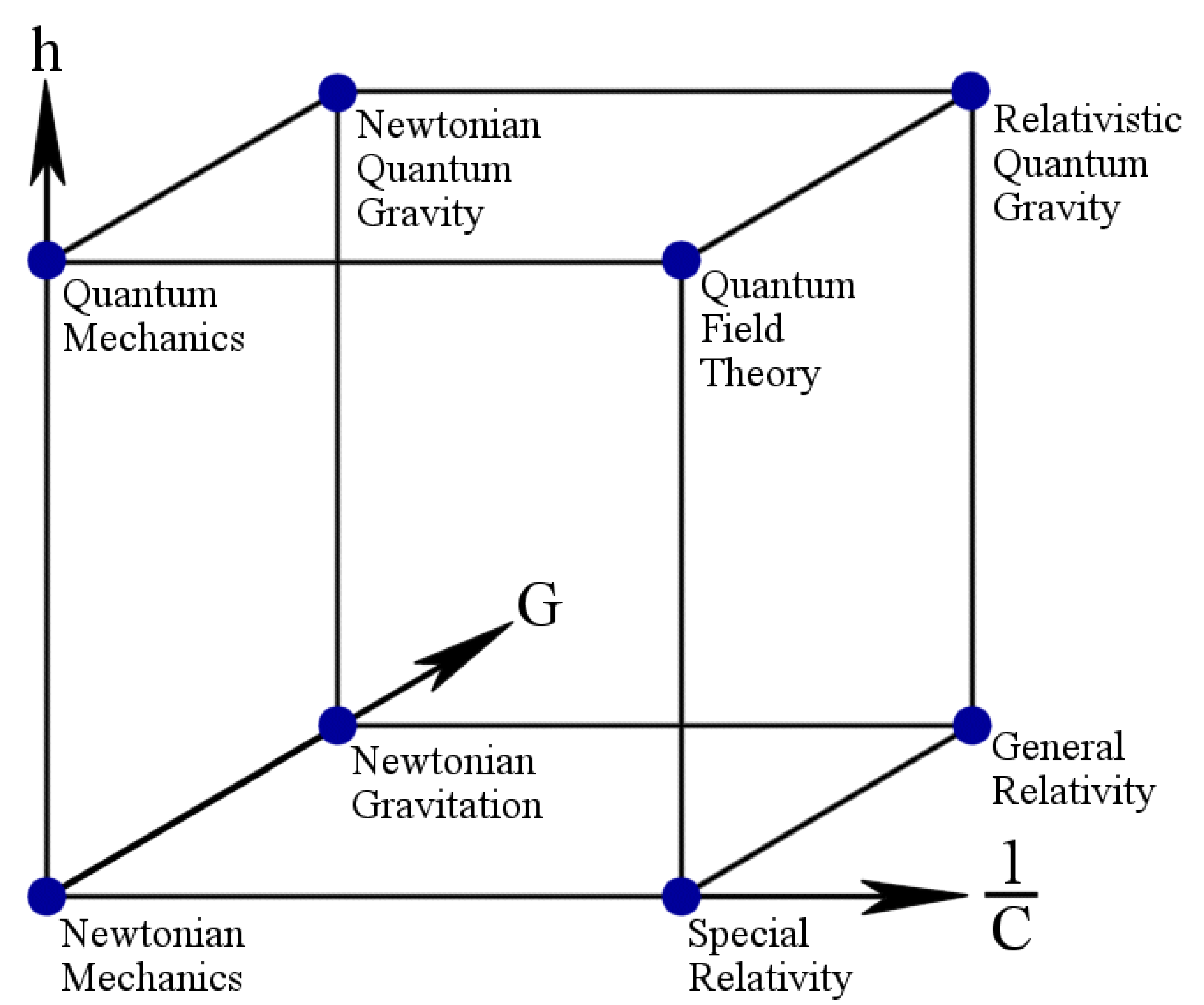
-
Rasmussen’s Paradox that Nothing ExistsYeah, so we actually have:
1. anything must have some other explanation
2. reality in total cannot have another explanation — jorndoe
Yep. That was the position I argued against.
General necessities are hard to come by; self-consistency might be a candidate, then again that just seems like us imposing so we can make sense of things, don't think there's any guarantee of that. — jorndoe
In our "best" descriptions of nature, self-consistency in the form of some global finality, some general optimisation principle, is always needed, even if it can't be really explained by the view from the individual parts.
Take the Principle of Least Action and the way it must be smuggled in as the mysterious foundation to all mechanics. -
Rasmussen’s Paradox that Nothing ExistsThe external relation for Peirce was unconditional love. — Possibility
I guess it depends on how one interprets agapastic evolution.
Can it really be driven by such a transcendental quality as "cosmic love"? Or is it better covered by the prosaic systems view that, of course, all biosemiotic systems must balance the secondness of evolutionary competition with the thirdness of ecological cooperation?
So it is the dichotomy of competition~cooperation that is the driving immanent, or self-organising, dynamic that emerges from pure semiotic possibility in nature.
I’m actually in complete agreement with much of what you’re writing here. — Possibility
:up: -
Why are things the way they are?Even if we knew all the causes of how the brain produces conscious experiences, this still seems to leave untouched the question of why the brain produces conscious experiences. — Luke
Yeah. The how questions are questions about material and efficient causality. The why questions go to formal and final cause.
But why an organism would want to know its world seems an easy thing to see a purpose for. And how it does that is by constructing a neural modeling relation with that world.
The misstep in the causal analysis is to then talk about "conscious experience" as if it were just a product of the material "how" and not the finalistic "why". -
Why are things the way they are?I have noticed this particular "why" question crops up repeatedly in various guises in philosophy. — Luke
It's the search for a causal account. Every particular must be the product of something more general.
It is worth reflecting on what sort of answer might satisfy those who ask these "why" questions and whether there might be way of rephrasing them to exclude the "why". — Luke
Aristotle list the four general causes - or "becauses". Together, as a unity, they ought to offer a complete account.
Note how some things might be necessary to the reason why something is the way it is. Which is a pretty strong reason for the "why". But other things can be at the other extreme in being a contingent cause - a "mere accident". So the weakest seeming reason for some "why".
Why did the beam buckle, the cookie crumble, or the final straw break the camel's back? We can blame unlucky accident or randomness as the reasonable explanation. We could say absolutely any kind of pertubation, no matter how slight, could have tipped the balance.
So a four causes account covers both structural necessity - formal and final cause - and material accident, or material and efficient cause.
Thinking in these terms might also highlight the impotence of the "answer" given by the fine tuning argument. The fine tuning argument answers the question of why there is life in the universe by saying, basically: because otherwise there wouldn't be life in the universe. Or, in its more general form that applies to all of these questions: because otherwise things would not be the way they are. — Luke
This seems to conflate two possibilities.
In the one, fine-tuning is the result of structural necessity. Our Comos is what it is because that is the sum over all possibilities. In Platonic fashion, you can only have five Platonic solids. Given the constraints of a 3D world, those are the only fully symmetric regular polygon outcomes.
And in physics, this is the kind of gauge symmetry thinking that gives the Standard Model of particle physics. For Nature to reach its simplest possible state in terms of absolute regularity - a world where particles are excitations of the simplest achievable form - then the options are strictly limited in a Platonic structural fashion. So in this sense, fine-tuning is an illusion. Any world would have the same mathematical constraints.
But then the coupling constants of the Standard Model seem arbitrary. The mass of an electron or the strength of the electromagnetic field seem like arbitrary values - at least in the physics to date. And so the way around that is the anthropic principle. We imagine a multiverse or landscape of possibility in which every random combination of constants is tried. We then become the constraint that picks out the particular world-branch in which - by accident - the combination is such as to be able to produce us. The fine-tuning is again an illusion. But now in the sense that every accidental value will be manifested and so our reality now sits at the opposite end of the spectrum.
It is not Platonically necessary, but as causally contingent as it can be imagined to be.
So a lot now hinges on how much of the causal work done by the physical constants can be hoovered up by some future "beyond the Standard Model" physics. The "why" will be shifted from one causal bin to the other to the degree the arbitrary constants get explained as Platonic necessity.
But note that "contingent" is a causal concept just as much as "necessary". And the two being reciprocal views of "why-ness", we can expect always to have some measure of both in any full account. To be completely a case of one or the other is what we shouldn't expect, and what we don't in fact see. -
Rasmussen’s Paradox that Nothing ExistsI think that is impossible, because it would require another meta-theory from the vantage point of which you would have to check it, meta-metaphysics. — Tobias
Sure. No problem. Naturalism competes in the philosophy space with other metaphysical views - like those that are dualistic, intuitionistic, or anti-totalising. And in science, the holism of systems science competes against the reductionism of atomistic science.
Even within systems science there are dozens of camps.
Agreement can only arise in the long run - at the end of time. -
Rasmussen’s Paradox that Nothing ExistsWhen you say “we can...”, you’re referring to your own qualitative potential. — Possibility
I’m referring not to my qualitative judgements but that of a Peircean community of rational thinkers. I rely on the world-structuring of a logical semiotics as practiced within a pragmatic human tradition.
So as embodied in philosophical naturalism, quality gets properly defined - as dichotomous to quantification.
And the qualities employed are those that are the product of rational dialectical argument. Metaphysics was founded on the identification of such dichotomous qualities. Chance-necessity, matter-form, atom-void, being-becoming, stasis-flux, etc, etc.
Qualities are not free choices. They are the unities of opposites that reasoning about pure possibility must force upon us.
And then the value of these metaphysical distinctions are checked against the material facts by the scientific method - the methodological naturalism to complement the metaphysical naturalism.
The Tao Te Ching refers to this in its opening chapter, acknowledging that “The Tao which can be spoken is not the eternal Tao.” — Possibility
Sure, but how did Peirce resolve this Kantian dilemma? Do we fetishise the thing-in-itself or get on with the pragmatics of being selves in a modelling relation with our reality - the Umwelt argument.
So the Apeiron or Vagueness, or the quantum foam for that matter, are the eternal which cannot be spoken about. And yet still - pragmatically - we can be completist by including them in our conversation to the maximum degree that it is usefully possible.
The original ideographic language of the TTC is a qualitative logical structure, to which we as readers align our own qualitative logical structure (in a potential state ‘empty’ of effort), in order to relate to the unbound possibility of energy as a whole in absentia, and recognise the possibility of its unique path through our particular qualitative logical structure. — Possibility
In fact energy isn’t the ground level of physicalist ontology anymore. The modelling has moved on to information-entropy as the dichotomy that best captures the wholeness of reality’s foundations. So a structuralist account is replacing a materialist account.
As might be expected where rational structure is the stabilising cause of being, making materiality its “other” of the radical and undirected fluctuation, or fundamental instability. -
Rasmussen’s Paradox that Nothing ExistsDoes me referring the question to a certain type of analysis say anything about my metaphysical commitments? But no, I am not a metaphysical naturalist. — Tobias
It would help understand where you are coming from on his question. If we don’t share the same axioms, we are hardly going to agree on the same conclusions.
So all my arguments here are contingent on taking a totalising natural philosophy view.
But indeed if the claim is that 'the material word' somehow is the world as it is, qua metaphysical position, then no, I do not hold that. I think it is reductionist and well... metaphysical in the pejorative sense of the word. — Tobias
It is a checkable theory, like all metaphysics ought to be … to avoid being word salad.
I stand in the continental tradition rather squarely. — Tobias
Gotcha. (But I thought that had taken its own turn towards systems science with enthusiasms for things like Prigogine’s far from equilibrium thermodynamics.) -
Rasmussen’s Paradox that Nothing ExistsNo, I hold reality to be a metaphysical concept, not a physical one. — Tobias
So you don’t hold to metaphysical naturalism? Are you arguing for dualism or something?
Reality is a concept by which we refer to all that is real for us, or all that is the case. — Tobias
Those could be two different things.
Certainly from my Peircean approach to metaphysical naturalism, I recognise the potential and the necessary to be real along with the actualised, So all that is the case in terms of the brew which could result in a “real material world” includes the tychism of quantum potential and synechism of mathematical symmetry.
Thus metaphysics and physics wind up singing from the same hymn sheet. Talk about the origins of reality are informed both by the dialectics of metaphysics and the pragmatics of science.
That does not mean anything though in a metaphysical discussion. though when physicists and metaphysicians speak to each other they will first have to clear away such mutual understandings of a concept. — Tobias
Why wouldn’t physics and metaphysics be prioritising this merged approach?
Peirce has already done it. Ontic structural realism takes it seriously enough. I don’t see a problem for the metaphysical naturalist given physics used to call itself natural philosophy for just this reason.
apokrisis

Start FollowingSend a Message
- Other sites we like
- Social media
- Terms of Service
- Sign In
- Created with PlushForums
- © 2026 The Philosophy Forum