
-
OilWhat has happened historically in nearly all (if not all) countries is that when the population has gotten more prosperous, population growth has dramatically decreased. — ssu
Sure. I understand that.
What I questioned was the implication it could have a useful impact on the problems of peak fossil fuel and global warming.
You really would have start a genocide not seen ever in history to get to 2.5b. The Paris Climate Conference wasn't planning killing over 5 billion people. Sorry, but that is totally ludicrous and utterly crazy. — ssu
Again, that is the point.
So it’s back to wishing for a planned energy downshift and knowing that is impossible as a voluntary human action. -
OilI'm not so sure just how sensible this is. In the 1950's a lot of people even in the West were poor. So the program to save the World is to increase povetry? How well that will go? — ssu
Is your argument that we just have to wait for depopulation to reduce the overall pressure on energy consumption and environmental degradation?
That would work. But did you have a particular world population number in mind and a target date to reach it?
The details matter here. If world population is 7.8b now and we would need to cut it to the 2.5b of 1950 by say 2050 - a COP21 type target - how are you thinking of taking all those folk out of the equation?
Replacing 244 tanks, less tanks than in only one Cold War tank division, isn't such a big issue. — ssu
You were asked to compare green energy warfare against fossil fuel warfare. So whether it is 11 battalions or 85 battalions is not the point.
If your opponent turns up with a knife to a gunfight, do you politely toss away your Kalashnikov and ask him to wait while you run home to grab your Puukko? -
Preliminary Questions on Hierarchy TheoryMany human hierarchies are based upon the idea of, and even dictatorially imposed by, authority. The existence of self-organizing hierarchies in nature cannot provide ethical justification for any human hierarchy based on authority or brainwashing or coercion and so on. — Janus
Good reply. The curious thing is that @JerseyFlight says his perspective is Hegelian. But the Hegelian view of history was that it was a journey of progress towards a well balanced social order - one that properly expressed the dialectic of individual striving and collective rational order.
And that is the organic notion of a hierarchy. Peirce argued that the entire Cosmos expresses the same dynamic. The universe was a story of a universal increase in “general reasonableness”.
The kind of hierarchy everyone is attacking is a mechanical one. That is, one which is a rigid system of top-down control and no balancing bottom-up freedom. So a dictatorship or a slave owning elite.
The people at the top of the social order lay down the rules that suit their personal purposes. Then the people at the bottom find their actions completely determined by some rigid system of control. Either there is a state security apparatus and propaganda machinery - a Stazi - to take away all meaningful freedoms. Or, as with slaves, humans actually become property and treated by the system as such.
The organic model of a hierarchy which I have been talking about is of course at the opposite end of the spectrum.
The whole point of the top down constraints is to create a generalised set of individual freedoms. The constraints certainly have to shape behaviour in ways that are pro-social. So they do limit “freedoms” in that sense. But then the flip side is that the constraints positively fosters the freedoms which a society - as an organism - finds constructive.
As I said, a dictatorship or tyranny is also only about serving the purposes of the small circle at the top of the pile. In an organic hierarchy, the highest scale of organisation represents the collective purpose of the system. It is the opposite of personalised purpose. It is the purpose of the collective whole - as encoded in some system of law, rights, governance, custom, etc.
So sure, everything is wrong about a mechanical hierarchy. But that counts as the bleeding obvious.
My case is all about the natural inevitability of the other kind of hierarchy. I am pointing out that nature is in general organised by the rational principle of striking functional balances.
You need to separate the rival forces of competition and cooperation in a way that makes the best sense. And that means a local~global division where competition is the bottom up constructive drive and cooperation is the collective top down guiding hand of a system of constraint.
And if that is the order that Nature demonstrates to be rational, it would seem you would have to offer some new reason for why that wouldn’t also be optimal as the “ethical basis” of human social organisation. -
OilFar better is simply to have so much investment on renewables that they actually are cheaper than oil. — ssu
The problem is that oil could sustain a global capitalism because it is so energy dense and transportable. Renewables are local energy creation and many countries will struggle because they lack good hydro, wind or solar resources.
Consider the plight of Germany....
The results of the Energiewende program in Germany, started in the late 1990s, should put a knife through the heart of the belief that renewable energy sources are going to replace oil, and other fossil fuels, and solve the climate disruption problem. I’ve seen estimates as high as 500 billion euros (~$540 billion) for the cumulative cost of the program. Roughly 30,000 windmills and a high percentage of the world’s solar cells have been installed in Germany over the last few decades.
For all of that, there has been at best a minor decrease in per capita CO2 emissions over the last few decades (See Figure 2). Germany has one of the highest per capita CO2 emission rates in Europe, and the world, and the rate isn’t going down in a meaningful way.
https://www.resilience.org/stories/2020-09-11/the-end-of-oil-is-near-or-maybe-not/
Sensible folk would be planning for a general energy downshift - energy poverty replacing energy abundance.
The good news is that we would only have to get back to 1950s’ levels of individual consumption.
The bad news is no one wants to accept a degrowth economics. And if any nations do decide to do the right thing, others will take advantage of the elbow room that creates.
This is the nature of evolutionary forces. If you ain’t growing, then you are dying.
If everyone is locked into the same race to own resources, then a cooperative balance can emerge to regulate that “market”. You can have a system that makes sense and has a long run stability because all the players share the same goal and have to reach some mutual balance of interests.
But that emergent balance breaks down if some group of players decide degrowth has to be the new goal. That just reduces the competitive break on the remaining players. A tragedy of the commons ensues.
Imagine the German Army converting its tanks and ammunition to green renewables. Are the Russians going to say, OK, we will join your new Carbon zero game?
Degrowth will be forced on the world one way or another. But it won’t be a planned transition. And it will be very patchy. -
OilDo you really think this? I mean it makes for a good headline, — Hanover
The facts were in the article....
Global indexes measuring the value of the largest oil companies hit a 50-year low in 2018; of the world’s 100 biggest stocks, only six were oil producers. By 2019, the fossil fuel industry ranked dead last among major investment sectors in the United States. This was not surprising, given that the US oil and gas industry was in debt to the tune of $200 billion, largely because of struggling small fracking companies. -
Preliminary Questions on Hierarchy TheoryNo. It is simply that you are discussing something else.
Your peer to peer angle is talking about the blank canvas before the structure self organises,
Your harking on about control hierarchies - the popular mechanical conception - is bypassing my arguments based on physical and biological principles.
That’s ok. You never studied these things. And you have no interest. -
Preliminary Questions on Hierarchy TheoryHow exactly is Trump a debating point in favor of the thesis that the Internet is a hierarchy? Can you see that your enthusiasm for your thesis is causing your logic to be a bit weak? — fishfry
Yeah, I give up. If you don’t get network theory, then I’ll leave it there. -
Preliminary Questions on Hierarchy TheoryOf course hierarchies have arisen in the software layer (Facebook, etc.), but they don't invalidate the basic point. — fishfry
In fact it does.
Of course governments and corporations are getting a pretty good stranglehold on the Internet these days, which does support your point. — fishfry
It absolutely doesn’t.
Like the OP, you are applying a lay concept of a hierarchy. I am defending something else. -
Preliminary Questions on Hierarchy TheoryThe fact that it bolsters corporate hierarchies to the detriment of human potential. Privatizing economic sectors of public service to the disenfranchisement of individuals. Deregulation, austerity. Not sure what you need to know that you don't already know? — JerseyFlight
So corporations, privatisation and deregulation meet the definition of cruel and oppressive state rule. Sounds legit. -
Preliminary Questions on Hierarchy TheoryI would like to go back to your example of the Roman army, because one might point out the similarities and differences between discipline there and in the modern army. — Judaka
In my first example, I in fact had the modern army in mind. And then I mentioned the Greek hoplites as military histories like Carnage focus on the way that the social democracy of the Greeks was the reason they could self-organise in far more effective fashion as a fighting force.
For example, a restriction on behaviour for the purpose of discipline is necessary but the punishment for that in the Roman army might be execution or lashing, while in a modern army, the measures taken are substantially less severe. I think we could all agree that it is preferable to have the later approach though both undeniably function. Tyranny may become an issue where the Roman general has the complete authority to execute a soldier for a minor offence, whereas the authority of the modern general is far more constrained. — Judaka
The Roman army at least handed out punishment according to Roman concepts of law. There were rules and their consequences. And the discipline was beneficial when it came time to beat the ten times larger army of a barbarian horde.
If your boss is a Persian satrap, you could be lashed or executed by whim. Or at least your protection would be some kind of social communal level of tolerance. And not much connected with the real business of being a fighter.
But Roman generals were constrained by all sorts of rules. They got appointed. They couldn't bring their troops into the capital. There were all sorts of checks and balances that served the function of making the Roman army the colonising economic machine that it was.
And likewise, the modern professional army has its rules-based democracy which is consciously designed not so that is "good" but so that it is effective at its job. If you are hiring weapon system operators and logistic managers to wage your technological war rather than some random gang of toughs, then you have to start treating them like the white collar workers they are. They have to have soft beds, five choices of dessert, and a wifi connection while they are roughing it against the tribes in Afghanistan.
So what matters here is that the rules frame the freedoms. And the more you invest in small highly trained, highly equipped professionals, the less you want to make them go consider alternative career choices - right before you send them into action where their heads get blown off.
It seems we have the ability to impose constraints on behaviours which don't merely sabotage the effectiveness of the hierarchy but also on those that result in infringements upon human rights or our ideas about fairness. To what extent is it practical for us to think that we can introduce such restrictions due the concerns we might have about hierarchies? I am really interested in what is unrealistic for us to try to manufacture and what we should be able to do to make society as fair and pleasant as possible. What parts of the hierarchical system can't be touched? — Judaka
What has actually happened in society? I think we can say that live used to be lived in a very physical way. And the hierarchical organisation of society reflected that.
When I was a kid, you could still strapped on the hand for being cheeky to the teacher. That escalated to a caning at high school. A casual physical brutality was the norm. It was soft to take a tent when you went camping. School dentistry was done without anaesthetic and a slow drill. Nurses were known to do this on wee kids just for practice.
I could go on. But this was only the 1960s and 1970s. Hardly the Stone Age.
Nowadays no human or animal is meant to suffer anything - even the slightest insult to their ego and self-esteem.
Is this inherently better? It is certainly a direction history has taken for some reason. And we can talk about the functional outcomes - analyse them ahead of judging them.
So the big question is why might fairness and happiness seem the highest good? Where does that leave challenge and excitement? Where does that leave the casual freedom of the past? How does it relate to Maslow's hierarchy of needs where "self-actualisation" looks to be what every step leads to?
We have worked so hard as a modern society to remove real world physics as a constraint on our Being. We all laugh at the US military as it can't go anywhere in the world without comfy pillows and Frosty Freeze dispensers.
But in moving our Being into the virtual information reality of the cyberspace, into the temperature controlled environments and snack-filled fridges of our McMansions, into the woke safe zones of our social discourse, have we made some kind of real progress?
I really question that - while agreeing that I more than just about anyone have personally benefited.
So is constraint a problem in itself? Is there anything sacrosanct to be protected in the hierarchical arrangements we create?
My answer has been that constraints are a necessity. Nothing exists unless there is context to give it a shape. And even something to oppose, in the way any organism opposes its own wishes against the vagaries of the world.
So the very idea of a constraint is what entails a "degree of freedom". Constraints simply cause freedoms to become focused in some useful direction.
But the danger for life and mind - as hierarchical systems - lies in not paying sufficient attention to the fact that they are semiotic processes. They are all about information regulating physics (for the purposes of maintaining some balanced and well adapted state of existence).
So you do want to rise above the brute physical world to a pragmatic extent. Comfortable beds can be better than hard ground. But what of the idea of completely transcending the physical realm rather than being more intelligently engaged with it?
Is that where even existing begins to lose its point?
That is the kind of question you can ask of our collective social structure at this point in its evolution. To what degree is it some kind of mad idealist fantasy being spun off the illusory riches of fossil fuels?
Again, for me, modern life is bloody terrific. I'm not complaining personally.
But that is how my understanding of natural systems shapes my critique. If I wanted to put a finger on the lack of balance, it is in things like an economic system based on entropification that fails to account for the costs of its entropic sinks.
So neoliberalism can be fine as a theory. Up until the point it refuses to include the costs of the environment in its market pricing. -
Preliminary Questions on Hierarchy TheoryThe question you are asking me is negated by your metaphysics: "If tyrannies can persist, then hierarchy theory would demand that they have found some way to repair and reproduce their own fabric."
Which is contradicted by:
"It is the same as the wealth inequality story. We can't accuse neoliberalism of having a malign intent. It is just a fact of exponential growth..." — JerseyFlight
So in what technical sense is neoliberalism a tyranny?
I'm not saying that such an argument couldn't be made. But I'm asking you to make it.
So when you ask me about hierarchies versus hierarchy it is you who have made them the same thing, because by accepting them as normative you are also making the claim that they are socially intelligent standards. — JerseyFlight
You have a wild misreading of my ethical conclusions. In general, I don't find being either merely descriptive, nor rigidly normative, a dialectic that works for Natural Philosophy. The whole is~ought debate is a great pain in the arse.
A systems answer instead focuses on the reality that to exist, a system has to be - in some proper sense - functional. So that brings finality into play. A purpose is being served, even if it is merely "to exist".
But then grades of finality are also then recognised. The base grade for nature is the Laws of Thermodynamics. They are normative to the degree they allow no other physical choice. And they are positive as a brute description of what is (unless you want to argue some other cosmology).
But that cosmic grade of telos is a mere physical tendency. It ain't that restrictive. In fact it leaves almost everything to chance. Our major complaint about the Cosmos is that it seems meaningless and uncaring. It is happy being filled with entropy and randomness. It seems the opposite of a tyranny in being an anarchy, I guess. :razz:
Beyond the physico-chemical grade of telos as "tendency", things start to get interesting with living and mindful systems. Now they are driven by "functional" goals.
Then we start to get purpose proper with human language and culture. We can move beyond the merely functional and towards the intentional as - so we like to claim - a physically dissociated level of free choice. The dilemma of freewill and moral imperative is - idealistically - invented.
So my ethical framework is the one that encompasses the usual dialectic of is~ought and reveals its many grades of semiosis, its various levels of hierarchical constraint on individual freedom.
It is the richer view from a natural science perspective. Or the overly complex view, from a layperson's perspective. -
Preliminary Questions on Hierarchy Theoryfishfry, JerseyFlight and I don't agree. Not all complex systems are hierarchies. — Banno
Agreed. Even simple systems are as well. :up:
Your problem is that you don't even recognise when your examples of non-hierarchical systems are examples of hierarchical systems. That is what happens when google leads you to source material you can't comprehend.
Further, Apo says that it is science that backs his claim, while mixing in Hegel and Peirce. — Banno
What I actually said was that systems scientists pick out their own metaphysical heroes. So systems scientists set their holism against a reductionist metaphysics by citing Aristotle, and more recently, Peirce.
Hegel individually doesn't get that much of a look in. But Naturphilosophie as the broader strand of German idealism does.
Likewise Heraclitus sort of fits. But Aristotle gave the comprehensive framework.
Again, you are speaking of a whole vein of intellectual history that is above your pay grade. Your every comment reveals that ignorance. -
Preliminary Questions on Hierarchy TheoryMy entire discourse has been directed at potential tyranny. — JerseyFlight
So when hierarchies go bad? Or "all hierarchy is bad"?
Which claim do you mean to defend?
...are you sure that Hierarchy Theory will not end up going in this direction? — JerseyFlight
Your questions are mind-numbingly monotonic.
I've tried to give you a baseline description of hierarchies as the natural, logically inevitable, expression of functional organisation.
I've emphasised the way that this is a balancing act in terms I thought you might best understand - the Hegelian dialectic.
And so it should have sunk in by now that an organisation that is self-organised to achieve a dialectical balance could also fail to achieve that balance - and thus be ripe for evolutionary recycling.
If tyrannies (however you define that term, you are not saying) can persist, then hierarchy theory would demand that they have found some way to repair and reproduce their own fabric.
We could examine that and decide - from some other viewpoint - that it isn't ideal.
In a dictatorship, or a slave based society, there will be some folk who think that is a great deal. Yet clearly, there are tensions built into "what works". And over time we would expect those tensions manifest in ways that force change and achieve some better overall balance for the whole of that society.
So self-organising is self-correcting. Evolution does its job in good time. And if we understand the way it works - as we definitely started to with the Enlightenment and its inquiry into the nature of society - then we can even nudge things along to that broader state of global cohesion and individual contribution.
But to hear you bleat on about "hierarchies are the slippery slope to tyranny" is just painful to listen to. It's not my idea of a discussion of the realities. -
OilCost to environments should be taken into account so that it becomes more expensive. Markets seem to fail to do that, so they should be corrected. — ChatteringMonkey
Precisely right. The whole fossil fuel adventure was predicated on being able to treat the environment as a costless sink. That was a presumption built into the economic machine in the 1800s.
A farming economy, and even a nomadic herding economy, have to factor in the costs of their sinks. They live right in the shit they produce, the ecology they might denude.
But fossil fuel economics got locked into a fantasy of not having to account for its waste. Even when the rich West started to clean up its environment, it did that by exporting all the environmental destruction to the poor developing nations. That was what neoliberal globalisation was about. And industrial colonisation before it.
Until a few years ago, my own country proudly recycled all its household waste by shipping the useless plastics to China. And then China decided it was about time to get out of that "business". Heaps of used tyres are now piling up in fields and occasionally catching fire.
The oil industry peaked in 2006 in terms of conventional oil. And in its death throes, it paradoxically blocks a shift to green energy because oil producers are in a fight to be the last country standing.
The price of a barrel ought to be high just to justify corporate investment in moving to the extraction of unconventional oil. And it ought to be really high if the industry was forced to include the cost of the environmental sink that oil gets for free.
If the market actually functioned as advertised, these rational things would be happening and the world would be switching to renewables as the obviously cheaper/better choice.
Or in reality - as renewables can't practically deliver the same bang per buck - getting busy redesigning society for a post-growth world economy.
The definition of sanity is bleeding obvious. But coal and oil built their own social order. And that is only going to depart kicking and screaming. -
Preliminary Questions on Hierarchy TheoryIf you simply read over this thread you will see admissions from apokrisis that go exactly in this direction. — JerseyFlight
Instead of making hopeful sounds that people have no choice but to agree with you, why not make a considered argument.
For example, why did Marxist ideals wind up in the tyrannies imposed by Stalin and Mao? What went on there exactly?
Then why did those tyrannies collapse for a while only to be re-imposed (to some degree) by Putin and Xi?
The real world offers you interesting examples in terms of what you claim to be your area of interest. Yet you won't engage in such specifics. -
Preliminary Questions on Hierarchy TheorySo Herbert A. Simon's analysis is a start, not the end. — Banno
Has Banno actually read Simon? He contributed an excellent chapter to the 1973 classic edited by Howard Pattee - Hierarchy Theory: The Challenge of Complex Systems.
Contains the articles: "The Organization of Complex Systems" by Herbert A. Simon; "The Hierarchical Order and Neogenesis" by Clifford Drobstein; "Hierarchical Control Programs in Biological Development" By James Bonner; "The Physical Basis and Origin of Hierarchical Control" by Howard H. Pattee; and, "The Limits of Complexity" by Richard Levins.
And this wiki entry sums it up....
Empirically, a large proportion of the (complex) biological systems we observe in nature exhibit hierarchical structure. On theoretical grounds we could expect complex systems to be hierarchies in a world in which complexity had to evolve from simplicity. System hierarchies analysis performed in the 1950s, laid the empirical foundations for a field that would be, from the 1980s, hierarchical ecology.
The theoretical foundations are summarized by thermodynamics. When biological systems are modeled as physical systems, in its most general abstraction, they are thermodynamic open systems that exhibit self-organised behavior, and the set/subset relations between dissipative structures can be characterized in a hierarchy.
A simpler and more direct way to explain the fundamentals of the "hierarchical organization of life", was introduced in Ecology by Odum and others as the "Simon's hierarchical principle";[14] Simon[15] emphasized that hierarchy "emerges almost inevitably through a wide variety of evolutionary processes, for the simple reason that hierarchical structures are stable".
A lack of scholarship is one thing. A wilful ignorance being displayed while also citing said scholarship is taking it to another level, dontcha think? :chin: -
Preliminary Questions on Hierarchy TheoryI am sort of coming around to my original position. The non-hierarchical nature of the software at its core, has to be acknowledged. You can't just say it's a hierarchy because that's how the packets flow. It's a lot different than a pure hierarchical network. — fishfry
It might be helpful to talk about this in the language that network theory has created for itself.
In network science, a hub is a node with a number of links that greatly exceeds the average. Emergence of hubs is a consequence of a scale-free property of networks. While hubs cannot be observed in a random network, they are expected to emerge in scale-free networks. The uprise of hubs in scale-free networks is associated with power-law distribution. Hubs have a significant impact on the network topology. Hubs can be found in many real networks, such as the brain or the Internet.
https://en.wikipedia.org/wiki/Hub_(network_science)
So your peer-to-peer revolution created a flat landscape - a new world in which making an informational connection carried a uniform costs, regardless of the underlying hardware physics.
But then that flat landscape got colonised in a free or locally unconstrained way. Everyone got busy on the internet in ways that freely expressed their own functional(?) human interest.
Connections were added and a hierarchical structure resulted because of the Matthew Effect or preferential attachment. Hubs and fat tails became a thing.
A "flat" network would have had a Gaussian randomness in its connectivity - everyone would have connected to the same average degree. That is what net equality would have looked like.

But as a freely growing beast, the internet instead developed hierarchical complexity. It developed the different statistical pattern of scale invariance. It became fractally organised so that now scales of being were themselves "equalised" in that there was no one standard mean. Connectivity was powerlaw and hubs of any size could manifest.
Porn could dominate the internet. And philosophy forums could live alongside just as freely as the tiniest scales of interest communities.
Well, on technical point, the internet is probably more log/normal as a distribution and not quite making the giddy heights of a log/log distribution. Just like the stock market or most other real world systems.
So the Gaussian and Powerlaw models of "randomness" are a dialectic that frame the ideal extremes of self-organisation. Reality falls in-between the two, depending on how constrained or unconstrained the connectivity happens to be.
But the point is that hierarchies of connectivity emerge naturally as the structures that dissipate flows. And this is dialectical in the sense that either the flow tends towards the closed Gaussian equilibrium balance, or towards the exponentially growing Powerlaw equilibrium balance.
A Gaussian hierarchy is canonically simple. It is a single scale system because it has a single mean. Like an ideal gas, it has a stable temperature and pressure - even as all the gas particles ricochet about with statistical freedom. There are no internal scales of difference - gangs of particles that dominate. Everything is as average as possible. Internally there are no differences that make a difference, even if every particle is expressing some different momentum.
Then a Powerlaw system would be at the other extreme. As Universality describes, as you start to disrupt the stable Gaussian equilibrium of some flow by heating it up, it start to form internal structure.
You get the dialectical patterning that Banno stumbled upon when he hastily googled "What is self organisation"...
pigmentation of a porphyry olive shell
lichen growth
zebra and giraffe coat patterns
hexagonal Bénard convection cells
spiral patterns produced by the Belousov-Zhabotinski reaction — Banno
If an equilibrium balance is disturbed by an injection of energy, then it starts to oscillate. The system depends on some dissipative balance of reaction~diffusion and suddenly it is having to absorb more energy than it can immediately handle. It becomes like the straight river that begins to carve out a snaking channel. If the river can't drain faster, it can add dissipative capacity by becoming longer. And so it does.
But keep adding energy and there is a transition to chaos - a Powerlaw regime. Dissipative features - oscillations, turbulence, etc - start to appear on all scales as ways to absorb the increasing throughput. You again have a scalefree hierarchy of structure being expressed on every possible scale to cope with the demand. You arrive at an ecosystem level of complexity in biological terms.
So the patterns of nature take these forms. You have the highly Gaussian pole of being where the hierarchy is just a simple stable bounded system with no internal structure.
In human terms, we might be thinking of ideals like a hunter gatherer tribe or a Masonic lodge - a group with a stable common identity and no internal divisions. (Of course, no actual tribe or lodge is ideal as stuff is always happening to disrupt the "energy").
Then at the other extreme of being, you have the crazy chaos of the stock market or the internet. You have some essential dialectic - such as reaction~diffusion - being expressed over all possible scales of being. Internally, the number of hierarchical levels tends towards the infinite.
In terms of wealth vs poverty, or fame vs anonymity, these social systems have such diversity of outcomes that anything is possible in either direction. Life isn't homogenous as it is with a static hierarchical order - a single scale of local~global interaction, a single deal when it comes to the exchange between competitive and cooperative behaviours. It is instead as inhomogenous as could be imagined .... and yet still a stable, natural, functional, outcome in terms of producing the maximum dissipative flow that its structure can support.
Chaos as a dialectic expressed freely over infinite scale is also a hierarchical state of order.
And then - because we have these two ideal limit descriptions of hierarchical order - we also have all the intermediate states that are somewhere in between. We have the log/normal conditions where there is a fair bit of hubbing, but a fair bit of egalatarianism too. And this might be a functional balance for dealing with the available entropic throughput - doing the actual job of the system.
Not every river has to be a sluggish canal or a wild fractal delta. Plenty are carving out snaking loops across the landscape as an intermediate form of hierarchical architecture.
And here endeth another science lesson on how it all connects up. :grin: -
Preliminary Questions on Hierarchy TheoryYour criticisms are still too vague and unfocused. If you think Nature has an alternative, just spell out what that would look like.
Does Nature have a choice to be other than self organising? Well only if we start appealing to some divine creator.
Does Nature have a choice to be other than functional? Well only if we are not interested in forms of being that enjoy a capacity to persist as anything.
Does Nature have a choice to be other than hierarchically organised? Well dialectics tells us that the simplest model of a balanced structure is a complementary deal between global constraints and local degrees of freedom.
If you have some other model of self organising, persisting, functional structure, now would be the time to present it. -
Preliminary Questions on Hierarchy TheoryI would have thought that attaching Hegelian dialectic to thermodynamics — Banno
Not Hegel but Peirce. And Peirce was a scientist. His orientation was probabilistic and thus thermodynamic. -
Preliminary Questions on Hierarchy TheoryDo you think moderating how the hierarchy functions insofar as how it is enforced, who rises upward, the power granted to each ring and so on, is the best way to avoid negative outcomes? — Judaka
A hierarchy as understood in an organic systems sense, and not just a mechanistic construction sense, is a natural balance of complementary impulses. That is why it is self organising and self balancing.
So a social system would be trying to balance the contrasting things of local competition and global cooperation.
The hierarchy would be driven by the creative freedoms of individuals, and even groups of individuals, striving to better their positions (in whatever ways - money, status, power, reproductive success, happiness, self actualisation).
But this would be matched by some equal degree of cooperativity. Individuals and even groups of individuals, would do the opposite thing of competing hard. They would cooperate hard, because that is also an ultimately functional and self-interested thing to be doing when life is dependent on their being a collective functional social system.
It you want the status of being even an adequate tennis player, you have to support the existence of a tennis club and a game being played by shared rules. Cooperation on a general global level sets the scene such that you can actually express a competitive nature on the local and personal scale.
The same goes for any social function. Democracy is where we all agree to being bound by a collective rule of law that in turn clearly defines our individual rights and freedoms. That sets us up to compete in ways that - if they are functional - will rebuild, even grow, the very society that constrains us.
So our societies make us what we are by placing limits on our actions. And if those limits are well adapted, then we will spend our lives expressing the resulting habits of action in ways that bring personal achievement while confirming those same rules of engagement.
When we talk about negative outcomes, we are usually thinking of some idealised utopian view of the human condition, Maybe Rousseau’s noble savage, or the happy village before the dark satanic mills appeared. Competition and status seeking are modern distortions of what is best in humans - the cheerful commune where all are equal and help themselves to the common wealth as fits their needs.
Negativity is where a social order is authoritarian and suppressive of individuals freedoms. Things are unbalanced where one isn’t in fact free to compete according to a shared framework and so contribute fully to the functioning whole.
And negativity is also about the question of whether the whole system is aimed at a functional direction. What’s the point of the human rat race? Who benefits?
So there are plenty of ways the balancing act could go wrong. But there is still the naturalness, the logical inevitably, of a hierarchical relationship based on some systematised balance of local striving competition and globally constraining cooperativity.
If any social order persists for long, it can only have persisted because it did in fact strike some kind of balance in terms of being able to turn out individuals who then remade the social world as it had made them.
From a modern point of view, we would say that traditional social hierarchies were rather stagnant in character and lacked energetic growth. And yet they were functional for lives lived either as sparse populations of hunter gatherers, or denser populations of agrarian settlements - lives lived within the physical limits of solar energy.
And today we live lives as optimised to dissipate the energy bonanza that is fossil fuels. We have evolved the social settings which promote unbound growth. That’s a positive - or at least natural - for as long as it lasts.
But the main point here is that social structure is a dynamical balance. And that balancing act - in which global constraints need to produce the right kinds of local degrees of freedom to ensure the whole gets persistently rebuilt - is the guts of what hierarchy theory is describing. -
Preliminary Questions on Hierarchy TheoryHence the evolutionary advantage of non-hierarchical systems! — fishfry
The advantage was removing the real world physical limitations on open connectivity. The internet created a world of pure information flows where the cost of connecting was zeroed to some ISP rate. Physical distance, hardware configuration, and anything else that could physical constrain an act of communication were removed to produce a level playing field.
So it had nothing to do with going non-hierarchical and everything to do with creating a new virtual stage where the information was divorced from the physics.
People let rip in this new world. And as is natural, hierarchical order resulted. We ended up with the influencer economy, Trump, cancel culture, and all those other good things. -
Preliminary Questions on Hierarchy TheoryAs if your opinion is backed by any familiarity with that science. :yawn:
-
Preliminary Questions on Hierarchy TheoryWhat is most dangerous as I see it, and it is no surprise to me that you cannot see it, is this idea of natural order. — JerseyFlight
Is that more dangerous then folk invoking supernatural order?
And did you miss the bit where I said if you understand natural order, then you can actually answer the question of what else could you be doing?
So my point about fossil fuel economics is that it is a Hegelian force that has pushed us into our current economic and political paradigm. Oil produced neoliberalism as its way to achieve its goal.
But how can you even see that is what happened if you don’t understand the way nature works? -
Preliminary Questions on Hierarchy TheoryDoes your theory account for the fact that a hierarchical hardware layer with a peer-to-peer software layer seems to be the winning ticket? — fishfry
My point was that IBM was trying to preserve the world it knew, which was still a pretty small world. It owned the data processing market with it 370 architecture and its networks of dumb terminals. With minis and then PCs intruding on its monopoly, it wanted to shift to a “seamless” data world, but one still locked into its closed software standards.
But then came the open internet and open standards. Data processing morphed from business computing and eventually into phone driven social media.
So yes, hierarchies will always emerge as the natural way to organise flows - entropic or informational. But if IBM had managed to stay in control, then you would have been stuck with corporate information systems and not evolved to those new levels of information flow.
Another wrinkle of hierarchy theory is it predicts the simplification of its own foundations, constraints shape the degrees of freedom. And evolution moves in the direction of ever greater openness for that reason. It produces general purpose components that enable the shift to higher levels of complexity.
Virtual machines created a considerable increase in software load the hardware has to support. So it is quite a penalty overhead to add the flat world of peer to peer connectivity as an example. Yet that then allows another leap upwards in terms of the functional capacity of the architecture. It soon pays for itself if it leads to a world of increased information flow.
Or at least humans will be happy to pay the data centre electricity bills. -
Preliminary Questions on Hierarchy TheoryStill ... discovering that your worldview comes from IBM mainframes explains a lot :-) — fishfry
It definitely doesn’t. Although now you mention it, IBM did push the 80:20 rule as a primitive expression of the powerlaw story.
I actually did edit an IBM mainframe journal for a couple of years so interviewed guys like Gene Amdahl and Bill Gates. It was right at the time that IBM was losing the battle to impose its proprietary hierarchical SNA cooperative processing architecture on the data processing world. -
Preliminary Questions on Hierarchy TheoryHowever the phrase "global constraints imposed on local degrees of freedom" seems to be somewhat localised to your posts, so we might see what JerseyFlight thinks. — Banno
Sure. Don’t bother with the science. Sounds like a plan. -
Preliminary Questions on Hierarchy TheorySo it was all inevitable, and not an awful contingent perversion of the original idea. You're probably right. The utopian vision of the Internet failed; and it wasn't an accident or a plot of the telcos and the government; but rather some sort of structural law of nature in favor of hierarchies, if I can put it that way. — fishfry
It is the same as the wealth inequality story. We can't accuse neoliberalism of having a malign intent. It is just a fact of exponential growth that it shifts you from a Gaussian distribution into a Powerlaw regime. Creating a flat market with unbounded growth had to result in new extremes of inequality ... just because randomness and the Matthew effect. -
Preliminary Questions on Hierarchy TheoryThat's not hierarchy theory as such.
In hierarchy theory, it is about global constraints imposed on local degrees of freedom. And in self-organisation, both of those things emerge in mutually dependent fashion.
You're talking about some unscientific caricature - a layman's misunderstanding of the subject being discussed. -
Preliminary Questions on Hierarchy TheoryYou make it sound like I am trying to enlist some technique of rhetoric here. — JerseyFlight
You keep failing to substantiate your "criticisms".
What do you mean by "tyranny" exactly? Where is the evidence that cannibalism lacks evolutionary context? Why is preventing another Holocaust something to be loaded on the shoulders of hierarchy theory?
It is one rhetorical response after another from you. I'm am waiting for some reply with substance. -
Preliminary Questions on Hierarchy TheoryOk. Then you must agree with my point that the software protocols are peer-to-peer and the opposite of hierarchical. And I concede your point that the hardware infrastructure is hierarchical. — fishfry
Am I being too subtle?
The hardware was hierarchical because that's just the naturally efficient way to organise the world so it can handle a traffic of data.
Then the software was the attempt to create a new flat virtual realm on top - a unstructured network.
And yet once this software started to handle real world activity, it then developed a hierarchical pattern of activity. As again, that just is what is natural. The flat network became a hierarchical network of networks, with some networks much bigger than most of the others.
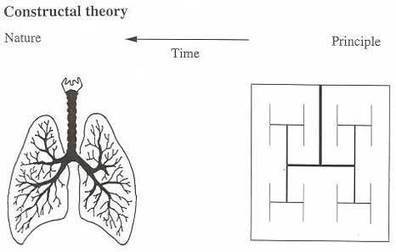
Check out constructal theory for the generality it this. -
Preliminary Questions on Hierarchy TheoryYou think that hierarchy theory is about stacking levels up like construction bricks? It's actually about forming levels. The symmetry breakings that result in structured flows.
So a BZ pattern for instance....

-
Preliminary Questions on Hierarchy TheoryThis is very basic technical information about how the 'net works. — fishfry
Thanks. I'm quite familiar with all that. I was around when IBM was pushing LU6.2. -
Preliminary Questions on Hierarchy TheoryAlways? Everywhere? Everywhen? — Banno
What exception did you have in mind? -
Preliminary Questions on Hierarchy Theory...but there are complex and self-organising structures in which this is not the case. And these are not hierarchical. — Banno
Sounds legit. Did you want that lack of hierarchical order computer generated or nature generated?....

Bleeding Hofstadter. You really need to read some other book on the subject. -
Preliminary Questions on Hierarchy TheoryTCP/IP in fact is a pure software specification and is not hierarchical in any way. — fishfry
So the peer-to-peer is implemented at a software level ... not the hardware level? And the article was about the hardware level.
And then at the software level - given a carefully-levelled playing field - we find, as I said, a scalefree network structure emerging?
One with a fat tail distribution of connectivity? One where no designing hand was involved and yet a hierarchical distribution of "significance" was formed? We see agglomeration and disintermediation as the signature of the dynamics? -
Preliminary Questions on Hierarchy TheoryFirst, the salient feature of a hierarchy is that one element is superior to every other element; but there are complex and self-organising structures in which this is not the case. — Banno
So it's a salient feature unless it's not? Well, that clears up any confusion I guess.
Second, that we can form hierarchies does not imply that we ought form hierarchies. — Banno
The question is about nature and why it does in fact organise itself hierarchically - the logical inevitability of that. -
Preliminary Questions on Hierarchy TheoryIsn't the global Internet a perfectly obvious counterexample? — fishfry
The internet is hierarchical in its hardware design - https://www.hierarchystructure.com/internets-hierarchical-structure/
But much more interestingly, it is hierarchical in the fashion of a scalefree network. It exhibits the natural fractal or powerlaw behaviour of any freely branching "far from equilbrium" system.
-
Preliminary Questions on Hierarchy TheoryWe used to eat each other. — JerseyFlight
And in what evolutionary context exactly? Let's have a little more precision in our arguments.
To observe human society at the point of cannibalism and then conclude that this is nature organizing itself... What am I missing here? — JerseyFlight
The easily available anthropological examination of where "cannibalism" appears in nature as a functional behaviour.
If you want to argue it isn't nature organising itself, what you are missing is the effort you would need to make to get acquainted with the evidence. Dispute that first, talk about your beliefs after.
What I am against is the dumb declaration that what we observe in nature is somehow a standard of intelligence in terms of social process. — JerseyFlight
You are arguing against a position you don't yet understand - by your own admission.
And why should I worry about dragging you kicking and screaming to your conversion? What's in it for me?
I am not a transcendental idealist, — JerseyFlight
You think you aren't and yet the argument you make is. I'm just pointing up that contradiction.
it seems you are positing a kind of natural idealism. — JerseyFlight
Yep. The pan-semiotic kind.
I am trying to ask critical questions against what I perceive to be a kind dogmatism, possibly even a naivety that has to do with an idealized version of nature. — JerseyFlight
Why ask a question when you have already assembled your reasons to never believe?
Where you say, accept the fact of self-organizing-logic, I see the potential for tyranny — JerseyFlight
Of course. The facts have to be twisted to fit your prejudices. You make that clear in every response.
Like Adorno, I believe the highest duty of philosophy is to prevent things like Auschwitz from ever happening. — JerseyFlight
Argument by virtue signalling. Seems legit.
Of course, everything is out of our control in terms of the universe, but not in terms of our own provincialism. — JerseyFlight
The Universe has a flow. As organisms, we are embedded in that flow. To the degree we don't question the impact of that, we will unthinkingly get carried along by that flow. All that is agreed.
The question then is what we will actually think about the situation once we realise we are entrained by it? That is where the "philosophy" can start.
And the answer probably isn't "nature is bad".
However my point remains - how could one even address this question unless one has a crystal clear understanding of Nature as it actually is?
Hierarchy theory - as the basic structuralist model of complex reality - is the way to arrive at that understanding. It's inherent organicism stands opposed to both a mechanical conception of nature, and a spiritual one.
Hierarchies are triadic structures. The systems science story. The step that leads on to a semiotic conception of nature. It accounts for complexity in terms of self-organising immanence.
So that makes it a self-consistent metaphysics. It is its own tradition in the history of ideas.
And what it stands against is the monism of a mechanical view of nature - a place where only a dumb atomistic simplicity is considered as real. There just is no such thing as final cause. That would be an "unscientific" delusion.
It likewise stands against the dualistic tradition we find from Plato to Descartes. The mechanical view can't explain how an orderly world could get created. The idealist instead take the creating mind for granted. There is final cause, but it comes from outside of creation.
So it boils down to a choice between three broad metaphysical alternatives. Hierarchy theory is part of the way that science can assert the natural philosophy point of view.
It is the way that the dialectic of the material and the ideal can be properly fused into the one larger story.
If you think "hierarchy theory" is all about hierarchical organisation gone bad, then you are likely thinking of machine-like situations in human history and not of Nature itself.
Study hierarchy theory and you will see that this mechanical conception of Nature is precisely what it critiques. It has a model of what "bad" looks like. It talks of machines as brittle and senescent - overly constrained and lacking in adaptive intelligence. -
Wittgenstein's ChairPopper’s approach, spelled out in the preface to the Open Society, is: Just try and get to the level of precision in language that you need in order to solve or at least describe the problem you are talking about. It’s all a matter of what works, of what’s good enough. Because your definitions are never going to be perfect. — Olivier5
Yep. Or indeed, the way that definitions are "perfect" is that they only attempt to constrain interpretation in a suitably general fashion. The appropriate level of precision is itself something we seek to communicate in terms of the differences that make a difference vs the differences that don't.
So the problem for naive realists or overly concrete thinkers is that they understand the world as some atomistic composite where every difference must be accounted for. A definition could only be precise if it mentions every possible difference. The problem then is that the potential differences in any "act of conception" are basically endless.
But the pragmatist story on this is that what we want to communicate is exactly where it is that further differences no longer matter to our conception.
If I want you to think about a cat, it doesn't really matter if you are thinking of a black cat or a white cat. Just some kind of average cat - an average level of variation on the theme, on the "family resemblance" - will suffice. That gets the job done in the most efficient way.
So all acts of interpretation are potentially open ended. We could fruitlessly pursue verbal precision to infinity and beyond. Yet the whole point of a pragmatic use of language is that we want to both get across an idea in general, and demonstrate the correct level of generality by our very failure to be more specific.
If "cat" should do the job, you can know that as the listener, because I didn't choose to specify further.
The essence I'm trying to communicate is the idea of a cat in general - a constraint on free possibility at that conceived level of existence. Thus also, as the corollary, whatever I just said was enough. Any difference in conception after that - whether it was black, three-legged, Persian, whatever - is not a fact that matters.
apokrisis

Start FollowingSend a Message
- Other sites we like
- Social media
- Terms of Service
- Sign In
- Created with PlushForums
- © 2026 The Philosophy Forum