
-
The Universe as a Gas Can – Part I: EntropyThis is pretty much what cosmology says. The Big Bang started in a state of thermal equilibrium - an even bath of radiation with all the same temperature. Then the radiation cooled to a point where a fair chunk of it condensed out as matter.
In that respect, the universe fell out of equilibrium and so there is an entropic equilibrium to restore. All the matter will want to find ways to turn back into radiation and catch up with the general cosmic flow again if it can. Hence stars, for instance. And black holes can also radiate so will eventually evaporate over sufficient time.
As an aside, consider how heat content and spatial extent are mirror images of each other at the Planck scale of the Big Bang.
The Planck temperature is defined by a wavelength with a frequency of one Planck distance. So it is all about the size of a single energetic vibration that can be packed into a single unit of space. This single wave is so compressed that it represents the hottest or most blueshifted light.
So the lack of room for light to move at the moment of the Big Bang is also what set its heat to the maximum energy scale or temperature that radiation can have.
You can see there is a very direct connection here between the container and its contents.
The Heat Death is then likewise defined by a Universe arriving at a state where any remaining photons are so redshifted that they are a single wavelength stretched the size of the visible universe. The radiation now has a temperature of virtually absolute zero degrees K.
So it is absolutely the case that there is a relation between the available space for radiation and its consequent energy scale. -
Emergence is incoherent from physical to mental eventsThat being said, we must define what the debate is. The debate is the nature of mental events. — schopenhauer1
Again, I am content with useful explanations. I don't see consciousness as a monistic substance and so I'm not expecting some kind of magic causal mechanism of completely unexpected kind that suddenly switches it on. I see it as a particular kind of process - a modellling relation - and so awareness is simply about how such a relationship is going to feel.
If there is visual modelling, then there is the appropriate kind of visual experience. As would be expected. It is hard to imagine it would not. Especially when we now know so much detail about how visual processing works.
The neuroscience explains so much about our visual phenomenology. It is not a mystery why we can experience bluish red but not greenish red. The design of the nervous system tells us why this must be the case.
Multiply that kind of exact causal account of phenomenology by a thousand other examples and really there just doesn't seem a basic mystery. There is no reason to treat awareness as a reified thing, a dualistic substance, which is the form of description you keep reverting to. It is just so obvious that the mind is whatever integrated set of habits get put together to forge a useful modelling relation with the world.
So your version of the hard problem hinges on consciousness being a substantial entity or state. It is, as you keep repeating, a particular quality.
I just don't feel the force of that argument as the level of mindfulness so clearly correlates with the complexity of the processing going on. Dennett would state it in more extreme fashion, but it is in the end a composite of multiple modelling processes tacked together to achieve a job. There is no one magic way of "doing consciousness", no special threshold to cross. It is a kitbag of useful habits that have evolved and yield whatever they yield.
So it boils down to our contrasting expectations. You want the one big answer that creates sudden causal magic. I instead see a ton of little answers adding up.
For me, it is about finding a metaphysical framework that best accounts for "mental" type processes whether they are very simple or instead a highly evolved collection. And that is what semiotics or the modelling relations approach targets. The commonality of the kind of process in question. -
On the transition from non-life to lifeI'm stifling a yawn. How could your replies become so anodyne so fast?
-
Why Can't the Universe be Contracting?Yes, click the link where it says "expanding universe" and you will find Wiki understands this too....
The metric expansion of space is the increase of the distance between two distant parts of the universe with time.[1] It is an intrinsic expansion whereby the scale of space itself changes. It means that the early universe did not expand "into" anything and does not require space to exist "outside" the universe - instead space itself changed, carrying the early universe with it as it grew. This is a completely different kind of expansion than expansions and explosions we see in daily life. It also seems to be a property of the entire universe as a whole rather than a phenomenon that applies just to one part of the universe or can be observed from "outside" it.
https://en.m.wikipedia.org/wiki/Metric_expansion_of_space -
Why Can't the Universe be Contracting?Sorry, you are wrong. Wiki has spoken....
In a hypothetical universe undergoing a runaway big crunch contraction, a cosmological blueshift would be observed, with galaxies further away being increasingly blueshifted; the exact opposite of the actually observed cosmological redshift in the present expanding universe.
https://en.m.wikipedia.org/wiki/Blueshift -
Is 'information' physical?Seems to work very well around here ;-) — Wayfarer
So Information theory has been around 70 years and ignorance remains an excuse? Cool. -
Emergence is incoherent from physical to mental eventsIf experience is there all the way down, experience is accounted for as a foundation. — schopenhauer1
Yes, this is attractive because it sounds like it is saying something. But unless this being the case makes some reasonable causal difference, then it is just empty words.
So in what way does the presence or absence of experience make a difference at the microscale? What would we expect to observe as a reasonable or causally-motivated counterfactual.
What I fear about your brand of semiotics philosophy is that it has a hidden dualisim (because it is not accounting for the nature of the difference between quality and material interactions) in that there is a spooky-like quality that results from the semiotic process. — schopenhauer1
Again, please remember that I am not claiming to answer this question. I only simply aim to give the most useful account. And a big part of that is starting with a deflation of your implicit assumptions about the nature of experience - questioning what you believe about observers, representations, qualia, etc. I also state up front the limits of any explanation I might have - the stone wall that exists if counterfactuals can't be imagined.
So sure. Anything I say is going to be understood by you of falling short of your explanatory requirements. But my reply is that your requirements are the result of faulty epistemology.
However, this hard ground at the bottom of the well, it really doesn't say much- thus the very speculative and imaginative answers to this question. — schopenhauer1
Except that my approach does travel a long way before a lack of counterfactuals kicks in. There is a huge amount of textbook science to traverse before one begins to feel any sense of the air growing thin.
Most folk love the hard problem because it means they can prattle on about the mind without having to actually study much mind science. Because no can know the answer - according to the hard problem - then no one need feel guilty about not even making a start on the vast amount of understanding that does exist.
Now, perhaps ideas like sign processing, the epistemic cut, hierarchical complexity, systems causality, etc. may be the light which leads out of this cave, but it has to be done with at least keeping in mind what I stated earlier about how the experientialness of certain processes should not be taken for granted as just "there" as the result of a series of processes without account for what "there" is. — schopenhauer1
Or translated: even if there is a lot of heavy duty theory to be mastered, luckily I can just ignore that fact as I've misrepresented how pragmatic explanation works.
I've given you the simple answer many times. If you understand how the brain models the world in a really detailed fashion, then it is hard to imagine all that being the case and it not feeling like something.
Yes, that may not mean much to you. But how much neuroscience have you mastered?
The counterfactual here would be if you knew as much as me on that front and still just saw no reason to think it would feel like something. Willing to conduct the experiment? Got 40 years to spare? :) -
Is 'information' physical?Are geometric forms, or Euclid's axioms, subject to entropy? Do they degrade over time? — Wayfarer
Silly question. Does the Platonic apple wither? Does the Platonic white horse grow old and grey?
If you want the serious answer, the connection that makes these mathematical forms "real" as physicalist constraints is the symmetries they encode. So triangles and circles are eternal, timeless, necessary, etc, as they capture the basic symmetries of Euclidean dimensionality. And likewise, fractals, chaos, and other dissipative patterns capture the basic scale symmetry of a dimensional existence.
Permutation symmetries then are metaphysical-strength forms in accounting for the fundamental possible local excitations of nature - the standard model particles.
So access to Platonia is through a door marked fundamental symmetries. It is not as if we don't now know why some mathematics is "Platonic" or unreasonably effective. -
Is 'information' physical?It seems to me that you are also insisting on some naive realism every time you talk about reality being a triad, as if it were ultimately true. — Harry Hindu
I am spelling out the ontological commitments of a model. So no, I am stating upfront that this is indirect realism, the proposal of a theory that can be falsified.
What I'm saying is that the contents of a mind are just as real as everything else. Colors are real. Sounds are real. They exist. They are both effects and causes themselves. They are the cause of me saying, "The apple is red.", or eating the apple because I like red apples. But colors are also an effect - the effect of light interacting with a visual sensory system. If they weren't then how can I say anything about the apple's state (like it being ripe or rotten)? — Harry Hindu
And I am pointing out the conceptual confusion that kind of talk produces. -
Is 'information' physical?The question I asked (also evaded) was that the distinction between the symbolic and the physical that you generally refer to, seems to originate with Von Neumann's idea, as then picked up by Pattee, in the paper, Physics and Metaphysics of Biosemiosis. I am saying, this is distinction that only appears evident in living systems - that is why, in scanning the universe for life, NASA has some idea what to look for. There is a particular order which is characteristic of living systems, is there not? And that is where the symbolic/physical distinction really comes into play. — Wayfarer
More bullshit. I have agreed umpteen times that the epistemic cut is where life and mind properly kick in. There is actual semiotic machinery involved, like receptors, membranes, pumps, channels, let alone the core stuff of codable memories - genes, neuons, language - that can read/write the information that stands for the purposes and constraints of a biological system.
A non-biological system can still be a dissipative structure. Now the world at large - the thermodynamic context - is the memory structure that represents the purpose and constraints. So there is no located epistemic cut - one internal to the self-describing or self-replicating organism. The cut is now only a distributed pattern of environmental information. This is when we get into the importance of event horizons as encoding the order of nature at a physical level.
So yes, we can also define pansemiosis as this more generalised type of metaphysics. And physics has been doing exactly that too.
But stop pretending that I am not clear about the fundamental difference between biosemiosis and pansemiosis in this regard. It gets really tedious. -
Is 'information' physical?I have no idea what that means, sorry. — Wayfarer
Bullshit. Plato's Heaven. Plato's realm of perfect ideas. This other place where you claim meaning finds its reality.
So again, are you willing to grant entropy the same Platonic status as negentropy, to summarise the nub of our long standing disagreement?
You argue information is only really information to the degree it is a signal, not noise. But I argue that the erasure of information - the very thing you cited in the OP - is also just as meaningful in being that which is the erased, the ignorable, the definitely meaningless. -
Is 'information' physical?It is inorganic precisely because it is not ordered in the way that living things are ordered, and so the distinction between symbol and matter is not evident in it. — Wayfarer
So the flow networks of the body, like our vascular system, are fractally organised and so exhibit the pure forms we associate with nature at its inorganic level. It is the kind of pattern we read as "noise" - literally. https://en.m.wikipedia.org/wiki/Pink_noise
And I note how carefully you are evading the more important point directed at your position.
Are you willing to grant access to Platonia for these other forms of nature which are just as mathematical - chaos, entropy, and other patterns of nature that you prefer to call bad on the grounds they "lack meaning or purpose". -
Emergence is incoherent from physical to mental eventsThe story remains the same.
1) It starts with the proper nature of explanation. An explanation of nature in terms of causality is a model - a rational account with observational consequences. This is going to happen because of that. The account thus depends on posited counterfactuals. If the particular predicted events don't happen, then something must be a problem with the general statements which are the theory.
On that score, it follows that you can't even have a theory if you can't identify counterfactuals. There has to be something to measure in terms of the claims being made.
So as I have said quite a few times to you, I agree that any theory of nature encounters a "hard problem" when it runs out of factual distinctions. About the Cosmos or Being itself, we can ask "Why anything?" and that question drops down a great big silent well to the degree we can't offer a measurable counterfactual. Show me the alternative to the simple fact of Being and then we can start to account for its existence employing counterfactual argument.
The same applies to other ultimately self-referential lines of questioning like "why is the mind a mind?", "why is red red?", etc. I accept a terminus to explanation - a hard problem of epistemology - if we run up against the brute factness of qualia, just as much as if we run up against a brute factness in regard to being.
But then you would have the complementary responsibility of not presenting me with "theories" that are "not even wrong". You can't employ brute fact to attempt to prove some naturalistic causal account.
That is precisely the problem with any variant of panpsychism. It presumes experience as a brute fact in a way that defies counterfactual analysis. It says be sure that matter has an experiential aspect, the intrinsic property of being aware, but there is then no way to measure that, to demonstrate that, because I have also constructed the theory in such a way that the presence of experience at the foundational level of matter makes absolutely no bleeding difference to anything you could observe.
The theory is just a tautology. It claims its results in a way that admits to no possible test. It founds itself in brute fact and then hides that while happily agreeing with anything a physicalist might have to say about the correlation of mentality with the complexity of material structures or the functionality of information processes.
Frankly, it is either a case of intellectual stupidity or intellectual dishonesty to advance panpsychism in any of its familiar forms. A theory isn't a theory unless it can be falsified. And panpsychism makes its claims in a way that put it beyond falsification. It becomes a tale of mind all the way down. And then mind does less and less until it is apparently doing nothing. We have the mind of a rock. But that is OK. because all the counterfactual heavy lifting is granted by the panpsychist to the standard material side of the equation.
The rock is a bunch of disunified occasions of experience, or some such utter guff. Brains have the material structure to produce a monarchy, a unity, of these occasions. Or more utter guff.
I'll stop there before even attempting to defend semiotics (sign processing, the epistemic cut, hierarchical complexity, systems causality, etc) as our best candidate theory of mind. The misunderstanding you have is at the most basic level of epistemology - what would even count as "a theory" or causal account of nature. -
Is 'information' physical?Unintentional noise. — Wayfarer
And how do you know that except you can read the clear sign of a "mindless physical process"?
The point is that a lack of meaningfulness is as much a matter of interpretation as the presence of meaning. Which blows a big hole in any belief in a "Platonic realm of meaning". Unless that Platonia also contains chaos, friction and entropy as part of its stable of perfect ideas ... all partaking in The Good.
Are some of your good things that are up in Platonia also bad things? Seems problematic. -
Is 'information' physical?There have been huge efforts to detect life on other planets, under the acronym SETI. That search is looking for the telltale signs of life. So far, other than a few anomalous messages, and the strange behaviour of some distant stellar objects, no such telltale signs have been found anywhere in the vast universe - it would be a huge news story if they had been.
So aren't these searches looking for a particular kind of order, the existence of which indicates a footprint of biological order? And it was in the context of that order, in which the division between 'symbolic' and 'physical' was made, wasn't it? How can that be extended to any old matter? — Wayfarer
I don't get how you don't get that you are restating my argument.
Look, here is the unmistakable evidence of intelligent life on Mars...
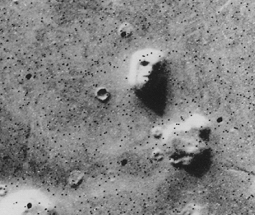
Is that physical information a deliberate signal or unintentional noise. You decide. Or rather, it is matter of interpretance. Which belief is going to minimise your capacity to make wrong predictions? -
Is 'information' physical?How can you go about testing your theory when the outcome of any test will have your purpose imposed on it? All you are saying is your theory is the result of YOUR purposes and your interests, which means that it is only useful to you, not anyone else. — Harry Hindu
My argument was against naive realism and in favour of indirect realism. And indirect realism accepts both the fact that knowledge is grounded in the subjectivity of self-interest, but can then aspire to the objectivity of invariant or self-interest free "truth" by a rational method of theory and test, or abductive reasoning.
So there is available to us a method for minimising the subjectivity of belief. We know how to do that measurably. It's called the scientific method. Pragmatism defines it.
You seem to both accept and reject indirect realism. It sounds as though you want to insist on some naive realism at base in talking about a cause and effect relation between the dynamics of the world and the symbols then generated within the mind.
The thing in itself is actually a pattern of radiation. The experience we have is of seeing red rather than green. Somehow that is veridical and direct as there is a physical chain of events that connects every step of the way.
But even the fact that the world is constituted of patterns of radiation - everything can be explained by the different possible frequencies of a light wave - is simply another level of idea or conception. It is a further level of theory and test.
Naive realism fails. It is indirect realism all the way down. All we can say is that a particular way of looking at the world is proving to be a good habit of interpretation over some larger scale of space and time.
This can be explained by conservation of energy. Natural selection must make compromises in "designing" sensory systems as the amount of energy available isn't infinite, and it would probably take an infinite amount of energy to be informed of the world in it's completeness. So, we would be limited by the amount of energy, not some self deciding which parts of a sensory system are more useful than another part. — Harry Hindu
Sure, the availability of energy is some kind of ultimate limit. But you are missing the point - which is how meaning even arises granted no particular limit to information capacity.
Meaning or semantics arises by a symmetry breaking of information. The information must be divided into signal and noise. The greater the contrast - the more information that is discarded as noise - the more meaningful the remaining information which is being treated as the signal.
So that is what the information theoretic approach is about. First establishing a baseline understanding of information in itself - as a physical capacity for variety, as some actual ensemble of possibilities. And then we can get to where we want to go - a principle for extracting the meaning of a message (or the physics of the world).
Semantics can be defined in a measurable fashion as the differences that make a difference ... because they are not a matter of general indifference.
That is why Landauer's principle was one of the important advances in turning attention to information discard or erasure. In the real world, eliminating noise is a big energetic cost. -
On the transition from non-life to lifeWell if you want your vagueness to apply only to mathematics and epistemology that is fine, but I thought we were talking about ontology. — Agustino
It is about logic - reasoning itself. So it is mathematical in that maths is our most rigorous language of reasoning. It is epistemology as the right way to reason is mission critical. And then it is ontology, because equipped with the right reasoning, the right logical framework, we can hope to make the best sense of what reality actually is.
You were asked in the conversation with MU to provide an example of vagueness which showed that vagueness was ontological, not epistemological. In other words, that it belonged to the terrain, not to the map that we have. — Agustino
This understanding of what is required just confirms you are a naive realist. Peirce established the proper pragmatic basis for a logico-scientific understanding of reality.
Rather than just a map and a territory, there are the three things of a modelling relation. The "map", or mediating level of sign, is a living and adaptive "umwelt".
So the map isn't the territory of course. But more than that, it doesn't aim to re-present the world. It aims to ignore that world as much as possible. So the map comes to be a map of our own interpretive interests as much as a map of the external reality. It is a picture of ourselves as much as it is a picture of the thing in itself.
The famous example is the London Underground map. It is a picture of our interest in getting from A to B in terms of changing trains. It does this by ignoring the actual geography of the world as much as it can.
So the Peircean argument is internalist. All we can know of the world is the beliefs that we are prepared to hold about it, the beliefs we are prepared to act by.
This doesn't deny the thing in itself. But it should also alert us to the fact we don't really care about the world in some disembodied fashion. The maps we make are as much a self-portrait - indeed, the very act of creating that "interpretive self" - as they are a re-presentation of the world as it might be said to be in terms of its own set of interests.
The map faces both ways. It mediates rather than represents. So our realism is psychologically indirect. And that is a feature not a bug as otherwise "we" - as a packaged set of interpretive habits - could not even "exist" unless we could find ourselves in the very maps we create. Our maps make our purposes concrete in a way we can then actually talk about ourselves as a further ontological fact of existence.
I'm an engineer (by degree anyway), and so it's been very well-ingrained into my blood to be sceptical of mathematics and mathematical models and to be aware that they are very limited in describing reality. You seem - coming from a background of theoretical physics/science - not to have this awareness of the limitations of mathematical modelling. — Agustino
Nice try at boxing me in. But that pragmatic intersection between theory and practice is exactly what I have a good meta-theoretic understanding of. -
Why Can't the Universe be Contracting?But say you could establish a contraction scenario that is exactly symmetric to the expansion scenario, what have you achieved but another way of saying the same thing? It wouldn't advance the science if it hasn't changed the science.
Under general relativity, the universe could be expanding or contracting. GR equations famously have symmetry in that precise regard. They don't specify a direction, so both directions make sense.
However the two directions make different predictions once we add in a conservation of energy constraint. Now one direction will cool radiation by stretching it, or redshifting it. The other will heat radiation by contracting it, or blue-shifting it.
So we looked up in the sky and saw unambiguously which it was. The Universe is redshifting evenly in every direction. At most, this would mean the earth just happens to be standing still as it sits right in the centre of the universe and everything else is for some reason moving away with ever greater speed according to it distance. So everything else is not just moving with some constant velocity but is carefully arranged so that velocity is faster the further away the object happens to be.
This kind of Copernican special arrangement doesn't generally make good science. It is simpler to believe that space expands the same for everyone everywhere at the same local rate. There is no centre to the expansion, and so no need to locate the earth in exactly that one spot.
Then again, even if the earth is in this special Copernican situation, we are not seeing the blueshift a generalised contraction ought to predict. The stars are not carefully arranged so that the most distant look to be rushing towards us the fastest. -
On the transition from non-life to lifeSo your version is that we have two lines that are touching but separate? Seems a little self contradictory given the definition of a line is that it has zero width. Does the PNC apply somehow? Something that doesn't extend in a direction, and so is definitely separate, also still extends in that direction, and so is able to touch?
I can see that you might be struggling to follow the logic of Peirce's example if you are unfamiliar with the philosophy of maths. This is a good clear primer on the continuum issue - why Peirce was following Aristotle in treating the numberline and dimensionality generally as the potentially infinite, not actually infinite - http://uberty.org/wp-content/uploads/2015/07/Zalamea-Peirces-Continuum.pdf
But another example of the vagueness/PNC~generality/LEM dichotomy which is basic to his logic is the triangle. A triangle is a general concept that forms a continuum limit - a global constraint - that then can't be exhausted by its particular instances. An infinite variety of particular triangles can be embraced by the general notion of a triangle.
So the LEM does not apply to this generality as a triangle can, in genus~species fashion, be equilateral, isosceles, or scalene. Of course the triangle must be a three-sided polygon, but that is talking of a still higher level generality of which it now partakes as a definite particular.
Peirce's point was that a general represents one notion of the indeterminate. As a description of a global constraint, the LEM fails to apply to it because contrary possibilities are not being excluded. Family resemblances are allowed within it.
Then vagueness is defined dichotomously to the general. Where generality allows you to say any particular triangle can be either scalene or isosceles, vagueness speaks to the indefinite case where there is as yet no triangle specified and so there is no fact of the matter as to whether it is scalene or isosceles. It is not a contradiction to say the potential triangle is both.
So the general is the global continuity that absorbs some category of all difference or particularity. The vague is the local generativity or spontaneity that produces all manner of difference or particularity.
You've leapt into a conversation without understanding its metaphysical intent, trying to turn it into a "commonsense" view of deep matters - commonsense representing the reductionist view of reality where crisp particulars are simply taken for granted, and so all causality is just a matter of composition or construction.
Peirce, like Aristotle, was fundamentally challenging that with a holistic or systems view of causality. So the laws of thought - in talking about the logic of definite particulars - are taken as being emergent. They have to develop their counterfactual definiteness within the two bounding and complementary limits of the vague and the general, or metaphysical Firstness and Thirdness. -
Emergence is incoherent from physical to mental eventsAnyone can simply say to go read their favorite philosopher and end the conversation. — schopenhauer1
Yeah. I mean anyone woulda thunk dis was a philosophical forum or sumthink. Next people will be making their case by posting large slabs of impenetrable text from blogs called larval subjects, or suchlike. I mean it's not like we can just google unfamiliar terms and start to educate ourselves.
Get over yourself man. -
Emergence is incoherent from physical to mental eventsThe thing is though, you are so close to being on the cusp of saying that, like Whitehead, the triadic hierarchies are experiential in their prehension and novelty all the way down — schopenhauer1
In your wet dreams. Even when arguing for pansemiosis, I am clear that life and mind are different in having an epistemic cut that puts hierarchical constraint "inside" the organism. I am arguing for the evolution of autonomy, not against it.
I am just rejecting your mental substance just as I would if you argued for elan vital.
You want to treat consciousness as some pure quality. You take it for granted there is a self who introspects on a Cartesian theatre of ideas and impressions. You argue that there is all the physical complexity of some information process - and then for no known reason, there is the added radioactive glow of phenomenal experience to light up the brain's dark circuits.
But then you turn out to be undecided on whether your ontology is one of dualist correlation or panpsychic monism. How could I be close to agreeing with you if you find it hard to agree with yourself?
I tried to be clear where I agree with Whitehead - on the generality of a holistic systems causality. Then where I fundamentally disagree - on experience or agency as a fundamental property or constituent of nature. Just go with the positions I actually argue when in doubt. -
Emergence is incoherent from physical to mental eventsSo you think using the term triadic hierarchy will somehow explain how one type of "process" is different than the rest? — schopenhauer1
It is hardly sneaking anything in in calling semiotics a triadic or hierarchical process. What else was Peirce describing? And what else has natural philosophy been saying since Anaximander and Aristotle?
So yes, a "system" is a quite specific kind of process. It has hierarchical structure. -
Emergence is incoherent from physical to mental eventsAll those could be good beginnings. But you've already slipped in "mind" in a contentious fashion.
Could you be clearer and say minds are the result of a process, and so not a brute fact on which the process depends. Could you say it is not mind but instead "minding", or at least "mindfulness", that characterises the material outcome, to make it clear a reified substance is not presumed which remains separate to the process itself?
These have been immediate sticking points so far. -
On the transition from non-life to life
-
Emergence is incoherent from physical to mental eventsBut I will repeat: — schopenhauer1
Of course you will. The same tautology over and over again. Duality is what you presume and dualism is what you conclude. The circularity is why you are on auto-repeat.
Please explain WHAT mental is compared to physical without magical fiat? — schopenhauer1
I have repeatedly - at your demand - explained that I ground my approach in semiosis. So the "duality" or dichotomy of matter and sign. Because it is dichotomy - a symmetry breaking - rather than a duality, how there is both the differentiation and the integration gets accounted for. And then development explains how the simple becomes the complex - how the dichotomised leads to the triadic or hierarchical with time.
If you don't get it, cool. In this thread I was asking you to justify your ontology, not seeking to explain mine yet again. -
Is 'information' physical?A theory of the development of semantics is more than just a list, surely?
-
On the transition from non-life to lifeI denied that there is any in-between. — Agustino
Of course you did. You said there was a boundary in-between. You also denied this. The boundary had its own location. But then it also doesn't. It all seems to make some weird kind of sense as an example of the PNC failing to apply.
There is NOTHING between the white line and the green line. — Agustino
You mean there is A nothing in-between the white line and the green line. Otherwise how are you claiming them to be actually separated if there is no thing to separate them? And if you take that position, you have created some third thing that has some bare property of location, and can somehow effect the change which is a transition, and yet says "nothing" when it comes to the important question of where does one hue leave off, the other one begin.
You are thinking mathematically, but I'm telling you how things are in reality. Mathematics is just an approximation, that's why you can infinitely divide in mathematics, but obviously can't do that in reality. — Agustino
Ah. I see. The problem is now that the maths is "approximate". And when the reason for that is pointed out - the logical vagueness where the PNC fails - you missed the point. You come blundering in with the usual half-baked response of the naive realist, muttering about how you can tell me all about the world as it actually is without all the philosophical bullshit.
Great work! -
On the transition from non-life to lifeDoesn't this boundary have a spatial location? Haven't you said this boundary is neither the line that marks the edge of the green area, nor the line that marks the edge of the white area? It is somehow a third line inbetween that executes "a transition". So we have the mystery of a third located entity that is neither the one thing, nor the other, by being a third thing?
You really are making a muck of this. -
On the transition from non-life to lifeSo now you are saying the boundary is both not a thing and also a thing.
Hmm. See what happens when you think you can get away with glib sophistry in place of serious thought. It might pay you to read up on the philosophy of boundaries before you make too much more of a fool of yourself. -
Emergence is incoherent from physical to mental eventsSo in that case, a pox on both houses as where experience is slapped on at the starting point in one, it is slapped towards the end of a process in another. I guess they both suffer the same problem. — schopenhauer1
Well it is only you slapping on "mental" as a term. I questioned your customary division of the phenomenal into the "self" and the "world". -
On the transition from non-life to lifeThere is no boundary as a thing. — Agustino
That's why the PNC fails to apply. -
Is 'information' physical?I was thinking about Grice's just-so story about how an animal might make what was heretofore an involuntary signal voluntarily, as a step toward language, etc. But this is already an in-band signal. — Srap Tasmaner
Peirce covers the intermediate cases by talking about three classes of sign - iconic, indexical and symbolic. One just accidentally indicates, one habitually points, the last is fully intentional as it demands interpretation. -
Is 'information' physical?What you seem to be saying is that there are two distinct realities. The one out there and the VR in your head. Isn't the VR in your head part of the world out there? If not, then how does information flow between your VR and the world out there? — Harry Hindu
I am saying the "reality" is the wholeness of the modelling relation. So it is the co-ordination between the two - the modeller and the world. And then the point that the mechanism of the co-ordination is not some naive realist "veridical representation", but in fact a useful "irreality" in terms of experiential sign.
For a semiotic relation to arise, first the mental side of the equation must be freed from having to be literal.
Imagine we just felt the radiant energy in some more literal fashion. Standing in the field, the tree would heat the surface of your body slightly differently depending on whether it was reflecting light more in the "green" frequency or more in the "red". In fact the difference would be so slight and so diffuse as to be pretty well useless at telling you anything. A vast amount of signal processing would have to be employed to tell you anything about the world.
But because biology is free to form its signs of the world in more logical fashion - as crisp binary signals of what is vs what is not - the irreality of colour discrimination can arise. Two frequencies of radiation that have a vanishingly slight difference from each other can be treated by the brain as the very opposite of each other - as with red and green.
So this is the crucial thing your argument looks to be missing. You want the world to be the cause, the perception the effect. But the mind wants to be disconnected from that kind of directness so it can invent its own more useful system of sign. It wants to already have converted the physical information available in the world into some logically-processed sensory quality.
Thus I'm not talking about a virtual reality, if you are going to take that as just talk about an attempt at a veridical re-presentation of the world within some Cartesean theatre. I'm talking about the virtuality of a semiotic umwelt. The world as we find it most useful to experience it. The signs that best anchor our habits of interpretance.
No. I was complaining that you were being inconsistent. If you say that we can never reach the truth, but only a semblance of it, then your explanation of reality is as irrelevant as anyone else's — Harry Hindu
That is silly. An epistemology that includes the fact that our view of reality is a purpose-soaked model, a semiotic umwelt, is truer than naive idealism or naive realism.
Explaining why and how the goal of "reaching truth" is naive realism is rather the point here.
It seems to me that natural selection would favor organisms that tend to impose their subjectivity on the world less and see the world more as it really is. — Harry Hindu
That is contradicted by the facts of psychology and neuroscience.
Just one example that always struck me. Compared to chimps, humans have a proportionately larger foveal representation in their primary visual cortex, a proportionately smaller peripheral vision one.
So we have evolved less need to process the edges of our visual field as we are more certain about where we need to focus our attention. A larger brain makes us better at predicting the part of the world which is going to be interesting to us.
Think also of colour vision. Why do birds and bees have more cone pigments than we do? We make do with just three. They get four or five. And it would seem trivial for evolution to generate any number. Why is less also more in hue discrimination?
If we created a world when we close our eyes, then why is there a clear distinction between the world I imagine and the world I experience when I open my eyes. — Harry Hindu
But sensory deprivation experiments (and hypnagogic imagery/REM dreams) show that starved of real world input for long enough, the brain does just completely invent a world of impressions. And we can't distinguish the fictional nature of the experience while that is our state of experience. Even afterwards, hallucinations may never be categorised as unreal. -
Is 'information' physical?This is just a way of framing the issue. — Srap Tasmaner
It's a good point. But doesn't the distinction give rise to a four way division as we now have two different dimensions to consider?
One is the intentional vs accidental distinction. The other is the sender vs receiver distinction.
So we can have the sender accidentally sending, but the receiver reading intentional meaning into the signs - as with the U-boat leaking news of its position or the plant seeking the light.
Then we have the three other cases. Intentional sender/intentional receiver. Intentional sender/accidental receiver. Accidental sender/accidental receiver.
A rock heated by the sun lacks the intention (the reason, the purpose, the functional benefit, the semantic meaningfulness) just as much as the sun lacks the intention of transmitting that heat to the rock.
A religious crank with a placard might intone his message to the crowd, but for the crowd it is just background noise. A case of intentional sender/accidental receiver.
Then we have the actual case of transmitted meanings which require the co-ordination of intentional sender/intentional receiver. The two sides of the equation have to become co-ordinated in their mental state. They must have understandings that are similarly constrained.
And of course this is where we get to the "beetle in a box" difficulty of private meanings and have to conclude something about how, in practice, this level of semantic meaningfulness can only be demonstrated by the similarity of behaviour that results. Semantics does boil down to effective limits on material spontaneity or behavioural degrees of freedom.
This is in fact an important point, given Wayfarer wants to defend the mental reality of meaning. He wants to grant understanding some kind of res cogitans status separate from the material signs themselves. But maybe the psychological reality just is established habits of behaviour. The mental does reduce to the actions that make sense of signs, or pragmatic interpretance.
Anyway, the OP does focus on the transmission of information. And it is in itself telling that it was just assumed the transmission was between minds with matchable states of intentionality when it should be obvious that the boundary between the deliberate and the accidental is porous here. Any reader can read too much or too little into any signal. The perfect transmission of semantics in fact looks an impossible dream. The sending and receiving of messages is always fraught with uncertainty.
Which should really make one think about what is going on when one talks things through with oneself. :) -
On the transition from non-life to lifeA transition is a process of passing from one thing to another - in this case from a green line to white line — Agustino
You are just playing with words. The talk here is of the boundary that marks the position where the transition happens. It's a well traversed debate in the philosophy of maths.
Your philosophy implies that envy can be white because there is some limit after which the two become indistinguishable in the supreme vagueness of the apeiron — Agustino
Sure, the Apeiron would absorb all differences of any category. But the categories that matter at a metaphysical level are all the product of dialectical reasoning. They are dichotomies.
So there is no dialectical connection between white and envy. One might talk about black and white and the spectrum of gray inbetween. One might talk about envy and whatever its polar opposite seems to be, plus the transition then connecting them which is defined in terms of these limits. But that kind of category forming relation is not being claimed of randomly chosen particulars like white and envy. They are not opposites and so neither in any useful sense the same.
Say what you will, but logically this is the status of your thought. — Agustino
I'll just say I thought you were smarter than this. Looks like you can't in fact rise above glibness. At least MU is passionate about ideas. You don't sound like you believe your own argument for a minute. -
Emergence is incoherent from physical to mental eventsThe most obvious example of this is when the molecule-occasions and cell-occasions in a body produce, by means of a central nervous system, a mind or soul. — http://www.iep.utm.edu/processp/
This is just repeating the same old. What causes mind as we mean it - human minds rather than rock minds - is a physical structure. The evolved complexity of a nervous system doing information processing.
Then "experience" gets slapped on by fiat as the bit of magic which explains why material complexity alone couldn't do the trick.
It is exactly like saying that a living organism is only living because there is all this biological structure. Plus a vital spirit that then ensures the structure has the added quality of animation. -
On the transition from non-life to lifeThe division constitutes in a transition from a white line, to a green line and vice-versa. — Agustino
So does the PNC apply to this "transition"? Can we say whether it is white or green? Do we feel moved to claim it has to be one or other because it can't be both? Or do we want to say the question of which colour it is seems vague?
apokrisis

Start FollowingSend a Message
- Other sites we like
- Social media
- Terms of Service
- Sign In
- Created with PlushForums
- © 2026 The Philosophy Forum