
-
My "nihilism"How can I find error in your claims if you don't answer my questions? — Harry Hindu
By pointing out the error in the claim, of course.
You error would be in avoiding my questions.
I haven’t claimed to be avoiding your questions.
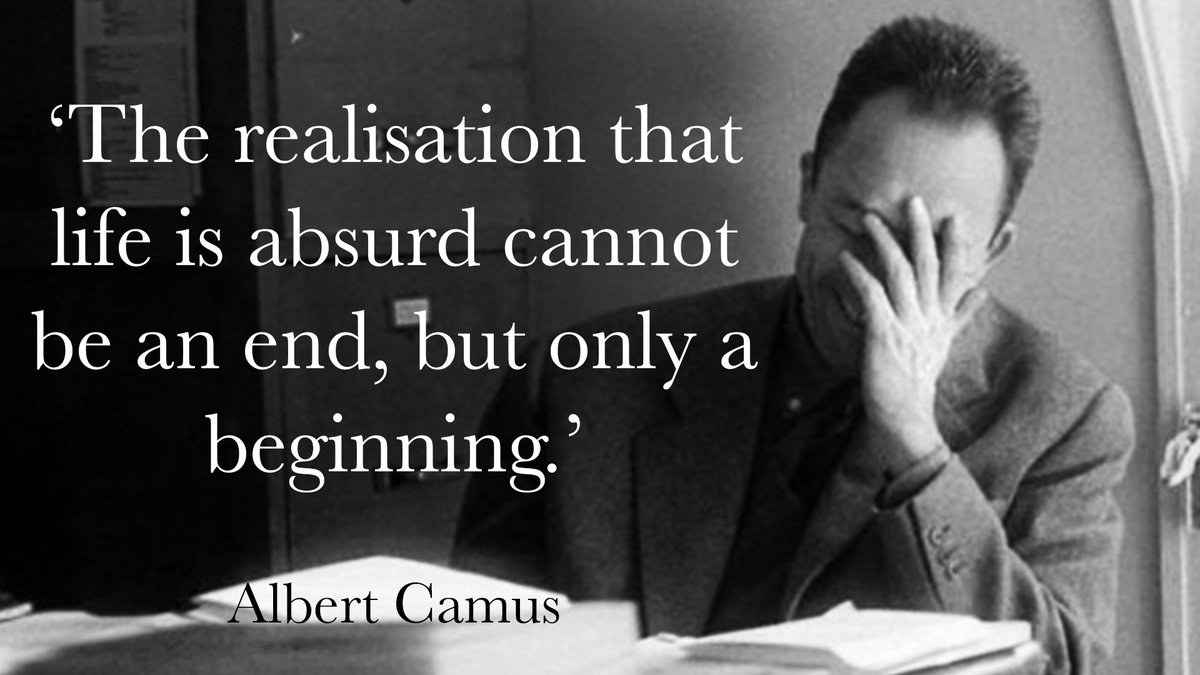
why did you seem to care, and think that I cared, that Camus declared that life is absurd?
I didn’t assume that you cared. I simply pointed out an absurdist when you inquired about the meaning of the absurd.
I care because it’s a valuable way to talk about nihilism.
Why do some think it is? Because they’re not comfortable with not knowing, I suppose.
What do you think?
— praxis
I think that you have just described the God of the Gaps.
— Harry Hindu
Nonsense, I’ve made no metaphysical description or claim whatever.
What do you think? -
My "nihilism"I'm avoiding the entire mountain of cultural accretions. — yupamiralda
Those accretions run deeper than you may realize. -
Virginia Beach Shooting-When will America stop?The issue is heavily politicized, so not for a long time. We Americans are like...

And easily lead to slaughter. -
Beauty And Its AbusesI didn’t finish reading the post but wanted to mention that plastic surgeons have little influence on cultural concepts of beauty, much less grade school kids.
If you enjoy pointing fingers you should at least put some effort into pointing in the right direction. -
My "nihilism"As opposed to the fact that life is actually absurd, which is why I asked why life is absurd. Is it actually absurd, or do some people just think that and why? — Harry Hindu
I don’t think anyone will care if I declare life or the universe absurd. Anyway, if that were known it wouldn’t be a philosophical matter. Why do some think it is? Because they’re not comfortable with not knowing, I suppose.
What do you think? -
My "nihilism"
The reaction against religious belief in the form of secularism is centered in concern with irrationality, is my point. -
My "nihilism"
Frankly, I don’t see much of a difference between an organized religion and any other sort of ideology or shared fiction. Religion is particularly powerful because it has existential meaning or significance, but the essential function is the same, which is binding large groups of people with comma goals and values so they can act cooperatively.
Trumpism, for example, is a developing ideology (I use the term loosely) where its adherents value the solidarity of the group more than they value the truth. It’s reported that Trump has made more than 10k false claims since his inauguration. Yesterday Trump claimed that Mueller is a “never Trumper,” signaling to his followers that, though Republican, he’s still a heathen. I mean, isn’t that bizarre language for a president to use, a never-Trumper?
I know you’re not a Trump fan and that’s why I use his example. Surely his ability to influence his supporters, or rather the manner of his influence, concerns you. -
My "nihilism"
Great point. :up:
If you can find an error in any of my “claims” then please point them out, @Harry Hindu. -
My "nihilism"How is something that is successful, bleak? — Harry Hindu
Well, legend has it that Sisyphus successfully rolled a rock up a hill. :party:
I asked why life is absurd. It seems to me that youre saying its simply a way of thinking. — Harry Hindu
As opposed to what? It's also a matter of experiencing the feeling of meaninglessness. -
My "nihilism"You've seriously never heard of absurdism?
A narrative can be bleak. Which narrative? — Harry Hindu
Whichever one defines, "successful" or what entails "success," I assume. -
My "nihilism"Clearly, being a "successful biological organism" is rather devoid of meaning.
— praxis
How so? Wouldnt it be dependent on how one defined, "successful" or what entails "success"? — Harry Hindu
Yes, certainly, but without the narrative it sounds rather bleak.
-
My "nihilism"Dead to those for whom it has no meaning, to be sure. :grin: — Janus
It was stupid of me to claim that the vast majority of religious authorities have been proven to be frauds. That hasn't been proven and I doubt the majority are intentionally deceitful. It may be fair to say that Wayfarer, who I believe is a Buddhist, disagrees with the vast majority of spiritual authorities. That doesn't mean that he hates them. In fact, I would guess that he considers them something like kindred spirits, all living under the general banner of religion or perhaps some form of idealism. In that way, they are all of the same tribe. -
My "nihilism"Maybe I just don't understand my own position. I basically believe that nothing has any meaning. When asking myself what I should do under this condition, I decided I didn't believe in anything more strongly than that I was a biological organism, and my thinking should revolve around the idea of being a successful biological organism (and doing what I can to ensure my offspring's success). I know my ideas are troubling, or absurd, or whatever. But they all follow, somehow, from that. I'm here because I don't totally trust my own thinking and I want criticism, even insults. — yupamiralda
Your ideas are not absurd, you're merely now facing the absurd as, hopefully, we all do eventually. Whatever lead to your disillusionment, your only choice is to find meaning for yourself, or to live in 'bad faith'. Clearly, being a "successful biological organism" is rather devoid of meaning.
There are two basic approaches to dealing with the absurd that I've found to be successful. One is to simply fulfill our natural desire for meaning as well as possible. This is actually simple and straightforward, and a decent guide could probably be found in any self-help book section. The other approach is to transcend the absurd via spiritual practice or contemplation. A desire for meaning is strongly tied to self-identity, and contemplative practice can mediate the conflicts generated by our sense of self.
Have faith and be an absurd hero. :razz: -
My "nihilism"modern culture is grounded in rejecting that authority, on thinking for yourself - as Praxis has stated more than once in this thread. So there's a perceived antinomy between conformist, authoritarian religious belief, and contrarian, creative individualism. — Wayfarer
Modern culture is more individualistic, but we nevertheless share all sorts of fictions and ideologies, as well as willingly follow worthy leaders. -
My "nihilism"This is false.
— praxis
Well, that was my interpretation of the kinds of things you say, such as
Because the foundation (spiritual authorities) have been proven to be frauds, for the vast majority anyway.
— praxis
Perhaps I misunderstood? — Wayfarer
Granted that God has not been proven to be dead. A meaningless God, however, is for all intents and purposes, dead. -
My "nihilism"if you're not with them then you're against (hate) them.
— praxis
It's not a general statement, but an observation based on what you say. OK, maybe 'hate' might be too strong a word but you generally express a very strong sense of hostility, scepticism, or something similar, against anything you deem 'religious'. — Wayfarer
This is false. In fact, I know that you’ve “observed” me sing the praises of Meido Zentetsu Roshi, if no other thing deemed religious.
How can you be so fucking blind? In a word: tribalism. Tribal life is so deliciously meaningful. -
My "nihilism"
-
My "nihilism"Any such notion of a self with all its meanings set against a meaningless world is an archetypal expression of Cartesian thinking. This is one of the very important themes in Heidegger. — Janus
I don't know, it doesn't seem particularly dualistic to think that meaning exists in minds and not in shoeboxes. The same shoebox can have a wide variety of meanings for different minds. That doesn't mean that mind and matter are separable. Also, a mind can contrive meaning, or even a system of meaning as with religion.
I would not necessarily agree that "there is ALWAYS an out-group for the religious" — Janus
For this to not be the case, a religion would need to allow its tenets to be freely questioned and revised by any of its members. Do you know of any such religion?
Just look at our friend Wayfarer, who espouses the value of religion AND enthusiastically condemns the materialist infidels. -
My "nihilism"I think it depends on how much that thinking is dominated by the 'subject/object, internal/external' paradigm which has dominated the West and more intensely so since the Enlightenment. So, the way I see it "thinking for yourself" involves most importantly freeing yourself from that mode of thinking. — Janus
As I see it there are two related but distinct aspects to this, which is basically spiritual (individual) and religious (group), and the thing that few realize or will acknowledge is that the ‘subject/object’ duality that the former may struggle with is merely replaced with an ‘in-group/out-group’ duality in the latter. There is ALWAYS an out-group for the religious. It is fundamental to its function.
Western culture has lost its spiritual foundation. — Wayfarer
Because the foundation (spiritual authorities) have been proven to be frauds, for the vast majority anyway.
So you might ask, am I suggesting a return to traditional religion? I don’t think that’s possible
Because traditional religion is no longer meaningful. -
My "nihilism"Meaninglessness is the shadow of democratic liberalism. — Wayfarer
Meaninglessness shadows anyone who can think for themselves. -
The source of moralsYour recent summary of merk and my discussion was spot on. The links to harvard have not worked for me. I may have misattributed meaning to your post offering the link to the test. My apologies if that was the case. That is of interest, and relevant in more than one way here. — creativesoul
I just took the implicit association test for race (between black & white). I like to think of myself as completely non-racist but the test showed a 'slight' (from no preference to slight, moderate, or strong) preference for white people. So on a subconscious level, according to the results of the test, I have a slight tendency to see white people as good or a slight tendency to see black people as bad. I took the same test many years ago so the results didn't surprise me this time, but I was initially surprised.
The point is that our subconscious mind... how should I say this, isn't as aligned with our conscious mind as we might think it is. This is shown in other ways as well, like hypnosis or placebo/nocebo, or just intuition in general.
This is meant to support the theory of ethical intuitionism. -
The source of moralsThat's a bad analogy, because the existence of neutrinos is known via predictions and precise measurements of observed and quantifiable phenomena which confirm those predictions. Nothing like that is possible with the moral thought and behavior of others. — Janus
Actually there are theories of intelligence that are exactly like that, and would apply to moral thought and behavior of others. See: https://en.m.wikipedia.org/wiki/On_Intelligence
What would you claim are the bases of inferences that others have moral feelings, thoughts and dispositions, and that their behavior is morally motivated? — Janus
The vast amount of stored memory we possess of observed and quantifiable phenomena (in the form of sense data patterns) which confirm predictions. -
The source of morals
The state provides many services in exchange for our loyalty or participation, such as law enforcement, emergency services, etc. -
The source of morals
There are theories of moral developmental reasoning. I think kohlberg's is considered a little out of date. -
The source of moralsI never addressed the OP, I just realized.
First I'm not asking for what is right or wrong, rather were do our sense of right and wrong come from.
Personally I developed this thesis:
We start life with the need to continue our species existence.
Then we move to develop them independently (divine command, unitilitarianism, and whatever else) then to form governments with some degree of state control we use contractarianism.
After these steps we try to spread our morality to others as a sense ofapprovalsolidarity, the idea being wedon't want to live thinking we did something wrong (not wanting our morals challenged)need to live cooperatively for mutual benefit on a large scale.
Those we disagree with are our enemies and we treat them how our independent morals demand (so different for everyone).
I'm sure I haven't covered all my bases so I'm asking for, people to point out my mistakes and contribute new ideas I haven't come up with yet. — hachit
Strikethrough and bolding are my suggestions. Moral issues are often politicized to promote a particular party or ideology. Things like abortion and capital punishment are used by politicians to whip-up support for themselves or their party, without really caring about the moral issue. Unfortunately, it's typical for this to be more about gaining and maintaining wealth and power than it is for promoting human flourishing. -
The source of moralsCan you identify the most egregious error so far? Or if that's too difficult for you, many just pick one of the worst.
— praxis
Primarily, this is supposed to be a discussion about the source of morals. No one has defined either what is meant by 'source', nor what is meant by 'morals'. A discussion cannot even start without that, and I don't mean by that some kind of anthropological investigation into all the ways the word is used (that would be pointless unless we are to invoke some kind of global wordsmith who ensures all our uses are compatible). I mean a commitment to a class of uses. We can start there. — Isaac
Creativesoul and Merk have put a good deal of effort into attempting to develop a universal criterion for what counts as a moral thing. -
The source of moralsI'm not sure one would, at least not in this metaphor. One would simply say an entirely new car was required. — Isaac
Okay let's drop the metaphor. Can you identify the most egregious error so far? Or if that's too difficult for you, many just pick one of the worst. -
The source of morals
A pile of scrap metal posses no traffic safety issue or emissions issue, so you wouldn't need to start. If for some reason there were an issue you would naturally begin with the most egregious violation. Surely you know enough to identify the most egregious error, yes? -
The source of moralsYou can have the idea and desire to develop a particular habit but until it is actually a habit it is not internalized. Make sense?
— praxis
It doesn't make sense with respect to the conventional connotation of the term "internalized." It's not a word to use for that context if that's what you want to say and you want anyone to understand it. — Terrapin Station
So how would you word it? -
The source of moralsIf memory serves, page 16 is about the time when creativesoul’s fan club went on sabbatical.
Coincidence or moral transgression? -
The source of morals
I'm just trying to figure out why you're having trouble with the meaning of 'internalize'.
Maybe try to think of it as forming a habit. You can have the idea and desire to develop a particular habit but until it is actually a habit it is not internalized. Make sense? or is that too pedestrian of an explanation? -
The source of moralsInternalize has a connotation that something was external. — Terrapin Station
You're a Solipsist? -
The source of morals
Internalize:
- make (attitudes or behavior) part of one's nature by learning or unconscious assimilation.
-
The source of moralsIt's like asking if your daydreams are internal to me, as if I could literally observe your daydreams. — Terrapin Station
Right. Anyway, I'm sure you have some sense of what internalize means, right? Do we really need to go over that?

praxis

Start FollowingSend a Message
- Other sites we like
- Social media
- Terms of Service
- Sign In
- Created with PlushForums
- © 2026 The Philosophy Forum