
-
Emotions are a sense like sight and hearingI think it's pretty obvious that the dominant mood of the USA right now is anger. I won't elaborate on why, but I am sure you can figure it out! — Brian
It's also currently deeply polarized in sets of values, liberal vs conservative, yet none contest the shared indentity of Americans. Well, with minor exceptions, like the birther thing. -
Emotions are a sense like sight and hearing
Like for example a culture that one might say is 'fear based', as opposed to a culture that has more of a compassionate style?It is the way societies create the kind of self-regulating individuals that can then perpetuate that particular collective social style. — apokrisis
This actually made me chuckle a bit. It's fine if this sort of thing amuses you. I would advise that you try to be more subtle though.You said you were enthusiastic about the constructivist point of view, and yet you don't appear to get the first thing about it. — apokrisis -
Emotions are a sense like sight and hearing@TranscendedRealms
What do you think of the idea that, rather than a sense, emotions are more like a filter for our senses, shaping and distorting our mental simulations according to its predictions and the immediate needs of our mind/body? -
Emotions are a sense like sight and hearingIf you want to understand something, try to pin-point the difficulty you are having a little more crisply. — apokrisis
It's not like I didn't put effort into doing just that with the following quote.
I've understood that emotions are, generally speaking, like conditioned responses that help regulate what Barrett refers to as the 'body budget', conserving (parasympathetic) energy as conditions warrant and providing more (sympathetic) energy in other circumstances, via the endocrine system or whatever.
When you say "emotion language" it's not clear if you mean an emotion concept or the expression of it. We both know the concept of an automobile, for instance, so I can intentionally communicate the concept by vocalizing or writing the word pretty reliably. That's a clear use of language. I can also intentionally communicate an emotion concept like fear using words. If I feel fear and express it bodily in the normally recognizable way I wouldn't be doing it intentionally. So even though it may be useful communication is it correct to think of it as a use of language in the absence of intent? I also don't understand the dimension of social acceptability as it relates to emotion concepts and their expression. — praxis
You're free to ignore this of course.
If you accept emotion is constructed, then the question is constructed by who? The individual might eventually learn to construct the experience for themselves, but only after being suitably taught. Who does the teaching and so whose purposes are being ultimately expressed? Society. Culture. The community that ultimately owns the language. — apokrisis
I believe it could be, but it's not my understanding that emotion concepts are deliberately or consciously taught.
If you're suggesting that societies intentionally and purposefully teach these concepts, what is the purpose in doing so? -
Emotions are a sense like sight and hearingUnconvincing that I don't know what to make of your phrasing? Well, I convinced myself, for what that's worth.
Perhaps I may have at least convinced you of my interest in better understanding what you wrote. -
Stuff you'd like to say but don't since this is a philosophy forum'It is what it is', meaning?
It's not what it's not. -
Emotions are a sense like sight and hearingSo she says biologically there are bodily sensations - what it feels like to be aroused or otherwise moved physiologically in preparation for anticipated action. And then emotion language is how we make sense of what is going on in a socially accepted fashion. — apokrisis
I don't know what to make of your phrasing it this way, that emotion language is how we make sense of what is going on in a socially accepted fashion.
I've understood that emotions are, generally speaking, like conditioned responses that help regulate what Barrett refers to as the 'body budget', conserving (parasympathetic) energy as conditions warrant and providing more (sympathetic) energy in other circumstances, via the endocrine system or whatever.
When you say "emotion language" it's not clear if you mean an emotion concept or the expression of it. We both know the concept of an automobile, for instance, so I can intentionally communicate the concept by vocalizing or writing the word pretty reliably. That's a clear use of language. I can also intentionally communicate an emotion concept like fear using words. If I feel fear and express it bodily in the normally recognizable way I wouldn't be doing it intentionally. So even though it may be useful communication is it correct to think of it as a use of language in the absence of intent? I also don't understand the dimension of social acceptability as it relates to emotion concepts and their expression. -
Emotions are a sense like sight and hearingWhose theory [constructed emotion] is this exactly? — apokrisis
I don't know.
I remember you were reading some book but can't recall the author. — apokrisis
Lisa Feldman Barrett
And you think he literally felt smug hilarity? — apokrisis
I imagine he may have felt somewhat irritated. Isn't that the general direction you were aiming for?
You don't think the emoticon represented what he hoped I would think he felt, rather than what he actually felt? — apokrisis
You appear to be suggesting that what he felt, assuming it was irritation, is always expressed as a something like this :( ? Really?
So sure, he obviously felt something. And he also just as obviously reached for the standard social mask. — apokrisis
It's really not obvious. Perhaps you should go back and look at it again to refresh your memory. You have to admit your one-word response of "Citations?" could be seen as a bit silly under the circumstances.
That too is as clear as mud when you try to parse it. Perhaps you can expand, or copy and paste some of this constructed emotion theory you have in mind? — apokrisis
My interest is to better understand the theory. I've found that discussing things that I don't understand in forums like this sometimes helps. Sometimes it's just ego games. -
Emotions are a sense like sight and hearingAnyway, it is amusing how you [creativesoul] now seek to socially-frame this conversation with an emoticon response. You are telling me you felt nothing - "physiologically sensory perception" speaking. There was no heart rate acceleration, no defensive contraction of the pupils, no measurable sweating of the palms. You put on a smiling face to the world and that thought became the only detectable emotion inside your head. — apokrisis
Ironically this indicates that you don't understand or appreciate the theory that you espouse. According to the theory of constructed emotion, there's no universal fingerprint (or emoticon) for an instance of emotion. Creativesoul's emotional response, in person, may well be expressed as a smile. My impression is that it would be. In any case, he's not telling you that he felt nothing. Using the emoticon is literally signifying that he felt something.
The gist of creativesoul's comments, as I interpret them, is an argument against the notion that 'emotions are a sense like sight and hearing'. For some reason you didn't see this, or perhaps you deliberately chose a different response, a response that might lead to amusing yourself.
Rather than a sense, from what I understand emotions are more like a filter for our senses, shaping and distorting our mental simulations according to its predictions and the immediate needs of our mind/body. -
Utilitarian AII was thinking about AI in relation to emotions today. I just finished reading a book about the theory of constructed emotion. Upon completion, one thing that stuck out is how much emotion is linked to simply regulating metabolism and other things that a machine would most likely do in a very different way. No one would build an AI with an endocrine system, for example, that secretes stress hormones to help deal with dangerous situations.
-
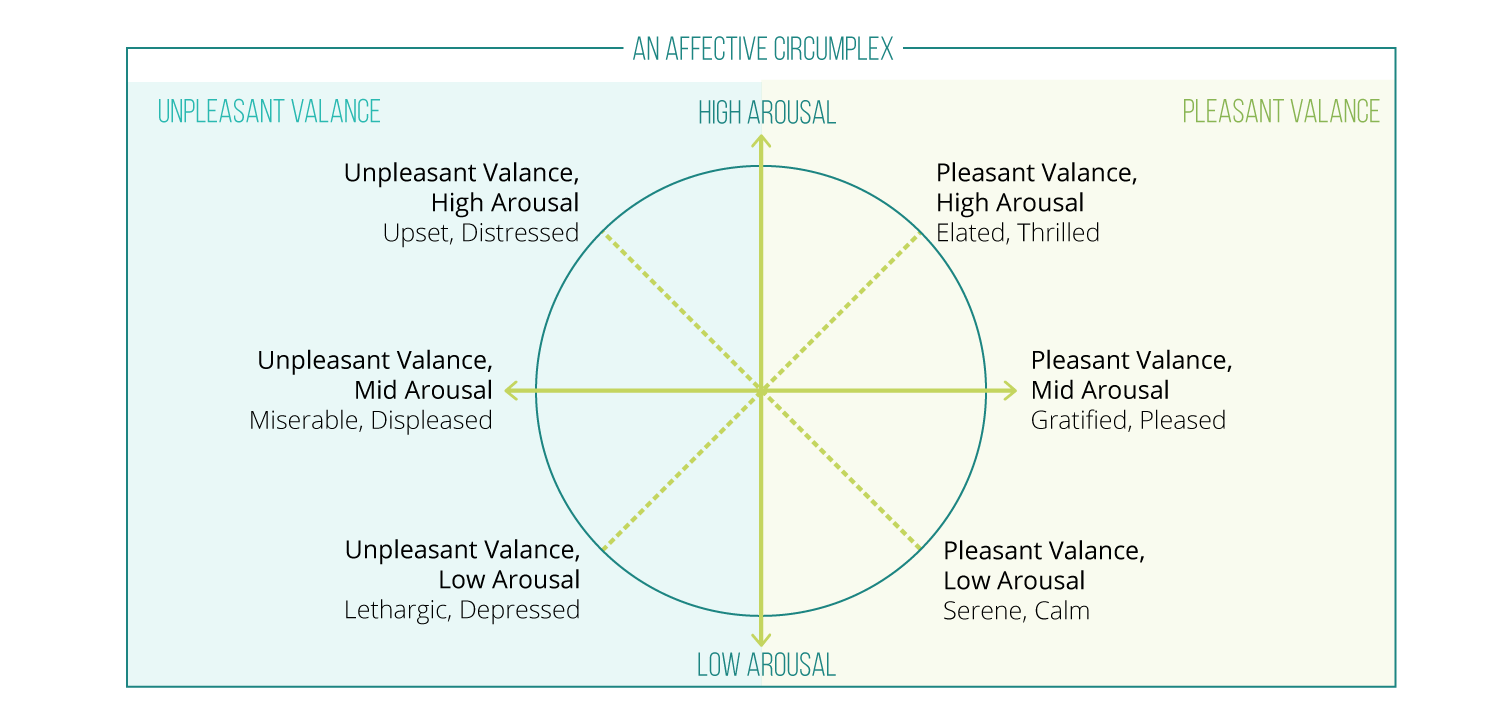
Emotions are a sense like sight and hearingAccording to that effect chart, negative expressions and tones reflect negative emotions while positive expressions and tones reflect positive emotions. — TranscendedRealms
The chart shows an affective circumplex. It does not chart emotions or expressions of emotions.
Interoception or affect is part of what makes an instance of emotion. We also need emotion concepts like trepidation or cheeriness to distinguish instances of affect. Abstract things that we might value, like truth, bravery, or life, are also concepts. Emotion concepts, value concepts, affect, and external stimuli are all variable and not fixed. We might love life one day and hate it the next. We might have an experience that changes our concept of bravery. An apple could be delicious or disgusting depending on our affect. Being well rested and fed our affect could pleasant and calm.
There are only instances of emotion and value, so it should be no surprise that they may sometimes appear to disagree. -
Utilitarian AIWouldn't it be much better informed and nonbiased to even eventually make moral statements and ethical postulates? — Posty McPostface
As I see it the best or safest approach to what you propose would be to program a non-sentient AI to express human ideals, and to give it control over us, forcing us to live up to our own ideals. If it were sentient and too much like us it would be just as irrational as we are. -
Emotions are a sense like sight and hearingYou're basically describing affect.
It's not clear how you're relating affect to emotion and value concepts. -
Emotions are a sense like sight and hearingyou still would not be able to actually see the good value that the apple has as long as you are not in a positive emotional state. — TranscendedRealms
You know this isn't true. We do things all the time that we don't feel like doing yet we know that they're good things to do. -
Emotions are a sense like sight and hearingEmotions are actually a sense like sight. — TranscendedRealms
One fundamental difference is that given the same stimulus, like an apple, our sense of sight will always convey the same sensory information, whereas our emotional sense will not always convey the same emotional sense. If we're very hungry an apple will be desirable, valuable or generally 'good'. If we're full or sick an apple could be very unappealing, not valued or generally 'bad'. Nevertheless, we could override our emotional response to an apple and eat it anyway because we value its good qualities.
Your error is in essentialism. -
What is spiritual beauty?
Indeed, my understanding is that the real Jesus wasn't white with blond hair. Affective realism can be expressed in art rather concretely, or should I say marbly.The reality of works of art change the way we think about and perceive the world. — Cavacava -
What is spiritual beauty?In some ways suffering ceases to be suffering at the moment it finds a meaning, such as the meaning of a sacrifice. — Viktor E. Frankl
Here's an article. -
What is spiritual beauty?You wrote that the aesthetic would warm you up in a snow storm. That's affective realism. At a minimum this would ease your discomfort. It may also provide additional and possibly even life saving benefits via the autonomic system. I'd say that was useful.
-
What is spiritual beauty?

I believe the basic idea is that our perception is partly shaped by our affect. Some call this affective realism. Another dimension is the concepts we have about ourselves and the world, much of which is supplied by culture.
I don't know anything about Michelangelo's Pieta. It appears to be female figure holding a post-crucified Christ, an artifact infused with cultural and religious meaning.
If I saw Michelangelo's Pieta in the middle of a snow storm its beauty would still astonish me, warm me up. — Cavacava
Assuming that "spiritual beauty" is distinct from material beauty because it transcends materialistic concerns (such as adequate warmth), its immediate utility would apparently be to help regulate autonomic functions to optimally adapt to circumstances outside the sphere of control. Being in constant fear of freezing to death and the resulting stress, for instance, may be counterproductive to survival.
On a broader level, transcendence of materialistic concerns, facilitated by aesthetic concepts, may be expressed as compassion, or perhaps selflessness. Christ is a powerful symbol of sacrifice. On this broader level the question might be: what's the utility of selflessness or sacrifice in an evolutionary sense? If the underlying goal of evolution is the propagation of genes, self-sacrifice may be the best strategy in many circumstances, because there's a high probability that you share genes with those around you. If you sacrifice yourself for your family, there's a good chance that more of your genetic material will pass on, if there are at least more than one of them anyway.
Working cooperatively is a better survival strategy in general (and for the propagation of your genes), in other words, but this may require sacrifice, assuming the concept of sacrifice exists in your culture. -
We Need to Talk about KevinOver the years in the previous forum I have manage to arrive at sense of personal security that allows me to be quite sensitive and yet more or less immune from hurt. It is a condition of being eager to learn and change, but unattached to what has already been learned. — unenlightened
You do show good technique, reframing a horrifying tragedy to a dance party. However the effort doesn't indicate immunity. -
We Need to Talk about KevinThe film also didn't have a happy ending. It was painful to watch Kevin's mother deal with the grief, shame, guilt, and ultimately failure to protect those for whom she was responsible.
-
What Does Globalization Do to Art?What I was saying is that the socio-economic pressure on art industries changes how the value of art is perceived, which means it doesn't play the same role in society that it used to. After the World Wars, for instance, there was this massive, sort of tragic collective sigh which manifested in post-modern art, atonal, music, etc. — Noble Dust
This is awfully ambiguous, and that's fine if you chose not to elaborate.
It [increased sensibilities] might lead to greater appreciation in the sense of a more nuanced appreciation, but it seems that most people still place high importance on whatever first pieces of music or artworks first got them excited about a given medium. — Noble Dust
We're limited to some degree by our predispositions, sure.
Another consequence of that granularity is that it gets increasingly harder to be impressed by a given artwork the more you know about the medium, genre, etc. Music criticism is a perfect example of that. The joy of discovery is hard to maintain. — Noble Dust
I strongly disagree. In personal experience, I've done a fair amount of plein air painting and know a lot about the medium and particular challenges of the genre. Nevertheless a California impressionist masterpiece can take my breath away, and I think that's particularly the case because I can more fully recognize the mastery. If a layman found a California impressionist painting in a garage sale they may well not think it very good. -
What Does Globalization Do to Art?I'm thinking that two major factors are the pace of innovation, which is clearly vastly accelerated, and what I'll call the increased granularity of our artistic sensibilities. What I mean by granularity is basically more concepts made out of our raw experience. I don't see why an increase in these factors would prevent the development of a new concepts.
And as I mentioned earlier, I believe the increased granularity of our sensibilities leads to greater appreciation. Range is not that same as quantity. MacDonald's is an expression of increased efficiency, predicability, and caters to base impulses because it's motivated by the singular goal of creating capital. But there's no reason I can see that McDonaldization constrains art or new movements in art. -
What Does Globalization Do to Art?It's not that simple, in my opinion. Consider the possibility that the value of art or how we experience it is a social construct. If that's the case then just about anything could be perceived as art, and also the value of it could vary wildly.
Rather than catering to the concepts of beauty or art that a society may have, an artist could create new concepts, in affect changing, or rather adding, new sources of artistic value. As I see it that's what this topic is about, but rather than technology, abundance, or globalization being the irritant for the aspiring artist, it's simply that all the low lying fruit has been picked, so to speak. Major movements in art like realism, impressionism, abstract art, etc., to speak only of painting, have all been done, so it's more difficult to be original or to create new concepts. But then maybe it isn't actually more difficult than it was in days gone by. That might only be our perception.

Andy Warhol's 200 One Dollar Bills sold at Sotheby's in 2009 for $43.8 million. -
What Does Globalization Do to Art?Maybe it would be worth wild to explore the idea of what pleasing others means in this context.
-
Life needs positive emotions
I think this is a good scenario to explore your ideas about emotion.If, let's pretend, that I was telepathic and I could only communicate feelings rather than thoughts, then if I were to telepathically send you a feeling that I got from a certain character, you would be able to describe the attributes of this character to me. You would tell me that this character is beautiful, a joyful god or goddess out on a heavenly tropical adventure, etc. — TranscendedRealms
It is unclear exactly what you would be teleporting to another mind. You say "feelings rather than thoughts" but then claim that a character with attributes is communicated. Is a "character" a feeling? Are attributes a feeling?
Perhaps you're implying that it doesn't really matter how a feeling manifests and what character or attributes it takes on in the receiver, and all that matters is that it's generally 'good'. But in this case what good is simply feeling good? We have drugs that accomplish this, and as the current opioid crisis attests, this is not good.
For one thing, hypothetical scenarios don't prove anything but the capacity to construct hypothetical scenarios. For second, you haven't actually shown what intrinsic qualities emotions possess. See above.This clearly proves that our positive and negative emotions possess intrinsic qualities. Many people think they don't. — TranscendedRealms
This seems to imply that our emotions are intrinsic or that we all possess the same set of emotions. Is that right?They think it is all a matter of our value judgment that determines whether something is beautiful, good, or horrible to us. I am here to challenge this notion. I think it can only be our emotions that can make things beautiful or horrible to us. — TranscendedRealms -
What Does Globalization Do to Art?If it's only a means to reveal the inner creative self then after it's done that it should have no value if indeed that's all there is to it.
-
What Does Globalization Do to Art?I can see the impulse to do art in this circumstance as a means of self-exploration, now that I think about it. You use the word "express" however, and an expression needs an audience, does it not?
-
What Does Globalization Do to Art?Just as a kind of thought experiment, if you were the last person on earth and had a long life ahead of you, do you think that you would still have an impulse to create art? I don't think that I would.
-
We Need to Talk about KevinIs there evidence that Kevin has driven away a significant number of valued members?
-
What Does Globalization Do to Art?Well, technically the "internet age" is only about 20 years, right? so some forum members could have experience prior to that. In any case, I was asking about your experience. Sorry if that wasn't clear.
The notion that "ubiquity" degrades appreciation is curious. I would think that abundance generally enhances or widens sensibilities. -
What Does Globalization Do to Art?And you can't answer because you don't have pre-internet age experience?
If you do feel that your experience is consistently lackluster it may be due to other causes. Have you considered this? -
Life needs positive emotionsHow you think is how you will feel. — TranscendedRealms
You seem to take this as a premise. I want logical reasoning to back up this claim. — BlueBanana
This rings true according to the theory of constructed emotion that I'm currently learning about. The basic logic of it is that emotions are essentially concepts which are learned. For instance, a constructionist might say that ArguingWAristotleTiff changed instances of her emotional concepts, or perhaps simply created new emotional concepts. And of course our concepts affect our perception. -
What Does Globalization Do to Art?I cannot agree or disagree with your experience. Especially if I don't know what it is.
-
What Does Globalization Do to Art?... trips to museums and concert halls were much more special occasions than they are now, due to the ubiquity of art in the modern age. — Noble Dust
Is this is your experience? -
ATTENTION! Petition to Introduce Guidelines Against Slanderand he has the opportunity to learn and change, rather than trying change the forum.
-
ATTENTION! Petition to Introduce Guidelines Against SlanderGuidelines won't help, Agustino, you've already been successfully branded. You should put your efforts into rebranding yourself.
praxis

Start FollowingSend a Message
- Other sites we like
- Social media
- Terms of Service
- Sign In
- Created with PlushForums
- © 2026 The Philosophy Forum