
-
What is a painting?Ontology is usually understood to be concerned with what exists, and what exists is usually considered to be not a matter of opinion or interpretation. — Janus
I think you went off-topic. @Moliere simply asked why we have different concepts of painting. Since the painting of a wall to a piece of art painted in oil on canvas. Why is the first not considered art but the second is hung in the museums? I guess that's the main subject of discussion in this thread...
What does ontology have to do with that? -
What is a painting?Seen from 300 years ago, TNR would look quite eccentric, and hence, "artistic". — hypericin
Yes, I agree. What a shame that they are not here to see it! -
What is a painting?I might put doubt on a printed paper using Times New Roman saying "This is Art", but painting letters is part of art at this point. — Moliere
Yes, I agree that painted letters might not be considered an art at all but rather a writing technique. Nonetheless, I read about Japanese Shodō, and most of the people who do it are regarded as artists, but the 'Shodō' itself is not considered an art, paradoxically. :sweat:
Another interesting thing: Back in the day, most of the Japanese prime ministers were very good at doing 'shodō', but folks call them 'master' rather than 'artist'. For example, Noboru Takeshita was a real master of that Japanese art (can we consider an art painting the Japanese kanji of your name?):

As explained to me, yes, we can considered it an art* because the Japanse Shodō is intended as paintings, not signs.
Edit*: and, therefore, a painting per se. -
What is a painting?In answer to the question, what is a painting, a preliminary meaning of "a painting" may be understood by looking at the following 8 objects. — RussellA
Good/Ditto.
Don't you think this may be considered a painting as well?
Japanese Shodō.

-
What is a painting?Why would you say that is not a picture? — Janus
If I am not mistaken, I think you use the word 'picture' thinking of the way of representing real life. At least pictures and photographs are about that. Nonetheless, there are artists (such as Dalí) who painted surrealismo. His paintings were far from a picture but a good example of how our imagination and mind can work.
Painting' as a verb signifies the act, and as a noun the product of the act. Same with 'drawing'. — Janus
So, you don't see differences at all.
I still think that painting is a way of expressing art. For example -- when you paint Christ or a landscape in an oil on canvas. But drawing is a technique used by the artist to work the figure. The melting clocks of Dali is also a good example. He painted his hallucination, and he drew the outline. -
What is a painting?A painting is a picture... — Janus
A picture? Tell this to surrealist artists such as Salvador Dalí. :snicker:
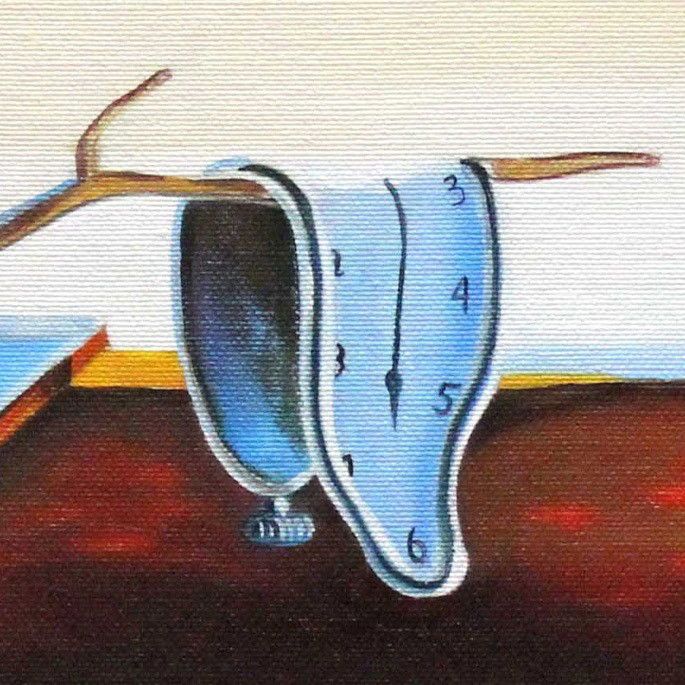
Art is the persistence of memory -- Salvador Dalí.
The soft watches are an unconscious symbol of the relativity of space and time, a Surrealist meditation on the collapse of our notions of a fixed cosmic order.
Isn't painting the way we express our dreams and hallucinations, while drawing is a simple technique? -
UK Voting Age Reduced to 16What do you think is the best age to allow for voting. — I like sushi
21 or 25.
Although there are always exceptions to the rule, I think the span should be between that range of ages because it is when the people (the vast majority) start to be more mature because they have already gotten into adult life.
When you have taken part in some social scheme? — I like sushi
Well, I think we all take part in society from the very first day we are born. We are born having rights, and the government or the public administration has the commitment to help us out. It is very different from taking part in politics actively. I have had the right to vote since I was 18, but I barely used that right because politics are not interesting to me. Nonetheless, I am part of society in other ways: when I pay for using public transport or when I visit the doctor.
What do you think. — I like sushi
That age is used by the politicians depending on the circumstances. -
Australian politicsAnd remember that Albanese has seen Xi Jinping four times, and Trump zero.
Pedro Sánchez also had three or four meetings with Xi while with Trump zero and it is obvious that my government is trying to avoid him. But it seems very difficult, and the tariffs would affect us tremendously. I believe it would be a good deal if we started to export to Australia more than we already do! -
Beautiful Things:rofl:
Well, at least when Miklos Banffy was alive, it was sufficient to chop pieces of wood from the closest forest. But now I can't imagine how expensive the gas or power bill could be! Crazy! -
Beautiful ThingsThe Banffy Castle—the main location where the Transylvanian trilogy is taking part. I am really enjoying these volumes written by Miklos Banffy.
In that period of time, early 20th century, the territory where the castle is located belonged to Hungary, and it was called Kolozsvár. But now belongs to Romanian territory, and it is called Cluj-Napoca.

-
From morality to equalityAs we discussed in another thread of mine, I think suffering is something intrinsically human. Perhaps something that is very connected to the human condition. We only distinguish between physical and psychological to make boundaries, but the effect is the same.
-
From morality to equalityI understand your point, and I can't disagree with that. But I want to point out that there can be a possibility that the person you are thinking of doesn't want to live accordingly. I mean, there are some nomads out there. There are examples of people who live here and fro without having a constant house to live in. Perhaps it would be interesting to study each individual case rather than trying to promote access to housing for everyone.
-
From morality to equalityThink of a situation in which you are living on the street. — MoK
It would be a hard situation, but I can't see if it is related to inequality. Perhaps it is more connected to my personal circumstances which make me live on the street. In my humble opinion, I believe we should consider why I could end up living on the street rather than if it is a lack of inequality. Living on the street may be a personal decision to escape from reality rather than a cause of financial issues. -
What are the philosophical perspectives on depression?Whether one prefers to achieve these insights in the form of psychology, philosophy or literature, if they do no more than reinforce a sense of victimization, then they will leave you imprisoned in your own anger. — Joshs
I promise I am not angry! It is true that depression is often associated with anger or makes people more susceptible to being angry. But that's not my case. I said that I don't believe that forgiveness is not a solution in some specific cases. It seems that some of you see it as the better solution to move on, but I think it is more difficult than we ever thought. As you very well said, if a family member abuses me, how can I trust society? And, on the other hand, if I can't even forgive my father (for example), how can I forgive strangers? The closest members of our lives are the most important. If they abuse us or destroy our confidence, everything starts breaking into pieces.
As a result, those complex situations lead us to unanswered questions, as you stated. Keep in mind that I don't even blame destiny for choosing "me", but the fact that the abuse actually exists and the people can be miserable and deplorable. Even though there are also beautiful things in life and there are also people who make great things, those people overshadow all. -
What are the philosophical perspectives on depression?I have been diagnosed with a fairly mild form of bipolar disorder, formerly known as manic-depression disorder, but I am rarely depressed as I normally think about it. It usually manifests as anxiety. I do take drugs, but my advice to those of us who want to really deal with this problem is "Retire." I know BC will back me up on this. For some reason, many people find this advice unhelpful. — T Clark
Clarky, first of all, I really appreciate you openly shared that you were diagnosed with bipolar disorder and manic depression. I understand that this is not an easy thing to do. Mental states and illnesses are still a taboo, and some people think that it is better to hide it. When I was diagnosed with depression, I only told it to my parents and Martín (@Arcane Sandwich). Since then, I was also looking for sharing it here, but I didn't know how. I didn't want to turn TPF in my therapy session. But I decided to start a thread this Monday because I thought that depression may have philosophical aspects to discuss. I do use drugs. I need them at the moment since they help me sleep and keep calm.
I have come to see philosophy as a practice like meditation, yoga, or tai chi. It's goal is to make us more self-aware. I think this is true of all such practices. I also see psychotherapy as a practice — T Clark
Yes, they are all practices, and I think each of them can help us in different ways. Yet I have never experienced good results through psychology or psychiatrists. I felt like I was talking like a straw man, and folks didn't even understand me. For this reason, I found help in other areas. I believe philosophy and literature are very good to face depression, but they do not have the "chemical" effects that the drugs do, so it is obvious that we should ask for professional help when it is needed, absolutely.
I think I came to a more focused interest in philosophy with a prejudice that modern, western philosophy, at least, is more a place to hide from our problems than to face them. — T Clark
I understand what you mean. Western philosophy is a difficult take, and when I started this thread, I wasn't aware if this would work at all because mental states are not really part of 'philosophy of mind', and neither is a practice, as you explained. The texts only make us wonder how our minds work, but I think we should go beyond and turn a bit sentimental. I believe that depression is also a spiritual state. I am not religious, but I struggle a lot with ethical and soul crises. I suffer when I see people suffer. Philosophy would only help me in an objective way, almost boring to get up with the issue. But some authors, like Dostoevsky, helped me to understand and see it in a different manner.
I honestly see Dostoevsky's novels as more helpful than Kierkegaard's or Schopenhauer's. I always did my best at understanding them, but they only talk like life was an essay, and it is more complex than that. On the other hand, some works like Crime and Punishment or The Eternal Husband helped me to have a clear approach to how the misery of life works, the evil of some people and the frustration of why some difficulties happen.
The first time I remember thinking about that was in a thread with my friend TimeLine. She had a very difficult childhood but she was so smart and so self-aware that you could almost feel her struggle up out of the hole she started in using the ideas Kant, Hume, and all those guys. I found it very moving, inspiring. I still do, and it changed the way I feel about philosophy. That doesn't mean I don't think that for many of us philosophy is still a place to hide. — T Clark
Interesting! What an excellent example. I was talking with @Metaphysician Undercover about how a damaged youngster would approach life later. It is encouraging to know that she was able to progress thanks to the writings of several great philosophers, such as Hume. I wish she could come back and explain why Hume helped her and what aspects she focused on in his philosophy. An intriguing perspective, and thank you for sharing your personal experience and ideas, Clarky. I am also always here to talk if you need to. -
What are the philosophical perspectives on depression?Forgiving involves the latter narrative, sharing your present happiness with the abusive individual. — Metaphysician Undercover
You are giving as granted that I or the child who suffered abuse in the past is now happy. What if the person can never be happy? Although I can agree with you that time can cure the scars and help us to move on, I still see it as hard that a person who passed through that kind of experience could be happy nowadays. I accept that he or she can live a normal life, but nothing more. I doubt they can be happy. For this reason, some of them even start taking drugs. We can pick a random drug addict, and probably this person suffered in the past. I know that there are many different examples and each individual is a different case. But it is difficult to be happy to understand those kinds of circumstances.
I really do not understand what is meant by "the childhood has already been taken away". I understand "trauma", but unless this involves unconsciousness, or coma, this is a matter of receiving experience, not a matter of taking anything away. — Metaphysician Undercover
I mean, childhood is a period of life that supposedly makes children happy with their innocence, helps them to learn things, provides good and formidable experiences, etc. It is not the period to "corrupt" and destroy their mental state. A six-year-old child needs to watch cartoons or paint drawings, not hide from his abusive father or learn how to cheat or whatever to defend himself. It is not the appropriate time, mate. Childhood is for different things.
But it is [forgiveness] always the right thing. — Metaphysician Undercover
Why do you think it is always the right thing?
How can you be a part of the struggle of an abstract abuse victim? Now you are left attempting to do what is impossible, being a part of the struggle of an abstract, fictional, individual. So you are engaged in a hopeless task, which will never be productive, and always be disappointing. — Metaphysician Undercover
Because, as I previously explained, I am aware that those situations exist. Probably, I am overreacting a bit; I agree with you on this point. What I am trying to explain is that it is important to care about these situations. It is not about only taking the happy part of life and realising that some cannot even make it. If you think deeply, there are many reasons to give up on happiness, and I can't see if forgiveness can help me at the moment. -
What are the philosophical perspectives on depression?Good point.
I think you are trying to make me see that perhaps forgiveness is a good idea to cure my soul. I will not say that is a bad idea. Au contraire, it is a great practice. But, following the examples I shared previously, it will be hard to forgive. You keep thinking that the characters and situations that make me suffer are just narrative. Well, imagine a real alcoholic abusive father. It is not hard too. Unfortunately and sadly, there are hundreds and hundreds of these kinds of monsters. Who is the one who has to forgive here?
It would be perfectly possible that the son or daughter ends up forgiving his/her parents. Nonetheless, the childhood has already been taken away, and they are probably traumatised for many reasons. Forgiveness is an interesting act, and Dostoevsky also explored this point because he was influenced by Orthodox Christianity. I learnt something important from his writings, and that is that forgiveness is not ultimate nor absolute. We have the risk of passing through serious dilemmas when we are doubting whether forgiveness is the right thing to do or not. Furthermore, this only applies to specific cases that we are close to. I can't 'forgive' an abstract abusive father. I know these exist, but it is true that I don't have direct contact with them. I am affected because of the suffering of others who are experiencing that. This is the main issue. I want to be part of their struggle, and I am comfortable with this for the moment. -
What are the philosophical perspectives on depression?User Survey: On a scale of 1 - 10, with "1" being fabulous advice and "10" being a pile of shit, how would you rate this post in terms of helpfulness? — BC
:rofl:
Your posts are always fabulous!
Points and advice taken. But I don't think stoicism would help me, friend... I tried it, and there is something that doesn't fit with my mood or personality. I would like to stick with the Russian and Eastern European authors. They are helping me to open the eyes and understand the human condition. I don't want to overcome it but just to learn to live with this situation. -
What are the philosophical perspectives on depression?What is evidence of an "illness" (as opposed to a natural reaction) is experiencing depressive symptoms in the absence of any significant negative experiences. — LuckyR
I agree. But I think I shared a lot of negative experiences along this thread. Seriously, don't you feel sad when a child is abused or when a dog is injured? These are very negative experiences. If you want something more precise, look at what some did to @MoK. They stole his intellectual property! The human condition only makes people depressed! -
What are the philosophical perspectives on depression?Your experience is a perfect example of what I argued on this thread. Your intellectual property was stolen by another person, and it was published with his name instead of yours. You could hire a lawyer and send him a lawsuit. But we the humans also have a soul, and we suffer from what we experience. It is not "Bah. Nothing really matters. Time would help me to overcome this and bla bla."
The human condition is miserable and horrible. In most cases, it is only showing the worst part of all of us. Now, you can't say to me to only focus on the nice aspects of life or contemplate a gorgeous garden. I was talking about children suffering, but you also brought another good example. People are greedy. They steal things from others. Didn't you ever ask yourself why that happened in the first place? If I were you, I would have lost confidence in people.
I don't think a psychiatrist can help us in that way. Do you know why? Because the malice of some folks is incomprehensible. And what do you expect to do? To go to a doctor with the aim of convincing me to better focus on the beautiful side of life and leave behind the negative aspects? Sure, I can go to a garden and contemplate the gorgeous flowers, but your intellectual property was stolen, and a child is suffering abuse somewhere. -
What are the philosophical perspectives on depression?Why a person experiences depression is the subject of discussion! — MoK
Yes, I agree! But I would like to find out philosophy and ideas to face depression. I don't want to know why we experience depression in our lives. I already accepted that this comes and goes sooner or later. I believe it is key to try to live with this mental condition. -
What are the philosophical perspectives on depression?I understand you now. Well, I believe I can approach what you want to mean. Nonetheless, I still remain in my position. I don't think Dostoevsky used his amazing talent to grasp the audience. Most of the plots of his novels are influenced by real-life experiences. For example, Notes from the House of the Dead is based on his experience when he was locked up in jail. I think that is where his amazing talent pops up. The art of showing the misery of their characters, but with the surprise that life can be even harder.
On the other hand, since his works are narrative and it’s supposed to capture our emotions, there should be a beginning and an end. Harry Potter is clearly narrative/fictional because it stimulates our way of dreaming and imagining. But this has an end. Magic only exists for a moment. Yet a starving child or an alcoholic abusive father exists when you close and open your eyes. Just randomly pick a novel of Dostoevsky. I promise every one of them would apply to real-life scenarios.
"I don't want to see the UNICEF pictures either." OK, it is understandable. But the starving child still exists, whether you want to accept it or not.
For this reason, I think that it is important to take into account some authors that help us to embrace pessimism or existentialism. I think it is a good take and another acceptable way of seeing the world. -
What are the philosophical perspectives on depression?You seem to be attracted to reading material which has negative content, stories with suffering. And you empathize with those characters. But this is not likely to be real suffering, it's a fictional description, produced by the author, so that you are actually empathizing with fictional suffering. — Metaphysician Undercover
Sorry, but I disagree with you in that part. Trust me when I claim that the characters and plot shown in Dostoevsky's works are far from being 'fictional'. Furthermore, I believe that they are more real than I could have ever imagined. It is true that he was influenced by specific social and political contexts, but there are themes in his novels that can be applied nowadays.
As I remarked previously, Dostoevsky emphasises the death and suffering of children. There are two good examples of this. One is shown in Humiliated and Insulted where thirteen-year-old orphan Nellie suffers from an abusive household.The other is shown in The Eternal Husband where eight-year-old Liza dies of an illness I can't remember now. But what I can really remember is that Liza suffered from uncertainty because she was raised by an alcoholic that turned out to not be her biological father.
These works investigate the poor human condition of some youngsters, and while they may be deemed 'extreme', they are not fiction. Orphans exist. Children are unwell and can die. Fictional? Romantic novellas are my definition of fiction. -
What are the philosophical perspectives on depression?Interesting input, thanks. Every reply to this thread is welcome. So, yes, your post helps me.
On the other hand, I believe I would only be able to put into practice your thoughts if I were capable of discerning what is important. Yesterday, I learnt something important. What is necessarily important to me and should concern me is not so for others. Children suffering is a good example of this. You say that 'sadness is the loss of something good.' But those infants didn't have the chance to have something good and then lose it.
Furthermore, I still don't see why nothingness should be taken into account regarding the moral uncertainty I am referring to. It does affect me, and it influences me to take one decision or another. Even death has a meaning, in my opinion. I take nihilistic arguments as important, and I respect them, but there is something that doesn't convince me, actually.
For the reasons I expressed above, I wanted to know if thinking that suffering is intrinsically human is actually extreme. Probably, depression and other negative moods lead me to think that way. I can't disagree with that. Nonetheless, I came to the point that people necessarily suffer. It is difficult to focus on the positive sides of life because pain is always present. -
What are the philosophical perspectives on depression?You can find a lot of stuff written about this. — Count Timothy von Icarus
Interesting! Thank you for telling me.
I believe it is an appropriate parable to argue that a lack of proper hope is regarded a vice.
Nice point... I will attempt to read all of that written stuff. -
What are the philosophical perspectives on depression?On the other hand true depression is a serious and debilitating illness and probably requires treatment and the right support. — Tom Storm
Can that treatment be found in philosophical writings or literature? Is there a possibility to understand depression at all? Because I feel that depression is very connected to existentialism and the suffering of why life is often incomprehensible. This is the way I see it, but I can be perfectly wrong. -
What are the philosophical perspectives on depression?I think you misunderstood me. I don't want to find out a diagnosis of depression, but what are the philosophical inputs on this matter. As well as philosophers debating about the origin of the ideas (for example), why not get a philosophical approach to depression?
-
What are the philosophical perspectives on depression?I think your conclusion here isn't sound. You empathize with people suffering, but not with people who are happy. Why does the one type of person deserve empathy more than the other? And, it is only by choosing this one type to empathize with, that you reach the conclusion that people tend to face dramatic situations rather than happy ones.
Why will you not empathize with people who are happy? Would this make you feel bad (jealous perhaps), because these people are better off than you, truly happy, and you would only be feeling that happiness through empathy? To see others happy, when I am not happy, seems to emphasize my unhappiness, so I direct my attention toward the miserable. Misery loves company. Would empathizing with those who are suffering somehow make you feel good, because they are worse off than you, truly suffering while you only feel that suffering through empathy? If this is the case, then this is not true empathy. True empathy allows you to feel what the other feels. Therefore you ought to see no reason not to empathize with those who are happy. Why not share in that joy? — Metaphysician Undercover
I see your point.
But let me explain that it is quite difficult to have motivation for (let's say) participating in the joy and happiness of others. I don't think this is a matter of envy or jealousy. It is just that a person under the spectrum of pessimism is hard to find joy beyond the way he sees the world. I believe we should take your point the other way around. Don't you believe that happy people should be the ones who have to empathise with the rest? We are talking about putting some kind of responsibility on someone's shoulders. For this reason, I hardly see that a depressed person must embrace the happiness of others. Keep in mind that seeing the world in such a way is just a different perspective. I don't want to have anything against it. But I would not say it is better to wonder and be concerned about the misery of the world. It seems that according to some, the world is also full of beautiful things. Thus, they see the glass half full. But it is important to understand that others can't bear how incomprehensible life actually is. For one reason or another, there are always more reasons to be sad than happy. -
What are the philosophical perspectives on depression?
What is the definition of "meaning" for you? When I use it in the context of "the meaning of suffering" or "the meaninglessness of the universe", I am referring to a conscious-independent purpose or value. — Showmee
I am referring to value. I don’t think a purpose is suitable here, but it is true that some acts and decisions are often taken because of a purpose. This is true. But I want to go a bit further: let’s say that acting accordingly has good consequences, while being a person with malicious thoughts can make you struggle. This is very basic, but it is where we should start. Now, if I thought that exceeding some limits was actually plausible to get some results, why do I end up regretting it? This is shown in ‘Crime and Punishment,’ but with the writing talent of Dostoevsky.
but to ask what the "fundamental" meaning of these things is in the aforementioned sense, I suppose, is meaningless (in a semantic sense). Asking why children suffer from war is the same as asking, say, why it is raining or not raining right now—if by "why" you are not referring to a physical or psychological process or causation, but rather to a metaphysical purpose. — Showmee
I am referring to a metaphysical purpose.
The question is not whether it is pouring or not. The question is not why children die. Everything goes beyond all of that. I don’t understand how Cosmos works, and I don’t really believe in God. But, for reasons that I would like to know, I am sitting here talking with you on a forum while a child is starving in the Gaza Strip. Why does this happen to the child and not me? I think it is a serious thing to approach. On this matter, I am not very fond of defending predeterminism. I can’t buy that some suffer and live miserable lives while others have fun just because the dice were thrown to the air and the numbers decided the will of different children. For this reason, I think it is a good exercise to do an act of empathy with them [the people who suffer]. But exactly here is when the paths crossed. If they suffer because they were born in a place where you can’t live (objective suffering) and I suffer because I realise what the human condition is (subjective suffering), then people tend to face dramatic situations rather than happy ones. Accepting that this is the case, I believe it is plausible to wonder why children die rather than why it is raining. The first is a pattern intrinsically human; the second is just trifling.
Moreover, the answer would vary depending on one’s metaphysical stance. — Showmee
Yes, I agree. -
What are the philosophical perspectives on depression?Hey, good post. You are right that is important to first identify what exactly the problem is.
Insomnia/hypersomnia daily.
Feeling of worthless, inappropriate and low self-esteem.
Recurrent thought of death or suicide — Showmee
Those three patterns are the main ones. I believe that suicidal thoughts and insomnia have been by my side for a long time. Before starting to read Dostoevsky, I remember that Mishima was also an important author to understand and approach the concept of death. Specifically speaking, it is worth quoting his following quote: "The Japanese have always been a people with a severe awareness of death. But the Japanese concept of death is pure and clear, and in that sense it is different from death as something disgusting and terrible as it is perceived by Westerners."
But I failed trying to embrace the Japanese way of life and death. I can't see 'heroic' or 'pure' ways to live, so I can't see death in the same way. Furthermore, I believe that dying can be the solution to many problems caused by my circumstances. But, reflecting on it deeply, I still believe that this thought is selfish. For this reason, Western existentialism and Dostoevsky's literature helped me to understand that life is a continuous struggle, that familiar problems exist and children die. I can't do anything but face it and accept that life is the way it is represented in The Brothers Karamazov or Stepanchikovo.
Social and environmental factors encompass the influence of one’s surroundings, such as adverse childhood experiences, chronic stress (e.g., from work), and low socioeconomic status. Personal history—such as a specific traumatic or tragic event—also plays a role. — Showmee
Exactly. But this makes me wonder: who the hell has never experienced tragic experiences or traumatic events?
Dostoevsky’s recurring themes of human misery, I think it is misguided to focus exclusively on this aspect. One could just as easily find numerous counterexamples. What often appears to be timeless human suffering is, in many cases, the result of specific historical and political conditions. — Showmee
I can't disagree with that point, but I think it is important to emphasise that Dostoevsky went beyond political factors. The human condition tends to be miserable. Wishing the death of a father (The Brothers Karamazov) or stealing your daughter's money because you are a gambler. People do this, and after that, the following can happen: regretting or not caring. I go for the first option, and I explain to you why: for unknown reasons, people tend to act viciously, and when they understand the moral consequences of their acts, it is too late. Now that the problem has happened, what can we do? If I wasn't ethical in the first place, why am I suffering from my consequences now?
Sartre, for instance, saw the inherent meaninglessness of the world as the foundation for human freedom and agency. Camus, on the other hand, insisted that the beauty and essence of life lie in the absurd revolt—our rational craving for meaning set against the irrational silence of the universe. — Showmee
Yes, but I believe that French existentialist writers are a bit naive in their views. I can't say that children dying in Gaza or starving in a random cold oblast is inherent meaninglessness for the sake of freedom. It might help me to find freedom for myself. But, again, what still happens to those children? The point here is that, according to the way I see things, it would be selfish to act pretending that human misery is meaninglessness. At least, it is a cause to make me feel depressed.
In any case, I wish you strength and improvement in your journey. — Showmee
Thanks. It was a productive and interesting exchange. Sorry if my grammar and expressions are not very accurate. I am not a native speaker. -
What are the philosophical perspectives on depression?Yes, I read some works on Stoicism or by stoic authors. They are not my cup of tea, sorry. It is interesting how they approach life and the circumstances, but I ended up not "buying" their motto. Furthermore, I hardly recall if they apply their views to familiar problems. I believe they belong to the classics, and it is not comparable with modern authors on the same topic.
The example of Hercules is perfect for what I think. I don't want to become a superman. I just want to know whether I should bear all uncomfortable circumstances or not. I don't want to find a way of escaping through luxuries either. When an ethical dilemma pops up, we have to be ready to act. The big issue here is if I really act accordingly. If not, I am at risk of being depressed. This is incomprehensible, but I get why existentialism fits with my way of viewing the world. -
What are the philosophical perspectives on depression?I come from the opposite end of the spectrum and I believe that it is childhood and what happens in childhood that moulds the adult. Not that these things are set in stone. — Malcolm Parry
Good point. This is why I stated that one of the themes where Dostoevsky approaches depression is the suffering of children. I don't know if you read 'The Eternal Houseband', but it is actually a great novel. One of the characters is a child, and she suffers from having an agitated childhood with a dead mother and unknown father. Everything happens here, at this age. It is cruel but realistic at the same time; because some writers only show childhood as if it were a fairy tale. But the reality could be more different.
My wife and child work in Mental health jobs and see the damage done by childhood. It isn't just horrendous stories but just parents being not very good. — Malcolm Parry
Understood. It is not being too bizarre but the absence of parents can make children depressed too.
What is it about yourself you feel bad about? Don't answer if you don't want to. — Malcolm Parry
I feel selfish because I believe that I don't appreciate my life enough. I complained and behaved childishly in many different ways. For example: destiny and circumstances are often the things that make me feel depressed. I always wonder, "Why does this happen to me?" Or "Why did I make this decision?" etc. While I stick the TV on, and I watch a lot of children dying in Gaza or starving in a random village in Africa. Then I say to myself, What do you complain about? Look how thousands and thousands of citizens actually live! And then, reflecting on that makes me a bit depressed because although my life is "better" than theirs, I believe my life is not always satisfactory.
These kind of dilemmas are found in Dostoevsky. Humiliated and Injured comes to my mind. -
What are the philosophical perspectives on depression?First of all, thanks for bringing the psychology approach to this discussion. I completely missed it, although I am aware that it is very important. I went to the psychologist a few times in my life, but the results were not satisfactory. We didn't talk about the philosophy of mind, neither moral nor ethical dilemmas. I guess this is not what psychologists are up to. But I ended up bored in the sessions, and I decided to not come back ever again and try to find out other ways to understand depression. As I said, I think that some authors are worth reading because they explore human behaviour. Nonetheless, this didn't heal my depression, and I still needed antidepressants to feel better with myself.
It is true that Sigmund Freud is an important author to consider in terms of understanding the mind. But I want to go beyond biological matters. My seek is more focused on human behaviour and personal circumstances which lead us to an incomprehensible suffering.
That's why I believe Dostoevsky was very good expressing the sentimental nature of humans.
javi2541997

Start FollowingSend a Message
- Other sites we like
- Social media
- Terms of Service
- Sign In
- Created with PlushForums
- © 2026 The Philosophy Forum