
-
 ssu
9.8k
ssu
9.8k
Again here, if you elect the Comission directly by EU voters, you seriously undermine the nation states and national sovereignty. The European Council has no say to the Comission. It basically creates just parallel organizations that structurally aren't cooperating. And the voting? It's basically just Germans, the Spanish, the Italians and the French can choose the leader. What do other nations think, who cares?It's a bit like with congress in the US, where de facto the president and his administration gets to decide for the most part and congress just approves things. The difference is that the president in the US is elected whereas the Commission is not. — ChatteringMonkey

Secondly, if the Comissars are elected even nationally, the Comission isn't responsible to the. And just for what position are they electing?
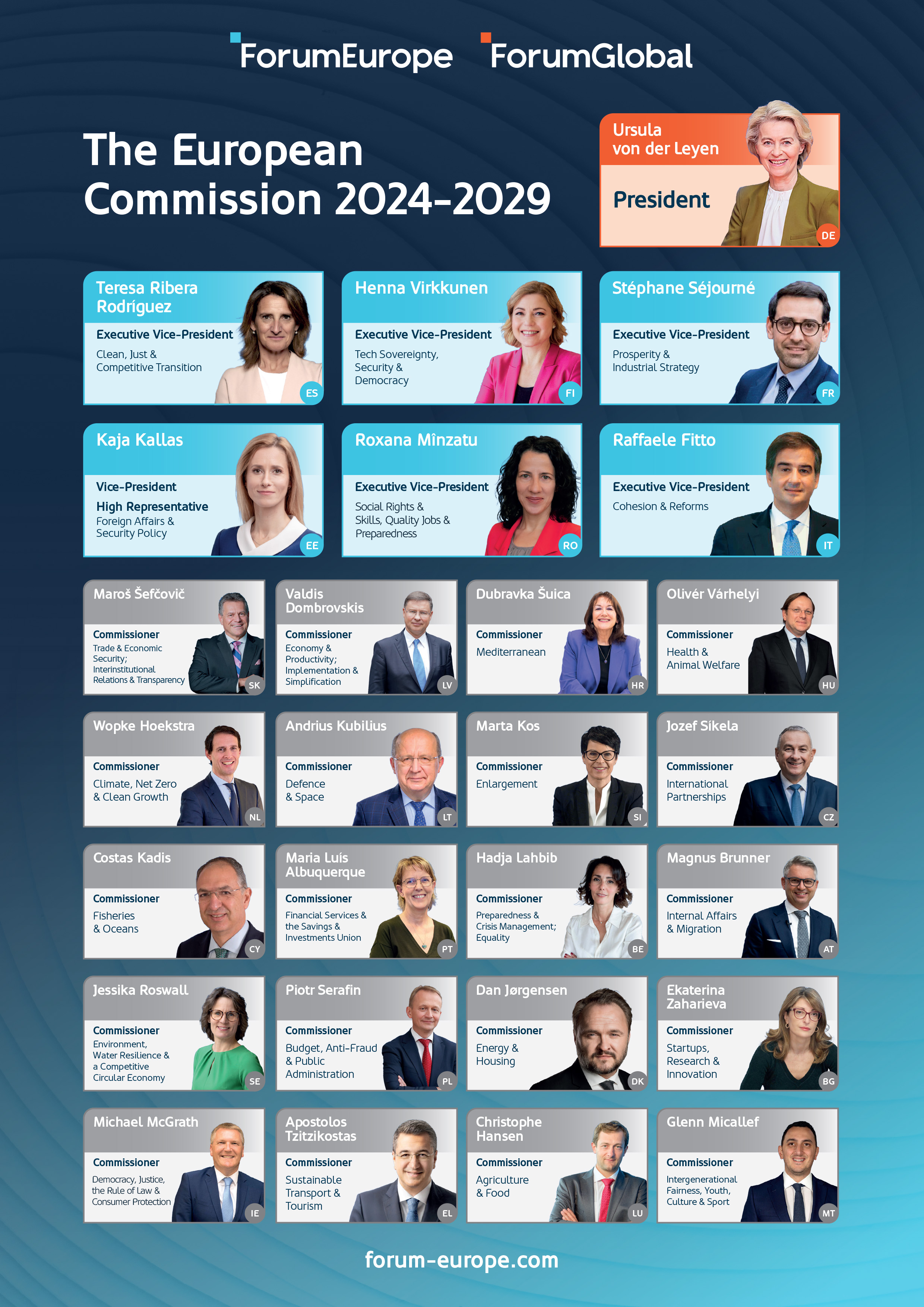
Perhaps Estonians (1,37 million) can be happy that their former president is now (to the anger of Trump & Putin) the High Representative for EU, but would that position be decided by voters? Surely not.
Yep. That's the intention in having the common market. It was also very beneficial to Germany. Countries that don't have competitive economies, it isn't so great.The aid was not the most important part, it's the access to the free market that was very beneficial for them. — ChatteringMonkey
It seems like that, but just focus a bit more in the actions of each member state, be they in EU or NATO. Let's take defense and security policy. For my country it's all about Russia. But for Spain and Portugal, it's North Africa, which is totally logical. If Morocco collapsed into a bloody civil war like in Syria, for Portugal and Spain it would a real problem. For Finland, not so. But then, if "Russian volunteers" marched over the border of Estonia to help to Russian minority in Estonia, this would be a serious issue for Finland. Yet for Portugal and Spain it's far away. Yet the cooperation does work, Spain, Portugal and Finland are in the "Coalition of the Willing" when it comes to Ukraine, yet this cooperation is done by sovereign states from their own national interests. If it would be Brussels deciding where to send your country's armed forces, that is totally different that it's your country's elected government making that decision.I'm more than fine to respect the cultural heritage and sovereignity of the states where that makes sense. But I don't think it does make a lot of sense on foreign policy, certainly not when it pertains to geo-politics or international trade, because de facto the security and intelligence is already organisated on the supra-national level of NATO, or for trade in larger European trade-agreements. — ChatteringMonkey
Actively destroying everything older generations have worked for since WW2 isn't facing reality, it's sheer stupidity.Things change. Percentage of world GDP goes down, debts go up... the US was already in the process of losing its position of global hegemon. At some point you have to face reality, the longer you deny it, the harder the fall. — ChatteringMonkey
I wonder just how much is the Kremlin budget for international bribes. It effects are quite awesome compared to constructing new tanks. -
 jorndoe
4.2k, good question. :grin: You can get a lot of Gill-bribes for the price of a tank. A dozen tanks might buy a fair bit of division/polarization.
jorndoe
4.2k, good question. :grin: You can get a lot of Gill-bribes for the price of a tank. A dozen tanks might buy a fair bit of division/polarization.
Actively destroying everything older generations have worked for since WW2 isn't facing reality, it's sheer stupidity. — ssu
And it's playing into the hands of adversaries. Seems like the Coalition of the willing works well as a supplement. -
 ChatteringMonkey
1.7kAgain here, if you elect the Comission directly by EU voters, you seriously undermine the nation states and national sovereignty. The European Council has no say to the Comission. It basically creates just parallel organizations that structurally aren't cooperating. And the voting? It's basically just Germans, the Spanish, the Italians and the French can choose the leader. What do other nations think, who cares? — ssu
ChatteringMonkey
1.7kAgain here, if you elect the Comission directly by EU voters, you seriously undermine the nation states and national sovereignty. The European Council has no say to the Comission. It basically creates just parallel organizations that structurally aren't cooperating. And the voting? It's basically just Germans, the Spanish, the Italians and the French can choose the leader. What do other nations think, who cares? — ssu
Ok I agree that it would be difficult to find a good formula, but it's not as if nation states have more sovereignty by remaining subservient to an unelected bureaucracy.
It seems like that, but just focus a bit more in the actions of each member state, be they in EU or NATO. Let's take defense and security policy. For my country it's all about Russia. But for Spain and Portugal, it's North Africa, which is totally logical. If Morocco collapsed into a bloody civil war like in Syria, for Portugal and Spain it would a real problem. For Finland, not so. But then, if "Russian volunteers" marched over the border of Estonia to help to Russian minority in Estonia, this would be a serious issue for Finland. Yet for Portugal and Spain it's far away. Yet the cooperation does work, Spain, Portugal and Finland are in the "Coalition of the Willing" when it comes to Ukraine, yet this cooperation is done by sovereign states from their own national interests. If it would be Brussels deciding where to send your country's armed forces, that is totally different that it's your country's elected government making that decision. — ssu
Coalition of the willing will always be reactive. There's no way to project power proactively like that, and so you will effectively be at the mercy of other great powers. The choice is not between sovereignty or Brussels, but between Brussels or Washington... or Peking or Moscow.
Actively destroying everything older generations have worked for since WW2 isn't facing reality, it's sheer stupidity. — ssu
No, older generations have left the younger generations without perspective. -
 Tzeentch
4.4kWhat Europe needs is a NATO without the US, and subsequently to dissolve the European Union.
Tzeentch
4.4kWhat Europe needs is a NATO without the US, and subsequently to dissolve the European Union.
That way countries can run their own affairs as they have successfully done for centuries, while still enjoying collective security.
Europe does not need the US in ANY capacity, and to have a distant great power meddling in security affairs on the European mainland is a recipe for disaster - as disaster which is already starting to unfold before our eyes and which will have a singular destination: war with Russia and the destruction of Europe, the beneficiary of which will be the US (as it was during WW2). -
ChatteringMonkey
1.7kI don't disagree generally, but it's maybe a bit simplistic to just do away with the EU. There's some things that probably are to our benefit, like the single market to name one. I don't see how you stay competitive for instance if you simply fall back to the nation state of old... the world has changed you know.
-
Tzeentch
4.4kI don't see how you stay competitive for instance if you simply fall back to the nation state of old. — ChatteringMonkey
The other 150+ countries seem to be getting by just fine. -
ChatteringMonkey
1.7kI don't think a lot of them are doing that great to be honest. And those that are doing fine, have other supra-national organisations or agreements, like say ASEAN.
-
ssu
9.8k
That is the worrisome thing. Yet the case of Nathan Gill shows just how this works: Gill has publicly stated that he is for Ukraine and against the Russian invasion, but then did speak on behalf of the pro-Russian Ukrainians that bribed him. So a small bribe goes so far.good question. :grin: You can get a lot of Gill-bribes for the price of a tank. A dozen tanks might buy a fair bit of division/polarization. — jorndoe
With others, those who are basically Western talking heads of Putin and reurgitate the Kremlin line and never, ever speak anything negative about Russia and Putin are obviously on the payroll. Perfect example of this is prof Jeffrey Sachs, who earlier was actually a professor focused on global poverty and now is a full on Kremlin spokesperson.
Yet what do you get with the big money? Already the White House has basically given Russia what was their main goal in their military doctrine and Russia is extremely happy with the National Security Strategy.
It's the result when the US abandons it's allies. Even if after Trump the democrats take power and steer back the US to the traditional alliances, the damage has been already done.Seems like the Coalition of the willing works well as a supplement. — jorndoe
Doesn't make sense. What will happen that NATO without US will come closer to the EU. Already you have things like the European Defence Industry Program in the EU, which benefits hugely the NATO without the US. Then there's SAFE (Security Action for Europe), which even Canada has joined!What Europe needs is a NATO without the US, and subsequently to dissolve the European Union.
That way countries can run their own affairs as they have successfully done for centuries, while still enjoying collective security. — Tzeentch
(Dec 1st,2025) Today, the Prime Minister, Mark Carney, announced the conclusion of negotiations for Canada’s participation in SAFE – unlocking billions of dollars in potential defence opportunities for Canadian businesses. SAFE provides up to $244 billion in loans to EU Member States to support large-scale defence projects, including acquiring critical capabilities such as ammunition, missiles, drones, artillery systems, and infantry weapons. As all 27 EU Member States increase defence investments, greater cooperation on procurement opens massive new opportunities for Canadian manufacturers to build and export Canadian-made technologies and capabilities.
As EU countries strengthen their defence capabilities through SAFE, Canadian participation will give our defence industry expanded access to the European market, attract new reliable suppliers for the Canadian Armed Forces, and catalyse massive private investment in Canada – creating higher-paying careers, growing Canadian industries, and bolstering transatlantic defence readiness. With this agreement, Canada will become the only country outside of Europe with preferential access.
Many agree that the EU should be improved, be more transparent and seriously tackle corruption and bureacracy, yet those arguing for the dissolution of the European Union now usually are the Putinists. -
Tzeentch
4.4kAnd those that are doing fine, have other supra-national organisation or agreements, like say ASEAN. — ChatteringMonkey
Well, lets then opt for those 'other' types of agreements, rather than the abomination that is the EU. -
ChatteringMonkey
1.7kWell sure, like I said I don't disagree generally, the question is what kind of arrangement we do want.
-
Tzeentch
4.4kI think that is best left up to countries themselves. What we have with the EU is a typical 'one size fits none'.
Besides, I think by now it is corrupt and porous beyond redemption. Reform is a pipe-dream, especially with these clownish leaders who jump on every opportunity to declare crises, so they can seize even more power. -
ChatteringMonkey
1.7k
I object to the framing that anyone who wants to get rid of the EU is one the side of Putin. The fact that Putin or Trump happen to want a similar thing shouldn't prevent us from evaluating something on its own merits.
This is a tactic that has been shown to been dangerous and contra-productive, for instance in the case of immigration where any discussion of the topic has for the longest time been made virtually impossible because of various accusations of racism, fascism or Nazism and the like as soon as the issue was brought up.
You should know better. -
 Punshhh
3.6kPerhaps if that’s what I said, but it isn’t. I said Putin would agree that the EU should be got rid of too. That’s all.
Punshhh
3.6kPerhaps if that’s what I said, but it isn’t. I said Putin would agree that the EU should be got rid of too. That’s all. -
Tzeentch
4.4kYou're absolutely right, but it's unfortunately what I've come to expect from this forum.
-
ssu
9.8k
"Now usually" doesn't mean the same as "anyone".I object to the framing that anyone who wants to get rid of the EU is one the side of Putin. — ChatteringMonkey
I've been myself a eurosceptic before, but especially after Brexit, the dissolution of EU doesn't make much sense. Criticism about the EU has existed far more longer than the present era, naturally. And criticism of the present is a healthy important part in a democracy, especially if it is constructive and helpful.
Wokeness is a perfect example of this also. But as @Punshhh said, that wasn't our intent.This is a tactic that has been shown to been dangerous and contra-productive, for instance in the case of immigration where any discussion of the topic has for the longest time been made virtually impossible because of various accusations of racism, fascism or Nazism and the like as soon as the issue was brought up. — ChatteringMonkey
Yet when two large countries basically make it policy to be against the EU and intervene in matters of the union members, it's noteworthy and shouldn't be disregarded. And likely the outcome is different than they anticipated. Europe has to stand up against this. It doesn't stand up if it does what the bullies want it to do.
Actually the Chinese learnt that this kind of "diplomacy" works against the objectives. From the 2010's until the early 2020's Chinese adapted a style of Wolf Warrior diplomacy, an inherently hostile, offensive and coercive style of diplomacy. It quickly backfired: basically the hostility just made US warnings about China more credible. Now you can see that China isn't hostile against the EU (and likely won't be so hostile towards Trumps administration after this NSS).
Of course this is now the standard rhetoric from Russia, the latest with Putin himself calling Eu leaders "little pigs/swines" alongside accusing of Biden “consciously” unleashing the war in Ukraine.
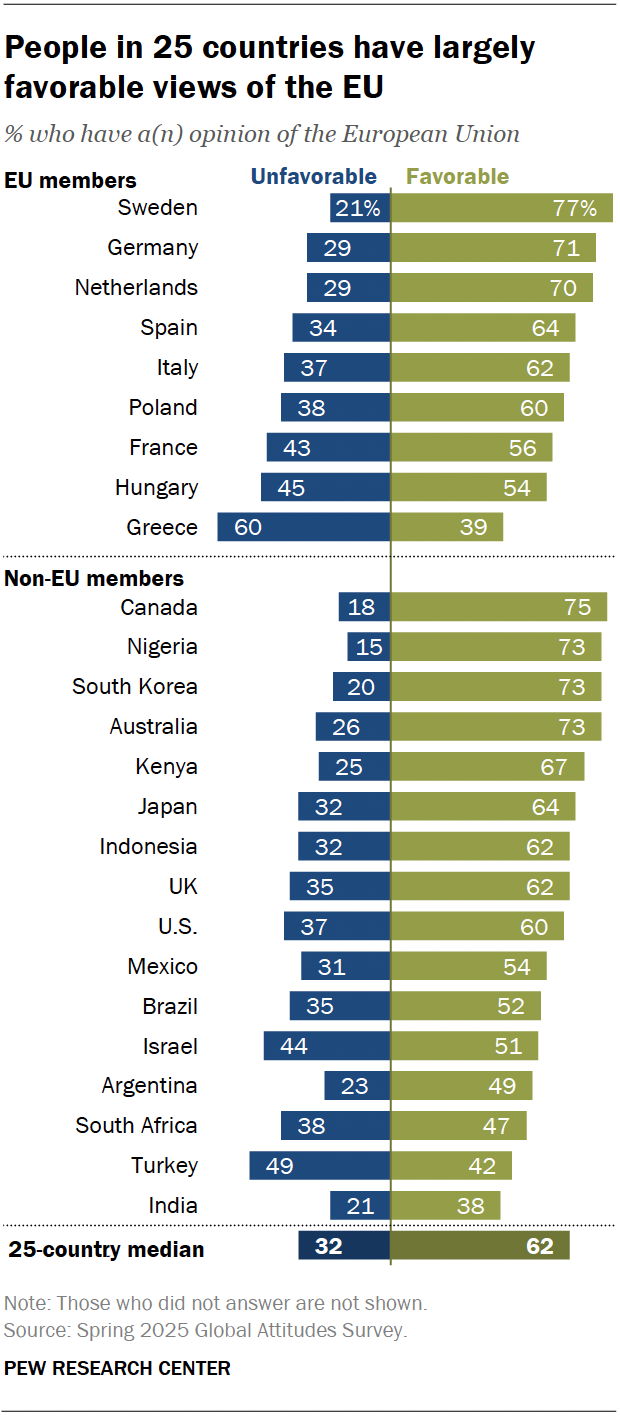
But then again, he has already said a long time that Russia is at war with NATO (and EU). Attacks on the EU will likely make EU like even more the EU... perhaps with the exception of the Greeks. Btw notice that Americans do like the EU, just as they approve helping Ukraine and don't have such love for Russia as the Trump administration has.
From 2025 polls:
-
Punshhh
3.6k
Yes, I saw that, Putin laughing and calling the EU leaders piglets. Reminds me of the little green men in Ukraine. He has contempt for European institutions and will press ahead with his hybrid war. We have hard evidence of this now with Russian drone ships detected in European waters.Of course this is now the standard rhetoric from Russia, the latest with Putin himself calling Eu leaders "little pigs/swines" alongside accusing of Biden “consciously” unleashing the war in Ukraine.
Should the EU split up. There will be hybrid war with each individual country with the intention of installing Russia friendly governments, to further destabilise the block. -
ChatteringMonkey
1.7kYet when two large countries basically make it policy to be against the EU and intervene in matters of the union members, it's noteworthy and shouldn't be disregarded. And likely the outcome is different than they anticipated. Europe has to stand up against this. It doesn't stand up if it does what the bullies want it to do. — ssu
Here is how I think this plays out.
Russia does want to dissolve the EU and is actively supporting various people in our societies to further their goals.
Since we are, if not directly at war with Russia, at least supporting the party that is at war with Russia, Russia is perceived to be the enemy. And since they are the enemy, supporting a goal that is aligned with the goals of Russia is often perceived as a kind of treason.
This is how group dynamics work, if there is a perceived threat to the group, you get cries to rally around a flag that is in opposition to that threat. This dynamic then get used to silence those who might support goals that are aligned with a goal of the enemies.... propaganda on both sides.
What this does is you effectively push those opinions that don't necessarily have anything to do with being pro-Russia underground, and risk radicalising them to the point that might eventually end up being pro-Russia, or at least more anti-establishment.
This also prevent any further public discussion on the merits of the EU itself or the war in Ukraine, effectively preventing people from forming a more secure reasoned-out position on these issues... it mostly becomes a matter of supporting the group then.
If people would have a more secure position on these issues, Russian propaganda would become less effective in swaying opinions. If opinions are mostly a matter of supporting the group Russian propaganda has to potential to flip people to their side if they manage to pierce through some of the half-truth that are promoted by the West.
People have favourable views on the EU now partly because the cries to rally around the flag, but that could change pretty quick if they are based on nothing more substantial.
Anyway, Russia wanting something is in my opinion not a good reason for just doing the opposite. It's reactive, narrowly defined in opposition, and I think It's better to look to be proactive, and look at things in their whole context. -
ssu
9.8k
Exactly.Should the EU split up. There will be hybrid war with each individual country with the intention of installing Russia friendly governments, to further destabilise the block. — Punshhh
Every European country, be it Germany, France or Luxembourg, is vis-a-vis weaker to Russia. Thus Putin's Russia desires this outcome so eagerly.
Basically this is totally similar to the Cold War against the Soviet Union.Since we are, if not directly at war with Russia, at least supporting the party that is at war with Russia, Russia is perceived to be the enemy. And since they are the enemy, supporting a goal that is aligned with the goals of Russia is often perceived as a kind of treason. — ChatteringMonkey
Yet even then, as Western allies were democracies, those speaking on behalf of the Soviet Union and praising it were tolerated. They weren't traitors as there was no actual war, only a Cold War. A functioning democracy is able to withstand the propaganda of those that are hostile against it. It comes with free speech. It truly has to become outright slander and threats against people or individuals were we have to draw the line just where free speech ends and what are open threats and defamation.
And needless to say, many leftists even some older PF members, who were (are) Marxists, but did criticize even back the Soviet Union. Yet there were many of those leftists that saw Marxism-Leninism as the way forward also for the West-European countries and who saw nothing bad in the Soviet Union and saw it as a victim. That these parties are people got money from the Soviet Union was hardly a surprise to anyone. What then has changed?
What is laughable is when the populists that are in power claim that they are for free speech, because they openly attack anybody that is against what they themselves say. Hence it's no surprise just how low Hungary or the US are in the indexes when it is about the freedom of the press.
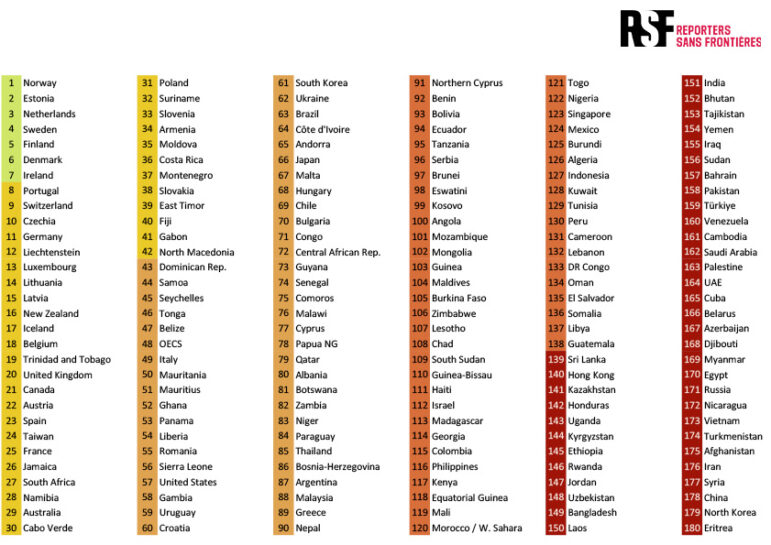
The US in place 57, Victor Orban's Hungary at 68. -
ChatteringMonkey
1.7kWhat then has changed? — ssu
What has changed is that we feel less secure in our ideals now. And additionally the challenge to the establishment isn't coming from the left this time. After WWII certain factions from the right have always been systematically excluded from public debate and political power. -
ssu
9.8k
If we talk about fascists and authoritarian parties, certainly. And for a reason. Otherwise I think that the left is far too eager to paint nearly in the right to be part of the "extreme-right".After WWII certain factions from the right have been systematically excluded from public debate and political power. — ChatteringMonkey
In my view, the basic problem is that populism emphasizes the "us-them" dichotomy, increases political polarization and basically opposes democracy. Why?Accusing a certain group of people being The argumentation is that democracy has lead to "the elite" to control, and this can be only replaced by strong leaders and a new elite made up by the populists themselves. Hence political corruption isn't fought against transparency and reinforcing the institutions, but with a populist takeover lead by a strong leader.
The irony of then Russian propaganda talking about the loss of freedom of speech in the EU. Remembering just how many reporters have been killed in Russia, in a country where simply saying a war being a war can get you jailed, for starters... -
Punshhh
3.6k
I take on board your criticism, I don’t normally get involved in tit for tat comments, although in this occasion this did happen after I pointed out to Tzeentch that I perceive a clear anti European bias.This is a tactic that has been shown to been dangerous and contra-productive, for instance in the case of immigration where any discussion of the topic has for the longest time been made virtually impossible because of various accusations of racism, fascism or Nazism and the like as soon as the issue was brought up.
I would say though, that we are in a rarefied space inhabited by deep thinking, knowledgeable philosophers, who are already well versed in the arguments. As such I would expect there to be a serious intellectual consideration of the issues by everyone and that the full range of issues and positions should be on the table. With contributors expecting their positions to be challenged and to in turn challenge their interlocutors. -
ChatteringMonkey
1.7kI take on board your criticism, I don’t normally get involved in tit for tat comments, although in this occasion this did happen after I pointed out to Tzeentch that I perceive a clear anti European bias. — Punshhh
Don't take it to personally, it was as much me wanting to make a point about current discourse more generally, than criticising anyone in particular.
The EU and Europe are not one and the same. Anti-EU doesn't necessarily mean anti-Europe, though Putin and Trump being specifically disparaging of the EU and its associated elites does complicate things further.
It's tempting to view this merely as cynical power plays of authoritarian leaders to further their authoritarian causes... divide et impera. And then the natural response would seem to be that we have to unite and defend the EU.
But aside from geo-political interests there's also a deeper ideological battle going on for what the future direction of 'the West' should be. It think it would be a shame if we pigeonholed ourselves into merely defending the current system when there might be good reasons to criticize it. -
ChatteringMonkey
1.7kIn my view, the basic problem is that populism emphasizes the "us-them" dichotomy, increases political polarization and basically opposes democracy. Why?Accusing a certain group of people being The argumentation is that democracy has lead to "the elite" to control, and this can be only replaced by strong leaders and a new elite made up by the populists themselves. Hence political corruption isn't fought against transparency and reinforcing the institutions, but with a populist takeover lead by a strong leader. — ssu
Ok but it has been the case for decades now that democracy hasn't delivered governments that align with the will of the people on key issues, immigration of course being the prime example.
And then if this keeps happening over and over, if the institutions of the system don't seem to deliver, you will get a call for populists to take over and dismantle the institutions because they are perceived to be a part of the problem.
The underlying problem seems to be that institutions don't seem to work anymore and that there doesn't seem to be another way to deal with that. -
ssu
9.8k
In the Nordic countries this isn't the case.Ok but it has been the case for decades now that democracy hasn't delivered governments that align with the will of the people on key issues, immigration of course being the prime example. — ChatteringMonkey
The change in immigration policies is obvious and the change has been done for example in Sweden by the Social Democrats themselves. Danish and Finnish immigration has been limited also. Basically Europe isn't Angela Merkel's Europe anymore, but naturally the populists keep totally silent about this and portray there to be rampant totally unrestricted immigration from Muslim countries to Europe.
Immigration to Sweden: Notice the trend after 2017.

The only possible way to make a forecast that Sweden is becoming Muslim is simply to extrapolate the trend that ended in 2017 and assume similar (50 000 or more) refugees coming to Sweden. Because otherwise you simply don't get a 8% - 10% minority to grow to become the majority as forecasting several generations into the future is very difficult. -
ChatteringMonkey
1.7kThe issue is not the percentage of the total population, but the concentration in the cities. The immigrants are not integrating, have more kids than the natives and the natives are leaving the cities. That essentially means that what used to be the local cultural centres are turning into another culture... more and more visibly so.
Immigration policies may have changed over the last couple of years, but I don't see how you stop this ongoing process without measures most would rather avoid. And wherever one may fall on this issue, I think it is pretty save to say it will cause a lot of problems down the road. -
Punshhh
3.6k
Yes, there is change in the air as a result of world events and the politicians are very slow to catch up. In many cases, they seem to ignore it and stick doggedly what they used to do in the past.Ok but it has been the case for decades now that democracy hasn't delivered governments that align with the will of the people on key issues, immigration of course being the prime example.
There is a broader shift going on though, with big tectonic plates within society moving and we don’t know where we are going, how to get there, or where we will end up. I think more blame can be laid at the door of the financial crisis of 2008 than on the issues around migration, or the growth of social media. Especially in the U.K., where the Tory’s dominance in the political sphere since Thatcherism was built on the idea of tight fiscal policy, reducing taxes, privatisation and freeing the markets. This backfired spectacularly with the financial crisis, throwing this whole ideology and the Tory party into chaos ( I’m working on the assumption that Blair and Brown continued Thatcherite policies 1997-2010). Privatisation was throwing up all sorts of profiteering and failed services. Then Austerity starved institutions of funds to the point that they now don’t work, as you say.
I’m very much of the opinion that the Tory politicians and their wealthy backers came to a realisation that capitalism was broken, we had passed the peak in 2008 and from now on it was about extracting as much wealth out of the population as possible over the next decade and run for the hills. This was compounded by the disastrous decision to have an EU referendum on a 50/50 majority.
Now we have populists filling the void left by the implosion of the Tory party and the rise of culture wars. I do see your concerns over immigration, but the issue is definitely being inflated by populist rhetoric and used as a means to getting them into power. However it is important to address the issue of immigration and hopefully Starmer is going to get a grip of it eventually. He repeatedly says that Reform are a one trick pony and take the immigration issue away and they have no other policies.


Welcome to The Philosophy Forum!
Get involved in philosophical discussions about knowledge, truth, language, consciousness, science, politics, religion, logic and mathematics, art, history, and lots more. No ads, no clutter, and very little agreement — just fascinating conversations.
Categories
- Guest category
- Phil. Writing Challenge - June 2025
- The Lounge
- General Philosophy
- Metaphysics & Epistemology
- Philosophy of Mind
- Ethics
- Political Philosophy
- Philosophy of Art
- Logic & Philosophy of Mathematics
- Philosophy of Religion
- Philosophy of Science
- Philosophy of Language
- Interesting Stuff
- Politics and Current Affairs
- Humanities and Social Sciences
- Science and Technology
- Non-English Discussion
- German Discussion
- Spanish Discussion
- Learning Centre
- Resources
- Books and Papers
- Reading groups
- Questions
- Guest Speakers
- David Pearce
- Massimo Pigliucci
- Debates
- Debate Proposals
- Debate Discussion
- Feedback
- Article submissions
- About TPF
- Help
More Discussions
- Other sites we like
- Social media
- Terms of Service
- Sign In
- Created with PlushForums
- © 2026 The Philosophy Forum