
-
 Hanover
15.3kI was playing around with AI and asked it to extrapolate the way English would look in the year 3500 based upon how it has evolved over the past 1,500 years or so. According to AI and the articles I could locate, languages compress over time, with the more "evolved" languages showing great reliance upon contextual clues and less extraneous words like articles and the like. Mandarin, for example, is a highly compresed language, which is why native speakers translate English in a compressed way. As in they might say, "I bring two chair" instead of "I will bring you two chairs," often eliminating pronouns, plural designations and the like.
Hanover
15.3kI was playing around with AI and asked it to extrapolate the way English would look in the year 3500 based upon how it has evolved over the past 1,500 years or so. According to AI and the articles I could locate, languages compress over time, with the more "evolved" languages showing great reliance upon contextual clues and less extraneous words like articles and the like. Mandarin, for example, is a highly compresed language, which is why native speakers translate English in a compressed way. As in they might say, "I bring two chair" instead of "I will bring you two chairs," often eliminating pronouns, plural designations and the like.
As an interesting aside, you can also ask AI to speak English as a Russian, French, German, or whatever would. It gives a quick understanding of how other languages use word order, emphasis, and so on.
Anyway, this got me to thinking, which is that one would expect one's internal langauge to be highly compressed, meaning it need not adhere to conventional grammar in order to be language, but it would need to adhere to some sort of grammar to be a rule oriented language (per Wittgenstein).
For example, to say "brick" while pointing to a brick could mean "hand me that brick" or "that is a brick" or "watch out, there's a brick in the road," etc. That is a highly compressed sentence, dependant upon context and even gesture.
Consider, "the egg dropped," which means "there is yolk on the floor that needs to be cleaned up," and yet there is no mention of yolks, floors, or cleaning in the text itself. If I shrug when I see it, that might mean, "you need to pay better attention next time, and you're the one that needs to clean that up, not me."
This then raises the question of what linguistic process goes in in my head when I arrive at a propositional truth. It might be so highly compressed it would not appear as language at all, but as long as it is translatable into a longer expression, that it began compressed does not matter.
I think this might be where some confusion arises where people refer to their internal processes as mentalese. It's not. It's just highly compressed language. True mentalese would be pure experience, like pain, not reducible into language at all.
But the distinction becomes harder to maintain when our internal sentences are so elliptical (the ommission of superfluous words while still maintaining meaning) that they lack almost any structure, and we are forced to argue that our compressed internal speech (not to be confused with private language) is expressed in long-hand when spoken, as a type of translation of one grammar (i.e. language game) to another. And we are forced to deal with the fact that our internal speech without sound is a public language even though it might have no identifiable syntax.
"When I think in language, there aren’t ‘meanings’ going through my mind in addition to the verbal expressions: the language is itself the vehicle of thought." — PI §329
What then does the hyper-compressed vehicle look like if not letters, words, and sentences? How does that shrug look prior to my shoulder shrugging?
Anyway, I leave this open to thoughts, efforts to clarify whatever my misunderstandings might be, and possibly to better understand what language actually is under this framework. -
 Banno
30.6kQuality OP
Banno
30.6kQuality OP
To consider mentalese as a highly compressed language is to accept mentalese.
The idea of a private mental language supposedly explains how pubic languages come about, emerging from some innate and private place. It's a supposed computational explanation for how language arrises.
Private language was shown to be incoherent.
And we increasingly understand how the brain is not computational. It uses neural nets, which do not code situations symbolically.
So mentalese, if it is anything at all, must be a form of talking to oneself that is a back-construct from public language.
So briefly and dogmatically, mentalese as an innate, computational system is incoherent. Internal thought may appear compressed or elliptical, but it is always derived from public, norm-governed language. Any “mental language” we experience is a back-constructed internalisation of public language, not a separate symbolic system. The brain’s architecture (neural nets, not symbolic computation) supports this derivative view.
But that idea of thinking as a very compressed language still has merit. -
 kindred
246Language is more than a tool for mapping descriptions to the external world. In as far as it’s used to communicate ideas, feelings and even sensations it can only be compressed based on the familiarity with which the circle is acquainted with one another. Think of in jokes for example to ones outside the circle it might not make sense yet to the inner circle it does without context being supplied. I think this is the essence of compressed language the idea of an in language as in an in joke between the parties partaking in communication with each other.
kindred
246Language is more than a tool for mapping descriptions to the external world. In as far as it’s used to communicate ideas, feelings and even sensations it can only be compressed based on the familiarity with which the circle is acquainted with one another. Think of in jokes for example to ones outside the circle it might not make sense yet to the inner circle it does without context being supplied. I think this is the essence of compressed language the idea of an in language as in an in joke between the parties partaking in communication with each other. -
 T_Clark
16.1k"When I think in language, there aren’t ‘meanings’ going through my mind in addition to the verbal expressions: the language is itself the vehicle of thought." — PI §329 — Hanover
T_Clark
16.1k"When I think in language, there aren’t ‘meanings’ going through my mind in addition to the verbal expressions: the language is itself the vehicle of thought." — PI §329 — Hanover
This of course is the problem. Assuming all thought is verbal is clearly not right.
As I noted elsewhere, the answers to your questions are not philosophy, they’re science. I doubt anyone likely to participate in this discussion knows enough to have a credible opinion about this subject.
Nuff said. -
Hanover
15.3kThis of course is the problem. Assuming all thought is verbal is clearly not right. — T Clark
No one suggests that though. The quote only says that there are not meanings outside language but the meaning is the language.As I noted elsewhere, the answers to your questions are not philosophy, they’re science. — T Clark
This too is incorrect because if you look at what I said above, I made no reference to brains or neuroscience. We're defining terms: language and meaning. -
Banno
30.6kI doubt anyone likely to participate in this discussion knows enough to have a credible opinion about this subject. — T Clark
Then since you participated, we need not pay your opinion any attention. :wink:
PI §329, in context, does not presume that all thought is linguistic. Rather it is giving consideration to linguist thought as a sample that is readily available for philosophical consideration. He's talking about linguistic thought for the same sort of methodological reason that a geneticist might study fruit fly rather than elephants - it's easier, and we can extrapolate later. -
Banno
30.6kFurhter, ther eis plenty in @Hanover's OP that is philosophical - conceptual - rather than scientific. The nature of internal thought and language, the relation between compressed thought and propositional truth, the distinction between internal language and private language and mentalese...
What is the minimal criterion for a thought to be considered “linguistic”? Does internal compression preserve the normativity and rule-following required for something to qualify as language? How can a single, highly elliptical internal expression maintain truth-conditions? What does it mean for a thought to be “true” if the content is context-dependent and underspecified? How do we rigorously distinguish between internalized forms of public language and a hypothetical private language? What guarantees that internal compression doesn’t slip into the incoherent private-language scenario that Wittgenstein critiques?
These are not issues that can be decided by experimentation. -
Hanover
15.3kSo briefly and dogmatically, mentalese as an innate, computational system is incoherent. — Banno
Perhaps "incoherent" is the proper term, but there's no suggestion that thoughts emerge without all sorts of unknowable brain processes. What is incoherent is how those pre-linguistic whatevers can "mean" something. Meaning requires use of the language I say this for @T Clark's benefit as well, so as to avoid some suggestion we're delving into neuroscience. The question is whether the neural goings on can have meaning without public use, and the answer per Witt is no.The brain’s architecture (neural nets, not symbolic computation) supports this derivative view. — Banno
Let's say it didn't, and we discovered the mind computed symbolically, why would that matter? That seems problematic, as that would suggest Wittgenstein is only valid insofar as science reveals him to be, but I'd assert his claims are entirely non-science based.. -
Banno
30.6k
If the mind computes symbolically, we'd be heading in support of Fodor and Pinker, and we really would have to conclude that all thinking is symbolic, linguistic, and indeed, algorithmic.Let's say it didn't, and we discovered the mind computed symbolically, why would that matter? — Hanover
But it seems to me that such a view would be far too restrictive. -
Banno
30.6kYes, tot he first paragraph of your reply.
If, of course, we look not to meaning but to use, those neural weightings and whatever do stuff with hands and eyes and so on. Language develops as we do stuff together. Then we learn to talk to ourselves internally. A potted analysis, an outline, but it might be worthy of some consideration.What is incoherent is how those pre-linguistic whatevers can "mean" something. — Hanover -
 apokrisis
7.8kAnyway, this got me to thinking, which is that one would expect one's internal langauge to be highly compressed, meaning it need not adhere to conventional grammar in order to be language, — Hanover
apokrisis
7.8kAnyway, this got me to thinking, which is that one would expect one's internal langauge to be highly compressed, meaning it need not adhere to conventional grammar in order to be language, — Hanover
In terms of the neuroscience, the "compression" happens as you don't have to fully unpack an intention because you already know where it is largely about to go.
Standing waiting to return a tennis serve, you could go through the effort of constructing a complete mental image of lunging low to your backhand and smiting the ball straight as an arrow down the line. Or you could just stand there feeling the general intention of being about to do exactly that kind of thing should the need occur.
So it a general thing about the brain. You know what to do from well-drilled habit. And you also know that you need to be ready and focused in an oriented and intentful way. Each moment presents its challenge. You are aware enough of what it is to already be predicting your actual response with the degree of vividness and fixity that would be helpful.
And so it is with our linguistic responses to the world. And with our own internal organising narrative of that world.
We face the moment in a way that already the right kind of words are starting to assemble. If we wanted, we could develop that general oriented intent into some spoken utterance. Or even the motor image of that utterance as words we are saying to ourselves in our head. A shadow sensorimotor image of exactly the same sort which would be imagining the perfect backhand return if we happened to get a wide kicker served by our net-rushing opponent.
But much of the time, we don't have to promote an intent to respond to a full actual – or even vividly imagined – sensorimotor response. Just being aware the circumstances of the moment are what they are, and this is the general idea of how we might launch into some fully grammatical structure of words as a suitable thought, has already got the job done. We can skip on ahead having just got ready to say something, and not then hanging around to articulate what would be by now a rather predictable thing to have heard being said.
Often we do articulate our inner speech – promote it to sentences – as it is useful to be surprised by how our machinery of speech habits does express our intent. But mostly the world moves fast and so we let the articulation slide. Our thoughts feel as if they fly along in rather wordless fashion. Perhaps just fragments of phrases and abandoned points we might have made.
So there is an interesting question about how languages evolve to become better for some kinds of thinking. English is said to be good for form abstract nouns out of everything. The Chinese number system is better suited to maths.
But the mentalese issue is explained by the fact that cognition divides into rapid learnt habit vs slower patient attention.
The brain always needs to be reacting to whatever is happening. So everything passing through our lives is putting us in mind of the sort of responses we ought to start generating. The kinds of clever things we could put some attention on and develop into a fully imagined motor intent.
But more often than not, the challenges of the moment turn out rather mundane. We get ready, but can already start to relax again. Something else is bubbling up and now we are getting ready to lurch in this next direction instead. -
 Paine
3.2k
Paine
3.2k
One way to hear the PI §329 statement is that some kinds of internal dialogue demonstrate that the thinking through using language is where thinking would otherwise not happen. It may not be exclusively "private" in origin, but it is nonetheless personal.
That would make it different from both the dialogue with others or translating a purely individual experience into words. -
 J
2.5kJust to be sure I'm understanding you: When, for instance, I have an ordinary conversation, and find myself using a sentence to reply to something that was said perhaps half a second ago, is the idea that I had a brain event that preceded this sentence, something in mentalese that contained the thought I then express out loud in English? Is this what is "so highly compressed it would not appear as language at all"? Certainly there hasn't been time to form the words prior to saying them, if "forming words" indeed takes time.
J
2.5kJust to be sure I'm understanding you: When, for instance, I have an ordinary conversation, and find myself using a sentence to reply to something that was said perhaps half a second ago, is the idea that I had a brain event that preceded this sentence, something in mentalese that contained the thought I then express out loud in English? Is this what is "so highly compressed it would not appear as language at all"? Certainly there hasn't been time to form the words prior to saying them, if "forming words" indeed takes time.
(I do think something like this happens, but I'm not sure how to describe it.) -
 Manuel
4.4kWhat then does the hyper-compressed vehicle look like if not letters, words, and sentences? How does that shrug look prior to my shoulder shrugging?
Manuel
4.4kWhat then does the hyper-compressed vehicle look like if not letters, words, and sentences? How does that shrug look prior to my shoulder shrugging?
Anyway, I leave this open to thoughts, efforts to clarify whatever my misunderstandings might be, and possibly to better understand what language actually is under this framework. — Hanover
I think taking a look at Polanyi's work, particularly The Tacit Dimension might be very interesting. At least the first half of the book. The second half gets quite weird.
But the mantra coming from him is "we know more than we can say." Quite right. That's why people write novels, draw paintings, compose music, etc.
As for the mentalese part, as far as I understand (which is not much, I have not read Fodor too much) it is not quite language and it is not quite thought, it's a mixture of the two.
Putting Fodor aside, we end up articulating a part of our thought through externalization. Other parts we can't.
That's why you get the phenomenon of not being able to find "the right word". There's something there we can't say. Maybe a passage in a novel gets it, maybe a scene in a movie. Sometimes nothing.
The answer to your question is, we don't know very well. Some kind of structural shortcut that can be used when we acquire a language. -
Hanover
15.3kIf the mind computes symbolically, we'd be heading in support of Fodor and Pinker, and we really would have to conclude that all thinking is symbolic, linguistic, and indeed, algorithmic. — Banno
This comment suggests it matters how the brain computes things and lends support does it not to the idea that Pinker and Wittgenstein operate within the same sphere, which is to offer an explanation for how the brain uses language?
I see Wittgenstein"s objective is to show us how we use langauge in our everyday lives and clarify its limitations.
I sense a category error in throwing a cognitive scientist into the ring with a philosopher.
I agree generally that Pinker et al appear facially contradictory to Wittgenstein because they assert an a priori sort of linguistic underpinning while Wittgenstein is purely posteriori in outlook (he requires public usage for langauge to exist), but I don't think there is true contradiction.
Even if langauge emerges from symbol manipulation, that doesn't suggest private langauge can exist. Under my compressive language challenge, you can preserve Wittgenstein only if you deny that shorthand language is primordial, but you must insist it is full language, publicly confirmable to grammar rules.
If I think in Latin as the last Roman, I don't have a private language as long as it can be spoken in the common language among the people. -
Hanover
15.3kThat's why you get the phenomenon of not being able to find "the right word". There's something there we can't say. Maybe a passage in a novel gets it, maybe a scene in a movie. Sometimes nothing. — Manuel
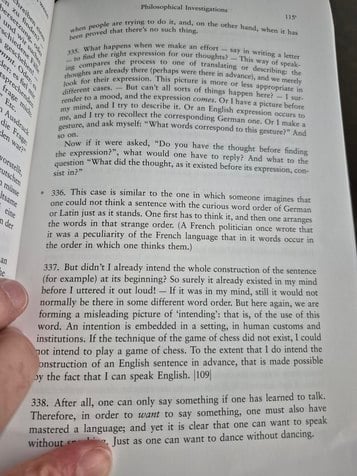
This very issue is discussed at length in Philosophical Investigations, starting at 335 and going to 339. The critical line comes at the end of 337 where my hand is, "To the extent that I do intend the construction of an English sentence in advance, that is made possible by the fact that I can speak English." That is, sure, you're word searching, but you must have an appreciation for the rules of the language game you play to even engage in the search. You might not know which chess move you'll make until you find it, but you necessarily searched within the confines of the rules.
-
 ProtagoranSocratist
278There seems to be, at least in english speaking countries, a big rift between the formal "proper" english and the various dialects. I personally wouldn't bet that it's different anywhere else, but that's a source of friction against the context-based simplification of languages that you describe.
ProtagoranSocratist
278There seems to be, at least in english speaking countries, a big rift between the formal "proper" english and the various dialects. I personally wouldn't bet that it's different anywhere else, but that's a source of friction against the context-based simplification of languages that you describe.
And predicting english over 1000 years into the future is quite a monstrous task: it seems that the technologies that people use in their daily life has a big effect on it, both in terms of vocabulary and manner of use. For example, it seems that the internet has encouraged the use of acronyms due to the freedom from phonetics. -
 Astorre
417An interesting topic, very much in line with my research into languages.
Astorre
417An interesting topic, very much in line with my research into languages.
According to AI and the articles I could locate, languages compress over time, with the more "evolved" languages showing great reliance upon contextual clues and less extraneous words like articles and the like — Hanover
In my opinion, this is quite controversial, since the very method of predicting future events based on hindsight is quite dubious. As we know, history develops in fits and starts, and some languages that existed 1,000 years ago (and were even considered global) are no longer used at all. This point is important to emphasize.
Mandarin, for example, is a highly compresed language, which is why native speakers translate English in a compressed way. As in they might say, "I bring two chair" instead of "I will bring you two chairs," often eliminating pronouns, plural designations and the like. — Hanover
This observation is interesting, but it may be related not to a desire to simplify, but to the native speaker's language itself. Specifically, in Chinese, tenses are expressed differently than in English, and the use of prepositions or copulas in many languages is replaced by suffixes. Therefore, when English is learned rather than acquired from birth, the native speaker's knowledge of their native language undoubtedly makes a difference. For example, as a native Russian speaker, I have great difficulty correctly placing words in sentences when I try to speak English. If we consider the differences with Turkic languages, such as Kazakh, it's difficult to grasp the use of copulas and prepositions (there, everything is done with suffixes). I also have difficulty expressing thoughts within the three cases that English has, and it seems that in my native language, what I want to say sounds more phenomenological, that is, more sensual. Although, of course, all this is mitigated by a more advanced knowledge of English.
What would I like to say about the current state of language? The constant invention of new, specific terms or different interpretations of words in narrow areas of human activity already easily leads to misunderstandings between representatives of different professions, even within the same language. This is easily verified: try philosophizing using a philosophical dictionary on a factory floor or in a boardroom—most listeners will say, "Interesting man, but what the hell did he say?"
What then does the hyper-compressed vehicle look like if not letters, words, and sentences? How does that shrug look prior to my shoulder shrugging? — Hanover
In my experience, I've noticed that expressing your thoughts in nuanced language is always slower than the thought itself. I like the flow of complexity and duration, because as I speak, I have time to think about what I'll say next. -
Banno
30.6k
I suppose it might be seen as pretty unfair on Pinker. :wink:I sense a category error in throwing a cognitive scientist into the ring with a philosopher. — Hanover
Yes, there is a significant difference in the tasks each has at hand, and you summarise that well, with Wittgenstein doing conceptual clarification while Pinker is seeking explanatory hypotheses. Wittgenstein is not, like Pinker, offering an alternative scientific hypothesis about the nature of language, but working through how we might coherently talk about language.
But these two are not mutually exclusive. In so far as Wittgenstein has a cogent description of what language is, Pinker's explanation of how language functions shouldn't gainsay it.
But as I understand Fodor and Pinker, symbolic manipulation goes all the way down. Mentalese is the real deal, and public language a pale shadow, forced to conform to the vagaries of public usage. So it appears to rely on private language from the get go.
I'm fairly confident about Fodor here, bit less so about Pinker. I'd need to do some reading. -
ProtagoranSocratist
278I suppose it might be seen as pretty unfair on Pinker. — Banno
Pinker would utterly disagree with OP, since OP says that language is the vehicle for thought. Overall, I'm more on the side of Pinker with the linguistic discussion here, even though I do think his analysis that language does not effect the way speakers perceive the world around them is too one-sided, even though the opposing theories he criticizes, about how language and perception are totally inextricable, are much more ridiculous in my opinion.
The other problem with compressing language based on context is that sometimes it does remove significant meaning. For example, "you need to pay better attention next time, and you're the one that needs to clean that up, not me.", is radically different from "the egg dropped", and there aren't any english speakers i know of that would use the latter as a replacement for the first one. You can of course cut the first one down substantially and preserve the important parts ("you dropped the egg, clean it up!"), which is generally what professional translation tends to be all about. -
 Outlander
3.2k
Outlander
3.2k
Could it be that times (perhaps even minds) were simpler as recent as 200 years ago before any sort of recognizable modern engine, let alone technology? Perhaps compounded by a harsher, constant "fight or die" environment before man gained mastery over said environment allowing for more time to think and "mentally evolve", per se? :chin:
Perhaps it depends on the climate of the environment as well. More time indoors versus moving around for survival (or perhaps a harsh winter climate that required long periods inside with one's community in a confined place with little to do) would probably lead to a sophistication in language. Or would it?
Ergo, language was simpler because times were simpler. There just wasn't much to talk about or perhaps even not much time to idly ponder the things the average person does today. -
 Jamal
11.8k
Jamal
11.8k
But first you'd have to show that languages were simpler in the past, and I don't think that's supported by historical linguistics. And @Hanover might be interpreted as pointing out the opposite: the simplification of languages over time, rather than their complexification.
But I don't think historical linguistics is in the region of what Hanover is really getting at, although with Hanover it can be difficult to tell, such is his wildly fecund mind. -
ProtagoranSocratist
278But I don't think historical linguistics is in the region of what Hanover is really getting at, although with Hanover it can be difficult to tell, such is his wildly fecund mind. — Jamal
Well done, you know how to compliment your moderator friend, but are surprisingly sensitive when someone criticizes one of your posts...even once. This ultimately the issue with just mysteriously erasing posts without any comment whatsoever, everyone just magically loses a reference. This is clearly not a very Socratic type of environment.
Why i thought it was possible for a moderator to engage in hypocrisy less frequently than what i've seen well...this one is beyond me...clearly there's some personal failing at work on my part. -
Jamal
11.8k
I honestly don’t know what you’re referring to, and so your post seems to me unmotivated and out of the blue. In any case, you’re off-topic. To complain about a member of staff, please create a new topic in the Feedback category. -
Hanover
15.3kErgo, language was simpler because times were simpler. There just wasn't much to talk about or perhaps even not much time to idly ponder the things the average person does today. — Outlander
Consider the number of cases in the following languages:
Modern English - 2
German - 4
Old English -4 or 5
Middle English - 2
Cherokee - 6
Mandarin - 0
A common cause for this simplification is the introduction of adult non-native speakers into language. Adults are poor learners of language and as diverse populations enter, the language corrupts through simplification, but, interestingly does not affect the ability of the language to convey information. This points to the fact that much of language serves functions other than direct communication of thought.
Any marker that comminicates one's ethnicity, country of origin, educational level, etc. serves sociological functions. It obviously matters greatly from an evolutionary perspective that I immediately know you were raised in Germany, you were born in Boston, that you were not formally educated, etc. Consider Cherokee, unless you are very adept at language learning, you will never convince a native speaker that you grew up on the reservation if you didn't because you'll never master the complexity of the language. You'll also never match their accent.
But this is all (an interesting) aside. My point wasn't to wander down the path of language evolution as much as to say that it's entirely possible that our internal language (and please don't confuse"private language" with "internal language" in the Wittngensteinian sense) bears limited resemblance to the full expressive language we use in public where we're trying to get others to understand us.
And Wittgenstein went to great lengths not to catagorize what a language is (as in requiring particular syntax or form), but only to require that it comport to a grammar, which he defines very liberally to mean that it follows rules within a particular community of speakers and is publicly confirmable.
I will concede of course to the speculative nature of AI's attempt at extrapolation of English in the year 3500. So you know, it could not reverse engineer from 2025 backwards simply because it's not possible to predict what arbitrary elements might have existed in a language over time and then fell out. -
Outlander
3.2kBut first you'd have to show that languages were simpler in the past, and I don't think that's supported by historical linguistics. — Jamal
Isn't that supported by basic evolution? Even common layperson knowledge (caveman grunts, etc.)? A child can barely speak, but typically, gains the ability to as most every person can today. Isn't this a parallel to evolution of human society?
Sure, that's not to say some societies or groups happened to evolve their language skills "quicker", at least in relative comparison to others who may have existed somewhere at the time. Perhaps those in the immediate past, who were forced to suffer and toil, thus bringing about the knowledge and experience we now take for granted as "common sense", may have been more advanced and then other societies kind of, you know, "simplified things" the way a computer used to take up the entire size of a room yet can now fit on a person's wrist and perform equal and even greater function, yes.
But I don't think historical linguistics is in the region of what Hanover is really getting at — Jamal
What is your take on his intention, then? Don't worry, he likely won't be offended if you're way off course. :razz: -
Jamal
11.8kIsn't that supported by basic evolution? Even common layperson knowledge (caveman grunts, etc.)? A child can barely speak, but typically, gains the ability to as most every person can today. Isn't this a parallel to evolution of human society? — Outlander
The "caveman grunts" idea is not supported by any evidence. It's just a nineteenth century stereotype. The fact is that we cannot know, looking back in time, what language was like beyond a certain point. But the earliest languages we can actually study, like Sumerian, Old Chinese, and early Indo-European languages, are more complex grammatically than many languages today. So the evidence actually runs the other way.
So as I said, historical linguistics doesn't support your speculative claim, which is an empirical claim best settled scientifically (i.e., by historical linguistics).
And no, child development does not recapitulate evolution: the speech of children does not mirror some earlier, ostensibly simple, stage of human language. Children speak simply because they're starting out in learning a massively complex system, and within a few years they've mastered it, whereas adults from other language communities take many years to become fluent. Crucially, this quick mastery is evidence of how deep and ancient our linguistic capacities already are—it does not in any way say that earlier languages were simpler. -
Hanover
15.3kIn my opinion, this is quite controversial, since the very method of predicting future events based on hindsight is quite dubious. As we know, history develops in fits and starts, and some languages that existed 1,000 years ago (and were even considered global) are no longer used at all. This point is important to emphasize. — Astorre
I concede to speculation, but trending of languages can be observed and general observations noted.This observation is interesting, but it may be related not to a desire to simplify, but to the native speaker's language itself — Astorre
As I've noted, much linguistic change occurs as the result of the introduction of non-native speakers (of course there's internal drift (caused by all sorts of things) as well, but this really isn't meant to be an all inclusive conversation in linguistics, much of which goes well beyond what I know). That is, people who speak other languages mix up the prior language, trending toward elimination of differences, resulting in a less complex system for the new members of the community. That is, if suddenly we see great change to a previously stable language, we can expect that a good number of adults just arrived and they are all insisting upon using that language.In my experience, I've noticed that expressing your thoughts in nuanced language is always slower than the thought itself. I like the flow of complexity and duration, because as I speak, I have time to think about what I'll say next. — Astorre
This is more specifically on topic with the OP. The critical distinction here is whether you are saying (1) you had a thought and it was in a primordial language, not something identfiable, but a constructed idea that had not yet seen language or (2) you had a full language that identified your thought but it was compressed and then you expressed it fully into complicated words and syntax. If you go with #1, you are arguing a mentalese. If #2, you are giving room for a Wittgensteinian analysis. -
Astorre
417
I've tried to think about this, but it's incredibly difficult. I've established for myself, and found it sufficient, the following: when I speak or write, I kind of imagine what I want my interlocutor to feel. This doesn't come in the form of words or even images, but rather in the form of emotions. That is, each subsequent word must be such that it evokes the response I intend in the other person's mind. Let me clarify how this works. In Russian, the everyday language of a normal educated person, there are about 40,000 words. This isn't bragging; it's the breadth of how subtly I can express what I feel. This makes me want to read literature, to master the language so that I can express precisely this feeling I've intended, down to the subtlest details. Incidentally, I think this is why Dostoevsky is so popular. He expresses himself incredibly precisely.
Here on the forum, I see that there are also people who speak incredibly precisely and use English to do so. And they achieve this not by the quantity of words, but by the ability to use fewer.
To answer your question, it's more about the emotional image I want to evoke in the interlocutor, and the words themselves emerge.


Welcome to The Philosophy Forum!
Get involved in philosophical discussions about knowledge, truth, language, consciousness, science, politics, religion, logic and mathematics, art, history, and lots more. No ads, no clutter, and very little agreement — just fascinating conversations.
Categories
- Guest category
- Phil. Writing Challenge - June 2025
- The Lounge
- General Philosophy
- Metaphysics & Epistemology
- Philosophy of Mind
- Ethics
- Political Philosophy
- Philosophy of Art
- Logic & Philosophy of Mathematics
- Philosophy of Religion
- Philosophy of Science
- Philosophy of Language
- Interesting Stuff
- Politics and Current Affairs
- Humanities and Social Sciences
- Science and Technology
- Non-English Discussion
- German Discussion
- Spanish Discussion
- Learning Centre
- Resources
- Books and Papers
- Reading groups
- Questions
- Guest Speakers
- David Pearce
- Massimo Pigliucci
- Debates
- Debate Proposals
- Debate Discussion
- Feedback
- Article submissions
- About TPF
- Help
More Discussions
- Other sites we like
- Social media
- Terms of Service
- Sign In
- Created with PlushForums
- © 2026 The Philosophy Forum