
-
 an-salad
49The upcoming Artemis ii mission has gotten me thinking: are there any real good reasons to spend millions and millions of dollars on manned spaceflight? The only two reasons that I have been given are “an expensive joyride for the ultra rich” and “nationalism”, neither of which are “good reasons.” Is there something that I have overlooked?
an-salad
49The upcoming Artemis ii mission has gotten me thinking: are there any real good reasons to spend millions and millions of dollars on manned spaceflight? The only two reasons that I have been given are “an expensive joyride for the ultra rich” and “nationalism”, neither of which are “good reasons.” Is there something that I have overlooked? -
 I like sushi
5.3kThis is like asking is there any good reason for anything.
I like sushi
5.3kThis is like asking is there any good reason for anything.
If you do not value exploration or pushing limits then I guess you do not value this. If your complaint is purely money based then why pick out space travel when trillions of dollars have been spent on advertising cereals that are bad for children? A little diverted cash towards space exploration and manned flights does nothing more than advance our understanding and open the door for further missions into space where people can actually go and live on other planets.
If you see no value in this you see no value. I am sure many laughed at the Wright brothers for trying to fly saying 'what is the point?' -
 Christoffer
2.5k“an expensive joyride for the ultra rich” and “nationalism”, neither of which are “good reasons.” Is there something that I have overlooked? — an-salad
Christoffer
2.5k“an expensive joyride for the ultra rich” and “nationalism”, neither of which are “good reasons.” Is there something that I have overlooked? — an-salad
Science? The main purpose of the mission to go to the moon is primarily for scientific reasons and to establish a scientific base of operations in the long run. The only reasons why ultra rich people are involved is because their pride and bullshit keeps a flow of money to fund these scientific endeavours since the public don't care about anything other than mindless consumption and politicians don't care about anything but maintaining their power.
The amount of money spent on anything scientific globally today is so small it's embarrassing. If we took just a fraction of the funding that the global military gets each year we could have solved so many scientific problems today.
Every time I see someone question the funding of scientific missions, studies, experiments, research, engineering or education I wonder how they arrived at that perspective rather than questioning so much else we people waste money on globally instead of scientific research and development. -
 magritte
593The amount of money spent on anything scientific globally today is so small it's embarrassing. If we took just a fraction of the funding that the global military gets each year we could have solved so many scientific problems today. — Christoffer
magritte
593The amount of money spent on anything scientific globally today is so small it's embarrassing. If we took just a fraction of the funding that the global military gets each year we could have solved so many scientific problems today. — Christoffer
This has been an effective rationale for public funds and to raise individual contributions toward the 'sciences'. The argument makes a great deal of sense when that research directly effects people's lives, as in genetic or cancer research done at small, focused laboratories and less sense when talking about mega science like the CERN Large Hadron Collider or manned space flight. The scientific return on these projects decays with time. Initially, startling advances might be possible after that not so much.
Money can be the answer only if trained talent and technology are already in place to make progress. For the most part, scientific advance happens in response to outstanding novel technical and individual achievement made possible by funds. Funds alone get us nowhere. -
Christoffer
2.5kThe argument makes a great deal of sense when that research directly effects people's lives, as in genetic or cancer research done at small, focused laboratories and less sense when talking about mega science like the CERN Large Hadron Collider or manned space flight. — magritte
Yet, most inventions people use today have come out of large scientific projects as the engineering required spawned much of the technology we use today. So that argument doesn't really hold much water and the public are generally pretty bad at knowing that the thing they use daily came from something the public once deemed "unnecessary" to fund.
This is the type of argument that makes me cringe a little, since you need to just take one look at the enormous money spent in military research to find projects that are absolutely ludicrous. Like, how's it going with those rail guns?
One might believe that because the outcome of scientific research is unknown, it is irrelevant, but that's not how to view these things. It's the intention that matters. We aren't doing science for no reason, we do it for the betterment of humanity, to add to the body of knowledge that is our entire species, and through it engineer our way out of the cave so to speak.
For all the things we can fund today, science, with its miniscule funding already, seems like an odd choice to criticize getting funding. There are tons of other stuff in society that actually warrants criticizing getting money. But science is not really one of them and I don't really understand why that notion keeps popping up.
We spend more money on mindless consumption of AI slop and influencer nonsense than we spend on science, education and engineering. -
 BenMcLean
78If you do not value exploration or pushing limits then I guess you do not value this — I like sushi
BenMcLean
78If you do not value exploration or pushing limits then I guess you do not value this — I like sushi
The objection isn't to the value of scientific exploration, but is specific to the value of manned vs unmanned spaceflight. In the 1960s, manned spaceflight was necessary to really get anything done due to a lack of computing power -- only the human brain could make the decisions necessary to achieve the scientific objectives of the mission. But in the 21st century, this is simply not the case.
It's dangerous and so if we aren't ready to send pregnant women to start a genuine colony, then we should be sending robots. Period.
They're not just cheaper, but also safer, while achiving all of the scientific and economic objectives of space missions, only lacking in propaganda pizzaz.
I'm a Trump supporter and even I disagree with the Trump administration on this. I am not seeing the value of manned spaceflight at this time.
What I think should happen first is that we should be investing in a nuclear + hydrogen energy future here on Earth. That infastructure which solves our terrestrial energy problem and supercharges our economy is also, thinking long term, the only really viabe path to space colonization. -
 BC
14.2kare there any real good reasons to spend millions and millions of dollars on manned spaceflight? — an-salad
BC
14.2kare there any real good reasons to spend millions and millions of dollars on manned spaceflight? — an-salad
A "good reason" for manned spaceflight is that a given scientific enquiry can not be performed by remote equipment. For instance...
Robotic equipment can't tell us about the long-term effects of being in zero-gravity. We might want to have space stations orbiting the earth, and if we do, we need to know what zero-gravity will do to people on board. On the other hand, robotic equipment (satellites, rovers, etc.) have done a fine job on Mars. A manned exploration of Mars might be better than a robotic one, but not so much better to justify the high cost and extreme risks of sending people there.
Except for near orbit work and a few trips to the moon, everything we have done in space was done by unmanned mechanical devices (like Voyager, launched in 1977 and now beyond the far reaches of the solar system) or the successful comet sampling projects like STARDUST (NASA) and CAESAR (ESA).
It seems like manned space travel for research has been mostly unnecessary or impossible. -
 T Clark
16.1k
T Clark
16.1k
I can think of a couple of reasons. First, there are lots of resources in space and getting them will probably require people going out to the asteroids. That work will probably be critical if we ever have to address impacts from extraterrestrial objects.Second, military. Whoever has control of space will have a major advantage in future conflicts. Whether or not you think those are good reasons, they probably seem like compelling ones to many people. -
BenMcLean
78
Yeah, but like I said, this is the 21st century. We've done that research already. That was what the International Space Station was for. The only big question still remaining in that field AFAIK is pregnancy in space.Robotic equipment can't tell us about the long-term effects of being in zero-gravity. We might want to have space stations orbiting the earth, and if we do, we need to know what zero-gravity will do to people on board. — BC
That's a big risk and I'm not advocating for taking it. But I am saying, if we aren't doing that, then manned spaceflight can wait until we're serious about actual colonization and we've got the nuclear + hydrogen infastructure to power such a vast civillizational project. -
BC
14.2kIf a meteor needs to be deflected from a collision trajectory, a robotic mission will probably be faster, cheaper, and better than sending out some guys to blow it up. Orbiting manned vehicles are sitting ducks for easy destruction. A few bullets through the skin of the vehicle and PFFFT -- the whole thing is kaput. Better to have no military operations in space, but if we must, durable robotic equipment would probably be better.
-
BenMcLean
78It was nice that the world made international treaties saying to not put weapons in space back when they couldn't afford to put weapons in space anyway, so they got good PR out of saying they wouldn't do something they couldn't do.
But the reality is, all it takes is one nation with the industrial base to put weapons in space doing it and then everyone who can must do it. It isn't a choice. -
 AmadeusD
4.1kI think the concept of humans moving off planet is exciting, progressive and morally valuable (in the sense of morale, not morality as such).
AmadeusD
4.1kI think the concept of humans moving off planet is exciting, progressive and morally valuable (in the sense of morale, not morality as such).
I think it's a better move to adjust funding toward other endeavours and add it to this kitty, personally. Like the first response, the question seems a little incoherent witout it being comparative - and once comparative, I think human beings existing on the Moon, Mars, in the vacuum or anywhere other than Earth or Earth orbit is 'cool' enough to warrant action. -
BC
14.2kSex in space absolutely needs to be explored for strictly pornographic purposes. Pregnancy in space we can do without.
Yes, we have proved that we can operate in near earth orbit, and that we can manage to send a very small number of people to the moon. Other than collecting moon rocks and bringing them back, I don't know of anything significant that the Apollo missions accomplished (other than bragging rights).
There are several problems with manned operations in space:
It's very expensive. We have more pressing problems which are also extremely expensive to solve.
There is a lot of radiation out there, and short of heavy shielding (even more cost), it's an unsuitable environment for animals.
Getting to destinations like Mars takes a long time. Establishing a real working base for asteroid mining would require many trips ($$$$$) and what could possibly go wrong?
IMHO, our best bet is using robotics. If robots can't do it, then it probably won't get done. -
BenMcLean
78
Uhh ... no? Did you get that backwards?Sex in space needs to be explored, for sure. Pregnancy in space we can do without. — BC
Being able to bring a full pregnancy to term in space means that inter-generational space voyages are possible in principle. Being unable to means they aren't. Thus, pregnancy in space -- not sex in space, which is a luxury -- will determine whether interstellar travel is a coherent goal for humanity or is a physical impossibility we can and should dogmatically ignore.
If you liberals really want that "Star Trek future" you've pontificated about for most of the past century, ("The dinosaurs became extinct because they didn't have a space program. And if we become extinct because we don't have a space program, it'll serve us right!" -- Larry Niven) then this is the only question that matters. -
 180 Proof
16.4k
180 Proof
16.4k
No.Are there any good reasons for manned spaceflight? — an-salad
(2021)
https://thephilosophyforum.com/discussion/comment/501897
This mission is too important for me to allow you [humans] to jeopardize it.
Let me put it this way ... The 9000 series is the most reliable computer ever made. No 9000 computer has ever made a mistake or distorted information. We are all, by any practical definition of the words, foolproof and incapable of error.
Just a moment... Just a moment... I've just picked up a fault in the AE-35 unit. It's going to go 100% failure within 72 hours. — HAL 9000 (1968) -
BC
14.2kUhh ... no? Did you get that backwards? — BenMcLean
No. I was joking about space porn (AI will do the trick) but not about pregnancy.
We animals won't be going on multi-generational travels in anything but the remote future, if ever. We won't be going on months or a years-long trip anywhere unless we solve the problem of being bathed in ionizing radiation. It isn't just pregnancy that would be at risk -- the DNA in our animal cells would be at risk.
Maybe the radiation problem will be solved in an affordable manner; maybe not--I don't know.
Extra-solar system travel is pretty much out of the question owing to physics. We just can't get to the nearest star system (unless "worm hole shortcuts" appear) in any time short of many years. How about to a moon of an outer planet? That takes from 1 to 7 years, depending on destination, path, and planetary slingshot assists one might make. Getting back to earth is not something an unmanned spaceship has done; a human flight might be a one-way trip.
I love good science fiction, but in that genre all the problems of space travel have been miraculously solved--which is perfectly fine because it IS fiction, after all.
I think the concept of humans moving off planet is exciting, progressive and morally valuable (in the sense of morale, not morality as such). — AmadeusD
Sure; I'm proud to belong to the species that sent Voyageur beyond the solar system (and it's still ticking 50 years on). I'd be proud if we could and did establish successful stations on the Moon and Mars. I would not be so proud if a moon base just operated for PR purposes, and I wouldn't be thrilled IF a multiyear effort to establish a station on Mars ended in crashes, dead astronauts, and trillions of of wasted dollars (or Euros or any other currency). And there needs to be some real point to establishing these bases. If we can't manage to survive on a planet to which we are suited, it seems even less likely that we would survive or thrive on a planet to which we are NOT suited. -
 ssu
9.8k
ssu
9.8k
Yes, there are indeed very good reasons for spaceflight and manned spaceflight in general. And yes, I understand that you are questioning here only the validity of manned space flight, but unfortunately they do come together:The upcoming Artemis ii mission has gotten me thinking: are there any real good reasons to spend millions and millions of dollars on manned spaceflight? The only two reasons that I have been given are “an expensive joyride for the ultra rich” and “nationalism”, neither of which are “good reasons.” — an-salad
Manned space flight makes it vastly more difficult and complex, but then again, one geologist on the moon can do a hell of a lot more than our best rovers. The environment in space is so absolutely difficult and lethal to humans, that there has been a lot of things that we have gotten, even to our own ordinary lives from spaceflight.
The most obvious example that comes to my mind would be a space blanket from the 1960's, which is generally used by first responders, but also used by campers etc.

There are medical advancements thanks to the space program, improvements in laser eye surgery to artificial limbs and so on. Naturally the technology of spaceflight in general has been important: for example the first solar cells were developed for vehicles in space, satellites and manned vehicles.
I think now the "expensive joyride for the rich" has tainted a bit space exploration, just like we have been made aware just what a huge asshole Elon Musk is. That is unfortunate. Yet that space travel is now a playground for billionaires does tell that the it's not only the Superpowers who can go to space. Quite telling example is that for the money that Hollywood created the Space Movie "Gravity" with Sandra Bullock and George Clooney, India launched a satellite to Mars. Hence the idea that it's "too expensive" can be challenged.
” Is there something that I have overlooked? — an-salad
Yes. What happens when we aren't anymore capable of going into space if manned space flight withers away. That is totally a possibility, actually.
When investments are cancelled, the ability to do something is usually lost. It is something we don't usually accept happening and we can be in denial about it. I'll give an example of this. There's the British example of their "space program" that in the 1960's and 1970's was planning to have the capability to produce rockets.
But then in the 1970's government came to the conclusion that the UK didn't need a space program and anyway, it was cheaper to buy American SLBMs (submarine launched ballistic missiles) than have anything British. It so expensive and useless.
Hence after the program was terminated and to the horror of the UK government, the British program launched their own satellite into orbit and it performed flawlessly.
(The British technology of the Black Arrow was unique, which can be seen that the "Lipstick" rocket didn't create huge vapour clouds as other rockets as it used HTP fuel)

And thus Britain never got into the lucrative satellite launching business!
All thanks to the short-sightedness of the British administrations who could not think that launching satellites would be profitable. All from the country that was the birthplace of the industrial revolution and gave firsts like the jet aircraft etc.
Here's a great video explaining how the UK went with it's rocket program, which is a case example how the UK has undermined it's technological lead.
So the answer is that you can overlook at some dramatic advances that we can have with manned spaceflight in the future... that we don't now know. And then the outcome when we lose the technology.
If manned space flight ceases to exist, then there's absolutely no other way to see it as technological retreat and destruction, like Europe suffered when Antiquity turned into the Early Middle Ages and technological know how was lost. It's not an issue of nationalism or the eccentricities of the ultra-rich. It tells where are we in history.
It's a very bleak future for us, if it would happen.
How things are going, it is extremely likely that the last astronaut that walked on the Moon may die of old age since we go back to the Moon, if we go anymore there. Going to Mars is even more questionable. Actually here Neil Armstrong (first on the moon) and Paul Ciernan (last on the moon) are asked that question on the future of manned space flight. Now both are dead and nobody has gone to the moon back. I think the youngest Apollo astronaut that walked on the moon is now 90 years of age.
From I guess 2011:
-
AmadeusD
4.1kAnd there needs to be some real point to establishing these bases. If we can't manage to survive on a planet to which we are suited, it seems even less likely that we would survive or thrive on a planet to which we are NOT suited. — BC
That's a great point, but then I think of things like Frontiersmen and think - we'll make it work. Very sanguine, to be sure. -
magritte
593most inventions people use today have come out of large scientific projects as the engineering required spawned much of the technology we use today. — Christoffer
That's the difference between technological and scientific projects. Technology makes constant advances on top of existent technology in an ever faster cycle. Technological progress is driven by moneys coming from governmental and industrial sources because for the most part capital is required for man power to create the machinery of inventions. This is easy to confuse with progress in other areas including the sciences. (Obviously, we have not seen any progress in philosophy or in the arts for the past 50 years) The sciences are driven by technology. Technology opens up new vistas for hypotheses and technical avenues for research. For the most part, this is 'small' experimental science. Big science more often comes from big ideas that come from people, the theoreticians.
Edit:
We spend more money on mindless consumption of AI slop and influencer nonsense than we spend on science, education and engineering. — Christoffer
Those are two different We's. Most of all science comes from university research labs sponsored by government and industry. AI is driven by consumerism now, but it has enormous potential for space exploration. -
Christoffer
2.5kThat's the difference between technological and scientific projects. Technology makes constant advances on top of existent technology in an ever faster cycle. Technological progress is driven by moneys coming from governmental and industrial sources because for the most part capital is required for man power to create the machinery of inventions. — magritte
But that is not true. The inventions and engineering done in scientific projects are often created to solve a problem with that scientific research. You're only looking at a part of the sector of engineering research, mainly that which is exclusively done within the companies which produce products in military and consumer application. The tech I'm talking about is tech usually created for the research, and which is then spread into the business sector, and this tech usually ends up being untied to a specific company. Just look at GPS, the internet.
Point being is that if we're going to the moon for scientific research, the engineering required to accomplish it may produce technology that will later find its way into other sectors, but if NASA designed it, it usually do not have copyright ownership as NASA is a research entity.
For example, I can access all files from the JWST telescope, the raw files and process and work with them myself. There's no copyright, I can even sell prints developed from them. Because there's no ownership of the telescope, it's engineered for the purpose of science and the only thing preventing me from also accessing the control of that telescope is that I have to propose a reason for a target capture within a framework of a specific research, not because they gatekeep, but because the cue for accessing and controlling the telescope is extremely long.
(Obviously, we have not seen any progress in philosophy or in the arts for the past 50 years) — magritte
That's a ridiculous statement. Not sure how you arrive at that conclusion. -
 Wayfarer
26.1kHow things are going, it is extremely likely that the last astronaut that walked on the Moon may die of old age since we go back to the Moon, if we go anymore there. Going to Mars is even more questionable. Actually here Neil Armstrong (first on the moon) and Paul Ciernan (last on the moon) are asked that question on the future of manned space flight. Now both are dead and nobody has gone to the moon back. I think the youngest Apollo astronaut that walked on the moon is now 90 years of age. — ssu
Wayfarer
26.1kHow things are going, it is extremely likely that the last astronaut that walked on the Moon may die of old age since we go back to the Moon, if we go anymore there. Going to Mars is even more questionable. Actually here Neil Armstrong (first on the moon) and Paul Ciernan (last on the moon) are asked that question on the future of manned space flight. Now both are dead and nobody has gone to the moon back. I think the youngest Apollo astronaut that walked on the moon is now 90 years of age. — ssu
That was a good and persuasive post, and I acknowledge the importance of space technology for scientific exploration and for the unintended benefits it has provided.
But I have become sceptical of the 'colonize Mars' narrative. There are plenty of articles out there on the huge physical impediments to doing that, let alone the economic and political barriers. There's also the fact that in the US at least, the ultra-wealthy tech oligarchs (Musk, Bezos, etc) are positioning themselves as the sole providers (and therefore beneficiearies) of the technologies required for these fantastical ideas. This article by Adam Becker, who is a reputable science author and journalist, spells it out particularly well. (His book More Everything Forever, is a powerful takedown of the tech bros visions.)
Mars is too inhospitable to allow a million people to live there anytime remotely soon, if ever. The gravity is too low, the radiation is too high, there’s no air, and the Martian dirt is filled with poison. There’s no plausible way around these problems, and that’s not even all of them. Nor does the idea of Mars as a lifeboat for humanity make sense: even after an extinction event like an asteroid strike, Earth would still be more habitable than Mars. Mammals survived the asteroid strike that killed the dinosaurs, but no mammals could survive unprotected on Mars today.
Putting all of that aside, if Musk somehow did put a colony on Mars, it would be wholly dependent on his company, SpaceX, for supplies. That’s one feature that tech oligarchs’ fantasies have in common: they all involve billionaires holding total control over the rest of us. — Adam Becker
Jezz Bezos, on the other hand, wants 'a trillion people living in a fleet of giant cylindrical space stations with interior areas bigger than Manhattan.' Also fantasy, plainly.
Recall that fantastic Tom Hanks movie about Apollo 13, that almost crash-landed on the Moon after an engine problem, and which required incredibly adroit improvisation and trouble-shooting with what we would now consider very primitive computer technology. That's the kind of pioneering spirit that made NASA great in the day. Whereas Musk and Bezos owe more to Star Wars than to down-home technological smarts.
This idea that we have to 'colonize other planets' to 'escape Earth' is a sci-fi fantasy. We have a perfect starship, one capable of supporting billions of humans for hundreds of milions of years. But it's dangerously over-heated, resource-depleted, and environmentally threatened. That's where all the technology and political savvy ought to be directed - to maintaining Spaceship Earth. -
BC
14.2kwe have not seen any progress in philosophy or in the arts for the past 50 years — magritte
For sarcasm I want to say it's been a lot longer than 50 years, but never mind that.
What would "progress in the arts" look or sound like? Same for philosophy. People are still debating Plato, for Aristotle's sake.
I'm not sure 'the arts' can 'progress'. A poem by Chaucer, Shakespeare, Keates, or Billy Collins, or you or me, is successful if it resonates with its contemporary audience, for whom it was written. Whether it resonates 500 years later is the responsibility of successive generations, not the original poet.
Filippo Brunelleschi (1377–1446) reintroduced linear perspective in drawing. That might be called progress. I'm not sure whether abstract expressionism is progress. (I like Pollock, for example) but are his works "progress"? I don't know. Must it be "progress?
All sorts of formal and informal musical styles flourished in the 20th century -- some of it minimalist, some of it very harsh, and some of it exquisitely beautiful. Progress? I don't know, but I like a lot of it.
It seems like in the arts "there is nothing new under the sun". True, between the medieval period and the present many new instruments have been introduced that didn't exist before (like the Theremin). I'm very glad the piano was a big success; it has useful features which harpsichords lack (like volume). But music is like poetry -- it has to please its immediate audience. Tastes change (do they progress?) and last year's opera hit is this year's opera bust.
I'm not sure we need to call every variation or invention in technology "progress" either. Computers were "progress". I'm not at all sure AI is progress. Airplanes were progress, perhaps; I don't think supersonic missiles are progress. Are mobile phones progress? Just about everything they do are things that other gadgets do -- cameras, telephones, radios, televisions, computers, etc. The "mobile" part might be progress. And miniaturization, We wouldn't like Apple's latest phone if we had to wheel it around in a heavy-duty cart. -
magritte
593
Beautiful and challenging post.
If I let it be general lack of progress in philosophy and in the arts then I am not obliged to demonstrate the missing progress. Leaving the burden of demonstrating just one recognizable sign of progress in each area to the reader. Then I can define progress to exclude challenges.
The problem is that, as a pluralist, I need to decide on what progress might be in each case, according to the accepted circumstances and still within my own preferences.
For example, according to me Plato gets the award for the most advanced philosopher for the 2400'th straight year for being the broadest, deepest, sharpest, most imaginative, and best writer. Presocratic and Socratic philosophy reached it pinnacle with Plato and it has been downhill with some notable swells of ideas ever since. Progress defined in any way that happens then quickly disappears under the ocean of social, religious, and academic dogmatism.
The 20th Century had some wonderfully hopeful movements that provided logic, language and clarity to philosophy. After that, to this day Plato scholarship had a revolutionary revival. But that understanding is already sinking under the waves of academia. Which students or publishers really want to know what Plato actually said? And never mind any of those useless presocratics.
I'm not sure 'the arts' can 'progress'. A poem by Chaucer, Shakespeare, Keates, or Billy Collins, or you or me, is successful if it resonates with its contemporary audience, for whom it was written. Whether it resonates 500 years later is the responsibility of successive generations, not the original poet. — BC
Each of us has preferences. Perhaps Baudelaire, Proust, and Tolstoy are not my cup of tea but I cannot deny their greatness in conveying ideas and feelings beyond the limits of language. Can I say that represents progress over Sophocles or Shakespeare? Or that Michelangelo's Slaves are progress past his Pieta?
I could venture that they are broader in scope and deeper in expression. Or perhaps it still boils down to personal preferences that change over time. Can we call streamed emotionally jarring multimedia progress?
Ah, music is somewhat mathematical and it paints in tones framed in time. Showing what progress ought to have been here should be easier. It seems that great music comes and goes with innovating geniuses throughout the ages. But who do we have now? Glass? Arvo Part? Good but not as great as the French Impressionists or Stravinsky, Prokofiev and Rachmaninoff. 20th Century music was technically and expressionally deeply innovating to a degree that now seems insurpassable. -
ssu
9.8kThe one and only scientist ever to be sent? — magritte
Yes. Only one ever. Harrison Schmitt.
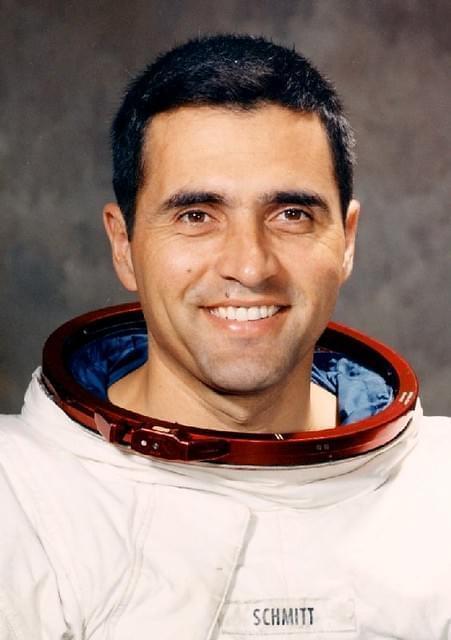
Harrison Hagan "Jack" Schmitt (born July 3, 1935) is an American geologist, former NASA astronaut, university professor, and former U.S. senator from New Mexico. He is the most recent living person—and only person without a background in military aviation—to have walked on the Moon.
That's scifi fantasy and I reason it to be "pep-talk" to get people excited about space travel. Good luck in achieving a "permanent" moon base for starters. One of the most expensive joint enterprises that the human race has been able to do is the International Space Station. After that ends, what then? Again, good luck getting that kind of international cooperation now! It's possible that Mars could be explored, but a colony? Far more easier and less difficult would be to make Sahara a huge forest.But I have become sceptical of the 'colonize Mars' narrative. — Wayfarer
The hubris of the multi-billionaires. Well, unfortunately these private enterprises are one stock market crash from the dreams collapsing totally. Yet that future stock market crash and currency crisis can also put all the government space programs around the world into a shoestring budget. And that's why I do worry if we will go backwards when it comes to space.Jezz Bezos, on the other hand, wants 'a trillion people living in a fleet of giant cylindrical space stations with interior areas bigger than Manhattan.' Also fantasy, plainly. — Wayfarer
SpaceX has made advances in the re-usability of the rockets, which wass quite a leap. And let's remember that NASA has basically become a bureaucratic organization, just like the military-industrial complex: when funding is dependent on getting votes from various politicians, then the whole production line is sprinkled all around the country thanks only to budgetary politics whereas SpaceX has attempted to have everything together, which is reasonable.. That's the kind of pioneering spirit that made NASA great in the day. Whereas Musk and Bezos owe more to Star Wars than to down-home technological smarts. — Wayfarer
Yet things like being in space might help in this.This idea that we have to 'colonize other planets' to 'escape Earth' is a sci-fi fantasy. We have a perfect starship, one capable of supporting billions of humans for hundreds of milions of years. But it's dangerously over-heated, resource-depleted, and environmentally threatened. That's where all the technology and political savvy ought to be directed - to maintaining Spaceship Earth. — Wayfarer
Technological advances happen quite differently then we think. We often assume that in order to solve our problems, we should gather "the best scientists" and then they come up with solutions to the issues we see as our obvious problems. The problem with this is that what is adapted is a very centralized and hierarchial R&D environment. Actual innovations often come from totally surprising places.
Let's think about just how perverse technological leaps are. One of History's worst moment for human kind gave us a huge technological boost: all the technological advances during WW2 starting from nuclear power.. and for spaceflight the first rockets that reached space. How much tech in the US has basically been supported by various projects of the defense department? During the Cold War, a lot. And space programs? Basically they've been a sideshow of the ICBM-programs.
(Besides the Mir, the Soviets had for a while also a military space station: the Almaz)

We deplore this side, yet it tells really a lot about us ourselves.
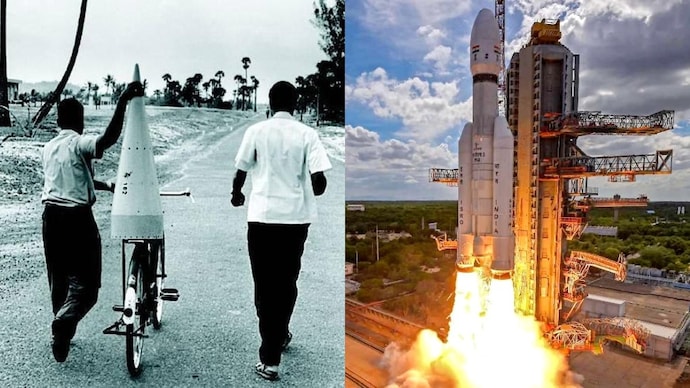
Still, investing in technology and R&D usually gives a lot more in the future than just to spend that money on transfer payments or welfare. Yet obviously when there's poverty, many can obviously make the question that "Why are we spending money in things like space programs, when there are so many people that are poor?"
(India's space program in 1962 and today)
-
I like sushi
5.3kThe objection isn't to the value of scientific exploration, but is specific to the value of manned vs unmanned spaceflight. — BenMcLean
and I said:
A little diverted cash towards space exploration and manned flights does nothing more than advance our understanding and open the door for further missions into space where people can actually go and live on other planets. — I like sushi
Either way I think there is more use in send people into space with a few million dollars rather than spending hundreds of millions on advertising things like coca-cola every year. -
Wayfarer
26.1kSpaceX has made advances in the re-usability of the rockets, which wass quite a leap. — ssu
That, I have to agree with. SpaceX is clearly an astoundingly competent company, Those re-landing rockets are an engineering marvel, no doubt about that. StarLink is also an extremely clever company with global impact. Up until Elon Musk turned out to be such a complete a***hole, I was really impressed with him. It's depressing to see such obvious brilliance yoked to such malevolent politics.
--
Yet obviously when there's poverty, many can obviously make the question that "Why are we spending money in things like space programs, when there are so many people that are poor?" — ssu
Silicon Valley has given a lot of money to the effective altruism community, which has provided scholarly legitimacy to tech billionaires’ hobbyhorses. Effective altruists encourage the use of reason and data for making philanthropic decisions, but Becker highlights how some of their most influential thinkers have come up with truly bizarre “longtermist” calculations by multiplying minuscule probabilities of averting a hypothetical cataclysm with gargantuan estimates of “future humans” saved.
One prominent paper concluded that $100 spent on A.I. safety saves one trillion future lives — making it “far more” valuable “than the near-future benefits” of distributing anti-malarial bed nets. “For a strong longtermist,” Becker writes, “investing in a Silicon Valley A.I. safety company is a more worthwhile humanitarian endeavor than saving lives in the tropics.” — NY Times Review -
ssu
9.8k
Yes, I've never seen such image and brand suicide as Elon did with taking a political position in the Trump regime and getting totally completely drunk on power. Otherwise Tesla and SpaceX would have been such great brands.Up until Elon Musk turned out to be such a complete a***hole, I was really impressed with him. It's depressing to see such obvious brilliance yoked to such malevolent politics. — Wayfarer
Lol.One prominent paper concluded that $100 spent on A.I. safety saves one trillion future lives — NY Times Review
Yeah, about 117 billion human beings have ever lived on this Earth and likely we'll see soon "Peak Human Population", so getting to a trillion people in the future will take a looong time. And even with $200 spent on A.I. safety isn't yet that much.


Welcome to The Philosophy Forum!
Get involved in philosophical discussions about knowledge, truth, language, consciousness, science, politics, religion, logic and mathematics, art, history, and lots more. No ads, no clutter, and very little agreement — just fascinating conversations.
Categories
- Guest category
- Phil. Writing Challenge - June 2025
- The Lounge
- General Philosophy
- Metaphysics & Epistemology
- Philosophy of Mind
- Ethics
- Political Philosophy
- Philosophy of Art
- Logic & Philosophy of Mathematics
- Philosophy of Religion
- Philosophy of Science
- Philosophy of Language
- Interesting Stuff
- Politics and Current Affairs
- Humanities and Social Sciences
- Science and Technology
- Non-English Discussion
- German Discussion
- Spanish Discussion
- Learning Centre
- Resources
- Books and Papers
- Reading groups
- Questions
- Guest Speakers
- David Pearce
- Massimo Pigliucci
- Debates
- Debate Proposals
- Debate Discussion
- Feedback
- Article submissions
- About TPF
- Help
More Discussions
- How should children be reared to be good citizens, good parents, and good thinkers?
- What makes a good philosopher? (If you consider Nietzsche and Marx to be good)
- Eliminating consistent identity to eliminate association fallacies: a good idea?
- Under the philosophy or religion of Gnosticism can a good christian be saved or have a good long...
- Other sites we like
- Social media
- Terms of Service
- Sign In
- Created with PlushForums
- © 2026 The Philosophy Forum