
-
 Athena
3.8kIn another forum, someone posted a warning for the US about following the path that led to the Nazis and the horrors of the Second World War. I am wondering what Socrates, Plato, and Aristotle would say about what happened in Germany and what is happening in the US, and the importance of the separation of church and state. Is the separation of church and state even possible?
Athena
3.8kIn another forum, someone posted a warning for the US about following the path that led to the Nazis and the horrors of the Second World War. I am wondering what Socrates, Plato, and Aristotle would say about what happened in Germany and what is happening in the US, and the importance of the separation of church and state. Is the separation of church and state even possible?
Today, Franklin Graham is in charge of the multimillion-dollar organization his father made possible. Franklin Graham is a supporter of Trump, as Evangelicals supported Hitler. Christians ignored the suffering of Palestine and supported Israel almost from the beginning for religious reasons. This is a hard pill for non-Christians to swallow, and the way protesters wanting to defend the Palestinians, were treated, was religiously and politically motivated. There are serious ramifications that could lead to a 3rd world war. What would Socrates, Plato, Aristotle, and Cicero say about this?
I will repeat that the US is on the path of Fascism and the Evangelicals are a strong force for this, because that has me very worried. -
 jkop
1kIs the separation of church and state even possible? — Athena
jkop
1kIs the separation of church and state even possible? — Athena
Of course.
For example, in Sweden state and church separated gradually in the 1800s and 1900s, and completely in 2000. Sweden is a secular state allowing freedom of religion. Most swedes would say that religious belief is a private matter.
Unlike private belief, a church is a means to practice shared belief in large groups, which then becomes an opportunity for its leaders to control people. A state can therefore use a church to control entire populations. -
 BC
14.3kThank you for the post. White Christian Nationalism (WCN) may or may not be the harbinger of a future fascist United States, but if such a thing should happen, WCN will definitely be on the reviewing stand as the Männerbund stomps past singing
BC
14.3kThank you for the post. White Christian Nationalism (WCN) may or may not be the harbinger of a future fascist United States, but if such a thing should happen, WCN will definitely be on the reviewing stand as the Männerbund stomps past singing
… In our own towns, we're foreigners now
Our names are spat and cursed
The headline smack, of another attack
Not the last, and not the worst
Oh my fathers, they look down on me
I wonder what they feel
To see their noble sons driven down beneath a cowards heel
Oh by God we'll have our home again...
Church and state can be, and have been kept separate a good share of the time (IMHO). What can't be, and hasn't been, kept separate are religious and secular cultural drivers. Sometimes that is a very positive thing -- think of the mix of religious and secular impulses in the mid-20th century civil rights movement. There is a long history of the religious-secular mix, from the Puritans to the present.
Add racism, nationalism, testosterone, resentment, etc., and you have a highly toxic brew.
I agree that there are very conservative Christian denominations and congregations that are hotbeds of authoritarianism. A lot of them are charismatic / evangelical. But the term "evangelical" also applies to mainline Lutherans, (it's part of their official name), who are far from WCN.
Prayer breakfasts at the White House are an abomination, for sure, and we should remember Jefferson's statement, "Indeed I tremble for my country when reflect that God is just: that his justice cannot sleep for ever." -
 Paine
3.2k
Paine
3.2k
Yours is a helpful consideration. The abolitionists of ante bellum U.S. were an important force against slavery, even though most other opponents to the institution at the time were more self-interested. Lincoln started in the latter camp but ended up in the "justice of history" group by the time of his second inauguration. -
Athena
3.8kWhat forces separated Sweden's Church and State? Billy Graham established a relationship with Eisenhower during the Cold War with the Soviet Union. The US was intentionally united against the Soviet Union with constant media bombardment of those ungodly people. At this time, the word "God" was added to our Pledge of Allegiance. We did not always say "one nation under God".
This is how the US Pledge of Allegiance was written..
"I pledge allegiance to my Flag and to the Republic for which it stands, one Nation indivisible, with Liberty and Justice for all".
I would love it if we could get back to the Pledge of Allegiance. We sure need that Pledge of Allegiance today.
PS I remember when our day at school started with the original pledge. -
Athena
3.8kWhite Christian Nationalism (WCN) may or may not be the harbinger of a future fascist United States, but if such a thing should happen, WCN will definitely be on the reviewing stand as the Männerbund stomps past singing — BC
Where did you get your information about the White Christian Nationalism? I have a couple of books on the subject, and I was shocked when I first learned about it. "American Theocracy- The Peril and Politics of Radical Religion, Oil, and Borrowed Money in the 21st Century" by Kevin Phillips is frightening. We have "In God we trust" stamped on our money. :worry: I thought it was harmless, but not anymore.
That book brings up the rift between the North and South and the US Civil War. To pull this into a philosophical point of view, Socrates questioned the belief in the gods and was executed for this. That doesn't fully address my question: just how dangerous is this clash of religious perspectives, and how dangerous is the South's determination to win the Civil War?
Texas Republicans stood against schools teaching the Higher Order Thinking Skills. These are the skills needed for independent thinking, and the TR argued against children learning them because the children will question their parents' judgment. Understand, TR is favoring authority over the people, and uses Christianity for this purpose. Teachers had to take Texas to court to end teaching Creationism in science textbooks and classes. In the oil-controlled states, the science for understanding global warming is not taught.
Did Sweden have anything like this? Is there anything we can do about it? Might we at least get back to the original Pledge of Allegiance? -
Athena
3.8kWe still are not at peace with the meaning of "human rights". Both the North and the South thought God was on their side, making the war worse than it would have been if God had nothing to do with the war.
I checked AI to be sure I have remembered correctly. "In the antebellum South, pro-slavery advocates argued that slavery was a "positive good" and an essential part of the social and family order." -
Paine
3.2k
When one searches Google Scholar for "denominations that split during the civil war", the results show how divisive the presence of slavery had become.
This happened in the context of the Establishment of Religion clause of the First Amendment. It is this inclusion that has been the most important separation of church and state. It was adopted to avoid the religious dynamic that drove the English Civil Wars.
WCN would like to bring that dynamic back -
jkop
1kWhat forces separated Sweden's Church and State? — Athena
I'd say gradual changes in how the state remains in charge until it no longer needed the church.
Already back in the 1500s the state cut its ties to the Roman church because a national church would give the state more control of its people. So the king formed a national church based on evangelical lutheranism, and although it had its own priests they were ultimately controlled by the state. Formally, the state's king or prime minister was the head of the national church.
So for almost 300 years state and church were joined, and being a citizen meant being a member of the national church.
But in 1862-63 new laws defined the role of local municipalities and congregations. This meant a change in the administration of your citizenship and place of birth. Membership to the national church was detached from citicenship and administered instead by the local congregation where you are born. So you're still a citizen and a member of the national church, but citizenship and membership are now separate things.
In the 1900s we got laws that allow freedom of religion, including the freedom to leave one's membership to the national church, and in the 1990s the state decided to cut the remaining formal and administrational ties to the national church. Administration of where people are born and where they live is nowadays handled by the tax authority.
One might add, that modernity, access to free education, free healthcare, and increased living standard also reduced the relevance of the church. -
 Ludwig V
2.5k
Ludwig V
2.5k
A lot depends on what you mean by "separation". I was tempted to say that it is relatively simple to sort out at the institutional level. Quite a lot of states have done that in one way or another. However, it is a comparatively modern invention. For most of human history, church and state have been very closely aligned. Separating them was hugely controversial and complex. Nonetheless, many states have achieved it and it seems to me that it is not longer a hugely divisive issue in most states that I know of. (Iran is a prominent exception.)Is the separation of church and state even possible? — Athena
That's right. A national church is a powerful instrument of control for the state. So it is remarkable that the Roman Catholic church sustained its position in so many countries for so long. The key point is the question of loyalty, and the independent church could easily become a force to undermine the state. Very few states would put up with that, and during the Reformation in Europe, the dam burst in country after country.Unlike private belief, a church is a means to practice shared belief in large groups, which then becomes an opportunity for its leaders to control people. A state can therefore use a church to control entire populations. — jkop
However, even if church and state are institutionally separated, that doesn't mean the the church(es) will not exercise power in different ways. A church is a large body of organized people, so, at an institutional level, it seems inevitable that churches will have a considerable influence on the state, alongside all the other lobby groups that vie for the opportunity to exercise their influence.
Desirable as it is, it seems to me asking a lot to ask people to keep their religious beliefs as a private matter. Religions are about how to live life and pursue happiness. Religious beliefs are hugely important to people. It seems to me most unrealistic to expect people to keep their most important beliefs, not only about their own lives, but about the lives of everyone else as well, entirely to themselves. -
Athena
3.8kThat is a very interesting explanation. I am going to have to think on that for a while, because it is so far beyond anything I have experienced. I love the way you explain the change
"This meant a change in the administration of your citizenship and place of birth." Registration of my birth was secular, and a state-authorized copy of my birth certificate is essential to having a driver's license. When I was given custody of my grandchildren, copies of their birth certificates were essential to getting assistance.
Thank you so much. My head is working on the relationships. We have so many churches that it would be insane if the church were still the main administrative authority. In my head, that looks like a pile of tangled yarn. -
Athena
3.8kIt was adopted to avoid the religious dynamic that drove the English Civil Wars.
WCN would like to bring that dynamic back — Paine
Ah, how delicious. I love history. But it can be ironic. The Puritans in their North American colony did not practice religious freedom. They drove people out if they didn't conform. But the Quakers were respectful to everyone, even native Americans. They follow Jesus and ignore the Old Testament. It is my understanding that Quakers played a strong role in establishing American values and in ending slavery.
Hmm, what all do we have in this stew? I am going to have to think a little harder about the fact that Christianity is not one thing! Evangelists have become very popular, and they are using the latest technology to reach every life and convert every person, and they seem fine with blending with the government. They are following the path the Evangelicals followed in Germany, believing that God is in charge and works through strong men like Hitler and Trump. It is a myth that can have bad consequences. However, several of the demonstrations strongly oppose the blending of church and government.
I do not have enough information to untangle this. I do not know the reasoning of denominations that want the separation of church and state. -
BC
14.3kWhat forces separated Sweden's Church and State? — Athena
I can't remember who it was that said this, or in what book, but back in the '80s when I was reading a lot of theology, the author mentioned the state of Christianity in Sweden. He referred to the 1963 Bergman film, Winter Light, about a church so dead that not even God showed up. I saw the film a long time ago - it's very dry.
By and large, 'the church' in Europe (like Sweden, Germany, England, etc.) tends to be 'established', state supported, and thus at least somewhat state controlled. When European immigrants arrived in the United States (after the Revolution) they brought their home churches with them and had to support them without state subsidies or governance. The absence of state control and support is one reason why American Christianity has been much more successful and vital, particularly in the 20th century, while European churches faded. American Christianity has hatched all sorts of sects, sub-sects, and sub-sub-sects over the years, which has kept religion more lively here (for worse, mostly, not better).
Vital or not, whatever it was that drained European churches of congregants, started draining American churches of members too. By the decade of 1960-1970, protestant denominations, particularly, lost millions of members who never came back, and the losses continue. In 2026, it seems like the US has become more secular -- but not in the manner of liberal Europe .
Politics in the churches has become much more polarized, leading to new sectarian splits -- the breakup of the United Methodist Church over accepting homosexuals is a good example; or the rip in the Anglican Church over homosexuality and the ordination of women.
Polarization tends to separate people with extreme views from those with moderate views, and the extremists tend to be very conservative, more authoritarian, and nationalistic -- leading to fertile ground for White Christian Nationalism. -
BC
14.3kThe Puritans in their North American colony did not practice religious freedom. They drove people out if they didn't conform. — Athena
True. The Puritans were pretty rigid for the first 100 years or so (starting in the early 17th century). Over time, though, they mellowed out becoming as one historian put it, "balmy congregationalists". The Puritans established the "yankee" style of New England, believing that the state could be harnessed for good results for the people. "Yankeedom" spread westward, with migrating New Englanders, contributing to the progressiveness of northern states -- Massachusetts, New York, Pennsylvania, Ohio,Michigan, Indiana, Illinois, Wisconsin, and Minnesota. [see "The Nine Nations of North America"]
Yankeedom in general values public education, public health, public infrastructure, and so on--quite different than the pattern one sees across the southern tier of states.
So, what puritans did was use the state to build the secular 'city on the hill'. -
Athena
3.8kDesirable as it is, it seems to me asking a lot to ask people to keep their religious beliefs as a private matter. — Ludwig V
I wonder how old you are because I remember when things were different. My grandmother never talked about religion, and neither did I until Bush junior was reelected after putting us in a war with Iraq. That was the last straw for me.
In Dale Carnegie's day, our private lives were private. He was among the first experts on self-improvement and effective salesmanship. Back in the day, our lives were built on trust, and that meant good customer service and products made to last. It was such a different world. No religion had 25-million-dollar organizations, but Billy Graham was working with President Eisenhower in the 50tys to use religion to mobilize the capitalist US against the "godless" communists in Soviet Russia. On that day, both Graham and Eisenhower increased their power by quantum leaps when they agreed to work together.
In today's world, privacy, tolerance, and respect are soooo different. I went into shock when the news thought it needed to tell us that doctors found polyps in President Reagan's ass.:grimace: Franklin Roosevelt was crippled by polio, and the media kept that secret. I am quite sure Kennedy was a womanizer, and the press kept that secret. It was a different world. Religion was not marketed as it is today and I was not so aware of our government using Christian mythology to justify wars. That has to end. -
jkop
1kit seems inevitable that churches will have a considerable influence on the state — Ludwig V
I don't think the state here would care about a gang of church-goers. Less than 10% of the population go to church regularily, and for others it's just a traditional ritual, e.g. some get married and baptise their children in church, funerals are held there and cemetaries are managed by the church.
It seems to me most unrealistic to expect people to keep their most important beliefs, not only about their own lives, but about the lives of everyone else as well, entirely to themselves. — Ludwig V
It's unrealistic to expect everyone else to comply to one particular religious belief. Freedom of religion means that people are free to practice their beliefs on condition that they don't violate each other.
He referred to the 1963 Bergman film, Winter Light, about a church so dead that not even God showed up. I saw the film a long time ago - it's very dry. — BC
:lol: :up:
whatever it was that drained European churches of congregants, started draining American churches of members too. By the decade of 1960-1970, protestant denominations, particularly, lost millions of members who never came back, and the losses continue. In 2026, it seems like the US has become more secular -- but not in the manner of liberal Europe . — BC
For more than a century humans around the globe have become more aware of the fact that science and technology can solve real problems more reliably than prayer. Religious beliefs, like habits and traditions, may fade slowly, but eventually they disappear. -
Paine
3.2k
I suppose the most common ground for those desiring separation is a version of Hank William's "If you mind your own business then you won't be minding mine."
But that personal sense of liberty does not represent many communities that were established to preserve a separate space that excludes outsiders on various levels.
While you have the "worldly" churches BC is referring to, there are groups like the Branch Davidians who came into armed conflict with Federal agencies. The Unification Church has split into those seeking acceptance by a larger public and those who reject such as heresy. There are many other agendas to consider with their own divisions.
What the First Amendment permits is the freedom to teach your children what you wish. There are extreme examples where Common Law restricts that freedom. But those peculiar instances should not obscure the fact that the U.S.is built with such a permission accepted into the structure of governance by default. -
Ludwig V
2.5k
I think that both religion and politics were tabu, except on specific occasions. I don't know about wider society, but it seems to be still observed in most of the circles I move in. Perhaps there are generational differences here. There's a good reason for a ban. Those are both topics that are likely to disrupt social and business occasions.My grandmother never talked about religion, — Athena
Yes. It was, let us say, tactful of them. Roosevelt's polio didn't interfere much with his work as President. The issues about the Kennedys are more serious. I think that cases like that are part of the reason for today's, perhaps over-done, openness.Franklin Roosevelt was crippled by polio, and the media kept that secret. I am quite sure Kennedy was a womanizer, and the press kept that secret. — Athena
I think that religious lobbying tends to punch above its weight. In spite of the various scandals, religion still tends to command the high moral ground.I don't think the state here would care about a gang of church-goers. — jkop
Yes, that's the rule. But the difficulty is getting agreement on what violates people. It can't work unless there is consensus and mutual respect. A large religious community is always going to be at least visible. There's no need to push religious communities into a ghetto, where they can be ignored.It's unrealistic to expect everyone else to comply to one particular religious belief. Freedom of religion means that people are free to practice their beliefs on condition that they don't violate each other. — jkop
Yes. It's the other side of the coin from the worldly churches. Those sequestered communities can become a problem for wider society. It's a difficult balance.But that personal sense of liberty does not represent many communities that were established to preserve a separate space that excludes outsiders on various levels. — Paine -
Athena
3.8kVery interesting. I knew nothing about the spread of Puritans across the Northern states. Is there a book explaining that division and why the South is different? We can not relate to each other if we do not understand where the divide is and why. Just what I need, one more book. :lol: But really, how can I live without knowing more about the differences?
-
Athena
3.8k
I am frantic about the United States being united. Education in the US was based on the Athenian model of education for individual development and good citizenship. We did not have education for technology until the first World War. However, the education for good citizenship remained the priority because we believed our national defense depended mostly on patriotic citizens who understand why our democracy must be defended.
We were far behind Germany when it came to military technology, because Germany was run by Prussia, and Prussia centralized education and focused it on technology for military and industrial purposes. The urgency of the national defense need, focused us on education for technolgy and this was a huge economic benefit that changed our reality. Parents became more interested in sending their children to school when that education could mean better jobs and better lives. The change came with a growing middle class and those who think I am just opposed to technology aren't seeing all the facts. I am very much in favor of technology but when we it goes so far as living civics and culture out of education.
In 1958, the National Defense Education Act created a national disaster and here is where the religious issue comes in! There are two ways to have social control: authority over the people or culture. We had education in good moral judgment and good citizenship until that act, which left moral training to the church and dropped civics. That leaves only one way to maintain social order: authority over the people.
Depending on how people interpret the Bible and their understanding of mythology, this change can be disastrous. German Evangicals supported the rise of Hitler with the belief that he was a strong man because God had chosen him to lead Germany. Today, the Evangelicals believe Trump is strong because he is the man God has chosen to lead us.
The White Christian Nation that was Fascist Germany is now the US. That makes it pretty important we take steps to reclaim the understanding of democracy that we once had, and keep the Christian mythology out of our politics. Keep the church and government separate to avoid the horrors of fascism and to maintain our liberty and justice. -
Athena
3.8kI think that religious lobbying tends to punch above its weight. In spite of the various scandals, religion still tends to command the high moral ground. — Ludwig V
I have to argue this point. Again a flash back to the past when we read children moral stories and would ask, "What is the moral of that story". The expected answer would be cause and effect. The Little Hen didn't share her bread because no one would share in the work. The little boy who cried out, " The king has no clothes when no one would say so because they were afraid of being stupid, teaches us speak out when something is wrong.
These stories carry our culture and prepare us for good moral judgment. The Greeks, with a concept of logos, saw morals as a matter of understanding the universal laws of cause and effect. Democracy ideally is rule by reason, and good moral judgment is understanding logos, the reasoning. The gods argued with each other until they had a consensus on the best reasoning, and democracy is an imitation of the gods, which replaces the animalistic law of nature that was brute force.
I am telling the reality of school books and beliefs that made the US a world leader. And we defended the democracy that began in Athens in two world wars. The "White Christian Nationalism" we have today empowered fascism, and that is what we are dealing with today. WHN is a mythology of a god who chooses strong men who intend to be in authority over us. Some fear what Islam will do to our democracy; well, it can not be worse than what WCN is doing to our country. Democracy depends on the philosophy of Hellenism and Rome. Not the Bible and German philosophers. -
BC
14.3kThe Puritans began arriving in what would become Massachusetts around 1620. Significant westward migration from New England didn't get underway until after the Revolution. So the puritans had around 150 years to calm down.
Just to be clear, "Puritans" per se did not migrate westward and influence the cultures of the several states they settled in. It was the descendants of the puritans--New Englanders--who did that. So what happened to the Puritans? Removed from their original motivation--opposition to the "popery" of the Church of England and Catholics in England, replanted in a new land where they were dominant (a pretty small territory, actually), they gradually lost their oppositional edge--a perfectly normal process. Though they mellowed out, they still left a very strong imprint on the culture and politics of New England -- what some geographers call "yankeedom".
You've heard of "A city on a hill"--the shining beacon. The religious puritans believed that it was neetm right, and salutary for the State to be the primary contractor in building the city on a hill. They didn't invent the idea, but they made good use of it. "Yankeedom" is characterized by solid public works -- health, education, and welfare, generally speaking. Yankees didn't count on the most wealthy people to shell out. Instead they taxed and built to suit public purposes.
Yankeedom is in contrast to an opposing pattern of abhorring an active, taxing state, located in the south and the west.
Naturally, the yankees are not perfect. Some of the places they settled have at times been depressing pits of corruption, like modern Detroit, or Chicago. Boston is a wonderful city, but it has had episodes of gear-wrecking corruption too. And in contrast, a state like Mississippi which has performed abysmally for at least a century and a half, is currently experiencing an education revitalization that is quite remarkable, so I've heard. I still don't want to live there. -
Ludwig V
2.5k
I wasn't arguing that secular morality is not part of how we bring up our children. So I don't disagree with you at all. My perception of the political landscape in which we leave is that religious leaders attract more publicity and exercise more influence than you would expect, given the size of their congregations. That's all.I have to argue this point. — Athena
I don't know how many supporters White Christian Nationalists have, but I'm willing to bet that their leaders have more political clout than you would expect from those numbers.
We certainly think we are the heirs of Greece in the matter of democracy. Rome's democracy is, I would think, less influential, given that it was an autocracy for so long. The Bible is certainly not a democratic document. But, in the history of European institutions, there was an ancient German tradition that was very influential.Democracy depends on the philosophy of Hellenism and Rome. Not the Bible and German philosophers. — Athena
The reports of this institution go back to the 1st century CE.A thing also known as a folkmoot, assembly, tribal council, and by other names, was a governing assembly in early Germanic society, made up of the free people of the community presided over by a lawspeaker. — Wikipedia - Thing, assembly
The oldest democratic institution still surviving is almost certainly the Icelandic parliament, which owes nothing to the Greco-Roman tradition and everything to the German-Scandinavian tradition. The Althing was founded in 930 CE.
(Did you ever wonder why the person who chairs the debates in the UK parliament is known as the Speaker? Now you know.) -
BC
14.3kYes, there are books that discuss the influence of puritanism and how the south got the way it is. It's been at least 10-15 years since I read them, and I can't now cite title and author from memory. Below is a screen capture of the cover of American Nations: A History of the Eleven Rival Regional Cultures of North America by Colin Woodard, published in 2012. This is a cultural map.
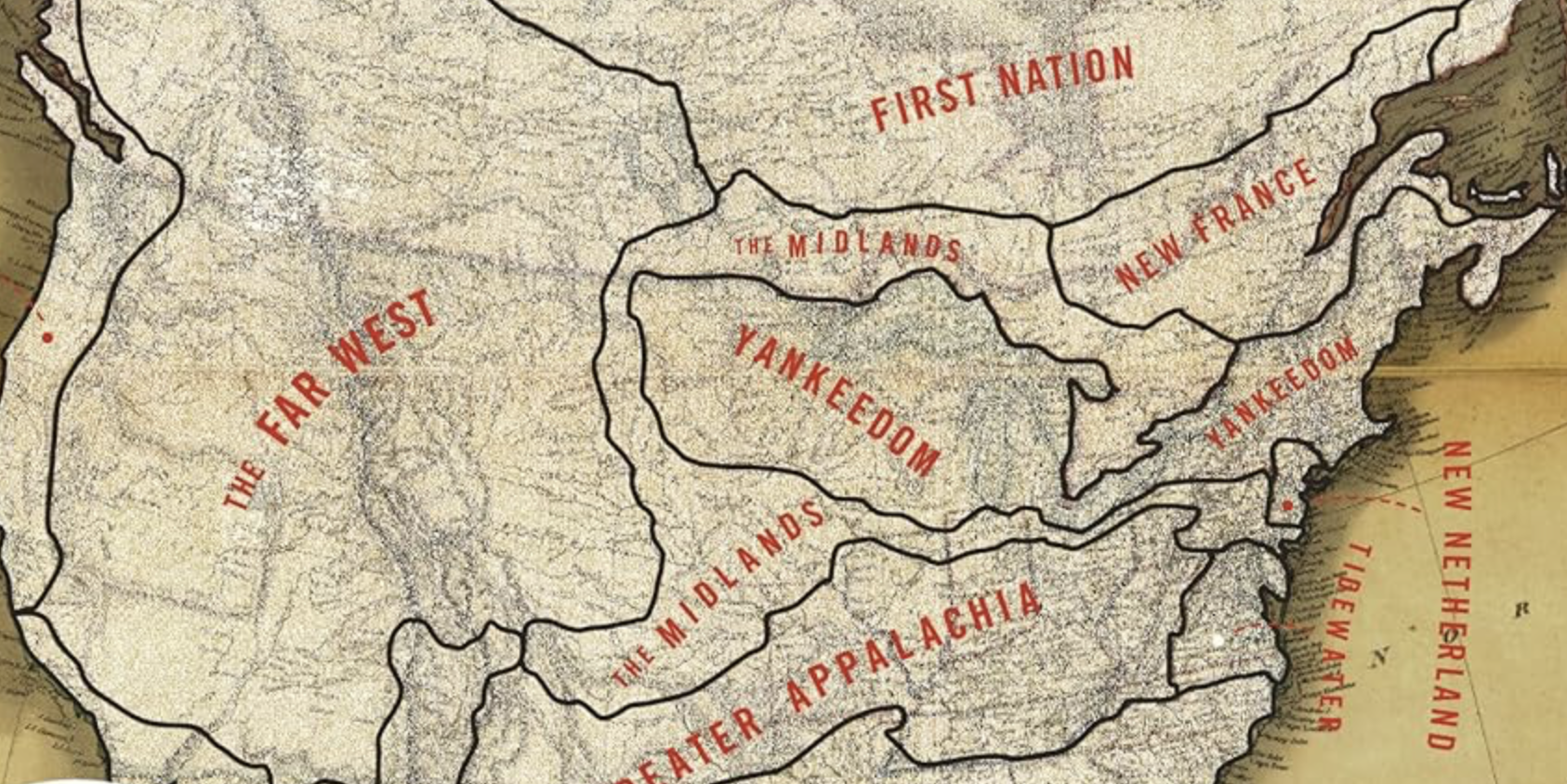
Is this the gospel truth of hard core political and social science? No, but it isn't fiction either.
How did the south get the way it is? Well, one big factor is where the settlers of the south came from, vs. where the settlers of New England came from. As I understand it, the south was initially settled by people from the border regions of Scotland and England, in the 16th and 17th century, a fairly rough and violent area of conflict. Puritans came from the SE coastal region of England, a placid farming area.
Again, I can't cite a book for this, just off hand. -
Athena
3.8kAnd in contrast, a state like Mississippi which has performed abysmally for at least a century and a half, is currently experiencing an education revitalization that is quite remarkable, so I've heard. I still don't want to live there. — BC
Thank you so much for that information. I googled it and for me the important part is they turned to phonics and gave children extra help if they needed it. There is no excuse for every state not having phonics. For years, we have known that the site-and-say method of learning to read does not work for many children.
The same goes for math! Insisting children learn new math is like insisting every learn to read with the site-and-say method. Teachers wanting parents to help their children with math need teach the parents new math, before the parents can help. Not like the old math that was solidly tried to everyday life and learning how to reason word problems.
The push for technology education and the expectation that every child goes on to college cheats millions of children out of the education they need to discover their talents and interests, and to see how those talents and interests can lead to satisfying careers.
To get this back on track, Learning to read so everyone can read the Bible helped us develop an education system, but believing it is the Church's job to provide moral education is very much our education problem!!! It is an incomplete understanding of the importance of moral training that matches a liberal democratic nation.
Right now, it is popular to blame Industry for our educational failures, and I do not believe that is the industry's fault. I think religion is the problem, and a more Puritanical opinion that we should not expect our schools to give the children a moral education. Every civilization has had the equivalent of the 10 commandments. Good values are part of every religion and philosophy. It goes with being civilized and when we used public education to teach morality, we used literature from all civilizations. But the Military Industrial Complex and Evangelicals controlling education decisions have been very harmful. -
Paine
3.2k
In terms of where people came from within Britan, Albion's Seed by David Fischer gives a brilliant report on differences in how they lived and why they left. The subtitle is Four British Folkways in America.
In regard to the Puritans, their role in the English Civil Wars found them siding mostly with the Parliamentarians against the Royalists. When considering the aristocratic bent of the ante-bellum South, Kevin Phillips' The Cousins' Wars makes a strong argument that the dividing lines of previous generations re-emerged in the American Civil War. It is interesting but does not really engage the problem of slavery and how people responded to it. This place is a hot mess. -
Athena
3.8kI don't know how many supporters White Christian Nationalists have, but I'm willing to bet that their leaders have more political clout than you would expect from those numbers. — Ludwig V
That is certainly so for Franklin Graham, the son of Billy Graham. Eisenhower and Billy Graham sat together planning how they would expand the the power of the Church and the government. It was like the story of Satan tempting Jesus, only this time, Eisenhower saw the Cold War offer as a good deal, and we were united against those godless communists. Making our relationship with Israel more important. Oy voy.
We certainly think we are the heirs of Greece in the matter of democracy. Rome's democracy is, I would think, less influential, given that it was an autocracy for so long. The Bible is certainly not a democratic document. But, in the history of European institutions, there was an ancient German tradition that was very influential. — Ludwig V
Yes, I have read that the Celts got along with the Greeks with no problem, but they clashed badly with the Romans. From the Celtic point of view, Rome even made slaves of their own people. I assume that speaks of a Roman hierarchy of power and authority, and many Celts died in wars against the Romans. I have read the Celts had a much higher moral code than the Romans. More in keeping with German-Scandinavian tradition.
I believe this difference involved a spiritual perspective. The Celts and Greeks shared a similar spiritual notion. I appreciate this because the wondering talk comes to Rome's conversion to Christianity, which gave the Romans greater power to conquer the world, until they came up against the Muslims. Another branch of the God of Abraham religions that, for a while, was winning the wars.
Whatever, Evangelical Franklin Graham supports Trump, and leads prayer at the Capitol, he is more politically motivated than his father was. Franklin is using nightly commercials to expand his $25 million holy empire, and I am sure his spot, following a popular news show, cost a pretty penny. We sure are not talking about the average preacher who is pleased to fill one church. -
Athena
3.8kOh boy, I googled for a book and got my favorite online used book store and a few different offers included the one in your post. As much as I want one, I think I'd better hold off until I read the books I already have. On the other hand, if my goal is a united the United States, that information looks pretty important.
:nerd:
There is so much to learn! I think if we lived 300 years, there would still be things we need to learn. -
Athena
3.8kWhen considering the aristocratic bent of the ante-bellum South, Kevin Phillips' The Cousins' Wars makes a strong argument that the dividing lines of previous generations re-emerged in the American Civil War. It is interesting but does not really engage the problem of slavery and how people responded to it. — Paine
Are you sure it doesn't include the problem of slavery? I am really curious because I have learned the South argued that slavery is an important part of social order. This one line from AI says, " the institution (slavery) was a benevolent, familial, or "paternalistic" arrangement rather than a harsh, profit-driven system."
I had no idea how anyone could think that, but as this thread unfolds, I see that is the same way landowners saw their role in relationship to the people who lived on the land, the serfs, who were later thrown off the land during the "enclosure". The landlord had a paternalistic relationship with the people living on the land, which traces back to Rome and the importance of the Father, and is related to our Father in heaven.
To just throw the people off the land was unconscionable. It was the wrong thing to do during the enclosure, and I am sure it would have been the equally wrong thing to do to slaves. I am not defending slavery, but saying I get it. I finally understand how Jefferson could want to end slavery, but could not just throw everyone off the land. Slavery should have never begun, but once it was established, how was it made right? How does this connect with the British landlords and the "enclosure"? What are the religious truths from a book about slaves and kings that some people claim is the word of God?


Welcome to The Philosophy Forum!
Get involved in philosophical discussions about knowledge, truth, language, consciousness, science, politics, religion, logic and mathematics, art, history, and lots more. No ads, no clutter, and very little agreement — just fascinating conversations.
Categories
- Guest category
- Phil. Writing Challenge - June 2025
- The Lounge
- General Philosophy
- Metaphysics & Epistemology
- Philosophy of Mind
- Ethics
- Political Philosophy
- Philosophy of Art
- Logic & Philosophy of Mathematics
- Philosophy of Religion
- Philosophy of Science
- Philosophy of Language
- Interesting Stuff
- Politics and Current Affairs
- Humanities and Social Sciences
- Science and Technology
- Non-English Discussion
- German Discussion
- Spanish Discussion
- Learning Centre
- Resources
- Books and Papers
- Reading groups
- Questions
- Guest Speakers
- David Pearce
- Massimo Pigliucci
- Debates
- Debate Proposals
- Debate Discussion
- Feedback
- Article submissions
- About TPF
- Help
More Discussions
- Other sites we like
- Social media
- Terms of Service
- Sign In
- Created with PlushForums
- © 2026 The Philosophy Forum