
Comments
-
Welcome to The Philosophy Forum - an introduction threadWelcome John27, it's good to have you here.
-
Can a Metaphor be a single word?I actually enjoyed seeing your thought process at work; the way you clarified what you meant. — Amity
No problem. I aim to please! :grin:
I had intended to return and pick out some of the key points to further discuss.
Or perhaps simply bullet-point...
To avoid any misrepresentation on my part, perhaps you could gather them up in a summary? — Amity
Unfortunately my mind seems to have moved on to more verdant pastures. -
Can a Metaphor be a single word?"I was bruised by T Clark's harsh criticisms"
The metaphor is "bruised". Is there more to say? — jamalrob
To be more accurate, the metaphor is the particular use of the word. But we can still say when referring to the sentence, as the unnamed philosopher mentioned in the OP similarly did when referring to some sentences of Heidegger, that "bruised" here is a metaphor.
(Too many consecutive posts; this is what happens when you don't think things through) -
Can a Metaphor be a single word?Of course, there are deeper and more interesting levels of metaphor, as pointed out by @Amity earlier:
https://thephilosophyforum.com/discussion/comment/633114 -
Can a Metaphor be a single word?So my earlier claim was making the point that the following in the OP...
Recently I heard a philosopher speaking about a certain term Heidegger used as being a 'metaphor" — jancanc
...is not affected by an argument to the effect that a metaphor requires the context of other words, because of course, the term did have such a context. -
Can a Metaphor be a single word?Analogically, a preposition can be one word even if it takes more than one word to make it a preposition. A preposition on its own is nothing.
This analogy works because prepositions indicate relations, as do metaphors. I'm just making the simple point that in both cases they can consist of a single word.*
* though not, of course, a single word alone (whatever that would mean) -
Can a Metaphor be a single word?Why doesn't it have any bearing? — T Clark
I shall attempt a clarification. There appears in jancanc's posts to be a conflation of two things: first, a metaphor as a term with no (implied) connection to, or context of, the thing or concept represented; and second, a metaphor as a single word. The OP uncritically takes the latter to entail the former.
When I said that "all that has been established is that a metaphor cannot be a single word without context, which, however, has no bearing on the OP", I was wrong, or at least imprecise. I was just trying to say that Heidegger's use of a metaphor (if that's what it is) doesn't require that he use more than one word. Or I could say that more than one word is always required to produce the metaphoricality of a metaphor, because a word spoken or written without context cannot be metaphorical. Such a contextless word is likely meaningless anyway. But the requirement for contextual words does not negate the claim that the metaphor itself is a metaphor, whether it's one word or a few. -
Can a Metaphor be a single word?So it's established that metaphor cannot be a single word. Great. What now? — emancipate
As far as I can tell, all that has been established is that a metaphor cannot be a single word without context, which, however, has no bearing on the OP. -
Currently Reading:cool: — 180 Proof
I think I've had Molloy on my reading list since I noticed you saying something about it years ago, either here or on the old forum. So, thanks. :cool:
(Now the pointlessness and stupidity of my existence is confirmed beyond doubt :wink:) -
Currently ReadingJust read and currently reading, with detailed emoji reviews.
Italo Calvino, Invisible Cities :up: :starstruck: :sparkle:
Joris-Karl Huysmans, Against Nature :up: :down: :yawn:
Joseph Conrad, Heart of Darkness :up: :down: :yawn:
Nikolai Gogol, Petersburg Tales :up: :lol: :love:
Samuel Beckett, Molloy :up: :100: :death: :rofl: :sparkle: :love: -
2021: The year in a nutshell - your impression, conclusion, lessons, etc. you wish to shareHe's up on what I call the Wyoming Steppe, land of horizontal snow. Bison (now cattle, in the summer) country. They have a nice ranch but treat the little bastards like queens in a barn; letting them out when the weather is nice. I thought they would grow better wool if left outside in the winter, but I don't know shit about them so I keep my mouth shut. They do have to worry about predators, though. So they have big white dogs and some Llamas. — James Riley
Very evocative. :cool: -
2021: The year in a nutshell - your impression, conclusion, lessons, etc. you wish to shareI hope they're as warm as my camel socks. Softer, probably. Where in the US does your friend keep those 135 alpacas?
It's not just socks. Apparently these Russian alpacas are good for weddings too:
https://www.instagram.com/p/CQGi9Tkl0RO/Alpacas at a wedding create a fabulous atmosphere, emphasize the individuality of the event and simply have a positive effect on the psyche. — Alpaca House
This is all off-topic but it's the Lounge and I don't believe in summarizing the year in a nutshell.
No, it is impossible; it is impossible to convey the life-sensation of any given epoch of one’s existence--that which makes its truth, its meaning--its subtle and penetrating essence. It is impossible. We live, as we dream--alone. — Joseph Conrad, Heart of Darkness -
2021: The year in a nutshell - your impression, conclusion, lessons, etc. you wish to shareThere were some alpacas running around the outskirts of Moscow a few weeks ago:
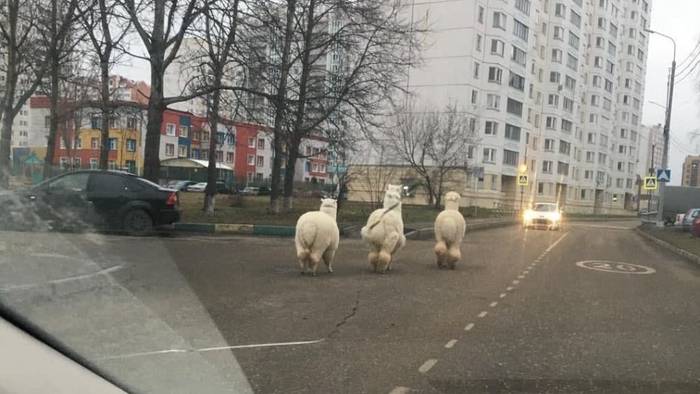
Nothing to do with the pandemic, but quite noteworthy.
Alpacas are amazing animals that captivate everyone literally at first sight. Their homeland is South America, but to get to know them, you do not need to travel so far, it is enough to go to the Moscow region. In the urban district of Serpukhov, there is a small farm "Alpaca House", where you can communicate with these friendly animals. — mosreg.ru -
Which member on here has the best thumbnail in your opinion?An adult sperm whale can hold its breath for an hour and a half, FYI. Pretty impressive, you must admint. — praxis
Sperm whales are great, so don't get me wrong, but an hour and a half isn't all that impressive to me. I mean, they're sea creatures. It's been 50 million years since they, in a fit of madness, decided to return to the sea. That's plenty of time to practice. An hour and a half over 50 million years? Could do better. -
Which member on here has the best thumbnail in your opinion?That's Hypatia, Greek neoplatonist philosopher, astronomer, and mathematician. It shows up on all the staff members' thumbnails.
-
Is magick real? If so, should there be laws governing how magick can be practiced?A state monopoly on magick enforced by clairvoyant tactical police units.
-
Is magick real? If so, should there be laws governing how magick can be practiced?I don’t understand the regulation question. The only Crowley quote I had ever heard was “Do what thou wilt shall be the whole of the law.” — Srap Tasmaner
Yes, it's odd that the question of regulation would come up. It almost makes me suspect that the OP is some kind of satire.
But if we're talking about criminal law rather than mere institutional regulation, I'm staunchly in favour of punishing a person for magickally forcing someone off the edge of a cliff in the same way as if they had physically pushed them. -
Is magick real? If so, should there be laws governing how magick can be practiced?A magickal act of will is arguably an act.
-
Is magick real? If so, should there be laws governing how magick can be practiced?That's what I was thinking. Maybe something like The science and art of causing change to occur in conformity with Will alone or unaided.
-
Which member on here has the best thumbnail in your opinion?Okay, 180's gets my vote too, partly because if I'm not mistaken he's been using it unwaveringly since I first encountered him on the olden forum way back in the olden days.
-
Joseph Goebbels said the most absurd thingWhy would someone want to convince someone else of something that they themselves think is false? — clemogo
That's what lying is. Deception is an obvious fact of life. -
Which member on here has the best thumbnail in your opinion?All of them are fine except for TheMadFool's and Sir2u's.
-
Some remarks on Wittgenstein's private language argument (PLA)Sorry Luke, but trying for years to persuade MU looks a bit like insanity to me. I'd prefer if you conducted that effort privately.
-
Some remarks on Wittgenstein's private language argument (PLA)@Banno is right.
@Metaphysician Undercover @Luke Can you please use PM or email for these discussions instead of hijacking threads. It's basically a private conversation that you're having, spread out over numerous discussion threads. I'm pretty confident that nobody else is interested, and you're spoiling things for everyone else. -
SportsAmong American intellectuals, baseball seems to be popular. Stephen Jay Gould, who was pretty philosophical, wrote a book called Full House (Life's Grandeur in the UK) that extensively uses baseball in the argument. Something about batting averages and probability, I can't really remember.
And I think there have been several American writers of literary fiction, intellectual types, who've been into baseball.
Maybe when people are young they split into nerds and jocks (to use the American parlance). Those who like computers and books maybe don't play sports much. But later, when the nerds have gotten over their teenage traumas, they feel free to take an interest in sport. -
God exists, Whatever thinks exists, thoughts exist, whatever existsThanks, I'm glad I'm off the hook.
-
God exists, Whatever thinks exists, thoughts exist, whatever existsIf one cannot doubt one's existence, then why would one need an argument to prove that one exists?
Descartes decided to doubt as much as he could, without good reason, and found himself stuck at not being able to doubt the doubter. Wittgenstein pointed out that doubting can only occur against a background of certainty. Something must be held firm in order for there to be any doubt.
SO the cogito is not making the same point as Wittgenstein is making. Wittgenstein is saying we don't need the cogito. — Banno
That's fair, but Descartes doesn't argue that he exists; he says he cannot doubt it. This is at least part of what Sam was saying and which I pointed out that Descartes was also saying.
Otherwise, of course you're right that it was Wittgenstein, not Descartes, who showed "that doubting can only occur against a background of certainty".
I'm not sure it's right to say that Descartes tried to doubt everything without good reason, but that's a historical matter. -
God exists, Whatever thinks exists, thoughts exist, whatever existsWell, my criticism was maybe pedantic, and I was going too far in saying that the cogito can't be regarded as an attempted proof. My main point was about the impossibility of doubting one's existence. Of course, if you can't doubt your existence then proof is inappropriate.
-
God exists, Whatever thinks exists, thoughts exist, whatever existsIt is my point, but Descartes analysis is not the same as Wittgenstein's analysis in OC, which is what I was trying to represent — Sam26
You were responding to a representation of the cogito, and you didn't acknowledge, probably because you didn't know, that the cogito makes the same point you were making. I intervened to correct this. I'm aware that Wittgenstein's analysis is different from Descartes'. -
God exists, Whatever thinks exists, thoughts exist, whatever existsOK, but I wasn't addressing your general opinion of Descartes. Carry on.
-
God exists, Whatever thinks exists, thoughts exist, whatever existsWhat? Descartes was confused about the whole notion of doubting. — Sam26
His point was that you cannot doubt your existence. It's not the kind of thing that can be doubted. I took that to be your own point. -
God exists, Whatever thinks exists, thoughts exist, whatever existsYes, this was Descartes' point, which GMBA has either misunderstood or just described incorrectly.
-
Is China going to surpass the US and become the world's most powerful superpower?Hopefully after you watch all these videos you will have a better idea of what China is trying to do. — dclements
Thanks!
I guess you forgot about the fact that China is threating military action against Taiwan if Taiwan doesn't surrender to China in the near future. Also they are doing everything and anything they can to take over islands in Pacific through either political pressure or money, as well as threating India and other neighboring countries. Also China is trying to gain power in Africa, as well as trying to use computer espionage in any country they can in order to gain some leverage over whatever/whomever they can. — dclements
So...
1. The People's Republic of China wants to get the Republic of China back, and will use bullying and coercion to do it.
2. It wants some islands in its vicinity, for trade and control and regional dominance and all that.
3. The Chinese are exploiting Africans in the context of global capitalism.
4. They're doing espionage.
None of this backs up your statement. I don't approve of what they're doing and how they do it, but their foreign adventures are nothing in comparison with those of some other countries. In any case, none of it shows that they intend to actually invade and "swallow up" the rest of the world, as you claimed. That is just your frenzied fantasy. Taiwan is obviously a special case. -
Humour in philosophy - where is it?Yes, I thought about mentioning Zizek. He uses jokes to elucidate his concepts, especially the concept of ideology.
-
BanningsThread still open? — Metaphysician Undercover
Yes, it's quite surprising. I think we, the staff, have a loose convention whereby it's the banner who is responsible for closing the thread. Baden might be leaving it open to catch some more misogynists.
Jamal
Start FollowingSend a Message
- Other sites we like
- Social media
- Terms of Service
- Sign In
- Created with PlushForums
- © 2026 The Philosophy Forum