
Comments
-
Submit an article for publicationThere have been very few submissions. Maybe just one or two aside from my own, and they were not what we're looking for. I'm as surprised about this as you are. I suppose that those who are able to write good articles would rather publish them elsewhere.
-
Submit an article for publicationI didn't even know you had sent it. In our private conversation, you just went silent, giving no indication of what you were going to do, and I rarely check infoatthephilosophyforumdotcom . I've posted it in the editors' private area, so maybe someone will read it now. Thanks for the contribution.
-
BooksI left a few hundred books stored in boxes in Scotland when I took up my itinerant life in 2012 and had to get a kindle. I went back to hard copies recently and it has triggered a new enthusiasm for reading, but I'm disappointed at how bad the print quality and font sizes are in many printed books--no doubt my eyesight has deteriorated over the past few years. On a kindle I can adjust the font size, and I have a backlight that doesn't disturb my sleeping wife, so I'm going back to kindle except for books that just feel a lot better in printed form: big complex books and those with pictures or diagrams.
I love buying and possessing books but I'm aware that this probably shallow acquisitiveness disappears when I actually get into reading one. Or rather, it's independent of the experience of reading: the book I'm into is no longer interesting from the acquisitive standpoint, which turns towards other, newer, immaculate and shiny books.
That's how I tend to end up with many more books than I can possibly read. If I didn't live in a foreign country with only a couple of English-language bookshops and no Amazon, I would have lost control of this tendency some time ago.
If they're paperbacks, the books I read do not remain immaculate and shiny. Among other bad habits, I use the page corners--say 20 pages together--to clean my nails.
Take them with you on trips? — tim wood
If I'm going away for a day or two, yes, but not generally when I'm leaving the house. I don't understand how people can walk and read, or even read in public at all. I can't not look at and listen to what's around me. For reading I prefer to be alone in a quiet place where there's no risk of being disturbed, and no extraneous stimulation. -
Word of the day - Not to be mistaken for "Word de jour.":cool:
Here's something about words that I find interesting, but I'm not sure if you Americans will understand it. When I'm bantering with my brother or my close friends, we will call each other names, and I often reach for American ones like dingus, dweeb, doofus, douchebag/douche, and poindexter (it's not all Ds).
There's an amusing ironic quality to the insults when I use those words, because they're not natural words for us to use with each other. They sound almost corny--we Brits pick them up from old movies and TV, of course--so they undercut the offensiveness of the insults. To use one of those words is to make oneself ridiculous, thereby introducing the classic comedy of a self-righteously angry but ridiculous person.
... I'm not sure if you Americans will understand it — me in this very post
I imagine that Americans might sometimes use British (or Italian or Spanish or whatever) terms in a similar way, but surely the resulting quality, texture, and humour of the insult are quite different? -
Word of the day - Not to be mistaken for "Word de jour."Yes I know, but I'm generous with my condescending approval.
-
Word of the day - Not to be mistaken for "Word de jour."Incidentally, I quite like "scurrilous". It's partly because it makes me think of squirrels and other rodents, I suppose because they're animals that scurry.
-
Word of the day - Not to be mistaken for "Word de jour."The next part that you didn't quote explains this. — Noble Dust
No, it doesn't.
As I said, I didn't start this thread; I only revived it. I dunno what else you want. — Noble Dust
I want to criticize you for bizarrely trying to police this thread.
Cradle — Noble Dust
Very nice. But I could say, inspired by you: may I remind you that the point of this thread is not to just give us a word you like, with no comment about it. T Clark showed us the way, by giving us some words and telling us why he liked them. I'm worried that this thread has devolved into a word-mentioning contest, devoid of actual appreciation. And so on. It should be obvious that this isn't serious; I hope you get the point.
I can; however, this is not what people are actually doing. — Noble Dust
This is a scurrilous accusation. Perhaps dick-measuring is what Sir2u is doing, but I don't see any evidence otherwise. Anyway, so what?
In my case, I chose a word that was obscure to me, but not because I wanted to impress anyone. I was really struck by the word and was quite excited about it. It kind of ... opened up a world to me. -
Word of the day - Not to be mistaken for "Word de jour."What I'm worried about is... — Noble Dust
Why on Earth would you be worried?
has devolved into a love of impressive/and/or/obscure words — Noble Dust
Maybe you should have posted some rules in bold and upper case, like "Please post words that you love, unless they are impressive and obscure. Only familiar words are allowed. If you break this rule I will throw tantrums."
But pleasing words don't have to be any of these things. — Noble Dust
You can demonstrate this by continuing to post unimpressive and familiar words that you like.
Generally, why can't you just let people post words that take their fancy? Why this weird need for control? Why so serious? You're just spoiling people's fun. -
What are you listening to right now?It's great. Interestingly, it's based on an earlier piece composed for ondes martenot, an early electronic instrument:
It doesn't have the same power as the version in the Quartet for the End of Time, but it's quite amazing: ethereal and pleasingly strange. -
BanningsYeh it's unfortunate that his fanaticism is what came to the fore. He was warned about it several times, so the ban didn't come out of nowhere.
-
How can I get more engagement with my comments on other peoples posts?You're getting plenty of engagement, MSC, much more than most who've been here only one week. If someone in particular doesn't reply to you, I suggest you get over it. I've been ignored by the old goat Banno too many times to mention.
-
A plea to the moderators of this sitePlease report any posts or discussions that you think should be subject to some sort of moderation. You can use the flag function or, like Philosophim suggests, PM one of the staff.
I'm moving this to the Feedback section and closing it. -
Deep SongsIf you haven't read it, I recommend Ben Watson's book Frank Zappa: The Negative Dialectics of Poodle Play, which looks at Zappa's music through the lens of critical theory, Marxism and left-wing politics, literary theory, and so on. It's very weird and I think misguided in places, but really good fun, and genuinely insightful and interesting. And you can tell he's a true fan. The word he often uses for Zappa's music is I think perfect: scabrous.
-
Deep SongsThe thing about that song's lyrics that I've always found most interesting is the temporal transgressiveness:
My python boot is too tight
I couldn't get it off last night
A week went by, and now it's July
How does that work?
EDIT: That's the best Zappa band lineup in my opinion. Virtuosic but warm, with Frank at his best on guitar. -
How can I get more engagement with my comments on other peoples posts?Unless you take Pinprick's easy route to engagement--which I don't advise--it can take a while to get noticed. The old timers here tend to engage with each other, and newbies are sometimes ignored at first. Just keep at it.
-
Adventures in Modern RussiaGod-forward. I'm not keen on god-level sweet.
There's a lot of crappy cheap god-level sweet Russian wines, but there are some good ones. Krasnodar Krai has the perfect conditions and many of their wines produce reactions like, "daahling this is simply divine!" -
Adventures in Modern RussiaI like Georgian wine but in Sochi I was drinking local Russian (Krasnodar Krai) and Crimean wine.
-
Adventures in Modern RussiaYes she's Russian, but no, just a three month visa. But they're changing the rules, so soon I'll be able to get longer visas. It's a big hassle so I hope they hurry up and introduce the changes before I apply for the next one.
-
Adventures in Modern RussiaThanks to the Russian President's ukaz decreeing that foreigners can stay for [visa expiration date] + 185 days, I've been happily stuck here in Russia since January (thank you Vladimir Vladimirovich). I'll have to leave next month so now seems like a good time to update this thread.
I first went to the Caucasus in early March. That was a fascinating trip, but in this post I'll write about my most recent visit to that region, a holiday in and around Sochi that I've just got back from.
Sochi is a holiday resort in the South of Russia on the Black Sea, at one end of the Caucasus mountains and very close to the border with Abkhazia (or Georgia if you choose not to recognize Abkhazia's independence). The coastline here is sometimes called the Caucasian Riviera, and together with the nearby Crimea it's the only warm water coastline in Russia. The climate is humid subtropical, and high forested mountains rise up just inland. It's a beautiful part of the world, and quite strange. Imagine a Soviet Monaco.
One of the books I had with me was a history of Russia, but it failed to cover the one subject that would have given me an insight into the surprising experiences I had while I was there: the Soviet tradition of taking your allotted two week holiday in a Black Sea sanatorium.
Soviet sanatoriums, which were also popular in Communist Eastern and Central Europe, were different from Western European and American sanatoriums (or sanitariums), which were mainly for chronic illness or mental disorders. The Soviet ones were more like holiday health resorts, but with more medical facilities than you would associate with a Western spa. I knew a little about them through my interest in modernist architecture, but I didn't know they were still a part of Russian life: that some of them are still going, that there are modern hotels that offer the same treatments, and that Russian attitudes to holidays and health are still informed by the tradition.
The system of sanatorium holidays was based on an ideology that combined patriotic dedication to hard work—which could only be ensured with an annual two week rest—with the ideal of a healthy lifestyle supported by natural therapies and "wellness", preventive medicine, strict diets (with no alcohol), and moral and intellectual edification. This was meant to contrast with the decadent bourgeois practice of going on holiday just to have fun.
Being a decadent Western (petit) bourgeois myself, I had intended to consume a lot of rich and unusual food and alcohol. The area produces delicious wine, seafood, figs and cheese are abundant, the local bread is as good as any French or Italian bread, but different. Lamb from the mountains is marinated and grilled over wood and served with plum sauce.
And that's what I did while we were in Sochi itself, in a hotel by the sea that I had booked. But for the second part of the holiday we moved to another hotel, this time in the mountains. My wife chose it and I didn't know much about it except that it looked nice, was surrounded by mountains, and they demanded a negative COVID‑19 test, which kind of impressed me.
On our first day at this hotel I got a cold, and my wife suggested I visit the inhalatorium downstairs. My normal strategy against colds is like Field Marshal Kutuzov's successful strategy against Napoleon: do nothing and it'll go away. But I went along with her suggestion, and I was curious anyway. It turns out there was a kind of hospital downstairs, staffed by various medical specialists.
When the procedures were over and I'd taken the plastic tube out of my nose, my wife said she'd made some more appointments for me over the next few days and I could cancel them if I wanted. I didn't cancel them but I did resent the imposition, even though it was well-meant. I hadn't expected all this. Had it been intentional deception on my wife's part, or did it seem so normal to her that she hadn't thought to mention it? In any case, my own feeling is that I don't mind going to doctors but I don't want to do it when I'm trying to relax and enjoy myself. It began to dawn on me that there was more to this holiday than I'd been led to believe, that this was some kind of modern-day sanatorium.
And that's pretty much what it was: true, it wasn't called a sanatorium but a "medical spa hotel"; we weren't assigned the accommodation by the state; the services were not free; I could drink wine if I wanted (tellingly though, vodka was unavailable); and our daily timetable was not set by the staff. But otherwise it was definitely in the sanatorial tradition. The mineral water on tap and the oxygen cocktails at the bar all began to make sense.
As with the Soviet sanatoriums themselves, it wasn't all quackery. These were real doctors. I had a few diagnostic scans, general checkups and consultations, all of which seemed pretty legit. Turns out I need to lose weight, eat less salt and fried food, and drink less alcohol, or else I'll be at risk of heart attacks down the road. On the one hand, they would say that. On the other hand, they're probably right. It shouldn't have been a surprising diagnosis but I was shocked and disappointed, and became a bit depressed about it, which made me even more resentful.
Then I got gastroenteritis. The result was that I was stuck in the room most of the time, on a diet of gruel, plain rice, sauceless chicken breast, and herbal tea. And I couldn't drink coffee or alcohol. My mother-in-law had unexpectedly followed us to the same hotel, and she and my wife ganged up on me to make me comply with these rules.
Through sheer force of will I recovered after 24 hours and eased myself back to holiday decadence. My mother-in-law said that if I was going to drink so soon after my gastrointestinal troubles—which she did not advise—it should be Armenian brandy, which was okay with me. Of course, I couldn't get brandy in the hotel and had to go to a nearby cafe. Incidentally, the biggest name in Armenian brandy is Ararat, but Mount Ararat seems to be in Turkey, and only visible from Armenia, so I don't know what's going on with that.
The biggest surprise came on the last day. I was due for another ultrasound check and I was expecting it to be the bladder and maybe even some gentle genital examination, but as I was undressing, my wife translated one of the doctor's questions, which was along the lines of "are you sure you're okay to do this now?" I saw the instrument by her side and asked, "is that an anal probe?" Indeed it was. For a moment I felt panic, but realized that backing out now would have been lame, and I had to start getting tested for prostate cancer anyway.
Lying on my side with a large and bulbous plastic transducer up my ass, I said to my wife, who was watching the whole thing, "this is the best holiday I've ever had". We all laughed, and afterwards I went straight out and had three Armenian brandies while waiting for the airport taxi.
In case you're wondering, my prostate is fine and I have a flawless rectum.
-----------------------------------------------------
The Rosa Springs Hotel ... offers treatment at the highest sanatorium standards in its own Health Center, specialized in health improvement through water using the healing mineral springs of Krasnaya Polyana.
The balneological direction of the hotel was not chosen by chance. It was in the Rosa Springs building during the 2014 Winter Olympics that the medical center was located with the latest diagnostic and treatment facilities for Olympians. The healing effect in the mountains of Krasnaya Polyana is achieved thanks to a life-giving combination of two elements - the sea and the mountains: ionized air has unique healing properties. — Rosa Springs Hotel
The tension between turning to nature for health and conquering nature through rapid industrialization and urbanization was inherent to the Soviet project at its origins. As I reveal, the health resort was cultivated as a place apart from the politics and mass mobilization of the city. Yet it encouraged popular attachment to the native land, and provided important benefits to the population, and so had a stabilizing function in Soviet society and culture, ultimately supporting the Soviet project. — Geisler, The Soviet Sanatorium: Medicine, Nature and Mass Culture in Sochi, 1917-1991
The photo below is of Druzhba Sanatorium, one of the famous Soviet-era Black Sea sanatoriums.
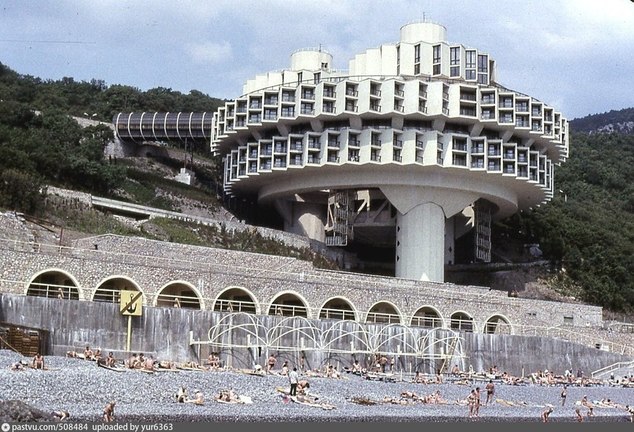
https://www.calvertjournal.com/features/show/9100/holidays-in-soviet-sanatoriums-ussr-tourism-photography
https://en.wikipedia.org/wiki/Sanatorium_(resort)
The Soviet Sanatorium: Medicine, Nature and Mass Culture in Sochi, 1917-1991 -
Why was my post removed?I don't think I broke any guidelines for this forum. And if I did, it was completely innocent. I have a screenshot of the discussion. Can anyone kindly explain what it is I violated? — Christopher
This is good writing. The post I deleted was not. Sorry, it was just too unclear for an opening post. -
Wittgenstein's ChairIf we follow Daniel Bonevac's logic, and I'm sure he's not alone in this, there's no such thing as misuse of words, there is never an error in applying words to objects - every single time a word is used, it's always used correctly. — TheMadFool
I don't think he actually says this, and this is the conclusion to his logic only if you assume that to misuse a word is to fail to satisfy an essential definition. It seems to me rather that to misuse a word is to use it in some way unconventionally. If you want to apply Wittgenstein in the "chair" case then this could mean something like: not used according to the family resemblances that we can see in the word's conventional uses. -
Intellectuals and philosophers, do you ever find it difficult to maintain relationships?The OP is very clear that the difficulty is not about being an introvert or socially awkward.
-
David Graeber - Introduction to Mutual AidThat's it! :up:
I did suspect he was getting at something like identity politics as the flipside of neoliberalism. -
Some Similarities Between Farsi, English and SpanishCool. It's almost as if the languages are related or something :wink:
There are some tables of cognates across various Indo-European languages here: https://en.wikipedia.org/wiki/Indo-European_vocabulary -
Languages; doing, being and possessingThese subtle differences in the use of our most common verbs must have a profound effect on our perspective or understanding of the world between cultures. — Benj96
I think you need to argue for this or cite the research. The Sapir-Whorf hypothesis is very controversial.
What I find a bit more plausible is that while these differences don't result in profoundly different ways of understanding the world in ordinary life, they do result in different ways of doing philosophy in the different languages, an example of philosophers being led astray by language in the way that Wittgenstein described. If he was right, we should in principle be able to discern differences in philosophy from different countries and map them to such linguistic differences as the ones you describe: being/having, being/doing, and so on. I don't know if there's any research into that. -
The meaning of the existential quantifierI’m more going on about how “all rectangles have different length legs” fleshes out to “if something is a rectangle then it has different length legs”, and we can affirm or deny that conditional statement without asserting the existence, in any ordinary sense, of any rectangles at all: a disagreement about that conditional is a disagreement about what would count as a rectangle if any such things existed, not about what kind of things exist. — Pfhorrest
Some thoughts of a non-logician that may have been covered already by those more expert...
Doesn't it just depend on context, determined by the domain? Shouldn't the domain always be defined, thus making it clear how "exist" is meant to be understood, which is not necessarily "in any ordinary sense"? Although I'm not sure what counts as ordinary for you: do mathematical objects exist ordinarily?
Or, one could say that with different domains of discourse, different ordinary language interpretations of the quantifier will seem more or less appropriate, among "there exists", "for some", etc. Incidentally, "for some" seems to be pretty common.
Are you worried that an interpretation along the lines of "there exists a rectangle that...", implies the existence of rectangles, thereby introducing ontological commitments in your philosophy of mathematics? I'm prepared to be told that your worry is more subtle than that, and that I'm missing the point. -
David Graeber - Introduction to Mutual AidYes it does look like that. But it was the phrase "internalizing and reproducing all the most distressing aspects of the neoliberal economism" that particularly caught my eye, because that seemed like it could point to something more than simply the negative approach of Leftist analyses.
-
David Graeber - Introduction to Mutual AidMaybe one way to bring out the tension pointed to in the criticism is contrasting Street's OP quote from Graeber ... To the concept of totality — fdrake
Yeah, there's certainly a tension there!
They could mean something like that, but it seems too vague to pin down. -
David Graeber - Introduction to Mutual AidI've had his books on my reading list for some time. I'm particularly interested in The Utopia of Rules and Bullshit Jobs.
Among the last things he wrote was an introduction, with Andrej Grubačić, to Kropotkin’s Mutual Aid. It can be read, in full, here. — StreetlightX
Interesting potted intellectual history, though I'm not sure I find it convincing. I'm curious as to what they're referring to here:
Sometimes it seems as if the academic Left has ended up as a result gradually internalizing and reproducing all the most distressing aspects of the neoliberal economism it claims to oppose, to the point where, reading many such analyses (we’re going to be nice and not mention any names), one finds oneself asking, how different all of this really is from the sociobiological hypothesis that our behavior is governed by “selfish genes!”
I wish they'd named names. Does anyone know what kind of academic analyses they're talking about? @StreetlightX @fdrake
Jamal
Start FollowingSend a Message
- Other sites we like
- Social media
- Terms of Service
- Sign In
- Created with PlushForums
- © 2026 The Philosophy Forum