
Comments
-
BanningsIn an unprecedented move, the staff has decided to unban @Pfhorrest after communicating with him by email. We're confident that the flaming was out of character and won't happen again.
-
BanningsI see what you're saying, but I haven't seen flaming as bad as this for a very long time, perhaps never on this forum. The guidelines make it clear that racism and homophobia are not tolerated.
https://thephilosophyforum.com/discussion/480/site-guidelines
His language was grounds for an instant ban, and I was initially pretty lenient in applying the rules. -
BanningsYes, it was about those comments. It was me who deleted them. And I did in fact give him a chance by first opting to warn him instead of banning instantly, on the basis that it was totally out of character, but he seemed to have no remorse about it even many hours later, and couldn't bring himself to give a strong assurance that it wouldn't happen again, and that's why I finally banned him.
-
Objective truth and certaintyObjective truth should be contrasted with subjective truth. Objective truths are quite mind-independent. For example, the Earth has one moon reflects a state-of-affairs that exists apart from any mind. In other words, one could eliminate all minds, and the fact would still obtain. There might not be anyone around to apprehend the objective truth, but the fact would still exist.
Subjective truths, on the other hand, are mind-dependent. For example, "Tim likes apples," is dependent on Tim for its truth or falsity, i.e., it is either the case that Tim does or does not like apples. The truth of the statement, for Tim, is subjective, dependent on the subject, his taste, likes or dislikes, etc. Eliminate all minds and you eliminate all subjective truths. — Sam26
I'm never convinced by this way of using the terms "subjective" and "objective".
"Tim likes apples" is not objectively true? Isn't it a fact that Tim likes apples? Are you saying there are subjective facts?
And if "Tim likes apples" is subjectively true because it's "dependent on Tim for its truth or falsity", then "Slavoj Zizek is a philosopher" is also subjectively true, because it's similarly dependent on Slavoj Zizek.
I imagine you might go on to say that subjective truths are only about a person's "taste, likes or dislikes, etc", as if those were something private and inaccessible. But those things are expressed in a person's behaviour: Tim's taste for apples can be seen in his excessive consumption of apples, and Zizek's taste for thinking about Hegel is expressed in the fact that he's a philosopher who writes about Hegel.
I don't see the utility of saying that a truth is in a special class of truths if the subject of the statement happens to have a mind.
In my view, the terms "subjective" and "objective" make better sense as: from only one point of view and not from only one point of view. Under this scheme, though, we can't really talk about subjective and objective truths at all, unless we want to follow the popular mode of "it's my truth", or, "Tim's truth is that apples are delicious". -
Bullshit jobsNot really. You're referenced inefficiencies that could result in fewer jobs if eliminated. The corporate America I worked for measured every move until we all became efficient mindless robots devoid of personal authority because that would de-systemetize the machine. The bullshit was that people were treated as cogs. It was dehumanizing and tragic if one ponders these are people who are dedicating their lives to this.
Finding and eliminating inefficiencies is corporate speak for creating a dystopia. It won't result in shorter days, just more tasks during the day monitoring efficiencies and chasing away inefficiencies. The reason for squeezing the most from the worker is because people want more bullshit products and there's no way to predictably get people to do what you need them to than by endless forms, datasets, and numeric monitoring. — Hanover
I think this gives too much credit to corporations. In my experience of corporations, they're more like badly run local government: bureaucratic and stupid. I think Graeber's idea is that corporations are not, in fact, particularly good at capitalism, at least according to how it is imagined by its advocates, i.e., as the most efficient and productive economic system possible.
He thinks that (1) "financial services or telemarketing", "corporate law, academic and health administration, human resources, and public relations", are pointless and unproductive, and (2) that their existence doesn't have an economic basis, but a moral and political one.
It's as if someone were out there making up pointless jobs just for the sake of keeping us all working. And here, precisely, lies the mystery. In capitalism, this is precisely what is not supposed to happen. Sure, in the old inefficient socialist states like the Soviet Union, where employment was considered both a right and a sacred duty, the system made up as many jobs as they had to (this is why in Soviet department stores it took three clerks to sell a piece of meat). But, of course, this is the sort of very problem market competition is supposed to fix. According to economic theory, at least, the last thing a profit-seeking firm is going to do is shell out money to workers they don't really need to employ. Still, somehow, it happens.
While corporations may engage in ruthless downsizing, the layoffs and speed-ups invariably fall on that class of people who are actually making, moving, fixing and maintaining things; through some strange alchemy no one can quite explain, the number of salaried paper-pushers ultimately seems to expand, and more and more employees find themselves, not unlike Soviet workers actually, working 40 or even 50 hour weeks on paper, but effectively working 15 hours just as Keynes predicted, since the rest of their time is spent organizing or attending motivational seminars, updating their facebook profiles or downloading TV box-sets. — Graeber
The Soviet Union hasn't been around for a while, but since I've been living in Moscow I've been struck by the number of workers doing jobs that could be done by fewer people. Apartment buildings with six security guards, small shops staffed by four people, that kind of thing. The explanation can't be strong trade unions fighting for full employment, because the unions are weak (or effectively part of the state). And the Russians, or a class of them, embraced a predatory capitalism in the nineties that still largely exists, though now combined with authoritarian government. The underlying explanation might be cultural, which is similar to part of Graeber's diagnosis when he explains the moral and political reasons for the growth of bullshit jobs:
... the feeling that work is a moral value in itself, and that anyone not willing to submit themselves to some kind of intense work discipline for most of their waking hours deserves nothing — Graeber
And this is convenient for a ruling class that won't share its wealth.
If you can work from home, there's a good chance yours is a bullshit job. — Banno
My case might be interesting. I work from home, I'm the co-founder of a very small company, and everyone who works for the company is working very productively. I'm a software developer and my work isn't bullshit. Or, it certainly doesn't feel like it. On the other hand, Graeber might argue that the thing we're working on, the web application we're running, is bullshit, because it's not in itself productive, but merely makes the lives of our customers easier in some ways. So, unlike the paper-pushers, I'm actually making something, it's just that what I'm making might be bullshit. -
What are you listening to right now?One of my favourites.
EDIT: this is the best performance and recording I've seen of it online. Thanks. -
#IsoIsolationNot the same thing but I enjoyed this one:
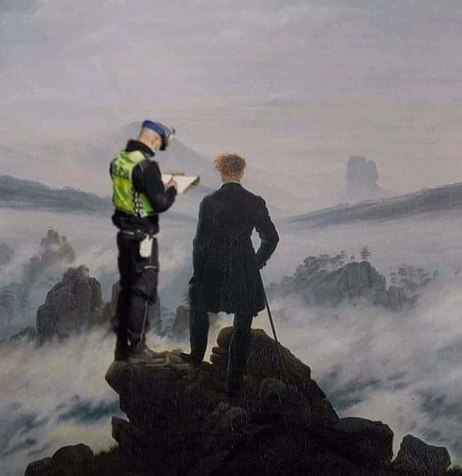
https://www.facebook.com/arsgratiartismutatismutandis.25/posts/1602738313206550 -
#IsoIsolationAh, I see you've done your homework while in Russia :) It's an iconic image, but somehow perhaps due to the historic remoteness or to its fastidious realist execution, it doesn't seem to have the same emotional impact as, say, the Guernica. — SophistiCat
Yes, I know what you mean. When I first saw it, at the Tretyakov Gallery, I was unmoved as I wandered past staring at it vacantly. Only later I realized, oh, wait a minute, that was a pile of human skulls being picked clean by crows, and I should have experienced it as a stunning indictment of war. -
Joe Biden (+General Biden/Harris Administration)That comment is so fucking nuts...that anyone attempting to comment on it further than what I am saying right here, is also fucking nuts. — Frank Apisa
:lol:
I guess I'll have to refrain from commenting to the effect that Street and Baden are right. -
#IsoIsolationThe painting of the pile of skulls is called "The Apotheosis of War" by Vasily Vereshchagin, sarcastically dedicated "to all great conquerors, past, present and to come". Recreating it with frozen dumplings for skulls is either sick or brilliant, or perhaps both.
-
A Very Basic Guide To Truth-Functional LogicUsing [ code ] means you can write it in a monospace text editor and paste it straight in:
p------q----------------(p----[⊃]----q)------⊃---q
___________________________________________________
T------T----------------T------T------T------T----T
T------F----------------T------F------F------T----F
F------T----------------F------T------T------T----T
F------F----------------F------T------F------F----F
-
What afterlife do you believe awaits us after death?It was me. It's possible I was a little hasty in moving it, because I didn't really look at the responses, basing my decision mainly on the OP. But still, I don't think it's a philosophical question so I'm not too regretful about my decision.
@Noble Dust -
What are you listening to right now?I remember when I first heard that song on Obscured by Clouds, thinking, ah, it's nice to get a bit of light relief; a jaunty whimsical reflection on life. By the end of the song, I was disabused:
You shuffle in gloom in the sickroom
And talk to yourself till you die -
CoronavirusAren't you allowed to go out to exercise? — Punshhh
Since March 30, officially no:
According to the published decree, leaving one’s place of residence is permitted only for the following: seeking emergency medical care or other direct threats to life and health; traveling to and from work if required to do so; shopping at the nearest existing store or pharmacy; walking pets at a distance not to exceed 100 meters from one’s residence; taking out household garbage. — US embassy
But so far it's not as strict as Spain. Unlike there, I haven't encountered any police checking what I buy at the supermarket. In fact I haven't seen any police in this neighbourhood at all.
Don't worry about the mess, my house would be messy if my wife didn't make me remind me to tidy up and do the housework regularly — Punshhh
Unfortunately my wife is as bad as me.
Tomorrow, I'll definitely do it tomorrow. -
CoronavirusPerhaps if folk post an image of where they isolate, it would be interesting to see how our experiences differ? — Punshhh
Right now I long for a garden like that. England?
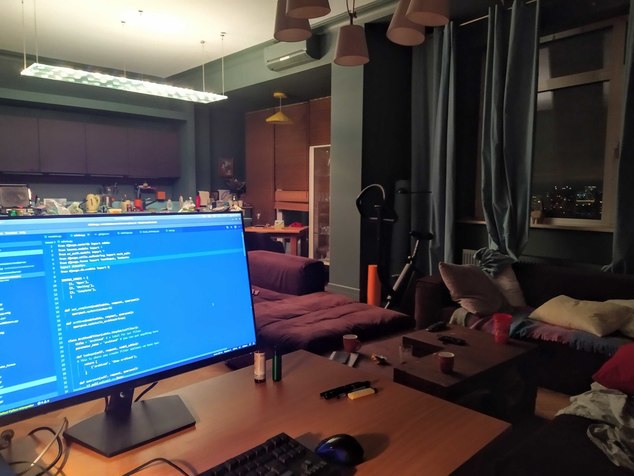
Isolation Station, Moscow. Pretty much the same as before to be honest, although now my wife is working from home as well, and we can't go out except for essentials. Out the window I can see for many miles across the city, places I cannot go.
Earlier this week, or maybe last week, the Moscow authorities introduced a pass system for travel. If you want to go anywhere in a car or by public transport, you need to get a special QR code from the local government web site. If the police catch you without one they'll fine you 5000 rubles.
Locals are generally derisive about this system, partly because it's been introduced in a rush and quite incompetently and chaotically. The web site crashed several times and the mayor immediately blamed foreign hackers--which I think convinced exactly nobody--and the police don't have scanning devices to check the QR codes, so they have to call back to base to confirm the code's validity. This has caused long queues at the metro stations, leading one journalist to caption a photo with "Stations of the Moscow metro are experiencing unprecedented DDoS attacks organized from abroad". I'm getting to like the Russian sense of humour.
EDIT: I really should clean up. -
Is Philosophical Pessimism based on a... mood?There was a member here called The Great Whatever. He had a powerful intellect and a persuasive character, an unremitting pessimist, and said the only reason he was still alive was to save his loved ones from the pain.
-
Is Philosophical Pessimism based on a... mood?I presume that antinatalists stay alive merely to convince others. And, not to be too flippant, it's a hard thing on your loved ones to commit suicide.
-
Is Philosophical Pessimism based on a... mood?Yes, I do think that pessimism, or at least antinatalism, is fundamentally a matter of temperament, as something beyond or prior to the rational. The times when I've lost my optimism, in an ethical or political context, have been under the weight of powerful, eloquent pessimism; not because I agreed with any of the arguments of my pessimistic interlocutors, but because they began to emotionally force upon me their outlook. In the end, there is nothing to say to a temperament that has it that the suffering is not worth it.
Antinatalism is not really a philosophy, a free questioning towards truth or towards better ways of thinking or living(!), but more like an aplogetics of a temperamental pessimism. It begins in the temperamental and depends on it completely, which is why the antinatalists can only win if they succeed in spreading their temperamental pessimism. So long as people have the will to live and build and breed, the antinatalists can't get anywhere (I'm not saying that will always be the case). Pessimists realize this and lament it, but...what of it?
It's like the Chartists against the ruling class: it's a battle with good arguments on each side that make no difference except as propaganda: not a matter of objective fact. In the case of pessimism, it's a battle that the pessimists seem so far always to lose, because the a-rational will to live and create is stronger than the urge to give up and let it all fade away. That's a folksy way of putting it, I suppose, but here I feel philosophy doesn't really help, certainly if what is desired is some definitive answer.
EDIT: In @Pfhorrest's terms, most of us, philosophical or not, are ontophiles, and that's not amenable to argument. -
Coronavirus
"Heymann said masks could create a false sense of security that could end up putting people at greater risk. Even with the mouth and nose fully covered, the virus can still enter through the eyes."
This and the recommendation that carers of covid-19 patients should wear masks both contradict the headline. In fact, the whole article is confusing, and it's not the fault of the article.
It seems that the WHO has been downplaying the protective utility of masks so as to emphasize the more important things, namely distancing and hand washing, etc. Fair enough, but I don't believe masks offer no protection at all, neither does the evidence show that. After all, the virus can enter through the nose and mouth. -
What are you listening to right now?Mainly I like No-Man and some of his other offshoots.
-
What are you listening to right now?Aye well I like some of his stuff, but personally don't like the stuff where he sings himself, like Porcupine Tree.
-
Self love as the highest good.Yes, without self-love you don't hold yourself to account. One way to look at it: when you don't love someone, you're indifferent to their actions--you don't care if they do bad shit.
-
CoronavirusYou can return to the UK and self isolate for 7 days, then live with your parents and help them self isolate. — Punshhh
Yes, that's my top plan right now. Stay in a hotel, or a cottage in the mountains, for 7-10 days till I'm sure I'm ok, and then go to them.
Moscow is fairly relaxed. No signs of panic buying, barely any face masks in the streets or even on the metro (that was a few days ago--I'm avoiding it now and staying at home).
I don't know if I should admire the response of the Russian people or be worried: people are spreading stupid conspiracy theories and pretending the threat doesn't exist. -
CoronavirusI'm in Russia but my visa runs out next month, when I'm due to return to Spain, which is currently under lockdown as one of the worst-hit countries in the world. Visa extension applications in Russia have been blocked until May 1st, which is too late for me. I face a choice between travelling to Valencia via Madrid--which is possible as things stand as I have legal residency in Spain, but difficult because of the lockdown, and a bit dangerous just because of the virus--or else going back to the UK and staying with my parents. But I can't risk exposing them to the virus, because they're over 70.
In either case, I might struggle later on, to get a visa back into Russia in July as I'd planned.
Trying to work out if I could get a visa extension and stay here, I called the British Embassy in Moscow, thinking they might be helpful. "You'll have to contact the relevant Russian authorities," they said apologetically. Then they gave me a link to the Russian Embassy in London. I called them and they were not only unhelpful but also unfriendly (she was Russian and trained in the Russian style of customer service). So I asked the question on a Moscow expats Facebook group. One person said contact the Ministry of Internal Affairs. Another said no it's the Ministry of Foreign Affairs. Someone else said no it's the Central Immigration Centre. Yet another person said no, they have nothing to do with visas. Someone suggested I go to Thailand.
Just moaning.
Should we be worried — Punshhh
I don't think there's a choice now, unless you choose some kind of oblivion*. We're all swept up in this.
* I'm drinking Russian cognac as I write -
What are you listening to right now?Don't know.
Turns out it's sung in Russian in an Armenian style, and it's a hugely popular song around the Caucasus. -
Philosophy on TwitterThere's a twitter icon in the editor tools, which is a shortcut for the code that you can, alternatively, enter manually:
[tweet]https://twitter.com/randypaint/status/1237816688332111875[/tweet]
-
What are you listening to right now?I've been repeatedly listening to this short recording I made while having a beer in a cafe in a ski resort at the foot of Mount Elbrus in the mainly Muslim Russian Republic of Kabardino-Balkaria in the Caucasus mountains. I'm trying to work out what the music is. Shazam and other apps are giving me no results, and I'm not even sure what the language is. Arabic? Azerbaijani? Turkish? Karachay-Balkar or some other North Caucasian language?
Please help.
Jamal
Start FollowingSend a Message
- Other sites we like
- Social media
- Terms of Service
- Sign In
- Created with PlushForums
- © 2026 The Philosophy Forum